Karachay-Cherkessia: Where Circassian Heritage Meets the Caucasus
📖 In This Guide
- Republic at a Glance — Key facts, demographics & statistics
- Cherkessk: The Capital — City landmarks & cultural centers
- The Cherkess People — Identity, Besleney tribe & Abazin connection
- Natural Wonders — Bermamyt, Dombay, Arkhyz & ancient churches
- Culture, Economy & Modern Life — Revival, famous personalities & tourism
- The Roots of Our Families — Tribal origins, diaspora & genealogy
- Travel Guide & Resources — Destinations, practical tips & references
The Hidden Gem of the North Caucasus — Karachay-Cherkess Republic
A Mosaic of Peoples in the Mountains
The Karachay-Cherkess Republic (Къэрэшей-Черкес Республикэ in Kabardian) occupies 14,277 square kilometers of predominantly mountainous terrain in the northwestern Caucasus. Bordered by Krasnodar Krai to the west, Stavropol Krai to the north, Kabardino-Balkaria to the east, and Georgia and Abkhazia to the south, this republic is among the most ethnically diverse territories in the entire North Caucasus.
With a population of approximately 465,000, the republic is home to five major ethnic groups: the Karachay (a Turkic people, ~41%), Russians (~32%), Cherkess (Circassians, ~12%), Abazins (~7.8%), and Nogays (~3.4%). The Cherkess — who are linguistically and culturally identical to the Kabardians of neighboring Kabardino-Balkaria — represent the Circassian population of this republic, and their presence gives the territory its distinctive dual name.
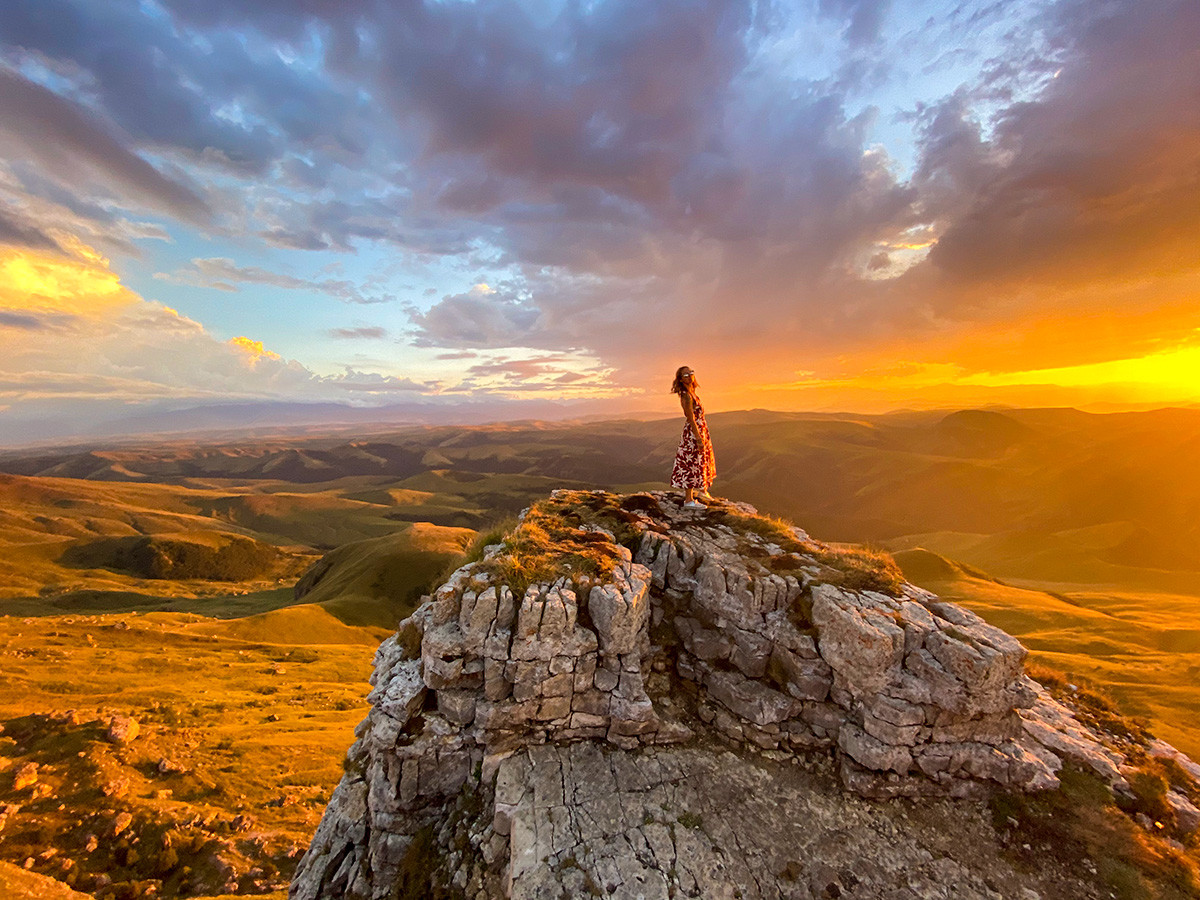
The otherworldly Bermamyt Plateau at sunrise — often called the "Mars Outpost of the North Caucasus"
Republic at a Glance — Key Facts & Figures
Essential data and statistics about Karachay-Cherkessia:
- Area: 14,277 km² (5,512 sq mi) — 80% mountainous terrain
- Population: ~469,865 (2021 Census) — 44.4% Karachays, 27.5% Russians, 12.7% Cherkess, 8.1% Abazins, 3.7% Nogais
- Capital: Cherkessk — the city named after the Circassian people
- Official Languages: Russian, Cherkess (Kabardian), Karachay-Balkar, Abaza, Nogai — the most multilingual republic with five official languages
- Head of Republic: Rashid Temrezov
- Established: 3 July 1991 (republic status); originally founded 12 January 1922
- Rivers: 172 rivers including Kuban, Bolshoy Zelenchuk, Maly Zelenchuk, Urup, Laba
- Lakes: ~130 mountain lakes of glacial origin, plus abundant mineral springs
- Climate: Moderate — January avg −3.2°C, July avg +20.6°C; precipitation 550–2,500 mm
- Natural Resources: Gold, coal, clays, and extensive mineral water sources
- No Airport: KChR is the only North Caucasus republic without an airport — nearest airports are Mineralnye Vody (MRV) and Nalchik
- Key Tourism Sites: Dombay (10 ski pistes up to 3,012 m), Arkhyz (newest resort), Teberda Nature Reserve (85,000 hectares)
- Historical Note: The 1943 deportation of Karachays to Central Asia (70,000 people); rehabilitated in 1957
- Time Zone: UTC+3 (Moscow Time)
- Official Website: kchr.ru
Cherkessk: The Capital
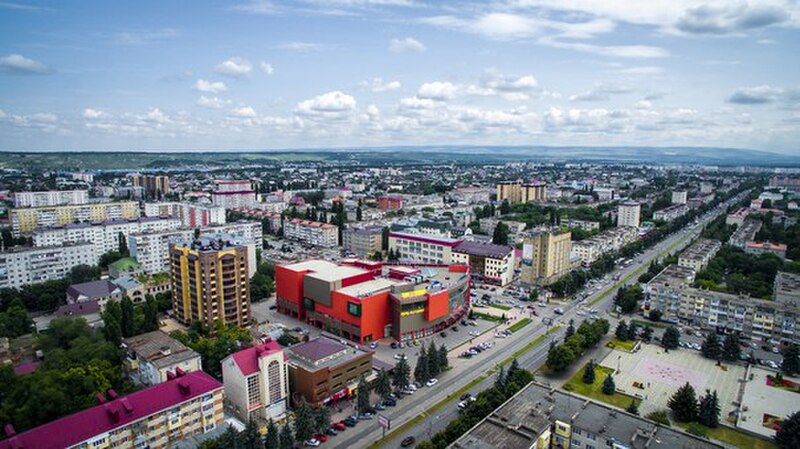
Cherkessk — the capital of Karachay-Cherkessia, named in honor of the Circassian (Cherkess) people
The capital city, Cherkessk (Черкесск), has a population of about 122,000. Founded in 1825 as the Cossack staniza (village) of Batalpashinskaya, named after a Russian military victory over Ottoman forces in 1790, the settlement was renamed Cherkessk in 1939 — a name that directly honors the Circassian (Cherkess) people.
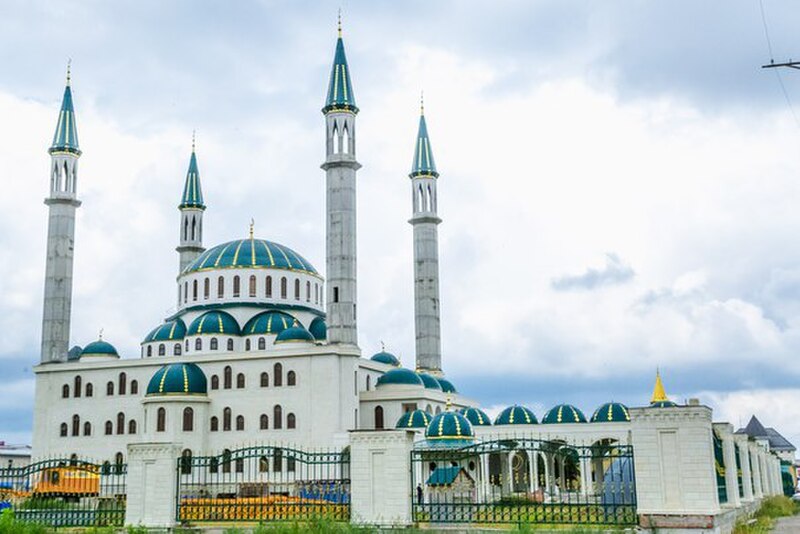
Cherkessk city center with its central mosque — the administrative heart of Karachay-Cherkessia
The city sits on the banks of the Kuban River, one of the major rivers of the North Caucasus that originates from the glaciers of Mount Elbrus. Key landmarks include the Central Mosque, the Saint Nicholas Cathedral, the Friendship of Peoples Monument (symbolizing the multi-ethnic coexistence of the republic), and the Republic Museum of Local Lore which houses collections related to all five ethnic groups.
The city also features the Karachay-Cherkess State Drama Theatre, which performs in Russian, Karachay, and Kabardian (Cherkess). The Cherkess section of the theatre has been particularly active in recent years, staging adaptations of Nart epic narratives and contemporary plays about Circassian diaspora identity. The Republican Library houses one of the largest collections of Circassian-language publications in the world, including rare 19th-century books, manuscripts, and periodicals from the Ottoman-era diaspora.
The Cherkess People: Identity and History
The Cherkess of Karachay-Cherkessia speak Kabardian (the East Circassian language), identical to the language spoken in neighboring Kabardino-Balkaria. The distinction between "Kabardian" and "Cherkess" is political rather than ethnic — both groups are descendants of the same Circassian tribal confederation and share identical cultural practices, language, and identity. The separate designation arose from Soviet-era administrative divisions that split the Kabardian population between two different autonomous regions.
Before the deportations of 1864, the Circassian population in what is now Karachay-Cherkessia was significantly larger. The Besleney tribal group, one of the most prominent Circassian sub-groups historically, was centered in this region. Today, the Besleney constitute a notable portion of the Cherkess population, along with descendants of Kabardian settlers.
The question of Circassian national identity has been particularly active in Karachay-Cherkessia. In recent decades, Circassian activists across all three republics have advocated for recognition under a single ethnic designation — "Circassian" (Адыгэ) — rather than the fragmented Soviet-era categories of Adyghe, Kabardian, and Cherkess. This movement, while sensitive politically, reflects a genuine cultural reality: all three groups share a common language family, the same Adyghe Xabze code, and a unified historical narrative.
The Besleney: A Circassian Tribe with a Unique History
The Besleney (Беслъэней) deserve particular attention as one of the most historically significant Circassian tribal groups. Historically, the Besleney occupied the valleys of the upper Laba and Urup rivers — territory that forms the heart of what is now Karachay-Cherkessia. Their strategic position at the crossroads between the western Circassian tribes (Adyghe) and the eastern Kabardians gave them a unique role as cultural mediators and diplomatic intermediaries.
The Besleney were governed by their own princely dynasty, the Kanokos (Къанокъуэхэр), who maintained a sophisticated court and diplomatic service. Besleney princes were renowned for their horsemanship, eloquence, and strict adherence to the Adyghe Xabze. The Besleney dialect of Kabardian preserves several archaic features that have been lost in the standard Kabardian language, making it of great interest to linguists studying the evolution of the Circassian languages.
During the Russo-Circassian War, the Besleney mounted fierce resistance but were ultimately overwhelmed. A significant portion of the population was deported to the Ottoman Empire in the 1860s, and today the Besleney diaspora — primarily in Turkey — may outnumber the homeland community. The village of Besleney (Беслъэней) in the Khabez district remains the cultural center of this community, and the annual Besleney Cultural Festival attracts visitors from across the diaspora.
The Abazin Connection
The Abazins (Абазэхэр), who constitute nearly 8% of the republic's population, share deep historical and cultural ties with the Circassians. The Abazin language belongs to the same Northwest Caucasian language family as Circassian, and historically the Abazins and Circassians maintained close political alliances, intermarried extensively, and shared many aspects of the Adyghe Xabze. The Abazin settlements in Karachay-Cherkessia — particularly the village of Psyzh (Псыжь) — preserve a distinct but closely related cultural tradition that enriches the republic's Caucasian heritage.
The Abazin writer Begmas Tkhaytsukhov (1893–1938) created the first Abazin literary language and alphabet, establishing a written tradition for a people who had previously relied entirely on oral transmission. His work — and the broader project of creating written literatures for the small peoples of the Caucasus — was simultaneously an act of cultural preservation and a product of Soviet nationalities policy, which sought to develop distinct national identities among ethnic groups as a means of preventing pan-Caucasian or pan-Circassian solidarity.
Spectacular Natural Landmarks
The Bermamyt Plateau
Sunrise at the Bermamyt Plateau — dramatic cliff formations rising above a sea of clouds at 2,592 meters
Rising to 2,592 meters above sea level, the Bermamyt Plateau is perhaps the most visually striking natural formation in the entire North Caucasus. Its unusual rock formations — tall pillars, arches, and columns carved by millennia of wind and water erosion — create a landscape that has been compared to Mars. From the plateau's edge, on clear days, you get one of the most spectacular views of Mount Elbrus possible, with the volcano appearing to float above a sea of clouds.
The name "Bermamyt" comes from the Karachay-Balkar language, meaning "crooked knee" — a reference to the bent, jagged shape of the plateau's cliff edge. Russian painter Mikhail Lermontov, who spent time in the Caucasus during the 19th century, is said to have been inspired by Bermamyt's dramatic views. The writer described the spectacle in a letter to a friend: "From Bermamyt, Elbrus appears so close you could reach out and touch it — a throne of ice suspended between earth and sky."
The plateau is also significant in Circassian and Karachay folklore. Local legends describe it as a meeting place of spirits and djinn, and shepherds historically avoided camping on the plateau overnight. Scientific expeditions in the 19th century used Bermamyt as an astronomical observation point — the clear mountain air and high elevation made it ideal for studying atmospheric phenomena, and the first photographs of the Brocken spectre (a rare optical illusion) in the Caucasus were taken here.
Dombay: The Pearl of the Caucasus
Dombay resort in winter — cable cars ascend toward the snow-capped Caucasus peaks at over 3,200 meters
Dombay resort in winter — one of the premier mountain tourism destinations in the Caucasus
Dombay is a settlement and ski resort located in the Teberda Nature Reserve at the confluence of three mountain rivers. Surrounded by peaks exceeding 4,000 meters, Dombay has been a popular destination since the Soviet era, when it earned the nickname "the pearl of the Caucasus." The resort offers both alpine skiing (with runs up to 3,200 meters) and spectacular summer hiking through alpine meadows, glacial valleys, and pristine forests.
The Alibek Glacier, accessible by a half-day hike from Dombay, is one of the most visited glaciers in the Caucasus. The Amanauz Gorge, known as the "Devil's Mill" for the thundering sound of its waterfalls, and the Murudzhu Lakes — a chain of crystal-clear alpine lakes at 2,800 meters — are among the most popular hiking destinations.
The Teberda Nature Reserve itself, established in 1936, covers over 85,000 hectares and protects one of the most biodiverse ecosystems in the Caucasus. The reserve is home to Caucasian tur (mountain goat), brown bears, wolves, lynx, and the extremely rare Caucasian leopard — a subspecies that was thought extinct until sightings were confirmed in the early 2000s. The reserve's forests contain stands of Nordmann fir, beech, and Oriental spruce — some trees over 500 years old.
Arkhyz: The Rising Star
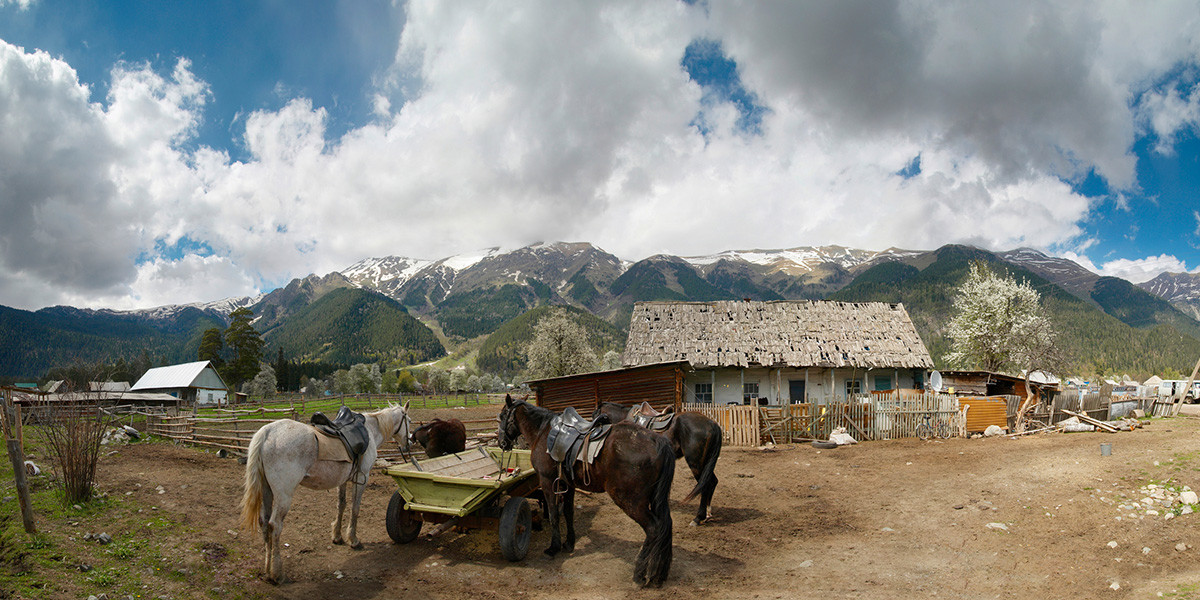
Arkhyz resort in summer — a rapidly growing mountain paradise in the Zelenchuk Valley
Arkhyz is a rapidly developing mountain resort in the Zelenchuk Valley that has emerged as a serious competitor to Dombay. Located at 1,450 meters, with ski lifts reaching 2,840 meters, Arkhyz offers over 25 kilometers of groomed pistes and is undergoing significant expansion. The resort area is also home to the Special Astrophysical Observatory (SAO), which operates the BTA-6 — a 6-meter optical telescope that was the world's largest when completed in 1975 and remains one of the most powerful in Eurasia. The combination of high altitude, low light pollution, and clear skies makes Arkhyz one of the premier stargazing destinations in Russia.
Near Arkhyz, the Sofia Waterfalls — a chain of nine waterfalls cascading from the Sofia Glacier at 3,637 meters — offer one of the most spectacular alpine hikes in the Caucasus. The Sophia Lakes, a set of turquoise glacial pools at 2,830 meters, are often described as the "eyes of the mountains" and have become iconic images of the North Caucasus tourism industry.
The Shoana Church
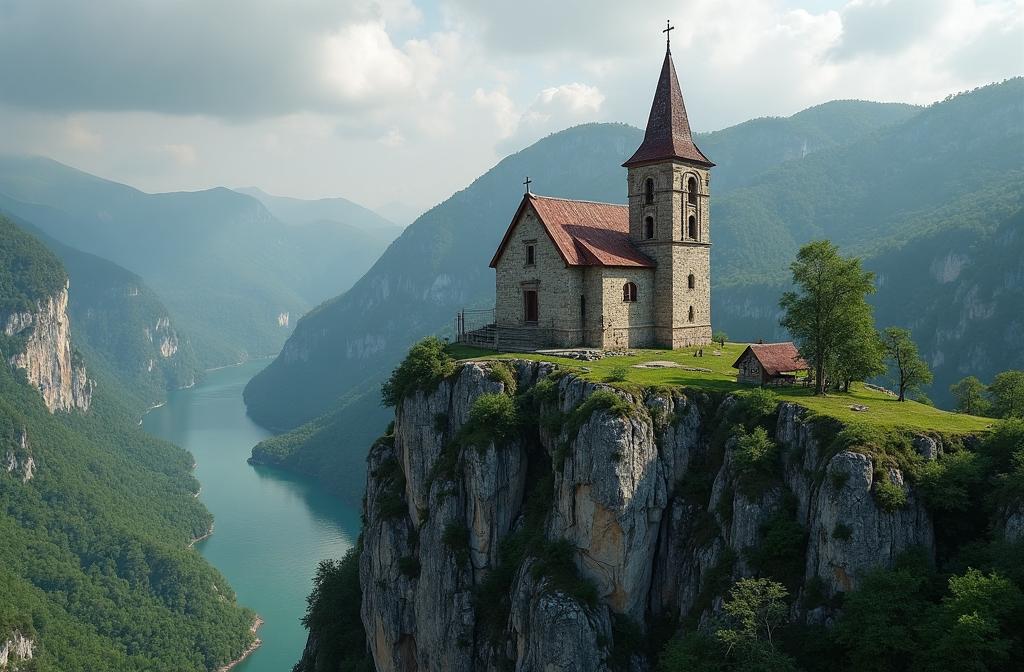
The Shoana Church (10th century) — one of the oldest churches in Russia, perched high above the Kuban River valley
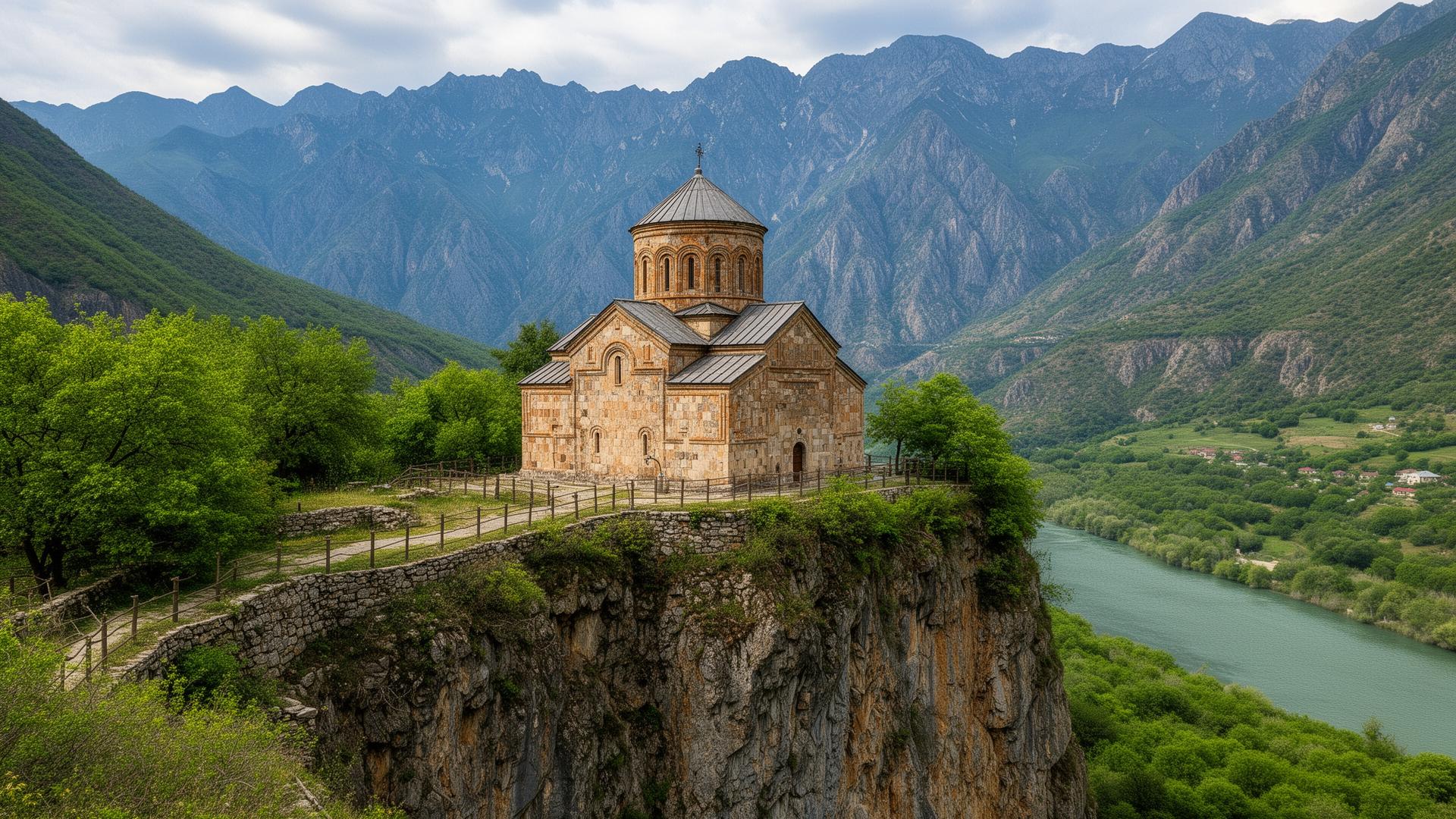
The 10th-century Shoana Church — one of the oldest functioning chapels in Russia, perched above the Kuban River
The Shoana Church (Шоанинский храм), dating to the early 10th century, is one of the oldest Christian churches in Russia. This Byzantine-style stone structure sits dramatically on the edge of a cliff high above the Kuban River, approximately 7 km north of the town of Karachayevsk. Built during the Alanian Kingdom period — when Christianity was the dominant religion in the North Caucasus — the church is a testament to the region's complex religious history.
Nearby, the Senty Church (another 10th-century Alanian temple) and numerous archaeological sites attest to the rich pre-Islamic and pre-Circassian civilization that flourished in this region. The Alanian civilization, which preceded the modern ethnic groups of the area, left behind a remarkable architectural and cultural legacy.
The Lower Arkhyz Archaeological Complex
One of the most significant historical sites in Karachay-Cherkessia is the Lower Arkhyz Archaeological Complex — the remains of the ancient Alanian capital city of Magas (or Maghas), which flourished from the 10th to 13th centuries. The complex covers over 90 hectares along the Bolshoy Zelenchuk River and includes the ruins of three Byzantine-style churches, residential quarters, defensive walls, and a pagan sanctuary.
The Northern Church (Северный храм), the largest of the three, is one of the oldest churches in Russia and may have served as the cathedral of the Alanian Archbishopric — the center of Christianity in the North Caucasus during the Byzantine period. Excavations have revealed frescoes, Greek inscriptions, and imported luxury goods from Constantinople, demonstrating that this city was a major node in trans-Caucasian trade networks connecting the Byzantine Empire with the Silk Road.
In 1999, a remarkable discovery was made on a cliff face near Lower Arkhyz: a naturally formed "Face of Christ" (Лик Христа) — a weathered image in the rock that bears an uncanny resemblance to Byzantine icon paintings. Whether natural or ancient human-made remains debated, but the image has become a major pilgrimage site and tourist attraction, with a specially constructed stairway of 526 steps leading up to it.
Culture, Economy & Modern Life
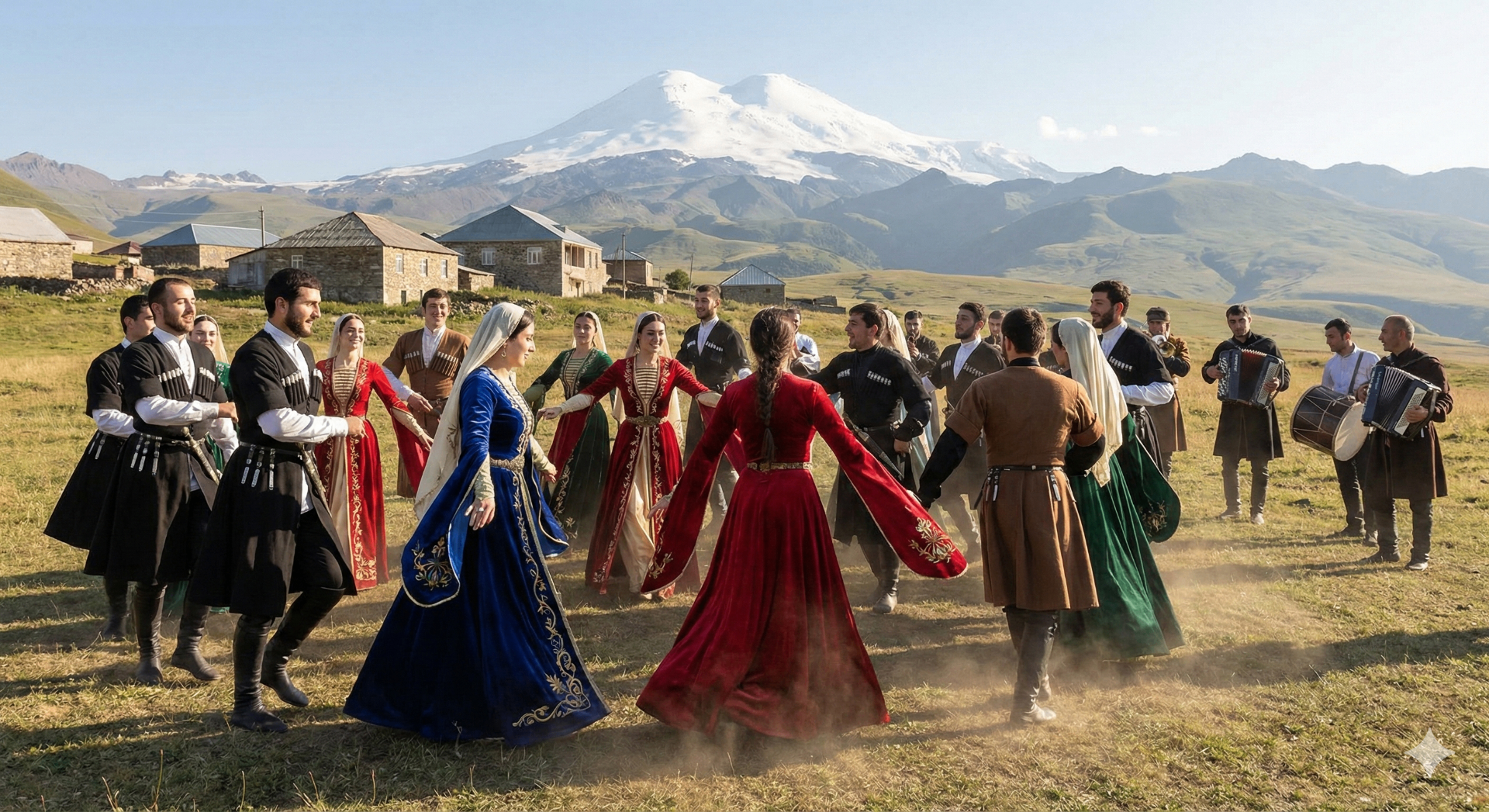
A Circassian cultural celebration in Karachay-Cherkessia — dance remains the most visible expression of Cherkess identity
The Cherkess community maintains its cultural traditions through dance ensembles, language education programs, and cultural associations. The Elbruzoid Ensemble and other performance groups keep the tradition of Circassian dance alive, while the Cherkess newspaper and radio programs in the Kabardian language serve the community's media needs.
The multi-ethnic character of the republic means that cultural festivals often bring together all five major groups. The annual Day of the Republic (celebrated on January 12) features performances, exhibitions, and culinary events from all ethnic communities. Traditional Circassian cuisine — including haliva, paste, and walnut-garlic sauces — is prepared alongside Karachay and Abazin dishes at communal celebrations.
The Cherkess Cultural Revival
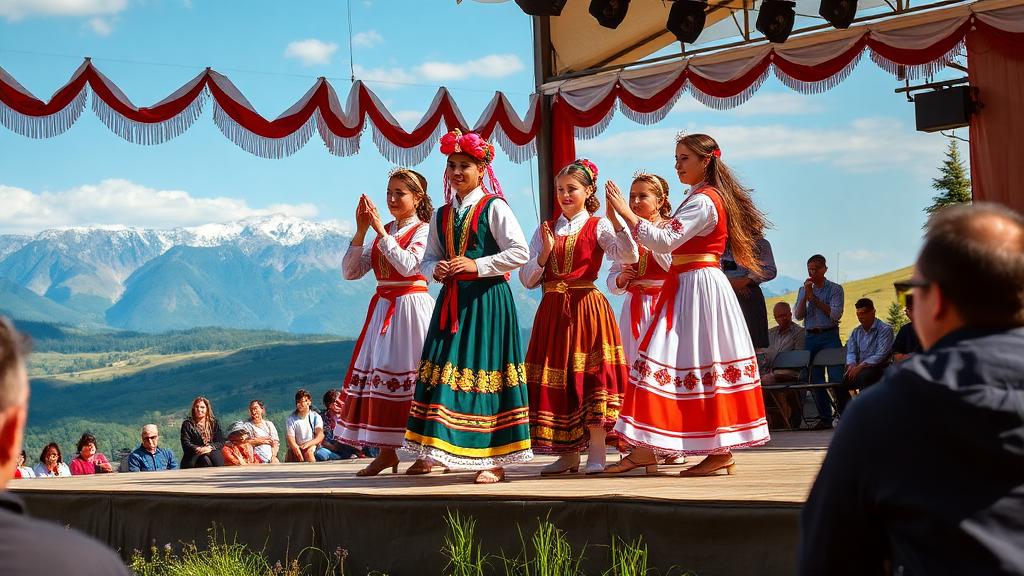
Young performers at a Cherkess cultural festival in Karachay-Cherkessia, keeping ancestral traditions alive
Despite being a minority in their own republic, the Cherkess community has experienced a remarkable cultural revival in recent decades. The Adyghe Khase of Karachay-Cherkessia (Адыгэ Хасэ) has been particularly active in promoting language education, organizing youth programs, and advocating for greater representation in republican government. The organization's efforts have led to increased Kabardian language instruction in schools, the establishment of Cherkess cultural centers in several towns, and the revival of traditional crafts including gold embroidery, felt-making, and woodcarving.
The annual Cherkess Cultural Festival, held each autumn in the village of Khabez (the center of Cherkess settlement), has grown from a small community gathering into a major regional event. The festival features traditional dance competitions, horseback riding demonstrations, cooking contests (with prizes for the best libzhe and khaliva), storytelling sessions in the Kabardian language, and a fashion show featuring both historical Circassian costumes and contemporary designs inspired by traditional tamga motifs.
Young Cherkess musicians have created a vibrant neo-folk music scene, blending traditional shichepshin melodies with modern electronic production. Groups like Jegue Zhyu and solo artists have gained followings not only in the North Caucasus but across the diaspora through social media, creating a new genre that diaspora youth have embraced as a way to connect with their heritage while speaking to contemporary experience.
Famous Cherkess Personalities from Karachay-Cherkessia
Mukhadin Kishev (Кишэ Мухьэдин, born 1939) is a celebrated sculptor whose monumental works adorn public spaces across the North Caucasus. His most famous piece, the "Mother Circassia" monument, depicts a Circassian woman sending her sons to war and has become an iconic symbol of Circassian resilience. His work draws on Circassian symbolic traditions — particularly the tree of life motif and warrior figure — to create sculptures that bridge ancient and modern aesthetics.
Pago Tambiev (Тамбий Пагуэ, 1894–1927) was one of the earliest Cherkess political leaders in the Soviet period. He played a key role in establishing the Cherkess Autonomous Oblast in 1922, advocating for Circassian political representation within the new Soviet system. His early death at 33 cut short a promising career, but he is remembered as the architect of Cherkess political autonomy in the region.
In sports, the Cherkess community has produced notable wrestlers and martial artists who compete at the national and international level. The tradition of Circassian wrestling (бэнэкIэ) — which emphasizes speed, technique, and honor over brute force — remains popular in Cherkess villages, with tournaments held at festivals and cultural gatherings.
Economy and Tourism
The republic's economy combines agriculture (livestock breeding, grain, and fruit orchards), mining (coal, copper, and building materials), and a growing tourism sector centered on Dombay, Arkhyz, and the Bermamyt Plateau. The Karachay-Cherkess State University in Cherkessk provides higher education in both Russian and the national languages.
Tourism has become an increasingly important economic driver, with the Arkhyz resort alone attracting over 500,000 visitors annually and growing rapidly. The Russian federal government has designated the North Caucasus as a priority tourism development zone, with billions of rubles invested in infrastructure, ski lifts, hotels, and road improvements. For the Cherkess community, this development presents both opportunities (employment, visibility for Circassian culture) and challenges (potential environmental damage to sacred landscapes, commodification of cultural practices).
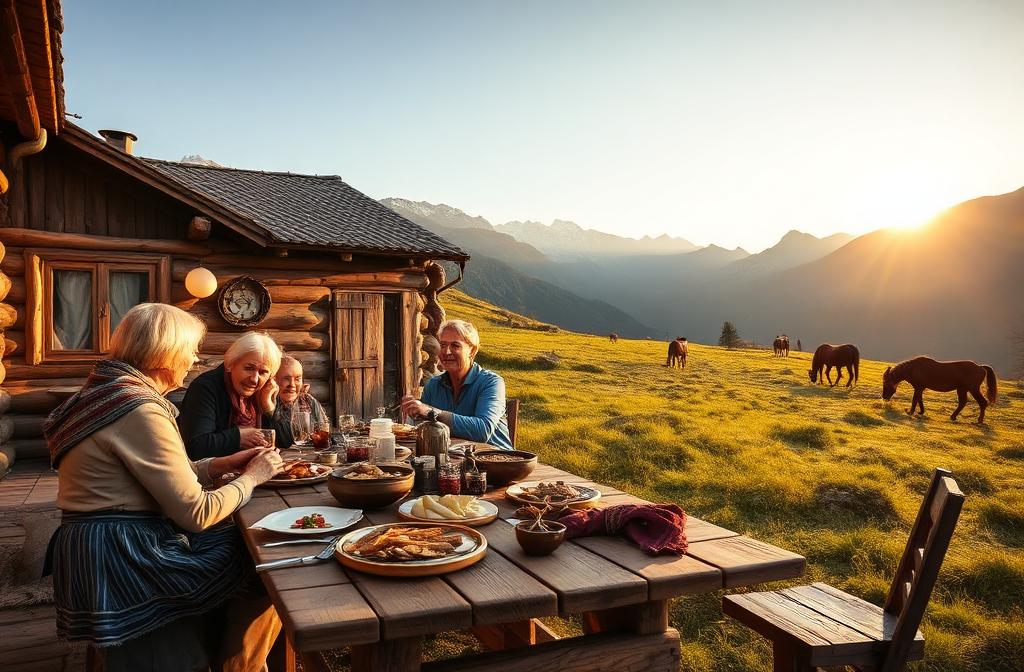
Agro-tourism in the Caucasus — families open their traditional homesteads for cultural immersion experiences
The republic is also developing agro-tourism, with several Cherkess and Karachay families opening their traditional homesteads to visitors for cultural immersion experiences — including participation in cheese-making, horseback riding through mountain meadows, traditional cooking classes, and evenings of Circassian music and storytelling around the fire.
Connecting Across Borders
For members of the global Circassian diaspora whose ancestors may have originated from the Besleney territories or other Circassian settlements in what is now Karachay-Cherkessia, understanding this republic's geography and ethnic complexity is essential. Build your family tree to explore how your lineage connects to the Cherkess communities that have persevered in this beautiful but politically complex corner of the Caucasus, or browse our family name database to identify your tribal origins.
Circassian Tribal Origins in Karachay-Cherkessia
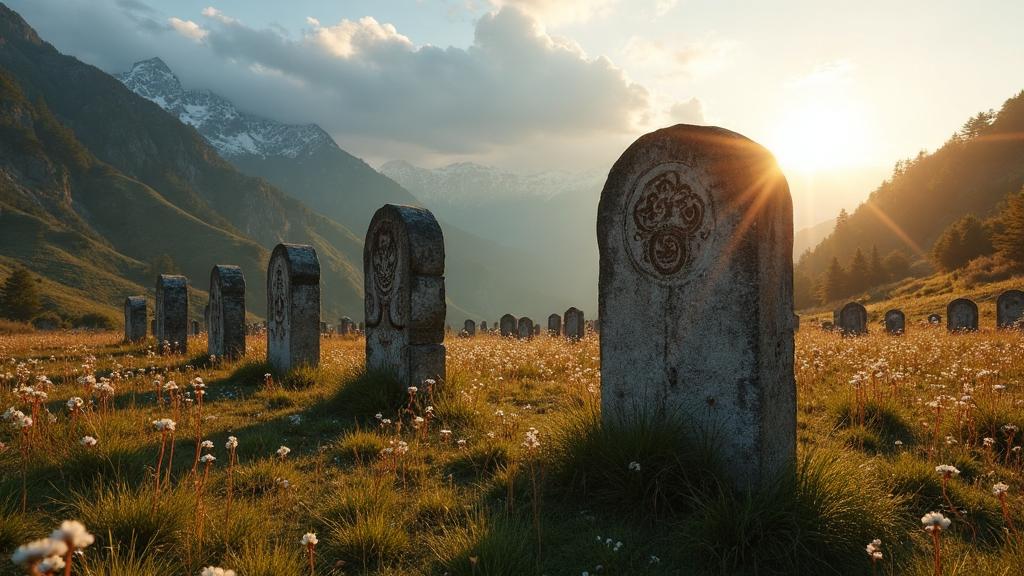
Ancient Circassian burial grounds with tamga-carved stones — silent witnesses to centuries of family heritage
For Circassians tracing their ancestry to Karachay-Cherkessia, the search leads to the Besleney (Беслъэней) and Abazin-connected Circassian communities who have inhabited the upper reaches of the Kuban, Zelenchuk, and Laba rivers since ancient times. This is where the eastern Circassian tribal world meets the mountain civilizations of the central Caucasus.
The Besleney — The Eastern Circassian Anchor
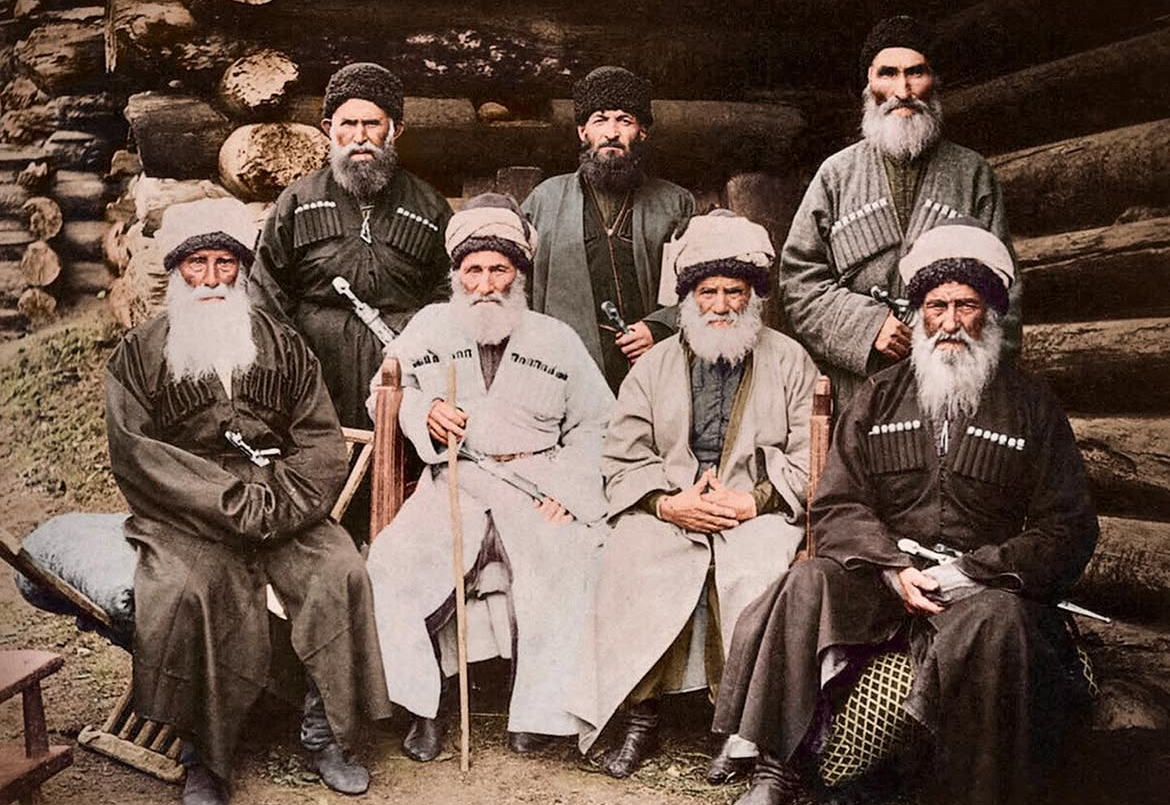
A gathering of Besleney elders — guardians of the eastern Circassian traditions and oral history
The Besleney (Беслъэней) are the primary Circassian tribe of Karachay-Cherkessia, and tracing your family to this tribe connects you to one of the most strategically important Circassian communities:
- Princely Families: The Besleney were ruled by the Kanokov (Къэныкъуэ) princely dynasty, which maintained alliances with both the Kabardian princes and the Crimean Khanate. Other noble families include Shardanov, Klyuchnikov (Шэрдан, Клычэ).
- Warrior Clans: Families like Khapsirokiv, Daukho, and Keshev served as the military elite, guarding the mountain passes between the Black Sea coast and the central Caucasus.
- Ancestral Villages: The historical Besleney settlements centered around modern-day Khabez, Besleney, and Ali-Berdukovsky — villages that still bear Circassian names and maintain family traditions.
The Tamga Connection — Reading Your Family's Stone Signature
One of the most powerful tools for tracing Circassian family roots in Karachay-Cherkessia is the tamga (тамгэ) — the ancient family brand symbol carved into gravestones, buildings, and livestock. In the mountains of KChR, ancient tamga-carved stones can still be found in:
- Old cemeteries near Khabez and Besleney — Where family tamga symbols mark graves dating back 200+ years
- Rock inscriptions in the Zelenchuk Valley — Including the famous Zelenchuk inscription, one of the oldest known texts in a Circassian-related language
- Traditional homesteads — Where tamga were carved above doorways to identify the family who built and owned the home
Explore our Tamga Symbols section to identify your family's historical mark.
Historical Family Origins and Migration Patterns
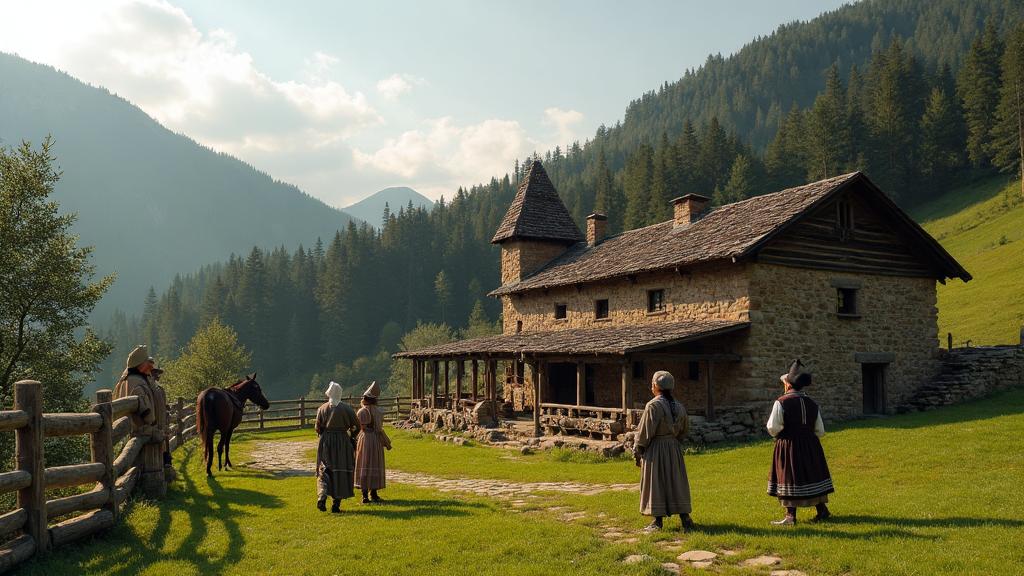
A traditional Circassian homestead in the mountain meadows — the foundation of family life for centuries
The Circassian families of Karachay-Cherkessia experienced a unique migration pattern that differs from the western and eastern Circassians:
- Pre-1864: The Mountain Confederation — Besleney families maintained a semi-independent existence, allied with but not subordinate to the Kabardian princes. Their mountain location provided natural fortress protection that preserved family structures longer than the lowland tribes.
- 1860s–1870s: The Great Exile — Many Besleney families were expelled through the Zelenchuk and Kuban river routes, eventually reaching Ottoman ports. Unlike coastal tribes who departed from Black Sea ports, Besleney families often traveled overland through Stavropol before reaching embarkation points.
- Those Who Remained — A significant number of Besleney families avoided exile by retreating into the upper mountain valleys. Their descendants form the core of today's Circassian community in KChR, maintaining unbroken genealogical records.
- Diaspora Destinations — Besleney families settled primarily in Turkey (Düzce, Bolu, and Kayseri provinces), Jordan (Amman and Jerash), and Syria (Damascus and Quneitra).
Key Circassian Family Names from Karachay-Cherkessia
If your family name matches any of these, your ancestral roots likely trace to Karachay-Cherkessia:
- Kanokov (Къэныкъуэ) — Besleney princely family, major landowners in the Zelenchuk valley
- Daukho (Даухъуэ) — Ancient warrior family with roots in the upper Kuban
- Keshev (Кӏэшъ) — Literary family; Adyl-Girey Keshev was the first Circassian novelist
- Shardanov (Шэрдан) — Noble family associated with the Besleney court
- Apshev (Ӏэпшъ) — Family with deep roots in the Laba River region
- Shorov (Шорэ) — Prominent family from the Khabez area
- Abdurakhmanov — Families who adopted Islamic naming patterns while maintaining Circassian identity
Building Your Family Tree from KChR Roots
To trace your family origins in Karachay-Cherkessia:
- Start with your surname — Use our Family Encyclopedia to identify tribal affiliation
- Search the Cherkessk Archives — The State Archive of KChR holds census records, land documents, and family registries from the 19th century
- Visit ancestral villages — Communities like Khabez, Besleney, Kosh-Khabl maintain living memory of family histories
- Connect with local elders — The Adyge Khase (Circassian Council) in Cherkessk can connect you with community historians who specialize in family genealogy
- Document with our tools — Create your family tree using our Family Tree Builder and connect with relatives who share your roots
Frequently Asked Questions
Where is Karachay-Cherkessia?
Karachay-Cherkessia is a republic in the northwestern Caucasus, Russia, with its capital in Cherkessk. It borders Krasnodar Krai and Kabardino-Balkaria.
Who are the Cherkess people?
The Cherkess of Karachay-Cherkessia are primarily Circassians from the Besleney and Kabardian tribal groups. The Karachays are a separate Turkic-speaking people who share the republic.
What Circassian cultural sites are in Karachay-Cherkessia?
Key sites include Circassian villages with preserved architecture, local museums in Cherkessk, ancient archaeological sites, and the stunning natural landscapes of the Teberda nature reserve and Dombay ski resort.
Roots & Travel Guide
Karachay-Cherkessia is a paradise for mountain lovers in both winter and summer. While less internationally known than neighboring Kabardino-Balkaria, the republic offers some of the most breathtaking landscapes in the entire Caucasus — and with less tourist congestion.
Getting There
The nearest airport is Mineralnye Vody (MRV), located approximately 100 kilometers from Cherkessk. A flight from Moscow takes about 2 hours 10 minutes. The nearest railway station is Nevinnomysskaya, 57 kilometers from Cherkessk, reachable by train from Moscow in about 27 hours.
The most practical approach is to first reach one of the Caucasian Mineral Waters cities — Kislovodsk, Pyatigorsk, Yessentuki, or Mineralnye Vody — and then take a bus to the ski resorts and mountain destinations of Karachay-Cherkessia. The border between Stavropol Krai and Karachay-Cherkessia is just a 20-minute drive from Kislovodsk, making it an excellent base for day trips.
Bermamyt Plateau: The Outpost of Mars
The Bermamyt Plateau at 2,592 meters above sea level is sometimes dubbed the "Outpost of Mars in the North Caucasus" because of its otherworldly terrain. Though only 30 kilometers from Kislovodsk, reaching it requires a four-wheel drive vehicle — and a tolerance for very bumpy roads. This relative inaccessibility means Bermamyt remains refreshingly untouristy.
On a clear day, the views reveal the incredible snow-covered ranges of the Greater Caucasus and Mount Elbrus in stunning clarity. Seasoned travelers who have seen sunsets on every continent say that the Bermamyt sunset is easily among the best in the world. The plateau was famously painted by Russian artist Mikhail Lermontov during his exile to the Caucasus and described in his literary works.
Dombay and Teberda: Mountain Paradise
Dombay and Teberda are two towns located within the Teberda Nature Reserve. In winter, Dombay is one of the most popular ski resorts in the Caucasus. In warmer months, it transforms into an absolute mecca for hikers — with virtually endless routes and opportunities. The reserve contains over 100 lakes and 64 waterfalls across its territory.
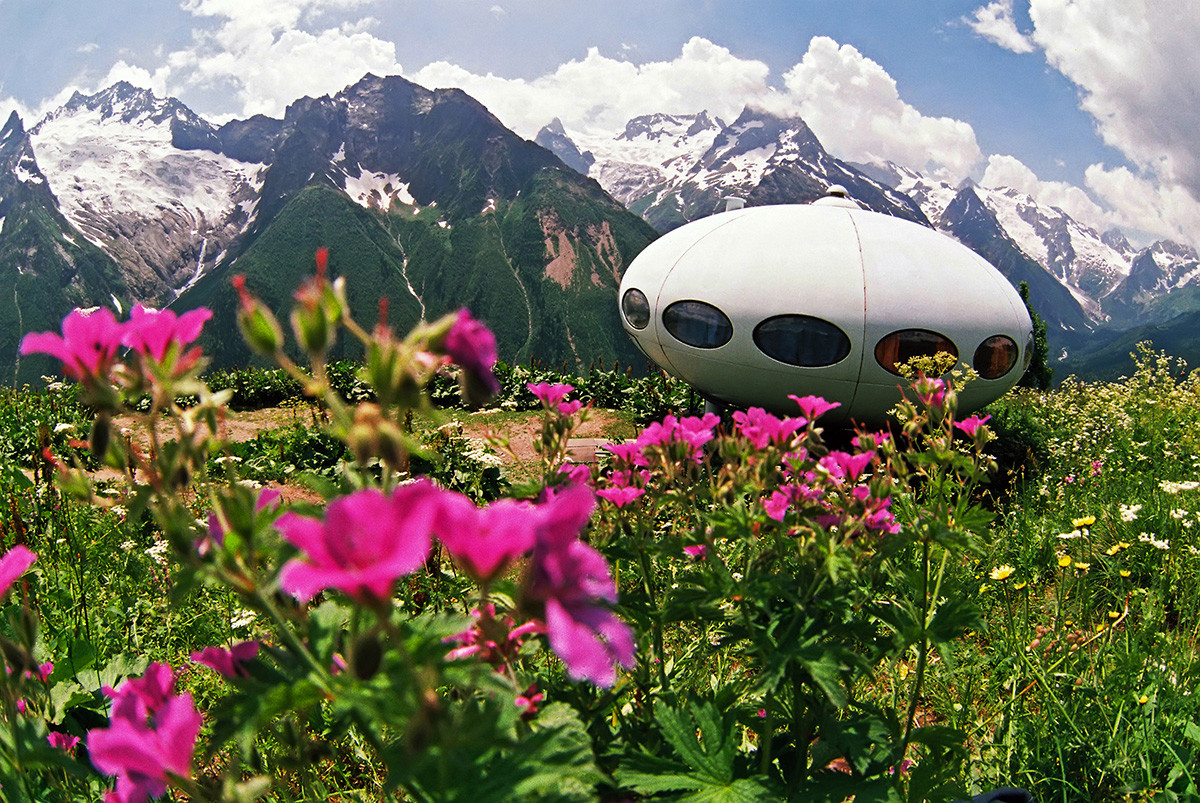
Dombay's highest peak, Mussa-Achitara (3,012 meters), offers ten ski pistes of varying difficulty and the chance to stay at the iconic UFO-shaped Tarelka ("Flying Saucer") Hotel, perched directly on the slope. For adrenaline seekers, off-piste skiing and snowboarding through fresh powder is possible with an experienced guide.
Summer highlights around Dombay and Teberda include Mount Mussa-Achitara, Gonachkhir Gorge, Baduk Lakes, Alibek Waterfall, Turye Lake, Amanauz Gorge, Chuchkhur Waterfalls, and 10th-century Byzantine temples. Hiking trails remain open until late autumn, providing an extended exploration season.
Arkhyz: Adventure Playground
Arkhyz sits in the valley of the Bolshoy Zelenchuk River at an altitude of 1,450 meters, attracting over 500,000 visitors annually and growing rapidly. In summer, the valley drowns in greenery with blue lakes and fast rivers perfect for easy rafting. The fresh mountain air has long attracted visitors seeking relief from respiratory conditions.
Near Arkhyz lies one of the most significant historical sites in the North Caucasus — the Lower Arkhyz Archaeological Complex, identified as the probable site of the medieval capital of Alania. Three magnificent 10th-century Christian churches built by Byzantine craftsmen still stand here, making them among the oldest churches in Russia — predating the Christianization of Kievan Rus by decades. A remarkable rock painting of Christ, dating to the 10th century but discovered only recently, is hidden on the slope of the Matseshta ridge.
In winter, Arkhyz operates as one of Russia's newest and most modern ski resorts, with infrastructure still expanding and experts predicting a major future. Prices for winter holidays are dramatically lower than comparable European resorts, while track quality and conditions rival their expensive counterparts.
Sofia Waterfalls and Lakes
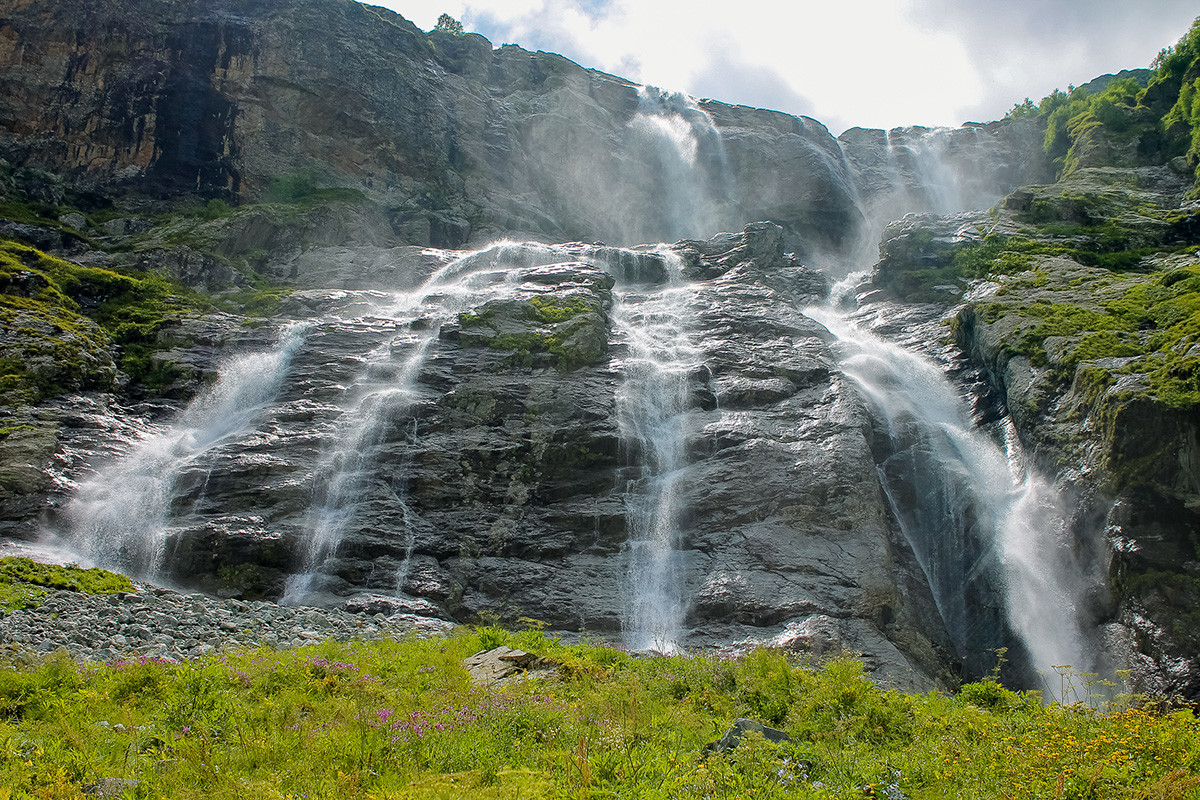
The Sofia Waterfalls and glacial lakes — among the most breathtaking alpine hikes in the Caucasus
A trek along Mount Sofia (3,637 meters, the second-highest peak in the area) offers lakes, waterfalls, glaciers, and flower meadows. Reaching the Sofia Waterfalls requires a jeep from Arkhyz followed by a 2-kilometer hike with a 300-meter climb — moderate difficulty but with some narrow, steep sections requiring sturdy footwear.
The Sofia Lakes demand more effort — a 4-kilometer trek with a 900-meter ascent — but reward hikers with scenery of extraordinary beauty: glacial lakes of impossible blue set among snow-streaked peaks. Visiting both waterfalls and lakes in one day is possible but challenging, covering 12 kilometers with 1,200 meters of elevation gain.
Ancient Alanian Churches
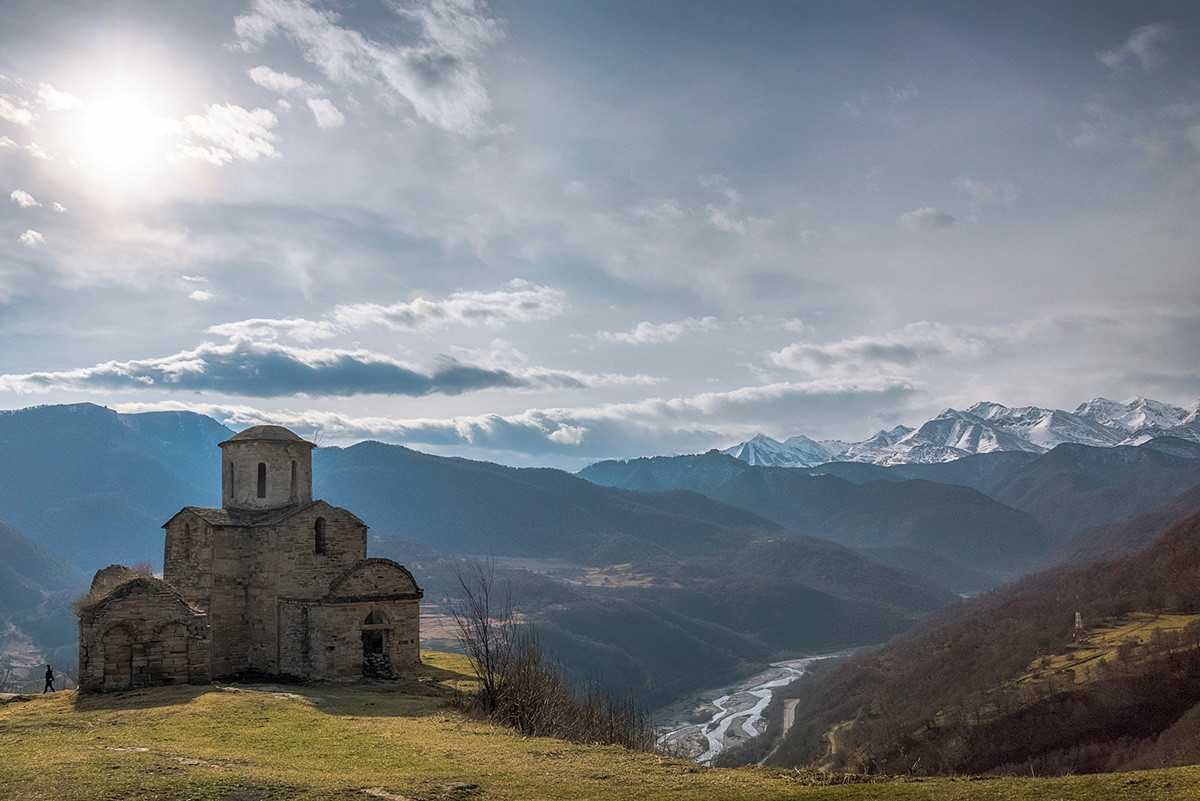
The Sentinsky Church (967 CE) — over a thousand years old, perched on the Burun-Syrt cliff above the Teberda valley
Karachay-Cherkessia contains five 10th-century Alanian churches, each in remarkably good condition given their millennium of history surviving Mongol invasions, Islamization, the Caucasus War, Soviet plundering, and World War II.
The Sentinsky Church, standing on a high rocky cliff of the Burun-Syrt massif overlooking the Teberda River valley, is over 1,000 years old and was built in April 967 CE (as confirmed by a recently discovered Greek inscription). The Shoana Church, visible from the Cherkessk-Dombay highway, rises dramatically from a rock spur above the Kuban River — a relatively small building (~13 meters high) built on an artificially leveled platform on uneven rock, demonstrating extraordinary medieval engineering.
Grishkina Balka Karst Caves
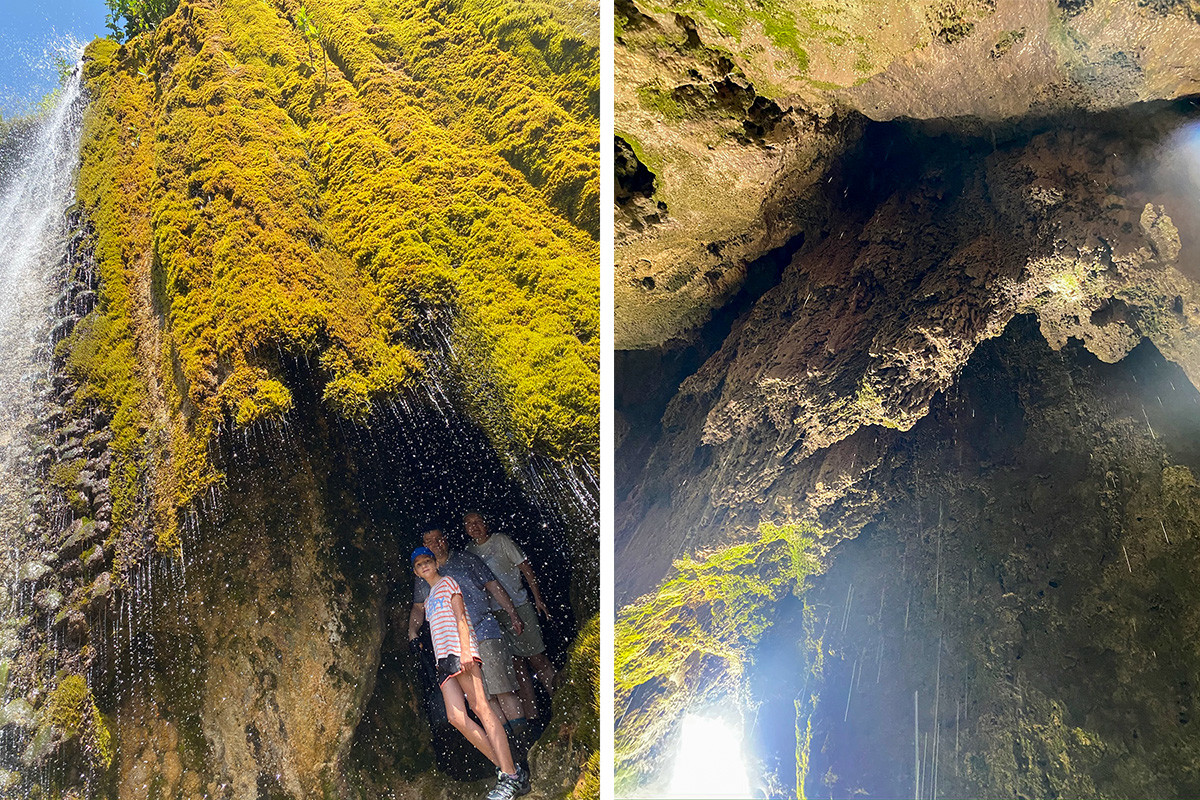
The dramatic entrance to the Grishkina Balka karst caves, a hidden natural wonder of Karachay-Cherkessia
These natural karst caves are a hidden gem that most visitors never discover. Formed naturally over millennia, the caves are large with passageways between them. The highlight is reaching them by passing under gently murmuring streams of spring water that shimmer in sunlight as they flow down moss-covered rock in a kaleidoscope of colors. Local guides say no camera can capture the experience — it must be felt.
Climate and Best Seasons
Karachay-Cherkessia enjoys a more comfortable climate than neighboring Krasnodar Krai, lacking the unbearable summer humidity. Even on the hottest days, a 40-minute drive into the mountains delivers cool air, clean springs, and centuries-old pine forests. Winters bring reliable snow to the mountains for skiing, though climate change has made snowfall less predictable in recent years. Average January temperatures reach about -8°C (18°F). Spring and autumn offer pleasant daytime temperatures of 12–15°C.
Local Guide Tips — Planning Your Visit
Local tour guide Artem Babaritsky, who has led daily tours around the Caucasus for 3+ years, shares these invaluable tips:
- Base Camp Strategy: Consider staying in Kislovodsk (neighboring Stavropol Krai) — it has superior tourist infrastructure, dining, and entertainment. The border with KChR is just a 20-minute drive away
- Day Trip Potential: "Everything within a 100 km radius cannot be seen in a week. But even a long weekend will give you a feel for the spirit and beauty of the Caucasus"
- Lake Abundance: Mountains are "overflowing with lakes at 2,000–3,000 meters above sea level with amazingly clear, glacial water"
- Cave Exploration: "There are so many caves that it is simply unrealistic to list and visit everything. Start with the small and nearest, then progress according to ascending levels of beauty and remoteness"
- Climate Advantage: "Compared to neighboring Krasnodar Krai, the climate here is much more comfortable. If you're sweltering in +37°C in the cities, just drive 40 minutes and you'll be in your own little paradise"
- Ideal Duration: Minimum 3 days for highlights; 7+ days recommended for thorough exploration of Dombay, Arkhyz, and Bermamyt
- Winter Note: Snowfall has become less predictable due to climate change. January temperatures average −8°C (18°F) in the mountains
Practical Travel Tips
- Base yourself strategically: Local guides recommend staying in Kislovodsk (Stavropol Krai) rather than Cherkessk, as the former has far better tourist infrastructure, dining, and entertainment. The border is only 20 minutes away, making day trips easy.
- Duration: Even local guides who've explored the region daily for years say they haven't seen everything. A long weekend gives a taste; a full week is ideal. Everything within a 100km radius cannot be covered in 7 days.
- Transport: A rental car or organized jeep tour is highly recommended for reaching remote destinations like Bermamyt, Sofia Lakes, and Grishkina Balka. Public transport connects main towns but not trailheads.
- Local food: Don't miss khychiny (Karachay flatbread with cheese), accompanied by ayran (fermented milk drink) and fragrant tea made from mountain herbs — the republic's signature refreshment.
- Accommodation: Hotels in Arkhyz and Dombay range from budget (
5–25/night) to modern resort ($60–120/night). In remote areas, local families near the Leso-Kyafar fortress and other sites rent rooms from around 0/night. - Suggested itinerary: Fly into MRV → Kislovodsk (1 night, base) → Bermamyt Plateau day trip → Arkhyz (2–3 nights, Lower Arkhyz churches + Sofia Lakes/Waterfalls) → Dombay (2–3 nights, hiking or skiing + Sentinsky/Shoana churches) → onward to Kabardino-Balkaria or Adygea.
Karachay-Cherkessia may be the least known of the three Circassian republics internationally, but for those who make the journey, it reveals a landscape of staggering beauty — from Mars-like plateaus to millennium-old churches, from glacial lakes to karst cave systems — all infused with the living heritage of the Cherkess and Karachay peoples who have called these mountains home for centuries.
Resources, References & Further Reading
The Circassian communities of Karachay-Cherkessia — particularly the Besleney tribe — represent a unique chapter in Circassian history. Below we provide comprehensive resources connecting platform tools, related articles, and external references to support your genealogical research and cultural exploration.
Explore Cherkess Heritage on Our Platform
Our integrated heritage tools are essential for anyone researching Besleney and Cherkess family origins:
- Family Tree Builder — Document your Besleney ancestry and connect with relatives across the diaspora
- Circassian Family Name Encyclopedia — Discover if your surname traces to Kanokov princes or Besleney warrior clans
- Cultural Encyclopedia — Explore Cherkess customs, Besleney traditions, and Abazin cultural connections
- DNA Heritage Analysis — Match your genetic profile to Caucasus ancestral populations
- Tamga Symbol Database — Identify your family brand from the tamga-carved stones of Khabez and Besleney
- Circassian Dictionary — Learn the Besleney dialect and archaic Kabardian vocabulary
- Community Forum — Connect with Cherkess descendants in Turkey, Jordan, and Russia
- Cultural Events Calendar — Find Cherkess cultural festivals including the annual Khabez gathering
- Community Chat — Join live discussions about Besleney genealogy and family research
- Diaspora World Map — Trace Besleney migration routes from the Zelenchuk Valley to the Ottoman Empire
- Circassian Marketplace — Support Cherkess artisans and traditional craftspeople
- Circassian Associations — Find Adyghe Khase organizations in KChR and worldwide
Related Articles on Circassian Heritage
Deepen your knowledge of Cherkess identity and the broader Circassian experience:
- The 1864 Deportation — The Besleney exile through Zelenchuk and Kuban routes
- Battle of Sochi (1864) — The final military chapter of Circassian resistance
- Genocide Recognition — International advocacy for acknowledging Circassian suffering
- The Adyghe Xabze — The ethical code that Besleney princes upheld with legendary strictness
- The Nart Sagas — Mythological heritage performed at Cherkess cultural festivals
- Music & Dance Traditions — The Elbruzoid ensemble and neo-folk music scene
- Traditional Cuisine — Haliva, paste, and walnut-garlic sauces of the Cherkess table
- Learning Circassian — Preserving the Besleney dialect and its archaic features
- Circassians in Jordan — Besleney families who settled in Amman and Jerash
- Kfar Kama — Circassian village in Israel with ties to eastern tribes
- Global Diaspora — Besleney migration patterns to Turkey and the Levant
- Wedding Traditions — Marriage customs of the Cherkess community
- Tamga Symbols — Stone-carved family marks in Khabez cemeteries
- Circassian Mamluks — Warriors from the Caucasus who ruled medieval Egypt
- DNA & Genealogy — Genetic testing for Cherkess ancestral confirmation
- Republic of Adygea — The western Circassian homeland and cultural sibling
- Kabardino-Balkaria — The Kabardian heartland and closest linguistic relatives
- The Circassian Tribes — The Besleney's place in the twelve-tribe confederation
- 8 Steps to Unity — Strategic community building across fragmented republics
- Language Preservation — Saving the endangered Besleney dialect
- Authentic Products — Traditional Cherkess crafts and artisan heritage goods
External Academic & Government Resources
For scholarly research and detailed information on Karachay-Cherkessia:
- Karachay-Cherkessia — Wikipedia — Republic overview with ethnic composition and government structure
- Cherkessk (Capital City) — The city named after the Circassian people
- Dombay Resort — The Pearl of the Caucasus ski and hiking destination
- Arkhyz Resort & Observatory — Mountain resort with the world's former largest telescope
- Circassian People — Ethnic profile including Cherkess and Besleney subgroups
- Teberda Nature Reserve — 85,000 hectares of protected Caucasus wilderness
- Ancient Alania — The medieval kingdom whose churches still stand in Lower Arkhyz
- Russo-Circassian War — The conflict that devastated Besleney territories
- Circassian Genocide — Historical documentation of Cherkess deportation
- Northwest Caucasian Languages — The language family connecting Circassian and Abazin peoples
The Cherkess people of Karachay-Cherkessia carry the memory of ancient mountain civilizations, Besleney princely courts, and warrior traditions that shaped the central Caucasus for millennia. From the tamga-carved gravestones of Khabez to the Byzantine churches of Lower Arkhyz, this multi-layered republic reveals a heritage of extraordinary depth. Use these tools and resources to uncover your family's connection to this remarkable corner of the Circassian world.