Circassian Diaspora: Countries, Population and Global History
What is the Circassian Diaspora?
The Circassian diaspora is one of the largest and most historically significant forced migrations of the 19th century.
Today, an estimated 3 to 7 million Circassians live in diasporas worldwide.
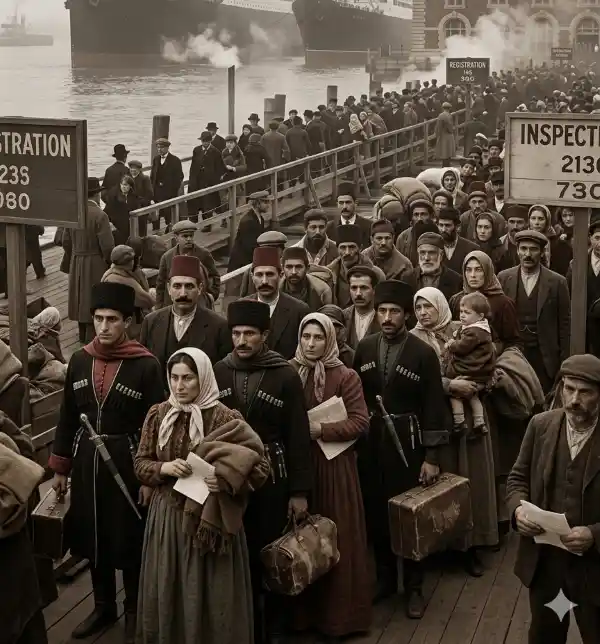
The Circassian diaspora refers to Circassian communities living outside their historical homeland in the North Caucasus. This diaspora was formed primarily as a result of the mass deportations carried out by the Russian Empire in the 19th century.
Estimates suggest that between 3 and 7 million Circassians live within the diaspora today, with only a smaller portion remaining in the Caucasus.
Spread across more than 40 countries, the Circassian diaspora is one of the largest exiled communities in history — and also one of the most resilient. From Turkey to Jordan and across the Americas, millions of Circassians have established lives far from their homeland, yet have not forgotten their roots.
This community was born from the catastrophic events of 1864 — the period when the Russian Empire deported the vast majority of Circassians from their homeland — and today it is spread across five continents. Based on this shared experience of exile, the diaspora is now spread across more than 40 countries on five continents.
1864 Turning Point: The Origins of the Diaspora
The Circassian diaspora was formed not through gradual migrations, but through violent mass deportations. Following the 1864 Russo-Circassian War, Russian authorities systematically deported approximately 1 to 1.5 million Circassians from their ancestral lands. Tens of thousands perished during forced marches to Black Sea ports, and many more died on overcrowded ships bound for Ottoman territories. This event fundamentally transformed the Circassian people—from a people of the homeland to a people of the diaspora.
Diaspora Overview
The diaspora is spread across more than 50 countries on 5 continents.
Approximately 90% of all Circassians live outside the Caucasus.
The 1864 deportation is a defining event for diaspora identity.
Modern studies focus on the preservation of culture and the right of return.
Where Do Circassians Live Today?
The largest Circassian communities are concentrated in the following regions:
Turkey — the largest population, numbering in the millions
Jordan — an important historical diaspora center
Syria — established communities
Israel — particularly Kfar Kama and Rehaniya
Europe and the USA — smaller modern diaspora groups
Circassians today live in more than 50 countries worldwide. The Circassian diaspora primarily refers to Circassians living outside the Caucasus due to the forced exile of the 19th century.

Settlement in the Ottoman Empire
The Ottoman Empire accepted the largest wave of Circassian refugees and settled them strategically in border regions — the Balkans, the Levant, and Anatolia. This settlement ensured that their military traditions served the empire's defense needs.
Turkey — The World's Largest Circassian Population
Turkey is home to the largest Circassian diaspora, with an estimated population of between 2 and 7 million. Major settlements are located in Istanbul, Düzce, Kayseri, Samsun, Tokat, Kahramanmaraş, and Adana. In recent years, a revival of cultural identity has been observed through language schools, media organizations, and youth organizations.
Jordan — A Key Role in the Founding of Amman
Circassians played a significant role in the founding of modern Jordan. They settled in Amman in the 1870s and actively participated in the city's construction. Today, Circassians serve in the Royal Guard, are represented in parliament, and maintain strong cultural institutions in Amman, Jerash, Sweileh, Na’ur, and Wadi al-Sir.
Syria: A Community Under Pressure
Before the civil war, approximately 100,000 Circassians lived in Syria. The conflicts that followed 2011 have destroyed many communities. Many Syrian Circassians have become refugees for a second time, and some have returned to the Caucasus through repatriation programs.
Israel: Two Villages, Living Culture
The villages of Kfar Kama and Rehaniya are remarkable examples of cultural preservation. Despite their small populations, these communities strongly maintain the Adyghe language, traditional dance, and cuisine.
Russia: Homeland Communities
Approximately 800,000 Circassians live in the Russian Federation. These communities serve as cultural centers for the global diaspora.
Europe and America
Germany There is a growing Circassian community in Germany numbering approximately 50,000 people.
USA and Canada Circassian communities in North America run cultural organizations and organize festivals.
Other Communities Smaller Circassian communities exist in the Netherlands, Belgium, Egypt, Iraq, Kosovo, and other countries.
Cultural Identity in the Diaspora
Despite being geographically dispersed, the Circassian diaspora possesses a cohesive cultural identity united around Adyghe Xabze, traditional dance, cuisine, and strong emotional ties to the Caucasus.
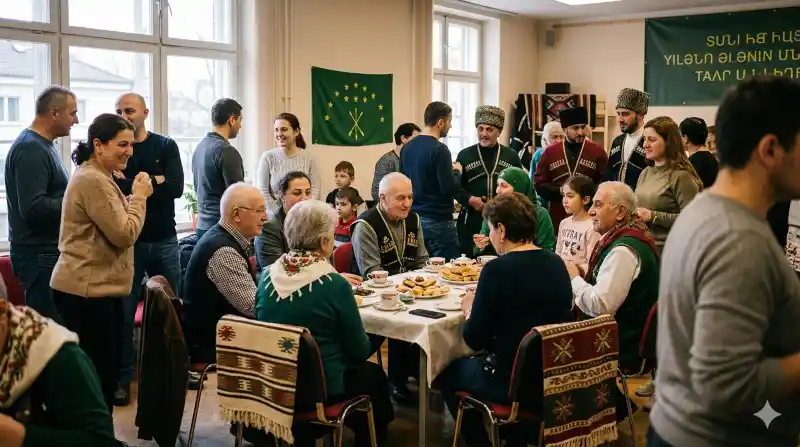
Language Loss and Revival
The Circassian language is classified as endangered by UNESCO. However, efforts to revive the language are increasing through digital learning tools, community schools, and social media content.
The Challenge of Unity Across Distance
One of the biggest challenges for the diaspora is coordinating among many countries with different political systems. Despite this, shared heritage, digital platforms, and international events are building strong bonds.
The Future
The diaspora is at a critical juncture. Digital tools and increasing cultural awareness offer new opportunities for the preservation of heritage.
Frequently Asked Questions
How many Circassians live in the diaspora?
Approximately 5–7 million people live outside the Caucasus.
Why do most Circassians live outside their homeland?
The 1864 deportation is the primary reason.
Do Circassians in the diaspora still speak the language?
It varies, but revitalization efforts are ongoing.