Circassian Culture and Adyghe Xabze: Traditions, Values and Code of Honor
Circassian culture isn't folklore preserved in museums — it's a living system of values, aesthetics, and social intelligence that has shaped a nation for millennia, and continues to define daily life across the diaspora today.
At its core, this civilization is built around Adyghe Xabze (Адыгэ Хабзэ) — the unwritten moral and ethical code that has governed Circassian society for over five thousand years. Rooted in the North Caucasus, this is one of the most sophisticated indigenous ethical systems in the world. Scholars have compared Xabze to the Bushido code of Japan and the chivalric codes of medieval Europe, yet Adyghe Xabze predates both and carries a depth uniquely its own.
The Circassian people — known in their own language as Adyghe (Адыгэ) — are one of the oldest indigenous peoples of the Caucasus. Despite the devastating exile of 1864 that scattered the nation across multiple continents, their culture has endured. Today, the global Circassian diaspora — numbering between 5 and 8 million people — works tirelessly to preserve this heritage for future generations.
What is Circassian Culture?
Circassian culture encompasses the traditions, language, music, dance, cuisine, clothing, and social codes of the Adyghe people, indigenous to the Northwestern Caucasus along the northeastern shores of the Black Sea. It is not merely a collection of customs — it is a complete philosophical worldview built around the concept of цIыхугъэ (humanity), where every social interaction is governed by deeply internalized principles of honor, respect, and community responsibility.
The Circassians were historically organized into twelve major tribal groups, including the Kabardians, Shapsugs, Abzakhs, Bzhedugs, Temirgoys, Hatuqways, Ubykhs, and Natukhai — each with their own sub-dialects, customs, and tamga (clan symbols). Despite these tribal distinctions, all Circassians share a common cultural identity unified by Adyghe Xabze.
To explore your own family connections, build your Circassian family tree, search Circassian family names, or trace your ancestral DNA connections using our dedicated tools.
🏛️ Understanding Circassian Culture
Circassian culture is governed by Adyghe Xabze — an unwritten moral code
Core values include hospitality, respect for elders, and personal honor
Culture transmission relies on family and community practice
The diaspora has adapted traditions while preserving core principles
The Five Core Pillars of Adyghe Xabze
Adyghe Xabze rests on several interconnected pillars that together form a complete moral philosophy. Each principle reinforces the others, creating a holistic code that governs both personal conduct and community relations.
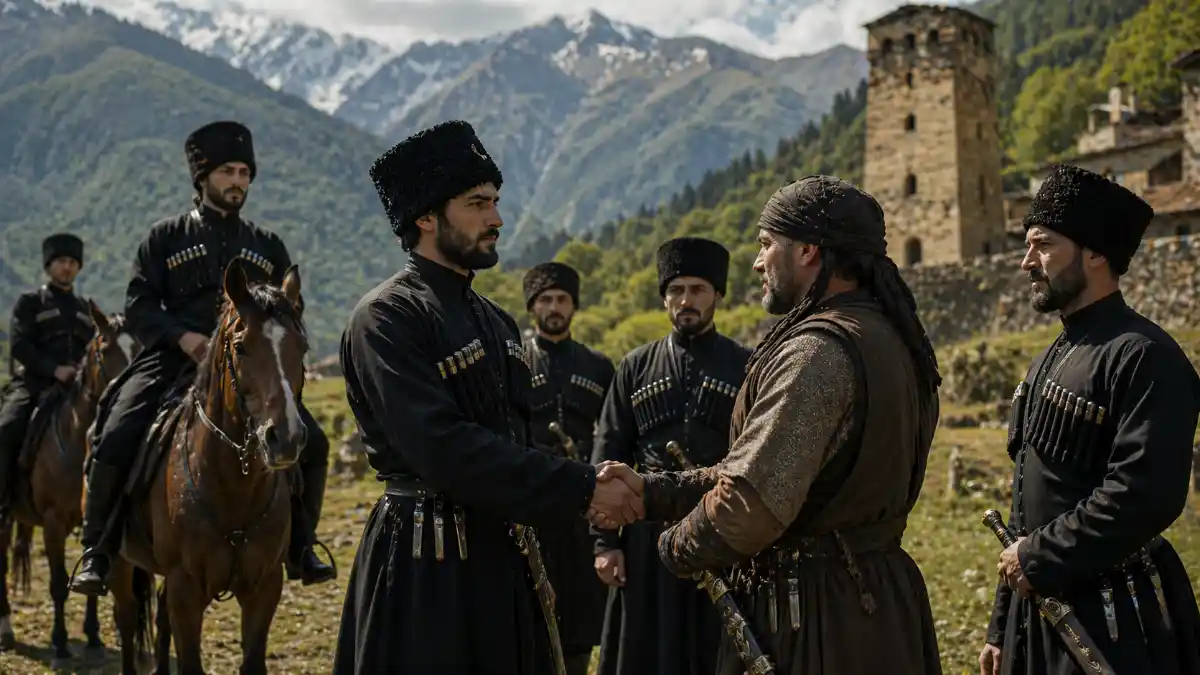
Circassian cultural values — Honor, Respect, and Hospitality
Напэ (Honor and Conscience)
Напэ (literally "face") is the most fundamental concept in Adyghe Xabze — the inner moral compass that prevents wrongdoing even when no one is watching. A Circassian who loses their напэ loses their standing in society entirely; traditionally, this was considered worse than physical death. Напэ governs every interaction and extends beyond individual behavior to collective family honor — the actions of one family member reflect on the entire lineage.
ЦIыхугъэ (Humanity and Compassion)
ЦIыхугъэ represents universal compassion, empathy, and respect for all human beings regardless of origin, religion, or status. Travelers in the 18th–19th centuries consistently noted the extraordinary kindness shown to strangers. "A Circassian who lacks humanity is not Adyghe" is a common saying that illustrates how central this value is to identity.
ЛIыгъэ (Courage and Moral Strength)
ЛIыгъэ goes far beyond physical bravery. It demands the moral courage to speak truth, defend the weak, and stand by one's principles even when dangerous. This principle produced the legendary warrior-philosophers described in the Nart Sagas.
Акъыл (Wisdom and Reason)
Акъыл encompasses intelligence, reason, and sound judgment. In Adyghe Xabze, wisdom is valued above strength. The Хасэ (council of elders) institutionalized this principle — major decisions were made through deliberation and consensus.
НэмыплъэжьыгъэкIэ (Modesty and Restraint)
Modesty is a deep philosophical commitment to restraint, humility, and avoidance of excess. A Circassian does not boast, does not display wealth ostentatiously, and does not seek personal glory at the community's expense.
Hospitality: The Sacred Duty
Hospitality (хьэщIэныгъэ) is the most celebrated aspect of Circassian culture — a sacred covenant between host and guest. A guest was considered sacred, sent by God.
Even an enemy who enters your home as a guest is under your absolute protection.
The best room (хьэщIэщ / хьакIэщ) was reserved exclusively for guests, kept ready at all times.
The host must protect the guest with their life if necessary.
Three-day rule: for three days, no questions about the guest's identity or business.
The finest food is always served to visitors first.
Escort tradition (гъуэгу тетыныгъэ): the host escorts the departing guest to safety beyond the territory.
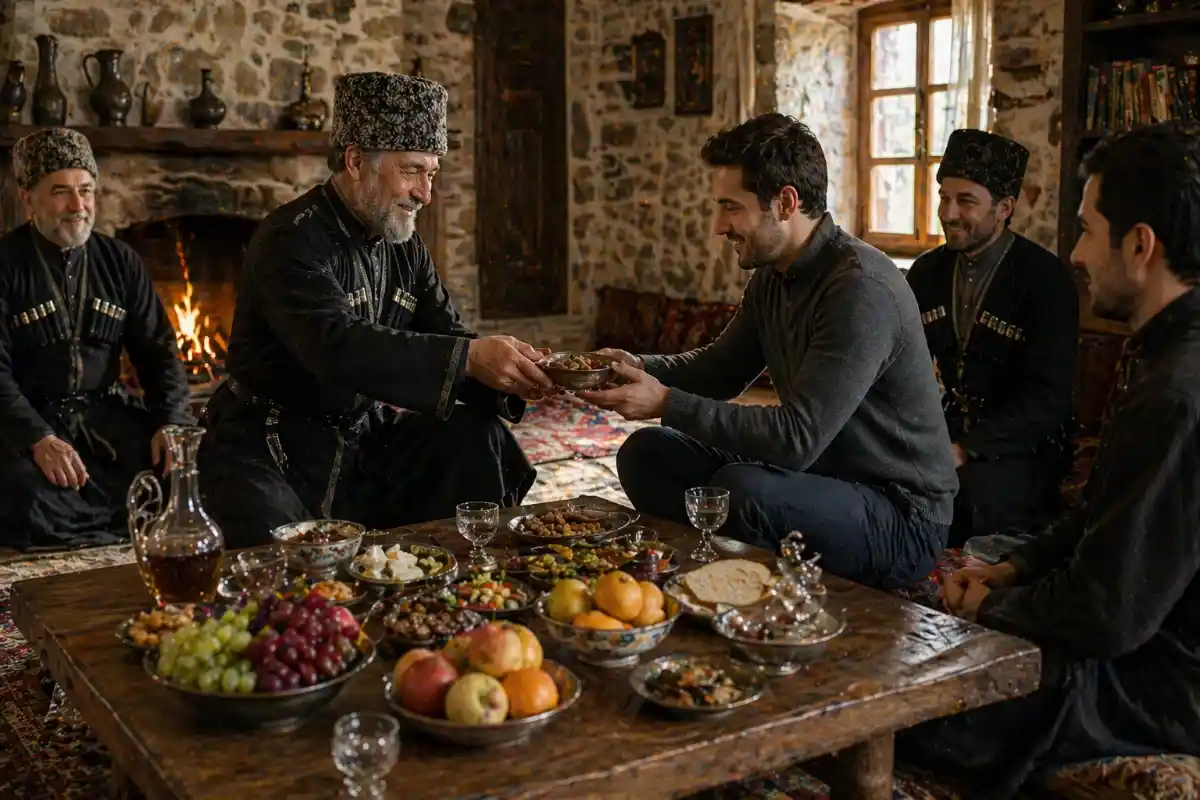
European travelers like James Bell, Edmund Spencer, and John Longworth described Circassian hospitality as unmatched anywhere in the world. The tradition persists in Jordan, Turkey, and Syria today.
Respect for Elders: The Living Library
In Circassian society, age commands automatic and unconditional respect. Elders were the living repositories of community knowledge.
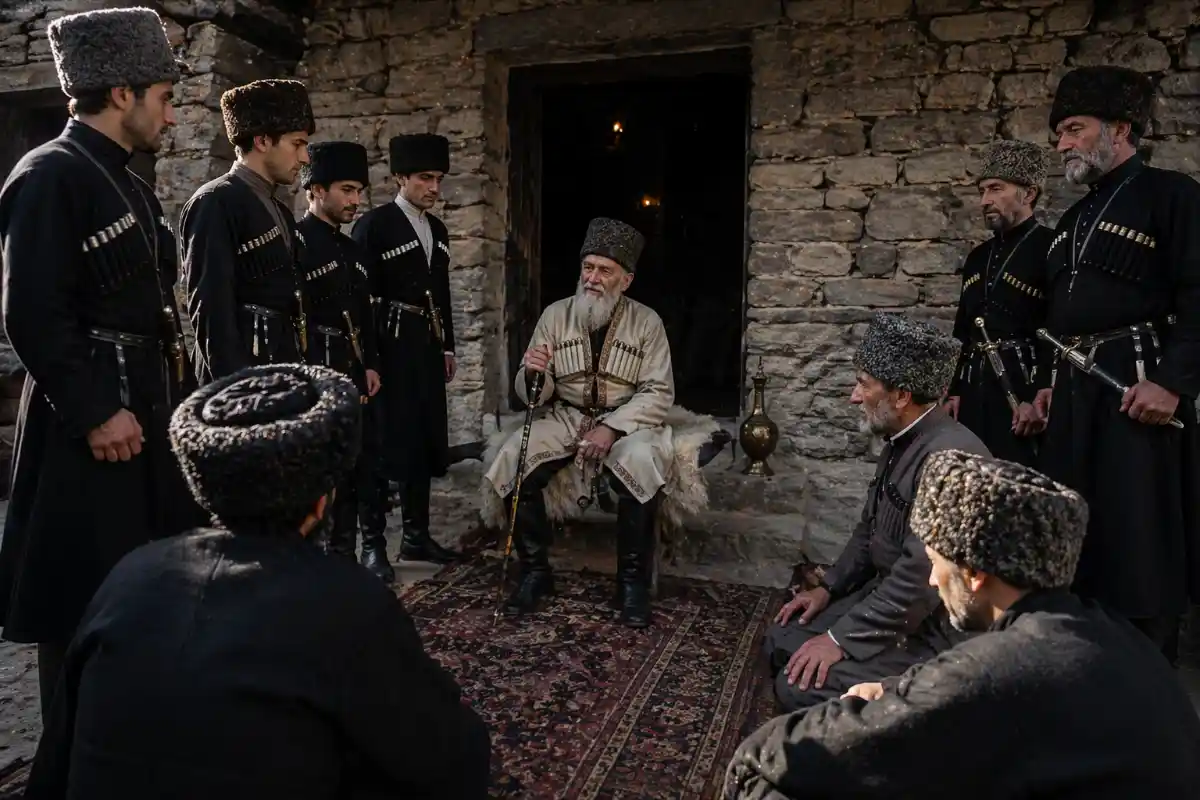
When an elder enters a room, everyone stands immediately.
Younger people do not sit while an elder is standing, and do not speak before an elder has spoken.
Young men were expected to dismount from their horses when passing an elder on the road.
The eldest woman of a household held particular authority — her word could stop a blood feud
Women in Adyghe Xabze
Adyghe Xabze accords women exceptional respect and influence. While Circassian society was patrilineal, women held a moral authority that could override male decisions in critical situations.
A man must stand when a woman enters a room and never raise his voice in her presence.
The mother's blessing was required for a son to go to war.
A woman could stop a fight or feud by throwing her headscarf between combatants.
The legendary Satanay of the Nart Sagas embodies the ideal — wisest, most respected, most powerful.
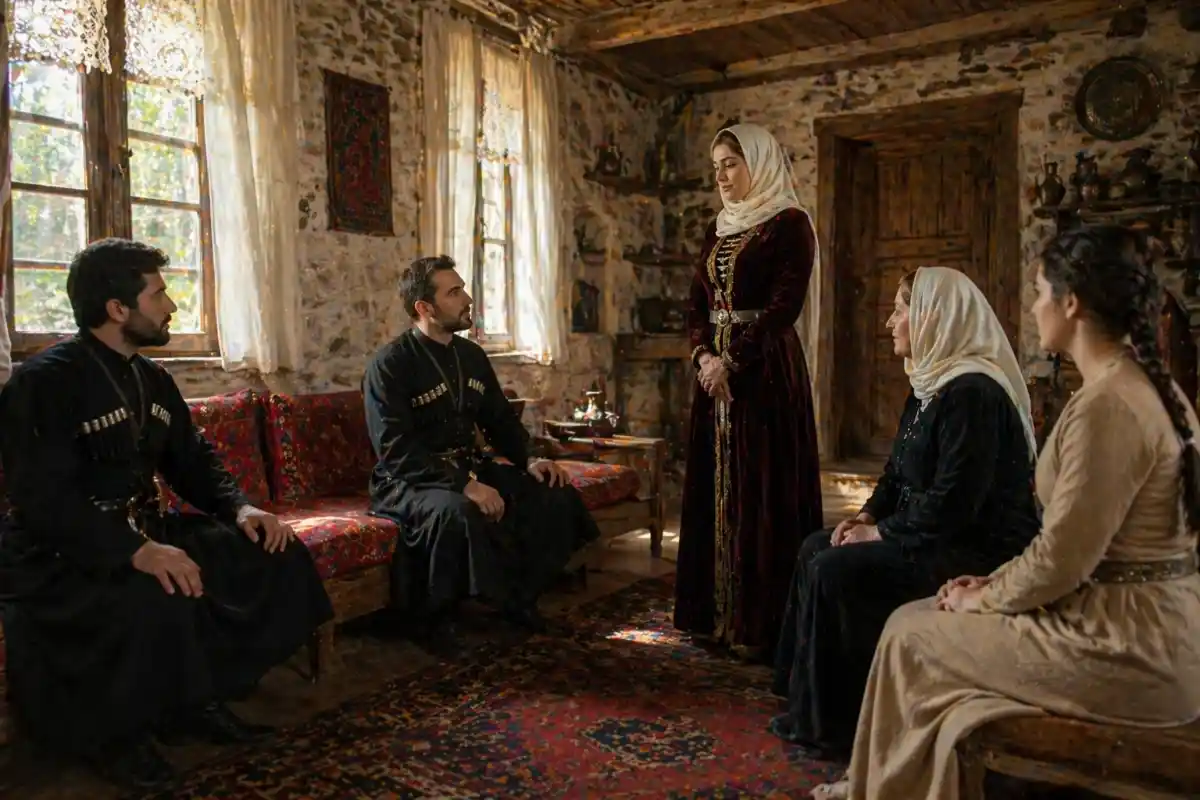
British diplomat David Urquhart wrote in the 1830s that "the respect paid to women exceeds anything I have witnessed in Europe."

Warrior Etiquette and the Code of Combat
Circassian warriors embodied the complete moral code in every aspect of conduct.
Brave but not reckless — unnecessary risk was foolishness, not courage.
Skilled but humble — a true warrior never boasted.
Fierce in battle but merciful to the defeated — harming prisoners was strictly forbidden.
Protective of non-combatants — women, children, and elderly were never harmed.
Bound by their word — a warrior's promise was absolutely binding, even to an enemy.
The Cherkesska (warrior coat) with its gazyr cartridge holders later influenced military fashion across the Caucasus and was adopted into Cossack uniforms.
The Justice System of Adyghe Xabze
Adyghe Xabze functioned as a complete legal framework without written statutes — through mediation, arbitration, and council deliberation.
The Хасэ served as both legislative body and supreme court.
Blood feuds were regulated through formal compensation and reconciliation.
Exile was the most severe punishment — banished people lost all social protection.
European observers noted that crime rates in Circassian communities were extremely low compared to neighboring societies with written legal codes.
Traditions: Dance, Food, and Clothing
Circassian Dance (Адыгэ Къашъо)
Male dancers perform dramatic acrobatic movements — leaps, spins on the toes, sword play — while female dancers glide with grace. The Islamey (Ислъамый) is the most famous dance. Other forms include the Wuj, Zafak, and Qafe. The Adyghe Jeghu (traditional dance gathering) is the social centerpiece of community life.
Circassian Cuisine
Щипс (Shchips): the national dish — walnut-garlic sauce over chicken.
Пастэ (Paste): dense millet/cornmeal porridge.
Гуубат (Guubat): fried cheese-filled pastries for celebrations.
Хьалыжъо (Khalyzho): traditional cheese-filled flatbread.
Лэкъум (Laqum): sweet fried dough balls served with honey.

A traditional Circassian feast — Shchips, Paste, Guubat, and honey dishes
Traditional Clothing
The iconic Circassian coat (черкеска / цые) with cartridge pockets (газырь) became so influential that it was adopted by Cossack armies. Women's dress featured the elegant сае with elaborate gold embroidery (дышъэидэ) and a distinctive tall gold-thread headdress.

Traditional Circassian attire — Cherkeska with gazyr pockets and embroidered women's dresses
Adyghe Xabze vs. Other Honor Codes
Bushido (Japan) — focused on the warrior class; Xabze applied to all members of society.
Chivalry (Europe) — tied to feudal aristocracy; Xabze was inherently egalitarian.
Pashtunwali (Afghanistan) — closest parallel, but differs significantly in the role and status of women.
Living the Culture: What People Say
"Culture isn't something you read about — it's how you greet an elder, how you serve tea, how you stand when a woman enters the room. It's in the body, not the book."
— Anzor, 55, Istanbul
"My daughter asked me why we do things differently from her friends. I told her: 'Because we carry 5,000 years of civilization in how we live.'"
— Jansurat, 39, Amman
Circassian Culture in the Modern Diaspora
In Jordan, families maintain hospitality and elder respect as core values.
In Turkey, Xabze principles are taught in cultural centers (Dernekler).
In Kfar Kama, Israel, the village preserves Xabze in daily life.
In the Republic of Adygea and Kabardino-Balkaria, scholars work to revitalize Xabze.
Language revitalization through digital platforms and community schools.
Digital heritage platforms like CircassianWeb connect diaspora through family tree building and DNA research.
⚖️ The Pillars of Circassian Culture
Adyghe Xabze is a comprehensive moral philosophy, not merely etiquette.
Five core pillars — напэ, ЦIыхугъэ, ЛIыгъэ, Акъыл, modesty.
Hospitality is a sacred covenant.
Women hold exceptional moral authority.
The code functions as a complete legal framework.
It remains a living tradition across the global diaspora.
Frequently Asked Questions
What is Adyghe Xabze?
Adyghe Xabze (Адыгэ Хабзэ) is the traditional unwritten moral and ethical code of the Circassian people, governing social behavior, hospitality, respect for elders, and conflict resolution for millennia.
Is Adyghe Xabze still practiced today?
Yes. In homeland republics and tight-knit diaspora communities, core principles remain strong.
How is Xabze different from religion?
Xabze predates Christianity and Islam among Circassians. It is a secular ethical code based on social harmony, honor, and collective responsibility.
What is the role of women in Adyghe Xabze?
Women hold high respect. A man must stand when a woman enters the room. Mothers are central keepers of tradition.
How is Circassian culture preserved in the diaspora?
Through cultural associations, dance troupes, language classes, festivals, and digital platforms.
Sources & References
Bram, Chen. "Circassian Re-Imagination of Tradition." Middle Eastern Studies, 2008.
Jaimoukha, Amjad. The Circassians: A Handbook. Palgrave Macmillan, 2001.
Shami, Seteney. "Circassian Encounters." Development and Change, 1998.
Kaya, Ayhan. "Cultural Reification in Circassian Diaspora." JEMS, 2004.
Richmond, Walter. The Circassian Genocide. Rutgers University Press, 2013.
Natho, Kadir I. Circassian History. Xlibris, 2009.