Circassian Tribes: The 12 Adyghe Tribes, History, Genocide, Exile & Survival
Table of Contents
Overview of Circassian Tribes
The Circassian people (Adyghe) are divided into many tribes and families, each with its own customs, traditions, and dialects. These tribes and families form an essential aspect of Circassian society, providing a sense of belonging and identity to their members.
The structure of the traditional Circassian family is based on the concept of extended families, where multiple generations live together under one roof.
The head of the family is usually the eldest male, who is responsible for making decisions on behalf of the entire family. In the past, Circassians were primarily a rural people, and their families worked in agriculture and livestock farming.
However, in recent times, many Circassians have moved to urban areas and engaged in a variety of professions.
Despite this change, the importance of family remains a central part of Circassian culture.
One of the main traditions in the Circassian family is the practice of arranged marriage. In this tradition, the parents of the bride and groom play a central role in choosing their children's future partners. While this may seem outdated to some, it is still a common practice among many Circassian families. Another important aspect of Circassian family life is the emphasis on education.
Education is highly valued in Circassian culture, and parents place a strong emphasis on their children receiving a good education. This has led to a high literacy rate among the Circassian population.
The strong bonds of family and community are a defining characteristic of the Circassian people.
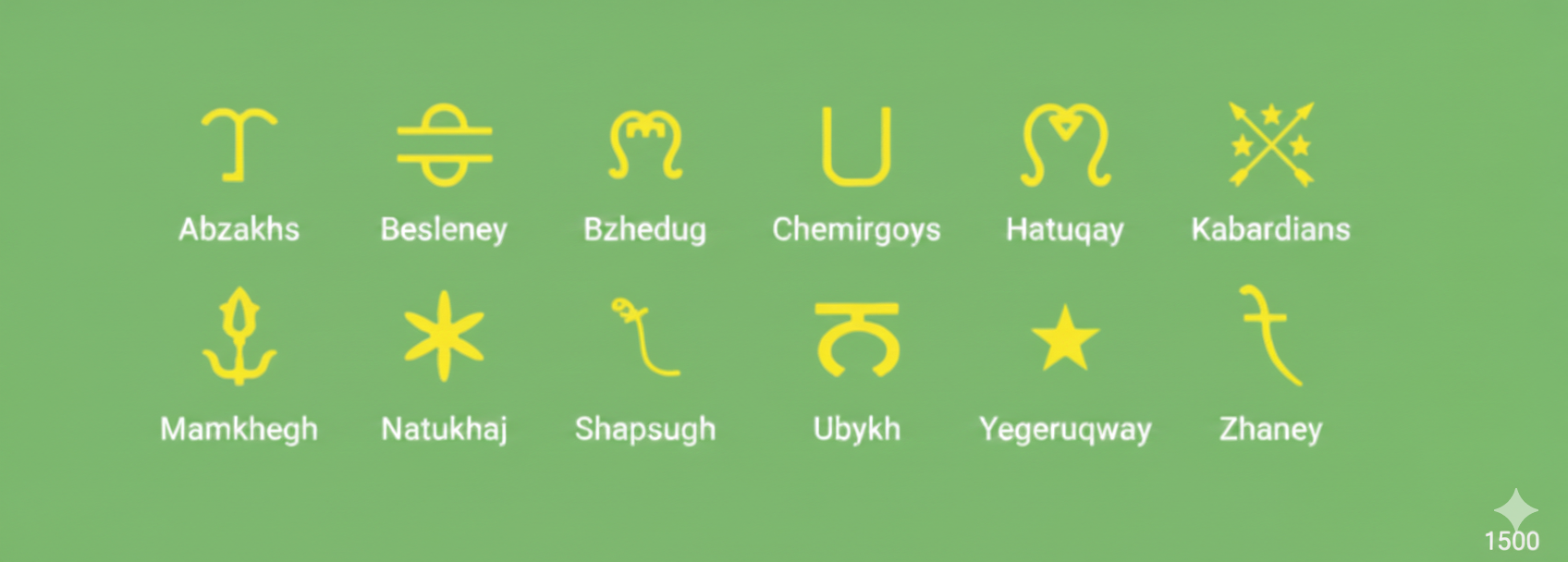
The Circassian people consist of a number of different tribes and families, each with its own unique history and cultural traditions. Circassians are known for having only 12 tribes. But historically, there were always many more. Unfortunately, they were all eradicated during the Russo-Circassian War and the genocide. Regardless, and no matter how many years pass, they will never be forgotten. May our nation return to life someday.
How did the Circassian tribes become “one people”?
The Circassian tribes were not originally “one tribe.” They were many related Adyghe communities living across the northwestern Caucasus, the Black Sea coast, the Kuban region, mountain valleys, and foothills. Over time, these communities developed separate tribal names, territories, dialects, princely houses, councils, family lines, and tamga symbols. But they remained connected by language, ancestry, Adyghe Khabze, shared customs, marriage networks, military alliances, and the idea that they belonged to the wider Adyghe people. Britannica describes Circassians as peoples of the northwestern Caucasus, while Encyclopaedia Iranica notes that “Cherkes / Čarkas” was used in Persian, Arabic, and Turkic for the Circassian people who call themselves Adyghe.
The word “Circassian” is an outside name, an exonym, connected to the older form Cherkess / Čarkas / Çerkes. Its exact origin is debated. Britannica says the ultimate derivation is thought to be from Kaz-kaz, an ancient name linked to people living near the southern Black Sea. Other explanations connect it to Persian, Turkic, Mongolian, or older tribal names, but there is no single fully accepted origin. The people’s own traditional self-name is Adyghe.
The formation of the tribes became clearer from the late medieval period onward. Several sources describe the Circassian tribes as territorial and political units that developed their own dialects and identities. A key traditional figure is Inal the Great, remembered in Circassian tradition as a unifier of Circassia in the 15th century. After his rule, Circassia divided again into princely and tribal entities, and several princely lines traced legitimacy back to him. This is important because it shows that Circassian unity was not only ethnic or cultural; it was also remembered as a political ideal.
Why were they all called Circassian?
They were called Circassian because outsiders saw them as one broad people of the northwestern Caucasus, even though internally they had many tribal names. In foreign sources, names like Cherkess, Čarkas, Circassian, and Çerkes became umbrella terms for the Adyghe-speaking peoples. Inside the community, however, people often identified more specifically by tribe, clan, village, and family name, while still belonging to the wider Adyghe world.
What united them?
The strongest unifying force was Adyghe Khabze. It was not just etiquette; it functioned as a moral, social, and legal code. It shaped respect for elders, hospitality, honor, courage, mediation, conflict resolution, marriage behavior, military discipline, and community responsibility. This shared code allowed different tribes to recognize each other as part of the same civilization, even when they had different dialects or political systems.
A second unifying force was language. Circassians spoke related Northwest Caucasian languages and dialects, mainly Adyghe in the west and Kabardian in the east. Dialect differences grew because tribes lived in different territories, but the language family and cultural vocabulary kept them connected.
A third unifying symbol is the Circassian flag. The flag has twelve stars representing twelve Circassian provinces or tribes, with three crossed arrows in the center. The flag became a national symbol of Circassian unity, especially in the 19th century and later in the diaspora.
How the Circassian Tribes Became One People
The Circassian tribes did not begin as a single centralized nation in the modern sense. They grew from related Adyghe communities spread across the northwestern Caucasus, each rooted in its own territory, river valley, mountain district, or coastal region. Over time, these communities became known as tribes, with their own names, dialects, noble families, councils, tamga symbols, and local traditions.
Yet the tribes were never strangers to one another. They shared a common Adyghe identity, related languages, marriage ties, military alliances, customs of hospitality, and the moral world of Adyghe Khabze. This shared code taught respect for elders, dignity, courage, self-restraint, loyalty to family, protection of guests, and responsibility toward the community. Through Khabze, a Kabardian, Shapsug, Abzakh, Bzhedug, Natukhai, Temirgoy, Yegeruqway, Zhaney, or any other Adyghe could recognize another as part of the same people.
The name “Circassian” came mostly from outside. Persian, Arabic, Turkic, Russian, and European sources used forms such as Cherkess, Čarkas, Çerkes, and Circassian to describe the Adyghe peoples of the northwestern Caucasus. But the inner name of the people remained Adyghe. This difference is important: “Circassian” became the international name, while “Adyghe” preserved the people’s own sense of identity.
In the late medieval period, the tribes became clearer as political and territorial communities. Circassian tradition remembers Inal the Great as a ruler who attempted to unite the Circassian lands under one authority. After him, the tribes and principalities again developed their own local leadership, but the memory of unity remained. This is why Circassian history is not only a history of separate tribes, but also a history of repeated attempts to preserve one shared peoplehood.
The twelve stars of the Circassian flag express this idea perfectly. Each star represents a tribe or province, but all appear together on one green field. The message is not division. It is unity through diversity: many tribes, one Adyghe people; many family lines, one historical homeland; many memories, one Circassian identity.
Geographic Distribution of the Tribes
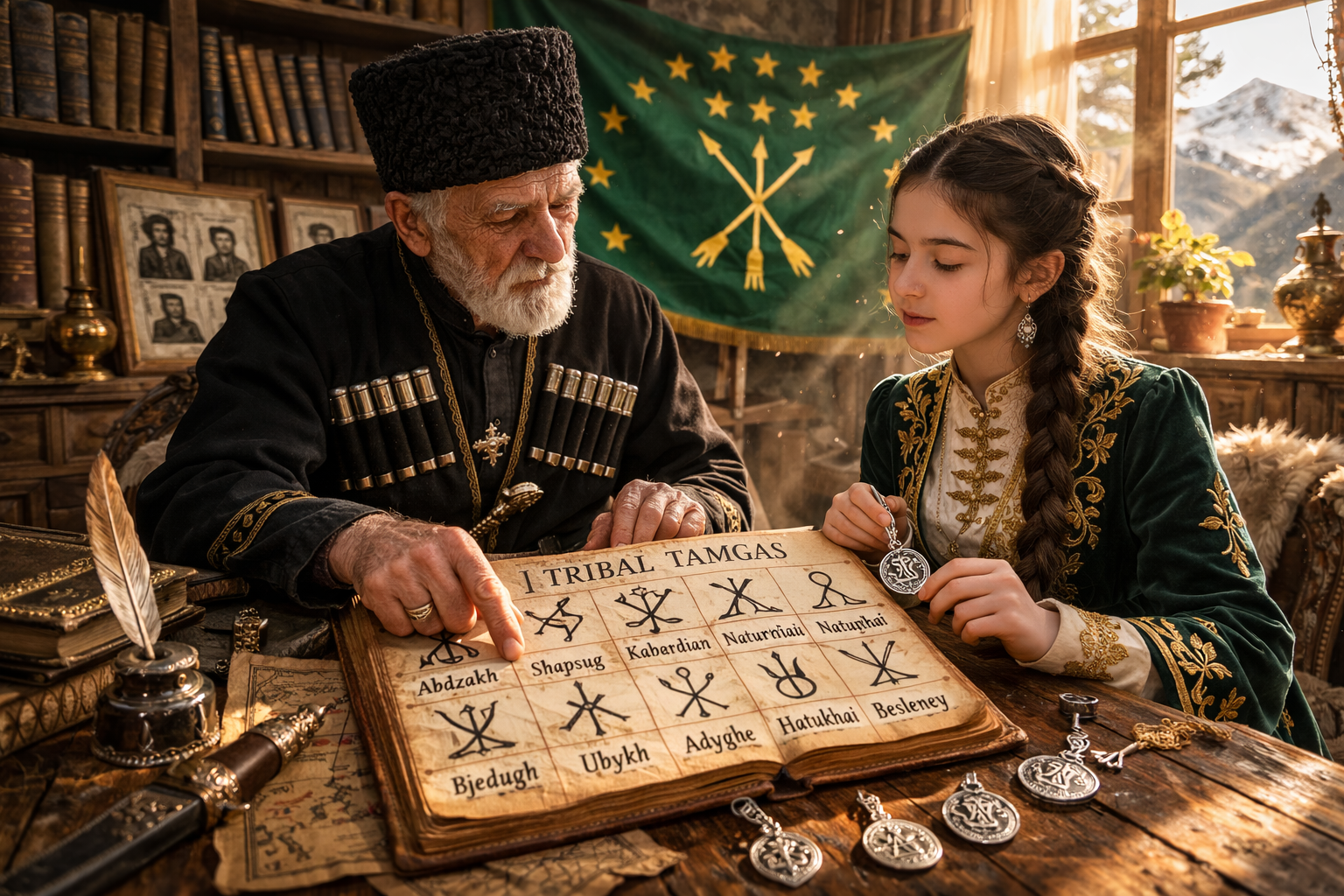
Circassian tribes can be grouped and compared in different ways based on their geographic location:
The narrow Black Sea coast, from north to south, was occupied by the Natukhai, Shapsug, and Ubykh. The main part of the Natukhai and Shapsug tribes was located north of the mountains. The Natukhai prospered through trade as their coasts were not backed by high mountains and opened onto the steppes.
The northern slope was inhabited, from north to south, by the Natukhai, Shapsug, and Abzakh. They appear to have been the most populous tribes after the Kabarda, and their inland location gave them some protection from Nogai and Cossack raids.
In the far west there were three small tribes that were absorbed into the Natukhai and disappeared. These were the Adil on the Taman Peninsula and the Shigakh and Shibsin near Anapa.
Along the Kuban were the Natukhai, Janeh, Bjedug, Khatukwai, and Temirgoy. The tribes along the Kuban and Laba rivers were more exposed to Nogai and Cossack raids than those inland.
In the east, between the Laba and Belaya rivers, from north to south, were the Temirgoy, Yegerukwai, Makhosh, and Besleney. The Besleney were a branch of the Kabardians.
In the far east, the Kabarda occupied about a third of the northern Caucasian foothills from central Circassia proper eastward to Chechnya. North of them were the nomadic Nogai, and south of them, deep in the mountains, from west to east, were the Karachay, Balkars, Ossetians, Ingush, and Chechens. The Kabardians were somewhat advanced, interacted with the Russians since the 16th century, and were greatly reduced by plague in the early 19th century.
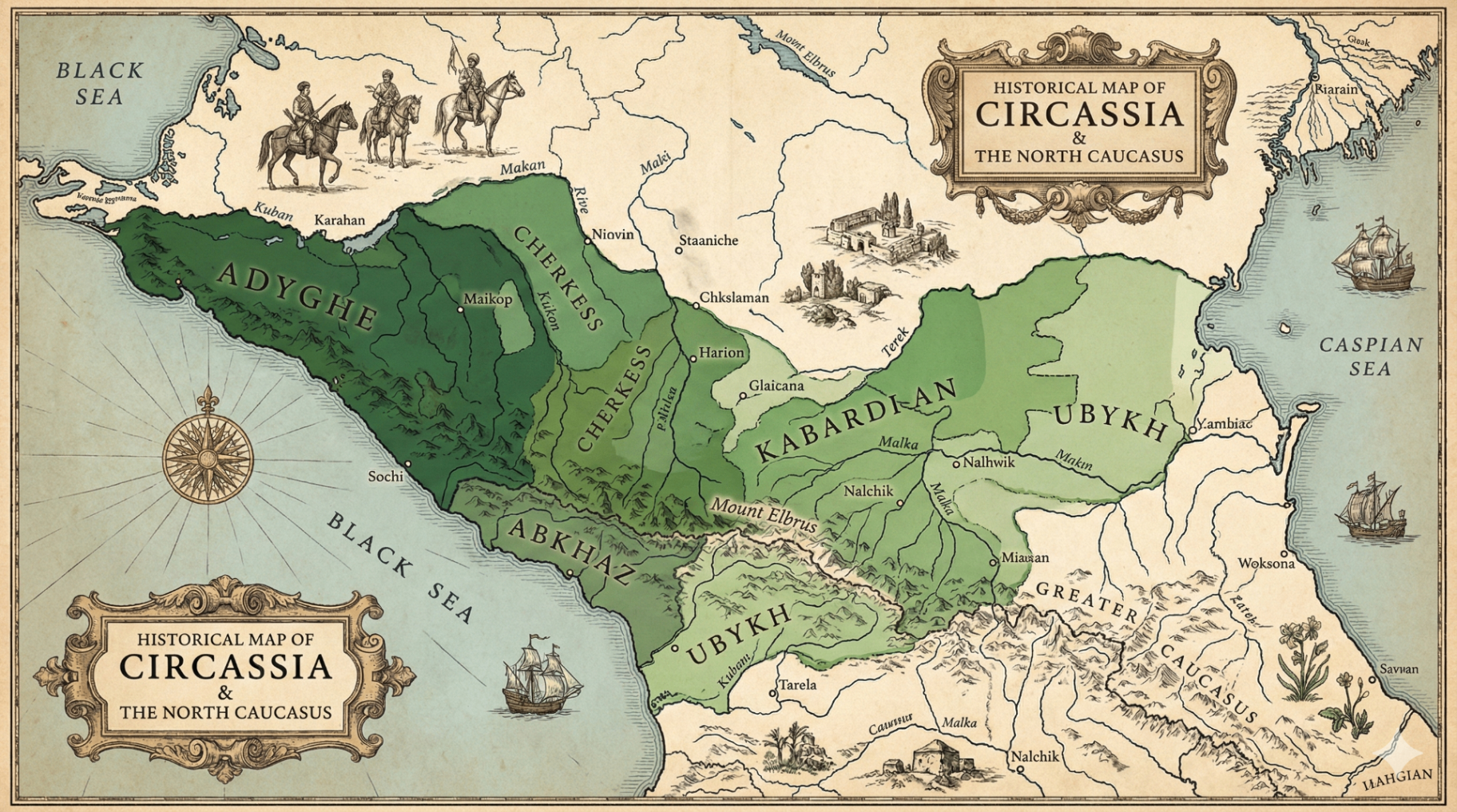
Tribe Summary Table
Tribe NameRegionKey CharacteristicsAbzakhMountain Adygea, Krasnodar KraiNine-company governance, mining, agricultureBesleneyLaba & Urup rivers, Karachay-CherkessiaClosest to Kabardians, noble lineage from Prince InalBjedugAdygea, Kuban River54% of Adygea villages, livestock & agricultureKabardianKabardino-Balkaria, North CaucasusLargest Circassian tribe, distinct dialectKhatukwaiKuban River, Pshish-Belaya valleysWarrior tribe, horse breedingMamkheghBelaya & Kurdzhips rivers, near MaykopDemocratic governance, no princely classNatukhaiBlack Sea coast, Anapa to NovorossiyskMaritime trade, 10 aristocratic familiesShapsugBlack Sea coast & northern Caucasus slopesOne of the largest tribes, democratic governanceTemirgoyBetween Belaya & Laba riversMost powerful & influential, strong class systemUbykhSochi region (ancient Sashi)Semi-nomadic horsemen, 11 subdivisionsYegerukwaiEastern CircassiaRich cultural heritage, Adyghe sub-tribeZhaneBlack Sea & Sea of Azov coastNearly destroyed in war, only 3 families survived
Complete List of Circassian Tribes
The main tribes and families among the Circassian people include:
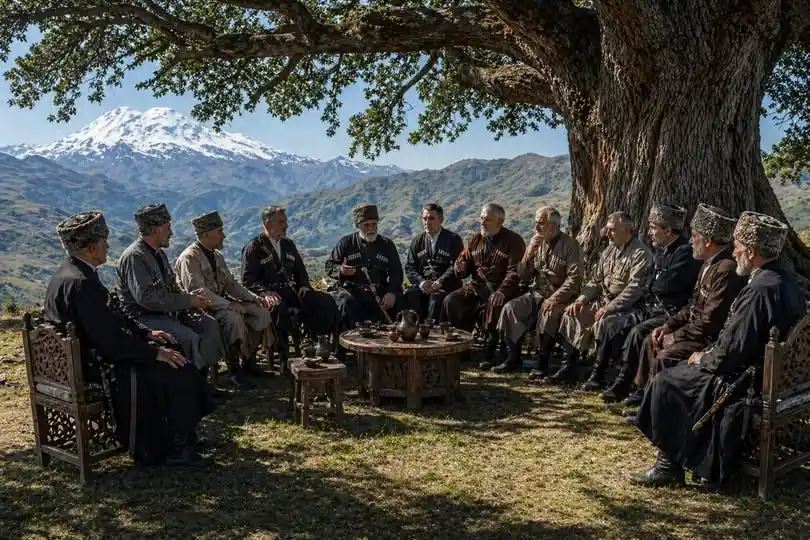
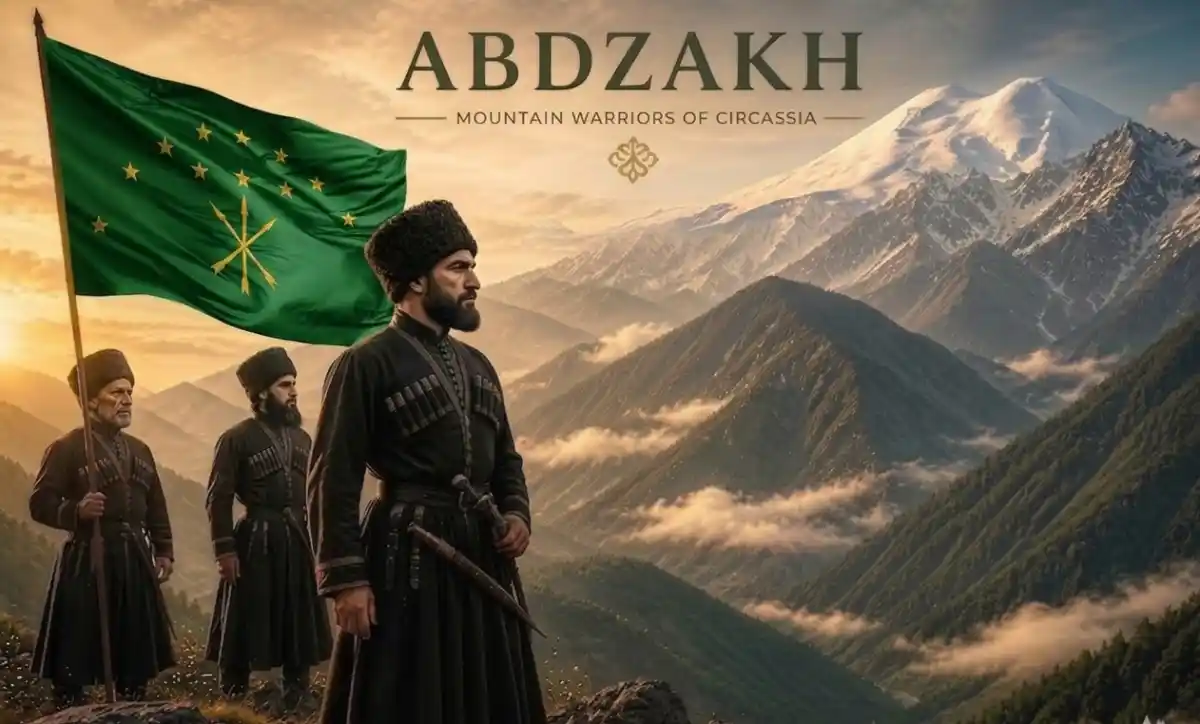
Abdzakh Tribe: Mountain Warriors of Circassia and Their Enduring Legacy
Also known as Abkhaz or Abadzekh. Historically, they lived in the mountainous regions of Adygea and Krasnodar Krai. The main settlements or villages were located in the river valleys of Kurdzhips, Pshikha, Pshish, and Pskups.
The Abzakh tribe was traditionally divided into nine companies, governed by elected elders. When discussing and resolving important issues, the elders agreed in a general meeting. The Abzakh tribe engaged in agriculture and horticulture, and kept many animals, especially valuable horses. In the mountains, the Abzakh mined copper, iron, lead, and silver.
The Abzakh should not be confused with the Abkhazians or Abaza. The remaining Abzakh were relocated to the current Shovgenovsky District in the steppes of Adygea.
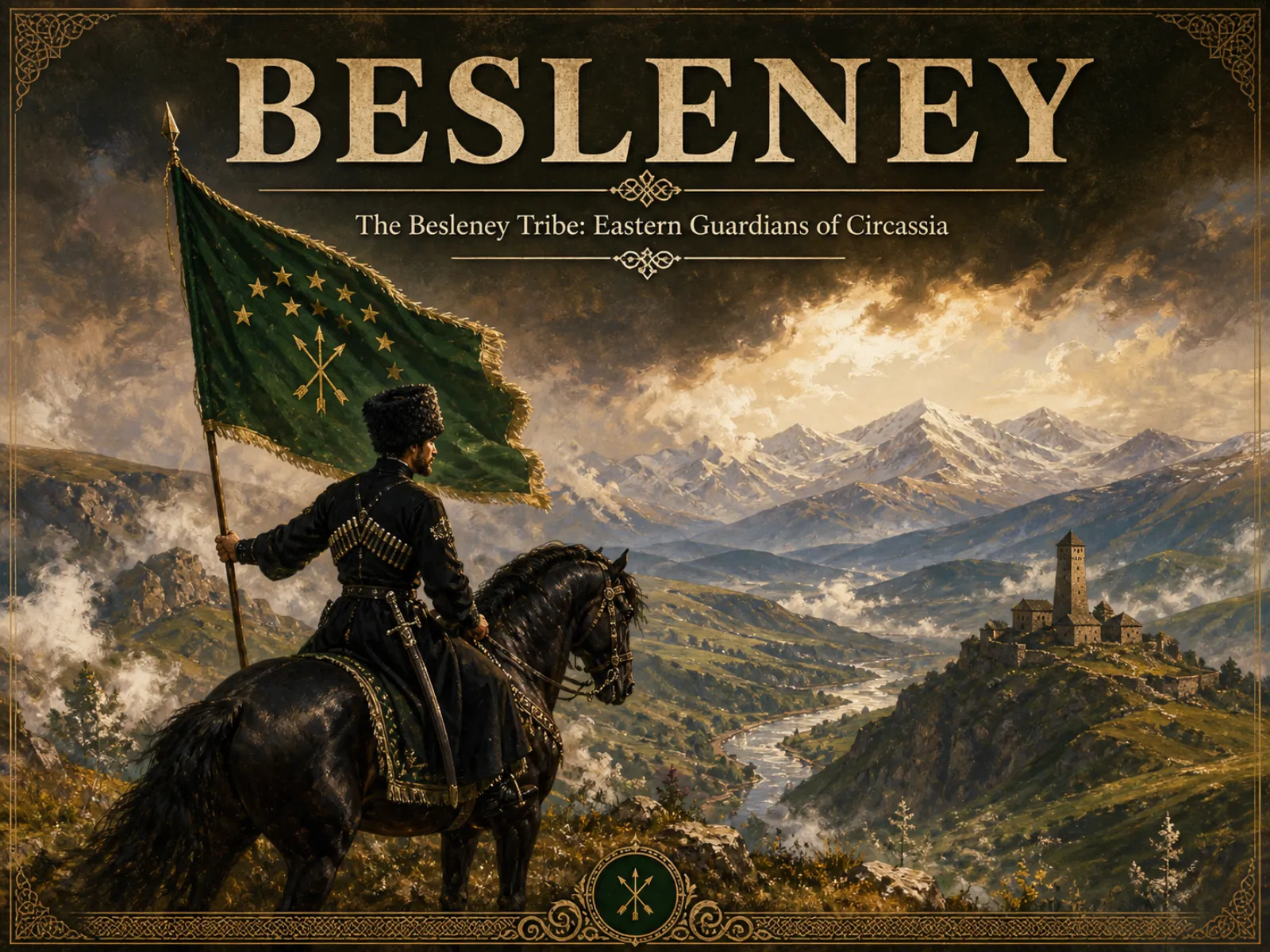
The Besleney Tribe: Eastern Guardians of Circassia
Also known as Besleney or Baslaney. The Besleney are the closest to the Kabardians.
The noble families of the Besleney were Kanuko and Shalukho, descendants of the Kabardian Prince Beslan (son of the legendary Prince Inal) who founded his own tribe with the same name.
The majority of Besleney live in the valleys of the Bolshaya and Malaya Laba rivers and on the banks of the Urup in Karachay-Cherkessia, Krasnodar Krai, and Adygea. They also extend into the valleys of Chetem, Fars, Psefir, Kuban (Western Circassia). The Besleney people speak the Besleney sub-dialect of the Kabardian Circassian dialect (Eastern Circassia). However, since the Besleney tribe lived in central Circassia, the Besleney dialect also shares a large number of features with the dialects of the Western Circassian dialect, such as the Shapsug Adyghe dialect.
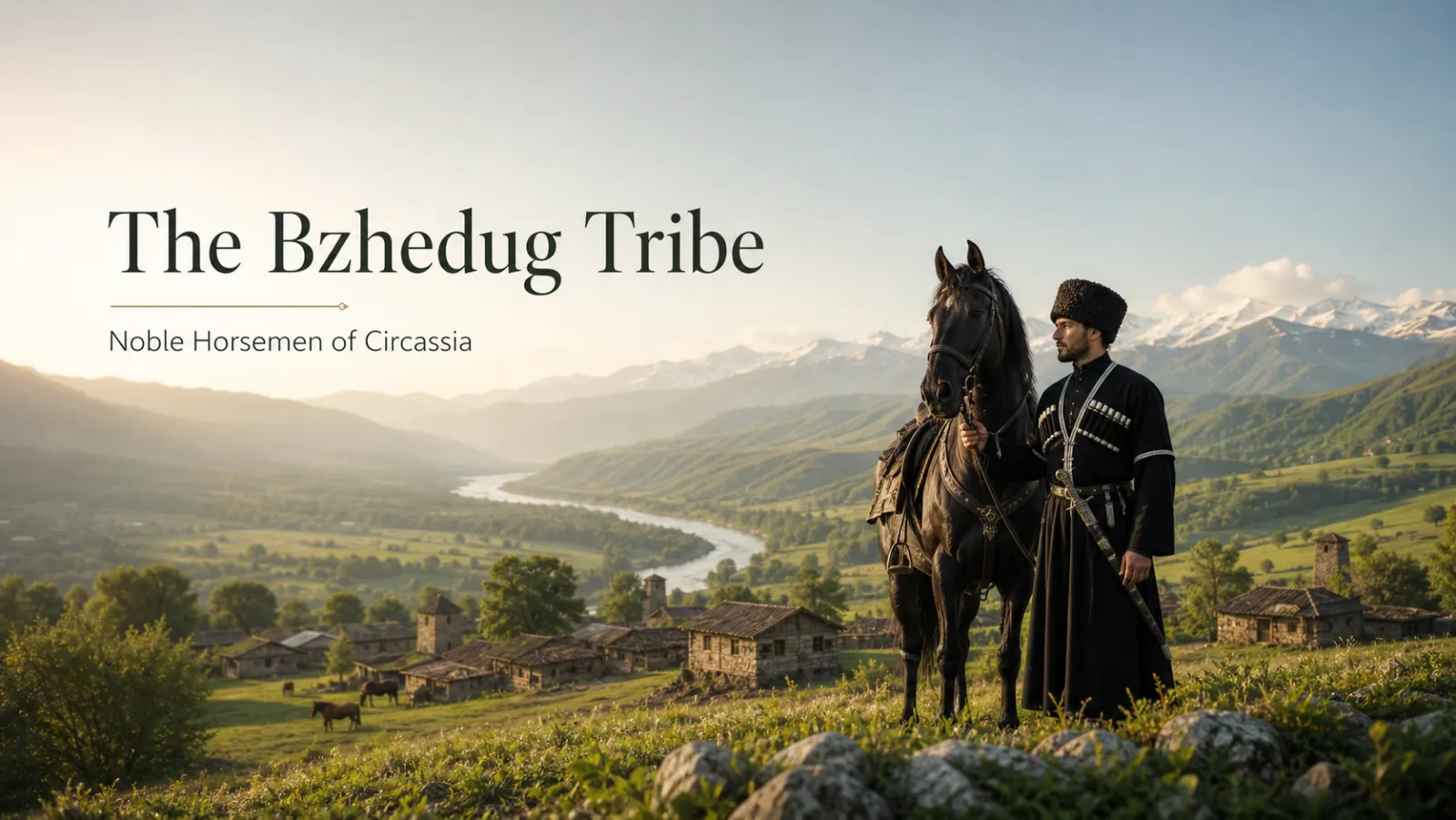
The Bzhedug Tribe: Noble Horsemen of Circassia
Also known as Bjedug or Bzedug. The Bjedug people live in Adygea and Krasnodar Krai, and are well-represented in the Adyghe diaspora in all countries of residence. Even in ancient times, the Bjedug people were divided into four tribes.
The Bjedug originally lived in the region of the Shakhe River, between Tuapse and Sochi. Later they split into two groups: those who lived near the Black Sea (Abkhazis) and the Adyghe (lands of the Kuban River).
There are 48 Circassian villages in the Republic of Adygea, 26 of which are Bjedug villages (54% of the villages in Adygea). They were engaged in livestock farming and agriculture, primarily cultivating crops and corn.
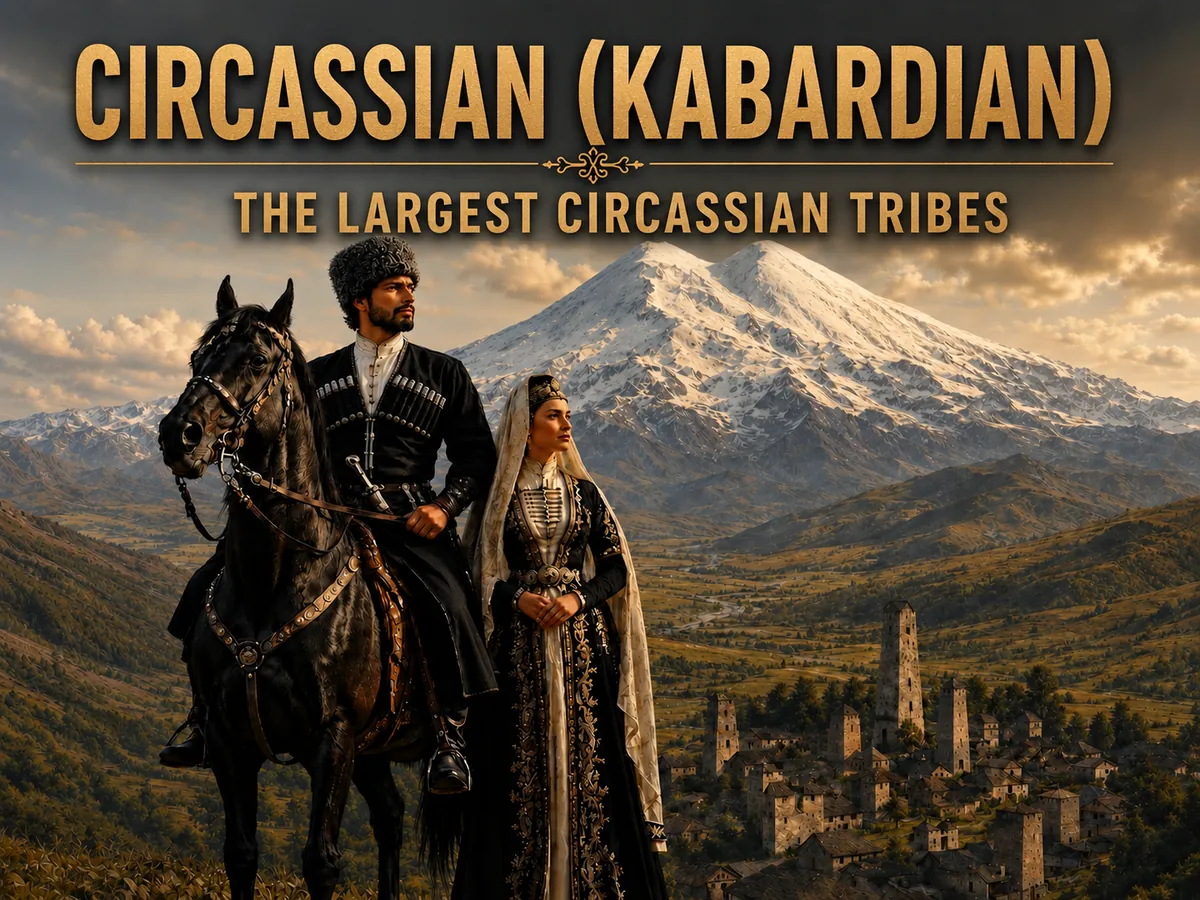
The Kabardian Tribe: Largest Circassian Nation
Also known as Kabardin, Kiberti, or Kabardia. The Kabardians are the largest Circassian (Adyghe) tribe in the world overall.
They speak a distinct dialect of the Adyghe language. Historically, the Kabardians lived in Kabardia, a region of the North Caucasus. The republic is located in the mountains of the North Caucasus, with plains in the northern part. The republic shares an international border with Georgia.
The Kabardian language has two main dialects: Kabardian and Besleney. Some linguists argue that Kabardian is just one dialect of the Adyghe language or the comprehensive Circassian language, which consists of all Adyghe and Kabardian dialects together. There are about 100 lakes in the republic, none of which are large.
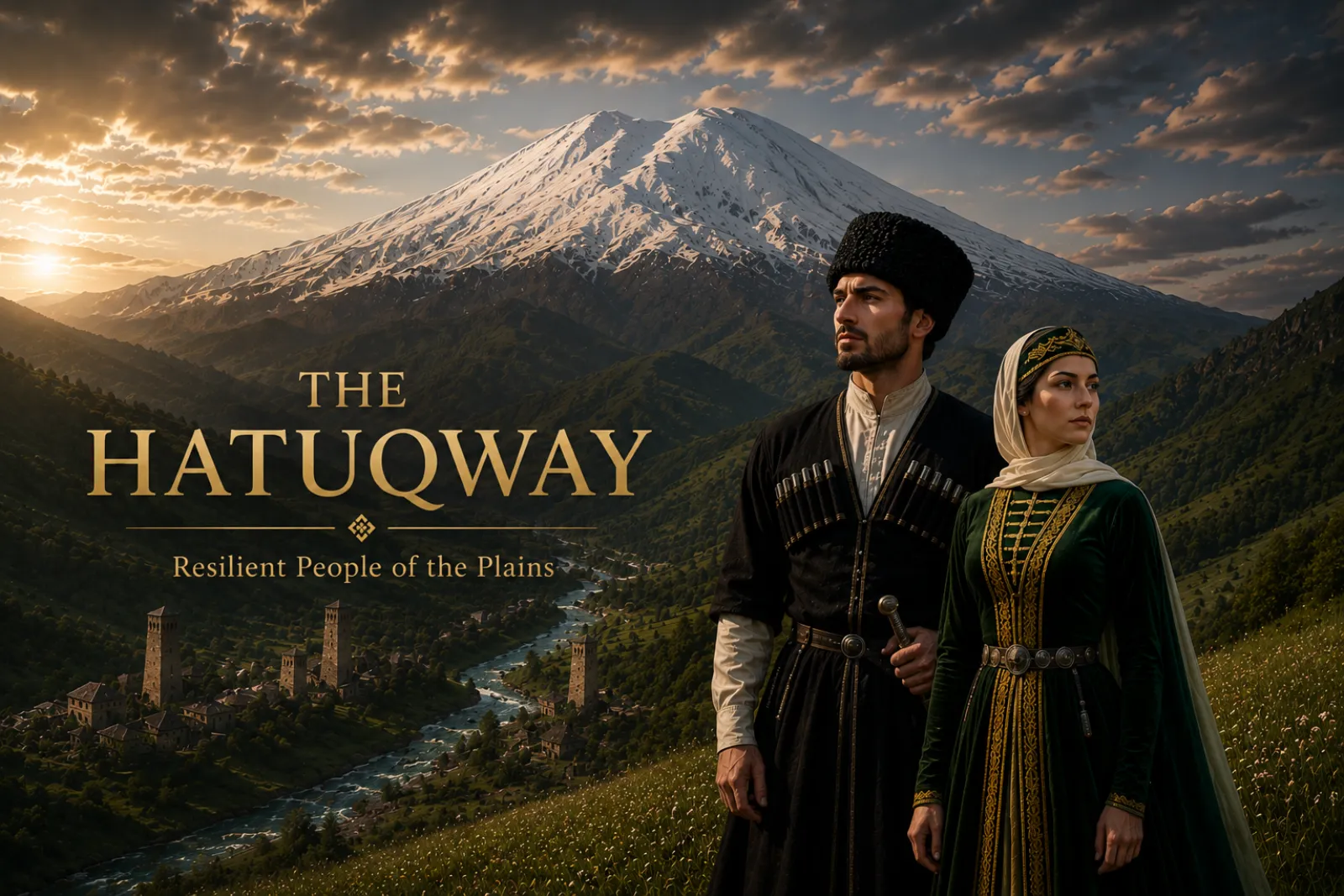
The Hatuqway (Hatukoy) Tribe: Resilient People of the Plains
They were known for their art of war as a warrior tribe. The Khatukwai were a Western Circassian tribal principality whose lands were located on the banks of the Kuban River. The Khatukwai people mostly lived in the mountains between the lower valleys of the Pshish River and the Belaya River.
Due to their small size and proximity to the Temirgoy tribe, they were considered one of the sub-groups of the Temirgoy tribe. In the time preceding the Russian invasion, the Khatukwai were known as a strong and warlike tribe that fought many wars, mostly against the Crimean Tatars.
The traditional culture of the Khatukwai is part of Circassian culture. The Khatukwai engaged in agriculture, livestock farming, and horse breeding. Before Islam, the Khatukwai worshipped Jesus as well as Circassian deities such as Shible (god of lightning and thunder), Sozresh (god of fertility), Yemish, Akhin, and Hakostash.
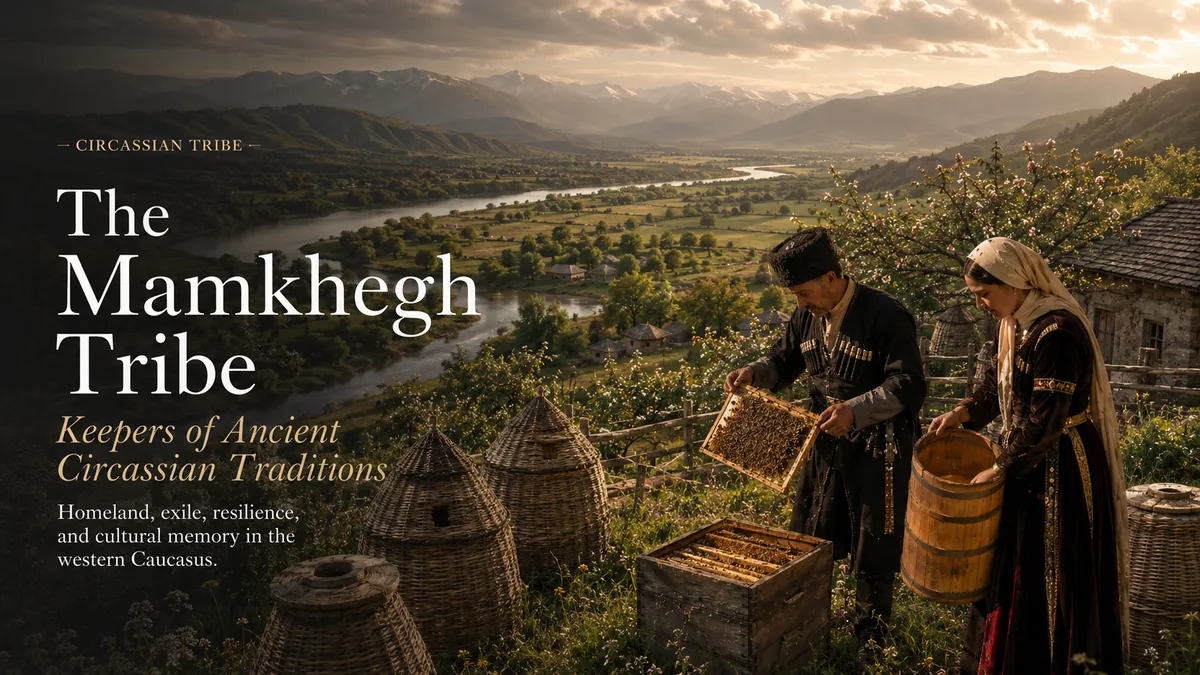
The Mamkhegh Tribe: Keepers of Ancient Circassian Traditions
Originally, the Mamkhegh lived in the region between the Belaya and Kurdzhips rivers, in the area of modern Maykop.
The Mamkhegh spoke a special dialect of the Adyghe language, which is closest to the Temirgoy dialect. However, they did not have the upper class of princes who usually controlled the villages, unlike most Circassian tribes. The rural administration was in the hands of elected elders from the class of freemen.
Legends say that they moved from the Black Sea coast to the upper reaches of the Pshisha River. Initially, the Mamkhegh were just three large families: Shnakh, Mami, and Tlizhu. Those who remained received Russian citizenship and founded a village called Mamkhegh, which still exists today in the Shovgenovsky District of modern Adygea.
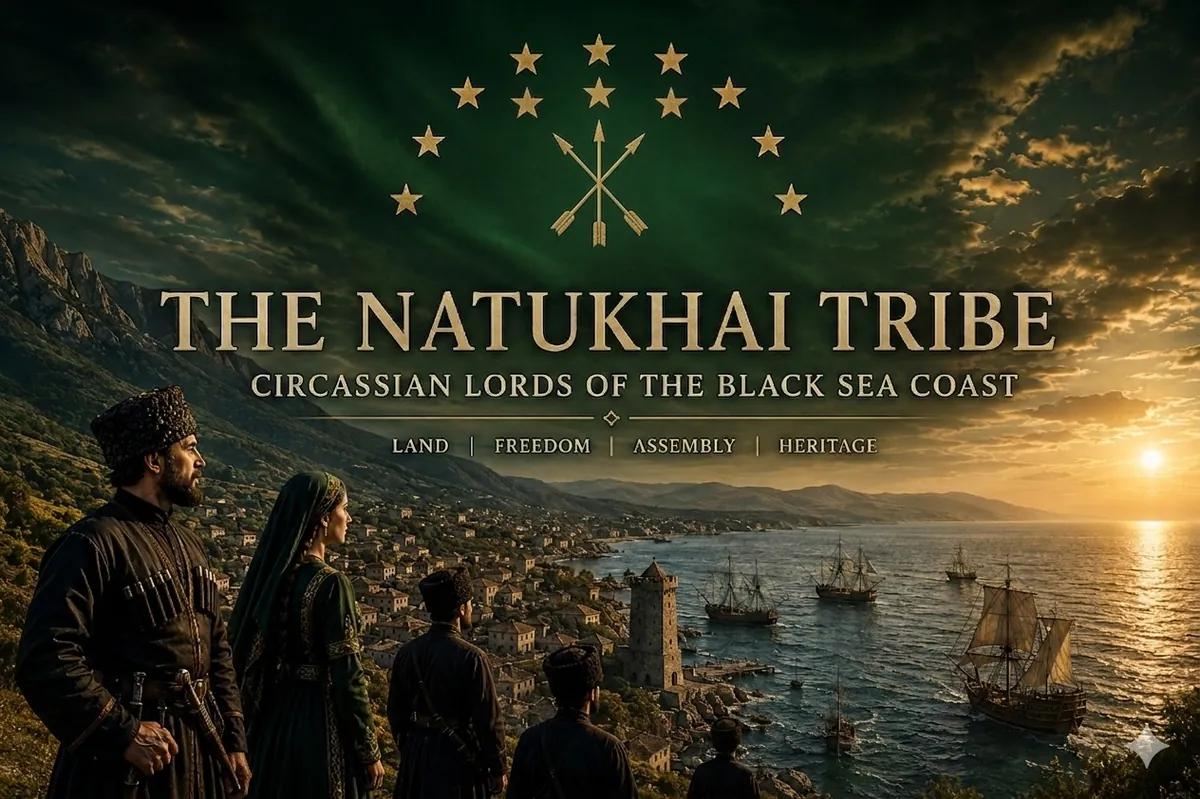
The Natukhai Tribe: Circassian Lords of the Black Sea Coast
Also known as Natukhai, Natukway or Natukha. Their territories historically extended along the Black Sea coast from Anapa in the north to Tsemes Bay (now Novorossiysk) in the south and from the northern side of the mountains to the lower Kuban River.
The Natukhai tribe consisted of 10 aristocratic families and 44 free clans, and was classified as a democratic Adyghe tribe. Since their coasts were not backed by high mountains and opened northwards to the steppes, the Natukhai were very active in trade with the Ottoman Empire and the Crimean Khanate.
In terms of culture, language, and character, they found themselves closest to Little Shapsug and even called themselves by the same name, Aguchips. The Natukhai, like the Shapsug and Abadzekh, were able to limit the power of the nobility in their tribe. Their villages were also governed by elected villagers. The Natukhai were among the tribes most inclined to a peaceful type of work.
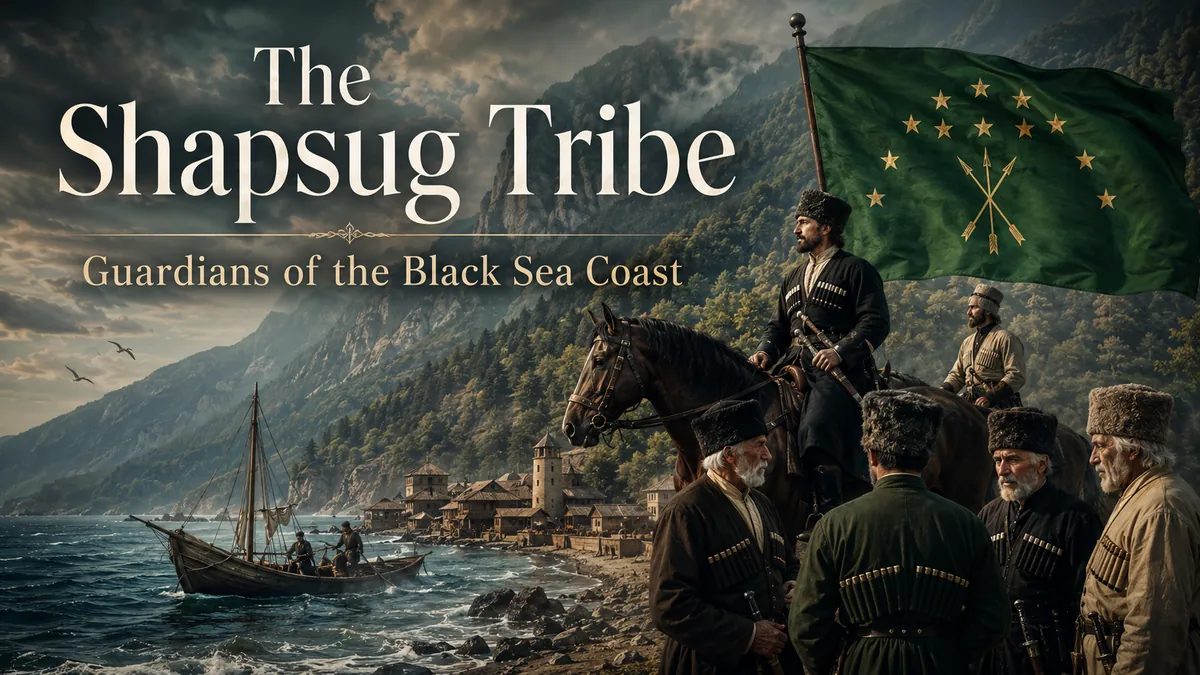
The Shapsug Tribe: Guardians of the Black Sea Coast
Also known as Shapsug or Shapsugh. Historically, the Shapsug tribe formed one of the largest groups of Black Sea Adyghe. The Shapsug were a very large tribe that occupied vast areas of the Black Sea coast and the Kuban River.
Various sources indicate that before the Russo-Caucasian War, they inhabited the region between the Dzhubga (meaning "wind" or "wind valley") and Shakhe rivers (the so-called Maly Shapsug, or Little Shapsug) and the high mountainous regions of the northern slopes of the Caucasus mountain range.
They are a sub-group of the larger Adyghe people and speak the Shapsug dialect of the Adyghe language. They were classified as one of the three democratic Adyghe tribes. The Shapsug were known for their support of other Adyghe tribes in their struggle against the Crimean Khanate.
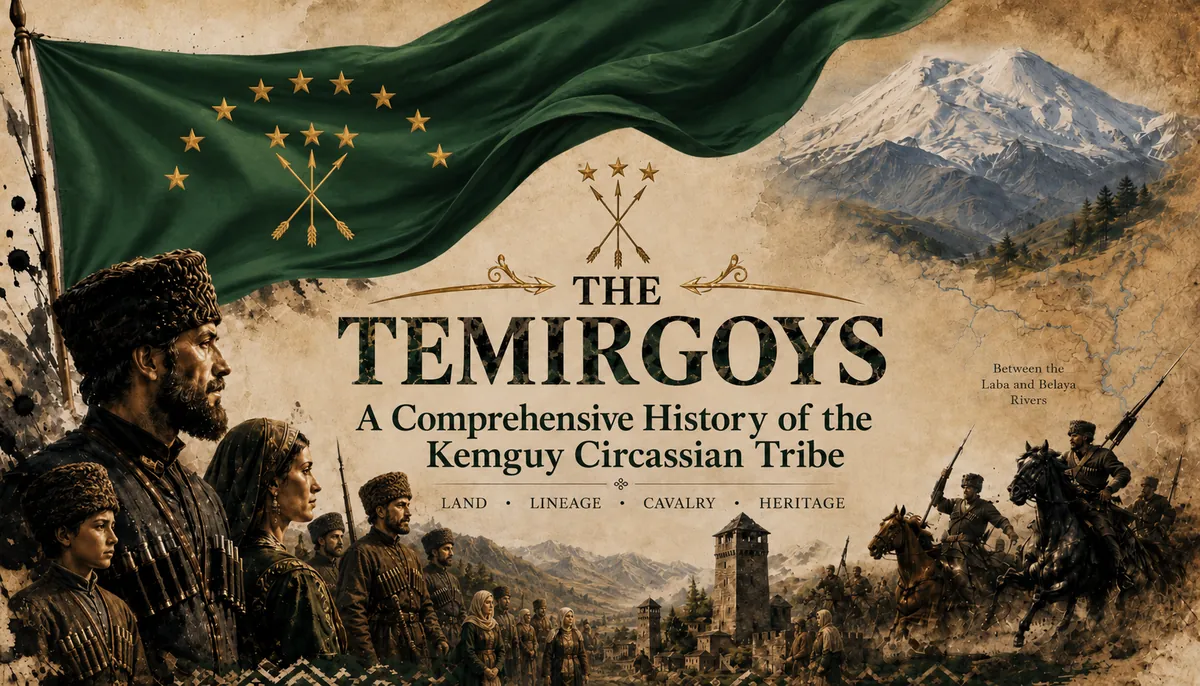
The Temirgoy (Chemguy) Tribe: Warriors of the Central Caucasus
Also known as Temirgoy, Chemrgoy, or Kemguy. They lived between the lower mouths of the Belaya and Laba rivers, and their lands extended north to the Kuban.
The Temirgoy were among the most powerful and influential Circassian tribes. Sources indicate that the Temirgoy tribe was richer than its neighbors. They practiced livestock farming and agriculture: millet, corn, wheat, barley, and sunflower.
Class distinction in the Temirgoy tribe was very clear. After the end of the Caucasian War, most Temirgoy were resettled in other Circassian villages (Bjedug, Kabarda, Urbsky). The most important family of princely origin was Bolotoko, which at one time controlled the Temirgoy, Yegeruko, and Mamkhegh tribes.
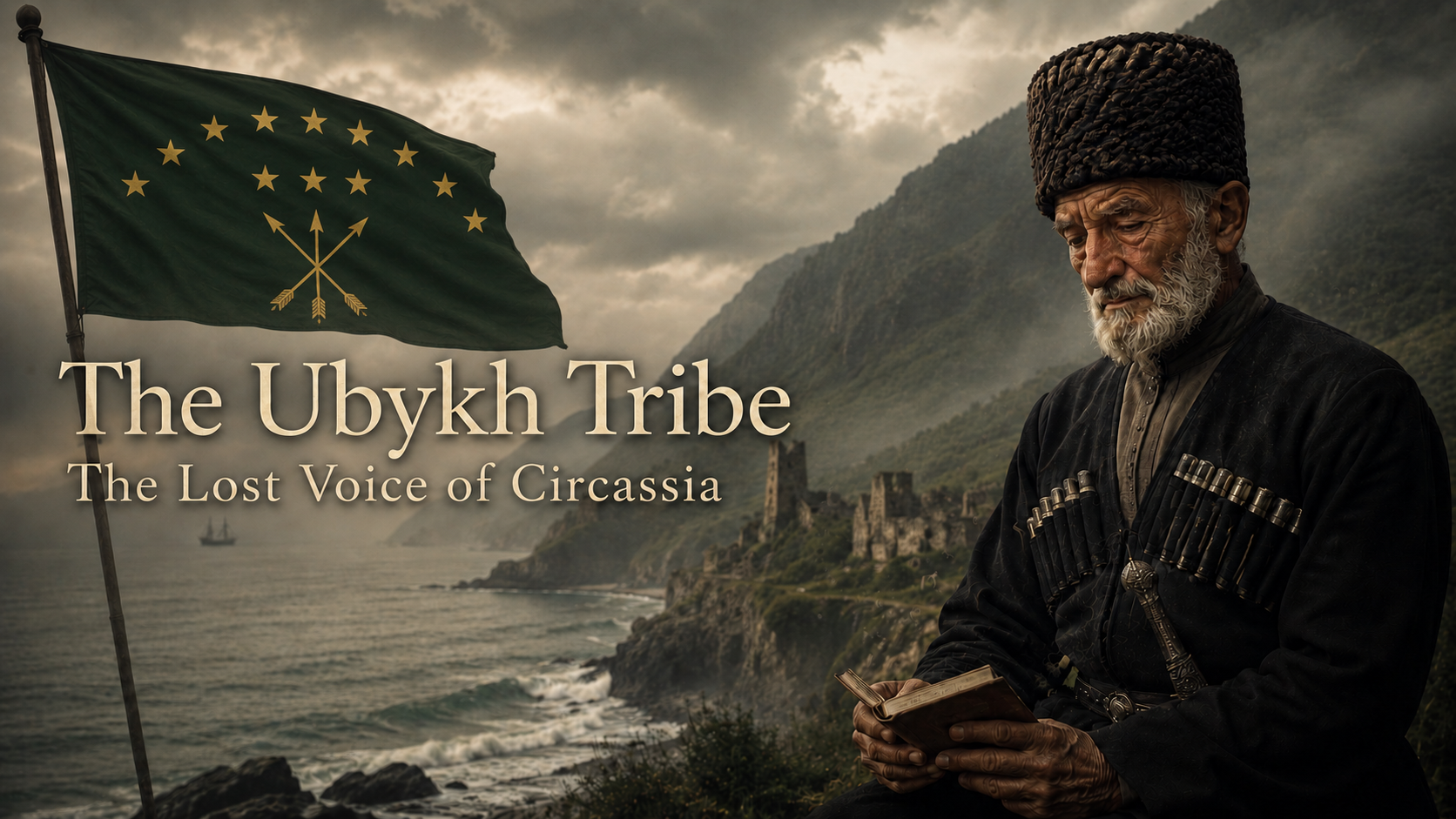
The Ubykh: The Lost Voice of Circassia
The name Ubykh is derived from Убыхыбзэ (/wɨbɨx/), which is its name in the Adyghe language. It is known in linguistic literature by many names: variants of Ubykh, such as Ubykh, Ubukh.
The Ubykh used to inhabit the capital of Circassia, Sashi (Circassian: literally "coastal") — modern Sochi, Krasnodar Krai. The Ubykh people replaced the Sadz Abkhaz from the region in the 17th century, and unlike the principality of Abkhazia, there were no princes in Ubykhia and it was governed by the Council, which represented the nobility from all 11 Ubykh subdivisions and two peoples, Akhchipsu and Sadz, integrated into the common wealth.
The Ubykh were semi-nomadic horsemen, and had a precisely differentiated vocabulary related to horses and equipment. Some Ubykh also practiced bean divination and shoulder blade divination.
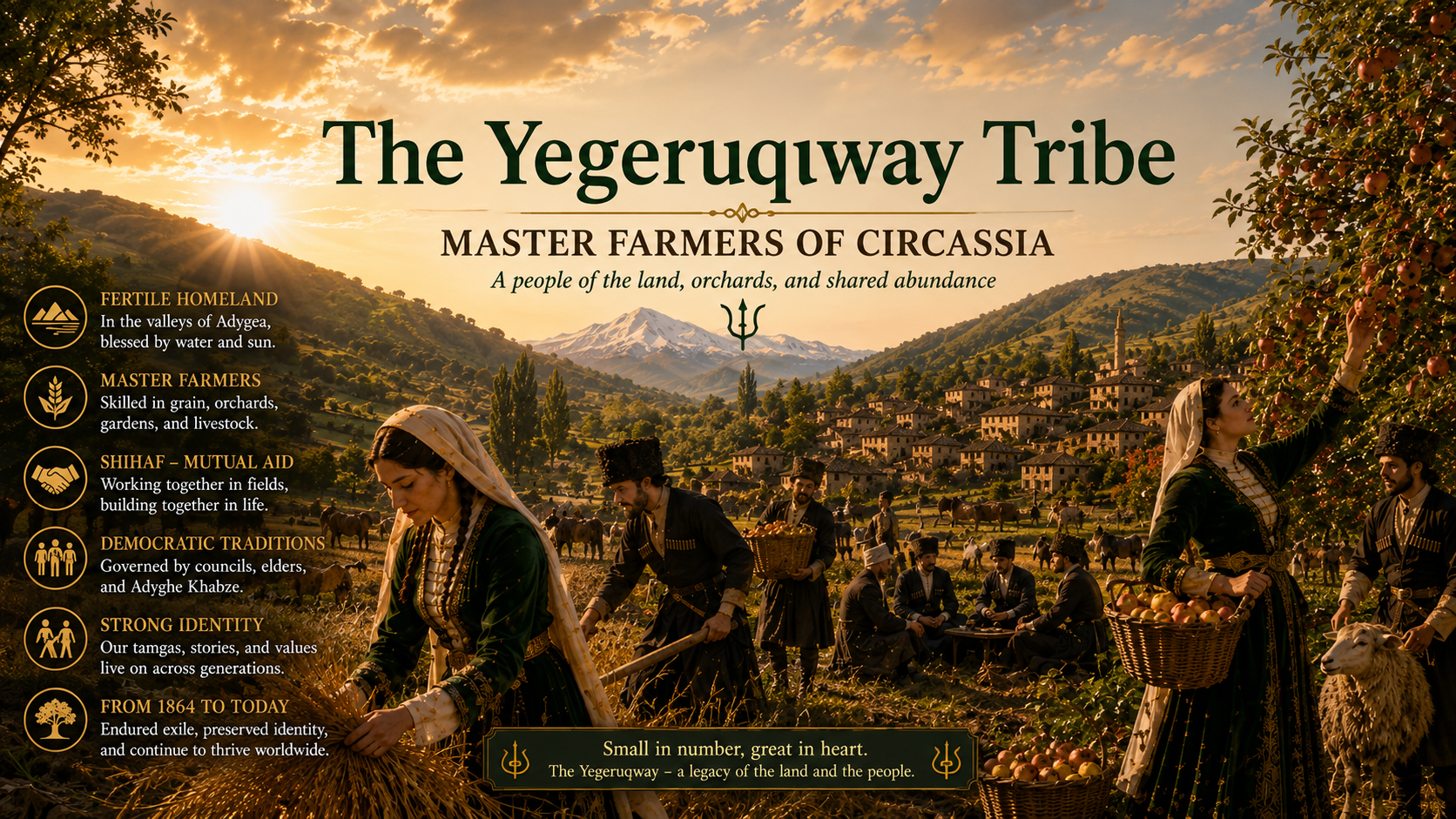
The Yegeruqway Tribe: Master Farmers of Circassia
The Yegerukwai are a sub-tribe of the Adyghe people, an indigenous Circassian people in the Caucasus region of Eastern Europe. The Adyghe people are divided into several sub-tribes, each with its own distinct language, culture, and traditions.
The Yegerukwai are one of these sub-tribes, and they are known for their rich cultural heritage and traditions.
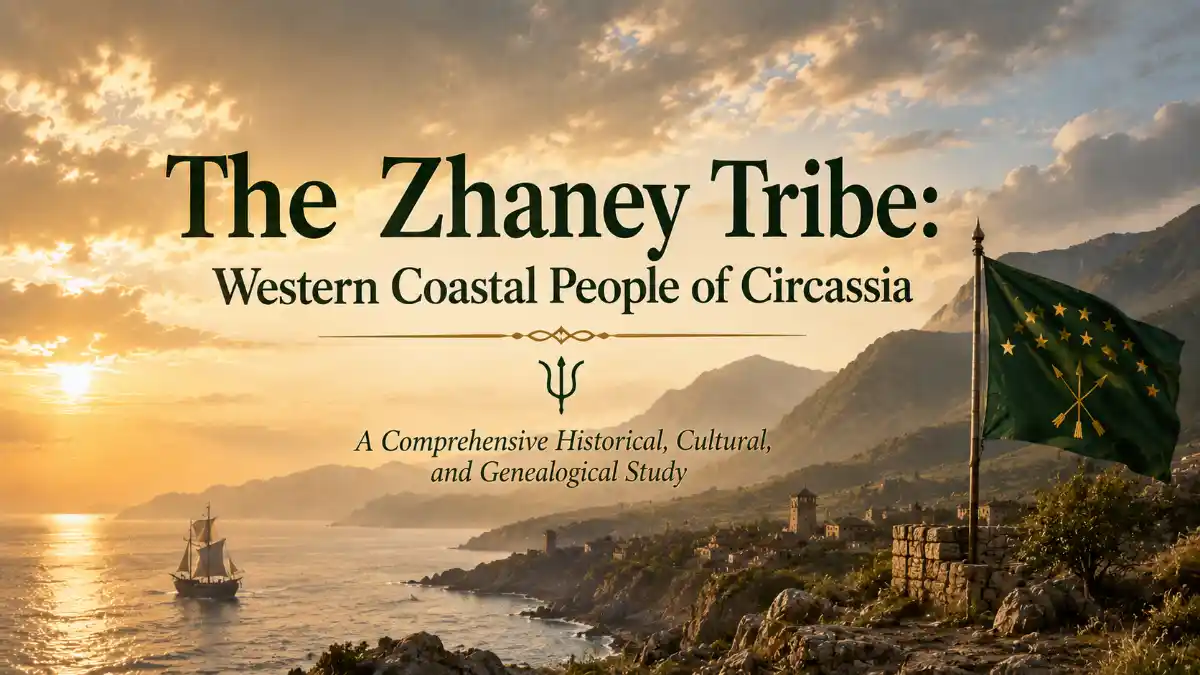
The Zhaney Tribe: Western Coastal People of Circassia
The Zhane tribe was a very powerful Circassian tribe in the past. They lived north of the Natukhai tribe's land on the coast of the Black Sea and the Sea of Azov in Eastern Europe.
A 17th-century map also shows that they lived next to the coast of the lower Kuban, behind Taman and Achue. As a result of the bloody Russo-Circassian War, the Zhane tribe was almost completely destroyed, with only 3 families surviving. The Zhane people are mainly found in the republics of Kabardino-Balkaria and Karachay-Cherkessia in Russia, where they form a significant part of the population.
The Circassian Tribes Most Affected by the Russian-Circassian War, Genocide, and Deportation
Important Note Before the Ranking
This ranking never means that one tribe was “better” than another, or that one tribe fought more than another, or that one tribe was braver than another. All Circassian tribes suffered, and all of them paid a heavy price in land, people, language, and memory.
The purpose here is to measure the historical, demographic, and cultural level of damage that affected each tribe according to its own circumstances: its size before the war, its geographic location, its closeness to the coast or the final front, the scale of deportation it experienced, how many remained in the homeland, and how far its tribal identity continued after 1864.
In other words, this is not a ranking of courage or resistance. It is a ranking of the scale of catastrophe that struck each tribe.
Criteria Used in the Ranking
To rank the Circassian tribes most affected by the war, several factors must be considered together, not only one.
1. Near Tribal Extinction
Some tribes did not only lose large numbers of people; they nearly disappeared as independent tribal identities, such as the Zhaney and the Ubykh.
2. Loss of Historical Homeland
The western and coastal tribes lost their territories almost completely after the end of the war, especially along the Black Sea coast.
3. Scale of Deportation to the Ottoman Empire
The wider the deportation, the greater the damage, because the tribe lost its land, villages, graves, and old social bonds.
4. Survival of Language or Dialect
Some tribes gradually lost their dialect or language in exile. The clearest example is the Ubykh, whose language later became extinct.
5. Continuity of Tribal Identity
Some tribes remained clearly known in the homeland and diaspora, while others were absorbed into larger tribes or into the wider Circassian identity.
General Ranking of the Circassian Tribes Most Affected
1. Zhaney / Jane
Why Does the Zhaney Tribe Come First?
The Zhaney, also called Jane, are among the Circassian tribes most severely affected by the Russian-Circassian War, genocide, and deportation. The reason is not only the number of victims, but the fact that the tribe nearly lost its independent tribal existence altogether.
The Zhaney were smaller than major tribes such as the Shapsug, Abzakh, or Kabardian. For that reason, the impact of the war on them was proportionally harsher. When a small tribe faces killing, deportation, and loss of land, it does not only lose individuals; it loses the ability to continue as a distinct community.
Reasons for the Damage Suffered by the Zhaney
Their lands were located in a strategic area near the Black Sea and Azov coasts, placing them directly in the path of Russian expansion.
Their villages, settlements, and fortifications were destroyed or emptied.
They lost a very large portion of their population during the war and deportation.
Those who survived were scattered across Adygea, Turkey, the Levant, and other regions.
Only a few known family lines remained, often mentioned as the Zhane, Zhanov, and Zhenetl’ families.
Many surviving Zhaney were absorbed into other Circassian tribes or into the broader Adyghe identity.
The Nature of the Zhaney Catastrophe
The catastrophe of the Zhaney was not only military or demographic. It was also a catastrophe of tribal memory itself. The tribe no longer remained a clear political and social force as it had been before the war. Preserving its name, genealogies, and history became a difficult task dependent on surviving families, oral memory, and modern research.
For this reason, the Zhaney can be considered one of the Circassian tribes that came closest to tribal extinction after the war.
2. Ubykh
Why Does the Ubykh Tribe Come Second?
The Ubykh are one of the most famous Circassian tribes in terms of cultural and linguistic catastrophe. They lived in the Sochi region and its surroundings, an area that became a symbol of the end of the Russian-Circassian War in 1864.
After the war, most Ubykhs were deported to the Ottoman Empire, and they no longer had a clear presence in their historical homeland. Over time, they lost their language, until Ubykh became extinct as a living language in the twentieth century.
Reasons for the Damage Suffered by the Ubykh
Their homeland was located in the area of the final phase of the war.
They experienced near-total deportation.
They lost their historical land in the Sochi region.
They merged in the diaspora with other Circassian tribes.
They later lost their original language.
Their independent tribal identity declined, although Ubykh memory survived in some families.
The Nature of the Ubykh Catastrophe
The Ubykh catastrophe was extremely deep because it included land, people, and language. Their story became a global symbol of language death after the passing of the last native speaker of Ubykh. However, the Zhaney may be considered more severely affected in terms of “relative tribal disappearance,” while the Ubykh are more famous in terms of “linguistic extinction.”
3. Natukhai
Why Were the Natukhai Severely Affected?
The Natukhai were one of the major coastal tribes of western Circassia, with lands around Anapa, Novorossiysk, and the Black Sea coast. This location placed them at the center of Russian operations, because control of the coast was a major military and political goal for Russia.
Reasons for the Damage Suffered by the Natukhai
They lost strategic coastal lands.
They were exposed to repeated military campaigns.
Their commercial and maritime centers collapsed.
Large numbers were deported to the Ottoman Empire.
Parts of their tribal identity were absorbed into the general Circassian diaspora.
Their presence in the homeland became weak compared to what it had been before the war.
The Nature of the Natukhai Catastrophe
The Natukhai did not disappear completely, but they experienced a broad uprooting from their land and lost much of their old presence on the coast. For this reason, they rank among the most affected tribes after the Zhaney and Ubykh.
4. Shapsug
Why Does the Shapsug Tribe Rank High?
The Shapsug were one of the largest western Circassian tribes and one of the most visible in the resistance. They suffered heavily because of their coastal and mountain location, and because their resistance continued into the final phases of the war.
Reasons for the Damage Suffered by the Shapsug
Their coastal and mountain regions came under intense military pressure.
Large numbers were deported to the Ottoman Empire.
Their presence in the homeland was greatly reduced.
Many villages and areas connected to them were destroyed.
Wide Shapsug family networks were scattered across Turkey and the Levant.
The Nature of the Shapsug Catastrophe
Despite enormous losses, Shapsug identity remained stronger than the identity of tribes that nearly disappeared completely. The Shapsug are still clearly known in both the homeland and the diaspora, which is why they do not come before the Zhaney, Ubykh, or Natukhai in this ranking.
5. Abzakh / Abadzekh
Why Were the Abzakh Severely Affected?
The Abzakh were one of the large and important mountain tribes, and they took part in a long resistance against Russian expansion. Because of the nature of their mountain lands and their strong social system, they were among the pillars of resistance, and therefore faced punishment, campaigns, and wide deportation.
Reasons for the Damage Suffered by the Abzakh
Long and intense resistance.
Destruction of many mountain villages.
Wide deportation to Anatolia and the Levant.
Loss of a large part of their traditional social structure.
Decline of their presence in the homeland compared with the pre-war period.
The Nature of the Abzakh Catastrophe
The Abzakh lost a great deal, but they remained a strong and clear identity in the diaspora, and their tribal name remained widely known. Their damage was therefore immense, but less than tribes that came close to complete disappearance, such as the Zhaney and Ubykh.
6. Hatuqwai
Why Were the Hatuqwai Affected?
The Hatuqwai were a relatively small tribe known for military and horse-riding traditions. Their small population made them more vulnerable to losing tribal continuity after the war.
Reasons for the Damage Suffered by the Hatuqwai
Small population size.
Location near zones of conflict and Russian expansion.
Deportation of many families.
Absorption of part of the tribe into other tribes.
Decline of their independent tribal visibility after the war.
The Nature of the Hatuqwai Catastrophe
Their catastrophe was not as widely known as that of the Ubykh or Shapsug, but it was large in proportional terms. When a small tribe is deported and scattered, it quickly loses the ability to preserve its name, dialect, and social ties.
7. Yegeruqway
Why Were the Yegeruqway Affected?
The Yegeruqway were an agricultural tribe connected to land, villages, and orchards. For that reason, the war was destructive not only militarily, but also economically and socially, because destroying the land meant destroying the foundation of life itself.
Reasons for the Damage Suffered by the Yegeruqway
Destruction of villages and farms.
Loss of important agricultural lands.
Scattering of families.
Deportation and absorption into larger communities.
Decline of independent tribal visibility in modern memory.
The Nature of the Yegeruqway Catastrophe
The damage suffered by the Yegeruqway was tied to the loss of village and agricultural life. They may not have been as prominent in the major military picture as the Shapsug or Abzakh, but their loss was deep because they lost the environment that preserved their identity.
8. Mamkhegh
Why Were the Mamkhegh Affected?
The Mamkhegh were a relatively small tribe in areas near Maykop, the Belaya, and the Kurdzhips. They were affected by war, deportation, and changes in Russian control, but clearer traces of them remained inside Adygea compared with coastal tribes that almost disappeared from the homeland.
Reasons for the Damage Suffered by the Mamkhegh
Small population size.
Destruction of villages and inland areas.
Migration of some families to the Ottoman Empire.
Absorption of some members into other Adyghe tribes.
Decline of their independent tribal role.
The Nature of the Mamkhegh Catastrophe
The Mamkhegh were severely affected, but they preserved some continuity in the homeland more than tribes such as the Zhaney, Ubykh, and Natukhai.
9. Temirgoy
Why Were the Temirgoy Affected?
The Temirgoy were among the strongest Circassian tribes politically and militarily. They faced heavy pressure during the war, but their demographic and political strength helped them preserve clearer continuity after the war.
Reasons for the Damage Suffered by the Temirgoy
Loss of old political influence.
Military pressure on their regions.
Migration of some families.
Decline of the old aristocratic and class system.
Absorption of some members into later Russian administrative structures.
The Nature of the Temirgoy Catastrophe
Their damage was serious, but they did not come close to tribal extinction like the Zhaney, nor did they lose their language or presence in the way the Ubykh did. For that reason, they rank lower than the smaller and coastal tribes that were more completely uprooted.
10. Bzhedug
Why Do the Bzhedug Rank Lower Relatively?
The Bzhedug suffered from the war like the other tribes, but they preserved a relatively strong presence inside Adygea. The existence of clear Bzhedug villages and the continuity of their identity made the damage less severe compared with tribes that lost most of their presence in the homeland.
Reasons for the Damage Suffered by the Bzhedug
Military campaigns and Russian pressure.
Migration of some families to the Ottoman Empire.
Loss of part of their old influence.
Demographic changes around them.
Decline of some traditional social practices.
The Nature of the Bzhedug Catastrophe
The Bzhedug suffered, but they did not lose tribal continuity to the same degree as the western coastal tribes. Therefore, they are placed lower relatively in terms of final damage.
11. Besleney
Why Were the Besleney Affected Less Severely Relatively?
The Besleney were affected by war, Russian pressure, and migration, but their inland location and their historical and linguistic closeness to the Kabardians helped their identity survive more clearly.
Reasons for the Damage Suffered by the Besleney
Loss of part of the population.
Migration of some families.
Russian administrative pressure.
Decline of old political independence.
Impact of the broader transformations that affected the North Caucasus.
The Nature of the Besleney Catastrophe
The Besleney did not experience the complete emptying of their land in the way the western coastal tribes did, and their identity did not come close to extinction like the Zhaney or Ubykh. For this reason, they rank eleventh.
12. Kabardian
Why Do the Kabardians Rank Last Relatively?
This does not mean that the Kabardians did not suffer. On the contrary, they experienced wars, Russian pressure, epidemics, and major losses in earlier phases. But compared with the western and coastal tribes, they preserved the greatest demographic, geographic, and political continuity.
Reasons for the Damage Suffered by the Kabardians
Early wars with Russia.
Long military and administrative pressure.
Loss of old political independence.
Epidemics and demographic collapses in some periods.
Migration of some families.
The Nature of the Kabardian Catastrophe
Despite the great damage, the Kabardians remained the largest Circassian group in terms of demographic, linguistic, and political continuity. Their land, identity, and institutions remained clearer than those of most other tribes. Therefore, they are the least affected relatively within this ranking, not because they did not suffer or did not resist.
Final Conclusion
This Ranking Does Not Measure Courage
It is very important to emphasize again: this ranking does not mean that one tribe was braver or less brave, and it does not mean that one tribe resisted more or less. All Circassian tribes experienced war, pressure, killing, deportation, and loss of land.
The difference here lies in the outcome of the catastrophe for each tribe.
The Tribes That Came Closest to Disappearance
The tribes most affected in terms of near tribal extinction or loss of continuity were:
Zhaney, Ubykh, Natukhai, Shapsug, and Abzakh.
These tribes were especially affected because they were located in the west, on the coast, and in the regions that witnessed the final and harshest phase of the Russian-Circassian War.
The Tribes That Preserved Greater Continuity
Tribes such as the Bzhedug, Besleney, and Kabardian were also affected, but they preserved a clearer degree of demographic, geographic, and linguistic continuity inside the homeland.
Final Article-Ready Summary
The ranking of Circassian tribes according to the scale of damage should not be understood as a judgment on the courage of the tribes or their role in resistance. All Circassian tribes suffered during the Russian-Circassian War, and all of them lost people, lands, villages, and memory. But the scale of the catastrophe was not equal. Some tribes, such as the Zhaney, Ubykh, and Natukhai, came closer to tribal extinction because of their smaller population, coastal location, or near-total deportation from their lands. Other tribes, such as the Kabardians, Bzhedug, and Besleney, preserved clearer demographic and geographic continuity, despite also experiencing war, pressure, and loss of sovereignty. Therefore, this ranking reflects the degree of historical, demographic, and cultural damage — not the value, courage, or status of any tribe within the one Adyghe people.
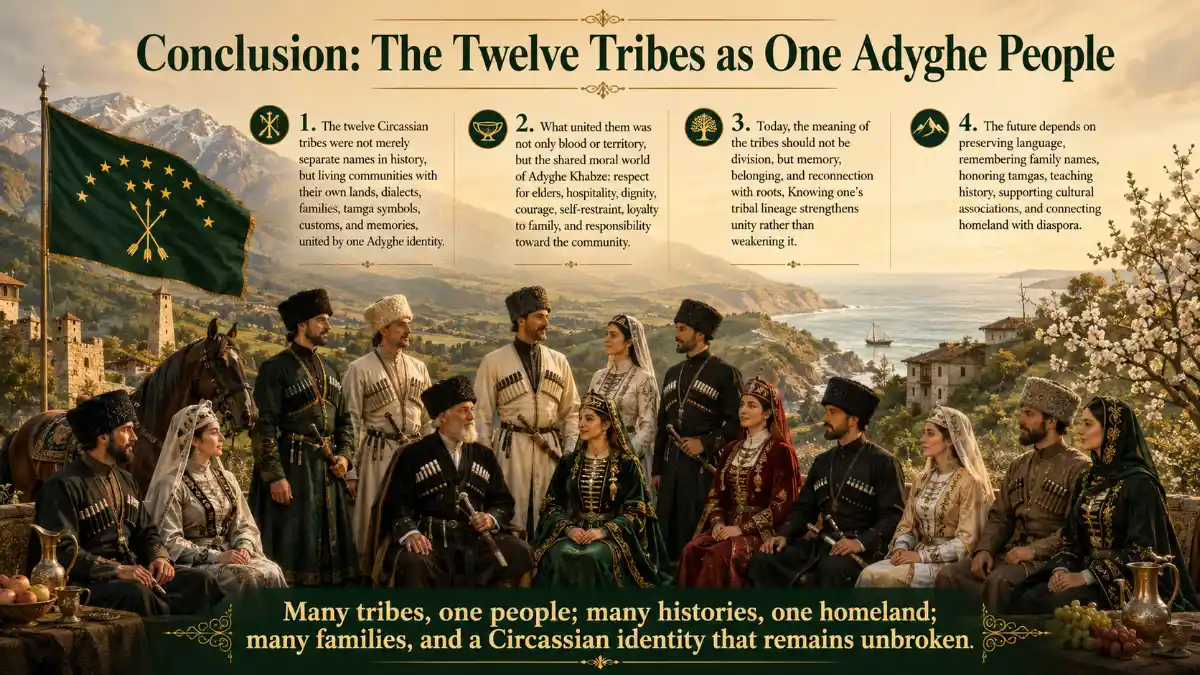
The Twelve Tribes as One Adyghe People
The twelve Circassian tribes were never simply separate names on a list. They were living communities, each with its own homeland, dialect, family lines, tamga symbols, customs, and historical memory. Some were known for mountain freedom, some for coastal life, some for agriculture, diplomacy, horsemanship, or resistance. Yet beneath these differences, they shared one deeper foundation: Adyghe identity.
What united them was not only blood or territory, but a common moral world shaped by Adyghe Khabze — respect for elders, hospitality, dignity, courage, restraint, loyalty to family, and responsibility toward the community. These values allowed different tribes to recognize one another as parts of the same people, even when geography, politics, and history separated them.
Today, the meaning of the Circassian tribes is not division. It is memory, belonging, and reconnection. To know whether one is Shapsug, Kabardian, Abzakh, Bzhedug, Natukhai, Temirgoy, Yegeruqway, Zhaney, or another Adyghe lineage is not to move away from unity — it is to return to the roots that make unity stronger.
The future of the Circassian people depends on rebuilding this shared social life: preserving language, remembering family names, honoring tamgas, teaching history, supporting cultural associations, connecting homeland and diaspora, and treating every tribe as one branch of the same Adyghe tree.
The twelve stars of the Circassian flag remind us of this truth: many tribes, one people; many histories, one homeland; many families, one enduring Circassian identity.
Sources & References
Jaimoukha, Amjad (2001). The Circassians: A Handbook. Abingdon: RoutledgeCurzon.
Richmond, Walter (2013). The Circassian Genocide. New Brunswick: Rutgers University Press.
Natho, Kadir (2009). Circassian History. New York: Xlibris Corporation.
Balanovsky, O. et al. (2011). "Parallel Evolution of Genes and Languages in the Caucasus Region." Molecular Biology and Evolution, 28(10), 2905–2920.
Henze, Paul B. (1992). "Circassian Resistance to Russia." The North Caucasus Barrier. New York: St. Martin's Press.
Kuipers, A. H. (1960). Phoneme and Morpheme in Kabardian. The Hague: Mouton.
Kaya, Ayhan (2005). "Circassian Diaspora in Turkey." New Perspectives on Turkey, 32, 113–133
Encyclopaedia Britannica — Circassian
Good for general historical description and the debated origin of the name Circassian.Encyclopaedia Iranica — Čarkas / Cherkes
Very useful for explaining that Cherkes / Čarkas was used in Persian, Arabic, and Turkic for the Adyghe people.Adyghe Khabze resources
Useful for explaining the shared moral and social system that united the tribes.Circassian flag history and symbolism
Useful for the twelve tribes / twelve stars symbolism and unity.Inal the Great / Circassian political tradition
Useful for the medieval unity tradition and the later formation of princely tribal lines.