Circassian Language: Complete Guide to Adyghe Alphabet
Linguists call it one of the most phonetically complex languages on Earth. UNESCO calls it "definitely endangered." For the millions of Circassians in the diaspora, Adyghabze is something more personal — it's the sound of home slipping away with each generation.
Of all the challenges facing the Circassian diaspora, none is more urgent than language loss. Adyghabze (Адыгабзэ) — the Circassian language — is classified as "definitely endangered" by UNESCO. In the diaspora, each generation speaks less than the one before. In Turkey, most young Circassians understand fragments but cannot hold a conversation. In Jordan and Israel, the situation is similar. Even in the Caucasus homeland, Russian increasingly dominates daily life.
Our Language Learning tools are designed to fight this decline — making it easier, more accessible, and more engaging for Circassians everywhere to learn, practice, and preserve their mother tongue.

A Circassian language gathering — where community becomes classroom
Why Learning Adyghabze Is Critical
Language is not just a communication tool. For Circassians, language is identity. The Adyghe Xabze — the traditional moral and social code — is encoded in the language itself. Concepts like "Адыгагъэ" (Circassian-ness) cannot be fully expressed in any other language. Proverbs, folk songs, and the Nart sagas carry layers of meaning that are lost in translation.
When a language dies, an entire worldview dies with it. Every Circassian word you learn is an act of cultural resistance. Linguists estimate that Adyghabze has fewer than 600,000 speakers worldwide — a number that has declined sharply over the past century due to forced displacement, assimilation pressures, and the dominance of state languages in countries where Circassians live.
The loss began with the Circassian Genocide of 1864, when the Russian Empire expelled over 90% of the Circassian people from their ancestral Caucasus homeland. Scattered across the Ottoman Empire and beyond, communities struggled to maintain their tongue against the tide of Turkish, Arabic, and Hebrew. Today, that struggle continues in living rooms, classrooms, and community centers from Amman to Berlin to New York.

Young Circassians rediscovering their mother tongue in a structured class setting
The Circassian Alphabet: Gateway to the Language
The modern Circassian writing system uses a Cyrillic-based alphabet developed in the 20th century. It contains letters not found in Russian, representing the unique phonemes of Adyghabze — including the famous ejective consonants that give the language its distinctive rhythmic quality. For diaspora Circassians raised on Arabic or Latin scripts, learning the Cyrillic-based Adyghe alphabet is the essential first step.
Many linguists describe Adyghabze as one of the world's most phonologically complex languages, with over 80 distinct phonemes. This richness is part of what makes the language so culturally expressive — and also part of what makes it challenging to learn without dedicated resources.
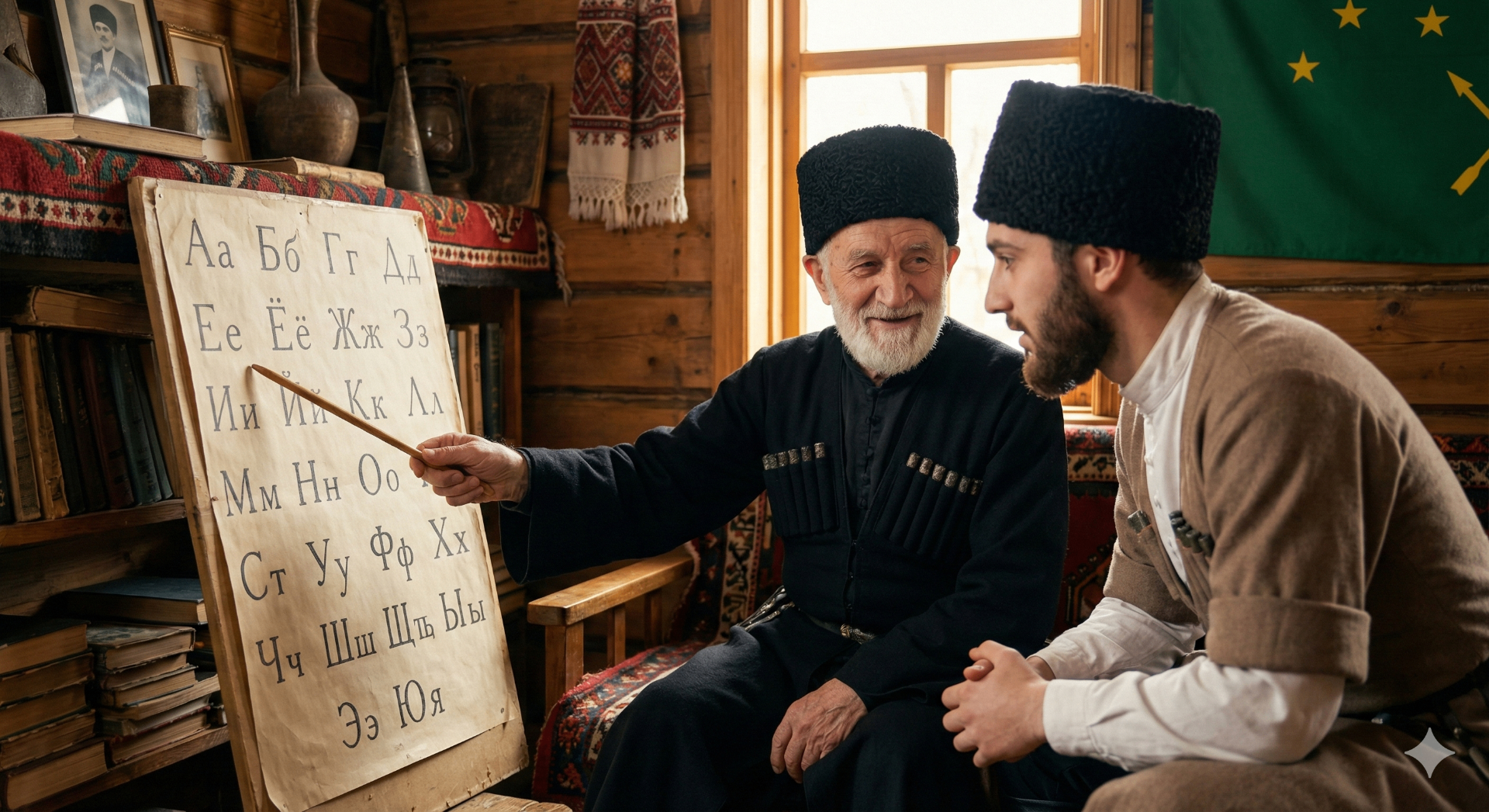
Intergenerational transmission — an elder teaches the Adyghe alphabet using traditional methods
🗣️ Why Adyghabze Matters
Circassian has up to 60+ consonant phonemes — among the highest in any language
Two main dialects: Kabardian (Eastern) and Adyghe (Western)
UNESCO classifies both dialects as endangered
Modern revival combines digital tools, community schools, and immersion
Comprehensive Dictionary
Our multilingual dictionary contains thousands of entries, each available in Circassian (Adyghe script), English, Arabic, Turkish, Russian, and Hebrew. Every entry includes:
Pronunciation guide using both Cyrillic and Latin transliteration
Example sentences with full translations in multiple languages
Audio pronunciation recordings by native speakers (for many entries)
Category classification (greetings, family, nature, food, ceremonies, etc.)
Dialect notes distinguishing Kabardian and Western Adyghe variants
Interactive Alphabet Learning
The Circassian alphabet can seem intimidating — especially for diaspora members who grew up using Latin, Arabic, or Hebrew scripts. Our interactive alphabet guide breaks down each of the 66 letters with pronunciation audio, example words, and visual guides. Practice at your own pace until the script feels natural. Each letter is introduced with memory aids specifically designed for heritage learners.
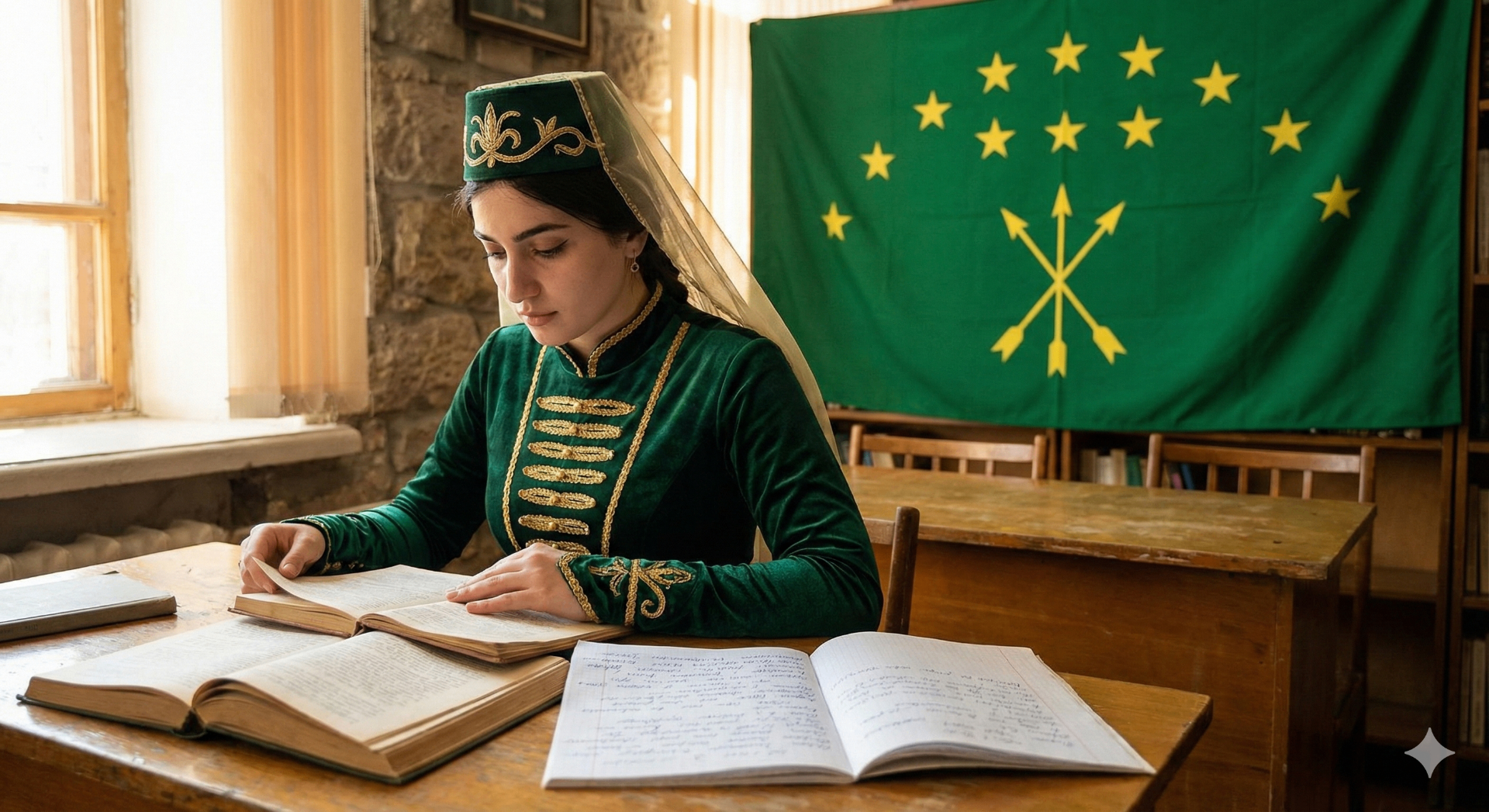
Studying ancient manuscripts — connecting written heritage to spoken language
Phrase Categories
Learn practical phrases organized by real-life situations:
Greetings and introductions — the foundation of Adyghe Xabze etiquette, including formal and informal registers
Family vocabulary — the rich, specific kinship terminology that distinguishes Circassian from most other languages
Cultural expressions — phrases used in ceremonies, celebrations, weddings, and traditional events
Daily conversation — practical vocabulary for everyday communication at home and in the community
Numbers and counting — the Circassian vigesimal (base-20) number system
Nature and geography — vocabulary rooted in the Caucasus landscape and its ecological heritage
Mastering Pronunciation: The Heart of Adyghabze
Circassian pronunciation is one of the most distinctive features of the language. The ejective consonants — sounds produced with a glottalic airstream — are found in very few languages outside the Caucasus region. Learning to produce them correctly takes practice, but with the right guidance it is entirely achievable for adult heritage learners.
Our pronunciation module uses audio recordings from native speakers across multiple dialects. You can slow down recordings, compare your pronunciation using your device's microphone, and practice minimal pairs — pairs of words that differ by just one sound — to train your ear to the subtleties of Adyghabze phonology.

Pronunciation practice — mastering the unique sounds of Adyghabze through repetition and feedback
Writing Adyghabze: Preserving the Script
Reading and writing Adyghabze is inseparable from speaking it. The written form preserves historical texts, poetry, and formal literature that cannot be fully appreciated in translation. Our writing module guides learners from basic letter formation through complete sentence construction, with exercises graded by difficulty.
For advanced learners, we offer access to digitized historical Circassian texts — including 19th-century travel accounts, folk poetry collections, and early Soviet-era language primers — providing windows into the language as it was written across different historical periods.
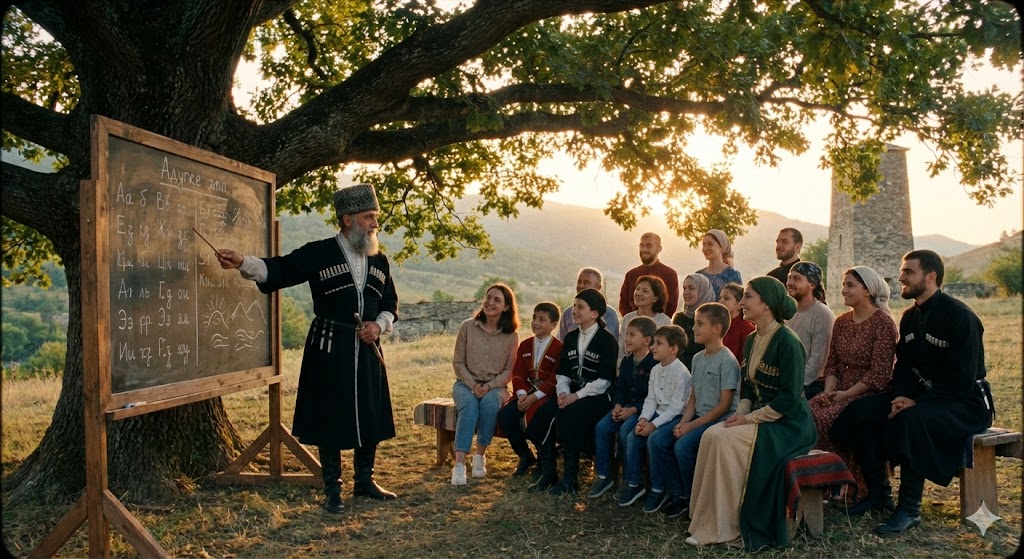
Writing Adyghabze — connecting modern learners to centuries of written heritage
Digital Tools for the Modern Learner
Language learning in the 21st century demands digital tools that meet learners where they are. Our platform is fully mobile-optimized, allowing you to practice during your commute, review vocabulary before bed, or listen to native speaker audio while cooking. We integrate with your daily life rather than demanding dedicated study sessions.
Features include:
Spaced repetition flashcards — proven memory technique that maximizes retention with minimal study time
Daily vocabulary challenges — a new word or phrase every day, delivered as a notification
Progress tracking — see your vocabulary grow week by week and set personal milestones
Community forums — ask questions, share recordings, and get feedback from fluent speakers
Offline mode — access your saved lessons and vocabulary lists without an internet connection

Modern tools for an ancient language — digital learning meets Circassian heritage
The Adyghe language has been added to Yandex Translate.
Click Here to visit and to use
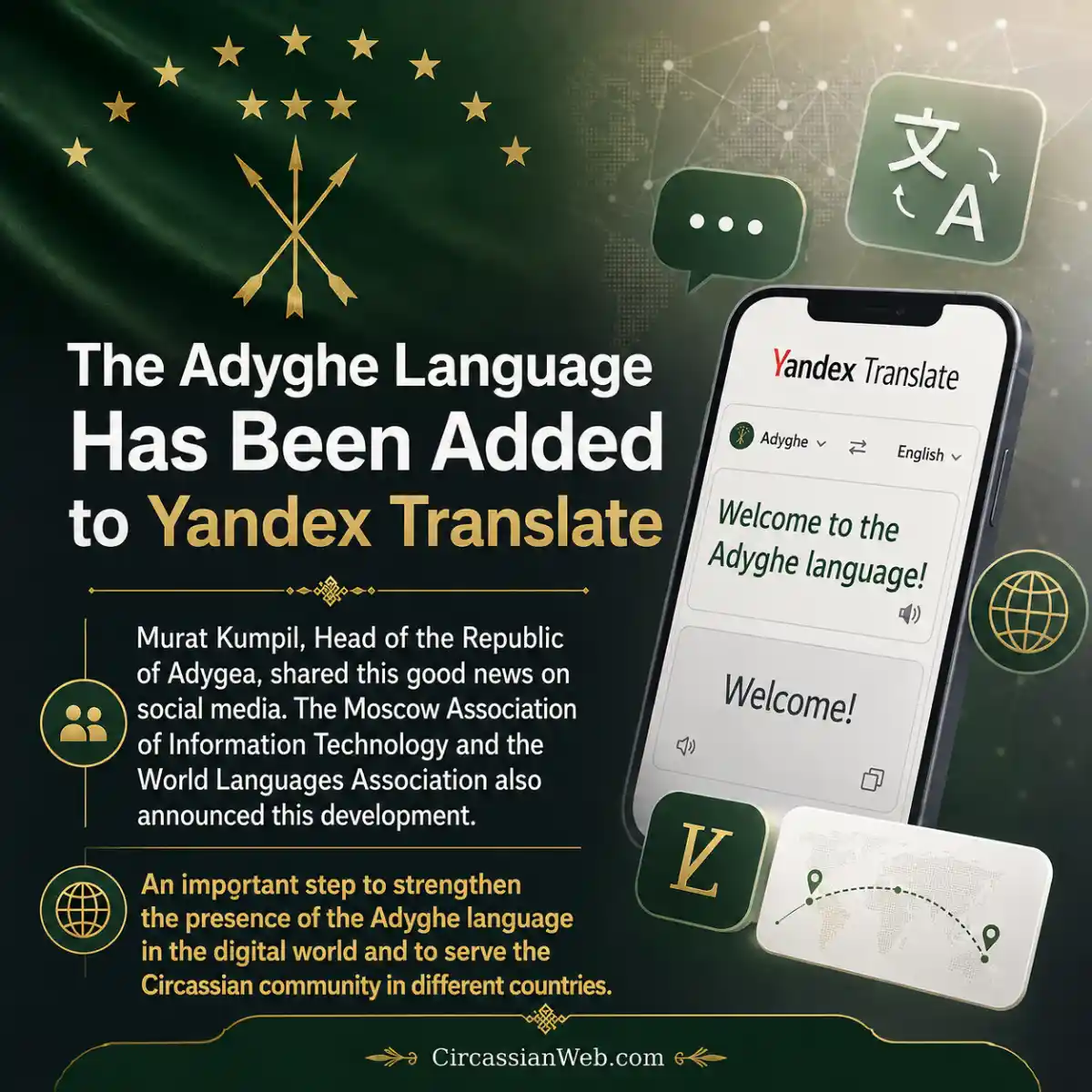
This is wonderful and meaningful news for the Circassian community around the world.
Murat Kumpil, Head of the Republic of Adygea, shared this positive development on social media. The news was also announced by the Moscow Association of Information Technology and the World Languages Association.
This is more than just a technical update. It is an important step for the visibility of the Adyghe language in the digital world, and a valuable service for Circassians living in different countries.
The Adyghe language is not only a way to communicate.
It is memory.
It is identity.
It is the voice of our ancestors.
It is one of the most precious parts of Circassian heritage.
The Bigger Picture: Language Revitalization as a Community Project
Language revitalization requires effort from the entire community. Parents need to speak Circassian at home. Communities need to organize language classes. Schools need Adyghabze curricula. And technology needs to make the language accessible to anyone, anywhere in the world, at any time.
Our platform is our contribution to that effort. But technology alone cannot save a language. What saves a language is community will — parents choosing to speak Adyghabze to their children, young people making the effort to learn, community leaders investing in language programs, and cultural organizations supporting language transmission.
We have seen remarkable success stories. Circassians in Israel have maintained spoken language across five generations in diaspora. In some villages in Jordan, grandparents and grandchildren still converse freely in Adyghabze. These communities demonstrate that diaspora language survival is possible — with the right cultural commitment and the right tools.
Every word you learn, every phrase you practice, every conversation you have in Adyghabze pushes back against language death. Every parent who speaks to their child in the mother tongue adds one more voice to the chain of transmission that stretches back thousands of years.
Build your family tree and discover your ancestral roots
Explore Tamga symbols — the ancient family crests of the 12 Adyghe tribes
Upload your DNA results to connect with genetic heritage
Discover the interactive map of original Circassian settlements
Contribute to research on Circassian genealogy and DNA heritage
Join the community chat and practice speaking with fellow Circassians
Test your knowledge in our weekly heritage quiz
Your ancestors fought to survive. Honor them by keeping their language alive. Сыд хуэдэу щымытми, Адыгэбзэр хъума хъун хуейщ — no matter what, the Circassian language must be preserved.
Frequently Asked Questions
Is Circassian one language or two?
There are two main varieties: Western Circassian (Adyghe) and Eastern Circassian (Kabardian). They are closely related but have significant phonological and lexical differences — mutual intelligibility is partial.
Is Circassian related to any other language?
Circassian belongs to the Northwest Caucasian family, related only to Abkhaz, Abaza, and the extinct Ubykh. This family has no proven relationship to any other language family in the world.
How difficult is Circassian to learn?
It is considered one of the most challenging languages for speakers of European languages, due to its complex consonant system (60+ phonemes), polysynthetic verb morphology, and ergative grammar. However, structured resources are improving access.
Sources & References
Balanovsky, O. P. (2011). The Indigenous Peoples of the Caucasus: Genetic Portraiture. Moscow: Nauchka Publishing House.
Colarusso, J. (2007). Nart Sagas from the Northwest Caucasus: Volume 1, Circassian Tales. Princeton, NJ: Princeton University Press.
Henze, P. (1992). Circassians: The Fight for Identity. London: The Royal Institute of International Affairs.
Jaimoukha, A. (2001). The Circassians: A Handbook. New York, NY: Palgrave Macmillan.
Kaya, A. (2005). Circassian Identity and Culture in the Diaspora: A Case Study of Turkey. In M. E. K. Kâşgârî & A. Kaya (Eds.), Circassian Culture and Identity in the Ottoman Empire and Modern Turkey (pp. 1-20). Ankara: Bilim ve Gelecek Kitapları.
Natho, A. (2009). Circassian History: A Comprehensive Overview. Xlibris Corporation.
Paris, M. (1974). Documents pour servir à l'histoire des langues tchérkesses: Essai de bibliographie et état des recherches. Paris: Centre d'études linguistiques slaves.
Richmond, S. R. (2013). The Circassians of Jordan: Negotiating Identity in a Transnational World. In F. Al-Sayed (Ed.), The Crescent and the Star: Identity and Politics in the Middle East (pp. 151-170). London: I.B. Tauris.
Shami, S. (1998). The Circassians of Jordan: A Case Study of Minority Identity. Amman: Al-Bayt University Press.