Republic of Adygea: The Western Heartland of the Circassian
📖 In This Guide
- Republic at a Glance — Key facts, demographics & statistics
- Maykop: The Capital City — Landmarks, museums & cultural centers
- Historical Significance — From Bronze Age to modern era
- Geography & Natural Wonders — Lago-Naki, gorges & UNESCO sites
- Adyghe Culture, Language & Cuisine — Crafts, music, food & oral traditions
- Famous Personalities — Writers, athletes & cultural icons
- Villages, Governance & Modern Life — Communities, politics & economy
- The Roots of Our Families — Tribal origins & genealogy
- Travel Guide & Resources — Getting there, what to see & references
Where Circassian Identity Lives On
Nestled on the northern slopes of the Caucasus Mountains, entirely enclaved within Krasnodar Krai, the Republic of Adygea (Адыгэ Республик in Adyghe) stands as one of the last remaining territorial footholds of the Circassian people on their ancestral land. Covering just 7,800 square kilometers, this small republic carries an outsized weight of cultural significance — it is the westernmost of the three Circassian republics in the Russian Federation and the only one where the indigenous people are specifically called Adyghe, the self-designation used by all Circassians.
Before 1864, the territory that is now Adygea was part of a much larger Circassia that stretched from the border of Abkhazia in the south to the Sea of Azov in the north. The Russo-Circassian War and the subsequent mass deportation of 1864 shattered this geography, scattering the majority of the Adyghe population across the Ottoman Empire. What remains is a republic where the Adyghe constitute roughly 25% of a population of approximately 501,000 people (2024 census), with Russians forming the majority at around 64%.
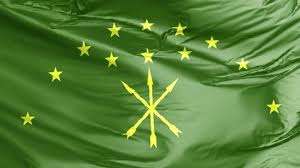
The flag of Adygea — twelve stars representing the twelve Circassian tribes, three arrows symbolizing unity
🎬 Video: Discover the Republic of Adygea
Republic at a Glance — Key Facts & Figures
Understanding Adygea by the numbers helps contextualize this compact but culturally rich republic:
- Area: 7,792 km² (3,009 sq mi) — the fifth-smallest federal subject in Russia, entirely surrounded by Krasnodar Krai
- Population: ~500,731 (2025 estimate) — approximately 25.7% Adyghe, 64.4% Russian, 3.3% Armenian
- Capital: Maykop — home to one-third of the republic's population
- Official Languages: Adyghe (West Circassian) and Russian
- Head of Republic: Murat Kumpilov (since 2017)
- Parliament: State Council (Khase) — preserving the traditional Circassian council name
- Highest Point: Chugush Mountain — 3,238 m (10,623 ft)
- Major Rivers: Kuban (870 km), Belaya, Laba, Psekups, Pshish
- Climate: Moderately warm, precipitation 540–860 mm per year
- Average Salary (2024): 53,451 rubles/month
- GRP (2023): 231.9 billion rubles — ranked #16 in Russia's National Investment Climate Ranking
- Key Industries: Agriculture (vegetables, fruits, honey), food processing, tourism, timber
- UNESCO Site: Caucasus Biosphere Reserve — Western Caucasus World Heritage Site
- Time Zone: UTC+3 (Moscow Time)
The republic's unique enclave status — entirely surrounded by Krasnodar Krai — makes it a distinct cultural island preserving Adyghe identity within the broader Russian Federation.
Maykop: The Capital City
The republican capital, Maykop (Мыекъуапэ in Adyghe, meaning "valley of apple trees"), was founded on May 17, 1857 as a Russian military fortress during the Caucasian War. Today it is home to approximately 144,000 residents and serves as the administrative, economic, and cultural center of the republic.
The city sits at an elevation of roughly 230 meters above sea level, at the confluence point of the Belaya River — one of the most beautiful waterways in the North Caucasus. The name Maykop itself tells the story of the land: before the fortress, this valley was blanketed with wild apple orchards, a detail that the Adyghe language preserved when Russian settlers chose their own name for the settlement.
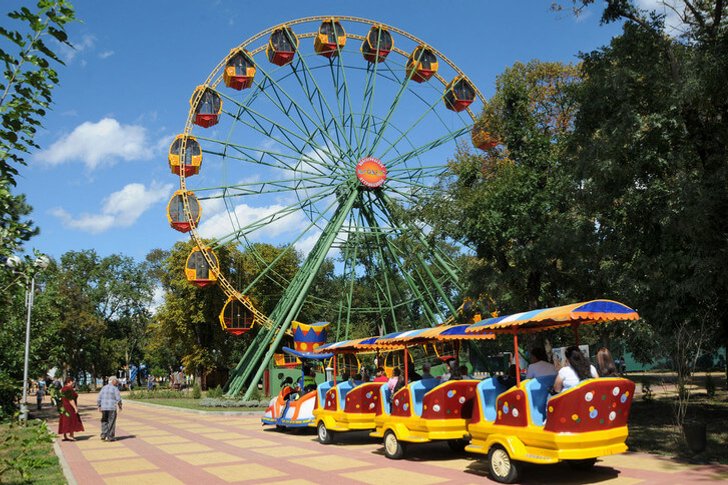
Maykop city center with the Grand Mosque — the largest mosque in Adygea — and the Caucasus foothills beyond
Key landmarks in Maykop include the Grand Mosque (Соборная мечеть), a striking white and blue structure with five domes that was built in 2000 with funding from an Arab prince; the Maykop State Philharmonic; the National Museum of the Republic of Adygea, which houses artifacts from the Maykop culture — a Bronze Age civilization dating to 3700–3000 BCE that was one of the earliest metalworking cultures in the world; and the Monument to Friendship between peoples.
The city also hosts the Adyghe National Drama Theatre, founded in 1936, which produces plays exclusively in the Adyghe language and is one of the oldest indigenous-language theaters in the Caucasus. Performances range from traditional Nart epic dramatizations to contemporary Adyghe playwrights exploring themes of identity, diaspora longing, and cultural survival. The theater has trained generations of Adyghe actors and directors who have become prominent cultural figures across the Circassian world.
Historical Significance
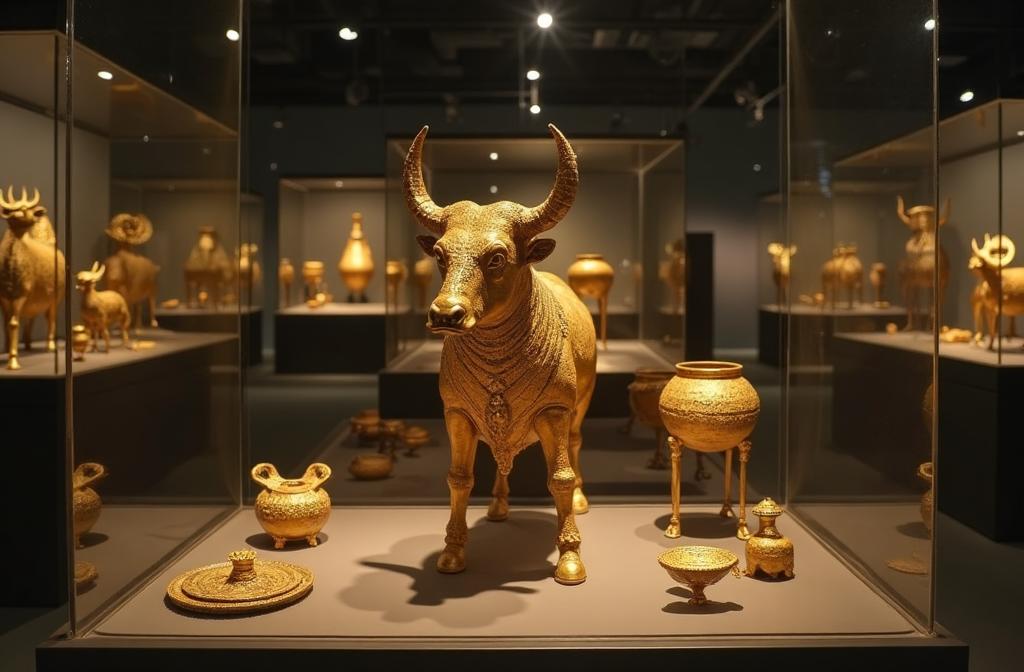
Gold artifacts from the Maykop Kurgan (3500 BCE) — one of the earliest metalworking civilizations in the world
Adygea's history stretches far beyond the modern republic. The Maykop Kurgan, discovered in 1897, remains one of the most significant Bronze Age archaeological finds ever made. The burial mound, dating to approximately 3500 BCE, contained gold, silver, and turquoise artifacts that demonstrated sophisticated metalworking techniques millennia ahead of surrounding cultures. These finds established the Maykop culture as one of the earliest complex societies in Europe.
The kurgan yielded over 500 gold objects, including two hollow gold bull figurines, a gold diadem, and silver vessels decorated with images of bears, bulls, and the Caucasus mountain range — the earliest known landscape depiction in world art. The artifacts revealed trade connections stretching to Mesopotamia and ancient Iran, proving that the Caucasus was a major crossroads of civilization over 5,000 years ago. Many of these treasures are now housed in the State Hermitage Museum in Saint Petersburg, though Adyghe cultural organizations have periodically advocated for their return to the republic.
During the medieval period, the Adyghe tribes of this region were known as fierce warriors and skilled horsemen who interacted with Greek colonies along the Black Sea coast, Byzantine missionaries, and Genoese trading posts. The region was gradually Islamized between the 15th and 18th centuries, primarily through Ottoman influence.
The Russo-Circassian War (1763–1864) devastated the region. The Adyghe population of what is now Adygea was reduced by an estimated 90% through death, deportation, and forced migration. The current Adyghe population represents the descendants of those who managed to remain on their ancestral land.
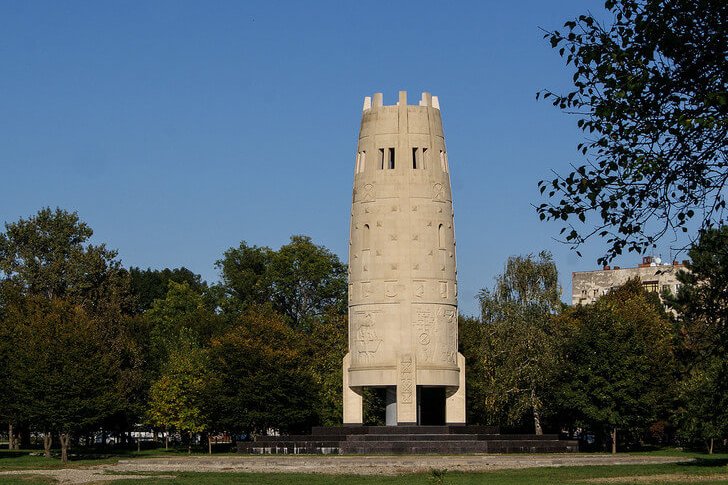
A restored traditional Adyghe dwelling in the Caucasus foothills — stone construction with carved wooden balconies
History & Natural Wonders
Adygea's landscape transitions dramatically from the flat Kuban Plain in the north to the rugged Caucasus Mountains in the south. The republic's southern territories include portions of the Caucasus Biosphere Reserve, a UNESCO World Heritage Site that protects some of the last virgin forests in Europe.
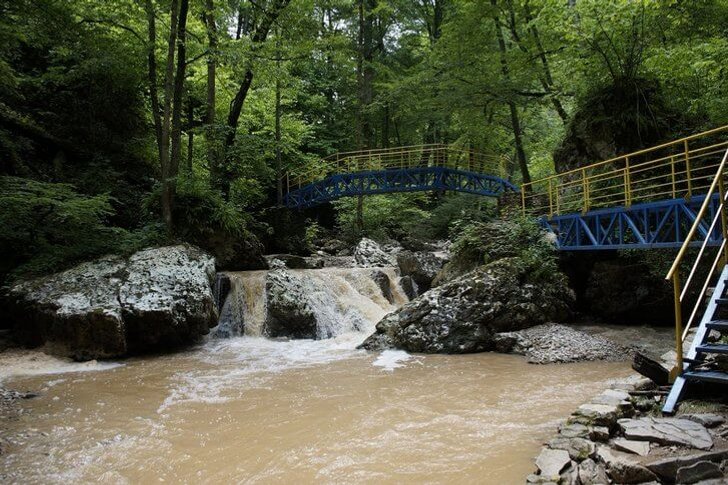
The Belaya River gorge — one of Adygea's most stunning natural formations
The Belaya River (Шъхьэгуашъэ in Adyghe) cuts through dramatic limestone gorges as it descends from the mountains, creating a landscape of waterfalls, caves, and steep forested valleys. The Khadzhokh Gorge near the settlement of Kamennomostsky is a particularly spectacular canyon where the river narrows to just 6-7 meters wide between towering 40-meter cliffs.
Other natural highlights include the Rufabgo Waterfalls, a chain of seven waterfalls hidden in a side canyon; Lago-Naki Plateau, a high-altitude karst plateau at 2,000+ meters known for alpine meadows and cave systems; and the Azish Cave, one of the most accessible show caves in the Caucasus region with impressive stalactite formations.
The Lago-Naki Plateau: A World Above the Clouds
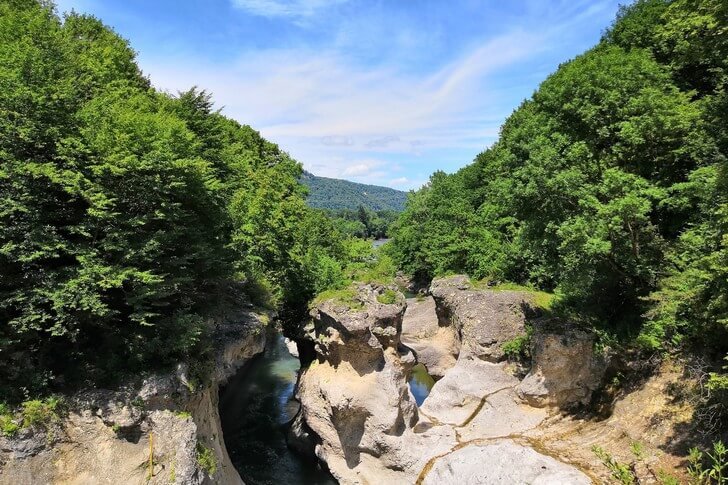
The Lago-Naki Plateau in summer — a carpet of alpine wildflowers at 2,000 meters above sea level
The Lago-Naki Plateau (Лэгъонакъэ in Adyghe) deserves special attention. This high-altitude karst formation at 2,000–2,200 meters above sea level is one of the most extraordinary landscapes in southern Russia. The plateau's name derives from a tragic Adyghe legend: Lago, a shepherd, and Naki, a princess, who fell in love across class boundaries and chose to leap from the cliffs together rather than be separated — a story that echoes the Romeo and Juliet narrative but predates it by centuries in Circassian oral tradition.
In summer, the plateau transforms into a vast carpet of alpine wildflowers — gentians, rhododendrons, and orchids creating a mosaic of color against the backdrop of snow-capped peaks. In winter, the area has been developed for cross-country skiing and snowshoeing. The plateau also contains the entrances to several of the deepest cave systems in Russia, including the Bolshaya Azishskaya Cave (over 640 meters of explored passages) and the Parashyutnaya Cave system. Plans to develop Lago-Naki as a major ski resort have been contested by environmental activists and Adyghe cultural organizations, who argue that construction would damage both the UNESCO-protected ecosystem and sites of Adyghe spiritual significance.
Adyghe Culture, Language & Cuisine
The Adyghe language (Адыгабзэ), also known as West Circassian, is one of two official languages of the republic alongside Russian. It belongs to the Northwest Caucasian language family and has one of the largest consonant inventories in the world — between 56 and 58 consonant phonemes depending on the dialect, but only three vowel sounds.
The Adyghe in Adygea primarily belong to the following tribal sub-groups: the Bzhedug, Temirgoy (Chemgui), Shapsug, Abadzekh, and Natukhai. Each historically occupied distinct territories within what is now the republic and surrounding Krasnodar Krai, and spoke distinct dialects — though today the literary Adyghe language is based primarily on the Temirgoy dialect.