Kabardino-Balkaria: The Heart of the Caucasus and the Kabardian Homeland
📖 In This Guide
- Republic at a Glance — Key facts, demographics & statistics
- Nalchik: The Garden City — Capital landmarks & hidden gems
- The Kabardian People — History, identity & social structure
- The Caucasian War — Conflict & its aftermath
- Famous Kabardian Figures — Writers, conductors & champions
- Natural Wonders & the Kabardian Horse — Elbrus, Blue Lakes, Chegem & the legendary breed
- Culture, Traditions & Village Life — Dance, cuisine, medicine & heritage communities
- Multi-Ethnic Relations & Diaspora — The Balkar question & global connections
- The Roots of Our Families — Tribal origins & genealogy
- Travel Guide & Resources — Valleys, attractions & references
Why Do People In The Caucasus Live So Long? — Kabardino-Balkaria (2024)
Europe's Roof, Circassia's Heartbeat
Kabardino-Balkaria (Къэбэрдей-Балъкъэр Республикэ in Kabardian) sits at the geographical center of the Greater Caucasus, a republic of staggering natural beauty and deep Circassian heritage. Within its 12,470 square kilometers rise some of the highest peaks in Europe, including the twin volcanic cones of Mount Elbrus at 5,642 meters — the undisputed highest point on the European continent.
But Kabardino-Balkaria is far more than a geographic superlative. It is the historical heartland of the Kabardians (Къэбэрдейхэр), the largest subgroup of the Circassian people, who have inhabited the foothills and lowlands of this region for millennia. With a total population of approximately 904,000 (2021 census), Kabardians constitute around 57% of the population — making this the only Circassian republic where Circassians form a majority.
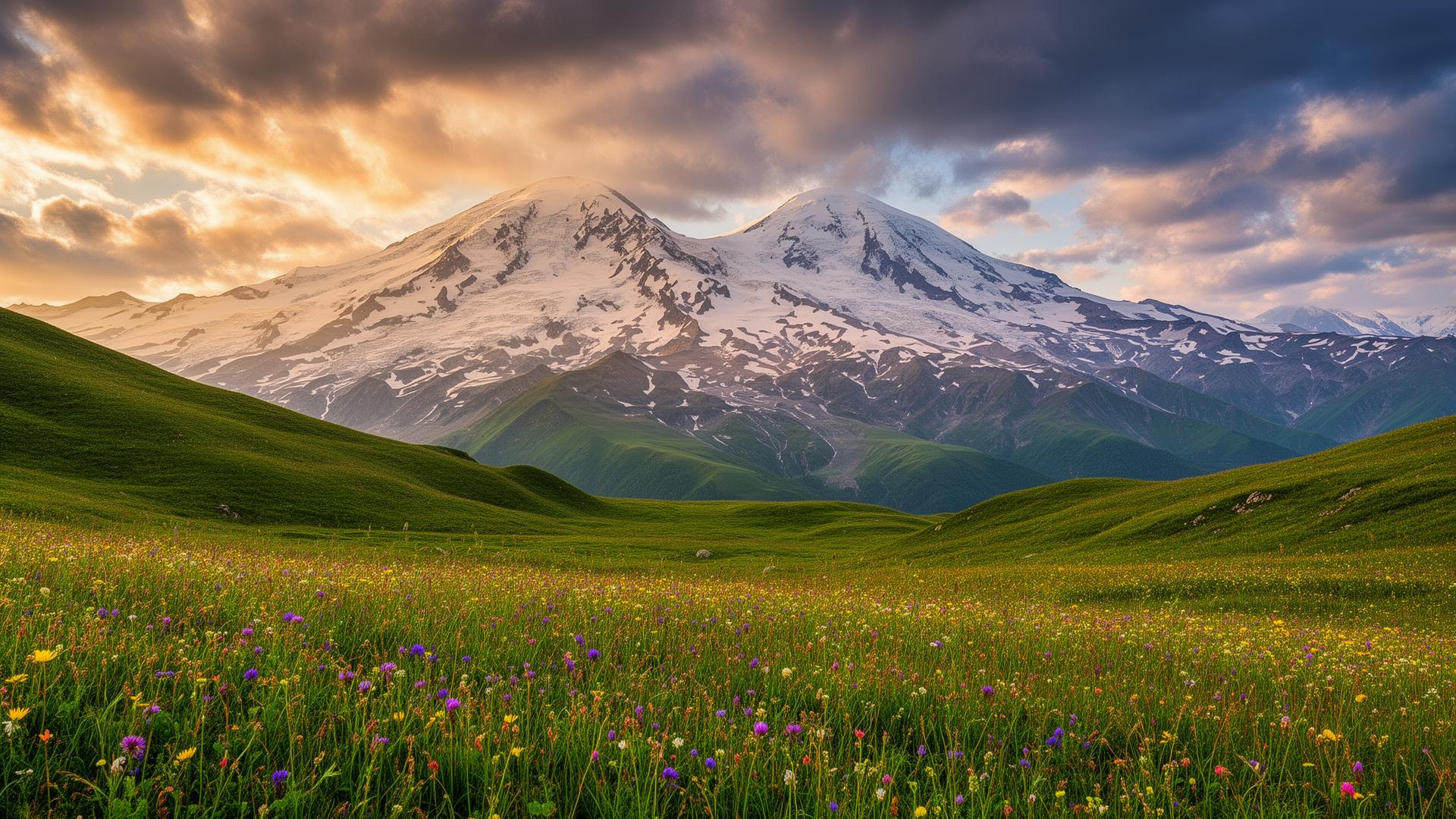
Mount Elbrus (5,642m) — the highest peak in Europe, located in Kabardino-Balkaria
Republic at a Glance — Key Facts & Figures
A data-driven overview of the Kabardian heartland:
- Area: 12,470 km² (4,810 sq mi) — bordered by Stavropol Krai, North Ossetia–Alania, Karachay-Cherkessia, and Georgia
- Population: ~904,200 (2021 Census) — 57.1% Kabardians, 19.8% Russians, 13.7% Balkars, 3% Cherkess
- Capital: Nalchik — a city of gardens and mineral springs
- Official Languages: Kabardian (East Circassian), Balkar (Turkic), and Russian
- Head of Republic: Kazbek Kokov
- Highest Point: Mount Elbrus — 5,642 m (18,510 ft), the highest peak in Europe
- Major Mountains: Dykhtau (5,402 m), Koshtantau (5,151 m), Shkhara (5,068 m), Pushkin Peak (5,033 m)
- Major Rivers: Terek (623 km), Malka (216 km), Baksan (173 km), Chegem (102 km), Cherek (76 km)
- Lakes: ~100 lakes including Tserikkel (368 m deep) and the famous Blue Lakes
- Climate: Continental — January avg −12°C (mountains) to −4°C (plains); July avg +4°C to +23°C; precipitation 500–2,000 mm
- Natural Resources: Molybdenum, tungsten, coal, and mineral springs
- Historical Note: Ancestors (Kassogs/Circassians) inhabited the area since at least the 6th century BCE
- Time Zone: UTC+3 (Moscow Time)
- Official Website: glava.kbr.ru
With five peaks above 5,000 meters, KBR is home to the most dramatic mountain landscape in all of European Russia.
Nalchik: The Garden City
The capital, Nalchik (НалщӀэч in Kabardian, meaning "small horseshoe" — a reference to the semicircular mountain ridge surrounding the city), has a population of roughly 265,000. Founded in 1724 as a Kabardian settlement, it developed into a major Soviet-era spa resort thanks to its mild climate, mineral springs, and protected location.
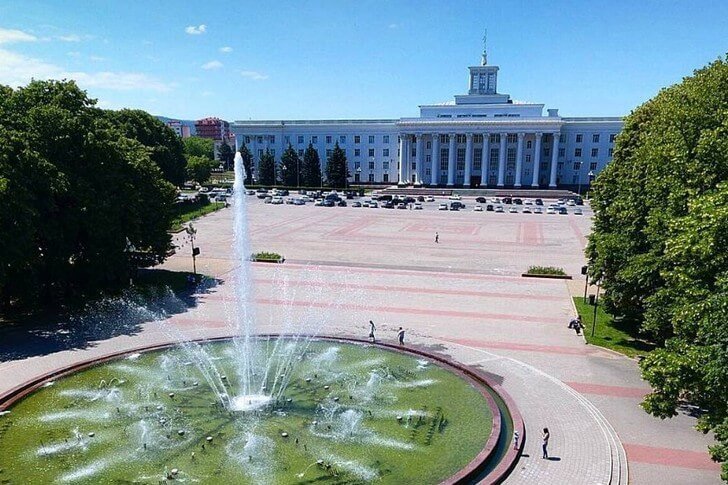
Lenin Prospekt in Nalchik — the main boulevard framed by white neoclassical buildings and the Caucasus range
Today Nalchik remains one of the greenest cities in Russia. Atazhukinsky Garden, the city's central park spanning over 250 hectares, is one of the largest urban parks in Europe. It features an artificial lake, botanical gardens, sanatoriums, and walking paths shaded by centuries-old trees. The park was named after Atazhuko Atazhukin, a Kabardian prince who played a significant role in the region's history.
Notable landmarks include the Kabardian Drama Theatre, the National Museum of Kabardino-Balkaria, the main Central Mosque, and the Restaurant Sosruko — a remarkable Soviet-era building shaped like the head of the legendary Nart hero Sosruko, perched on a cliff overlooking the city with a torch-shaped observation deck in his outstretched hand.
Nalchik's Hidden Gems
Beyond its famous landmarks, Nalchik offers numerous cultural treasures that many visitors miss. The Kabardino-Balkarian Fine Arts Museum houses an extraordinary collection of Circassian decorative arts — including ornamental weapons, gold-embroidered costumes, and silverwork dating from the 16th through 19th centuries. The museum's centerpiece is a reconstruction of a complete Kabardian nobleman's outfit from the 18th century, including the iconic cherkesska with silver cartridge tubes, a jeweled kinzhal (dagger), and a papakha (fur hat).
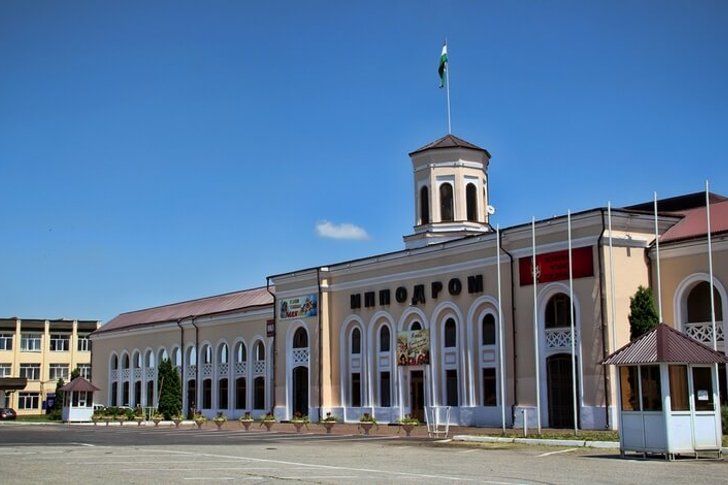
The Nalchik Hippodrome, one of the oldest in the North Caucasus, hosts regular races featuring Kabardian horses — a breed developed over centuries specifically for mountain warfare and long-distance endurance. The hippodrome also stages traditional equestrian games (шыгъажэ), including mounted archery, horseback wrestling, and the spectacular dzhigitovka — acrobatic stunts performed at full gallop that historically served as both military training and entertainment.
The Kabardian People: History and Identity
The Kabardians speak Kabardian (Адыгэбзэ/Къэбэрдеибзэ), classified as East Circassian, which is closely related to but distinct from the Adyghe language spoken in the Republic of Adygea. Kabardian has 48 consonants and is noted for its complex system of verbal morphology — a single verb can express what requires an entire sentence in English.
Historically, the Kabardians occupied a position of political and military preeminence among the Circassian tribes. The medieval Principality of Kabarda, governed by the aristocratic pshi (prince) class under the most prominent family — the Idarovs — controlled the central North Caucasus and exerted influence over neighboring peoples including the Balkars, Ossetians, and Chechens.
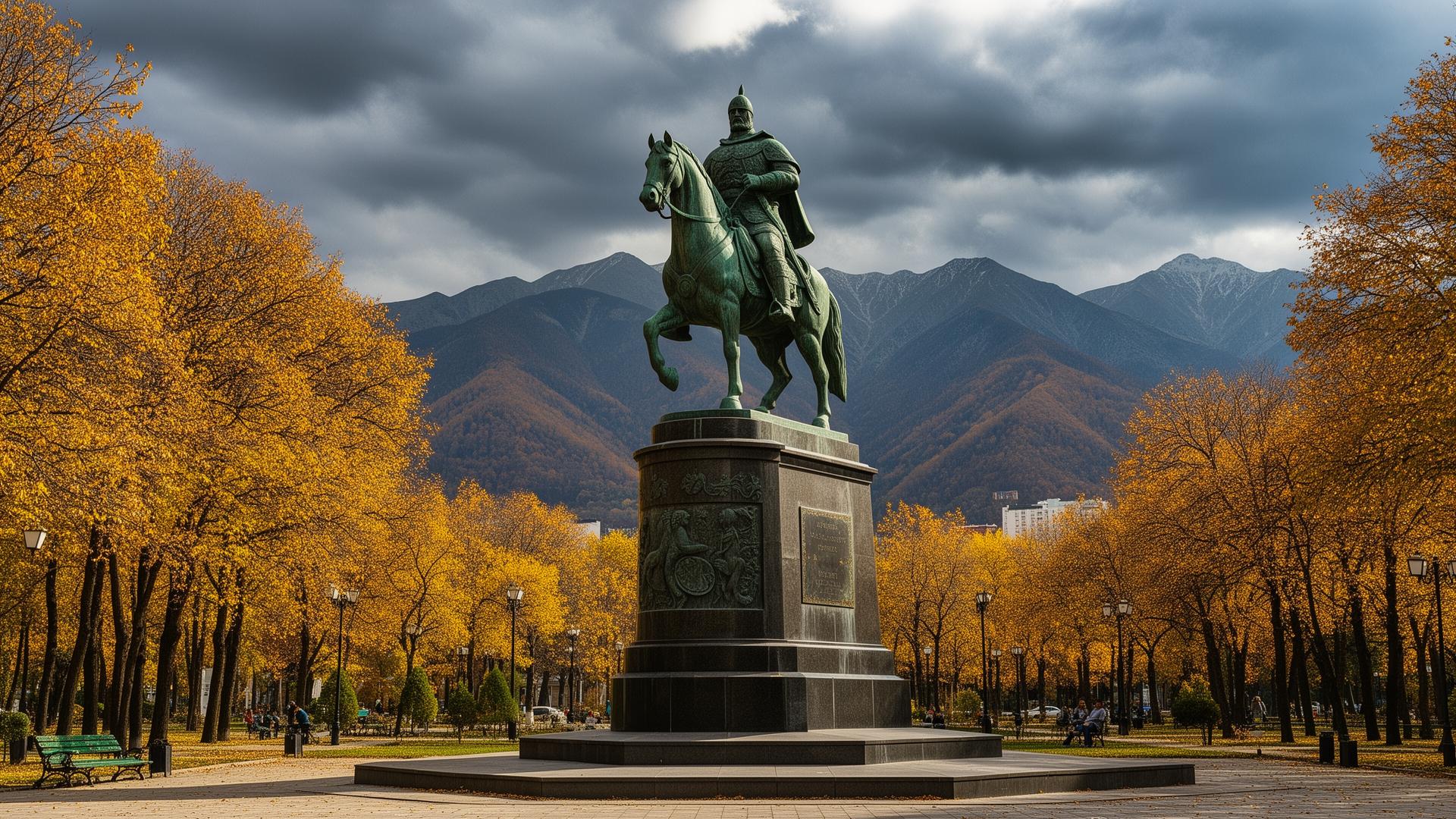
Monument in Nalchik honoring the Kabardian warrior tradition — horsemanship was central to Kabardian culture
Prince Inal, who lived in the 15th century, is traditionally credited with unifying the Circassian tribes under a single political structure. His descendants — the Inal dynasty — became the ruling aristocracy of Kabarda. The Kabardian horse breed, developed over centuries of selective breeding in these mountain valleys, became renowned throughout the Caucasus and beyond for its endurance, agility, and intelligence.
During the 16th century, Kabarda entered into complex diplomatic relations with Muscovite Russia. The marriage of Princess Guashane (baptized as Maria Temryukovna) to Tsar Ivan IV (Ivan the Terrible) in 1561 marked one of the most significant political alliances between Circassians and Russia, though it ultimately did not prevent later conflict.
The Kabardian Social Structure
The traditional Kabardian social hierarchy was one of the most complex and codified in the Caucasus, reflecting the Adyghe Xabze at its most elaborate. At the apex stood the pshi (пщы, princes), who were divided into two ranks: the greater princes (пщышхуэ) who held sovereignty over entire territorial districts, and lesser princes who governed individual valleys or settlements. Below them were the ork (уэркъ, nobility), further subdivided into tlekotlesh (first-rank nobles), dezhenugo (second-rank), and befynugo (third-rank). The tfokotl (тфокъуэл, free commoners) formed the majority of the population, while the pshitl (пщылI, serfs) and uneut (унэIут, household servants) occupied the lower rungs.
This stratified society produced a remarkably refined culture of etiquette, oratory, and diplomacy. The Kabardian aristocracy was famous across the Caucasus for its mastery of elegant speech — a Kabardian prince was expected to be as skilled with words as with weapons. The proverb "Адыгэ лIым жьэ зэIухагъэ иIэп, сэшхуэ зэтеIулIагъэ иIэп" ("A Circassian man has no open mouth and no sheathed sword") captured the dual expectation of verbal restraint and martial readiness.
The Caucasian War and Its Aftermath
The Russo-Circassian War hit Kabarda particularly hard. The Russian-Kabardian War (1763–1825) predated the main Caucasian War and resulted in the destruction of the Kabardian political system. The population of Kabarda declined from an estimated 300,000–350,000 in the mid-18th century to approximately 50,000 by the 1830s through a combination of military campaigns, plague epidemics deliberately left uncontrolled, and forced deportation (muhajirism).
The Russian military strategy against Kabarda was systematic and devastating. General Yermolov, who served as commander of the Caucasus Corps from 1816 to 1827, implemented a scorched-earth policy that involved burning villages, destroying crops, cutting down ancient forests, and establishing a chain of military fortifications (the "Kabardian Line") that bisected traditional Kabardian territories. The plague epidemic of 1804-1807, which killed an estimated half the Kabardian population, was exacerbated by Russian military blockades that prevented the Kabardians from dispersing to avoid contagion — a practice historians have characterized as biological warfare by omission.
Today, the global Kabardian diaspora — concentrated in Turkey, Jordan, and Syria — numbers several million, vastly outnumbering the roughly 520,000 Kabardians who remain in Russia.
The Caucasian War & Notable Figures
Kabardino-Balkaria has produced an extraordinary roster of figures who have achieved prominence far beyond the borders of the republic:
Ali Shogenov (Шогэнцыкъ Алий, 1900–1941) was one of the founders of modern Kabardian literature. His poetry, written in the Kabardian language, captured the beauty of the Caucasus landscape and the pain of cultural loss with a lyrical intensity that earned him comparisons to the great Russian poets. He was killed during World War II, but his works remain required reading in Kabardian schools.
Alim Keshokov (Кешоков Алим, 1914–2001) was Kabardino-Balkaria's most celebrated novelist. His trilogy "The Broken Horseshoe" (Щхьэмыгъазэ), which chronicles Kabardian life from the Revolution through World War II, is considered one of the masterworks of North Caucasian literature. He received the USSR State Prize and was elected to the Russian Academy of Arts.
Yuri Temirkanov (Темыркъан Юрий, born 1938) is among the most renowned orchestral conductors in the world. Born in Nalchik, he served as Music Director of the St. Petersburg Philharmonic Orchestra for over two decades and has conducted every major orchestra globally, including the Berlin Philharmonic, Vienna Philharmonic, and New York Philharmonic. He is widely considered the greatest Circassian classical musician in history.
In combat sports, the republic has been a global powerhouse. Zaurbek Sidakov won Olympic gold in freestyle wrestling at the 2020 Tokyo Olympics. Khazhbikar Mutaliyev claimed gold at the 2000 Sydney Olympics. The tradition of martial excellence runs deep — the Kabardian wrestling school (бэнэкIэ) has produced over 30 world and Olympic champions across wrestling, judo, and mixed martial arts, making this small republic one of the most prolific producers of combat sports champions per capita in the world.
The Kabardian Horse: A Living Heritage
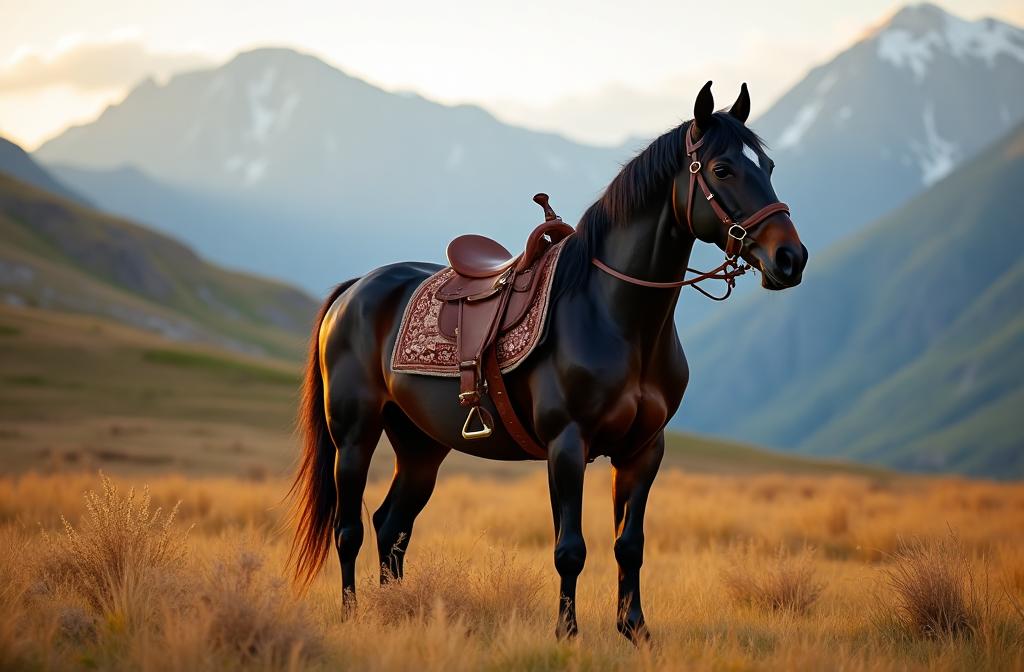
The Kabardian horse — bred for centuries in the Caucasus mountains for endurance, agility, and intelligence
No discussion of Kabardian culture is complete without the Kabardian horse (Адыгэш). This breed, developed over at least 400 years of selective breeding in the mountains and valleys of Kabardino-Balkaria, represents one of the most remarkable achievements of Circassian animal husbandry. The Kabardian horse is characterized by its extraordinary sure-footedness on mountain terrain, endurance over long distances, resistance to cold and disease, and a calm, intelligent temperament that made it the ideal cavalry mount.
In 1935, a group of riders completed the legendary "Kabardian Ring Ride" — a 3,000-kilometer journey around the Caucasus Mountains through treacherous terrain, including a crossing of the Klukhor Pass at 2,781 meters, accomplished in 47 days. This feat, performed entirely on Kabardian horses, proved the breed's extraordinary endurance and became a legendary event in Circassian equestrian history. In 1946, another expedition crossed the Elbrus saddle at 5,400 meters — the highest point ever reached by horses in Europe.
Today, the Nalchik Stud Farm and several private breeding programs work to preserve the purebred Kabardian horse. The Kabardian Horse Breeders Association maintains a studbook and organizes annual competitions. For diaspora Circassians visiting Kabardino-Balkaria, horseback riding excursions through the Baksan and Cherek valleys offer an incomparable connection to ancestral traditions.
Natural Wonders & the Kabardian Horse
While Mount Elbrus dominates the republic's international reputation, Kabardino-Balkaria contains an extraordinary concentration of natural wonders:
The Cherek Gorge — one of the deepest canyons in the Caucasus, with the Blue Lakes at its end
The Cherek Gorge and Blue Lakes (Голубые озёра) include five stunningly colored lakes, the most famous being the Lower Blue Lake (Церик-Кёл), one of the deepest lakes in Russia at 258 meters deep despite being only 235 meters across. Its water maintains a constant temperature of 9.3°C year-round and has a distinctive turquoise-blue color caused by dissolved hydrogen sulfide.
The Bezengi Wall (Безенги стена) is a 12-kilometer continuous mountain wall averaging over 5,000 meters in height, containing five of the Caucasus's eight peaks above 5,000 meters. Mountaineers call it the "Caucasian Himalaya." The Baksan Valley, stretching from Nalchik toward Elbrus, is one of the most scenic valleys in the region, dotted with traditional Kabardian villages, mineral springs, and the famous Baksan Neutrino Observatory — built deep inside a mountain to detect subatomic particles.
The Chegem Waterfalls
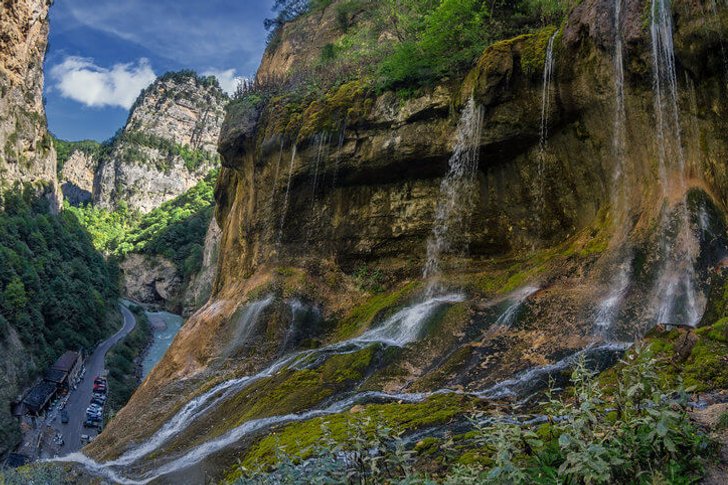
The Chegem Waterfalls in winter — massive frozen curtains of ice transforming the gorge into a natural ice palace
The Chegem Waterfalls (Чегемские водопады) are among the most visited natural sites in the entire North Caucasus. Located in the narrow Chegem Gorge, the waterfalls cascade directly from the cliff walls — water seeping through the limestone to create dozens of streams that pour from heights of up to 60 meters directly into the gorge. In winter, the waterfalls partially freeze, creating spectacular ice formations — massive blue-white stalactites and frozen curtains that transform the gorge into a natural ice palace.
The gorge is also significant in Circassian oral history. According to local tradition, during the Russian invasions, Kabardian women and children hid in the upper reaches of the Chegem Gorge while warriors defended the narrow entrance. The legend says that some women, faced with capture, chose to leap from the cliffs rather than submit — a story paralleled in multiple Circassian communities across the Caucasus and commemorated in the poem "The Chegem Women" by Kabardian poet Kaisyn Kuliev.
Traditional Kabardian Villages
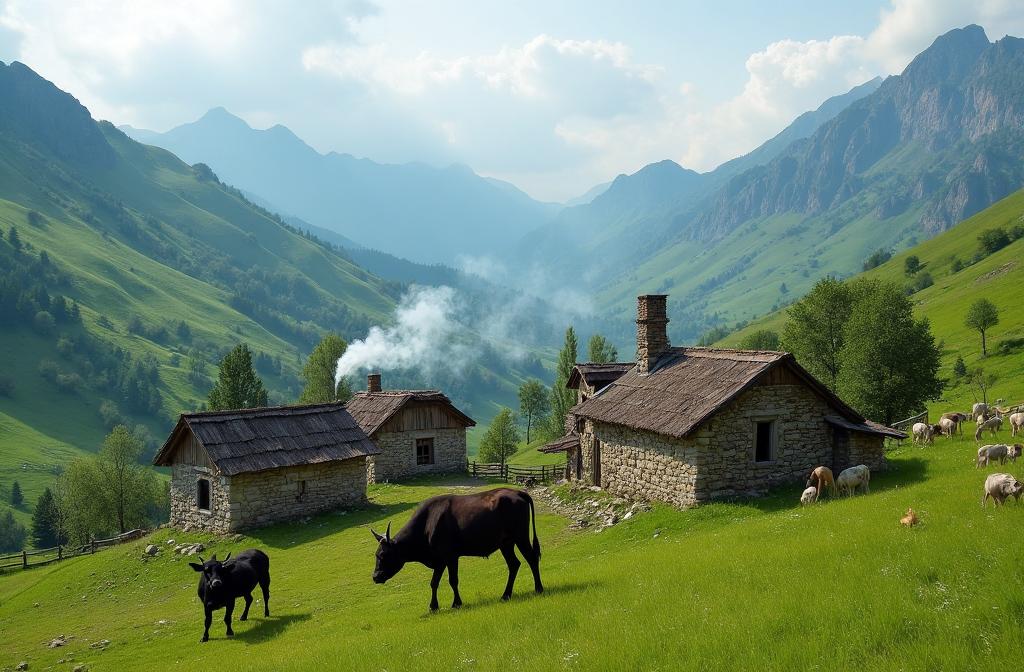
A traditional settlement in the Cherek Valley — stone houses nestled among green hills with the Caucasus range beyond
The village of Zaragizh (Зэрэгъыжь), located in the Cherek Valley, is one of the oldest Kabardian settlements with a documented history stretching back over 500 years. The village preserves traditional wattle-and-daub construction, communal spaces for elder councils (хасэ), and sacred groves where pre-Islamic Circassian rituals were historically performed.
The settlement of Kyzburun (Къызбурун) in the Baksan district is known as a center of traditional Kabardian blacksmithing. The village's smiths historically produced some of the finest swords, daggers, and armor in the Caucasus — weapons that were traded as far as Persia and Egypt. The craft tradition, while diminished, continues today with artisans producing ceremonial kinzhals and decorative metalwork for cultural events and diaspora collectors.
The village of Kamenka (Къэмэнкэ) is home to the last traditional Kabardian cheese dairy that uses exclusively ancestral methods — unpasteurized milk from free-range cattle, natural rennet, and wicker molds (хьэбыжь) that have been used for generations. The village's cheese, known as kue (къуэ), is considered by connoisseurs to be the finest example of authentic Circassian cheese-making.
Culture, Traditions & Village Life
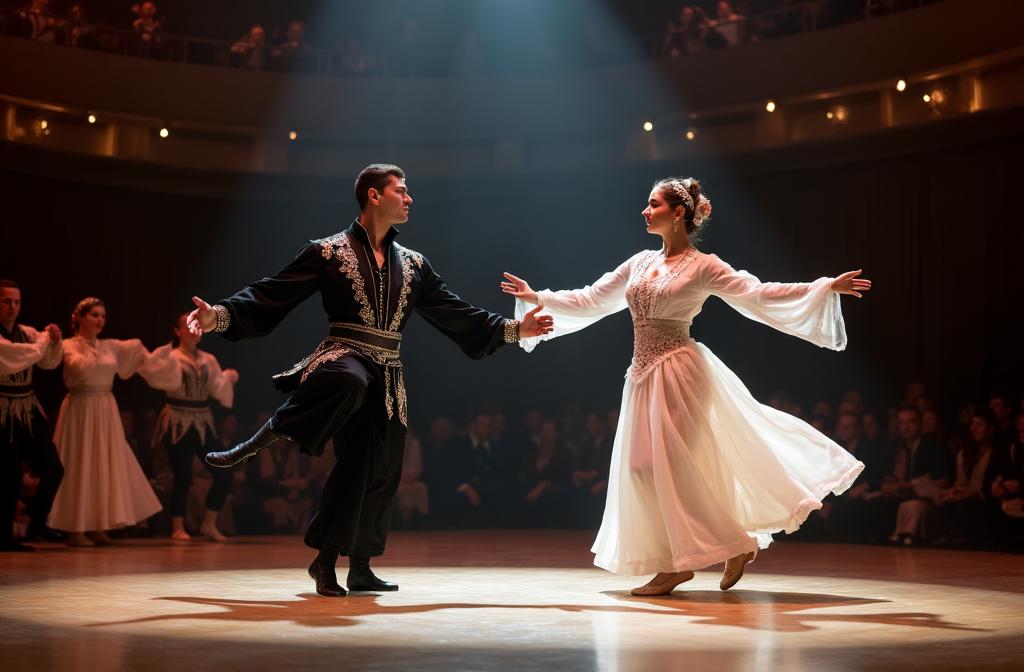
The Kabardinka State Dance Ensemble — one of the most prestigious Circassian dance troupes in the world
Kabardian culture follows the Adyghe Xabze code of conduct, which governs social behavior, hospitality, and inter-family relations. The Kabardinka State Dance Ensemble, founded in 1933, is one of the most prestigious Circassian dance troupes in the world and has performed in over 70 countries.
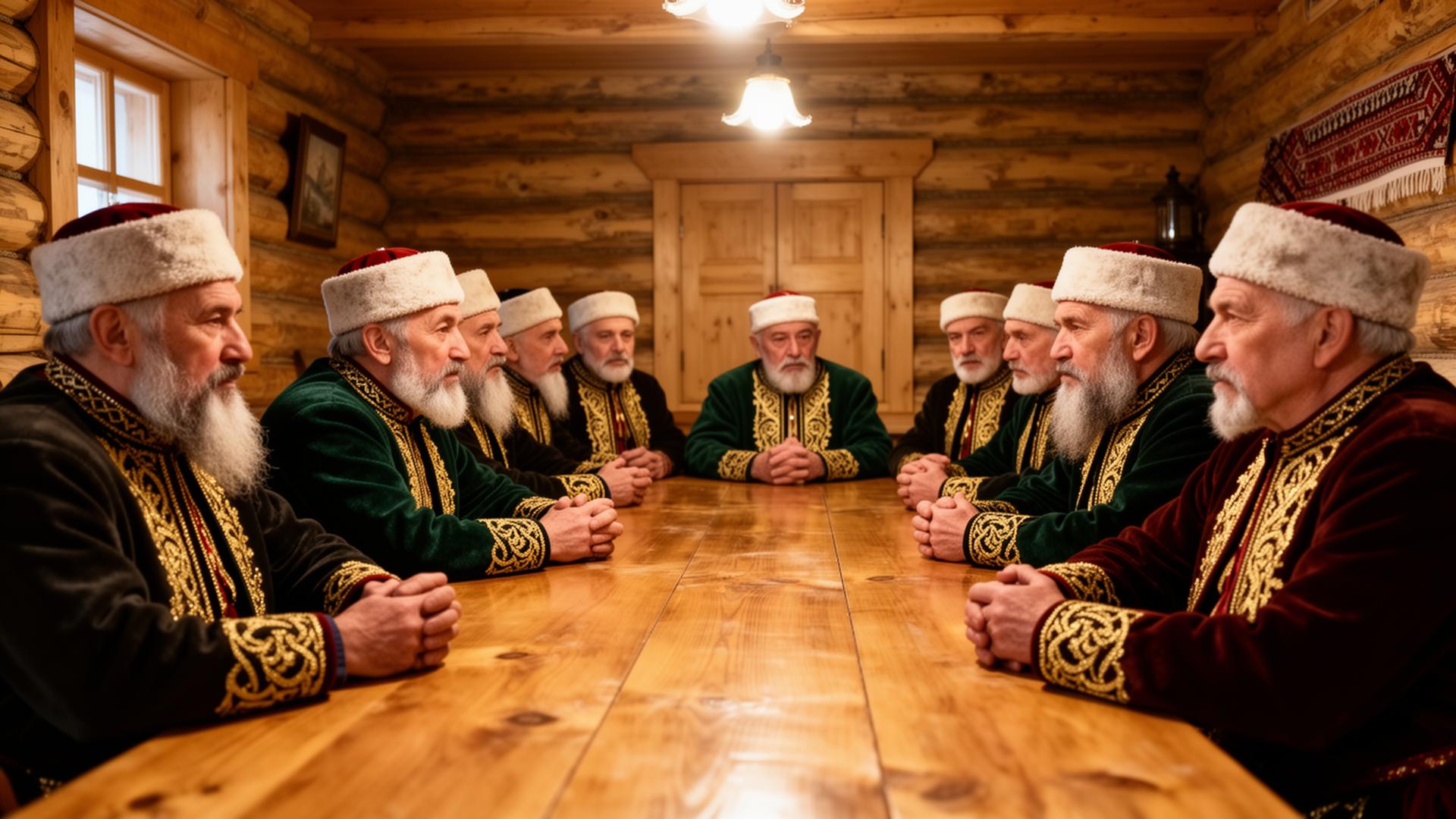
A gathering of Kabardian elders — the tradition of collective decision-making remains central to community life
Kabardian cuisine shares roots with broader Circassian food traditions: libzhe (meat stewed in onion sauce), gedlibzhe (chicken in cream-garlic sauce), khalva (fried dough with cheese), and the essential paste (thick millet or cornmeal porridge) that accompanies most meals. The republic also produces excellent honey from mountain apiaries and traditional fruit preserves.
Traditional Medicine and Herbalism
The Kabardians have a rich tradition of herbal medicine (удз хущхъуэ) that developed over centuries in the botanically diverse Caucasus environment. Traditional healers (хущхъуэзылIэ) used plants from the mountain meadows, forests, and river valleys to treat everything from battlefield wounds to chronic illnesses. Rhododendron tea was used for joint pain, wild thyme (ажэгъафэ) for respiratory ailments, St. John's wort for depression, and yarrow as a wound clotting agent — applications that modern pharmacology has largely validated.
The Institute of Pharmacology at the Kabardino-Balkarian State University has conducted extensive research on traditional Kabardian herbal remedies, finding that many contain bioactive compounds with genuine therapeutic properties. The institute maintains a living herbarium of over 2,000 species from the Caucasus region and has published studies linking traditional Circassian herbal knowledge to modern pharmacological applications.
The Kabardino-Balkarian State University (KBSU) in Nalchik is a major center for higher education in the North Caucasus, with departments of Kabardian philology, Circassian history, and Caucasus studies. The Institute of Humanities Research of the Kabardino-Balkarian Scientific Center of the Russian Academy of Sciences conducts ongoing research into Circassian language, history, and ethnography.
Multi-Ethnic Relations & Diaspora
The republic's dual name reflects its bi-national character. The Balkars (about 13% of the population) are a Turkic-speaking people who historically inhabited the high mountain valleys and gorges, while Kabardians occupied the foothills and lowlands. During World War II, the entire Balkar population was deported to Central Asia in 1944 under Stalin's orders, accused of collaboration with Nazi Germany — a charge that was officially repudiated in 1957 when they were allowed to return.
The deportation of the Balkars had profound consequences for the republic. During the 13 years of exile, an estimated 40% of the Balkar population perished from starvation, disease, and harsh conditions in Kazakhstan and Kyrgyzstan. When the survivors returned, they found their villages occupied and their livestock confiscated. The trauma of deportation remains central to Balkar identity, and March 8 is observed as a Day of Remembrance for the Balkar deportation.
Relations between Kabardians and Balkars have been complex but largely cooperative in the post-Soviet period, with both groups sharing governmental institutions while maintaining separate cultural and linguistic identities.
Diaspora Connections and Repatriation
For the global Kabardian diaspora, Kabardino-Balkaria represents the spiritual center of their identity. The International Circassian Association (Дунейпсо Адыгэ Хасэ), headquartered in Nalchik, serves as the main coordinating body for diaspora-homeland relations. The association organizes annual cultural congresses, facilitates student exchange programs, and advocates for simplified repatriation procedures for diaspora Circassians seeking to return.
Several hundred Circassians from Syria, Turkey, and Jordan have successfully repatriated to Kabardino-Balkaria since the 1990s, with a significant wave arriving during the Syrian Civil War after 2011. The repatriates face challenges including language barriers (many diaspora Circassians speak only Turkish or Arabic), employment difficulties, and bureaucratic complexities around residency permits — but the community has largely been welcoming, and many repatriates describe their arrival in Nalchik as a profoundly emotional homecoming.
Trace Your Kabardian Heritage
If your family name connects to the Kabardian aristocratic clans — the Tambiev, Shogenov, Kashezhev, Shkhagoshev, or any of the dozens of princely and noble families — you can begin building your family tree and explore how your lineage connects to this remarkable republic. Search our Circassian families database to discover your tribal origins and ancestral territories.
Diaspora & Tribal Origins
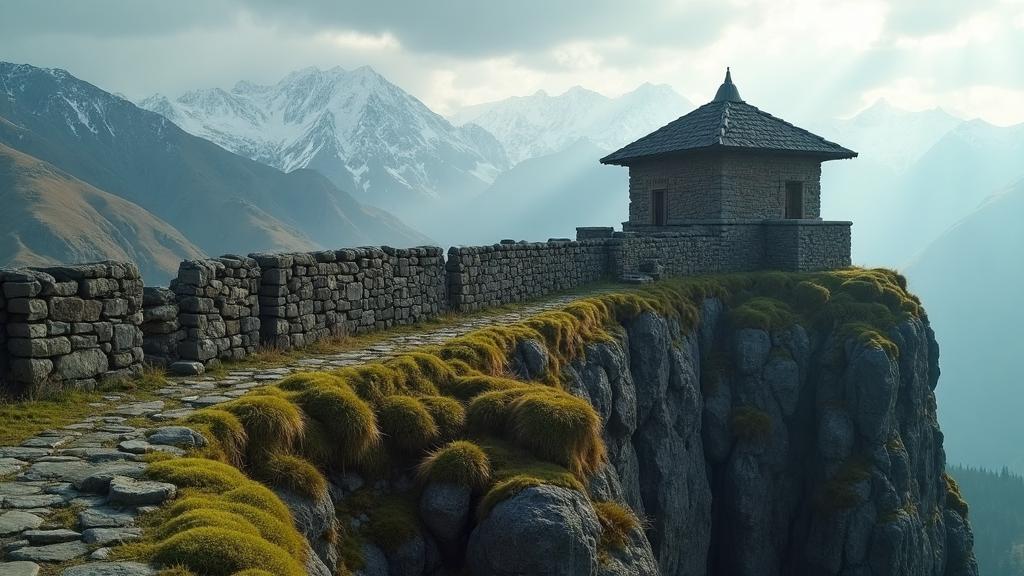
A Kabardian ancestral watchtower overlooking the Great Caucasus — guardians of the family homeland
Kabardino-Balkaria is the ancestral heartland of the Kabardians (Къэбэрдей) — the largest and historically most powerful Circassian tribe. For diaspora Circassians tracing their family trees, this republic holds the key to understanding princely lineages, warrior clans, and the feudal family structures that defined Kabardian society for centuries.
The Kabardian Social Hierarchy and Family Structure
Unlike the more democratic western Circassian tribes, Kabardian society was organized into a strict feudal hierarchy that directly shapes how family trees branch:
- Pshi (Пщы) — Princes: The ruling aristocracy. The most prominent princely families include Idarov, Kaytukhin, Misostov, Atazhukin, and Tausoltan. These families ruled the Great and Lesser Kabarda, and their descendants can be found in every corner of the Circassian diaspora.
- Work (Уэркъ) — Nobles/Warriors: The warrior nobility, bound to specific princely houses. Families like Shogenov, Kanokov, Naloev, Khamizov, Shokarov, and Beshtokov served as the military backbone. Their genealogies often intertwine with the princely lines through marriage alliances and blood oaths.
- Tlfokotl (Тлъфыкъуэтл) — Free Peasants: The majority of Kabardian families. While they lacked titles, their family trees are equally rich and traceable through village records and oral traditions.
- Pshitl (Пщылъ) — Serfs: Following emancipation in the 1860s, many adopted the surnames of their former lords or took new names based on their village of origin.
Great Kabardian Family Clans
Several clan families have shaped the history of Kabarda and continue to be recognized across the diaspora:
- The Idarov (Идарыкъуэхэ) — Founded by Prince Idar in the 15th century, this dynasty controlled Great Kabarda (the Baksan, Chegem, and Malka valleys). Their descendants include the famous Maria Temryukovna, who married Tsar Ivan the Terrible in 1561.
- The Kaytukhin (Къайтыкъуэхэ) — Rivals of the Idarov, they ruled Lesser Kabarda east of the Terek River. Many Kaytukhin descendants migrated to Jordan and Turkey during the exile.
- The Tambiiev (Тамбийхэ) — Influential noble family from the Baksan Valley, connected to the guardianship of Mount Elbrus access routes.
- The Anzorov (Анзорхэ) — A warrior clan renowned for producing legendary riders and military commanders.
Tracing Your Kabardian Family Tree
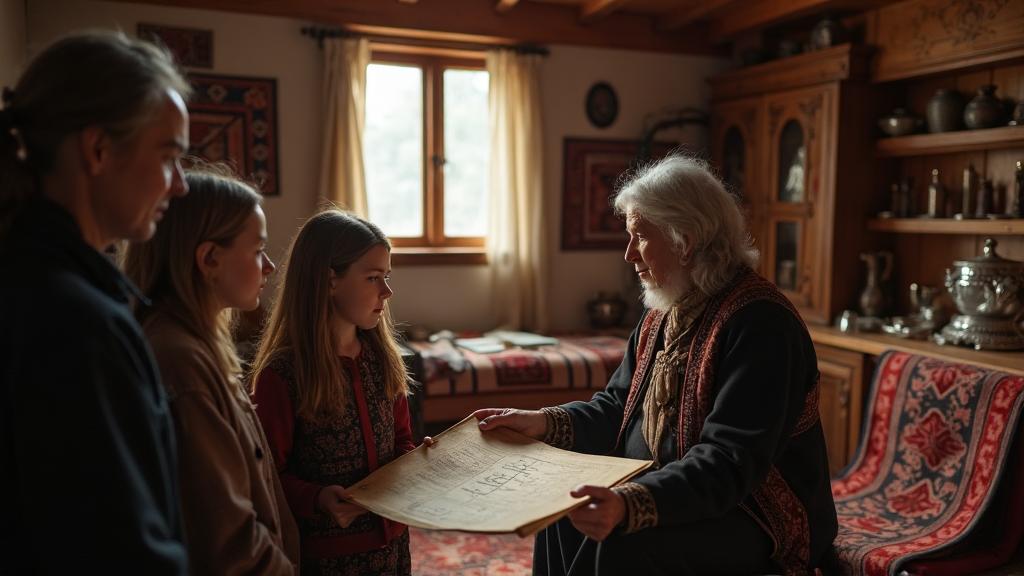
Passing down family history — the Kabardian tradition of oral genealogy
Kabardian families have a strong tradition of oral genealogy (лъэпкъ тхыдэ), where elders recite family lineages going back 7 to 12 generations. Here's how to leverage this for your family tree:
- Record the oral history — If you have access to Kabardian elders in your family, record their recollections. The traditional "Who are you? Whose son/daughter are you?" greeting (Ухэт? Хэт уикъуэ?) reveals tribal identity.
- Identify your princely district — Each Kabardian family historically belonged to a specific prince's domain. This determines which valley and village cluster your ancestors called home.
- Search the Nalchik archives — The Central State Archive of Kabardino-Balkaria holds records from the Russian Imperial period, including census records, land deeds, and military service documents from the 1800s.
- Check Ottoman exile records — For families who left during the 1864 muhajirlik, Turkish and Jordanian archives contain settlement registers (nüfus defterleri) that list family names, tribal affiliations, and villages of origin.
- Connect through DNA — Many Kabardian families share distinct Y-DNA haplogroups (particularly G2a and J2) that can confirm tribal connections. Our DNA Heritage section can help you get started.
Ancestral Villages of the Five Valleys
The Kabardian homeland is organized around five great river valleys, each associated with specific family clans:
- Baksan Valley (Бахъсэн) — Home to the Idarov princes and families including Balkizov, Zhambotov, and Kuashev. Villages: Zayukovo, Kashkhatau, Gundelen
- Chegem Valley (Шэджэм) — Families: Kuchmazokuev, Boliev, Tabaksoev. Ancient watchtowers and family burial grounds dot the gorge
- Cherek Valley (Шэрэдж) — The Blue Lakes region, ancestral territory of families like Khamukov and Shogenov
- Malka Valley (Мэлкъуэ) — Northern gateway, home to Khavpachev, Kardanov, and Pshukov families
- Urvan Valley (Урвэн) — Central agricultural heartland with families like Nagoev and Shkhagapsoev
Frequently Asked Questions
Where is Kabardino-Balkaria?
Kabardino-Balkaria is a republic in the North Caucasus region of Russia, bordered by Georgia to the south. Its capital is Nalchik. It is home to Mount Elbrus, the highest peak in Europe.
Are the people of Kabardino-Balkaria Circassian?
The Kabardians are the largest Circassian tribe, speaking Eastern Circassian (Kabardian). The Balkars are a separate Turkic-speaking people who share the republic.
Can I visit Kabardino-Balkaria?
Yes. The republic is accessible by air through Nalchik airport and offers cultural sites, museums, traditional villages, and world-class mountain scenery including Mount Elbrus and the Cherek Gorge.
Natural Wonders & Travel Guide
Kabardino-Balkaria is arguably the most accessible and spectacular of the three Circassian republics for travelers. It hosts a large number of both foreign and Russian visitors annually thanks to Mount Elbrus, but the republic offers far more than just Europe's highest peak.
Getting There
The most convenient gateway is Mineralnye Vody (MRV) airport in neighboring Stavropol Krai, the largest airport in the North Caucasus with daily direct flights from Moscow (all three airports: SVO, DME, VKO), St. Petersburg, and international routes from Istanbul, Dubai, Tel Aviv, and other cities. From MRV, it's approximately a 2-hour drive to Nalchik and 3.5 hours to Mount Elbrus.
The capital Nalchik (NAL) also has a small regional airport with daily Moscow flights and weekly Istanbul connections. For overland travelers, the federal highway E50 runs through Pyatigorsk into Kabardino-Balkaria, and daily marshrutkas (minibuses) connect Nalchik to Pyatigorsk, Vladikavkaz, Grozny, and Magas. From Nalchik's main bus station, a daily marshrutka departs around 12:30 PM to Terskol (Mount Elbrus base area). The famous Georgian Military Highway from Tbilisi crosses into Russia at Verkhni Lars, putting Nalchik roughly 2.5 hours away from the Georgian border.
Anyone traveling independently should download the Yandex taxi app (Russia's equivalent of Uber), which offers affordable rides with a user-friendly interface. In smaller villages where Yandex doesn't reach, asking locals will invariably connect you with someone willing to drive.
Nalchik: The Kabardian Capital
Nalchik (population ~250,000) is growing and modernizing, with new hotels appearing regularly. The city is far more than just a transit point — it's where travelers encounter authentic Kabardian culture and cuisine. The deeper you go into the mountain valleys, the more you encounter Balkar culture instead, making the contrast between lowland Kabardian and highland Balkar traditions one of the republic's most fascinating features.
You could comfortably spend a week in Nalchik while doing day trips into the republic's stunning mountain gorges. Recommended restaurants include Tameris (ul. Kuliyeva 3) for a relaxed café experience, and Café-Bar Oasis (ul. Kuliyeva 2), a hidden gem with a unique cafeteria-style ordering system where dishes are cooked on the spot — an excellent place to sample traditional Kabardian fare.
The Five Great Valleys
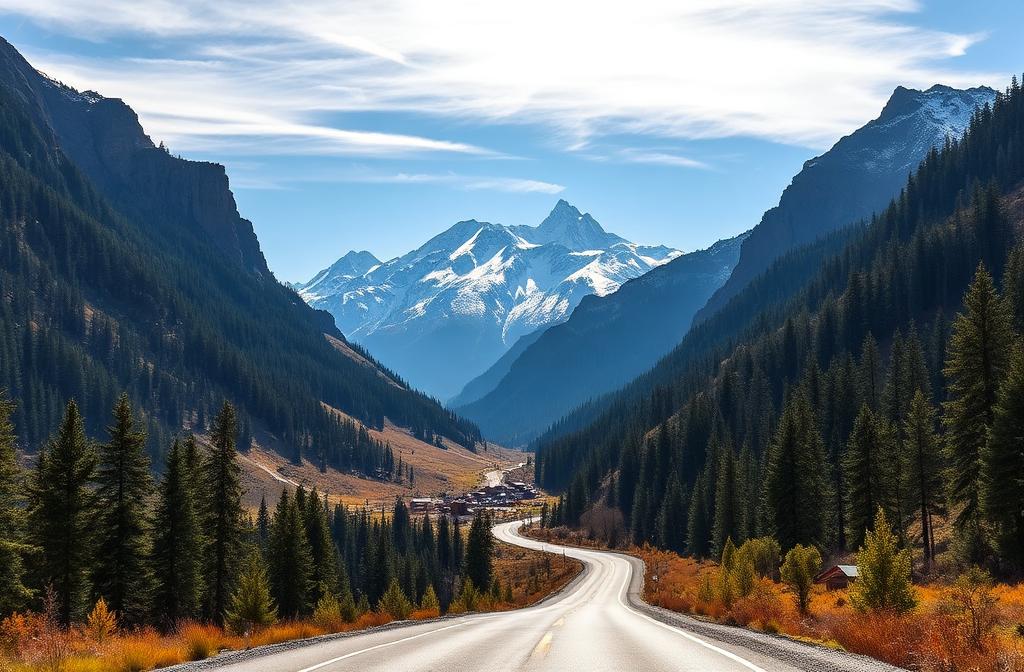
The Baksan Valley road leading toward Mount Elbrus — the most traveled route in Kabardino-Balkaria
Kabardino-Balkaria's geography is defined by a series of spectacular mountain gorges, each with its own character and attractions:
Baksan Valley (Баксан) — The most traveled road in the republic, leading to Mount Elbrus. The valley offers the widest range of accommodation, from 4-star hotels near Terskol to budget hostels. The town of Tirnauz, capital of the Elbrus district, is an interesting stop — once a booming Soviet mining town, now a gateway to the high mountains. For climbers targeting Elbrus's summit, 3–4 nights at the base camp at 4,000 meters are essential, with shelters ranging from the modern Leaprus capsules to the classic barrel huts.
Chegem Valley (Чегем) — Famous for the Chegem Waterfalls, which most tourists visit without continuing deeper into the gorge — a mistake. Beyond the waterfalls lies El-Tyubu, a picturesque Balkar village with ancient mausoleums and historical sites. The real gem is the Paradrome, Russia's premier paragliding destination. The combination of scenic surrounding mountains and constant winds produces near-daily conditions for soaring through the Caucasus sky. The legend says the Chegem Waterfalls were created by the tears of Circassian women who threw themselves from the cliffs rather than submit to invaders — a story that connects to the broader narrative of resistance and sacrifice in Circassian history.
Cherek Valley / Upper Balkaria (Черек) — The drive to the village of Upper Balkaria is itself one big destination. First, you pass the three consecutive Blue Lakes (Голубые озёра), one of which is among Russia's deepest lakes fed by an underground spring — its waters a surreal, vivid blue. Then the road becomes an adventure, squeezing past steep rock walls with dramatic drop-offs. Once through the valley walls, the landscape opens into a breathtaking panorama. The remains of ancient Balkar defensive towers dot the hillsides, testimony to centuries of highland civilization. The Tau-El tourist complex offers authentic lodging and outstanding local food.
Djili-Suu (Джилы-Су) — On the northern side of Mount Elbrus, this area is famous across Russia for its natural healing mineral springs and unique microclimate. It offers arguably the most unrivaled views of Elbrus in the North Caucasus — the mountain's double summit looming impossibly close. Wide areas are available for camping, and the site serves as base camp for climbers summiting from the northern route. Accessible from Kislovodsk (about 2 hours), it requires no border zone permit for Russian citizens.
Bezengi Valley (Безенги) — Known as the "Caucasian Himalaya", this valley runs into the border zone with Georgia and contains some of the most extreme alpine terrain in Europe. The famous Bezengi Wall — a 12-kilometer stretch of peaks above 5,000 meters — has challenged generations of mountaineers. A legendary mountaineering lodge operates here, but foreign visitors require a border zone permit (often taking 2 months to obtain).
Must-Try Local Food
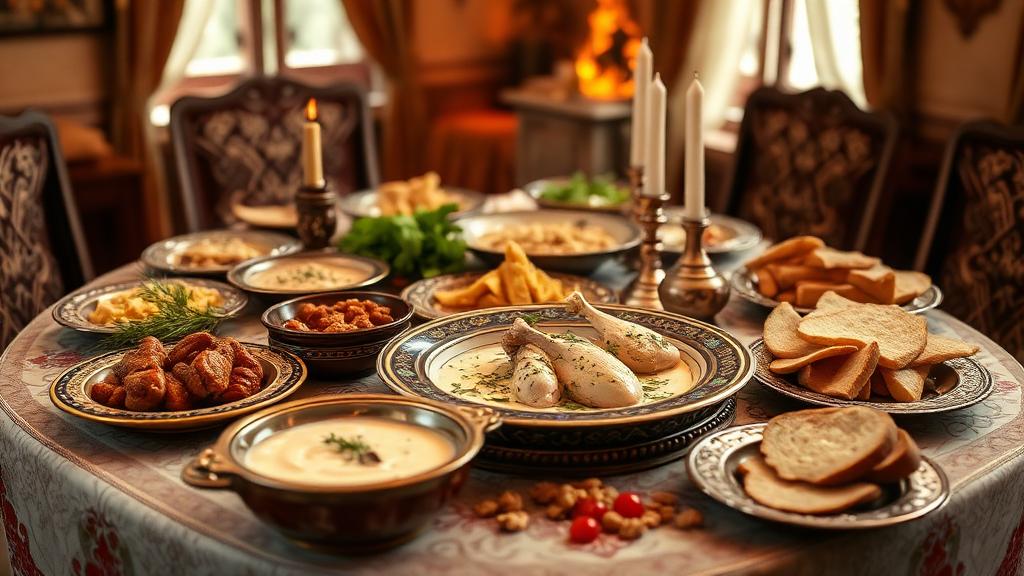
A traditional Kabardian feast table featuring gedlibzhe, fresh bread, and walnut-cream sauces
The cuisine of Kabardino-Balkaria is a highlight for any visitor:
- Khychiny (хычины) — The staple national dish of the Balkar people: thin, buttery flatbread cooked with fillings of cottage cheese, fresh greens, or potatoes. Generously slathered in butter, these are irresistibly delicious and will be served at every local table.
- Shashlik (шашлик) — Meat shish kebabs are the universal food of the North Caucasus. In this predominantly Muslim republic, lamb and chicken are the preferred meats, grilled over charcoal with a skill perfected over generations.
- Lakhman — A hearty Balkar soup, perfect for warming up after a day in the mountains. Served with fresh-baked bread or lavash, it's comfort food at altitude.
- Gedlibzhe (гэдлыбжьэ) — Traditional Kabardian chicken in a rich cream sauce, a festive dish that showcases the refined side of Circassian cuisine.
Practical Travel Tips
- Best seasons: June through September for hiking and mountain exploration. December through March for skiing at Elbrus. The Chegem Paradrome operates in suitable weather conditions year-round.
- Border zones: Several mountain valleys near the Georgian border require special permits for foreigners (often taking 2 months). Baksan Valley (Elbrus) and Chegem Valley are fully accessible without permits.
- Safety: Despite outdated travel advisories, Kabardino-Balkaria is well-traveled and safe for tourists. Thousands of international visitors summit Elbrus annually without incident.
- Language: Very limited English. Basic Russian is highly recommended. Restaurant menus at Elbrus tourist areas sometimes have English translations.
- Accommodation: Ranges from
Kabardino-Balkaria: The Heart of the Caucasus and the Kabardian Homeland
📖 In This Guide
- Republic at a Glance — Key facts, demographics & statistics
- Nalchik: The Garden City — Capital landmarks & hidden gems
- The Kabardian People — History, identity & social structure
- The Caucasian War — Conflict & its aftermath
- Famous Kabardian Figures — Writers, conductors & champions
- Natural Wonders & the Kabardian Horse — Elbrus, Blue Lakes, Chegem & the legendary breed
- Culture, Traditions & Village Life — Dance, cuisine, medicine & heritage communities
- Multi-Ethnic Relations & Diaspora — The Balkar question & global connections
- The Roots of Our Families — Tribal origins & genealogy
- Travel Guide & Resources — Valleys, attractions & references
Why Do People In The Caucasus Live So Long? — Kabardino-Balkaria (2024)
Europe's Roof, Circassia's Heartbeat
Kabardino-Balkaria (Къэбэрдей-Балъкъэр Республикэ in Kabardian) sits at the geographical center of the Greater Caucasus, a republic of staggering natural beauty and deep Circassian heritage. Within its 12,470 square kilometers rise some of the highest peaks in Europe, including the twin volcanic cones of Mount Elbrus at 5,642 meters — the undisputed highest point on the European continent.
But Kabardino-Balkaria is far more than a geographic superlative. It is the historical heartland of the Kabardians (Къэбэрдейхэр), the largest subgroup of the Circassian people, who have inhabited the foothills and lowlands of this region for millennia. With a total population of approximately 904,000 (2021 census), Kabardians constitute around 57% of the population — making this the only Circassian republic where Circassians form a majority.
Mount Elbrus (5,642m) — the highest peak in Europe, located in Kabardino-Balkaria
Republic at a Glance — Key Facts & Figures
A data-driven overview of the Kabardian heartland:
- Area: 12,470 km² (4,810 sq mi) — bordered by Stavropol Krai, North Ossetia–Alania, Karachay-Cherkessia, and Georgia
- Population: ~904,200 (2021 Census) — 57.1% Kabardians, 19.8% Russians, 13.7% Balkars, 3% Cherkess
- Capital: Nalchik — a city of gardens and mineral springs
- Official Languages: Kabardian (East Circassian), Balkar (Turkic), and Russian
- Head of Republic: Kazbek Kokov
- Highest Point: Mount Elbrus — 5,642 m (18,510 ft), the highest peak in Europe
- Major Mountains: Dykhtau (5,402 m), Koshtantau (5,151 m), Shkhara (5,068 m), Pushkin Peak (5,033 m)
- Major Rivers: Terek (623 km), Malka (216 km), Baksan (173 km), Chegem (102 km), Cherek (76 km)
- Lakes: ~100 lakes including Tserikkel (368 m deep) and the famous Blue Lakes
- Climate: Continental — January avg −12°C (mountains) to −4°C (plains); July avg +4°C to +23°C; precipitation 500–2,000 mm
- Natural Resources: Molybdenum, tungsten, coal, and mineral springs
- Historical Note: Ancestors (Kassogs/Circassians) inhabited the area since at least the 6th century BCE
- Time Zone: UTC+3 (Moscow Time)
- Official Website: glava.kbr.ru
With five peaks above 5,000 meters, KBR is home to the most dramatic mountain landscape in all of European Russia.
Nalchik: The Garden City
The capital, Nalchik (НалщӀэч in Kabardian, meaning "small horseshoe" — a reference to the semicircular mountain ridge surrounding the city), has a population of roughly 265,000. Founded in 1724 as a Kabardian settlement, it developed into a major Soviet-era spa resort thanks to its mild climate, mineral springs, and protected location.
Lenin Prospekt in Nalchik — the main boulevard framed by white neoclassical buildings and the Caucasus range
Today Nalchik remains one of the greenest cities in Russia. Atazhukinsky Garden, the city's central park spanning over 250 hectares, is one of the largest urban parks in Europe. It features an artificial lake, botanical gardens, sanatoriums, and walking paths shaded by centuries-old trees. The park was named after Atazhuko Atazhukin, a Kabardian prince who played a significant role in the region's history.
Notable landmarks include the Kabardian Drama Theatre, the National Museum of Kabardino-Balkaria, the main Central Mosque, and the Restaurant Sosruko — a remarkable Soviet-era building shaped like the head of the legendary Nart hero Sosruko, perched on a cliff overlooking the city with a torch-shaped observation deck in his outstretched hand.
Nalchik's Hidden Gems
Beyond its famous landmarks, Nalchik offers numerous cultural treasures that many visitors miss. The Kabardino-Balkarian Fine Arts Museum houses an extraordinary collection of Circassian decorative arts — including ornamental weapons, gold-embroidered costumes, and silverwork dating from the 16th through 19th centuries. The museum's centerpiece is a reconstruction of a complete Kabardian nobleman's outfit from the 18th century, including the iconic cherkesska with silver cartridge tubes, a jeweled kinzhal (dagger), and a papakha (fur hat).
The Nalchik Hippodrome, one of the oldest in the North Caucasus, hosts regular races featuring Kabardian horses — a breed developed over centuries specifically for mountain warfare and long-distance endurance. The hippodrome also stages traditional equestrian games (шыгъажэ), including mounted archery, horseback wrestling, and the spectacular dzhigitovka — acrobatic stunts performed at full gallop that historically served as both military training and entertainment.
The Kabardian People: History and Identity
The Kabardians speak Kabardian (Адыгэбзэ/Къэбэрдеибзэ), classified as East Circassian, which is closely related to but distinct from the Adyghe language spoken in the Republic of Adygea. Kabardian has 48 consonants and is noted for its complex system of verbal morphology — a single verb can express what requires an entire sentence in English.
Historically, the Kabardians occupied a position of political and military preeminence among the Circassian tribes. The medieval Principality of Kabarda, governed by the aristocratic pshi (prince) class under the most prominent family — the Idarovs — controlled the central North Caucasus and exerted influence over neighboring peoples including the Balkars, Ossetians, and Chechens.
Monument in Nalchik honoring the Kabardian warrior tradition — horsemanship was central to Kabardian culture
Prince Inal, who lived in the 15th century, is traditionally credited with unifying the Circassian tribes under a single political structure. His descendants — the Inal dynasty — became the ruling aristocracy of Kabarda. The Kabardian horse breed, developed over centuries of selective breeding in these mountain valleys, became renowned throughout the Caucasus and beyond for its endurance, agility, and intelligence.
During the 16th century, Kabarda entered into complex diplomatic relations with Muscovite Russia. The marriage of Princess Guashane (baptized as Maria Temryukovna) to Tsar Ivan IV (Ivan the Terrible) in 1561 marked one of the most significant political alliances between Circassians and Russia, though it ultimately did not prevent later conflict.
The Kabardian Social Structure
The traditional Kabardian social hierarchy was one of the most complex and codified in the Caucasus, reflecting the Adyghe Xabze at its most elaborate. At the apex stood the pshi (пщы, princes), who were divided into two ranks: the greater princes (пщышхуэ) who held sovereignty over entire territorial districts, and lesser princes who governed individual valleys or settlements. Below them were the ork (уэркъ, nobility), further subdivided into tlekotlesh (first-rank nobles), dezhenugo (second-rank), and befynugo (third-rank). The tfokotl (тфокъуэл, free commoners) formed the majority of the population, while the pshitl (пщылI, serfs) and uneut (унэIут, household servants) occupied the lower rungs.
This stratified society produced a remarkably refined culture of etiquette, oratory, and diplomacy. The Kabardian aristocracy was famous across the Caucasus for its mastery of elegant speech — a Kabardian prince was expected to be as skilled with words as with weapons. The proverb "Адыгэ лIым жьэ зэIухагъэ иIэп, сэшхуэ зэтеIулIагъэ иIэп" ("A Circassian man has no open mouth and no sheathed sword") captured the dual expectation of verbal restraint and martial readiness.
The Caucasian War and Its Aftermath
The Russo-Circassian War hit Kabarda particularly hard. The Russian-Kabardian War (1763–1825) predated the main Caucasian War and resulted in the destruction of the Kabardian political system. The population of Kabarda declined from an estimated 300,000–350,000 in the mid-18th century to approximately 50,000 by the 1830s through a combination of military campaigns, plague epidemics deliberately left uncontrolled, and forced deportation (muhajirism).
The Russian military strategy against Kabarda was systematic and devastating. General Yermolov, who served as commander of the Caucasus Corps from 1816 to 1827, implemented a scorched-earth policy that involved burning villages, destroying crops, cutting down ancient forests, and establishing a chain of military fortifications (the "Kabardian Line") that bisected traditional Kabardian territories. The plague epidemic of 1804-1807, which killed an estimated half the Kabardian population, was exacerbated by Russian military blockades that prevented the Kabardians from dispersing to avoid contagion — a practice historians have characterized as biological warfare by omission.
Today, the global Kabardian diaspora — concentrated in Turkey, Jordan, and Syria — numbers several million, vastly outnumbering the roughly 520,000 Kabardians who remain in Russia.
The Caucasian War & Notable Figures
Kabardino-Balkaria has produced an extraordinary roster of figures who have achieved prominence far beyond the borders of the republic:
Ali Shogenov (Шогэнцыкъ Алий, 1900–1941) was one of the founders of modern Kabardian literature. His poetry, written in the Kabardian language, captured the beauty of the Caucasus landscape and the pain of cultural loss with a lyrical intensity that earned him comparisons to the great Russian poets. He was killed during World War II, but his works remain required reading in Kabardian schools.
Alim Keshokov (Кешоков Алим, 1914–2001) was Kabardino-Balkaria's most celebrated novelist. His trilogy "The Broken Horseshoe" (Щхьэмыгъазэ), which chronicles Kabardian life from the Revolution through World War II, is considered one of the masterworks of North Caucasian literature. He received the USSR State Prize and was elected to the Russian Academy of Arts.
Yuri Temirkanov (Темыркъан Юрий, born 1938) is among the most renowned orchestral conductors in the world. Born in Nalchik, he served as Music Director of the St. Petersburg Philharmonic Orchestra for over two decades and has conducted every major orchestra globally, including the Berlin Philharmonic, Vienna Philharmonic, and New York Philharmonic. He is widely considered the greatest Circassian classical musician in history.
In combat sports, the republic has been a global powerhouse. Zaurbek Sidakov won Olympic gold in freestyle wrestling at the 2020 Tokyo Olympics. Khazhbikar Mutaliyev claimed gold at the 2000 Sydney Olympics. The tradition of martial excellence runs deep — the Kabardian wrestling school (бэнэкIэ) has produced over 30 world and Olympic champions across wrestling, judo, and mixed martial arts, making this small republic one of the most prolific producers of combat sports champions per capita in the world.
The Kabardian Horse: A Living Heritage
The Kabardian horse — bred for centuries in the Caucasus mountains for endurance, agility, and intelligence
No discussion of Kabardian culture is complete without the Kabardian horse (Адыгэш). This breed, developed over at least 400 years of selective breeding in the mountains and valleys of Kabardino-Balkaria, represents one of the most remarkable achievements of Circassian animal husbandry. The Kabardian horse is characterized by its extraordinary sure-footedness on mountain terrain, endurance over long distances, resistance to cold and disease, and a calm, intelligent temperament that made it the ideal cavalry mount.
In 1935, a group of riders completed the legendary "Kabardian Ring Ride" — a 3,000-kilometer journey around the Caucasus Mountains through treacherous terrain, including a crossing of the Klukhor Pass at 2,781 meters, accomplished in 47 days. This feat, performed entirely on Kabardian horses, proved the breed's extraordinary endurance and became a legendary event in Circassian equestrian history. In 1946, another expedition crossed the Elbrus saddle at 5,400 meters — the highest point ever reached by horses in Europe.
Today, the Nalchik Stud Farm and several private breeding programs work to preserve the purebred Kabardian horse. The Kabardian Horse Breeders Association maintains a studbook and organizes annual competitions. For diaspora Circassians visiting Kabardino-Balkaria, horseback riding excursions through the Baksan and Cherek valleys offer an incomparable connection to ancestral traditions.
Natural Wonders & the Kabardian Horse
While Mount Elbrus dominates the republic's international reputation, Kabardino-Balkaria contains an extraordinary concentration of natural wonders:
The Cherek Gorge — one of the deepest canyons in the Caucasus, with the Blue Lakes at its end
The Cherek Gorge and Blue Lakes (Голубые озёра) include five stunningly colored lakes, the most famous being the Lower Blue Lake (Церик-Кёл), one of the deepest lakes in Russia at 258 meters deep despite being only 235 meters across. Its water maintains a constant temperature of 9.3°C year-round and has a distinctive turquoise-blue color caused by dissolved hydrogen sulfide.
The Bezengi Wall (Безенги стена) is a 12-kilometer continuous mountain wall averaging over 5,000 meters in height, containing five of the Caucasus's eight peaks above 5,000 meters. Mountaineers call it the "Caucasian Himalaya." The Baksan Valley, stretching from Nalchik toward Elbrus, is one of the most scenic valleys in the region, dotted with traditional Kabardian villages, mineral springs, and the famous Baksan Neutrino Observatory — built deep inside a mountain to detect subatomic particles.
The Chegem Waterfalls
The Chegem Waterfalls in winter — massive frozen curtains of ice transforming the gorge into a natural ice palace
The Chegem Waterfalls (Чегемские водопады) are among the most visited natural sites in the entire North Caucasus. Located in the narrow Chegem Gorge, the waterfalls cascade directly from the cliff walls — water seeping through the limestone to create dozens of streams that pour from heights of up to 60 meters directly into the gorge. In winter, the waterfalls partially freeze, creating spectacular ice formations — massive blue-white stalactites and frozen curtains that transform the gorge into a natural ice palace.
The gorge is also significant in Circassian oral history. According to local tradition, during the Russian invasions, Kabardian women and children hid in the upper reaches of the Chegem Gorge while warriors defended the narrow entrance. The legend says that some women, faced with capture, chose to leap from the cliffs rather than submit — a story paralleled in multiple Circassian communities across the Caucasus and commemorated in the poem "The Chegem Women" by Kabardian poet Kaisyn Kuliev.
Traditional Kabardian Villages
A traditional settlement in the Cherek Valley — stone houses nestled among green hills with the Caucasus range beyond
The village of Zaragizh (Зэрэгъыжь), located in the Cherek Valley, is one of the oldest Kabardian settlements with a documented history stretching back over 500 years. The village preserves traditional wattle-and-daub construction, communal spaces for elder councils (хасэ), and sacred groves where pre-Islamic Circassian rituals were historically performed.
The settlement of Kyzburun (Къызбурун) in the Baksan district is known as a center of traditional Kabardian blacksmithing. The village's smiths historically produced some of the finest swords, daggers, and armor in the Caucasus — weapons that were traded as far as Persia and Egypt. The craft tradition, while diminished, continues today with artisans producing ceremonial kinzhals and decorative metalwork for cultural events and diaspora collectors.
The village of Kamenka (Къэмэнкэ) is home to the last traditional Kabardian cheese dairy that uses exclusively ancestral methods — unpasteurized milk from free-range cattle, natural rennet, and wicker molds (хьэбыжь) that have been used for generations. The village's cheese, known as kue (къуэ), is considered by connoisseurs to be the finest example of authentic Circassian cheese-making.
Culture, Traditions & Village Life
The Kabardinka State Dance Ensemble — one of the most prestigious Circassian dance troupes in the world
Kabardian culture follows the Adyghe Xabze code of conduct, which governs social behavior, hospitality, and inter-family relations. The Kabardinka State Dance Ensemble, founded in 1933, is one of the most prestigious Circassian dance troupes in the world and has performed in over 70 countries.
A gathering of Kabardian elders — the tradition of collective decision-making remains central to community life
Kabardian cuisine shares roots with broader Circassian food traditions: libzhe (meat stewed in onion sauce), gedlibzhe (chicken in cream-garlic sauce), khalva (fried dough with cheese), and the essential paste (thick millet or cornmeal porridge) that accompanies most meals. The republic also produces excellent honey from mountain apiaries and traditional fruit preserves.
Traditional Medicine and Herbalism
The Kabardians have a rich tradition of herbal medicine (удз хущхъуэ) that developed over centuries in the botanically diverse Caucasus environment. Traditional healers (хущхъуэзылIэ) used plants from the mountain meadows, forests, and river valleys to treat everything from battlefield wounds to chronic illnesses. Rhododendron tea was used for joint pain, wild thyme (ажэгъафэ) for respiratory ailments, St. John's wort for depression, and yarrow as a wound clotting agent — applications that modern pharmacology has largely validated.
The Institute of Pharmacology at the Kabardino-Balkarian State University has conducted extensive research on traditional Kabardian herbal remedies, finding that many contain bioactive compounds with genuine therapeutic properties. The institute maintains a living herbarium of over 2,000 species from the Caucasus region and has published studies linking traditional Circassian herbal knowledge to modern pharmacological applications.
The Kabardino-Balkarian State University (KBSU) in Nalchik is a major center for higher education in the North Caucasus, with departments of Kabardian philology, Circassian history, and Caucasus studies. The Institute of Humanities Research of the Kabardino-Balkarian Scientific Center of the Russian Academy of Sciences conducts ongoing research into Circassian language, history, and ethnography.
Multi-Ethnic Relations & Diaspora
The republic's dual name reflects its bi-national character. The Balkars (about 13% of the population) are a Turkic-speaking people who historically inhabited the high mountain valleys and gorges, while Kabardians occupied the foothills and lowlands. During World War II, the entire Balkar population was deported to Central Asia in 1944 under Stalin's orders, accused of collaboration with Nazi Germany — a charge that was officially repudiated in 1957 when they were allowed to return.
The deportation of the Balkars had profound consequences for the republic. During the 13 years of exile, an estimated 40% of the Balkar population perished from starvation, disease, and harsh conditions in Kazakhstan and Kyrgyzstan. When the survivors returned, they found their villages occupied and their livestock confiscated. The trauma of deportation remains central to Balkar identity, and March 8 is observed as a Day of Remembrance for the Balkar deportation.
Relations between Kabardians and Balkars have been complex but largely cooperative in the post-Soviet period, with both groups sharing governmental institutions while maintaining separate cultural and linguistic identities.
Diaspora Connections and Repatriation
For the global Kabardian diaspora, Kabardino-Balkaria represents the spiritual center of their identity. The International Circassian Association (Дунейпсо Адыгэ Хасэ), headquartered in Nalchik, serves as the main coordinating body for diaspora-homeland relations. The association organizes annual cultural congresses, facilitates student exchange programs, and advocates for simplified repatriation procedures for diaspora Circassians seeking to return.
Several hundred Circassians from Syria, Turkey, and Jordan have successfully repatriated to Kabardino-Balkaria since the 1990s, with a significant wave arriving during the Syrian Civil War after 2011. The repatriates face challenges including language barriers (many diaspora Circassians speak only Turkish or Arabic), employment difficulties, and bureaucratic complexities around residency permits — but the community has largely been welcoming, and many repatriates describe their arrival in Nalchik as a profoundly emotional homecoming.
Trace Your Kabardian Heritage
If your family name connects to the Kabardian aristocratic clans — the Tambiev, Shogenov, Kashezhev, Shkhagoshev, or any of the dozens of princely and noble families — you can begin building your family tree and explore how your lineage connects to this remarkable republic. Search our Circassian families database to discover your tribal origins and ancestral territories.
Diaspora & Tribal Origins
A Kabardian ancestral watchtower overlooking the Great Caucasus — guardians of the family homeland
Kabardino-Balkaria is the ancestral heartland of the Kabardians (Къэбэрдей) — the largest and historically most powerful Circassian tribe. For diaspora Circassians tracing their family trees, this republic holds the key to understanding princely lineages, warrior clans, and the feudal family structures that defined Kabardian society for centuries.
The Kabardian Social Hierarchy and Family Structure
Unlike the more democratic western Circassian tribes, Kabardian society was organized into a strict feudal hierarchy that directly shapes how family trees branch:
- Pshi (Пщы) — Princes: The ruling aristocracy. The most prominent princely families include Idarov, Kaytukhin, Misostov, Atazhukin, and Tausoltan. These families ruled the Great and Lesser Kabarda, and their descendants can be found in every corner of the Circassian diaspora.
- Work (Уэркъ) — Nobles/Warriors: The warrior nobility, bound to specific princely houses. Families like Shogenov, Kanokov, Naloev, Khamizov, Shokarov, and Beshtokov served as the military backbone. Their genealogies often intertwine with the princely lines through marriage alliances and blood oaths.
- Tlfokotl (Тлъфыкъуэтл) — Free Peasants: The majority of Kabardian families. While they lacked titles, their family trees are equally rich and traceable through village records and oral traditions.
- Pshitl (Пщылъ) — Serfs: Following emancipation in the 1860s, many adopted the surnames of their former lords or took new names based on their village of origin.
Great Kabardian Family Clans
Several clan families have shaped the history of Kabarda and continue to be recognized across the diaspora:
- The Idarov (Идарыкъуэхэ) — Founded by Prince Idar in the 15th century, this dynasty controlled Great Kabarda (the Baksan, Chegem, and Malka valleys). Their descendants include the famous Maria Temryukovna, who married Tsar Ivan the Terrible in 1561.
- The Kaytukhin (Къайтыкъуэхэ) — Rivals of the Idarov, they ruled Lesser Kabarda east of the Terek River. Many Kaytukhin descendants migrated to Jordan and Turkey during the exile.
- The Tambiiev (Тамбийхэ) — Influential noble family from the Baksan Valley, connected to the guardianship of Mount Elbrus access routes.
- The Anzorov (Анзорхэ) — A warrior clan renowned for producing legendary riders and military commanders.
Tracing Your Kabardian Family Tree
Passing down family history — the Kabardian tradition of oral genealogy
Kabardian families have a strong tradition of oral genealogy (лъэпкъ тхыдэ), where elders recite family lineages going back 7 to 12 generations. Here's how to leverage this for your family tree:
- Record the oral history — If you have access to Kabardian elders in your family, record their recollections. The traditional "Who are you? Whose son/daughter are you?" greeting (Ухэт? Хэт уикъуэ?) reveals tribal identity.
- Identify your princely district — Each Kabardian family historically belonged to a specific prince's domain. This determines which valley and village cluster your ancestors called home.
- Search the Nalchik archives — The Central State Archive of Kabardino-Balkaria holds records from the Russian Imperial period, including census records, land deeds, and military service documents from the 1800s.
- Check Ottoman exile records — For families who left during the 1864 muhajirlik, Turkish and Jordanian archives contain settlement registers (nüfus defterleri) that list family names, tribal affiliations, and villages of origin.
- Connect through DNA — Many Kabardian families share distinct Y-DNA haplogroups (particularly G2a and J2) that can confirm tribal connections. Our DNA Heritage section can help you get started.
Ancestral Villages of the Five Valleys
The Kabardian homeland is organized around five great river valleys, each associated with specific family clans:
- Baksan Valley (Бахъсэн) — Home to the Idarov princes and families including Balkizov, Zhambotov, and Kuashev. Villages: Zayukovo, Kashkhatau, Gundelen
- Chegem Valley (Шэджэм) — Families: Kuchmazokuev, Boliev, Tabaksoev. Ancient watchtowers and family burial grounds dot the gorge
- Cherek Valley (Шэрэдж) — The Blue Lakes region, ancestral territory of families like Khamukov and Shogenov
- Malka Valley (Мэлкъуэ) — Northern gateway, home to Khavpachev, Kardanov, and Pshukov families
- Urvan Valley (Урвэн) — Central agricultural heartland with families like Nagoev and Shkhagapsoev
Frequently Asked Questions
Where is Kabardino-Balkaria?
Kabardino-Balkaria is a republic in the North Caucasus region of Russia, bordered by Georgia to the south. Its capital is Nalchik. It is home to Mount Elbrus, the highest peak in Europe.
Are the people of Kabardino-Balkaria Circassian?
The Kabardians are the largest Circassian tribe, speaking Eastern Circassian (Kabardian). The Balkars are a separate Turkic-speaking people who share the republic.
Can I visit Kabardino-Balkaria?
Yes. The republic is accessible by air through Nalchik airport and offers cultural sites, museums, traditional villages, and world-class mountain scenery including Mount Elbrus and the Cherek Gorge.
Natural Wonders & Travel Guide
Kabardino-Balkaria is arguably the most accessible and spectacular of the three Circassian republics for travelers. It hosts a large number of both foreign and Russian visitors annually thanks to Mount Elbrus, but the republic offers far more than just Europe's highest peak.
Getting There
The most convenient gateway is Mineralnye Vody (MRV) airport in neighboring Stavropol Krai, the largest airport in the North Caucasus with daily direct flights from Moscow (all three airports: SVO, DME, VKO), St. Petersburg, and international routes from Istanbul, Dubai, Tel Aviv, and other cities. From MRV, it's approximately a 2-hour drive to Nalchik and 3.5 hours to Mount Elbrus.
The capital Nalchik (NAL) also has a small regional airport with daily Moscow flights and weekly Istanbul connections. For overland travelers, the federal highway E50 runs through Pyatigorsk into Kabardino-Balkaria, and daily marshrutkas (minibuses) connect Nalchik to Pyatigorsk, Vladikavkaz, Grozny, and Magas. From Nalchik's main bus station, a daily marshrutka departs around 12:30 PM to Terskol (Mount Elbrus base area). The famous Georgian Military Highway from Tbilisi crosses into Russia at Verkhni Lars, putting Nalchik roughly 2.5 hours away from the Georgian border.
Anyone traveling independently should download the Yandex taxi app (Russia's equivalent of Uber), which offers affordable rides with a user-friendly interface. In smaller villages where Yandex doesn't reach, asking locals will invariably connect you with someone willing to drive.
Nalchik: The Kabardian Capital
Nalchik (population ~250,000) is growing and modernizing, with new hotels appearing regularly. The city is far more than just a transit point — it's where travelers encounter authentic Kabardian culture and cuisine. The deeper you go into the mountain valleys, the more you encounter Balkar culture instead, making the contrast between lowland Kabardian and highland Balkar traditions one of the republic's most fascinating features.
You could comfortably spend a week in Nalchik while doing day trips into the republic's stunning mountain gorges. Recommended restaurants include Tameris (ul. Kuliyeva 3) for a relaxed café experience, and Café-Bar Oasis (ul. Kuliyeva 2), a hidden gem with a unique cafeteria-style ordering system where dishes are cooked on the spot — an excellent place to sample traditional Kabardian fare.
The Five Great Valleys
The Baksan Valley road leading toward Mount Elbrus — the most traveled route in Kabardino-Balkaria
Kabardino-Balkaria's geography is defined by a series of spectacular mountain gorges, each with its own character and attractions:
Baksan Valley (Баксан) — The most traveled road in the republic, leading to Mount Elbrus. The valley offers the widest range of accommodation, from 4-star hotels near Terskol to budget hostels. The town of Tirnauz, capital of the Elbrus district, is an interesting stop — once a booming Soviet mining town, now a gateway to the high mountains. For climbers targeting Elbrus's summit, 3–4 nights at the base camp at 4,000 meters are essential, with shelters ranging from the modern Leaprus capsules to the classic barrel huts.
Chegem Valley (Чегем) — Famous for the Chegem Waterfalls, which most tourists visit without continuing deeper into the gorge — a mistake. Beyond the waterfalls lies El-Tyubu, a picturesque Balkar village with ancient mausoleums and historical sites. The real gem is the Paradrome, Russia's premier paragliding destination. The combination of scenic surrounding mountains and constant winds produces near-daily conditions for soaring through the Caucasus sky. The legend says the Chegem Waterfalls were created by the tears of Circassian women who threw themselves from the cliffs rather than submit to invaders — a story that connects to the broader narrative of resistance and sacrifice in Circassian history.
Cherek Valley / Upper Balkaria (Черек) — The drive to the village of Upper Balkaria is itself one big destination. First, you pass the three consecutive Blue Lakes (Голубые озёра), one of which is among Russia's deepest lakes fed by an underground spring — its waters a surreal, vivid blue. Then the road becomes an adventure, squeezing past steep rock walls with dramatic drop-offs. Once through the valley walls, the landscape opens into a breathtaking panorama. The remains of ancient Balkar defensive towers dot the hillsides, testimony to centuries of highland civilization. The Tau-El tourist complex offers authentic lodging and outstanding local food.
Djili-Suu (Джилы-Су) — On the northern side of Mount Elbrus, this area is famous across Russia for its natural healing mineral springs and unique microclimate. It offers arguably the most unrivaled views of Elbrus in the North Caucasus — the mountain's double summit looming impossibly close. Wide areas are available for camping, and the site serves as base camp for climbers summiting from the northern route. Accessible from Kislovodsk (about 2 hours), it requires no border zone permit for Russian citizens.
Bezengi Valley (Безенги) — Known as the "Caucasian Himalaya", this valley runs into the border zone with Georgia and contains some of the most extreme alpine terrain in Europe. The famous Bezengi Wall — a 12-kilometer stretch of peaks above 5,000 meters — has challenged generations of mountaineers. A legendary mountaineering lodge operates here, but foreign visitors require a border zone permit (often taking 2 months to obtain).
Must-Try Local Food
A traditional Kabardian feast table featuring gedlibzhe, fresh bread, and walnut-cream sauces
The cuisine of Kabardino-Balkaria is a highlight for any visitor:
- Khychiny (хычины) — The staple national dish of the Balkar people: thin, buttery flatbread cooked with fillings of cottage cheese, fresh greens, or potatoes. Generously slathered in butter, these are irresistibly delicious and will be served at every local table.
- Shashlik (шашлик) — Meat shish kebabs are the universal food of the North Caucasus. In this predominantly Muslim republic, lamb and chicken are the preferred meats, grilled over charcoal with a skill perfected over generations.
- Lakhman — A hearty Balkar soup, perfect for warming up after a day in the mountains. Served with fresh-baked bread or lavash, it's comfort food at altitude.
- Gedlibzhe (гэдлыбжьэ) — Traditional Kabardian chicken in a rich cream sauce, a festive dish that showcases the refined side of Circassian cuisine.
Practical Travel Tips
- Best seasons: June through September for hiking and mountain exploration. December through March for skiing at Elbrus. The Chegem Paradrome operates in suitable weather conditions year-round.
- Border zones: Several mountain valleys near the Georgian border require special permits for foreigners (often taking 2 months). Baksan Valley (Elbrus) and Chegem Valley are fully accessible without permits.
- Safety: Despite outdated travel advisories, Kabardino-Balkaria is well-traveled and safe for tourists. Thousands of international visitors summit Elbrus annually without incident.
- Language: Very limited English. Basic Russian is highly recommended. Restaurant menus at Elbrus tourist areas sometimes have English translations.
- Accommodation: Ranges from $20–30/night in Nalchik guesthouses to $50–100+ at Elbrus-area hotels. Mountain lodges and camping offer budget alternatives.
- Suggested itinerary: Fly into MRV → Nalchik (2 nights, Kabardian culture + city park) → Chegem Valley day trip (waterfalls + paragliding) → Upper Balkaria day trip (Blue Lakes) → Baksan Valley/Elbrus (3–4 nights, hiking or climbing) → onward to Adygea or Karachay-Cherkessia.
Top 15 Attractions in Nalchik
As the capital of Kabardino-Balkaria, Nalchik (Налшык in Kabardian) is nestled among mountains covered with lush greenery. The hills protect the city from cold winds, creating a mild, stable climate that has made it one of Russia's premier resort cities — second only to Sochi in resort area. Here are the must-visit attractions:
1. Place de la Concorde (Площадь Согласия)
An extensive landscaped area in front of the Government House, featuring beautiful flower beds, tree plantings, and a spectacular light-and-music fountain launched in 2012. During warm months, it hosts a mesmerizing water show set to world classics. This is where Nalchik's main social events and celebrations take place — a true gathering point for the city.
2. Atazhukinsky Garden (Атажукинский сад)
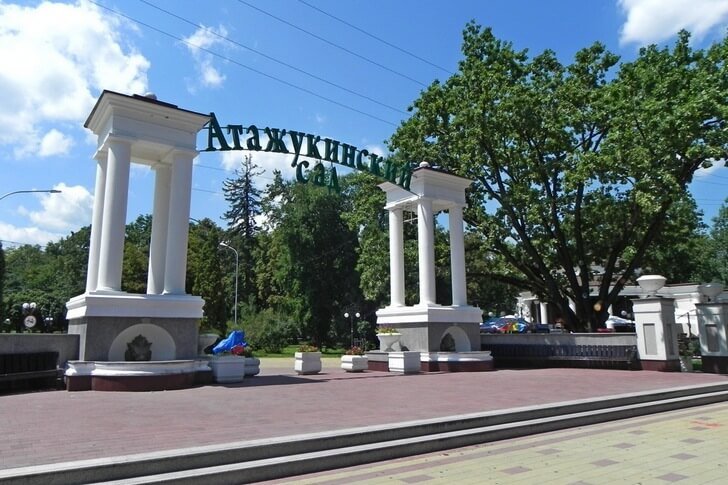
Atazhukinsky Garden — the largest park in the North Caucasus, covering 250 hectares of lush greenery
Founded in 1847, this is the largest park in the entire North Caucasus, covering approximately 250 hectares with a main alley stretching 1.5 kilometers. Named after the Kabardian prince who once owned these lands, the garden features exotic species including Japanese quinces, paulownias, and the rare two-lobed ginkgo. In 2002, it was officially recognized as the best park of culture and recreation in Russia.
3. Spa Lake (Курортное озеро)
This artificial reservoir sits within the city, framed by the spurs of the Wooded Range. Created in 1960 and filled with water from the Nalchik River, it's the only lake among four nearby where swimming is permitted. Willows line the banks, and family-friendly beaches offer catamaran and boat rentals during the season.
4. Green Theater (Зелёный театр)
Located inside Atazhukinsky Garden, this is Nalchik's main summer concert venue. Built in 2007 on the site of its predecessor, the amphitheater takes advantage of the mountain slope to create a natural, organic design. With a capacity of over 2,500 people, it hosts cultural performances and features a ground-floor café with a banquet hall.
5. Sosruko Restaurant (Ресторан Сосруко)
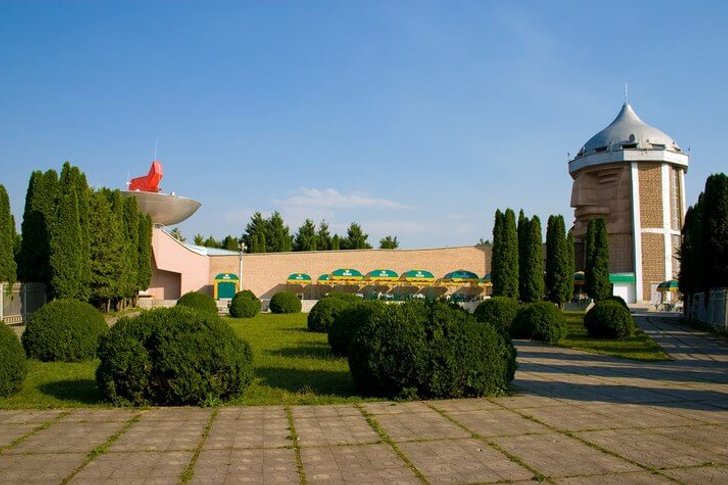
The iconic Sosruko Restaurant — shaped like the head of the legendary Nart hero, perched on Mount Kizilovka
Perched on Mount Kizilovka, this iconic building is shaped like the head of the Nart hero Sosruko (Сосрыкъуэ) — the legendary figure who stole fire from the gods for his people. According to the myth, he was imprisoned in the mountain with only his head and torch-bearing hand visible on the surface. This was a cult destination during the Soviet era, and every tourist considered dining at Sosruko an essential part of their Nalchik experience. The building remains one of the most photographed landmarks in the republic.
6. National Museum of Kabardino-Balkaria
Opened in 1921, this museum is divided into two major sections. The historical department showcases the peoples of the republic through archaeological and ethnographic finds, while the natural department highlights that Kabardino-Balkaria spans 5 distinct climatic zones, resulting in extraordinary biodiversity. Essential for understanding the deep roots of Kabardian Circassian culture.
7. Museum of Fine Arts (A. L. Tkachenko)
Founded in 1959, this museum houses works by masters including Shishkin, Aivazovsky, and Bryullov. A permanent exhibition features 18th-century French clocks, and the porcelain collection showcases pieces from Russia's finest factories alongside European and ancient Chinese masterworks.
8. Central Cathedral Mosque
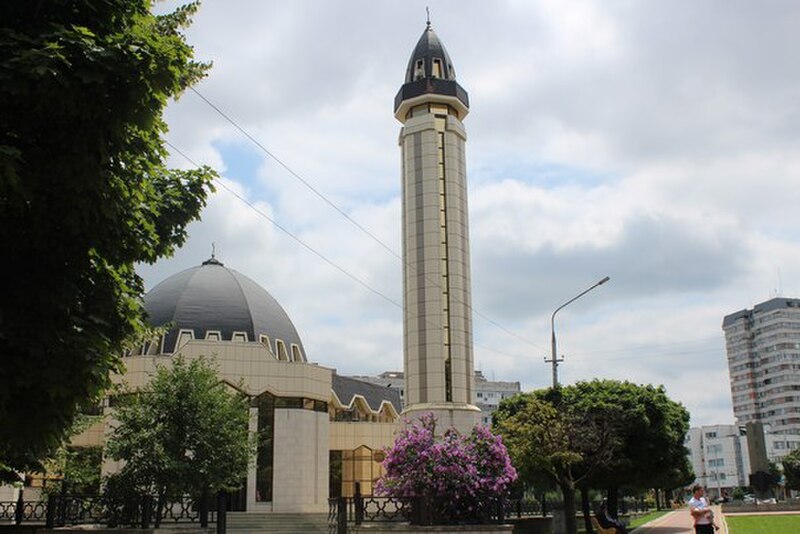
The Central Cathedral Mosque of Nalchik, a spiritual center for the Kabardian community
Opened in 2004, this striking mosque was built with local stone and materials reflecting the republic's traditions. Two 30-meter minarets rise beside the main entrance, and the building covers a total area of 1,700 square meters. It stands as a testament to the Islamic faith that is central to Kabardian and broader Circassian identity.
9. Nalchik Hippodrome
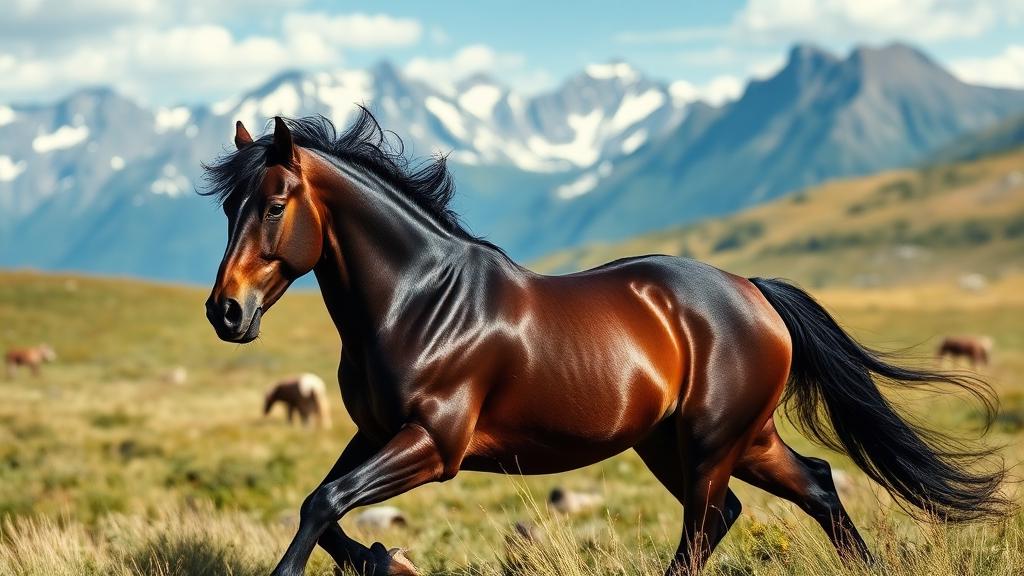
The legendary Kabardian horse — bred for over 400 years in the mountain pastures of the Central Caucasus
Since its opening in the 1930s, the hippodrome has been an integral part of city life. Kabardian horse breeders have always been renowned for raising hardy, graceful, and unpretentious horses — a tradition deeply connected to Circassian culture where the Kabardian horse breed (Адыгэш) is celebrated worldwide. Reconstructed in 2007, it remains one of the finest equestrian facilities in the country.
10. Blue Lakes (Голубые озёра)
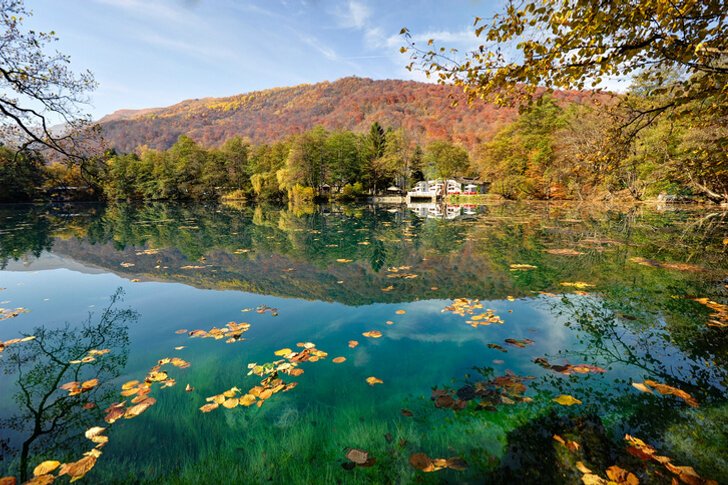
The Lower Blue Lake (Tserik-Kel) — one of the deepest karst lakes in the world with surreal turquoise waters
Located 30 km from Nalchik, these karst lakes are among the most mesmerizing natural wonders in the Caucasus. The Lower Blue Lake (Tserik-Kel / Церик-Кёл) is particularly famous — its name means "rotten" due to hydrogen sulfide deposits at depths exceeding 25 meters. Local legend speaks of a dragon lying at the bottom, shedding tears. It is considered one of the deepest karst lakes in the world, though its exact depth remains unknown. Camp sites dot the surrounding area.
11. Chegem Gorge and Waterfalls
This natural monument lies 55 km from Nalchik and features three spectacular waterfalls encountered while moving through the gorge: Adai-Su, Sakal-Tup, and Kayaarty. The last is the most popular — the river's flow splits into countless small streams, forming an inhomogeneous wall of cascading water. The attraction is visitable year-round, and in winter the frozen waterfalls create a magical ice formation.
Best Time to Visit Nalchik
- Spring (April–June) — Blooming nature and mild weather, perfect for park visits
- Summer (July–August) — Best for outdoor activities and lake swimming, though it can be hot
- Autumn (September–October) — Stunning fall foliage across the Caucasus mountains
- Winter (December–February) — Ideal for skiing at nearby Elbrus and winter sports
Nalchik Evening Activities
The city comes alive in the evening with leisurely walks through the illuminated City Park, traditional Kabardian cuisine at local restaurants, cultural performances at the Nalchik State Drama Theatre, and a modest but welcoming nightlife scene with live music venues. Street vendors offer local snacks, and the fountain shows at Place de la Concorde provide a perfect end to the day.
Resources, References & Further Reading
The Kabardian homeland in Kabardino-Balkaria is the most historically documented of all Circassian territories. Below we compile comprehensive resources covering princely genealogies, cultural institutions, natural wonders, and diaspora connections to help you trace your Kabardian roots.
Explore Kabardian Heritage on Our Platform
Our tools are designed specifically for Circassian genealogy research and cultural exploration:
- Family Tree Builder — Map your Kabardian lineage through the princely districts and five great valleys
- Circassian Family Name Encyclopedia — Identify whether your surname belongs to the Idarov, Kaytukhin, or other noble houses
- Cultural Encyclopedia — Deep-dive articles on Kabardian feudal society, warrior traditions, and court etiquette
- DNA Heritage Analysis — Discover your Y-DNA haplogroup connections to Kabardian tribal lineages
- Tamga Symbol Database — Find your family's ancient heraldic mark used by Kabardian clans for centuries
- Kabardian-English Dictionary — Master essential phrases in the East Circassian language
- Community Forum — Share genealogical discoveries and connect with Kabardian descendants globally
- Cultural Events Calendar — Track Kabardian cultural festivals and diaspora reunions
- Community Chat — Engage in real-time conversations with Kabardian heritage researchers
- Diaspora World Map — Visualize the global spread of Kabardian families from Nalchik to Amman
- Circassian Marketplace — Find authentic Kabardian crafts, traditional clothing, and cultural items
Related Articles on Circassian Heritage
Continue your exploration of Kabardian history and the broader Circassian world:
- The 1864 Circassian Deportation — How the Russian Empire expelled millions of Circassians including Kabardians
- The Battle of Sochi (1864) — The final chapter of the century-long Caucasian War
- Circassian Genocide Recognition — International efforts to acknowledge the Kabardian catastrophe
- The Adyghe Xabze — The aristocratic code perfected by Kabardian princes and nobles
- The Nart Sagas — Epic mythology featuring heroes like Sosruko immortalized in Nalchik's architecture
- Circassian Music & Dance — The Kabardinka ensemble and traditional performance arts
- Traditional Circassian Cuisine — Gedlibzhe, libzhe, and Kabardian feast traditions
- Learning Kabardian Language — Master the 48-consonant East Circassian tongue
- Circassians in Jordan — Kabardian families who built Amman's foundations
- Kfar Kama Village — Circassian heritage preserved in Israel's Galilee
- Global Diaspora Map — Kabardian migration routes across three continents
- Circassian Wedding Traditions — The elaborate marriage ceremonies of Kabardian nobility
- Tamga: Ancient Family Symbols — Princely clan marks from the Baksan and Cherek valleys
- Circassian Mamluks — Kabardian warriors who became sultans of Egypt
- DNA & Genealogy — Haplogroup analysis for Kabardian ancestral research
- Republic of Adygea — The western Circassian heartland and sister republic
- Karachay-Cherkessia — The Besleney territories and eastern Circassian frontier
- The Circassian Tribes — How Kabardians emerged as the dominant tribal confederation
- 8 Steps to Circassian Unity — Building bridges between homeland and diaspora communities
- Language Preservation — Efforts to save Kabardian as a living language
- Authentic Products — Kabardian traditional crafts and artisan goods
External Academic & Government Resources
For scholarly research and primary historical sources on Kabardino-Balkaria:
- Kabardino-Balkaria — Wikipedia — Republic overview with demographics and political history
- Nalchik (Capital City) — The garden city at the heart of Kabardian civilization
- Mount Elbrus — Europe's highest peak at 5,642 meters in Kabardian territory
- Kabardian Language — Linguistic analysis of East Circassian with 48 consonants
- Kabardian Horse Breed — The legendary mountain cavalry horse bred for 400+ years
- Circassian People — Comprehensive ethnic profile covering all Circassian tribes
- Russo-Circassian War — Military history of the Russian conquest of Kabarda
- Circassian Genocide — Documentation of the Kabardian population collapse
- Bezengi Wall — The 12-kilometer mountain wall known as the Caucasian Himalaya
- Chegem Waterfalls — Natural wonder with deep Kabardian historical significance
The Kabardian legacy stretches from the snow-capped summit of Elbrus to the bustling streets of Amman and Istanbul. Every Kabardian surname carries the memory of princes and warriors, poets and horsemen, who shaped one of the most remarkable civilizations in the history of the Caucasus. Use these resources to reclaim your heritage and connect with your ancestral homeland.
0–30/night in Nalchik guesthouses to $50–100+ at Elbrus-area hotels. Mountain lodges and camping offer budget alternatives. - Suggested itinerary: Fly into MRV → Nalchik (2 nights, Kabardian culture + city park) → Chegem Valley day trip (waterfalls + paragliding) → Upper Balkaria day trip (Blue Lakes) → Baksan Valley/Elbrus (3–4 nights, hiking or climbing) → onward to Adygea or Karachay-Cherkessia.
Top 15 Attractions in Nalchik
As the capital of Kabardino-Balkaria, Nalchik (Налшык in Kabardian) is nestled among mountains covered with lush greenery. The hills protect the city from cold winds, creating a mild, stable climate that has made it one of Russia's premier resort cities — second only to Sochi in resort area. Here are the must-visit attractions:
1. Place de la Concorde (Площадь Согласия)
An extensive landscaped area in front of the Government House, featuring beautiful flower beds, tree plantings, and a spectacular light-and-music fountain launched in 2012. During warm months, it hosts a mesmerizing water show set to world classics. This is where Nalchik's main social events and celebrations take place — a true gathering point for the city.
2. Atazhukinsky Garden (Атажукинский сад)
Atazhukinsky Garden — the largest park in the North Caucasus, covering 250 hectares of lush greenery
Founded in 1847, this is the largest park in the entire North Caucasus, covering approximately 250 hectares with a main alley stretching 1.5 kilometers. Named after the Kabardian prince who once owned these lands, the garden features exotic species including Japanese quinces, paulownias, and the rare two-lobed ginkgo. In 2002, it was officially recognized as the best park of culture and recreation in Russia.
3. Spa Lake (Курортное озеро)
This artificial reservoir sits within the city, framed by the spurs of the Wooded Range. Created in 1960 and filled with water from the Nalchik River, it's the only lake among four nearby where swimming is permitted. Willows line the banks, and family-friendly beaches offer catamaran and boat rentals during the season.
4. Green Theater (Зелёный театр)
Located inside Atazhukinsky Garden, this is Nalchik's main summer concert venue. Built in 2007 on the site of its predecessor, the amphitheater takes advantage of the mountain slope to create a natural, organic design. With a capacity of over 2,500 people, it hosts cultural performances and features a ground-floor café with a banquet hall.
5. Sosruko Restaurant (Ресторан Сосруко)
The iconic Sosruko Restaurant — shaped like the head of the legendary Nart hero, perched on Mount Kizilovka
Perched on Mount Kizilovka, this iconic building is shaped like the head of the Nart hero Sosruko (Сосрыкъуэ) — the legendary figure who stole fire from the gods for his people. According to the myth, he was imprisoned in the mountain with only his head and torch-bearing hand visible on the surface. This was a cult destination during the Soviet era, and every tourist considered dining at Sosruko an essential part of their Nalchik experience. The building remains one of the most photographed landmarks in the republic.
6. National Museum of Kabardino-Balkaria
Opened in 1921, this museum is divided into two major sections. The historical department showcases the peoples of the republic through archaeological and ethnographic finds, while the natural department highlights that Kabardino-Balkaria spans 5 distinct climatic zones, resulting in extraordinary biodiversity. Essential for understanding the deep roots of Kabardian Circassian culture.
7. Museum of Fine Arts (A. L. Tkachenko)
Founded in 1959, this museum houses works by masters including Shishkin, Aivazovsky, and Bryullov. A permanent exhibition features 18th-century French clocks, and the porcelain collection showcases pieces from Russia's finest factories alongside European and ancient Chinese masterworks.
8. Central Cathedral Mosque
The Central Cathedral Mosque of Nalchik, a spiritual center for the Kabardian community
Opened in 2004, this striking mosque was built with local stone and materials reflecting the republic's traditions. Two 30-meter minarets rise beside the main entrance, and the building covers a total area of 1,700 square meters. It stands as a testament to the Islamic faith that is central to Kabardian and broader Circassian identity.
9. Nalchik Hippodrome
The legendary Kabardian horse — bred for over 400 years in the mountain pastures of the Central Caucasus
Since its opening in the 1930s, the hippodrome has been an integral part of city life. Kabardian horse breeders have always been renowned for raising hardy, graceful, and unpretentious horses — a tradition deeply connected to Circassian culture where the Kabardian horse breed (Адыгэш) is celebrated worldwide. Reconstructed in 2007, it remains one of the finest equestrian facilities in the country.
10. Blue Lakes (Голубые озёра)
The Lower Blue Lake (Tserik-Kel) — one of the deepest karst lakes in the world with surreal turquoise waters
Located 30 km from Nalchik, these karst lakes are among the most mesmerizing natural wonders in the Caucasus. The Lower Blue Lake (Tserik-Kel / Церик-Кёл) is particularly famous — its name means "rotten" due to hydrogen sulfide deposits at depths exceeding 25 meters. Local legend speaks of a dragon lying at the bottom, shedding tears. It is considered one of the deepest karst lakes in the world, though its exact depth remains unknown. Camp sites dot the surrounding area.
11. Chegem Gorge and Waterfalls
This natural monument lies 55 km from Nalchik and features three spectacular waterfalls encountered while moving through the gorge: Adai-Su, Sakal-Tup, and Kayaarty. The last is the most popular — the river's flow splits into countless small streams, forming an inhomogeneous wall of cascading water. The attraction is visitable year-round, and in winter the frozen waterfalls create a magical ice formation.
Best Time to Visit Nalchik
- Spring (April–June) — Blooming nature and mild weather, perfect for park visits
- Summer (July–August) — Best for outdoor activities and lake swimming, though it can be hot
- Autumn (September–October) — Stunning fall foliage across the Caucasus mountains
- Winter (December–February) — Ideal for skiing at nearby Elbrus and winter sports
Nalchik Evening Activities
The city comes alive in the evening with leisurely walks through the illuminated City Park, traditional Kabardian cuisine at local restaurants, cultural performances at the Nalchik State Drama Theatre, and a modest but welcoming nightlife scene with live music venues. Street vendors offer local snacks, and the fountain shows at Place de la Concorde provide a perfect end to the day.
Resources, References & Further Reading
The Kabardian homeland in Kabardino-Balkaria is the most historically documented of all Circassian territories. Below we compile comprehensive resources covering princely genealogies, cultural institutions, natural wonders, and diaspora connections to help you trace your Kabardian roots.
Explore Kabardian Heritage on Our Platform
Our tools are designed specifically for Circassian genealogy research and cultural exploration:
- Family Tree Builder — Map your Kabardian lineage through the princely districts and five great valleys
- Circassian Family Name Encyclopedia — Identify whether your surname belongs to the Idarov, Kaytukhin, or other noble houses
- Cultural Encyclopedia — Deep-dive articles on Kabardian feudal society, warrior traditions, and court etiquette
- DNA Heritage Analysis — Discover your Y-DNA haplogroup connections to Kabardian tribal lineages
- Tamga Symbol Database — Find your family's ancient heraldic mark used by Kabardian clans for centuries
- Kabardian-English Dictionary — Master essential phrases in the East Circassian language
- Community Forum — Share genealogical discoveries and connect with Kabardian descendants globally
- Cultural Events Calendar — Track Kabardian cultural festivals and diaspora reunions
- Community Chat — Engage in real-time conversations with Kabardian heritage researchers
- Diaspora World Map — Visualize the global spread of Kabardian families from Nalchik to Amman
- Circassian Marketplace — Find authentic Kabardian crafts, traditional clothing, and cultural items
Related Articles on Circassian Heritage
Continue your exploration of Kabardian history and the broader Circassian world:
- The 1864 Circassian Deportation — How the Russian Empire expelled millions of Circassians including Kabardians
- The Battle of Sochi (1864) — The final chapter of the century-long Caucasian War
- Circassian Genocide Recognition — International efforts to acknowledge the Kabardian catastrophe
- The Adyghe Xabze — The aristocratic code perfected by Kabardian princes and nobles
- The Nart Sagas — Epic mythology featuring heroes like Sosruko immortalized in Nalchik's architecture
- Circassian Music & Dance — The Kabardinka ensemble and traditional performance arts
- Traditional Circassian Cuisine — Gedlibzhe, libzhe, and Kabardian feast traditions
- Learning Kabardian Language — Master the 48-consonant East Circassian tongue
- Circassians in Jordan — Kabardian families who built Amman's foundations
- Kfar Kama Village — Circassian heritage preserved in Israel's Galilee
- Global Diaspora Map — Kabardian migration routes across three continents
- Circassian Wedding Traditions — The elaborate marriage ceremonies of Kabardian nobility
- Tamga: Ancient Family Symbols — Princely clan marks from the Baksan and Cherek valleys
- Circassian Mamluks — Kabardian warriors who became sultans of Egypt
- DNA & Genealogy — Haplogroup analysis for Kabardian ancestral research
- Republic of Adygea — The western Circassian heartland and sister republic
- Karachay-Cherkessia — The Besleney territories and eastern Circassian frontier
- The Circassian Tribes — How Kabardians emerged as the dominant tribal confederation
- 8 Steps to Circassian Unity — Building bridges between homeland and diaspora communities
- Language Preservation — Efforts to save Kabardian as a living language
- Authentic Products — Kabardian traditional crafts and artisan goods
External Academic & Government Resources
For scholarly research and primary historical sources on Kabardino-Balkaria:
- Kabardino-Balkaria — Wikipedia — Republic overview with demographics and political history
- Nalchik (Capital City) — The garden city at the heart of Kabardian civilization
- Mount Elbrus — Europe's highest peak at 5,642 meters in Kabardian territory
- Kabardian Language — Linguistic analysis of East Circassian with 48 consonants
- Kabardian Horse Breed — The legendary mountain cavalry horse bred for 400+ years
- Circassian People — Comprehensive ethnic profile covering all Circassian tribes
- Russo-Circassian War — Military history of the Russian conquest of Kabarda
- Circassian Genocide — Documentation of the Kabardian population collapse
- Bezengi Wall — The 12-kilometer mountain wall known as the Caucasian Himalaya
- Chegem Waterfalls — Natural wonder with deep Kabardian historical significance
The Kabardian legacy stretches from the snow-capped summit of Elbrus to the bustling streets of Amman and Istanbul. Every Kabardian surname carries the memory of princes and warriors, poets and horsemen, who shaped one of the most remarkable civilizations in the history of the Caucasus. Use these resources to reclaim your heritage and connect with your ancestral homeland.