השבט הקברדיני: העם הצ’רקסי הגדול ביותר
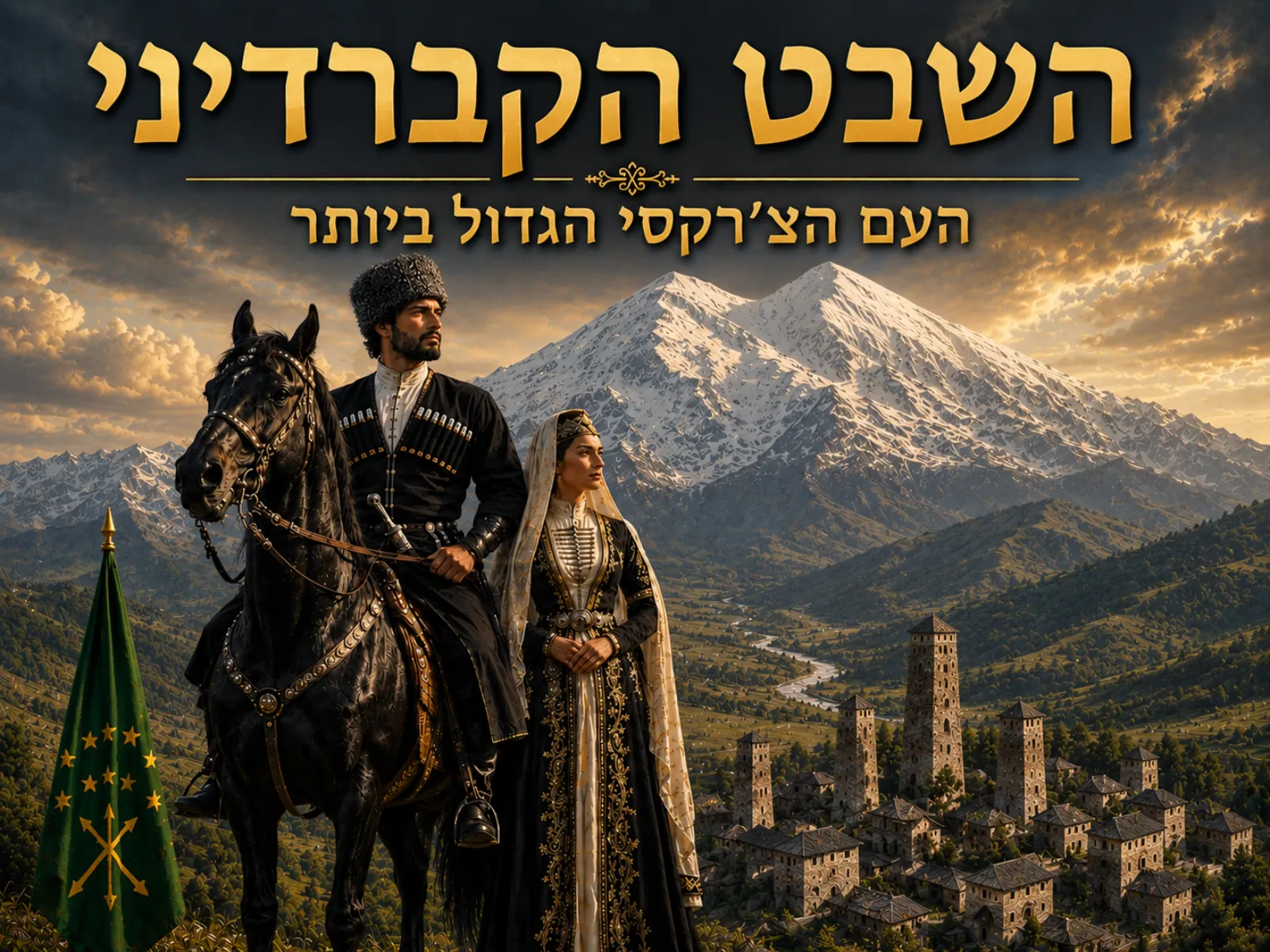
The Kabardian Tribe: Largest Circassian Nation
Къэбэрдей. The princely line that built the largest Circassian polity, married into the Russian throne, lost ninety percent of its population in a single decade, and still gives its language to every Adyghe child who learns to write today.
CircassianWebUpdated: January 202622–26 min readTribe profile
The Kabardians (Адыгэ: Къэбэрдей) are the largest of the twelve Circassian tribes. They sit at the eastern end of the Adyghe world, in the foothills and steppes between the Kuban basin and the Terek River. For four centuries, from roughly 1450 to 1820, they were also the most powerful Circassian polity. Their princes negotiated with Crimean khans, with Ottoman sultans, with Russian tsars, and with each other. One of their princesses married Ivan the Terrible. Their horses were known from Tabriz to Warsaw. Their language is the standard form of Eastern Circassian taught in schools today. And they are the tribe most Circassians outside the Caucasus first encountered when they tried to imagine "Circassian" as a single thing.
This is the long-form profile of the Kabardians. It covers the historical principality, the language, the social structure, the diplomacy with Russia, the catastrophic plague of 1804-1807, the Russo-Circassian War, the survival of the homeland community in the Republic of Kabardino-Balkaria, the famous princely families (Idarov, Kazbek, Atazhukin, Tambiev, Misostov), the Kabardian horse, the Islamey dance that found its way into Russian classical music, the diaspora today, the surnames you may carry, and a practical method for tracing your own Kabardian line. Sources include Wikipedia's Kabardians entry, Amjad Jaimoukha's The Circassians: A Handbook (2001) and his Kabardians: A Handbook, Walter Richmond's The Circassian Genocide, and primary material from Russian and Ottoman archives.
If your family identifies as Kabardian, this article is for you. If you suspect Kabardian heritage from a half-translated surname, a remembered village name, or a grandparent's reference to "Kabarda," "Nalchik," or "the Terek," the framework here will help you confirm or rule it out.
Who Are the Kabardians?
The largest Adyghe tribe, an Eastern Circassian people centred on the Terek River basin. Their language is the literary standard for Eastern Circassian, and their princely class shaped four centuries of Caucasian politics.
The Kabardians are the largest of the twelve Adyghe tribes. They speak Kabardian, an Eastern Circassian language, and they are the demographic majority in the Russian republic of Kabardino-Balkaria, where about 510,000 people identify as Kabardian. That figure makes them more numerous than all the other Adyghe tribes combined inside the Russian Federation. Outside Russia, the diaspora is also large: estimates for Kabardian-descended populations in Turkey alone run from a few hundred thousand to more than a million, depending on whether the count includes families who have lost active tribal identity.
The Kabardian story is, in many ways, the central thread in the broader Circassian narrative. They were the largest single principality in pre-conquest Circassia. Their language became the basis for written Eastern Adyghe, taught in Soviet schools and used in modern publishing and broadcasting. Their princely families dominated Adyghe diplomacy from the late medieval period through the early 19th century. And they suffered the most documented single-decade demographic collapse of any Adyghe tribe, when the plague of 1804-1807 cut their population by something close to ninety percent.
Despite that collapse, and despite the later catastrophe of the Russo-Circassian War, the Kabardians kept a substantial homeland community. That continuity matters today. A Kabardian family in Amman, Istanbul, or New Jersey can usually find a counterpart family in Nalchik or one of the surrounding villages, and the genealogical connection between them is often well-documented.
~510,000 Kabardians in Kabardino-Balkaria today
12 One of the 12 Adyghe tribes (largest)
~90% Population loss in the plague of 1804-1807
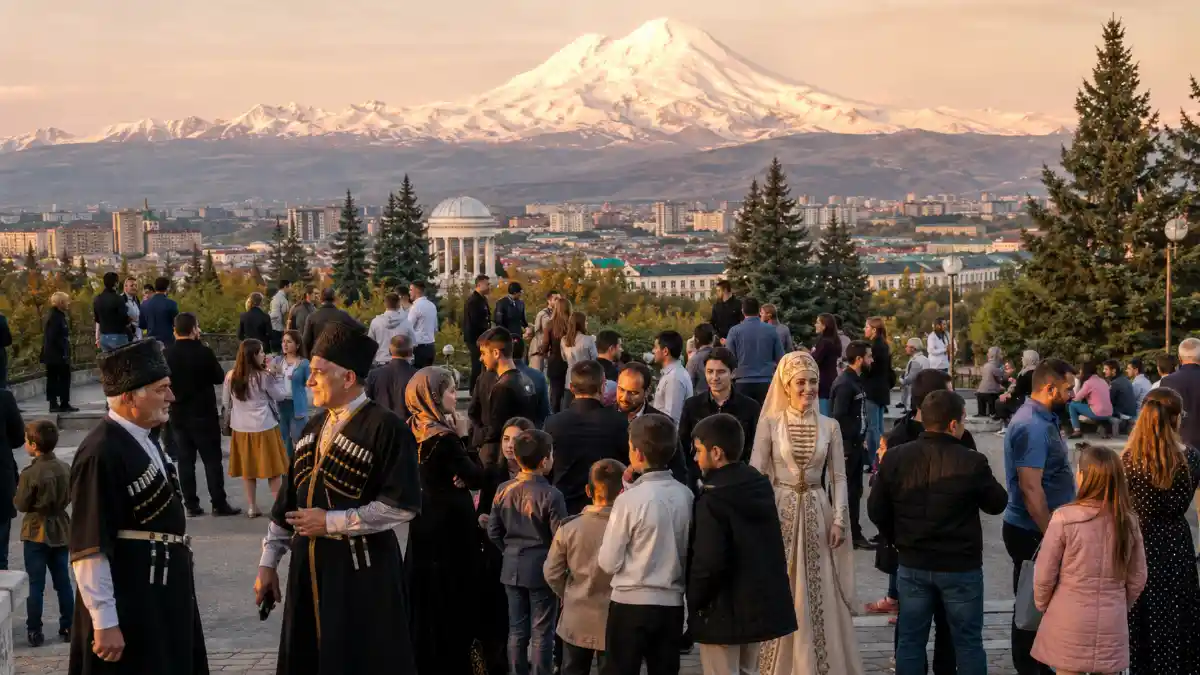
Where the name comes from
The name Kabardian (Къэбэрдей in Adyghe Cyrillic) refers to the territory of Kabarda, the historical principality on the Terek River. The etymology is debated. Some Adyghe sources link it to the personal name of an early ruler. Others trace it to older toponymic roots. What is clear is that "Kabardian" became the standard self-designation for the eastern Adyghe by the 15th and 16th centuries, when the principality of Kabarda emerged as a distinct political entity under the descendants of Inal the Great.
Inside the Caucasus, Kabardians historically distinguished themselves from western Adyghe groups (Bzhedug, Shapsug, Abzakh, and so on) and from their close eastern relatives the Besleneys. In the Soviet period, official ethnic categories grouped Kabardians together with the Cherkess of Karachay-Cherkessia under the umbrella of Kabardo-Cherkess speakers, and the term "Cherkess" entered Russian usage as a label for several related but distinct Adyghe groups.
Three things that make the Kabardians distinctive
Sheer size. They are the largest single Adyghe population, and their language is the literary standard for the eastern branch.
Diplomatic weight. From the late 15th century through the 1820s, Kabardian princely houses negotiated as equals with Crimean khans, Ottoman sultans, Russian tsars, and Persian shahs. No other Adyghe tribe had that level of external recognition.
Demographic resilience. Most Western Adyghe tribes were nearly emptied from the homeland in 1864. The Kabardians had already absorbed catastrophic losses earlier (the 1804-1807 plague), but the survivors stayed, and their descendants form the largest continuous Adyghe community on the homeland today.
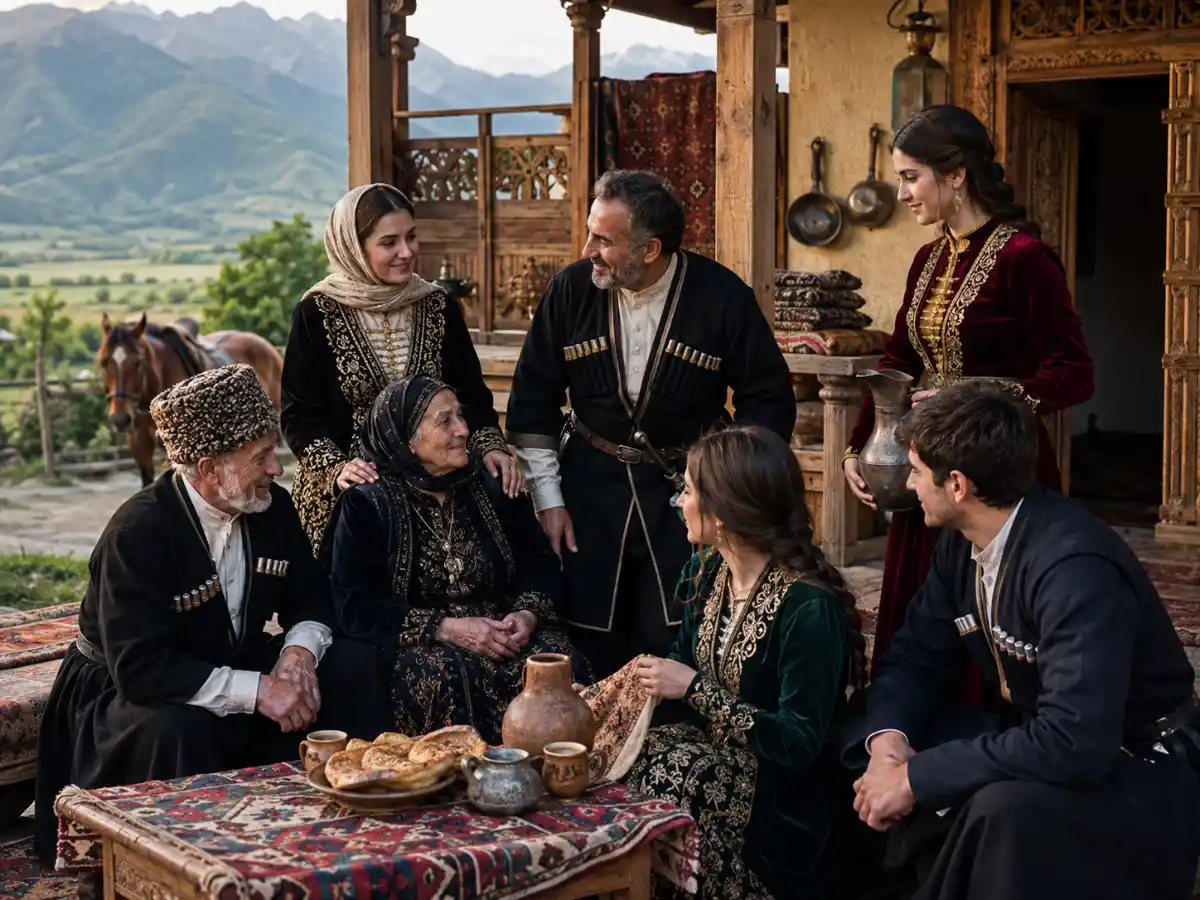
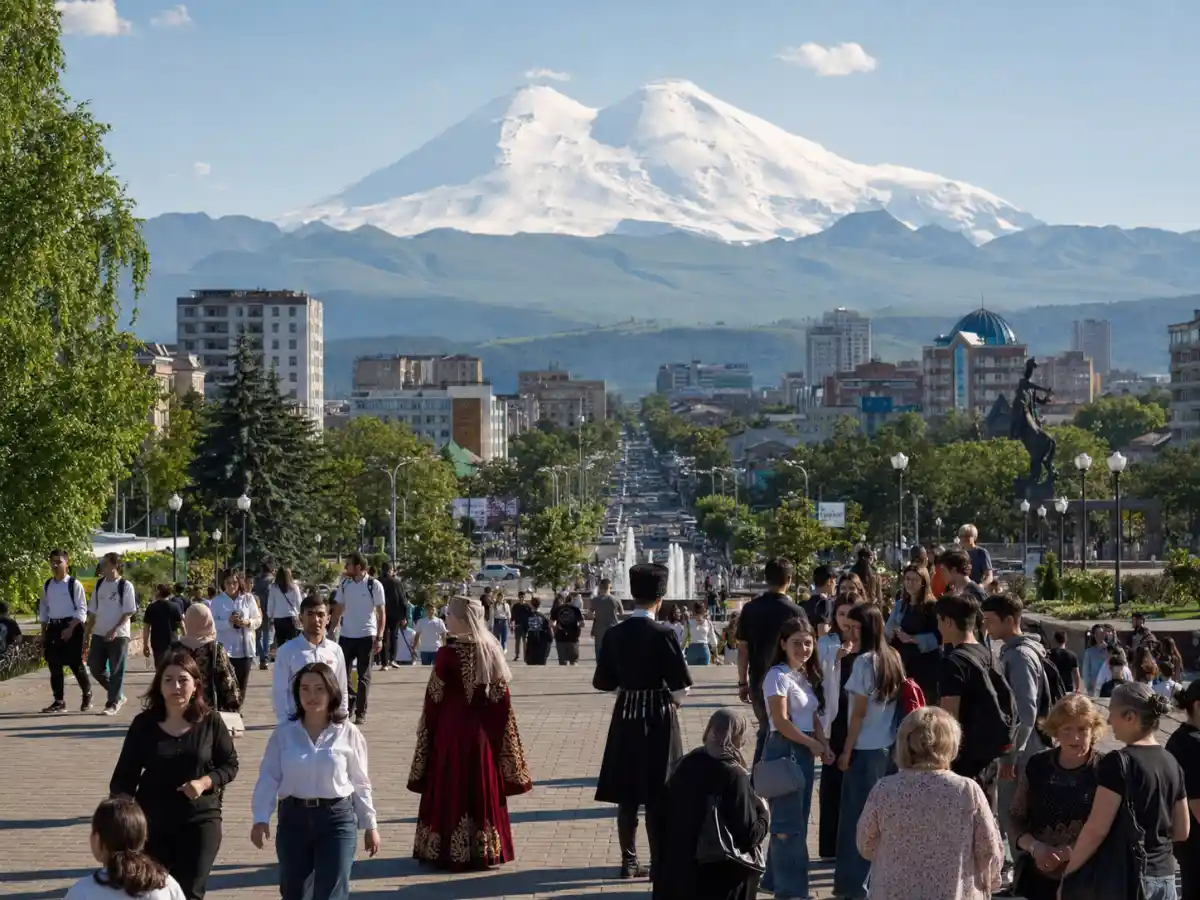
Kabarda · The homelandA Kabardian household in the Terek basin foothills. The chokha coat, the carpet textiles, and the wooden architecture reflect a tradition that survived three of the worst centuries any Adyghe tribe lived through, and continued unbroken into the present day.
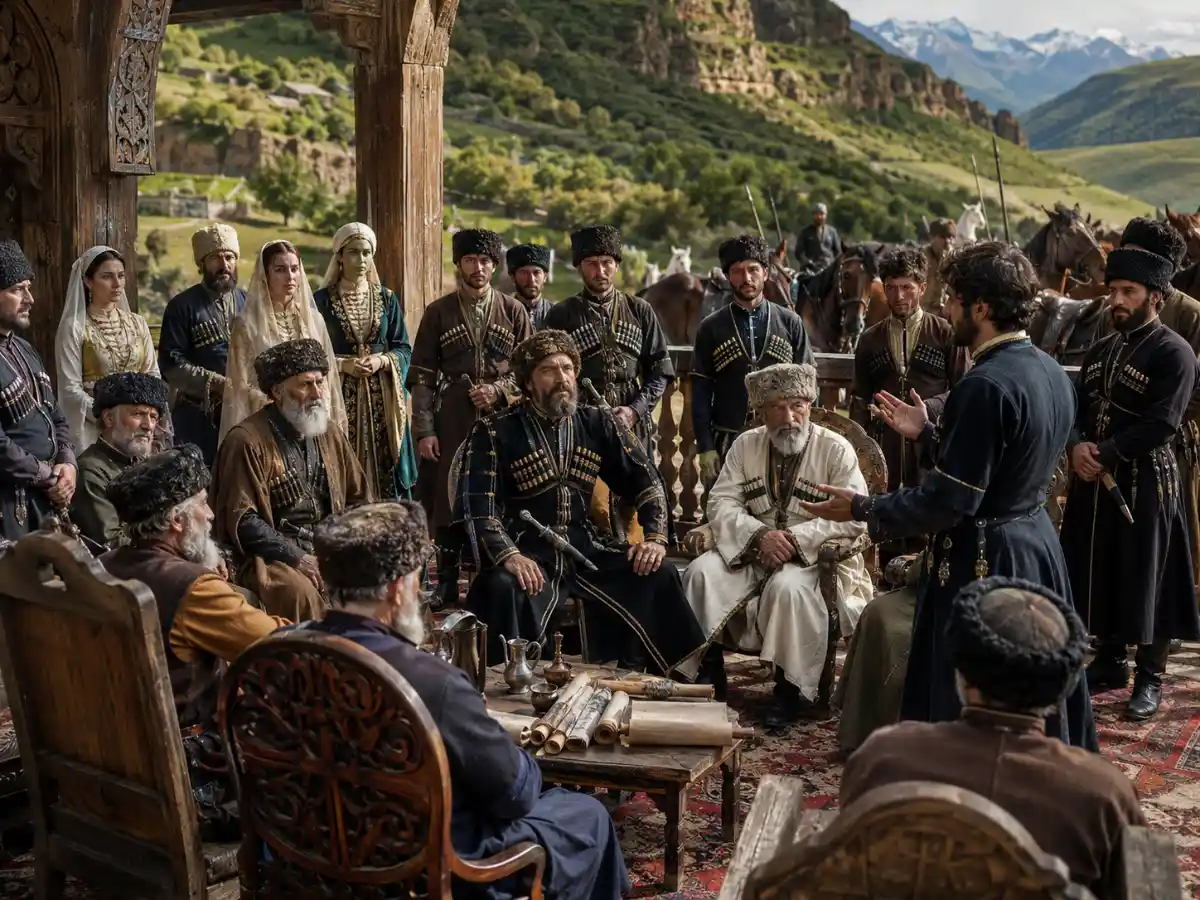
Inal the Great & the Kabardian Origin
Inal the Great, a 15th-century unifier of Adyghe principalities, is the legendary common ancestor of the Kabardian, Besleney, Hatuqay, and Temirgoy princely lines. His name still appears in genealogies recited in Kabardian families today.
The founding figure in Kabardian historical memory is Inal the Great (sometimes Inal Nef, "Inal the One-Eyed"), a prince who lived in the early-to-mid 15th century. Adyghe oral tradition, written down by 19th-century chroniclers like Shora Nogmov, credits him with unifying a fractured set of Adyghe principalities under a single rule and creating the political foundation on which the later Kabardian, Besleney, Hatuqay, and Temirgoy princedoms were built.
The historical Inal is hard to pin down with certainty. The chronicles that mention him are themselves later compilations, and his life sits at the boundary between history and legend. But several features of the Inal tradition are consistent across sources. He is described as a unifier, not a conqueror. His rule extended over the Adyghe-speaking peoples east and west of the central Caucasus. On his death, his domain was divided among his sons, and the resulting branches gave rise to the historically distinct Adyghe princedoms.
The Kabardians traditionally trace their princely line to Inal directly, through his son Tabula and a sequence of named descendants who built the principality of Kabarda on the Terek River. The Besleneys claim descent from Beslan, another son. The Temirgoy from Boletoqo. The Hatuqay from Hatuqo. This shared genealogy explains why the eastern Adyghe princely families intermarried for centuries and why a documented Kabardian noble pedigree often connects, three or four generations back, to a Besleney, Hatuqay, or Temirgoy noble house.
The chronicle of Shora Nogmov
The 19th-century Kabardian historian Shora Nogmov (1794-1844) compiled the standard written version of the Adyghe historical chronicle, working from oral traditions transmitted by elders. His History of the Adyghe People remains the foundational source for the Inal genealogy and for the medieval history of the Kabardian principality. Nogmov was himself a Kabardian, fluent in Russian and Arabic, and his work bridged Adyghe oral tradition with the imperial Russian historiographical conventions of his time.
Nogmov's chronicle is not unproblematic. He worked at a time when Russian scholarship was actively shaping the categories used to describe Caucasian peoples, and his account reflects some of that shaping. But for anyone tracing Kabardian genealogy, his work remains essential: most documented Kabardian princely lines trace through Nogmov's reconstruction of the Inal succession.
The seven-generation rule
One Kabardian custom that bears directly on genealogy: a young Kabardian noble was historically expected to recite his paternal lineage back seven generations. This was not a memory exercise. It governed marriage eligibility (you could not marry into a clan within seven generations of your own), social standing, and the family's place in the broader noble network.
That custom has had a remarkable effect on the modern record. Kabardian families, whether in the homeland or in the diaspora, often retain unusually deep oral genealogies. A grandparent in Amman or Kayseri may be able to recite five or six generations of ancestors by name, with patronymics, and sometimes with village names. That is the raw material on which any Kabardian ancestry research is built.
A young Kabardian was expected to recite his paternal lineage back seven generations. This was not academic. It determined marriage eligibility, social standing, and the family's role inside the tribal structure.— from CircassianWeb's guide to Circassian ancestry
Lesser Kabarda
The historical principality split into Greater Kabarda (south of the Terek, between the Terek and the Malka) and Lesser Kabarda (north of the Terek). Together they covered most of what is now Kabardino-Balkaria, with parts in modern North Ossetia, Stavropol Krai, and Karachay-Cherkessia.
The Kabardian homeland centred on the Terek River basin, with the principality split into two named sub-divisions:
Greater Kabarda (Адыгэбзэ Къэбэрдей Ин). The larger and more powerful sub-division, covering the lands south of the Terek and reaching south to the Malka and the foothills of the central Caucasus mountains. The political centre of Greater Kabarda lay in the area that is now the Kabardino-Balkarian capital, Nalchik, and the surrounding villages.
Lesser Kabarda (Къэбэрдей Цlыкlу). The smaller sub-division, covering the lands north of the Terek toward the open steppe. Lesser Kabarda was politically tied to Greater Kabarda but had its own princely houses and its own internal organisation.
The geographical advantage of Kabarda was its position. The principality controlled the entrance to the central Caucasus from the north. Trade routes from the Russian steppe to Transcaucasia ran through Kabardian territory. Military expeditions southward from the Russian frontier, and northward from Persia or the Ottoman Caucasus, had to cross Kabardian land. That position gave Kabardian princes leverage in diplomacy and in warfare, and it is the principal reason the principality remained a major regional power for so long.
The modern Republic of Kabardino-Balkaria
The historical Kabardian territory is mostly contained within the modern Russian republic of Kabardino-Balkaria, a federal subject of the Russian Federation in the North Caucasus. The republic is a binational state shared with the Turkic Balkar people, who live primarily in the high-mountain valleys to the south and east of the Kabardian lowlands. The capital is Nalchik, a city of about 240,000 people that sits at the foot of the central Caucasus.
Kabardino-Balkaria has a population of about 870,000, of whom roughly 510,000 are Kabardian (about 57 percent of the republic), 130,000 are Balkar, and the rest are Russian, Ossetian, and other ethnic groups. The republic functions as the principal anchor of Kabardian language, culture, and political identity. It hosts the Kabardino-Balkarian State University, the Kabardian Academy of Sciences, an Adyghe-language press, and the most extensive corpus of Kabardian-language television, radio, and digital media available anywhere.
Smaller Kabardian communities also live in Karachay-Cherkessia (where they are sometimes counted as "Cherkess" in official categories), in North Ossetia, and in Stavropol Krai. Together with the Kabardian population of Kabardino-Balkaria, these communities form the largest concentration of Adyghe-speaking people anywhere in the world.
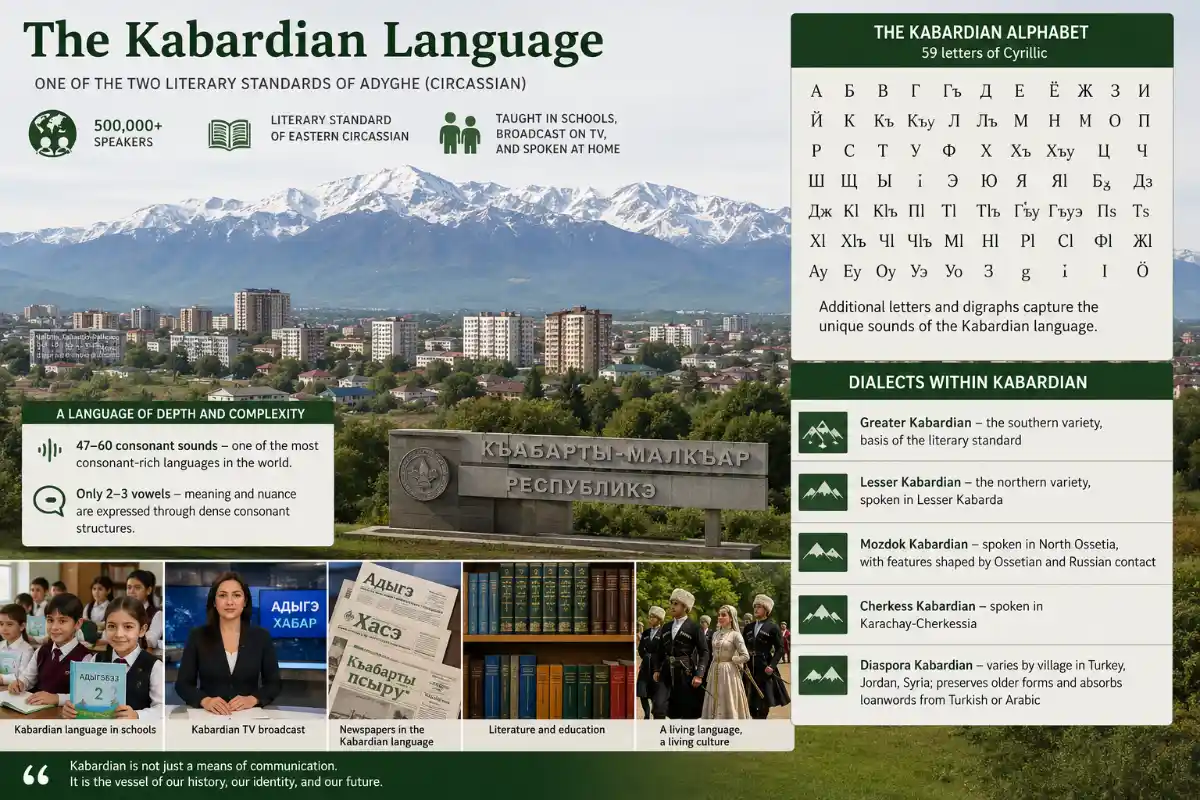
The Kabardian Language
Kabardian is one of two literary Circassian standards. It uses a 59-letter Cyrillic alphabet, has more than half a million speakers, and is the version of Adyghe most commonly taught and broadcast.
The Kabardian language is one of the two literary standards of Adyghe (Circassian). Linguists classify it as Eastern Circassian (Kabardo-Cherkess), distinct from West Circassian (Adyghe proper, including Bzhedug, Shapsug, Abzakh, Temirgoy, and other dialects). The two standards are mutually intelligible with effort but not with ease. A Kabardian speaker and a Bzhedug speaker can usually understand each other's main points but will miss specific vocabulary and idioms.
Kabardian is famous among linguists for two features: its enormous consonant inventory (between 47 and 60 distinct consonant phonemes, depending on dialect) and its small vowel inventory (only two or three vowels, with a great deal of complexity expressed through consonants). It is one of the most consonant-heavy languages on Earth. Words that look unmanageably long in Cyrillic transliteration are typically pronounced as a single dense cluster of consonants with brief vowel anchors.
The Kabardian alphabet
Modern written Kabardian uses a Cyrillic alphabet of 59 letters, developed in the Soviet period from earlier Arabic-script and Latin-script attempts. The alphabet expands the standard Russian Cyrillic with additional letters and digraphs to capture the language's consonant complexity. Letters like Хъ, Лъ, Кl, and Гъу represent specific consonants that have no direct equivalent in Russian.
The Kabardian alphabet is taught in primary schools across Kabardino-Balkaria. Newspapers, books, and television programmes are produced in the standard. Diaspora language schools in Turkey, Jordan, and elsewhere often teach Kabardian using the same standard, which has made it one of the most accessible varieties of Adyghe for diaspora learners.
Dialects within Kabardian
Inside Kabardian itself, several internal dialects are recognised:
Greater Kabardian (the southern variety, spoken across most of Kabardino-Balkaria) is the basis of the literary standard.
Lesser Kabardian (the northern variety, spoken in Lesser Kabarda) shows distinct phonetic and lexical features.
Mozdok Kabardian, a small dialect spoken by a Kabardian community in the Mozdok district of North Ossetia, has unique features partly shaped by long contact with neighbouring Ossetian and Russian speakers.
Cherkess Kabardian, spoken in Karachay-Cherkessia, is closely related to the standard but with its own dialect identity.
Diaspora Kabardian, in Turkey, Jordan, and Syria, varies village by village. Some communities have preserved older 19th-century forms; others have absorbed loanwords from Turkish or Arabic.
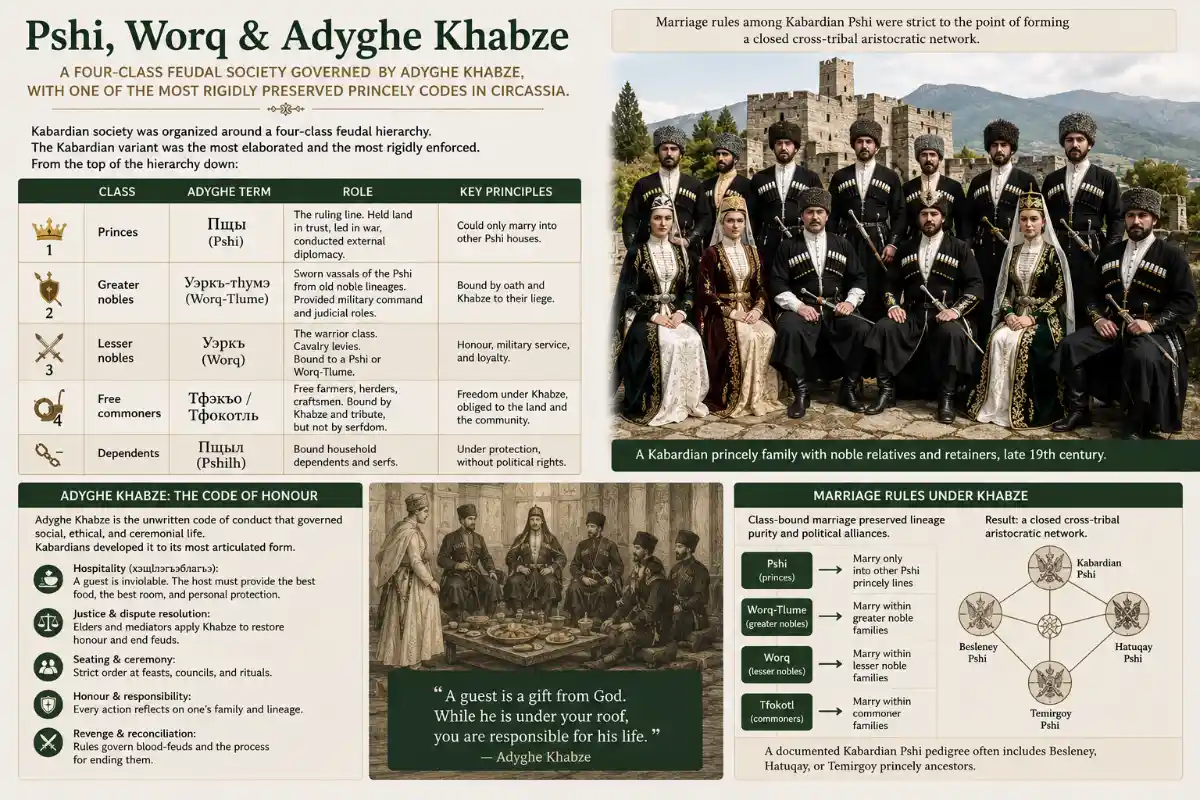
Pshi, Worq & Adyghe Khabze
A four-class feudal society governed by Adyghe Khabze, with one of the most rigidly preserved princely codes in Circassia. Marriage rules among Kabardian Pshi were strict to the point of forming a closed cross-tribal aristocratic network.
Kabardian society was organised around a four-class feudal hierarchy that was, in its formal structure, similar to that of other Adyghe tribes. The Kabardian variant was the most elaborated and the most rigidly enforced. From the top of the hierarchy down:
ClassAdyghe termRolePrincesПщы (Pshi)The ruling line. Held land in trust, led in war, conducted external diplomacy. Could only marry into other Pshi houses.Greater noblesУэркъ-тlумэ (Worq-Tlume)Sworn vassals of the Pshi from old noble lineages. Provided military command and judicial roles.Lesser noblesУэркъ (Worq)The warrior class. Cavalry levies. Bound to a Pshi or Worq-Tlume.Free commonersТфэкъо / ТфокотльFree farmers, herders, craftsmen. Bound by Khabze and tribute, but not by serfdom.DependentsПщылl (Pshilh)Bound household dependents and serfs.
Adyghe Khabze and the Kabardian Code
Adyghe Khabze is the unwritten code of conduct that governed Adyghe social, ethical, and ceremonial life. All twelve Adyghe tribes followed it, but the Kabardians are widely regarded as having developed it to its most articulated form. The Kabardian variant of Khabze, sometimes called Adyghe Xabze in Western texts and Адыгэ хабзэ in Cyrillic, set out detailed prescriptions for hospitality, dispute resolution, mourning, marriage, the seating order at feasts, the roles of elders, the rules of revenge, and the procedures for ending a feud.
One particularly important feature was the Kabardian rule of hospitality (хэщlэгъэблагъэ). A guest was inviolable. The host was obliged to provide the best food, the best room, the best company, and personal protection. A Kabardian noble was held responsible for the safety of any guest under his roof to a degree that would seem extreme by modern standards. The reverse was also true: the guest had ceremonial obligations, including specific ways of seating, speaking, departing, and reciprocating the hospitality at a later date.
Marriage rules under Khabze were strict and class-bound. A Kabardian Pshi could marry only into another Pshi line. Worq married Worq. Tfokotl married Tfokotl. The result was a closed cross-tribal aristocratic network. A documented Kabardian Pshi pedigree often turns up Besleney, Hatuqay, or Temirgoy princely cousins, because all four traced descent from Inal and intermarried for centuries
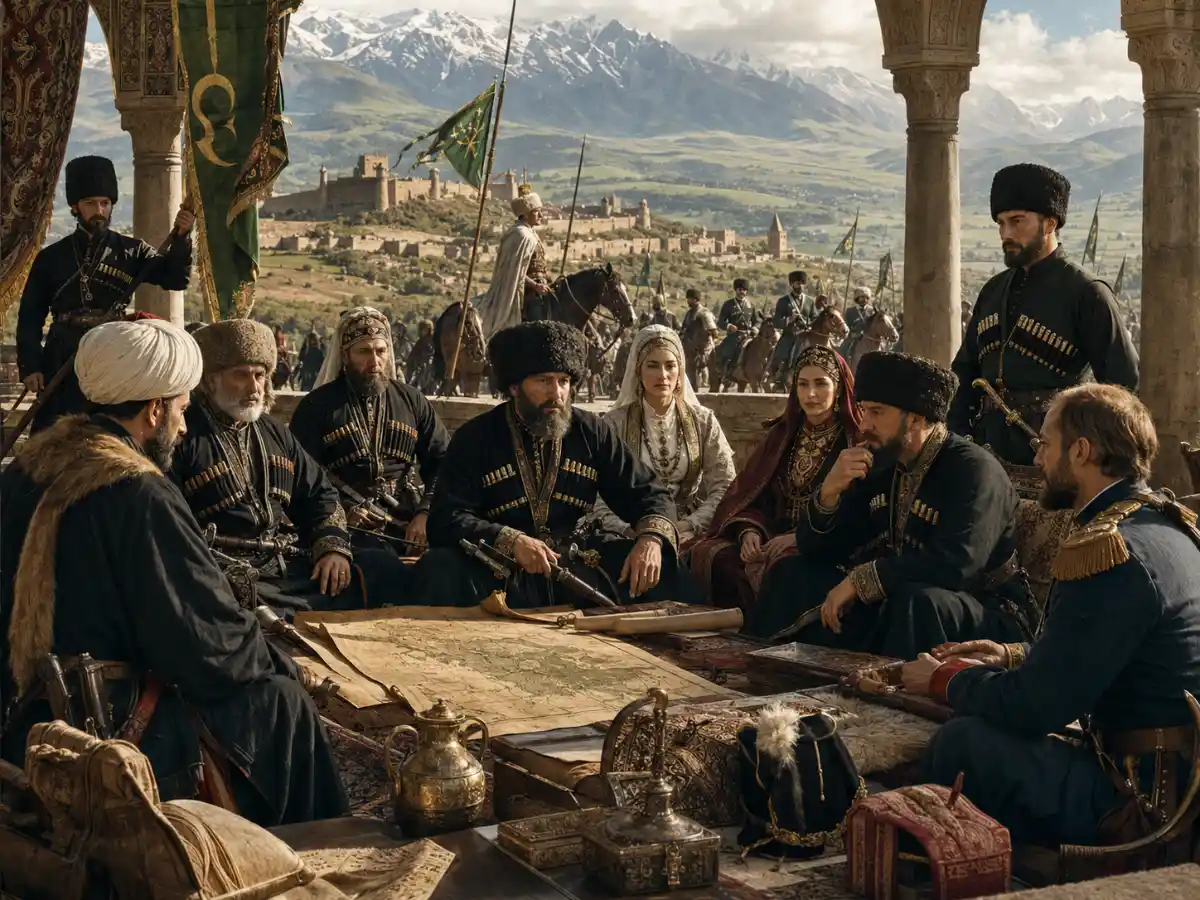
The Kabardian Principality
From roughly 1450 to 1820, Kabarda was the most powerful Adyghe polity. Its princes negotiated as equals with Crimean khans, Ottoman sultans, and Russian tsars, and at moments held suzerainty over neighbouring Caucasian peoples.
The Kabardian principality emerged in the second half of the 15th century, following the Inal succession. Its political weight grew through the 16th century, peaked in the 17th and 18th centuries, and was broken in the early 19th century by the combination of plague, internal conflict, and Russian military pressure.
At its peak, Kabarda was the most powerful Adyghe polity in the Caucasus. The principality maintained:
A standing princely military, drawn from the Worq cavalry class, capable of fielding several thousand mounted warriors on short notice.
A network of vassal relationships with smaller neighbouring peoples, including some of the Balkar, Karachay, Ossetian, Ingush, and Chechen communities, who paid tribute or provided military levies in exchange for protection.
Diplomatic recognition from the Crimean Khanate, the Ottoman Empire, the Russian Empire, and the Persian state. Kabardian princes received envoys, exchanged gifts, and conducted negotiations through formal protocol.
Internal political institutions, including a council of princes (the Khasa) that mediated disputes between Pshi houses and coordinated collective action.
The principality was never a centralised state in the modern sense. It was a federation of princely houses, each ruling its own territory under common Kabardian identity. Authority moved through personal alliances, marriage networks, and ritualised council deliberations rather than through bureaucratic institutions. That structure made Kabarda flexible and resilient in good times, but it also meant that a serious internal conflict could paralyse collective action, and exactly that paralysis became an exploitable weakness for outside powers in the 18th and 19th centuries.
The Crimean and Ottoman relationship
For much of the 16th and 17th centuries, the Kabardian relationship with the Crimean Khanate was the central external concern. The Crimean khans periodically demanded tribute from Kabardian princes and conducted slave-raiding expeditions into Adyghe territory. Kabardian responses ranged from negotiated payments to outright military resistance, with princes occasionally allying with the Crimean court and at other moments leading coalitions against it.
The Ottoman Empire stood in the background of these relationships. The Ottomans claimed nominal suzerainty over the broader Circassian region through their relationship with the Crimean khans, and they collected slaves and military recruits from the area. But Ottoman direct control of Kabarda was always limited. Kabardian princes corresponded with the Sublime Porte, accepted occasional Ottoman titles and gifts, and sent contingents to fight in Ottoman wars, but they ran their own affairs at home.
Maria Temryukovna & Ivan the Terrible
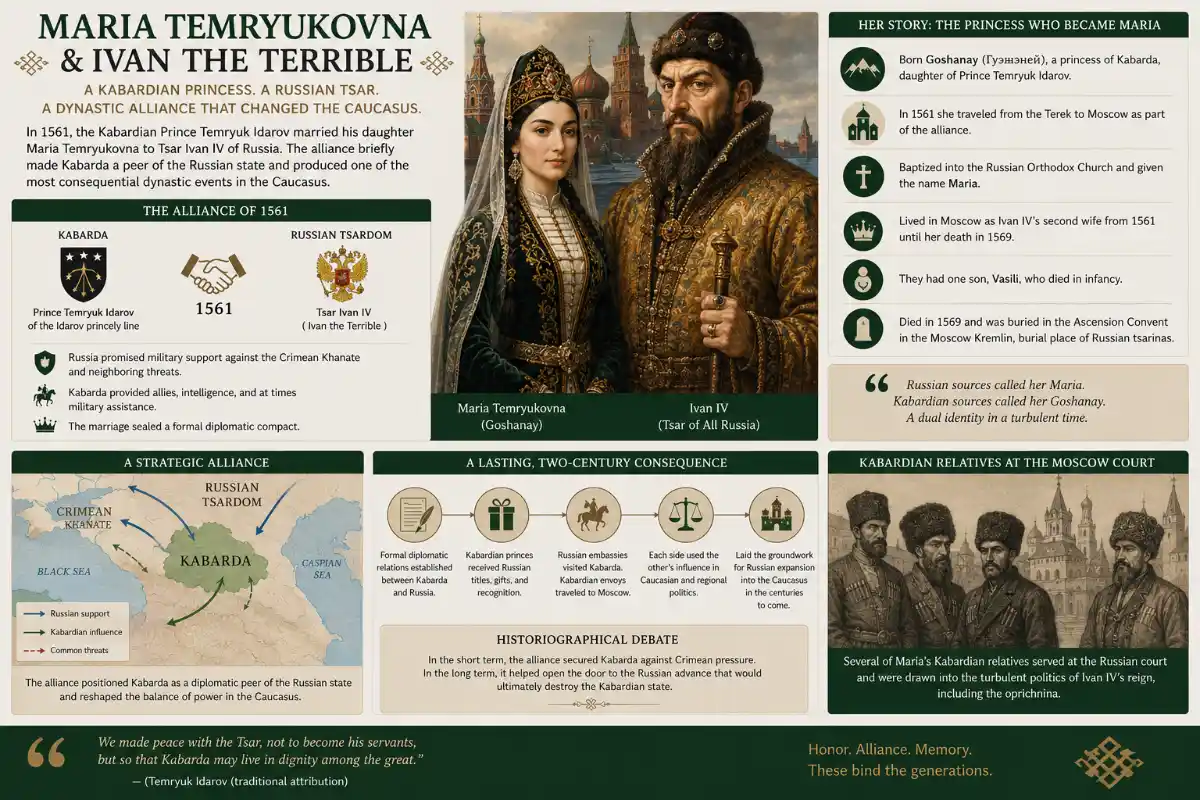
In 1561, the Kabardian Prince Temryuk Idarov married his daughter to Tsar Ivan IV. The alliance briefly made Kabarda a peer of the Russian state and produced one of the most consequential dynastic events in the Caucasus.
The most famous single event in Kabardian diplomatic history is the marriage in 1561 of Maria Temryukovna, a Kabardian princess, to Tsar Ivan IV of Russia, known to history as Ivan the Terrible. Maria was the daughter of Prince Temryuk Idarov, one of the most powerful Kabardian Pshi of the mid-16th century and the head of the Idarov princely line.
The marriage was a diplomatic instrument. The Kabardians, threatened by Crimean Tatar raids and shifting Caucasian alliances, sought a counterweight in the rising Russian state. Ivan, having recently conquered Kazan and Astrakhan and looking to extend Russian influence southward, saw a Kabardian alliance as a way to secure his frontier. The marriage sealed a Kabardian-Russian compact under which Russian forces provided military backing against the Crimean Khanate and Kabardian forces provided local intelligence, allies, and at moments direct military support to Russian campaigns.
Maria Temryukovna lived in Moscow as Ivan's second wife from 1561 until her death in 1569. The marriage produced one son, Vasili, who died in infancy. Maria's tenure at the Russian court was politically significant but personally turbulent: Ivan's reign was entering its most violent phase, and several of Maria's Kabardian relatives at the Moscow court were drawn into Russian internal politics, including the oprichnina.
The longer-term consequence of the alliance was substantial. Kabardian-Russian diplomatic relations were placed on a formal footing that would persist, with breaks and reversals, for two centuries. Kabardian princes received Russian titles and gifts. Russian embassies travelled to Kabarda. The Russian state used Kabardian leverage in Caucasian politics, and Kabardian princes used Russian leverage to negotiate with Ottoman and Crimean powers.
Whether the alliance ultimately served Kabardian interests is one of the central debates in the historiography of the principality. In the short term, it secured Kabarda against Crimean pressure. In the long term, it laid the institutional foundation for the Russian advance into the Caucasus that would, two and a half centuries later, destroy the Kabardian state.
Story: The princess who became Maria
Before her marriage, Maria Temryukovna was known by her Kabardian name, Goshanay (Гуэшэней). When the alliance was negotiated, she travelled north from her father's court on the Terek to Moscow, where she was baptised into the Russian Orthodox Church and given the Russian baptismal name Maria. The change of name was political theatre: it satisfied the religious requirements of the Russian throne while signalling the alliance to all parties. Kabardian sources continued to call her by her birth name. Russian sources called her Maria. The dual identity ran through her short life. When she died in 1569, she was buried in the Ascension Convent in the Moscow Kremlin, the burial place of Russian tsarinas. Her father's letters from Kabarda, addressed to Ivan, continued to use her Kabardian name.
The Plague of 1804-1807
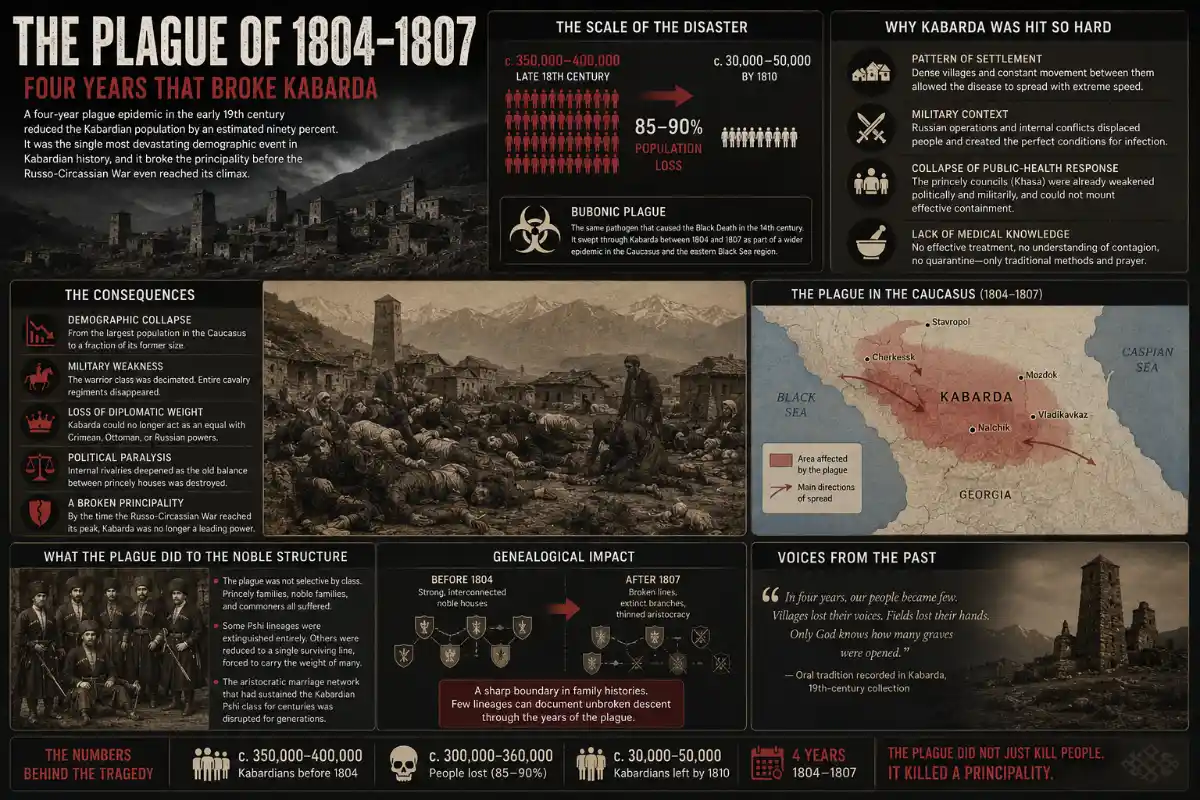
A four-year plague epidemic in the early 19th century reduced the Kabardian population by an estimated ninety percent. It was the single most devastating demographic event in Kabardian history, and it broke the principality before the Russo-Circassian War even reached its climax.
The 1804-1807 plague is the largest single disaster in recorded Kabardian history. Estimates of the population loss vary, but the most-cited figures suggest the Kabardian population fell from roughly 350,000-400,000 in the late 18th century to between 30,000 and 50,000 by 1810. That is a loss in the range of 85 to 90 percent, concentrated in a four-year period.
The plague that swept through Kabarda was part of a broader epidemic in the Caucasus and the eastern Black Sea region during the early 19th century. The disease itself was bubonic plague, the same pathogen responsible for the 14th-century Black Death in Europe. Several factors made the Kabardian outbreak particularly severe:
The pattern of settlement. Kabardian villages were relatively dense and densely connected, which favoured rapid spread.
The military context. Russian operations in the Caucasus and Kabardian internal conflicts displaced populations and concentrated them in conditions that accelerated infection.
The collapse of public-health responses. The princely Khasa councils, which had previously coordinated communal action in crises, were already strained by the political and military situation, and they were unable to mount an effective containment.
The demographic consequences echoed for generations. Where the pre-plague Kabardian population had been the largest in the Caucasus and a major regional power, the post-plague population was reduced to the level of a medium-sized Adyghe tribe. The Kabardian military capacity collapsed. Kabardian diplomatic weight in Crimean, Ottoman, and Russian negotiations evaporated. By the time the Russo-Circassian War reached its decisive phase in the 1830s and 1840s, the Kabardians were no longer in a position to lead a unified Adyghe resistance, even though they had been the most powerful tribe before the plague.
What the plague did to the noble structure
The plague was not selective by class. Princely families, noble families, and commoner families all suffered devastating losses. Some Pshi lineages were extinguished entirely. Others were reduced to a single surviving line, which then had to absorb the political weight of multiple extinct branches. The aristocratic marriage network that had sustained the Kabardian Pshi class for centuries was disrupted, and the post-plague generation of Kabardian princes inherited a thinned and reorganised political structure.
For genealogy, the plague produced a sharp pre/post boundary. Kabardian families who can document continuous descent through the 1804-1807 period are rare. Most modern Kabardian genealogies, including those carefully maintained in the diaspora, show breaks or reconstructions around this period. The records that do survive, especially in the Idarov, Atazhukin, and Misostov lines, are correspondingly valuable for any deeper Kabardian ancestry research.
Yermolov & the Scorched Earth
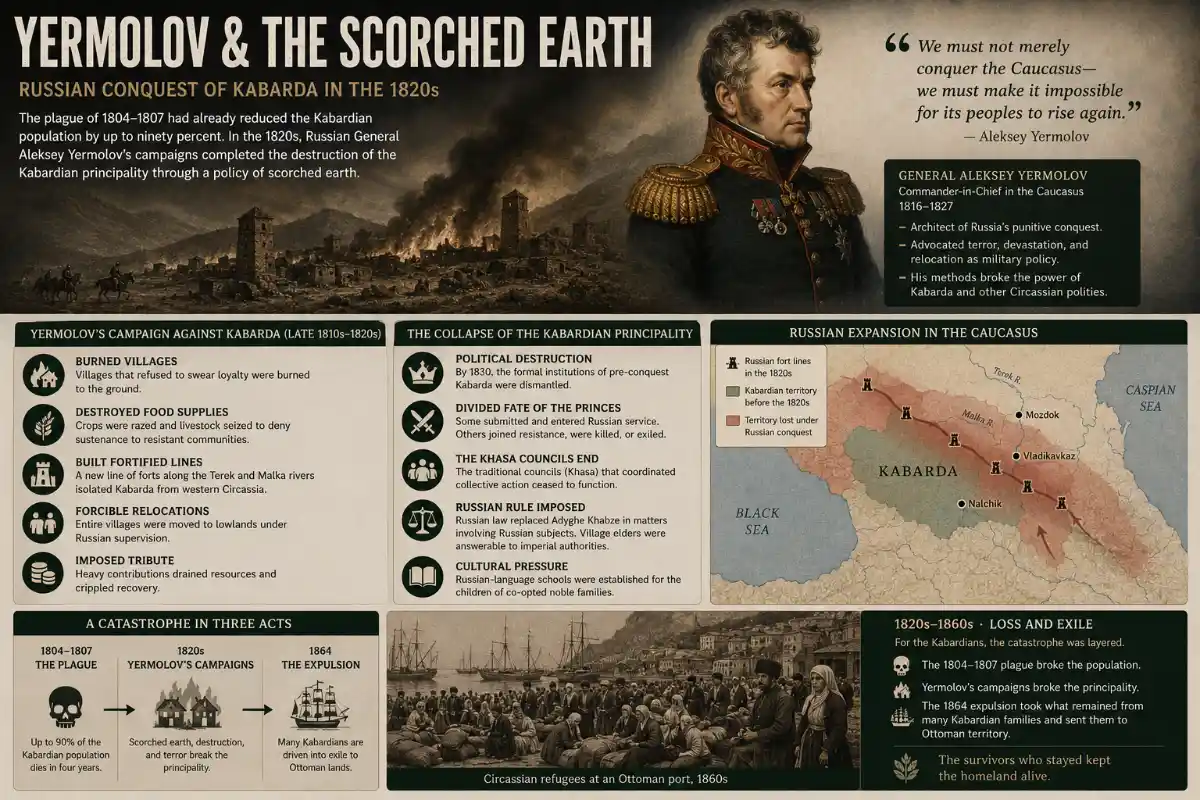
Russian General Aleksey Yermolov's Caucasian campaigns of the 1820s targeted Kabardian villages systematically, completing the demographic and political collapse that the plague had begun.
The post-plague Kabardian population was still in the early stages of recovery when Russian military pressure intensified in the 1820s. General Aleksey Yermolov, appointed commander of Russian forces in the Caucasus in 1816, pursued a strategic doctrine that was openly punitive. His standing orders called for the systematic destruction of villages that resisted Russian authority, the forcible relocation of populations that did not submit, and the construction of fortified Russian lines that would isolate Caucasian peoples from each other and from external support.
Yermolov's Kabardian campaign, conducted in the late 1810s and through the 1820s, was uncompromising. Russian forces:
Burned Kabardian villages whose princes refused to swear loyalty to the Russian state.
Razed crops and livestock to deny food to resistant communities.
Constructed a new line of fortifications along the Terek and Malka rivers that cut Kabarda off from the broader Adyghe lands to the west.
Forcibly relocated entire villages from the foothills to lowland areas under Russian observation.
Imposed contributions and tribute on submitting villages that further reduced their capacity to support resistance.
The combined effect of the plague and Yermolov's campaigns was the political destruction of the Kabardian principality. By 1830, the formal political institutions of pre-conquest Kabarda had been dismantled. Kabardian princes either submitted to the Russian state and became part of the imperial nobility, or they joined the wider Caucasian resistance and were killed or driven into exile. The Khasa councils that had coordinated Kabardian collective action ceased to function.
The Russian state, having broken the principality, then reorganised the surviving Kabardian population into administrative units that fit the imperial bureaucracy. Kabardian villages were assigned to Russian-appointed elders. Russian-language schools were established for the children of co-opted noble families. The traditional Kabardian legal code (Adyghe Khabze) was officially superseded by Russian law in disputes that involved Russian subjects, although Khabze continued to govern internal village life for decades.
1820s-1860s · Loss and exileFor the Kabardians, the catastrophe was layered. The 1804-1807 plague broke the population. Yermolov's campaigns broke the principality. The 1864 expulsion took what remained from many Kabardian families and sent them to Ottoman territory. The survivors who stayed kept the homeland alive.
1864 & the Survival of the Homeland
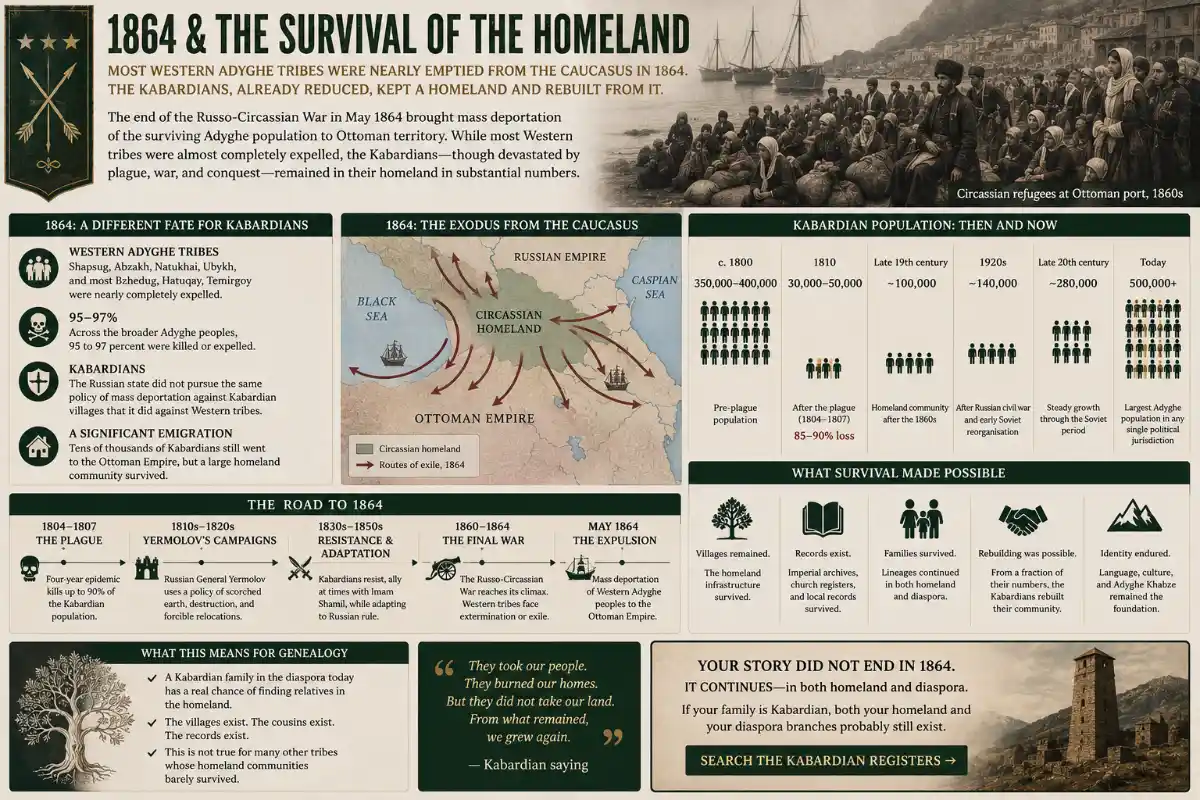
Most Western Adyghe tribes were nearly emptied from the Caucasus in 1864. The Kabardians, already reduced to a fraction of their pre-plague size, kept a substantial homeland community and rebuilt from it.
The end of the Russo-Circassian War in May 1864 brought mass deportation of the surviving Adyghe population to Ottoman territory. For the Western Adyghe tribes (Shapsug, Abzakh, Natukhai, Ubykh, and most Bzhedug, Hatuqay, Temirgoy), the consequence was near-total emptying of the homeland. Across the broader Adyghe peoples, the most-cited estimates suggest 95 to 97 percent of the population was killed or expelled.
For the Kabardians, the experience was distinct. The principality had already been broken in the 1820s. The post-plague Kabardian population had spent four decades adapting, with mixed results, to Russian administrative reality. By the 1860s, a substantial portion of the surviving Kabardian community was integrated into the imperial system, and the Russian state did not pursue the same policy of mass deportation against Kabardian villages that it pursued against the Western Adyghe.
A significant Kabardian emigration to Ottoman territory did take place, particularly among families who had remained in active resistance through the 1860s, families connected to the broader Caucasian resistance under Imam Shamil, and families who refused Russian administrative integration. Tens of thousands of Kabardians joined the broader muhajir flow to Anatolia and the Levant. But the homeland community survived in numbers that no other Adyghe tribe could match.
By the late 19th century, the Kabardian homeland community in Russian Kabarda numbered perhaps 100,000 people. By the 1920s, after the Russian civil war and early Soviet reorganisation, the population was about 140,000. Through the Soviet period the population grew steadily, reaching about 280,000 by the late 20th century. Today, with the Republic of Kabardino-Balkaria as the institutional anchor, the homeland community is the largest Adyghe population in any single political jurisdiction.
What that means for genealogy
The continuity matters. A Kabardian family in the diaspora today, looking for relatives in the homeland, has a real chance of finding them. The records exist. The villages exist. The cousins exist. That is not true for Shapsug, Abzakh, Ubykh, and many other tribes whose homeland communities barely survived. For Kabardians, the genealogical project is harder than the Bzhedug case (because of the plague-era records gap) but easier than the highly-displaced western tribes.
If your family is Kabardian, both your homeland and your diaspora branches probably still exist. We can help you find them.
The Kabardian Diaspora Today
The largest Kabardian diaspora is in Turkey (Kayseri, Samsun, Düzce, Sakarya, Uzunyayla). Substantial communities live in Jordan, Syria, and Israel, with smaller Western diaspora populations in Germany, the Netherlands, and the United States.
Turkey: the largest diaspora
The Kabardian diaspora in Turkey is the largest of all post-1864 Adyghe communities. Significant Kabardian populations live in:
Uzunyayla (Kayseri). The high plateau in central Anatolia where Ottoman authorities settled large numbers of Caucasian refugees. Of the 50-plus Adyghe villages on the plateau, the Kabardians are the largest single group, founders of the majority of the villages.
Samsun and the Black Sea coastal provinces. Major Kabardian populations in rural and urban communities along the southern Black Sea, including Çarşamba, Bafra, and surrounding villages.
Düzce, Sakarya, Bolu, Hendek. The northwestern Anatolian provinces, particularly inland from the Black Sea coast, host substantial Kabardian rural communities. These are some of the most cohesive diaspora villages, with continuous Adyghe-language use across multiple generations.
Tokat, Sivas, Çorum. Central Anatolian provinces with Kabardian populations dating to the 1860s settlement waves.
Istanbul, Ankara, Izmir. Major urban Kabardian populations, drawn from rural diaspora villages through 20th-century internal migration. Most Kabardian cultural associations and language schools in Turkey are based in these cities.
Total Kabardian-descended population in Turkey is hard to estimate. Conservative figures put it at several hundred thousand. Higher estimates, which include families with attenuated tribal identity, run to over a million.
Jordan
The Jordanian Kabardian community is among the founders of modern Amman. Ottoman authorities settled Circassians, including substantial numbers of Kabardians, in the area around Amman in the 1870s and 1880s. The community has historically maintained strong cultural identity, with continuous Kabardian-language use, well-organised cultural associations, and a long tradition of service in the Royal Hashemite Court and the Jordanian armed forces.
Major Jordanian Kabardian communities live in Amman (especially the older neighbourhoods of Wadi Saqra and Jabal Amman), Wadi al-Sir, Naur, Sweileh, Jerash, and several other cities and villages. Total Jordanian Circassian population is around 100,000-150,000, of whom Kabardians are a major component.
Syria
Syrian Kabardian families historically lived in Damascus, Homs, Aleppo, the Golan Heights (until 1967), and several rural villages. The post-2011 Syrian conflict has been catastrophic for the community. Many families have been displaced, with significant numbers relocating to Turkey, Germany, the Russian Federation (some via Adygea or Kabardino-Balkaria repatriation programmes), and elsewhere.
Israel
The Israeli Adyghe community is small but well documented. Kabardians live primarily in Kfar Kama, alongside the larger Shapsug community, with smaller numbers in Reyhaniye. Israeli national archives contain Ottoman-era settlement records that are useful for tracing diaspora Kabardian genealogy.
Germany, the United States, the Netherlands, and beyond
Twentieth- and twenty-first-century second-stage migration has produced Kabardian communities in Germany (especially through the Turkish guest-worker programme), the Netherlands, the United States (with hubs in New Jersey, California, and New York), and other Western countries. These newer communities often integrate Kabardian identity into broader pan-Circassian organisations, which makes tribal-level identification harder but creates valuable cross-country networks for ancestry research.
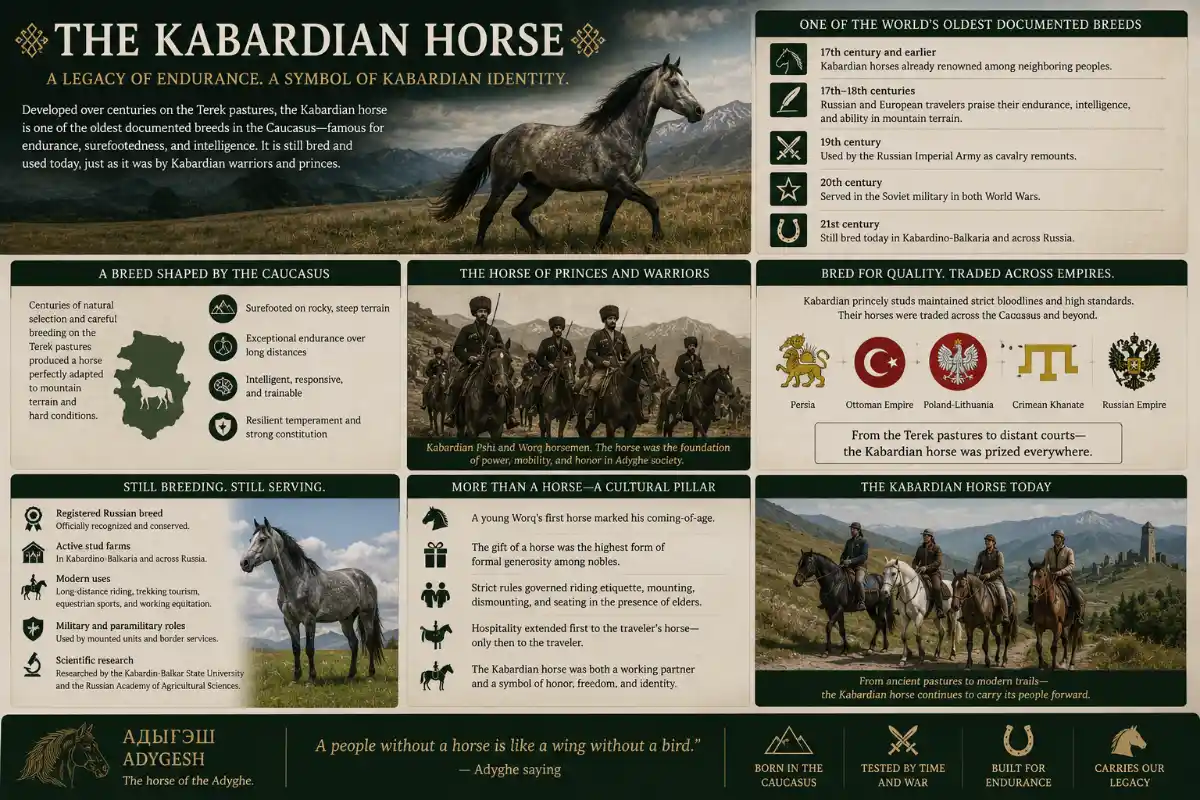
The Kabardian Horse
The Kabardian horse breed, developed over centuries on the Terek pastures, is one of the oldest documented breeds in the Caucasus. It is famous for endurance in mountain terrain and is still bred today.
The Kabardian horse (Кабардинская лошадь in Russian, Адыгэш in Kabardian) is one of the world's oldest documented horse breeds. Russian and European travellers to the Caucasus from the 17th century onwards consistently noted the qualities of Kabardian horses: surefootedness on rocky terrain, endurance over long distances, intelligence in close-quarters work, and a temperament that was both responsive and resilient. The breed was used as cavalry stock by the Russian Imperial Army in the 19th century, by the Soviet military in both world wars, and by several modern military and equestrian organisations.
The breed's foundation lay in the Kabardian noble class's deep investment in horse-breeding. Kabardian Pshi maintained large stud operations on the Terek pastures, with carefully tracked bloodlines and rigorous selection for working qualities. Bloodstock from these studs was traded across the Caucasus and reached as far as the Persian, Ottoman, and Polish horse markets.
The Kabardian horse breed survives today as a registered Russian breed, with active stud operations in Kabardino-Balkaria and several supporting institutions. The breed is used in long-distance riding events, in tourism (particularly trekking tourism in the Caucasus), in equestrian sports, and in military and paramilitary applications. The Kabardin-Balkar State University and the Russian Academy of Agricultural Sciences both maintain research programmes on the breed.
Why the breed mattered for Kabardian identity
For Kabardians, the horse was not just an economic asset. It was central to Adyghe Khabze and to noble identity. A young Worq's first horse was a milestone in his coming-of-age. The gift of a horse was the highest form of formal generosity in noble interactions. Specific rules governed the seating of riders relative to each other, the proper way to mount and dismount in the presence of an elder, and the obligation to provide hospitality first to a traveller's horse and only then to the traveller. The Kabardian horse was both a working animal and a cultural object.
Music, Dance & the Islamey
Kabardian music is built around the shichepshin fiddle, the pkhachich percussion clappers, and the modern button accordion. The Kabardian Islamey dance is the most internationally famous Adyghe dance, in part because it inspired the Russian composer Mily Balakirev's 1869 piano piece of the same name.
Kabardian musical tradition shares its core instruments with the broader Adyghe world but has developed several distinctive forms. The principal instruments are:
The shichepshin (шыкlэпщынэ), a bowed two-string fiddle with a hauntingly vocal tone. The shichepshin is used to accompany epic poetry, Nart-cycle storytelling, and sustained song forms.
The pkhachich (пхъэкlыч), a wooden percussion clapper used to keep rhythm in dance music.
The kamyl (къамыл), a long flute traditionally played by shepherds, used in pastoral and lyric music.
The pshyne (пщынэ), the modern button accordion, introduced in the late 19th century. The pshyne quickly became the dominant instrument in Kabardian dance music and remains so today, with prominent players in Kabardino-Balkaria, Turkey, and Jordan.
The Kabardian dance tradition
Kabardian dance is structured around a core repertoire of named forms, performed at weddings, festivals, and community gatherings:
The Wig (Удж), a slow processional circle dance, often opening a wedding ceremony.
The Kafa (Кафэ), a courtship dance in which a man and woman dance opposite each other within a circle of onlookers, performing prescribed gestures and movements.
The Lezginka family of fast dances, shared with broader Caucasian tradition but with distinct Kabardian variants.
The Islamey, the most internationally famous Kabardian dance, characterised by extreme rhythmic energy and athletic male solo movement.
The Islamey and Balakirev
The Russian composer Mily Balakirev visited the Caucasus in 1862-1863 and again in 1868, and during these travels he heard the Kabardian Islamey dance performed in its traditional form. He was so taken with the rhythmic and melodic structure that he composed a piano piece, Islamey: An Oriental Fantasy, in 1869. The piece, which uses Kabardian and Karachay melodic material, became one of the most technically demanding works in the standard piano repertoire. It is performed today by virtuoso pianists worldwide and has been arranged for orchestra, for two pianos, and for various ensemble formations.
The Balakirev Islamey introduced the Kabardian musical name to international audiences in a way that few other Caucasian forms achieved. For Kabardians today, particularly in the diaspora, the Balakirev piece is a useful cultural-diplomatic asset: it is widely known to Western classical-music audiences, and its existence opens conversations about Kabardian heritage that might otherwise be hard to start.
Today · A Kabardian reunionFor Kabardian families, the homeland branch and the diaspora branch usually both exist. The work today is reconnection: a tablet, a name, a village, a cousin in Nalchik or in Düzce. The line never broke. It only stretched.
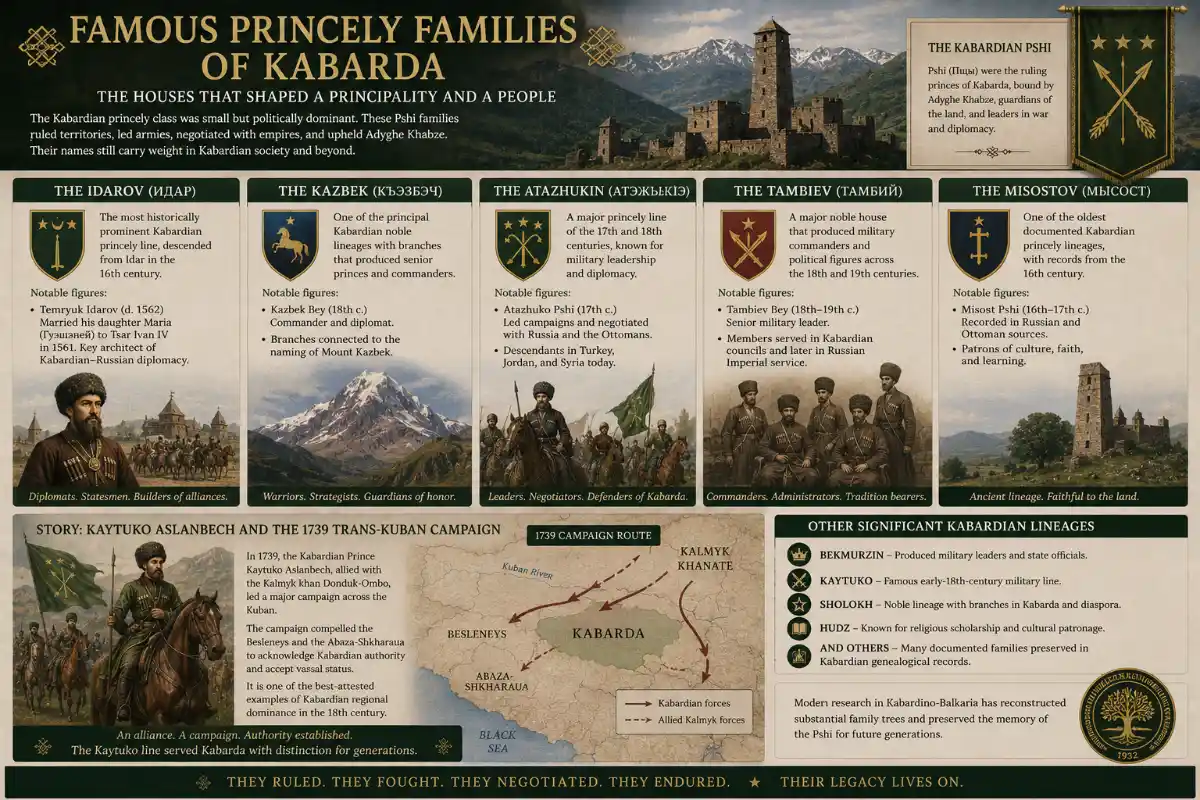
Famous Princely Families
The historic Kabardian princely class produced several lineages whose names still carry weight in Kabardian society and beyond. The Idarov, Kazbek, Atazhukin, Tambiev, and Misostov houses are the best-documented.
The Kabardian princely class was small but politically dominant. Each Pshi family controlled a defined territory, with its own villages, vassal nobles, and military levies. The major historic Kabardian princely lineages include:
The Idarov (Идар)
The Idarov line is the most historically prominent, descended from Idar, a 16th-century Kabardian Pshi. The line's most famous member was Temryuk Idarov, the prince who married his daughter Maria to Ivan the Terrible in 1561 and shaped Kabardian-Russian diplomacy for a generation. The Idarov line continued to produce major figures through the 17th and 18th centuries and is documented in Russian, Ottoman, and Adyghe sources.
The Kazbek (Къэзбэч)
The Kazbek (sometimes Qazbek, Kabardian Къэзбэч) is one of the principal Kabardian noble lineages, with branches that produced senior princes, military commanders, and cultural figures. The famous Mount Kazbek in the central Caucasus is named after a related historical figure. The Kazbek line spans both Kabardian and Ossetian territory in some genealogical reconstructions.
The Atazhukin (Атэжьыкlэ)
The Atazhukin (sometimes Atazhuko, Adyghe Атэжьыкlэ) is a major Kabardian princely line of the 17th and 18th centuries. The line produced several Pshi who led Kabardian military campaigns and conducted diplomacy with Russia and the Ottoman Empire. Atazhukin descendants appear in the diaspora particularly in Turkey and Jordan, where the surname is preserved in various transliterations.
The Tambiev (Тамбий)
The Tambiev line, sometimes Tambi or Tamby in diaspora variants, is another of the major Kabardian noble houses. The Tambiev produced senior military and political figures across the 18th and 19th centuries. The name appears in modern Kabardino-Balkarian academic, political, and cultural life.
The Misostov (Мысост)
The Misostov is one of the oldest documented Kabardian princely lineages, with records going back to the 16th century. The line produced senior princes, military leaders, and cultural patrons across the principality's history. The name is preserved both in the homeland and in diaspora communities, particularly in Turkey.
Other significant lineages
Beyond these five, the Kabardian princely and noble class included the Bekmurzin, the Kaytuko (a famous early-18th-century military line), the Sholokh, the Hudz, and several other documented lineages. Modern Kabardian genealogical work, particularly in Kabardino-Balkaria's academic institutions, has reconstructed substantial portions of these family trees and made them available for diaspora researchers.
Story: Kaytuko Aslanbech and the 1739 Trans-Kuban campaign
In 1739, the Kabardian Prince Kaytuko Aslanbech, allied with the Kalmyk khan Donduk-Ombo, led a major campaign across the Kuban that compelled the Besleneys and the Abaza-Shkharaua to acknowledge Kabardian authority and accept vassal status. The campaign is one of the best-attested examples of Kabardian regional dominance in the 18th century. It is also a useful illustration of how Kabardian diplomacy worked: a Pshi assembling an alliance with non-Adyghe partners (the Kalmyks), executing a coordinated military operation across hundreds of kilometres, and imposing political terms on neighbouring Adyghe principalities. The Kaytuko line produced military and political figures into the 19th century, when the family was caught up in the broader collapse of the principality after the plague and the Yermolov campaigns.
The Kabardian Tamga
Kabardian tamga symbols are among the best-documented in Circassia, with hundreds of recorded designs. They are useful for genealogy because they often survive in family memory when written records have been lost.
The tamga tradition was central to the Kabardian noble class. Each Pshi line, each Worq family, and many Tfokotl families had their own unique geometric tamga, used to brand livestock, mark property, identify lineage, and seal documents. Russian-imperial and Soviet-era ethnographers compiled extensive tamga catalogues, drawing on both fieldwork in Kabardian villages and on historical documents that preserved tamga designs.
Kabardian tamgas are particularly well-documented because:
The Kabardian princely class was unusually well-recorded in Russian imperial archives, which preserve tamga designs alongside genealogical and territorial documentation.
The Kabardian homeland community survived continuously through the 19th and 20th centuries, which means living memory of family tamgas was preserved even when written records were lost.
Modern Kabardino-Balkarian academic institutions, including the Kabardin-Balkar State University and the Adyghe Academy of Sciences, have prioritised tamga research and produced published catalogues.
For diaspora Kabardian families, the tamga is one of the strongest links to the homeland. A family that remembers a household mark, even partially, can match it against the documented Kabardian catalogue and often identify the specific Pshi or Worq line of origin. The Idarov, Misostov, and Atazhukin tamgas are particularly well-attested.
Practical tip Tamgas were never written down the way names were. They survived through being seen, on a saddle blanket, on a doorpost, on a piece of woodwork, on an embroidered cloth. Ask the eldest members of your family whether they remember a household mark. Even a partial sketch can match against the documented Kabardian tamgas and identify your specific lineage.
Surnames Across Five Scripts
Kabardian surnames exist in Adyghe Cyrillic, Russian Cyrillic, Turkish Latin, Arabic, and Hebrew variants. Cross-script lookup is essential for diaspora research, particularly for Turkish Kabardian families affected by the 1934 Surname Law.
Like all Adyghe surnames, Kabardian surnames exist in multiple scripts and have been transformed by every host country's naming policies. A Kabardian family in Kabardino-Balkaria carries an Adyghe-Cyrillic surname registered in Russian. The same family's branch in Amman carries an Arabic transliteration. The Kayseri branch carries a 1934 Turkish-Latin replacement name. The Kfar Kama branch carries a Hebrew rendering. Successful Kabardian genealogy requires checking all these variants.
Major Kabardian surnames
Original (Adyghe)Russian/CyrillicCommon Turkish formsNotesИдарИдаровыIdar, IdarovMajor princely line; ancestor of Temryuk IdarovКъэзбэчКазбековыKazbek, KazbegSenior noble lineage; mountain takes its nameАтэжьыкlэАтажукиныAtajuko, AtajukinMajor 17th-18th c. princely lineТамбийТамбиевыTambi, Tamby, TambievSignificant noble line in homeland and diasporaМысостМисостовыMisost, MisostovOne of the oldest documented Kabardian princely linesБекмурзэБекмурзиныBekmurza, BekmurzinNoble line with both homeland and Turkey branchesКъетlыкъуэКайтуковыKaytuko, Kaytuk18th-c. military line; Aslanbech of 1739 campaignШолэхъуШолоховыŞolohov, SholokhCross-tribal Kabardian-Besleney noble lineХьэткъоХатковыHatko, HatkovFound across multiple Adyghe tribes; strong Kabardian presence
Patterns to recognise
Surnames ending in -ov / -ev / -ovy in Russian sources are typically the Russified versions of older Adyghe forms (the Adyghe usually ends in -okuo, -okwa, or with no suffix).
Surnames in Turkey may have been replaced entirely in 1934. Common Turkish replacements adopted by Kabardian families include Adıgün, Kuban, Kafkas, Çerkes, and various nature-derived names. Recovering the pre-1934 Adyghe form often requires elder interviews and family records.
Surnames in Jordan are typically Arabic transliterations that approximate the original Adyghe sound, sometimes with consistent transliteration conventions across the community. Jordanian Circassian associations maintain registers that can help cross-reference.
Tracing Your Kabardian Ancestry: A Practical Method
A five-step framework, with Kabardian-specific notes. Because the homeland community survived, your ancestry can often be traced not just to a tribal identity but to a specific Kabardian village still standing today.
Step 1. Elder interviews
Start with the oldest members of the family. Specific Kabardian questions to ask:
Was the family ever called Kabardian (Къэбэрдей) or referred to as being from Kabarda?
Did anyone use a Russian-Cyrillic surname (ending in -ov, -ev) before the 1934 Turkish Surname Law? What was it?
Was the family from Greater Kabarda (south of the Terek) or Lesser Kabarda (north of the Terek)?
If they emigrated to Anatolia, what was the year? The 1860s? Earlier?
Any remembered tamga symbols?
Step 2. Surname research across five scripts
Run the surname through Adyghe (Cyrillic), Russian Cyrillic, Turkish (Ottoman and Republican), Arabic, and Hebrew variants. Kabardian-specific note: many Kabardian families in Turkey carry the original Adyghe surname in oral memory but a different Latin-script surname in legal documents. Recovering the Adyghe form is critical.
Step 3. Kabardino-Balkaria archives
The Kabardian homeland community maintains continuous village-level records going back to the 19th century, with substantial holdings from the late imperial and Soviet periods. The Kabardin-Balkar State Archive in Nalchik, the Kabardino-Balkarian Institute for Humanities Research, and individual village administrations can often produce direct family connections for diaspora researchers.
Step 4. Ottoman and Russian archives
For Kabardian families that emigrated to Ottoman territory between 1860 and 1880, the Ottoman Nüfus Defterleri at the Başbakanlık Osmanlı Arşivi in Istanbul are the primary record. Russian imperial archives (RGVIA in Moscow, regional archives in Stavropol and Vladikavkaz) hold complementary documents.
Step 5. DNA testing
Y-DNA haplogroups G2a (especially G-M406), J2, and R1a are common in Eastern Adyghe populations including Kabardians, with R1a particularly distinguishing the eastern from the western Adyghe pattern. CircassianWeb's DNA matching compares your raw data against the 109-record peer-reviewed Circassian reference panel, which includes Kabardian samples. The FamilyTreeDNA Circassian DNA Project has over 2,800 members, including many confirmed Kabardian lineages.
Kabardian Genetic Markers
Eastern Circassian populations, including Kabardians, show distinctive Y-DNA frequencies of G2a, J2, and R1a, with R1a particularly common compared to Western Adyghe groups.
Population genetic studies of Circassians (Balanovsky et al., 2011; Yunusbayev et al., 2012; subsequent FTDNA Circassian DNA Project work) document distinctive haplogroup frequencies across the Adyghe peoples. Kabardians, alongside the closely related Besleneys, show Eastern Adyghe patterns somewhat distinct from Western Adyghe groups.
HaplogroupTypeNotes for KabardianG2a (G-M406)Y-DNA paternalCommon across all Adyghe; principal lineage marker, traceable to pre-Bronze Age CaucasusJ2 (J-M172)Y-DNA paternalSignificant minority of Kabardian samples; shared with Western AdygheR1aY-DNA paternalHigher in Kabardian and Besleney than in Western Adyghe; one of the East/West distinguishing markersR1bY-DNA paternalLess common in Kabardian than in Western Adyghe; the R1b/R1a balance is one of the clearest population-genetic differencesH, U, TmtDNA maternalMaternal lineages broadly shared across the Northwest Caucasus; trace to Bronze Age populations
Important caveat Haplogroup associations are probabilistic and population-level, not individual identity tests. A Kabardian-specific identification almost always requires combining DNA results with surname research and family history. Because Kabardian and Besleney populations are genetically very close, DNA alone cannot always distinguish them. The surname and the village name are essential supplementary evidence.
The FamilyTreeDNA Circassian DNA Project, with over 2,800 members as of 2026, includes many confirmed Kabardian lineages and is searchable for direct matches. For Kabardian families today, uploading raw DNA and running it against the project database is one of the highest-value investigations available.
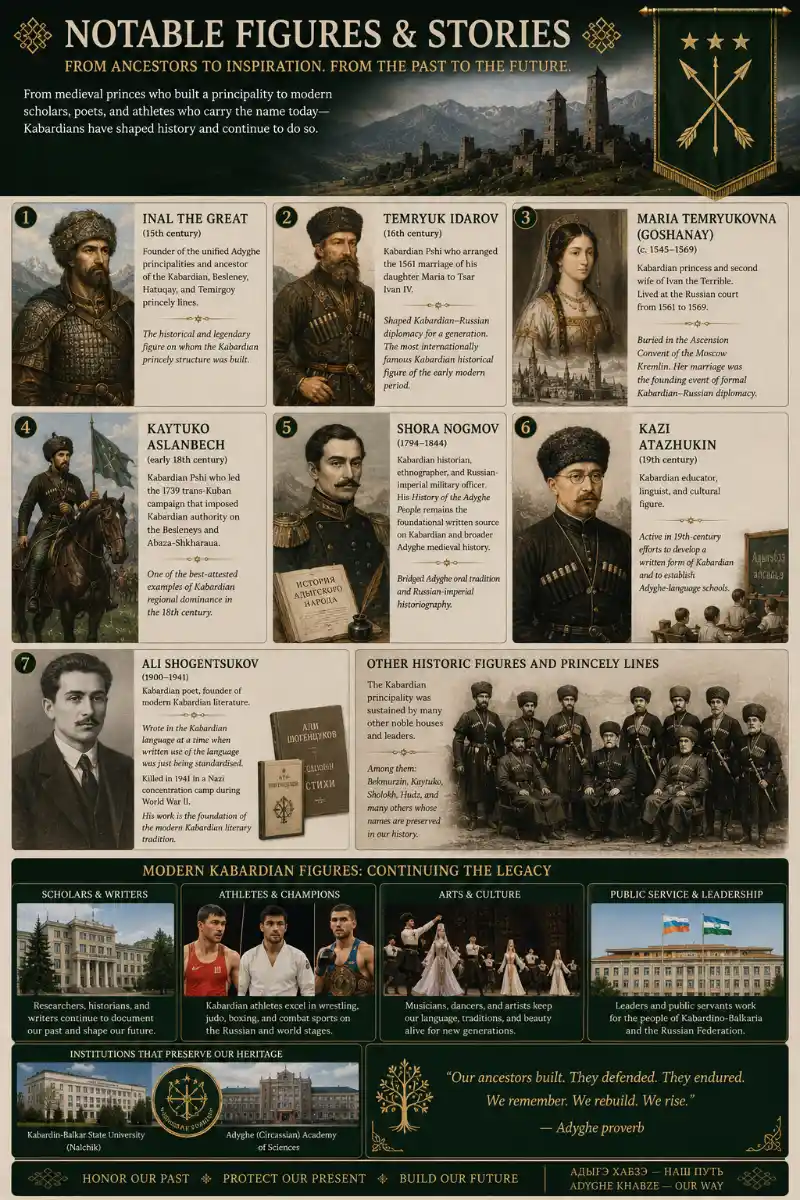
Notable Figures & Stories
From medieval princes to modern Olympic wrestlers, the Kabardians have produced an outsized share of historical and contemporary figures.
Inal the Great (15th century)
Founder of the unified Adyghe principalities and ancestor of the Kabardian, Besleney, Hatuqay, and Temirgoy princely lines. The historical and legendary figure on whom the Kabardian princely structure was built.
Temryuk Idarov (16th century)
Kabardian Pshi who arranged the 1561 marriage of his daughter Maria to Tsar Ivan IV. Shaped Kabardian-Russian diplomacy for a generation. The most internationally famous Kabardian historical figure of the early modern period.
Maria Temryukovna (Goshanay) (c. 1545-1569)
Kabardian princess and second wife of Ivan the Terrible. Lived at the Russian court from 1561 to 1569. Buried in the Ascension Convent of the Moscow Kremlin. Her marriage was the founding event of formal Kabardian-Russian diplomacy.
Kaytuko Aslanbech (early 18th century)
Kabardian Pshi who led the 1739 trans-Kuban campaign that imposed Kabardian authority on the Besleneys and Abaza-Shkharaua. One of the best-attested examples of Kabardian regional dominance in the 18th century.
Shora Nogmov (1794-1844)
Kabardian historian, ethnographer, and Russian-imperial military officer. His History of the Adyghe People remains the foundational written source on Kabardian and broader Adyghe medieval history. Bridged Adyghe oral tradition and Russian-imperial historiography.
Kazi Atazhukin (19th century)
Kabardian educator, linguist, and cultural figure. Active in 19th-century efforts to develop a written form of Kabardian and to establish Adyghe-language schools.
Ali Shogentsukov (1900-1941)
Kabardian poet, founder of modern Kabardian literature. Wrote in the Kabardian language at a time when written use of the language was just being standardised. Killed in 1941 in a Nazi concentration camp during World War II. His work is the foundation of the modern Kabardian literary tradition.
Modern Kabardian figures
The Republic of Kabardino-Balkaria has produced numerous prominent figures in 20th- and 21st-century Russian and international life: scholars, writers, military officers, athletes (particularly in wrestling, judo, and combat sports), musicians, and political figures. The Kabardian academic community in Nalchik has been particularly productive, with the Kabardin-Balkar State University and the Adyghe Academy of Sciences acting as the principal institutional anchors.
Stories from the diaspora
Story: The merchant of Amman
Among the founding families of modern Amman in the 1870s was a Kabardian merchant who had emigrated from the Terek basin in the late 1860s. The family established a trading business that connected the Caucasian diaspora across the Levant, dealing in horses, leather, textiles, and grain. By the early 20th century, the family had become one of the prominent Circassian commercial houses in Jordan, with branches in Damascus, Beirut, and Cairo. The merchant's grandchildren, several generations later, hold senior positions in Jordanian government, business, and the Royal Hashemite Court. Their family's continuous trail back to a specific Kabardian village in the Terek basin is preserved in oral genealogies and in the Jordanian Circassian community archives.
Story: The Olympic wrestler
Kabardian wrestlers have won multiple Olympic and world championship medals across the late 20th and early 21st centuries. The wrestling tradition draws on both Adyghe Khabze (which includes structured combat as part of noble training) and the Soviet-era infrastructure of state-supported sport. A Kabardian Olympic gold medallist in the early 2000s grew up in a small village in Kabardino-Balkaria, trained at a regional sports school, and became a national hero. He returned to his village after retirement to coach young athletes. The story is repeated, with variations, across multiple Kabardian wrestlers, judokas, and combat-sport athletes whose careers have made the republic one of Russia's most productive centres for these sports
Modern Cultural Revival
Because the Kabardian homeland community survived, Kabardian cultural revival has not had to begin from scratch. The work today is reconnection of diaspora to homeland.
Cultural revival for the Kabardians is anchored in the Republic of Kabardino-Balkaria, which provides institutional infrastructure that few other Adyghe groups can match:
The Kabardin-Balkar State University in Nalchik. Offers Kabardian-language degrees, conducts cultural research, trains language teachers.
The Kabardian Academy of Sciences and the Kabardino-Balkarian Institute for Humanities Research. Produce scholarship on history, ethnography, language, and folklore.
Kabardian-language media: state and private television, radio, publishing, online platforms.
The Kabardian State Folk Dance Ensemble and several private ensembles, performing internationally.
Cultural festivals across the republic, attracting diaspora attendees.
Repatriation programmes that have supported limited return migration since the 1990s, including notable post-2011 Syrian Circassian repatriation.
Diaspora-homeland networks: associations in Turkey, Jordan, Syria, Israel, Germany, and the United States increasingly coordinate with Kabardino-Balkarian institutions.
Diaspora Kabardians who would, in earlier generations, have struggled to find more than a handful of fellow Kabardian families now connect across continents through dedicated platforms, social media groups, DNA matching services, and homeland-coordinated cultural programmes. The combination of homeland continuity and diaspora reach gives the Kabardian revival movement an unusual degree of institutional depth.
Frequently Asked Questions
The questions readers most often ask about Kabardian heritage, identity, and ancestry research.
Are the Kabardians a separate nation, or part of "the Circassians"?
Both. Circassian is the umbrella term covering all twelve Adyghe tribes, of which the Kabardians are one. Kabardian identifies the largest specific tribe within that broader identity. A person can identify as Adyghe, as Circassian, and as Kabardian, all at once. These are nested layers, not alternatives. The Kabardians are simply the largest Adyghe people and the most institutionally established, with their own republic (Kabardino-Balkaria), their own literary language standard, and a distinct historical principality.
Where do most Kabardians live today?
The largest Kabardian community lives in the Republic of Kabardino-Balkaria in the Russian Federation, where about 510,000 people identify as Kabardian. Significant communities also live in Karachay-Cherkessia (often counted as "Cherkess"), North Ossetia, and Stavropol Krai. The diaspora is largest in Turkey (Kayseri, Samsun, Düzce, and other provinces), with substantial communities in Jordan, Syria, Israel, Germany, the United States, and elsewhere.
What is the difference between Kabardian and Cherkess?
Linguistically, the two are nearly identical: both speak Eastern Circassian (Kabardo-Cherkess). Politically, the difference is administrative. The term Kabardian is used for Eastern Adyghe communities centred on Kabardino-Balkaria. The term Cherkess is used for the Eastern Adyghe community of Karachay-Cherkessia, where they live alongside the Turkic Karachay people. Both groups speak essentially the same language and share a closely related history. In Soviet ethnic classification, they were treated as separate "nationalities," but linguistically and culturally they are very close.
What was the plague of 1804-1807?
A bubonic plague epidemic that swept through Kabarda in the early 19th century. It killed an estimated 85 to 90 percent of the Kabardian population, reducing the community from 350,000-400,000 to between 30,000 and 50,000 in just four years. It was the single most devastating event in Kabardian history, and it broke the political and military power of the principality before the Russo-Circassian War even reached its decisive phase. It is the principal reason that, by the time of the 1864 expulsion, Kabardian numbers were already a fraction of what they had been a generation earlier.
Who was Maria Temryukovna?
A Kabardian princess (Adyghe name: Goshanay), daughter of Prince Temryuk Idarov. In 1561, at about 16 years old, she travelled from Kabarda to Moscow and married Tsar Ivan IV, known as Ivan the Terrible. She lived at the Russian court until her death in 1569. The marriage cemented a Kabardian-Russian diplomatic alliance against the Crimean Khanate and laid the foundation for two centuries of formal Kabardian-Russian relations. She is buried in the Ascension Convent of the Moscow Kremlin.
Why is the Kabardian dialect the standard for Eastern Adyghe?
Several reasons. The Kabardian community was the largest Eastern Adyghe population through both the imperial and Soviet periods. The Kabardian variety was the best-documented in 19th-century scholarship. Soviet language planners chose the Kabardian dialect (specifically the Greater Kabardian variety) as the basis for the literary standard when they developed Cyrillic-based writing for the Adyghe languages in the 1920s and 1930s. Today, Kabardian is the literary form of Eastern Adyghe taught in schools across Kabardino-Balkaria and used in publishing and broadcasting.
What surnames indicate Kabardian heritage?
Common Kabardian princely and noble surnames include Idarov, Kazbek, Atazhukin, Tambiev, Misostov, Bekmurzin, Kaytuko, Sholokh, Hatkov, and many others. Common commoner surnames include a wide range of patronymic and topographic forms. Because of Turkey's 1934 Surname Law, many Kabardian families in Turkey carry surnames that don't reveal their tribal identity (Adıgün, Kuban, Kafkas, Çerkes, or nature-derived names). Recovering the original Adyghe surname often requires elder interviews and pre-1934 family records.
What is the Kabardian horse breed?
The Kabardian horse (Kabardinskaya in Russian, Адыгэш in Kabardian) is one of the world's oldest documented horse breeds, developed over centuries on the Terek pastures by Kabardian noble breeders. It is famous for surefootedness in mountain terrain, long-distance endurance, intelligence in close-quarters work, and a temperament suited to military and trekking applications. It was a major Russian Imperial cavalry breed in the 19th century and remains a registered Russian breed today, used in equestrian sports, long-distance riding, military and paramilitary work, and Caucasus trekking tourism.
What is the Islamey?
The Islamey is a Kabardian dance characterised by extreme rhythmic energy and athletic male solo movement. It is one of the most internationally famous Adyghe dances. Russian composer Mily Balakirev heard the Islamey performed during his Caucasus travels in the 1860s and composed a piano piece, Islamey: An Oriental Fantasy (1869), that uses Kabardian melodic material. The Balakirev piece is one of the most technically demanding works in the standard piano repertoire and has introduced the Kabardian musical name to international classical-music audiences.
Can DNA testing confirm Kabardian ancestry?
Partially. Y-DNA haplogroups G2a, J2, and R1a are common in Eastern Adyghe populations, including Kabardians, with R1a particularly distinguishing the eastern from the western Adyghe pattern. Matching against the FamilyTreeDNA Circassian DNA Project (2,800+ members, including many confirmed Kabardian lineages) can produce strong probabilistic evidence. DNA alone cannot always distinguish Kabardian from Besleney, since the two populations are genetically very close. The most reliable identification combines DNA results with surname research, family history, and village records.
How can I visit the Kabardian homeland?
The Republic of Kabardino-Balkaria is accessible from Mineralnye Vody International Airport (about 90 minutes' drive from Nalchik, the capital) or from Nalchik directly via flights from Moscow. The republic offers cultural tourism, mountain hiking and skiing in the central Caucasus (including Mount Elbrus, Europe's tallest peak), and connections to specific Kabardian villages for diaspora researchers. The Kabardin-Balkar State University, the Kabardian Academy of Sciences, and several cultural organisations welcome diaspora visitors.
What is the Republic of Kabardino-Balkaria?
A federal subject of the Russian Federation in the North Caucasus. It is a binational republic shared between two peoples: the Kabardians (an Adyghe people, demographic majority at about 57 percent) and the Balkars (a Turkic people, about 13 percent). The capital is Nalchik. Total population is about 870,000. The republic is the principal institutional anchor of modern Kabardian identity, with state recognition for the Kabardian language, schools, media, and cultural institutions.
Why did the Kabardians survive 1864 better than other Adyghe tribes?
Three reasons. First, the principality had already been broken in the 1820s by Yermolov's campaigns, so by 1864 there was no organised Kabardian resistance to deport at the scale of the Western Adyghe tribes. Second, the post-plague Kabardian population had been integrated, in mixed and complicated ways, into the Russian imperial administrative system, and the imperial state did not pursue mass deportation against settled Kabardian villages with the same intensity as against the Western Adyghe. Third, the Kabardian homeland was geographically further from the Black Sea coast used for transport to Ottoman territory, which made systematic deportation logistically harder. The result is that the Kabardian homeland community, though deeply damaged, survived in a way that no Western Adyghe homeland community did.
Where can I learn the Kabardian language?
Several options exist. The Kabardin-Balkar State University in Nalchik offers in-person and increasingly online courses in Kabardian. Diaspora cultural associations in Turkey (Kayseri, Düzce, Sakarya), Jordan (Amman), Israel (Kfar Kama), and elsewhere run language-learning programmes. Online platforms, including video courses and apps, increasingly offer Kabardian lessons. Because Kabardian is the literary standard for Eastern Adyghe and is widely taught and broadcast, it is one of the most accessible Adyghe varieties for diaspora learners.
Trace Your Kabardian Ancestry Today
Because the Kabardian homeland community survived, your line probably leads to a specific village in Kabardino-Balkaria. There may be someone with your surname still living there.
1 Build your tree
Start with three names: yourself, a parent, a grandparent.
2 Find your tribe
Match your surname against the Kabardian clan database.
4 Upload your DNA
Compare against the Circassian reference panel.
✓ Free forever · ✓ Your data stays yours · ✓ No credit card
Kabardians at a glance
Adyghe name Къэбэрдей (Kabardian), Адыгэхэр (Adyghe collective)
Branch Eastern Circassian (Kabardo-Cherkess)
Founder Inal the Great (15th century) — legendary unifier of the Adyghe principalities
Historic territory Greater Kabarda (between the Terek and the Malka) and Lesser Kabarda (north of the Terek)
Modern homeland Republic of Kabardino-Balkaria, capital Nalchik. Smaller communities in Karachay-Cherkessia, North Ossetia, and Stavropol Krai.
Population in homeland About 510,000 in Kabardino-Balkaria (the largest Circassian population in any single republic)
Language Kabardian (Kabardo-Cherkess), the literary standard for Eastern Circassian, with a Cyrillic alphabet of 59 letters
Closest related tribes Besleney, Cherkess (Karachay-Cherkessia)
Largest diaspora communities Turkey (Kayseri, Samsun, Düzce, Uzunyayla), Jordan (Amman), Syria, Israel
Famous princely lines Idarov, Kazbek, Atazhukin, Tambiev, Misostov, Bekmurzin, Kaytuko
On the Circassian flag One of the 12 gold stars
Sources & Further Reading
Wikipedia: Kabardians, Circassians, Circassia, Kabardino-Balkaria.
Wikipedia: Maria Temryukovna, Russo-Circassian War, Circassian Genocide.
Wikipedia: Islamey (Balakirev), Kabarda horse.
Jaimoukha, A. (2001). The Circassians: A Handbook. Palgrave Macmillan.
Jaimoukha, A. The Kabardians: A Handbook and related works.
Nogmov, S. (19th c., modern reprint editions). History of the Adyghe People.
Richmond, W. (2013). The Circassian Genocide. Rutgers University Press.
Khan-Girey, S. (1830s, modern reprint editions). Notes on Circassia.
Natho, K. (2009). Circassian History. Xlibris Corporation.
Balanovsky, O. et al. (2011). "Parallel Evolution of Genes and Languages in the Caucasus Region." Molecular Biology and Evolution, 28(10), 2905-2920.
Yunusbayev, B. et al. (2012). "The Caucasus as an asymmetric semipermeable barrier to ancient human migrations." Molecular Biology and Evolution, 29(1), 359-365.
Ottoman Nüfus Defterleri, Başbakanlık Osmanlı Arşivi (BOA), Istanbul.
Russian State Military History Archive (RGVIA), Moscow. Stavropol Regional Archive. Vladikavkaz Regional Archive.
Kabardin-Balkar State Archive (Nalchik). Kabardino-Balkarian Institute for Humanities Research.
FamilyTreeDNA Circassian DNA Project: familytreedna.com/groups/circassian.
CircassianWeb companion guides: Circassian Ancestry, The 12 Tribes, Besleney Tribe, Bzhedug Tribe, Tamga Finder, Adyghe Khabze, DNA Heritage Explorer.