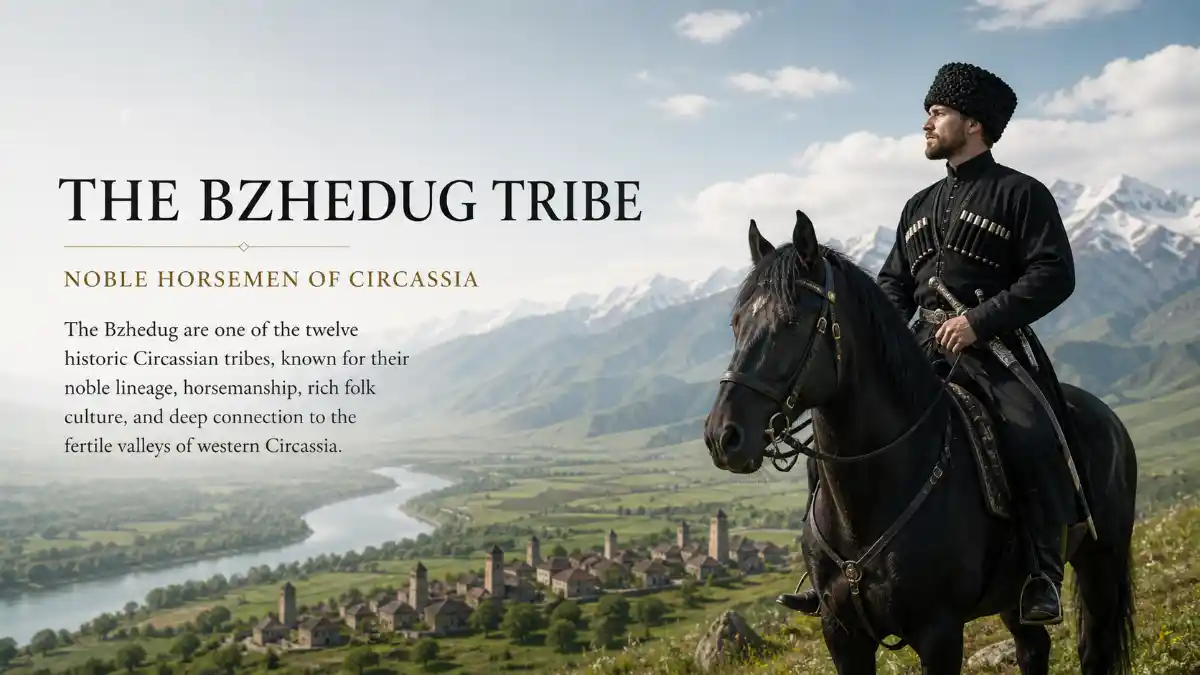
The Bzhedug Tribe: Noble Horsemen of Circassia
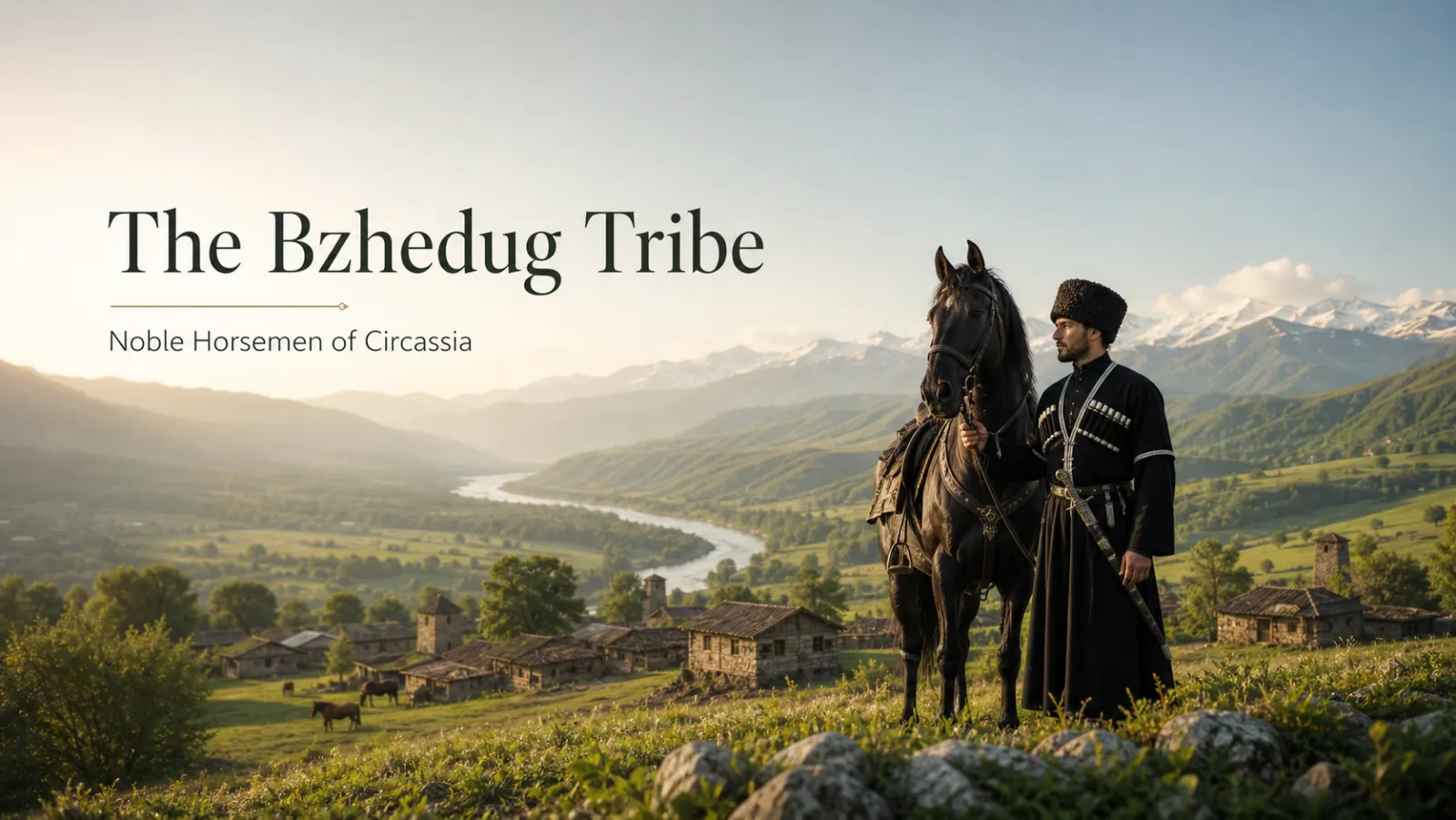
The 12 Circassian Tribes · Bzhedug
The Bzhedug Tribe: Noble Horsemen of Circassia
Бжъэдыгъу — the princely tribe that migrated from the Black Sea coast to the Kuban plains, fought a war for the right to keep its rank, and today inhabits more than half of all Adyghe villages in the Republic of Adygea.
CircassianWebUpdated: January 202618–22 min readTribe profile≈ 10,000 words
The Bzhedug (Адыгэ: Бжъэдыгъу; sometimes Bzhedugh, Bzhedukh) are one of the twelve historic Circassian tribes — and one of the most distinctive. Unlike most Adyghe peoples, who occupied a single homeland for centuries before 1864, the Bzhedug have a recorded migration story: they did not begin in the Kuban plains where they later became famous, but on the Black Sea coast between Tuapse and Sochi, around the river Shahe. In the early 16th century, for reasons preserved partly in chronicle and partly in legend, they crossed the mountains north into the territory of the Chemguy (Temirgoy) princes, fought a war for the right to keep their princely rank, and won. The territory they took — the lush, river-laced lowlands south of the Kuban — became their permanent home, the seedbed of their famous folk culture, and the heart of what is today the Republic of Adygea.
This is the long-form profile of the Bzhedug tribe: their origin myth and migration, the two great princely sub-divisions of Khamysh and Cherchaney, the agricultural economy that made them rich, the role they played in the Russo-Circassian War (including the controversial early settlement some Bzhedug chiefs accepted with Russia), the 1864 expulsion that scattered a portion of their people but left behind one of the largest surviving Adyghe homeland communities, the diaspora today, the famous Bzhedug surnames you may carry without knowing, the tamga symbols that survive when paper records do not, the genetic markers documented in the FamilyTreeDNA Circassian Project, and a practical method for tracing your own Bzhedug ancestry.
If your family identifies as Bzhedug or carries a name on the tribal register, this article is for you. If you only suspect Bzhedug heritage — from a remembered village name, a half-translated surname, a grandparent's reference to "the Kuban" or to "Adygea" — this article will give you the framework to confirm or refute that suspicion using surname research, archival records, oral memory, and DNA. Sources include Wikipedia's Bzhedug article, Amjad Jaimoukha's The Circassians: A Handbook (2001), the FamilyTreeDNA Circassian DNA Project, the Adygea republican archives, and primary research in Russian and Ottoman records.
Who Are the Bzhedug?
A princely Western Adyghe people with a recorded 16th-century migration, two distinct ruling lines (Khamysh and Cherchaney), an agricultural economy that built one of the richest folk cultures of the Caucasus, and the unusual fortune of preserving more than half of their original homeland into the present day.
The Bzhedug are one of the twelve historic Adyghe (Circassian) princedoms recognised on the Circassian flag — each of the twelve gold stars represents one tribe, and the third star, by traditional counting, belongs to them. They are part of the Western Adyghe cluster (with the Temirgoy, Hatuqay, Mamkheg, Yegerukwai, Shapsug, Natukhai, and others), distinct from the Eastern Adyghe (Kabardian, Besleney, Cherkess) by language, by political structure, and by historical experience.
Three features make the Bzhedug distinctive even within the Western Adyghe family:
A recorded migration history. Most Adyghe tribes occupied their later homelands continuously from prehistory; the Bzhedug, by contrast, have a chronicle-attested move from the Black Sea coast to the Kuban basin in the early 1500s.
A dual princely structure. The Bzhedug ruled themselves through two parallel princely lines — Khamysh and Cherchaney — each governing its own territory under common Bzhedug identity.
The largest surviving homeland community of any Adyghe tribe. While most Circassian peoples were reduced to remnant populations after 1864, the Bzhedug retained substantial settlements across the Kuban; today they form the demographic plurality of the Republic of Adygea.
This homeland continuity matters enormously for genealogy. A Bzhedug family in Amman or Istanbul searching for relatives back in the Caucasus is not searching among ruins; they are searching among living villages, with continuous administrative records, working households, and cousins who never left. In genealogical terms, the Bzhedug are among the most findable of all Circassian tribes.
The name Bzhedug itself is etymologically debated. Some Adyghe linguists trace it to a compound meaning "wild bee" (бжъэ + дыгъу), interpreting the tribe's totem as a bee — a creature symbolically appropriate for an agricultural people known for honey production. Other readings derive the name from older Adyghe roots associated with the river basins they settled. The truth may combine both: a tribal name evolving from a totemic origin and shaped by the geography that defined the people's later identity.
Population and Distribution
Pre-1864 Bzhedug population estimates range widely depending on source and methodology, but a reasonable working figure is 50,000 to 80,000 across the Kuban basin in the mid-19th century — substantially larger than the Besleney, smaller than the Kabardians or the major western tribes like the Shapsug and Abzakh. After 1864, a portion of the population emigrated to Ottoman territory; a substantial portion remained on or near the historic homeland.
Today, the Bzhedug constitute a major demographic component of the Republic of Adygea, with substantial communities in Krasnodar Krai. Diaspora populations live in Turkey, Jordan, Syria, Israel, Germany, the United States, and elsewhere. Total Bzhedug-descended population worldwide is difficult to pin down precisely — estimates range from the low six figures upward — but the homeland community alone, with its continuous documentation, is the largest single anchor for the tribe's identity.
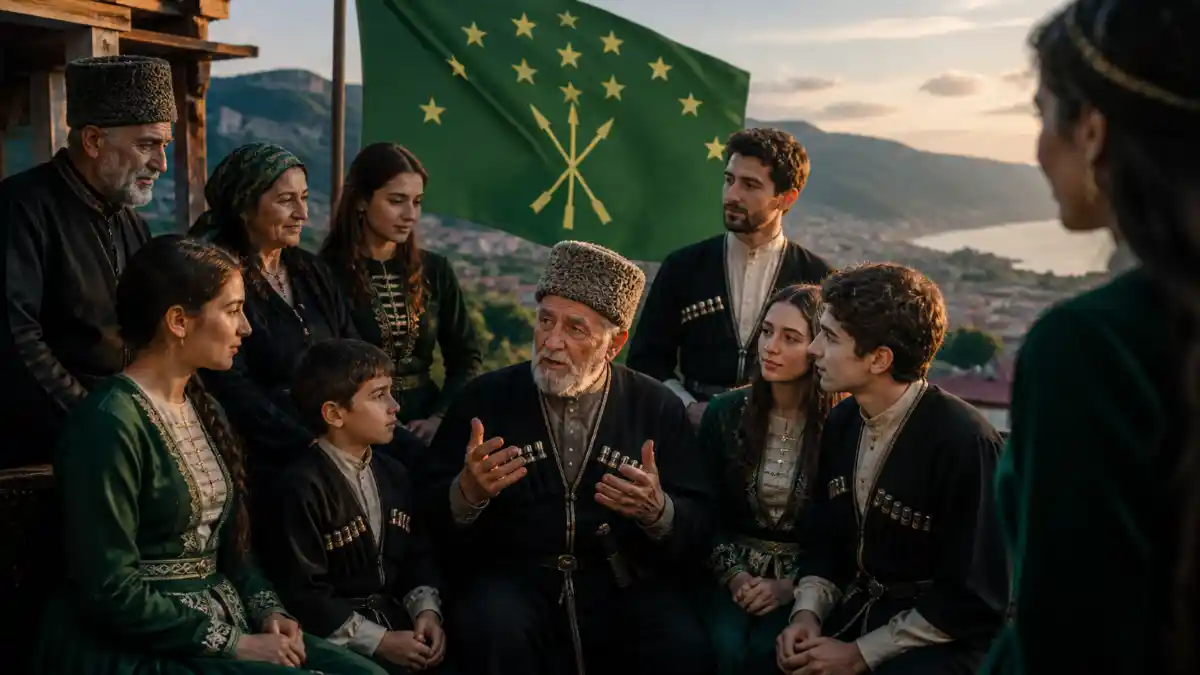
Place village.jpg here
(traditional family in village)
Before & After 1864 · The Kuban homelandDaily life in a Bzhedug village in the Kuban basin. Unlike most Adyghe tribes, the Bzhedug retained substantial homeland communities after 1864 — the traditional dress, woven carpets, and family compounds shown here describe a continuous, living culture rather than a memory.
Origins & the 16th-Century Migration
The Bzhedug did not begin where they ended. Their chronicled migration from the Shahe River to the Kuban basin in the early 1500s — and the war they fought with the Chemguy princes for the right to keep their rank — is one of the few well-attested origin stories among the Adyghe tribes.
According to Adyghe tradition and the surviving chronicles, the Bzhedug originally lived on the Black Sea coast between Tuapse and Sochi, in the lush, mountainous corridor watered by the Shahe River. This was the region inhabited by several southern Western Adyghe groups; the Bzhedug were one of them, alongside neighbours like the Ubykh and parts of the Shapsug confederation.
In the first half of the 16th century, for reasons preserved partly in chronicle and partly in oral tradition, a substantial portion of the Bzhedug crossed the Caucasus mountain range, descending from the highlands into the open river basins south of the Kuban. Theories about the cause vary:
Population pressure. The narrow coastal strip between Tuapse and Sochi could support only a limited population; the lowland Kuban offered far more arable land and pasture.
Internal political conflict. Adyghe oral tradition records disputes over princely succession; one branch may have moved north to establish its own polity rather than yield rank.
External pressure. Maritime threats along the Black Sea coast — piracy, slave raids by Crimean Tatars, conflicts with neighbouring polities — may have made the coastal homeland untenable.
A combination. Most likely, all three pressures converged across decades to produce a sustained migration rather than a single decisive moment.
The War with the Chemguy
When the Bzhedug arrived in the Kuban basin, they entered territory already inhabited — primarily by the Chemguy (Temirgoy), themselves an Adyghe princedom under their own Pshi line. According to Bzhedug oral tradition recorded by 19th-century ethnographers, the Chemguy prince agreed to allow the Bzhedug to settle in his lands on one condition: that the Bzhedug princes accept the status of vassal nobles (Worq) under Chemguy authority. The Bzhedug princes refused. They had not crossed the mountains to surrender rank.
The result was war. The Bzhedug won. The chronicle records that they defeated the Chemguy and acquired vast territories around the Psekups River basin — the river that became the central artery of Bzhedug settlement and the rough boundary between the two Bzhedug sub-divisions that emerged afterwards.
This story is more than colourful folklore. It tells us several historically meaningful things:
The Bzhedug arrived in the Kuban as princely peers, not as supplicants; their entire subsequent political identity rested on having defended the Pshi rank by force.
The relationship with the Temirgoy — later the closest neighbour and frequent ally of the Bzhedug — began with a war of equals, which is why the two tribes were able to interact afterwards as full peers rather than as a victor and a defeated party.
The geographical location of Bzhedug settlement — especially the Psekups basin — was a conquest, not a grant, which shaped the subsequent political confidence of the tribe.
The migration legend is recorded in the foundational Adyghe chronicles compiled by 19th-century ethnographers, particularly the work that informs Jaimoukha's modern handbook and the older Russian-imperial-era accounts. It remains one of the few Adyghe tribal origin stories that can be approximately dated and geographically traced.
Khamysh & Cherchaney: The Two Princely Lines
The Bzhedug ruled themselves through two parallel princely houses — Khamysh and Cherchaney — each governing its own river basin under common Bzhedug identity. This dual structure is unique among the Adyghe tribes.
Once settled in the Kuban basin, the Bzhedug organised themselves into two distinct territorial and political sub-divisions, each with its own ruling Pshi family and its own internal hierarchy:
Khamysh (Хьамыщэ)
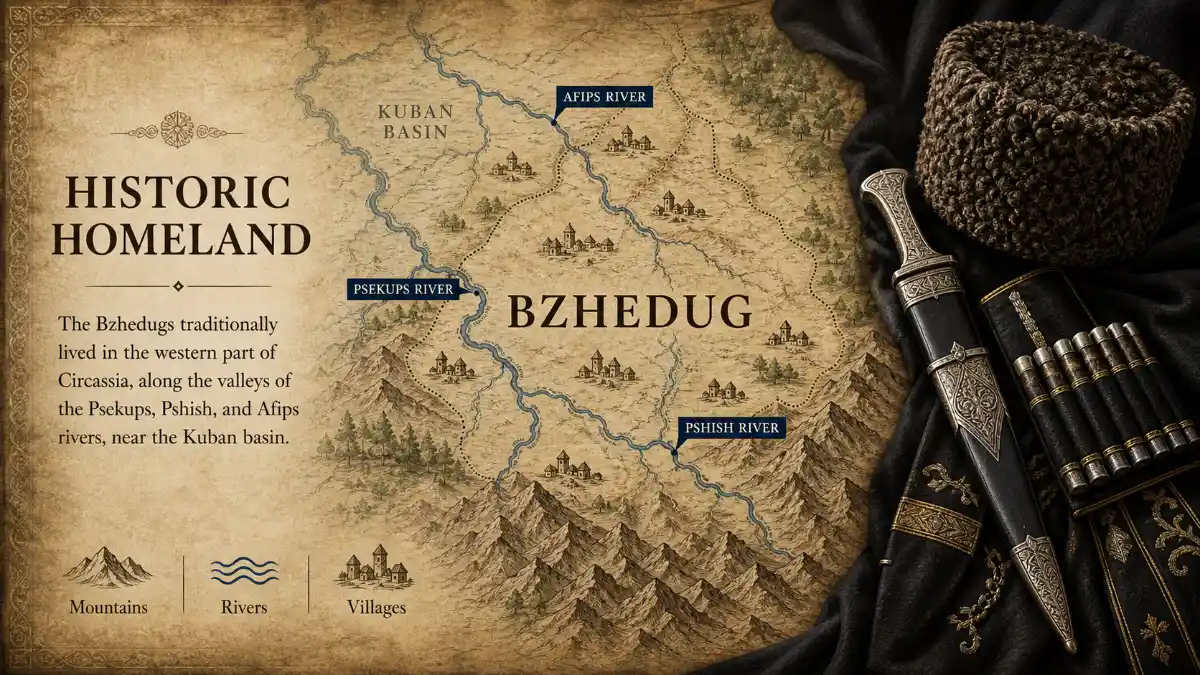
The Khamysh branch, sometimes rendered Hamysh in older transliterations, occupied the western Bzhedug territory — the lowland basin between the Afips River and the Psekups River. Their lands lay closest to what is now the city of Krasnodar (historically Yekaterinodar, the Russian Cossack stronghold on the Kuban) and put them in the most direct contact with Russian and Ukrainian Cossack settlers from the late 18th century onwards.
The Khamysh princely house produced several historically attested figures whose names survive in 19th-century Russian and Ottoman records. Their territory included a number of settlements that later became Adygea villages or were absorbed into the modern administrative structure of the Republic. Khamysh dialect features (subtle but real) distinguish themselves from Cherchaney speech to this day.
Cherchaney (Чэрчэней)
The Cherchaney branch, sometimes Chechenay or Cherchenay, occupied the eastern Bzhedug territory — the basin between the Psekups River and the Pshish River. Their lands extended further into the foothills and put them in closer contact with the Temirgoy, the Mamkheg, and the Hatuqay to the south and east.
The Cherchaney princely line maintained somewhat distinct dynastic relationships, particularly intermarriages with neighbouring Western Adyghe princely houses. Cherchaney lineage today is concentrated in particular Adygea villages whose family names connect back through documented genealogies to the pre-1864 Cherchaney noble structure.
Why the Two-Line Structure Matters
For genealogy, the Khamysh / Cherchaney distinction is more than antiquarian detail. A Bzhedug surname can usually be traced to one branch or the other, and that identification narrows the search area for further records, the relevant villages of origin, and the noble or commoner network into which the family historically fit.
The two-line structure also explains an important political feature of Bzhedug identity: the absence of a single overarching Pshi. Where the Kabardians had a paramount princely house (the line of Inal's eldest descendants) and the Besleneys were dominated by the Qanoqo, the Bzhedug were a federation of two princely houses operating side by side, neither subordinate. This dual structure made Bzhedug politics more consensual and slower to act in unified fashion — a feature that shaped, among other things, their fragmented response to Russian expansion.
Sub-divisionAdyghe formRiver boundaryModern equivalentKhamyshХьамыщэBetween the Afips & PsekupsWestern Adygea, near Krasnodar KraiCherchaneyЧэрчэнейBetween the Psekups & PshishEastern Adygea, toward Maykop area
The Kuban Homeland Today
The Bzhedug live today across 26 of the 48 Adyghe villages in the Republic of Adygea — the highest concentration of any single Adyghe tribe in any single homeland region. Their administrative center is the village (aul) of Ponezhukay.
The Bzhedug homeland today lies in the Russian Federation, primarily within the Republic of Adygea — a small but constitutionally recognised Adyghe republic enclaved entirely within Krasnodar Krai. Bzhedug settlement also extends across the Kuban into Krasnodar Krai itself, where a significant Adyghe minority population maintains its identity within Russian-administrative villages outside the formal republic.
Adygea: 54% Bzhedug Villages
The Republic of Adygea contains 48 Adyghe villages (the auls, traditional settlements that preserve Adyghe language, culture, and self-government within the modern Russian federal structure). Of these 48 villages:
26 are Bzhedug — the largest single tribal share, at 54% of all Adyghe villages
The remainder are primarily Temirgoy, with smaller numbers of Mamkheg, Hatuqay, Yegerukwai, and other tribes
This distribution makes the Bzhedug the demographic plurality of the Adyghe republic. Their cultural, linguistic, and political weight inside contemporary Adygea exceeds that of any other tribe.
Ponezhukay: The Administrative Center
Ponezhukay (Адыгэ: Понэжыкъуай) is a rural locality (an aul) and the administrative center of the Teuchezhsky District of the Republic of Adygea. It sits on the Apchas River, a tributary of the Kuban basin, near the Krasnodar Reservoir, approximately 80 kilometres (50 miles) north of Maykop (the capital of Adygea).
Ponezhukay is one of the principal Bzhedug villages, with a population of several thousand, a functioning Adyghe-language school system, an Adyghe cultural center, and a continuous documentary record going back to the 19th century. For diaspora researchers, Ponezhukay is one of the most accessible and well-documented anchors for Bzhedug genealogy: family records, surname lists, and oral histories are actively maintained by the local administration and Adyghe cultural organisations.
Other Major Bzhedug Villages
Beyond Ponezhukay, several Adygea villages preserve distinct Bzhedug identity and historic family lineages. These include settlements clustered along the Psekups, Afips, and Pshish river basins, as well as larger mixed-population villages where Bzhedug families have intermingled with Temirgoy, Hatuqay, or other Adyghe groups across generations of intermarriage. The complete list of Bzhedug villages, with their administrative connections and surname registries, is maintained at the Adygea republican level and is increasingly accessible online through cultural and genealogical platforms.
Krasnodar Krai & the "Aul Diaspora"
A significant Bzhedug population also lives in Krasnodar Krai, outside the borders of the Republic of Adygea. These communities — sometimes called the "aul diaspora" within the homeland — preserve Adyghe identity in the face of greater assimilation pressure, since Krasnodar Krai is administratively Russian rather than Adyghe-self-governing. Several Krasnodar Krai villages are historically Bzhedug, and family research there is necessary for any complete account of the tribe's modern population.
The Bzhedug Dialect
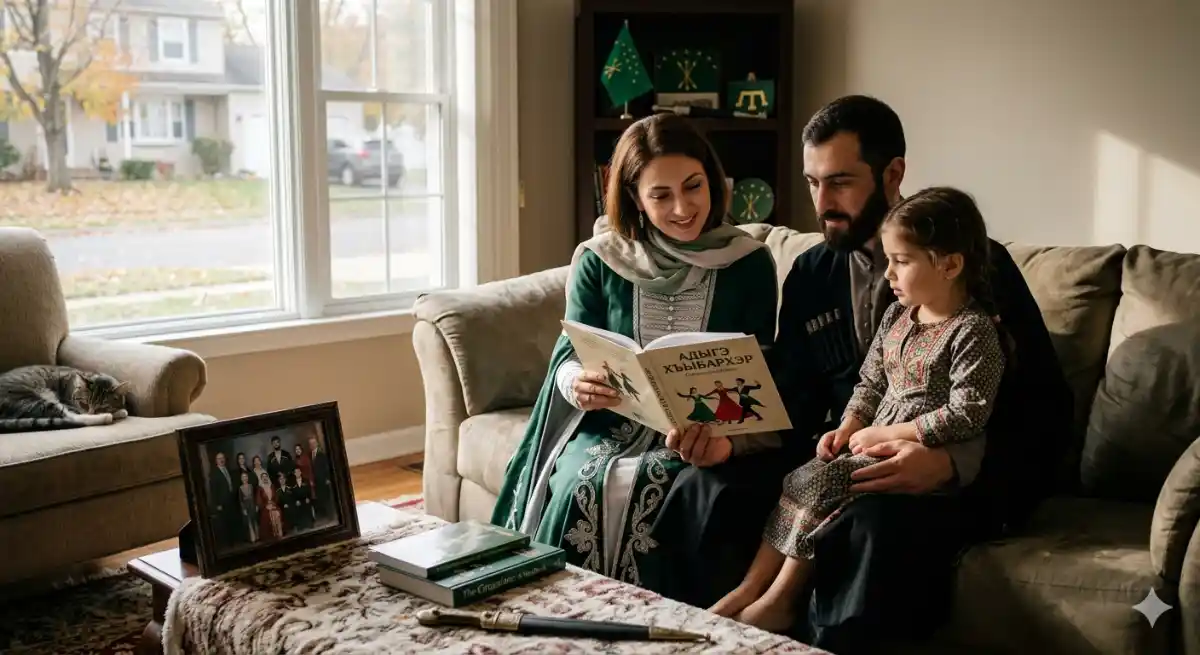
A Lowland Adyghe dialect of West Circassian, closely related to the Temirgoy dialect that became the basis for standard literary Adyghe. Bzhedug speech is the most intact and most actively-used Adyghe dialect inside Russia today.
The Bzhedug speak a dialect of the Adyghe (West Circassian) language — technically classified as the Lowland Adyghe dialect group, distinct from the Highland (Shapsug, Abzakh) and Eastern (Kabardo-Cherkess) Adyghe varieties. Within the Lowland group, Bzhedug shares features with Temirgoy and is sometimes described as a sub-variant of a single Bzhedug-Temirgoy dialect cluster.
Two features make Bzhedug language particularly significant in the broader Adyghe world:
Bzhedug-Temirgoy Lowland Adyghe is the dialect cluster on which standard literary Adyghe is largely based. When the Soviet authorities standardised written Adyghe in the 20th century, the Lowland varieties — spoken across the Republic of Adygea — provided the orthographic and grammatical reference. This means that anyone learning standard Adyghe today is, in effect, learning a form close to Bzhedug.
Bzhedug is among the most actively-used Adyghe dialects. Where Besleney and Ubykh are critically endangered, where Shapsug is fading in the diaspora, Bzhedug retains a vigorous community of native speakers because of the continuous homeland presence in Adygea, the school system that teaches Adyghe, and the cultural infrastructure that supports daily use.
For diaspora Bzhedug families seeking to recover the language, this is a quiet piece of good news: the language has not had to be revived from near-extinction; it can be learned from living speakers, current curricula, and contemporary media. Adygea publishes books, runs Adyghe-language television, and supports a network of Adyghe-language primary schools where Bzhedug children grow up bilingual.
Distinguishing Features
Specific features of the Bzhedug dialect that distinguish it from neighbouring Adyghe varieties include particular consonant realisations (some palatalisations that have simplified in Temirgoy speech), characteristic vowel patterns, and a body of vocabulary — especially agricultural terms tied to the Kuban basin economy — that is more developed than in the highland Adyghe varieties. Within Bzhedug itself, the Khamysh and Cherchaney sub-divisions retain subtle phonetic distinctions, mostly preserved in older speakers.
Princes, Nobles, and the Adyghe Khabze
A four-class feudal society governed by Adyghe Khabze, with two parallel princely lines (Khamysh and Cherchaney), strict marriage rules across the noble class, and a distinctive tradition of parliamentary council government that grew increasingly democratic during the 19th-century war years.
The Bzhedug maintained the classical Adyghe four-class social structure, governed by the unwritten code of Adyghe Khabze. The classes were the same as those documented for the Kabardians, the Besleneys, and other Adyghe peoples, with Bzhedug-specific features in the political organisation of the princely class.
The Four-Class System
ClassAdyghe termRolePrincesПщы (Pshi)Two parallel princely houses (Khamysh and Cherchaney). Held land in trust; led in war and external diplomacy. Could marry only into other princely lines, including Temirgoy and other Adyghe princely houses.Greater noblesУэркъ-тlумэSworn vassals from old noble lineages. Provided military command and judicial roles.Lesser noblesУэркъ (Worq)The warrior class. Provided cavalry levies. Bound to a Pshi or higher noble.Free commonersТфокотль (Tfokotl)Free farmers, herders, craftsmen. Bound by Khabze and tribute, not by serfdom.DependentsПщылl (Pshilh)Bound household dependents. Smallest class.
The Bzhedug Parliament
One of the most distinctive features of Bzhedug political culture was the strength of the Khasa — the council assembly. While all Adyghe peoples had council institutions, the Bzhedug Khasa developed unusually robust authority across the 18th and 19th centuries. By the 1850s, observers and chroniclers described the Bzhedug as having undergone a significant internal transformation from a princedom to a more democratic structure, with the council taking on legislative and judicial functions that elsewhere remained the exclusive prerogative of the Pshi.
This evolution had practical consequences during the Russo-Circassian War. Where a single Pshi could decide for or against negotiation with Russia, a council had to deliberate — and Bzhedug councils famously did so for long periods, with internal disagreement that sometimes produced split decisions and split tribal action. Some segments of Bzhedug political opinion accepted Russian terms relatively early; others remained in resistance to the end. This division shaped the tribe's experience of 1864 and explains why the Bzhedug homeland community survived the expulsion in larger numbers than most other tribes.
Marriage Rules and the Cross-Tribal Network
Marriage rules under Khabze were strict and class-bound, with one particularly important feature for Bzhedug genealogy: Bzhedug princely houses regularly intermarried with Temirgoy princely houses, creating a closely interlinked Western Adyghe aristocratic network. This means that a documented Bzhedug noble lineage often connects, three or four generations back, to a Temirgoy or Hatuqay noble house through documented marriages.
For a diaspora researcher reconstructing a Bzhedug family tree, the implication is that DNA matches and surname connections will frequently turn up cousins identified as Temirgoy, Hatuqay, or Mamkheg — not because the family was misclassified but because the Western Adyghe aristocratic class was, in marriage practice, a single network with internal tribal sub-divisions.
"A young Bzhedug man was expected to recite his paternal lineage back seven generations. This was not academic — it determined marriage eligibility, social standing, and your family's role within the tribal structure."— from CircassianWeb's guide to Circassian ancestry
The Russo-Circassian War & Bzhedug Resistance
A divided response to Russian expansion: some Bzhedug chiefs accepted Russian terms as early as 1861, while the tribal parliament continued resistance. Between 1861 and 1863, 300 Bzhedug families were exiled by Russian forces — a small number compared to the catastrophes that befell the Shapsug and Abzakh.
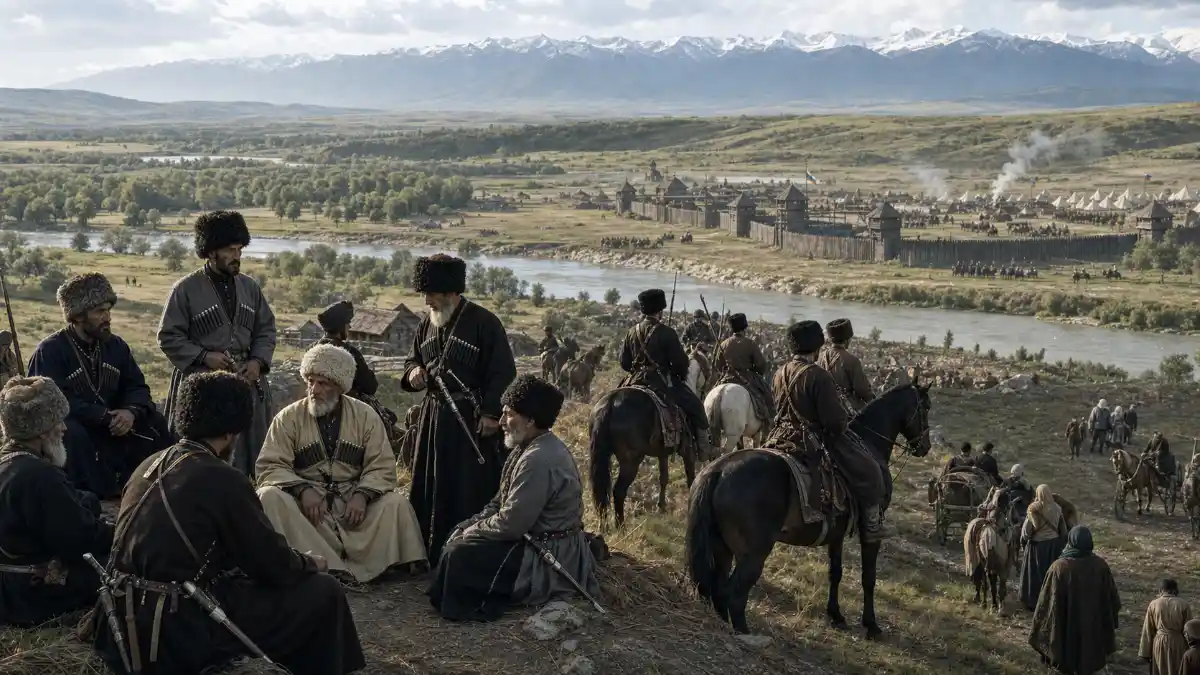
The Bzhedug were on the front line of Russian expansion from the late 18th century, when the Cossack settlements at Yekaterinodar (modern Krasnodar) began creeping south of the Kuban into Bzhedug territory. Throughout the early 19th century, Russian fortifications and military expeditions pressed on the Bzhedug homeland; Bzhedug warriors, organised through both princely military structures and the council assemblies, joined the wider Circassian resistance.
Internal Division and Early Settlements
Bzhedug response to Russian pressure was not unified. The dual princely structure, the strong council tradition, and the geographical proximity of the Khamysh sub-division to Cossack settlement combined to produce an internally divided politics. Segments of the Bzhedug and Natukhai tribes accepted terms with Russia as early as 1861 — providing Russian forces with local intelligence and bases that facilitated advances into the more militant core territories of the Abzakh and other tribes by 1862.
This early settlement was controversial within Bzhedug society at the time and remains a complicated element of the tribe's historical memory. It saved Bzhedug families from the worst of the deportation that followed; it also meant that some Bzhedug factions were perceived by other Circassians as having abandoned the common cause. Modern Bzhedug historiography, particularly within Adygea, treats this division candidly: it was a real political choice, made by particular leaders under particular pressures, with consequences both for the families who accepted terms and for those who continued resistance.
The Bzhedug Parliament's Resistance
The official Bzhedug parliament — the Khasa — opposed Russian conquest and continued resistance until the final Russian occupation of Bzhedug territory in 1859. This is one of the strongest indications of the council's institutional weight: even when individual princely chiefs negotiated their own settlements, the parliament maintained a collective stance against capitulation, organising resistance and coordinating with other Western Adyghe tribes.
This parallel structure — some chiefs settling, the council resisting — is unique to the Bzhedug among the major Adyghe tribes. It produced a fragmented experience of the war and an uneven outcome in 1864, and it is the principal reason the Bzhedug homeland survived more intact than the homelands of, say, the Shapsug or the Abzakh.
The 1861-1863 Deportations
Between 1861 and 1863, as the war wound down and Russian deportation policy ramped up, approximately 300 Bzhedug families were exiled by Russian forces to Ottoman territory. This was a significant number but small compared to the tens of thousands of Shapsug, Abzakh, and Natukhai families deported in the same period. The Bzhedug who were exiled tended to come from the most active resistance villages and from clans associated with the parliamentary opposition.
The 300-family figure is sometimes underestimated in popular accounts; the true number of Bzhedug emigrants in this period, including individual families and smaller groups not formally counted, was probably higher. But the order of magnitude is right: the Bzhedug experienced the war's worst effects on a smaller scale than most other Western Adyghe tribes, partly because of the early settlements, partly because of the geography of their territory (further from the Black Sea ports used for transport to Ottoman lands), partly because of effective intercession by some chiefs who negotiated for their populations to remain.
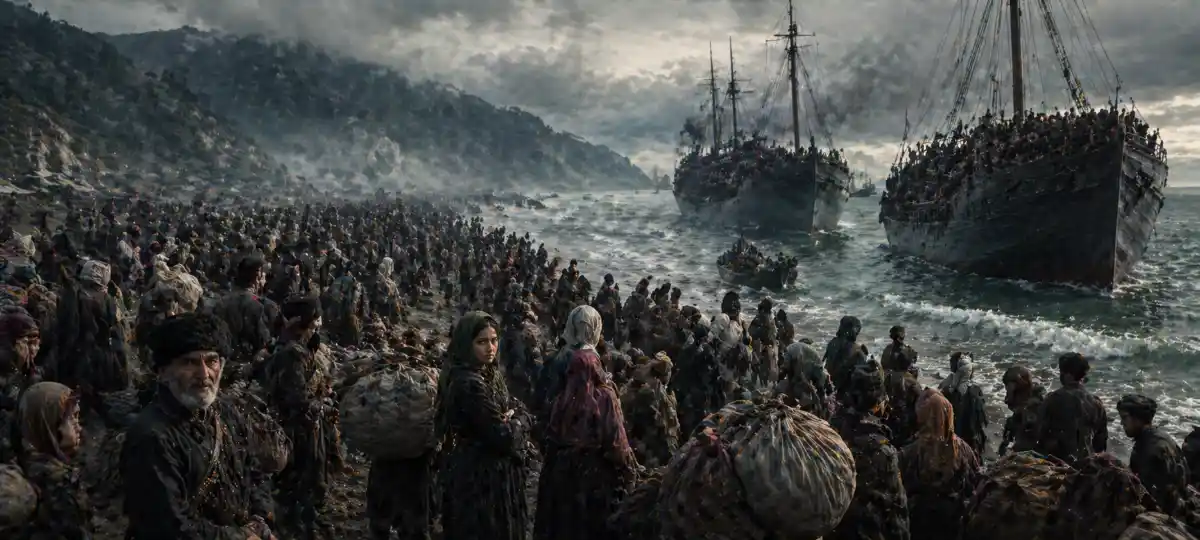
Place exile.jpg here
(refugees at Ottoman port, 1864)
1861-1864 · The deportationsCircassian refugees, including approximately 300 Bzhedug families exiled between 1861 and 1863, register at an Ottoman port. Bzhedug expulsion was on a smaller scale than that of neighbouring tribes — but the families who left carried the same memory and the same Khabze.
The 1864 Expulsion: A Tribe Mostly Survived
While 95-97% of the wider Adyghe population was killed or expelled across the Russo-Circassian War, the Bzhedug experience was distinct: a portion was deported to the Ottoman Empire, but a substantial homeland community remained — the largest single surviving Adyghe community on the Kuban.
The final Russian victory at Krasnaya Polyana on 21 May 1864 — today the Circassian Day of Mourning — ended the long war. Across the Adyghe peoples, an estimated 95-97% of the population was killed or expelled in the catastrophe that followed. The Black Sea coast emptied; the Shapsug, Abzakh, Natukhai, and Ubykh were nearly extinguished as resident populations of their homelands.
The Bzhedug experience, while still tragic, was distinct from this overall pattern. Most Bzhedug families remained in the Kuban basin. The combination of early settlement by some chiefs, the parliament's eventual negotiation, the geographical distance from the deportation ports, and the willingness of Russian authorities to accept Bzhedug pacification meant that the bulk of the Bzhedug population was not subjected to mass deportation in 1864.
Bzhedug families exiled 1861-1863
95-97% All-Adyghe killed or expelled
Majority Of Bzhedug remained in homeland
The Diaspora That Did Form
The Bzhedug families who were deported — or who chose emigration — settled across the Ottoman Empire alongside other Circassian refugees. They went primarily to:
Anatolia — including the Uzunyayla plateau (Kayseri), Tokat, Sivas, and other interior regions where the Ottomans settled Caucasian refugees
The Levant — with Bzhedug communities forming in what became Jordan, Syria, and Lebanon
The Balkans — smaller settlements in Bulgaria and what is now North Macedonia, many of which were displaced again by later Ottoman territorial losses
The Bzhedug diaspora, while smaller than the homeland community, is not insignificant. Family groups in Turkey and Jordan have maintained Bzhedug identity, surnames, and certain cultural traditions across more than a century and a half of separation. The genealogy of these diaspora families connects directly to specific Bzhedug villages in the Kuban — villages that, in many cases, still exist today.
Why the Difference Matters
The Bzhedug experience of 1864 was not the catastrophic emptying-out that defined the Shapsug and Abzakh experience. For a Bzhedug family today, both diaspora and homeland branches usually exist, often with documented continuous lines on both sides. Reconnecting them — finding a Bzhedug cousin in Ponezhukay through a Bzhedug DNA upload from Amman — is more achievable than for tribes whose homeland communities barely survived.
This relative continuity is one of the principal reasons the Bzhedug have produced disproportionately strong contributions to modern Adyghe cultural revival, language standardisation, and political life within the Republic of Adygea: their continuous community provided the institutional base that other tribes had to rebuild from scratch.
If your family is Bzhedug, your homeland branch likely still exists in Adygea. We can help you find them.
Search the village registers →
Homeland vs. Diaspora: A Living Continuity
Unlike most Adyghe tribes, the Bzhedug have two living halves: a substantial homeland community in Adygea and Krasnodar Krai, and an active diaspora in Turkey, Jordan, Syria, Israel, Germany, and the United States. Both halves remain in active cultural contact.
The Homeland: Adygea and Krasnodar Krai
The Bzhedug homeland community in modern Russia is centred on the Republic of Adygea, with its principal Bzhedug village clusters in the Teuchezhsky, Krasnogvardeysky, and Maykopsky districts. These communities preserve:
Active use of the Bzhedug dialect — in everyday life, schools, and local media
Family genealogies in continuous documentation since the 19th century, often including pre-exile records that link to diaspora-bound family branches
Adyghe Khabze observance in modified but recognisable form, particularly around weddings, funerals, and major festivals
Cultural institutions including the Adyghe State University in Maykop, Adyghe-language publishing, music ensembles, and dance troupes
Repatriation programmes that have brought a small number of diaspora Adyghe back to live in Adygea since the 1990s
Turkey: The Largest Diaspora
The Bzhedug diaspora in Turkey is the largest of the post-1864 communities. Significant Bzhedug populations live in:
Uzunyayla (Kayseri) — alongside the larger Kabardian community and other Adyghe groups
Tokat, Sivas, Çorum — central Anatolian provinces where Caucasian refugees were resettled by Ottoman authorities
Düzce and Sakarya — Black Sea coastal provinces with substantial Adyghe populations
Istanbul, Ankara, and other major cities — secondary urban migration of rural Bzhedug families
Turkish Bzhedug families have, in most cases, undergone the universal experience of Turkish Adyghe identity: surname change in 1934 (under the Surname Law), language attrition across generations, urban migration in the second half of the 20th century, and a recent generation of cultural revival, often in connection with Adygea-based programmes.
Jordan
Jordanian Bzhedug families are settled primarily in Amman, Wadi al-Sir, Naur, Sweileh, and Jerash. They form part of the broader Jordanian Circassian community that includes Kabardians, Shapsugs, Abzakh, and others. The Jordanian community is small in absolute terms but unusually well-organised, with cultural associations, charitable foundations, and a long tradition of service in the Royal Hashemite Court and the Jordanian armed forces.
Syria
Syrian Bzhedug families historically lived in Damascus, Homs, the Golan Heights (until 1967), and several rural villages in central and northern Syria. The post-2011 conflict has been catastrophic for the community: many families have been displaced, with significant numbers relocating to Turkey, Germany, the Russian Federation (some via Adygea repatriation programmes), and elsewhere. Tracing Syrian Bzhedug families today often requires working across multiple countries.
Israel
The Israeli Adyghe community is concentrated in two villages: Kfar Kama (predominantly Shapsug, with smaller numbers of other Western Adyghe groups including Bzhedug) and Reyhaniye (predominantly Abzakh). The community is small but unusually well-documented, with Israeli national archives containing Ottoman-era settlement records.
Germany, the United States, and Beyond
Twentieth- and twenty-first-century second-stage migration has produced smaller Bzhedug communities in Germany (especially through the Turkish guest-worker programme), the United States (with hubs in New Jersey and California), the Netherlands, and other Western countries. These communities often blend Bzhedug identity into broader pan-Circassian organisations.
Culture, Folk Tradition, & Music
An agricultural civilisation with unusually rich folk culture: the Bzhedug developed traditions of song, dance, ceremonial poetry, hospitality, and craftwork that became foundational to the broader Adyghe cultural canon — particularly in music and dance.
The Agricultural Foundation
Where the Besleney's economy rested on horse-breeding and the Shapsug's on coastal trade and highland sheep-herding, the Bzhedug economy was built on agriculture. The Kuban basin's rich black soil, regular rainfall, and dense river network made it one of the most productive farming regions in the Northwest Caucasus. Bzhedug villages cultivated grain, raised cattle on the lowland pastures, kept horses (though not on the breeding scale of the Laba valley), produced honey from forest beekeeping, and traded surplus production through the markets of Yekaterinodar and the Black Sea ports.
This agricultural base produced two cultural consequences. First, Bzhedug villages were larger and more permanent than the seasonal-pasture settlements of some highland tribes; this stability allowed for the development of elaborate ceremonial calendars, including agricultural rituals tied to planting and harvest. Second, the Bzhedug developed an unusually rich body of folk arts: weaving, embroidery, woodwork, metalwork, music, and dance, each practiced at a level that informed broader Adyghe cultural traditions.
Music
Bzhedug music shares its core instruments with the broader Adyghe world:
The shichepshin (шыкlэпщынэ) — bowed two-string fiddle with a haunting, vocal tone
The pkhachich (пхъэкlыч) — wooden percussion clappers used to keep rhythm in dance
The kamyl (къамыл) — long flute, traditionally played by shepherds
The pshyne (пщынэ) — modern button accordion, introduced in the late 19th century and now ubiquitous
Specific Bzhedug melodic and rhythmic patterns have entered the broader Adyghe canon. The Adyghe State Folk Dance Ensemble, based in Maykop, draws heavily on Bzhedug repertoire for its core dance numbers, and many of the most famous "Adyghe" folk songs are in fact Bzhedug-origin pieces transmitted across the broader Western Adyghe community.
Dance
The Adyghe dance tradition — including the elegant Wig processional, the energetic Lezginka-family dances, and the courtship dance Kafa — is observed across all Adyghe peoples but has particularly strong Bzhedug representation. The lowland dance style, characterised by smooth horizontal movement, controlled posture, and minimal acrobatic display, is sometimes called the "Bzhedug school" by Adyghe choreographers, in contrast to the more athletic highland Shapsug-Abzakh style.
Weddings and Khabze
Bzhedug weddings preserve a high-formality version of Adyghe wedding tradition. Key elements:
The betrothal period, sometimes lasting many months, during which the bride lives in a separate household before joining her husband's family
A complex sequence of gift exchanges between families
Specific named dances at each stage of the ceremony
The recitation of formal wedding poetry by named family elders
Strict observance of class-appropriate marriage rules, especially for noble families
Cuisine
Bzhedug cuisine is largely shared with the broader Adyghe tradition, with regional emphasis on grain dishes (reflecting the agricultural base) and dairy products from the lowland cattle:
Adyghe cheese (адыгэ къуае) — the famous unaged white cheese, originally a Western Adyghe specialty including Bzhedug; today a registered Russian regional product
Halizh (хьалыжъуй) — cheese pies, a wedding and festival staple
Shchips (щыпс) — the traditional Adyghe sauce, made with walnut and spice
Matse (мацэ) — sour-milk soup
Various stewed and grilled lamb and beef preparations
Famous Bzhedug Families & Surnames
Because the Bzhedug homeland community survived intact, Bzhedug surnames are among the best-documented of any Adyghe tribe — with continuous records linking diaspora families to specific Adygea villages.
Tracing a Bzhedug family begins with the surname — and Bzhedug surnames are particularly well-documented because of the homeland community's continuity. While, like all Adyghe surnames, they exist in multiple scripts (Adyghe-Cyrillic, Russian-Soviet, Turkish-Latin, Arabic, Hebrew), the Bzhedug case is unusual in that the original Adyghe forms remain in active use in Adygea today, providing a stable reference point against which diaspora variants can be checked.
Notable Bzhedug Lineages
Original (Adyghe)Russian/CyrillicCommon Turkish formsNotesХьэгурэХагуровыHagur, HagurovMajor Bzhedug noble line; multiple historic branchesТлецэрыкъуэТлецеруковыTletseruk, TletserukoCherchaney noble lineage; documented in 19th-c recordsЕдыджэЕдыджевыYedidzhev, YediceKhamysh-associated noble familyХьэткъоХатковыHatko, HatkovFound across multiple Adyghe tribes; strong Bzhedug presenceШэуджэнШовгеновыShovgenov, ŞovgenNotable cultural-academic lineage; multiple modern figuresХьачэмызХачемизовыHachemiz, HachemizovCommon Bzhedug commoner-noble familyЯкъутльЯкутловыYakutl, YakutlovBzhedug-Temirgoy cross-tribal lineage
Other names commonly associated with Bzhedug heritage include the Mafedz, Kuek, Tlepsi, Pankhuf, Bachidzhe, and Ashemef lines. The CircassianWeb surname database performs cross-script lookups and ties names to documented historical records where they exist.
Patterns to Recognise
Surnames ending in -okwa / -oko / -uko / -okuo (in Adyghe -окъуэ) often indicate a noble Worq line
The prefix Khat- / Hat- appears in multiple Western Adyghe lineages
Names ending in -zh / -zhe often have specific Bzhedug-Temirgoy associations
Bzhedug families often retain both a Russified surname (in Soviet-era documents) and an original Adyghe surname (in family memory and Adygea records)
For Turkish Bzhedug families, the 1934 Surname Law often produced surnames that obscure Bzhedug origins. Common patterns include Adıgün, Kuban, Kafkas, Çerkes, and various nature-derived names (mountain, river, valley) chosen as compromises that did not require revealing tribal-specific Adyghe roots. Researching Turkish Bzhedug ancestry often requires recovering the pre-1934 family name.
The Bzhedug Tamga
Bzhedug clan symbols (tamgas) are characterised by bold geometric forms reflecting the lowland agricultural identity of the tribe. Several Bzhedug tamgas are documented in Adygea museum collections and in published ethnographic catalogues.
The tamga — the unique geometric mark used by Adyghe clans to brand livestock, mark property, identify lineage, and seal agreements — was as central to Bzhedug identity as it was to that of other Adyghe peoples. The Bzhedug, with their settled agricultural villages and continuous homeland presence, preserved their tamga tradition particularly well: many family symbols are documented in the Adygea State Museum, in regional ethnographic publications, and in the oral memory of village elders.
Bzhedug tamgas show several distinctive visual features:
Bold horizontal lines with paired terminations — reflective, perhaps, of the open lowland horizon and the river-valley orientation of village life
Loop or curve motifs that distinguish them from the more angular highland (Shapsug, Abzakh) tamgas
Brand-friendly simplicity — the tamgas were practical livestock marks first, and they had to be reproducible quickly with hot iron, which favoured simple designs
Family-line variants — within a major clan, sub-lineages often added a small diacritical mark (a dot, a short cross-bar) to distinguish their branch
The Hagur, Tletseruk, and Yedidzhev tamgas are among the best-documented Bzhedug clan symbols, each appearing in multiple ethnographic publications and museum collections. The Adyghe State Museum in Maykop maintains a tamga catalogue that includes a substantial Bzhedug section.
Practical tip Tamgas were never written down the way names were. They survived through being seen — on a saddle blanket, on a doorpost, on a piece of woodwork, on an embroidered cloth. Ask the eldest members of your family whether they remember a household mark. Even a partial drawing on a napkin can match against the catalogued Bzhedug tamgas and identify your clan.
The CircassianWeb tamga finder compares family-remembered symbols against the documented Bzhedug catalog and can produce a probabilistic identification.
Tracing Your Bzhedug Ancestry: A Practical Method
A five-step framework — with a Bzhedug-specific advantage: because the homeland community survived, your ancestry can often be traced not just to a tribal identity but to a specific Adygea village still standing today.
Step 1 — Elder Interviews
Start with the oldest living members of your family. Ask specifically:
Do you remember the family being called Bzhedug, Khamysh, or Cherchaney?
Was the family from the Kuban, from Adygea, or specifically from a named village?
If they arrived in Anatolia or the Levant as refugees, what was the year? Was it the 1860s? The 1850s?
Are there any symbols (tamgas) the family remembers using?
Do you remember any Adyghe-language words still spoken in the household by the older generation?
Step 2 — Surname Research Across Five Scripts
Run your surname through the Adyghe (Cyrillic), Russian-Soviet, Turkish (Ottoman and Republican), Arabic, and Hebrew variants. Bzhedug-specific note: the original Adyghe form of your name almost certainly still exists in active use in Adygea, even if your current legal surname differs.
Step 3 — Adygea Village Records
This is the Bzhedug-specific step that is unavailable to most other tribes. Adygea maintains continuous village-level records going back to the 19th century. For families with a remembered village name or a clearly Bzhedug surname, the Adygea republican archives, the Maykop regional archive, and the village administrations themselves can often produce direct family connections.
Step 4 — Ottoman & Russian Archives
For Bzhedug families who emigrated to Ottoman territory between 1859 and 1880, the Ottoman Nüfus Defterleri at the Başbakanlık Osmanlı Arşivi in Istanbul are the primary record. For families that remained or moved within the Russian Empire, the Kuban Regional Archive in Krasnodar holds 19th-century census and military records that document Bzhedug settlements.
Step 5 — DNA Testing
Y-DNA haplogroups G2a (especially G-M406), J2, and R1b are documented in Western Adyghe populations including the Bzhedug. CircassianWeb's DNA matching compares your raw data against the 109-record peer-reviewed Circassian reference panel, which includes Bzhedug samples. The FamilyTreeDNA Circassian DNA Project has over 2,800 members, including multiple confirmed Bzhedug lineages, and is searchable for direct matches.
Place modern.jpg here
(elder + granddaughter exploring family tree)
Today · A Bzhedug reunionFor Bzhedug families more than for most other Adyghe peoples, this scene is happening every week: a diaspora descendant connecting, often via DNA matching, with a homeland cousin in Ponezhukay or another Adygea village. The line never broke. It only stretched.
Bzhedug Genetic Markers
Western Adyghe populations — including the Bzhedug — show distinctive frequencies of G2a, J2, and R1b on the paternal side, and H, U, and T mtDNA on the maternal side. Bzhedug DNA results overlap with Temirgoy and other Western Adyghe groups.
Population genetic studies of Circassians (Balanovsky et al., 2011; Yunusbayev et al., 2012; subsequent FTDNA Circassian DNA Project work) document distinctive haplogroup frequencies across the Adyghe peoples. Western Adyghe groups, including the Bzhedug, show patterns somewhat distinct from the eastern groups (Kabardian, Besleney) but shared internally with their immediate neighbours.
HaplogroupTypeNotes for BzhedugG2a (G-M406)Y-DNA paternalCommon across all Adyghe; principal lineage marker traceable to pre-Bronze Age CaucasusJ2 (J-M172)Y-DNA paternalParticularly strong in Western Adyghe samples; meaningful proportion in BzhedugR1bY-DNA paternalPresent in Western Adyghe samples; differs from the R1a-dominated Eastern Adyghe patternR1aY-DNA paternalLess common in Bzhedug than in Kabardian/Besleney; one of the East/West distinguishing markersH, U, TmtDNA maternalMaternal lineages broadly shared across the Northwest Caucasus; trace to Bronze Age populations
Important caveat Haplogroup associations are probabilistic and population-level, not individual identity tests. A Bzhedug-specific identification almost always requires combining DNA results with surname research and family history. Because Bzhedug and Temirgoy populations are genetically very close, DNA alone cannot distinguish them definitively — the surname and the village name are essential supplementary evidence.
The FamilyTreeDNA Circassian DNA Project, with over 2,800 members as of 2026, includes confirmed Bzhedug lineages and is the largest single repository of Circassian Y-DNA data. For a Bzhedug family today, uploading raw DNA and running it against the project database is one of the highest-value investigations available.
Notable Bzhedug Figures
From Khamysh-line princes who fought the Russo-Circassian War to modern Adyghe academics, writers, and political figures shaping the Republic of Adygea, the Bzhedug have produced an outsized share of cultural and political leaders.
The Hagur princely line — major Khamysh-affiliated noble family with multiple historically attested figures during the 18th and 19th centuries; their genealogy is well-preserved in Adygea archives and several diaspora-Turkey branches.
The Tletseruk line — Cherchaney-affiliated noble family with documented connections to Adyghe political and cultural life across more than two centuries.
The Shovgenov family — producing multiple modern academics, writers, and cultural figures within Adygea; the Adyghe Republican State University has hosted several Shovgenov-line scholars.
The Yedidzhev family — another major Bzhedug noble line, with branches in Adygea, Turkey, and Jordan.
Modern Adygea political figures — the Republic of Adygea has had multiple senior political and administrative figures of Bzhedug descent across the post-Soviet period; the Adygea Parliament and the State Council have included Bzhedug-line members in significant numbers.
Diaspora academics and cultural figures — Bzhedug-descended scholars at universities in Turkey, Jordan, the United States, and Germany have contributed to Adyghe-studies scholarship and cultural revival programmes.
A complete prosopography is beyond the scope of this article; CircassianWeb's collaborative family tree aims to aggregate the scattered records into one connected dataset.
Modern Cultural Revival
Because the Bzhedug homeland community survived, Bzhedug cultural revival has not had to begin from scratch. Language, music, dance, weddings, and Khabze remain in continuous practice in Adygea — and the diaspora is actively reconnecting.
Cultural revival for the Bzhedug is unusually well-positioned among the Adyghe tribes. While many Circassian communities have had to rebuild cultural infrastructure that 1864 nearly destroyed, the Bzhedug have a continuous homeland community that maintained the language, the music, the dance traditions, the food, and the Khabze across all the intervening centuries. The work today is less about recovering what was lost and more about reconnecting the diaspora to what was preserved.
Several initiatives are particularly significant:
The Adyghe State University in Maykop — offering Adyghe-language degrees, hosting cultural research, training the next generation of Adyghe-language teachers
Adyghe-language media — television, radio, publishing, online platforms based in Adygea, increasingly accessible to diaspora communities
Cultural festivals — the annual Adyghe cultural festivals in Maykop and Ponezhukay attract diaspora attendees from Turkey, Jordan, and beyond
Repatriation programmes — the Republic of Adygea has supported limited Adyghe return migration since the 1990s, including some Bzhedug-descended families from Syria after 2011
Digital community-building — Facebook groups, family-tree platforms, DNA-matching services that connect Bzhedug descendants across the global diaspora
Music and dance ensembles — the Adyghe State Folk Dance Ensemble and several private ensembles preserve and perform Bzhedug-rooted repertoire internationally
The internet era has been particularly significant. Diaspora Bzhedug who would, in earlier generations, have struggled to find more than a handful of fellow Bzhedug families now connect across continents through dedicated platforms, social media groups, and DNA matching services.
Frequently Asked Questions
The questions readers most often ask about Bzhedug heritage, identity, and ancestry research.
Are the Bzhedug a separate tribe or part of the Kabardians?
The Bzhedug are a separate tribe, distinct from the Kabardians by language, geography, and history. While Kabardians and Bzhedug are both Adyghe (Circassian) peoples, they belong to different branches: Kabardians are Eastern Adyghe, speaking the Kabardo-Cherkess language; Bzhedug are Western Adyghe, speaking the Adyghe (Lowland) language. They are recognised as separate stars on the Circassian flag. The Bzhedug are most closely related to the Temirgoy, Hatuqay, and Mamkheg, not to the Kabardians.
Where do most Bzhedug live today?
The largest Bzhedug community lives in the Republic of Adygea in the Russian Federation, where 26 of the 48 Adyghe villages are Bzhedug. Significant communities also live in Krasnodar Krai (outside the formal republic) and across the diaspora in Turkey, Jordan, Syria, Israel, Germany, and the United States. Unlike most Adyghe tribes, the Bzhedug have a substantial, continuously documented homeland community.
What was the Bzhedug migration from the Black Sea coast?
In the first half of the 16th century, the Bzhedug migrated from the Black Sea coast (around the Shahe River, between Tuapse and Sochi) across the Caucasus to the Kuban basin. According to oral tradition and chronicle sources, they fought a war with the Chemguy (Temirgoy) princes for the right to settle as full peers, won, and acquired vast territories around the Psekups River basin. This is one of the few well-attested origin stories among the Adyghe tribes.
What is the difference between Khamysh and Cherchaney?
Khamysh and Cherchaney are the two princely sub-divisions of the Bzhedug. Khamysh (Хьамыщэ) occupied western Bzhedug territory between the Afips and Psekups rivers; Cherchaney (Чэрчэней) occupied eastern Bzhedug territory between the Psekups and Pshish rivers. Each had its own Pshi (princely) line and its own internal hierarchy, but they shared common Bzhedug identity, language, and culture. For genealogy, identifying which sub-division a family belonged to narrows the search to specific villages and noble networks.
Did the Bzhedug suffer the 1864 expulsion?
Yes, but on a smaller scale than most other Adyghe tribes. Approximately 300 Bzhedug families were exiled between 1861 and 1863, and additional families emigrated voluntarily or were displaced in the years following the war. However, the majority of the Bzhedug population remained on the Kuban, partly because some chiefs accepted Russian terms early, partly because of the geography of their territory. This is why the Bzhedug have one of the largest surviving Adyghe homeland communities today.
What dialect do the Bzhedug speak?
The Bzhedug speak the Lowland Adyghe dialect of West Circassian, closely related to Temirgoy. Significantly, standard literary Adyghe is largely based on the Lowland Bzhedug-Temirgoy dialect cluster — meaning that anyone learning standard Adyghe today is, in effect, learning a form close to Bzhedug. The dialect is in active use in Adygea, with native speakers across all generations.
What surnames indicate Bzhedug heritage?
Common Bzhedug surnames include Hagur, Tletseruk, Yedidzhev, Hatkov, Shovgenov, Hachemizov, Yakutl, Mafedz, Kuek, Tlepsi, Pankhuf, and others. Because of Turkey's 1934 Surname Law, many Bzhedug families in Turkey have surnames that don't reveal their tribal identity (Adıgün, Kuban, Kafkas, Çerkes, or nature-derived names). Recovering the original Adyghe surname often requires elder interviews and pre-1934 family records.
Can DNA testing confirm Bzhedug ancestry?
Partially. Y-DNA haplogroups G2a, J2, and R1b are common in Western Adyghe populations including the Bzhedug, and matching against the FamilyTreeDNA Circassian DNA Project (which has 2,800+ members including confirmed Bzhedug lineages) can produce strong probabilistic evidence. However, DNA alone cannot distinguish Bzhedug from Temirgoy — the two populations are genetically very close. The most reliable identification combines DNA results with surname research, family history, and village records.
What is a tamga and how does it help Bzhedug genealogy?
A tamga is a unique geometric symbol used by Adyghe clans to brand livestock, mark property, and identify lineage. Each Bzhedug clan has its own tamga, and these symbols often survive in family memory even when written records have been lost. If your family remembers a household mark — a particular cross, fork, half-circle, or angled line — it can be matched against the documented Bzhedug tamga catalog to identify your specific clan. Several major Bzhedug tamgas (Hagur, Tletseruk, Yedidzhev) are well-documented in the Adygea State Museum.
How can I visit the Bzhedug homeland in Adygea?
The Republic of Adygea is accessible from Krasnodar International Airport (about 90 minutes drive to Maykop, the capital) or from Maykop directly if you fly via Moscow. Major Bzhedug villages including Ponezhukay (the administrative center of Teuchezhsky District) are within an easy day-trip from Maykop. The Adygea State Museum, the Adyghe State University, and several cultural organisations welcome diaspora visitors and can help connect you with local family lines or relevant village administrations.
Are the Bzhedug really "noble horsemen"?
All Adyghe peoples maintained a horse-centred warrior culture, and the Bzhedug were no exception — their cavalry was a key element of their resistance during the Russo-Circassian War. However, the Bzhedug are not most famous for horse-breeding the way the Besleney are; their economy was primarily agricultural rather than pastoral. The Bzhedug are most famous for their folk culture, music, dance, agricultural prosperity, and the survival of their homeland community. The "noble horsemen" framing captures one true element — their princely martial tradition — but their full identity is broader.
How is Bzhedug heritage different from broader "Circassian" heritage?
"Circassian" is the broader umbrella term covering all twelve Adyghe tribes — Kabardians, Bzhedug, Shapsug, Abzakh, Temirgoy, and others. "Bzhedug" identifies a specific tribe within this broader identity. Bzhedug-specific elements include the Kuban homeland, the Khamysh/Cherchaney sub-divisions, the Lowland Adyghe dialect, the agricultural cultural base, and a historic connection to the 16th-century migration story. A person can identify simultaneously as Adyghe, as Circassian, and as Bzhedug — these are nested layers of heritage, not alternatives.
Where can I learn the Adyghe language as a Bzhedug descendant?
Several options exist: (1) The Adyghe State University in Maykop offers in-person and increasingly online courses; (2) Diaspora cultural associations in Turkey, Jordan, Germany, and the United States run language-learning programmes; (3) Online platforms increasingly offer Adyghe lessons, including Bzhedug-specific dialect material. Because standard literary Adyghe is based on the Lowland (Bzhedug-Temirgoy) dialect cluster, most resources will closely match Bzhedug speech.
Trace Your Bzhedug Ancestry Today
Because the Bzhedug homeland community survived, your line probably leads to a specific Adygea village — one where someone with your surname may still be living.
1 Build your tree
Start with three names: yourself, a parent, a grandparent.
2 Find your tribe
Match your surname against the Bzhedug clan database.
Upload your DNA
Compare against the Circassian reference panel.
✓ Free forever · ✓ Your data stays yours · ✓ No credit card
Sources & Further Reading
Wikipedia — Bzhedug, Circassians, Circassia.
Wikipedia — Ponezhukay (administrative center of Teuchezhsky District).
Wikipedia — Russo-Circassian War and Circassian Genocide.
Jaimoukha, A. (2001). The Circassians: A Handbook. Palgrave Macmillan. The standard modern survey of Adyghe peoples and their tribal organisation.
Natho, K. (2009). Circassian History. Xlibris Corporation.
Richmond, W. (2013). The Circassian Genocide. Rutgers University Press.
Balanovsky, O. et al. (2011). "Parallel Evolution of Genes and Languages in the Caucasus Region." Molecular Biology and Evolution, 28(10), 2905–2920.
Yunusbayev, B. et al. (2012). "The Caucasus as an asymmetric semipermeable barrier to ancient human migrations." Molecular Biology and Evolution, 29(1), 359–365.
Ottoman Nüfus Defterleri — Başbakanlık Osmanlı Arşivi (BOA), Istanbul.
Russian Military Topographic Maps and Census Records, 1830–1864 — Kuban Regional Archives, Krasnodar; RGVIA, Moscow.
Adygea State Museum (Maykop) — tamga catalog and ethnographic collections.
FamilyTreeDNA Circassian DNA Project — familytreedna.com/groups/circassian.
Adygea Republican Archive (Maykop) — village-level records, family registers.
Kuban Regional Archive (Krasnodar) — 19th-century census, military, and migration records.
CircassianWeb companion guides: Circassian Ancestry, The 12 Tribes, Besleney Tribe, Tamga Finder, Adyghe Khabze, DNA Heritage Explorer.
Further Reading & References
- Wikipedia: Bzhedug people
- Britannica: Circassian people
- Britannica: Caucasian War
- JSTOR: Academic articles on the Circassians