שבט ה-Abdzakh: לוחמי ההרים של צ'רקסיה
Abdzakh Tribe: Mountain Warriors of Circassia and Their Enduring Legacy
The Abdzakhs (also known as Abadzekh or Abzakhs, Абдзах) were one of the largest and most influential Circassian tribes, inhabiting the mountainous interior of western Circassia. Their historical importance lies in their distinctive social structure, their strategic role in the Russo–Circassian War (1763–1864), and their position as one of the last organized centers of resistance in the Caucasus.
Within the broader framework of Circassian society, the Abdzakhs formed part of the western tribal groups, alongside communities such as the Shapsugs and Natukhais. Their history is essential to understanding the development of Circassian identity, resistance, and diaspora.
Introduction: A Defining Force in Circassian History
The Abdzakh tribe (Circassian: Абдзах), also known as Abadzekh, stands among the most influential and formidable of the twelve major tribes of Circassia. Renowned for their military strength, democratic governance, and deep-rooted cultural traditions, the Abdzakhs played a decisive role in shaping the political, social, and military landscape of the North Caucasus for centuries.
Heritage · Tribes & History
The Abdzakh Tribe: Mountain Warriors of Circassia
CircassianWeb · Heritage Research · 2026 · 20 min read
The Abdzakhs never had princes. That single fact explains almost everything else about them — how they fought, how they governed themselves, and why they were the last Circassian tribe to fall. When the Russian Empire finally moved to finish the conquest of Circassia in the 1860s, it was Abdzakh territory that held out longest. Not because they were the biggest or best-armed, but because every man in their forests had chosen to be there.
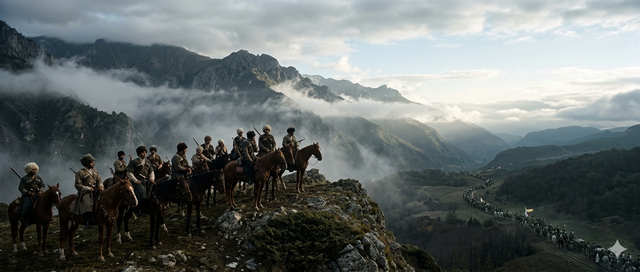
Circassian warriors — including the Abdzakh — used the mountain terrain with a tactical sophistication that imperial Russian officers documented with grudging admiration. The Belaya River valley, Abdzakh heartland, provided natural cover that made conventional warfare almost impossible for attackers.
3 Of 12 Circassian tribes classed as "democratic" — Abdzakh, Shapsug, Natukhai
1864 Year of final expulsion — among the last tribes to surrender their homeland
5 Countries where major Abdzakh diaspora communities exist today
A Tribe Without Princes
Most of what you hear about Circassian society focuses on the warrior code — the Xabze, the horsemanship, the elegance of Circassian dress in the Ottoman court. What gets less attention is the enormous political difference between Circassian tribes. The Kabardians had an aristocracy that would not have looked out of place in feudal Europe. The Abdzakhs had nothing of the sort.
Their governance was a tribal republic in practice if not in name. Disputes went before councils of elders. Decisions about war, territory, and alliance required broad consensus. A man who rose to leadership among the Abdzakhs did so because people chose to follow him, not because his grandfather had also been in charge. By the standards of 19th-century European political thought, this was remarkable. By the standards of Russian imperial military planners trying to figure out who to negotiate with, it was profoundly inconvenient.
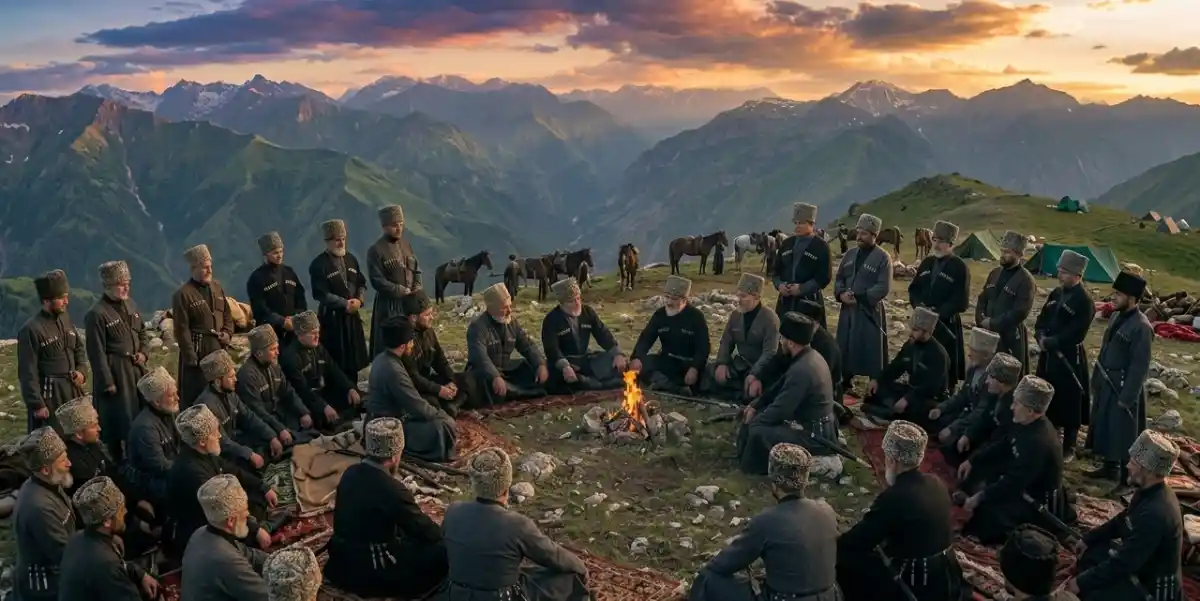
There was no Abdzakh prince whose surrender would settle the matter. There was no hierarchy to decapitate. Every warrior was, in a meaningful sense, a volunteer — and volunteers who understand what they are fighting for are harder to defeat than conscripts who don't.
"Unlike some neighboring regions that were gradually incorporated, Circassia resisted fiercely — and the Abdzakhs, in their mountain interior, became one of its last pillars."
The Land They Defended
To understand the Abdzakhs, you need to spend a moment with the geography. Their homeland sat in the upper valleys of the Belaya, Pshekha, and Pshish rivers — rivers that cut through dense forest and dropped into ravines that swallowed men and columns whole. The terrain wasn't just difficult. It was an ecosystem designed, if you'll forgive the stretch, for the kind of warfare the Abdzakhs practiced.
A Russian military column moving through Abdzakh territory in the 1840s faced: thick canopy that eliminated visibility beyond fifty meters, valley floors that funneled infantry into predictable chokepoints, ridges that seemed empty until they weren't, and a population that could disappear into the forest and reappear three kilometers away before the column finished regrouping.
General Yermolov — the Russian commander who burned more Circassian villages than perhaps any other single officer — described operations in the western Caucasus as like fighting a shadow. He didn't mean it as a compliment, but it was accurate.

Russian military operations in Abdzakh territory consistently cost far more than commanders anticipated. The combination of terrain, guerrilla tactics, and a population that refused to treat surrender as an option prolonged the conflict by years.
Origins: Who Were the Abdzakhs?
The Abdzakhs were part of the western Adyghe cluster, geographically and linguistically close to the Shapsugs and Natukhai and in particularly deep alliance with the Ubykh — a neighboring people they often described as kin. Their name's etymology is disputed. Some linguists connect it to their position relative to neighboring groups; others tie it to geographic features of their territory. Neither explanation is fully satisfying, which is often how etymology works.
What's clearer is their social DNA. The Abdzakhs were not a people who arrived from somewhere else with a founding myth. They were a product of this mountain landscape across centuries — shaped by the necessity of defending narrow passes, by the premium placed on community solidarity when every neighbor's survival depended on collective action, and by the particular psychology that emerges when people live lives that are genuinely difficult.
Their relationship with the Ubykh is worth noting. When the Russian Empire finally broke Circassian resistance, the Ubykh were the only Caucasian people to be entirely expelled — not a single family remained in their homeland. The Abdzakhs suffered a similar near-total displacement. The ties between these two groups weren't merely political. They shared a century of joint resistance and joint catastrophe.
How They Lived
Economy of a Mountain People
The Abdzakhs were not pastoral romantics. They farmed valley floors where the terrain allowed it, raised horses bred specifically for mountain conditions — short-legged, sure-footed, capable of carrying a rider at speed down slopes that would make most cavalry balk — and maintained a metallurgical tradition that gave them an advantage Russian commanders underestimated: they could make their own weapons.
Copper, iron, lead, silver — all pulled from Abdzakh mines. This self-sufficiency meant they were less dependent on the trade networks that Russia systematically disrupted as a tactic of conquest. Cut off a feudal tribe from its supply of powder and ball and you've already half-defeated them. The Abdzakhs could manufacture their own powder and cast their own shot.
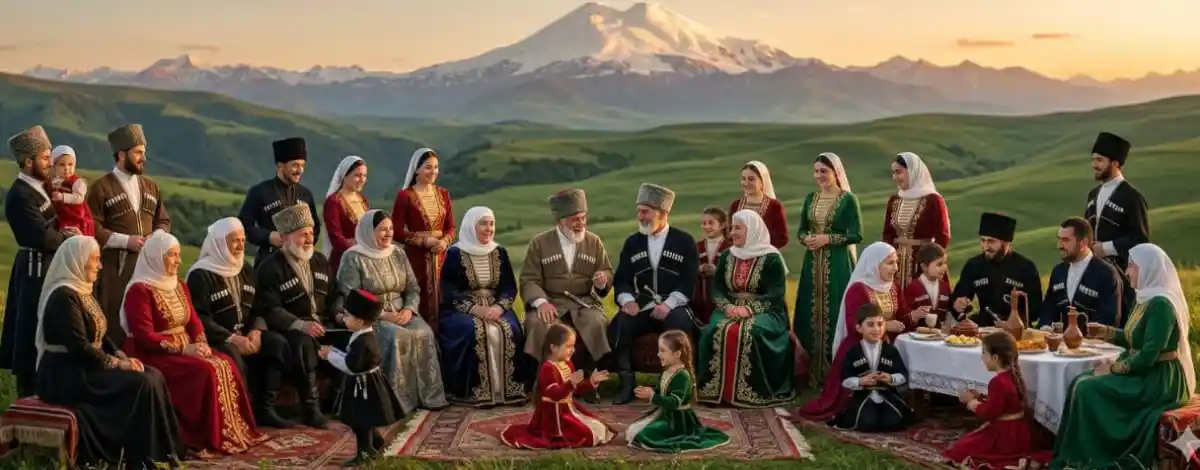
The Code That Held Everything Together
Adyghe Xabze governed Abdzakh social life the same way it governed all Circassian tribes, but its expression among a non-feudal people had a particular texture. Without a hereditary aristocracy to adjudicate disputes and enforce norms, the code carried more weight as an internalized system rather than an external one. You behaved with honor not because a prince was watching, but because the entire community was watching — and would remember.
Hospitality was absolute. A traveler who reached an Abdzakh household could expect protection regardless of their identity, and this wasn't merely custom — it was enforced by community sanction. The scholar James Bell, who spent time among western Circassians in the 1830s, wrote accounts of hospitality extended to people who were, by any measure, enemies. The code said you fed them first and dealt with the politics later.
Pre-1763
Abdzakhs occupy the upper valleys of the Belaya, Pshekha, and Pshish rivers — a non-feudal tribal republic in the mountainous interior of western Circassia.
1763
Russia establishes Fort Mozdok, beginning the slow encirclement of Circassia. The Abdzakhs, deep in the mountains, are not yet under direct threat but begin organizing in alliance with other western tribes.
1816–1827
General Yermolov's scorched-earth campaigns devastate plains-dwelling Circassians. Mountain tribes including the Abdzakhs provide refuge and begin coordinating resistance at a regional scale.
1840s–1850s
Peak of organized Circassian resistance. Abdzakh territory becomes a center of military planning. Imam Shamil's representatives attempt to coordinate western Circassian resistance with the eastern Caucasian uprising.
1856
Treaty of Paris ends the Crimean War. Circassian leaders had hoped for international protection. Britain and France, having made their point about Crimea, quietly abandon Circassia's case.
1860–1864
Russia launches its final campaign with 100,000 troops and a systematic scorched-earth strategy. Abdzakh territory is among the last to fall. The May 21, 1864 ceremony at Qbaada marks the official end.
1864–1867
Mass deportation. The majority of Abdzakhs are expelled to Ottoman territory. Thousands die crossing the Black Sea. The mountain valleys they had held for generations are resettled with Cossack colonists.
The War
The Russo-Circassian War lasted 101 years in total. The Abdzakhs were involved in its final, most brutal phase — the decade between roughly 1855 and 1864 when Russia stopped trying to negotiate and started trying to empty the mountains.
Their military system was exactly what you'd expect from a non-feudal people with deep forest cover: no standing army, no generals in the European sense, no fixed defensive lines. Instead, each clan contributed fighters who operated in small mobile units under leaders chosen for competence rather than birth. They hit supply lines, ambushed isolated outposts, retreated before the main force could fix them in place, and reappeared where they weren't expected. Russian military reports from the period use words like "elusive" and "unpredictable" so often they become a kind of inadvertent tribute.
What the Abdzakhs couldn't do was stop what was coming. By 1860, Russia had shifted strategy entirely. The goal was no longer to subdue the population. It was to remove it. Villages were burned not to deprive fighters of shelter but to destroy the agricultural base that sustained an entire civilization. Crops were torched. Orchards cut down. Livestock seized or killed.
On the scale of the expulsion: The Russian census of 1897 recorded roughly 150,000 Circassians remaining in the conquered territory — compared to a pre-war population that historians estimate at between one and four million. The disparity is not primarily explained by combat deaths. The deportation across the Black Sea, conducted under conditions that killed tens of thousands during the crossing alone, accounts for most of it.
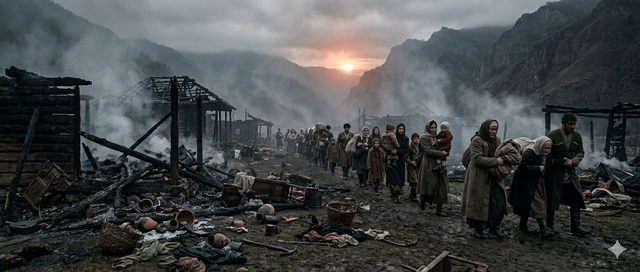
The systematic destruction of Abdzakh villages was not incidental to Russian strategy — it was the strategy. By eliminating the agricultural and social infrastructure of the mountain communities, Russian forces made continued resistance physically impossible regardless of military outcome in the field.
Primary Document — Tsar Alexander II, Imperial Rescript, June 25, 1861
"The matter of complete conquest of the Caucasus is near to conclusion… [the goal is] to utterly force out the hostile mountaineers from the fertile countries they occupy and settle on the latter a Russian Christian population forever."
Source: Russian State Archives — this document predates the final campaign by three years. The intention was stated plainly.
1864: What Happened After the Parade
On May 21, 1864, Russian officers assembled at Qbaada — a valley near the Black Sea coast that had been Abdzakh territory — and held a military parade. Speeches were made. Toasts drunk. Victory declared. Within days, the deportation that had been underway for months intensified into something that defies comfortable description.
The Black Sea ports — Anapa, Tuapse, Novorossiysk — filled with tens of thousands of people who had nothing. Ottoman ships came, but not enough of them, and not fast enough. The beach at Novorossiysk, by contemporary accounts, was covered for kilometers with families who had walked there from the mountains with whatever they could carry. Cholera moved through the camps with the efficiency of a weapon. Bodies were thrown into the water.
German historian Karl Friedrich Neumann estimated that of roughly 1.5 million Circassians who attempted the crossing, more than 500,000 died before reaching the other shore. Ottoman archives record nearly a million arrivals by 1879, with a catastrophic proportion dying immediately after landing.
The Ubykh — those close kin of the Abdzakhs — were entirely expelled. Not one Ubykh family remained. Their language, documented by linguists as having up to 84 consonant sounds, died in Turkey in 1992 with a man named Tevfik Esenç, the last native speaker. A language spoken in the Caucasus for millennia, gone in a single human lifetime after the deportation. That is the timescale of what happened.
The Black Sea coast became a site of mass death in the spring of 1864. Circassian families — including thousands of Abdzakhs — waited weeks for ships that arrived too slowly. British Ambassador Bulwer wrote urgently from Istanbul asking his government to send vessels. The ships came. Not nearly enough of them.
The Diaspora: Where the Abdzakhs Went
The survivors landed primarily in Ottoman territory. The empire resettled them across Anatolia, Syria, the Balkans, and — in numbers that became politically significant — in what is now Jordan. Circassians, including substantial Abdzakh communities, were settled by the Ottomans in frontier regions where their military skills were considered an asset. It was a pragmatic decision from the Ottoman perspective and, as it turned out, a consequential one.
In Jordan, Circassian families settled in Amman — then little more than ruins — and in the towns of Zarqa and Wadi Sir. They became disproportionately influential in the Hashemite state that emerged after World War I. Circassian officers served in the royal guard. Circassian professionals occupied positions in government and the military at rates that far exceeded their share of the population. Whether this represented successful integration or a kind of compensatory over-achievement by a displaced people is probably both.
In Turkey, Circassians are the largest diaspora community — between three and four million people by most estimates, though firm numbers are difficult to establish because Turkish identity politics made minority identification complicated for most of the 20th century. Many Abdzakh descendants in Turkey would identify primarily as Turkish, with Circassian identity carried in family memory rather than daily practice.
Language, Identity, and What Gets Lost
The Abdzakh dialect of Adyghe is one of the language's major variants. It has distinct phonetic features and vocabulary that mark it off from Kabardian (Eastern Adyghe) and from the Shapsug dialect — though all are mutually intelligible with some effort. In the diaspora, it faces the standard pressures: children grow up speaking Turkish or Arabic or English, the grandparents who carried the language fluently are gone, and institutional support for minority language education is thin to nonexistent in most countries.
The Republic of Adygea in Russia — one of the small federal subjects that represent fragments of the original Circassian homeland — gives the Adyghe language official status alongside Russian. There are cultural institutions, language programs, academic research. Whether this amounts to meaningful preservation or is primarily symbolic is genuinely uncertain. Urbanization draws young people toward Russian-medium employment and education. The language survives, but at what depth is hard to say.
Among diaspora communities, the pattern is familiar to anyone who has studied displaced populations: first generation speaks the language, second generation understands it but is more comfortable in the host-country language, third generation often has passive competence at best. The Abdzakh diaspora is old enough that many communities are at the third or fourth generation stage. The revival efforts — weekend language schools, YouTube channels, online courses, cultural associations — are real and in some cases impressive. Whether they can reverse a multigenerational trend is the question everyone involved is trying not to think about too directly.
The Question of Recognition
Georgia formally recognized the events of 1864 as genocide in 2011. The parliaments of Kabardino-Balkaria and Adygea issued condemnations in 1992 and 1996 respectively. Russia's federal government denies it, describes the Caucasian conquest as defensive, and its ambassador to Turkey once called the entire historical account a "beautiful legend." The evidence — much of it from Russian state archives — suggests otherwise, but political inconvenience has its own gravity.
For Abdzakh descendants and Circassians generally, the recognition question isn't primarily about legal remedy — there isn't going to be territorial restitution of the Belaya River valley. It's about historical honesty. It's about whether the people who lost everything are entitled to have what happened to them called by its correct name. That's a more modest ask than it sounds, and it remains unmet by most of the governments that matter.
The Abdzakh diaspora — scattered across Turkey, Jordan, Syria, Israel, and beyond — has maintained cultural identity through organizations, dance groups, language schools, and the specific kind of collective memory that survives when homeland does not. CircassianWeb exists to support this work.
The Abdzakhs Today
There is no single answer to where Abdzakh identity lives now. It lives in a grandmother in Amman who still uses Abdzakh-inflected vocabulary when she speaks Adyghe. It lives in a dance group in Ankara that performs at Circassian cultural festivals and probably doesn't think much about tribal distinctions but knows every step of the Islamey. It lives in academic papers written by researchers in Maikop who are trying to document dialect features before the last fluent speakers are gone. It lives in family trees being built on platforms like CircassianWeb by people in New Jersey or Berlin who know their great-great-grandparents came from somewhere in the Belaya River valley but can't say exactly where.
The Abdzakhs were not the largest Circassian tribe. They weren't the most famous. What they were was among the most stubborn — in the best sense of that word. People who governed themselves, defended themselves, and chose their leaders rather than inheriting them. People who lasted, in their mountain forests, longer than almost anyone else. That stubbornness didn't save Circassia. But it's not nothing. It's actually quite a lot.
Frequently Asked Questions
Who are the Abdzakhs and where do they fit among Circassian tribes?
The Abdzakhs (Абдзах) are one of the twelve major Adyghe tribes, historically occupying the mountainous interior of western Circassia along the Belaya, Pshekha, and Pshish river valleys. They are classed among the "democratic tribes" — alongside the Shapsugs and Natukhai — meaning they governed through councils rather than hereditary princes. This set them apart structurally from feudal tribes like the Kabardians and shaped both their military strategy and their resistance during the Russo-Circassian War.
Why were the Abdzakhs among the last to fall during the Russian conquest?
Two factors: terrain and structure. Their homeland in the upper Caucasus valleys was genuinely difficult to operate in militarily — dense forest, narrow passes, fast rivers. And their decentralized political structure meant there was no single point of surrender. With no prince to negotiate or capitulate, Russian forces had to defeat the Abdzakhs village by village, valley by valley. That took time and cost far more than the empire initially planned for.
What happened to the Abdzakhs after 1864?
The vast majority were expelled to Ottoman territory in the mass deportation that followed the end of the Russo-Circassian War. Thousands died during the crossing of the Black Sea due to overcrowding, disease, and inadequate food and water. Survivors were resettled primarily in Anatolia, Jordan, Syria, and the Balkans. The Abdzakh homeland in the Caucasus was subsequently resettled by Cossack colonists. A small number remained in what is now the Republic of Adygea.
Where do Abdzakh communities live today?
The largest populations are in Turkey (the biggest Circassian diaspora overall), Jordan (historically influential in state institutions), Syria, and Israel (well-organized villages in Kfar Kama and Rehaniya, though these are mixed Circassian communities rather than exclusively Abdzakh). A community exists within Russia's Republic of Adygea. Smaller diaspora populations are found in Europe and North America.
Is the Abdzakh language still spoken?
The Abdzakh dialect of Adyghe (Western Circassian) survives but is under significant pressure. In Adygea it has official status and is taught in some schools. In diaspora communities — Turkey, Jordan, Syria — it faces the standard pattern of generational language loss, with fluency declining sharply from the first to third diaspora generation. Revival efforts exist through cultural associations, digital platforms, and weekend language schools, but the scale of the challenge is large.
Do the Abdzakhs seek recognition of the 1864 genocide?
Yes, along with the broader Circassian community. Georgia formally recognized the events as genocide in 2011. The Russian regional parliaments of Kabardino-Balkaria (1992) and Adygea (1996) issued condemnations, though these have never been endorsed federally. Russia officially denies the characterization. Circassian diaspora organizations — including Abdzakh community groups — continue to advocate for broader international recognition, primarily as a matter of historical record rather than expectation of territorial remedy.
The Abdzakhs, in the End
There's something worth sitting with in the Abdzakh story: a people who chose their leaders, defended their valleys with extraordinary tenacity, were expelled anyway, scattered across five countries, and are still here — still speaking the language where they can, still dancing, still building family trees and asking their elders what valley their grandparents came from before the ships.
The Russian Empire didn't manage to finish what it started in 1864. The Abdzakhs aren't gone. They're in Amman and Ankara and Kfar Kama and Maikop, maintaining the thread. That's not a comfortable victory, and it shouldn't be called one. But it's something. After 160 years, it's still something.
Trace Your Abdzakh Roots
If you're of Abdzakh or Circassian descent, CircassianWeb can help you build your family tree, identify your tribal lineage, and connect with relatives across the global diaspora.
CircassianWeb — built for the 5 million Circassians living across 50+ countries. Genealogy tools, tribal records, DNA heritage, and diaspora connection. www.circassianweb.com
Sources & References
Richmond, Walter. The Circassian Genocide. Rutgers University Press, 2013.
King, Charles. The Ghost of Freedom: A History of the Caucasus. Oxford University Press, 2008.
Jaimoukha, Amjad. The Circassians: A Handbook. Palgrave Macmillan, 2001.
Bell, James Stanislaus. Journal of a Residence in Circassia. London, 1840.
Alexander II. Imperial Rescript on Settlement of the North Caucasus, June 25, 1861. Russian State Archives.
Longworth, J.A. A Year Among the Circassians. Henry Colburn, London, 1840.
Neumann, Karl Friedrich. Historical estimates of Circassian deportation casualties, 1866.
Ottoman Imperial Archives — migration records, 1864–1879. Istanbul.
Russian Imperial Census, 1897.
Georgia Parliament Resolution on Circassian Genocide, May 20, 2011.