Circassian Ancestry: Family Tree, DNA, Surnames & Adyghe Roots
Circassian ancestry refers to the lineage and family origins of the Circassian (Adyghe) people, tracing roots through tribes, clans, and generations from the Caucasus region. It can be identified through family history, tribal affiliation, surname research, tamga symbols, and modern DNA analysis. Today, millions of people across Turkey, Jordan, Syria, Israel, and beyond carry Circassian ancestry — and tools like CircassianWeb's family tree builder make it possible to reconstruct these connections.
In 1864, the Russian Empire expelled over one million Circassians from their homeland in the northwestern Caucasus. Entire villages were emptied. Families were separated at Ottoman ports. Children arrived in new lands without knowing their father's clan name. Within a single generation, centuries of carefully preserved lineage — the names, the villages, the tribal bonds — began to fade. Today, millions of people across Turkey, Jordan, Syria, Israel, and beyond carry Circassian ancestry without knowing the full depth of what that means, or how to trace it back.
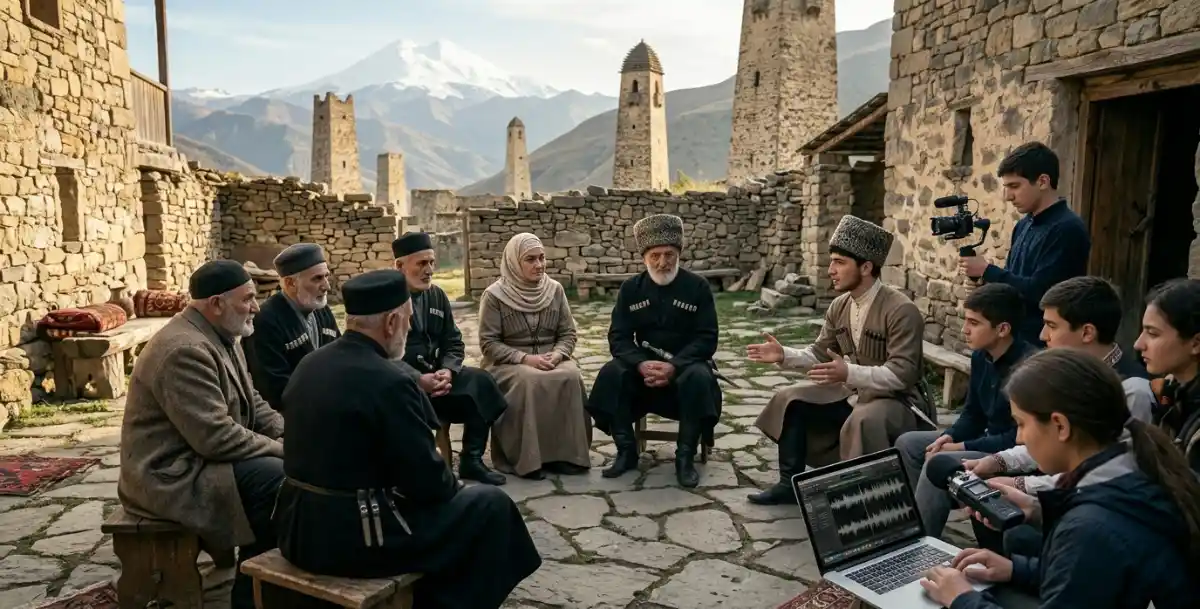
This guide is not a summary. It is a practical, detailed resource for anyone serious about recovering their Adyghe roots — whether you know your tribe or only have a family name and a feeling that your story goes deeper than you've been told.
📑 Table of Contents
What Circassian Ancestry Really Means
In most cultures, ancestry research is a personal hobby — a weekend project driven by curiosity. For Circassians (Adyghe), it carries a different weight entirely. Your Circassian ancestry determines your tribe, your tamga (clan symbol), your dialect, and even the specific mountain valleys your family inhabited for centuries before the forced exile of 1864.
In Circassian tradition, every person belongs to a chain of belonging that moves outward in concentric circles:
Унагъуэ (Unagwe) — Your immediate household
Лъэпкъ (Lepq) — Your extended clan or tribal family
Адыгэ (Adyghe) — The broader Circassian nation
Traditionally, a young Circassian man was expected to recite his paternal lineage back seven generations. This was not academic — it determined marriage eligibility (you could not marry within your own clan), social standing, and your family's role within the tribal structure. Women's lineages were equally respected, though tracked differently through maternal clan connections.
The 1864 displacement shattered this system. Families arriving at Ottoman ports — sick, grieving, stripped of possessions — were assigned new names by local administrators. A Bzhedug family from the village of Psefabe might become "Çerkes" (simply meaning "Circassian") in Turkish records. Seven generations of memory, reduced to a generic label.
This is why Circassian ancestry research is not a pastime — it is an act of cultural recovery.
Real Example: Tracing a Family from Surname to Village
Consider a real-world scenario that illustrates how Circassian ancestry research actually works in practice.
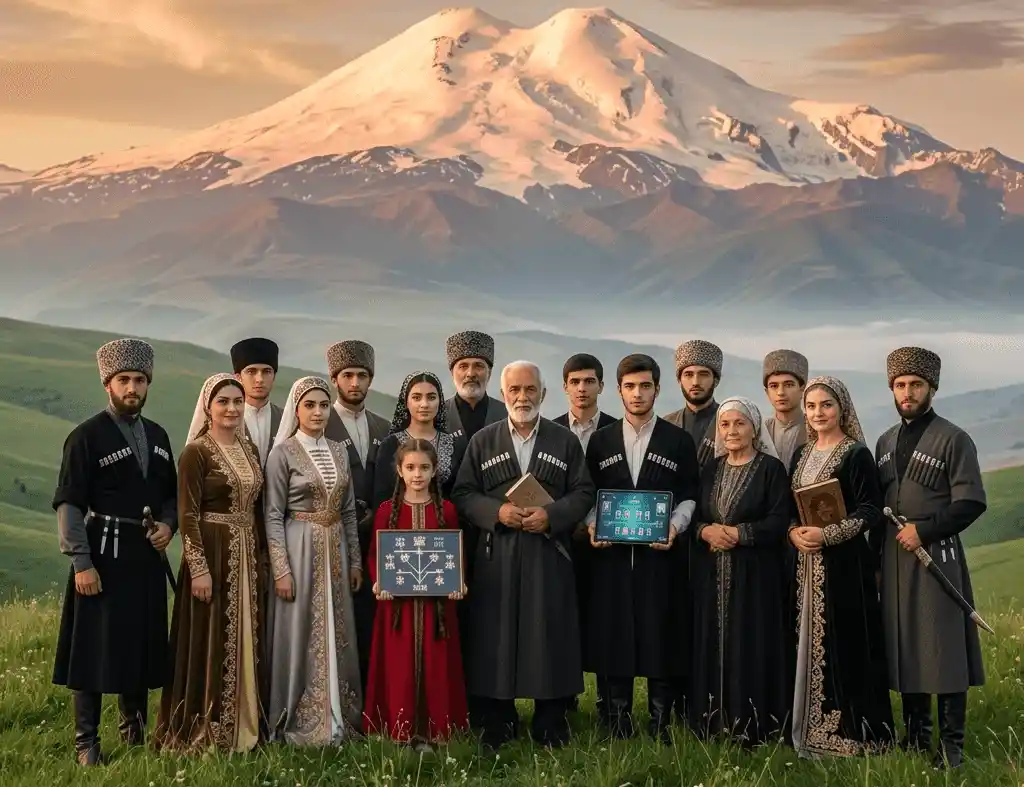
A Circassian family united across generations — tracing their lineage from surname to ancestral village in the Caucasus.
A family in Kayseri, Turkey carries the surname Berzeg. The grandfather remembers hearing that the family was "from the coast" and that they were Shapsug. Beyond that, no one knows more. Here is how you would trace this lineage step by step:
Surname research — The name Berzeg (Берзэдж) is a well-documented Circassian clan name associated with the Shapsug tribe. This confirms the grandfather's memory and immediately narrows the search to the Black Sea coastal region between the rivers Dzhubga and Shakhe.
Ottoman records — Searching the Nüfus Defterleri (Ottoman population registers) for "Berzeg" in the Kayseri sancak reveals a registration entry from 1878, listing a family of six arriving from Tuapse — a coastal town in what is now Krasnodar Krai.
Russian military maps — Cross-referencing 1850s Russian cartographic surveys shows a Shapsug village called Berzegoy (Бэрзэджхьабл) near the Tuapse River. The village name directly matches the family surname — a common pattern in Circassian settlement naming.
Tamga match — The family recalls a symbol their great-grandmother used to draw: a vertical line with two diagonal branches. Checking tamga databases confirms this as the Berzeg clan tamga, one of several Shapsug sub-clan markers.
Community connection — Entering the data into a digital family tree generates a match: another Berzeg family in Amman, Jordan whose great-grandfather also came from Tuapse. The families are linked.
This is not hypothetical — this is the real methodology that Circassian genealogy researchers use worldwide. The key is layering multiple sources: oral memory + surname databases + archival records + tamga identification + digital networking.
How to Trace Your Circassian Family Tree
Tracing your Circassian family tree requires working across multiple countries, languages, and record-keeping systems. Here is a structured framework, ordered from the most accessible to the most specialized:
Step 1: Structured Elder Interviews
Your oldest living relatives are your most valuable archive — and the most time-sensitive. Every elder who passes takes irreplaceable knowledge with them.
Record everything — Use your phone. Even casual comments like "Your grandfather's mother was from near Sochi" contain geographic clues that can pinpoint a specific village.
Ask about names systematically — Start with your grandparents' birth names (not married names), then their parents' names. Write down every version: the Adyghe pronunciation, the Arabic or Turkish version, any nicknames.
Ask about villages, not countries — Instead of "Where did the family come from?", ask: "Do you remember the name of the village? Was it near a river? Near the mountains or the coast?"
Ask about the exile journey — Which port did the family arrive at? Trabzon? Samsun? Varna? This reveals the migration route and narrows the search area in the Caucasus.
Step 2: Ottoman Archive Research
The Ottoman Empire meticulously recorded incoming Circassian refugees from the 1860s onward. These records — called Nüfus Defterleri — often contain:
The family's original village name in the Caucasus
Names of household members at time of registration
The settlement location assigned by Ottoman authorities
These records are held at the Ottoman Archives (Başbakanlık Osmanlı Arşivi) in Istanbul. Some have been digitized, but most require in-person research or a professional genealogist.
Step 3: Russian Military and Census Records
The Russian Empire conducted detailed surveys of Circassian populations before the expulsion. Key sources include military reconnaissance maps (1830s–1860s) listing villages by name, census records from the Kuban and Terek Oblasts, and exile lists recording families deported to Ottoman ports. These are preserved in the RGVIA in Moscow and regional archives in Maykop, Nalchik, and Cherkessk.
Step 4: Digital Networks and Community
The Circassian community itself is a research tool. Circassian associations maintain member registries with family and tribal information. Digital family tree platforms make your tree searchable — so when someone on the other side of the world enters the same ancestral village name, connections emerge that would otherwise remain hidden.
Circassian Tribes and Ancestral Origins
Understanding the twelve Circassian tribes is fundamental to ancestry research. Each tribe occupied a distinct territory, spoke a recognizable dialect, and maintained its own social structure. When you identify your tribal affiliation, you immediately narrow your search to a specific region.
TribeAdyghe NameRegionKey NotesKabardianКъэбэрдейCentral-eastern CaucasusLargest tribe; diplomatic leaders; developed Adyghe Xabze codeShapsugШапсыгъBlack Sea coastCoastal warriors; among the last to resist Russian conquestAbzakhАбдзахMountain interiorHighland warriors; rugged mountain territoryBzhedugБжъэдыгъуKuban River plainsAgricultural tradition; rich folk cultureTemirgoyКlэмгуйCentral CircassiaStrong military traditions; central positioningNatukhaiНатхъуаджNorthwestern coastMaritime activities; coastal trade networksBesleneyБэслъэнейEastern foothillsClosely related to KabardiansKhatukwaiХьатыкъуайBelaya River regionDistinct dialect and cultural practicesMamkheghМамхыгъSouthern interiorSmaller tribe; unique customs and identityYegerukwaiЕджэркъуайLaba River areaAgricultural expertise and horse breedingUbykhУбыхSochi coastal regionEntire tribe exiled; language now extinctZhaneЖанейWestern coastCoastal connections; land and sea traditions
Many families know their tribal name even when other details have been lost. If your family identifies as Shapsug, for example, your ancestors almost certainly lived between the Dzhubga and Shakhe rivers. This geographic specificity is what makes tribal knowledge so valuable for Circassian genealogy.
How Surnames Reveal Circassian Lineage
One of the biggest obstacles in Circassian genealogy is the multiple naming systems applied to the same family across different host countries. A single family can appear under completely different names:
ContextExample NameScriptOriginal AdygheХьатыкъуэCyrillicOttoman TurkishHatukayLatinJordanian ArabicحاتوقايArabicIsraeli HebrewחטוקאיHebrew
Successful Circassian ancestry research requires checking all surname variants across scripts. Many Circassian surnames encode valuable genealogical information:
Names ending in -qo or -ko often indicate the princely class (пщы)
Names ending in -ey or -ai frequently reference geographic origins
Compound names may reference an ancestor's occupation or physical trait
In Turkey, many families adopted Turkish surnames during the 1934 Surname Law, further obscuring Adyghe origins. A family named Шъхьэлахъо (Shkhealakho) might have become Dağlı ("mountain person") — losing the clan marker entirely. In Jordan and Syria, Arabic transliterations introduced additional variations. Recognizing these layers of renaming is essential for effective research.
Circassian Genealogy Across the Diaspora
The Circassian exile scattered families across the Ottoman Empire and beyond. Today, the Circassian diaspora spans continents:
Turkey — The Largest Diaspora
An estimated 5–7 million people of Circassian descent live in Turkey, making it the largest diaspora by far. Families settled primarily in Düzce, Bolu, Kayseri, Samsun, Adana, and Tokat. The Ottoman archives are the richest source for Turkish Circassians, but the 1934 surname changes and language suppression policies mean many families lost their Adyghe identifiers. Village-level research through muhtar (village head) records can be surprisingly productive.
Jordan — Founders of Amman
Circassians were among the original settlers of modern Amman in the 1870s. The community has maintained strong clan networks and well-preserved oral traditions. The Circassian Charity Association in Amman maintains genealogical records dating to the original settlements. Jordanian Circassians often preserved their tribal identity more consistently than those in Turkey.
Syria — Heritage Under Threat
The ongoing conflict has made archive access extremely difficult. Many records were destroyed. Diaspora communities in Germany and elsewhere are working to preserve what remains through oral history projects. The Circassian quarter of Damascus (Hay al-Akrad) and villages in the Golan Heights were historically key community centers.
Israel — Small but Well-Documented
The communities of Kfar Kama (Shapsug) and Rehaniya (Abzakh) are small but well-documented. Israeli national archives contain settlement records from the Ottoman period that can be cross-referenced with family histories.
Caucasus Homeland
The republics of Adygea, Kabardino-Balkaria, and Karachay-Cherkessia maintain local archives with pre-exile and Soviet-era records. Connecting with relatives who remained can fill gaps that diaspora records cannot.
DNA and Circassian Ancestry: Limitations and Insights
DNA heritage testing has opened a new avenue for Circassian ancestry research, but it is important to understand both its power and its limits.
What DNA can reveal:
Tribal connections — Certain Y-DNA haplogroups (such as G2a and J2) are strongly associated with specific Circassian tribes
Genetic relatives — DNA matches can connect you with distant cousins across different countries who share a common ancestor
Verification — Testing can confirm or challenge family stories about tribal origins
What DNA cannot do:
It cannot tell you your ancestor's name or village
Autosomal DNA tests have limited Caucasus reference populations — results may simply say "West Asian" without Circassian specificity
Maternal (mtDNA) and paternal (Y-DNA) lineages each trace only one line out of hundreds
The most effective approach combines DNA testing with traditional genealogy. Use DNA to find matches, then use archival and oral research to build the connections. Neither method alone tells the full story.
The Tamga: Your Family's Visual Signature
Beyond names and documents, there is another powerful tool for tracing Adyghe ancestry: the tamga. Each Circassian clan historically used a unique symbol — branded on livestock, carved into property, and passed down through generations. If your family remembers its tamga, you hold a direct visual link to a specific clan lineage that predates the exile.
Many tamga symbols have been documented and catalogued. Matching your family's remembered symbol against known clan tamgas can identify your exact ancestral clan — even when written records have been lost entirely.

Ancient Circassian tamga symbols — each tile represents a unique clan lineage passed down through generations.
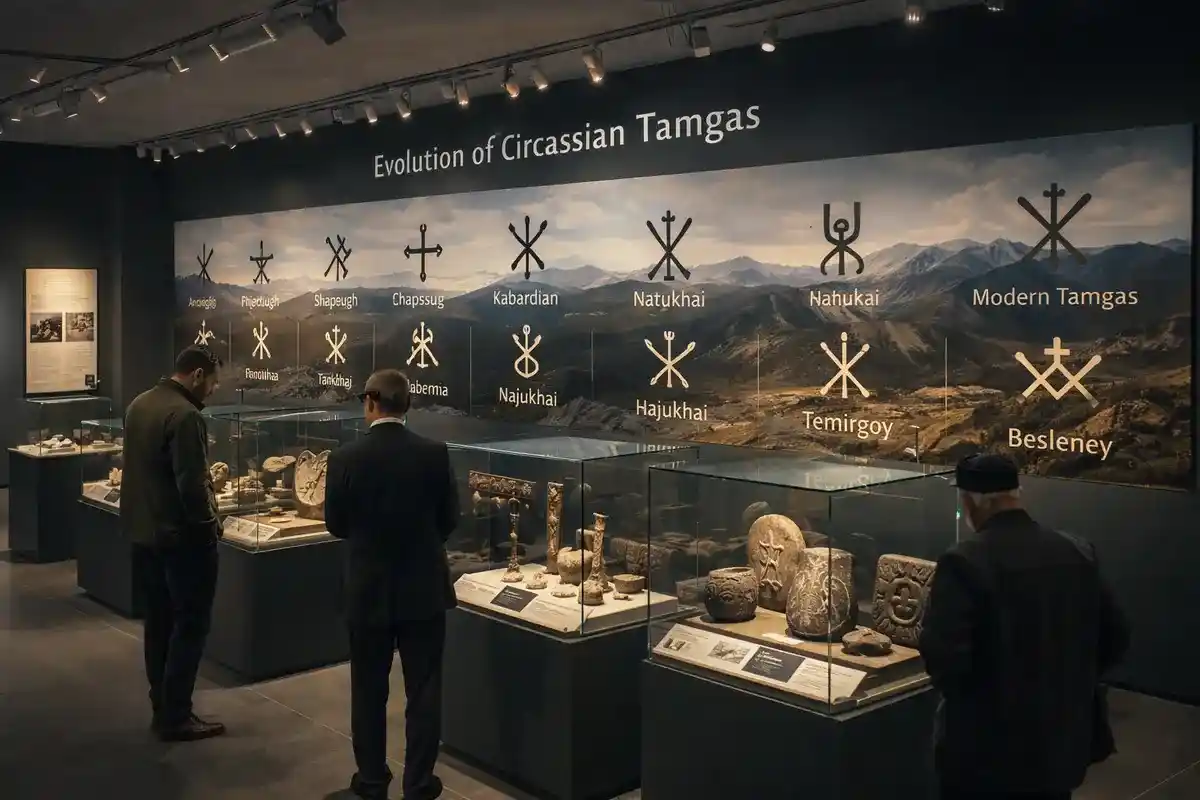
Evolution of Circassian Tamgas — tribal symbols documented across Kabardian, Shapsug, Natukhai, Temirgoy, Besleney and other Adyghe tribes.
How to Preserve Your Family History
Ancestry research is not only about looking backward — it is about ensuring that what you discover survives for future generations:
Build a digital family tree — Enter what you know. Even incomplete trees are valuable. Future relatives may fill gaps you cannot.
Record elder interviews — Audio and video recordings of family elders are primary historical sources. Store copies in multiple locations.
Photograph old documents — Ottoman records, identity cards, land deeds, and old photographs degrade with time. High-resolution digital copies ensure they survive.
Share your research — Connect with Circassian associations and genealogy communities. Your discoveries may be the missing piece for another family's search.
Teach the next generation — Share what you learn with younger family members. The seven-generation memory tradition starts with someone choosing to remember.
You do not need to be a historian to begin. Start with a single conversation with your oldest relative. Write down three names. That small act preserves something that might otherwise be lost within a generation.
Voices from the Diaspora: Real Stories of Tracing Circassian Roots
Behind every surname search and DNA result is a human story — a family reconnecting with something they were told had been lost forever. Here are real accounts from Circassians around the world who have walked this path.
Cem Özdemir — Rediscovering Circassian Identity in Germany
Cem Özdemir, the German politician of Circassian descent who became Minister-President of Baden-Württemberg in 2026, grew up in a small German town with almost no connection to his Circassian heritage. His father, a Circassian from Turkey who came to Germany in 1963 through the guest worker program, "had practically no one with whom he could speak his mother tongue" for years. It was only through political involvement and visits to Circassian clubs that his father found people to talk to again.
Özdemir recalls being puzzled as a child: "I was wondering why we shouldn't play Circassian music when entering Turkey by car at the border." Only later did he understand the assimilation pressures minorities faced. He eventually organized annual "Circassian Day" events in the European Parliament and traveled to Adygea with his father — a trip he describes as unforgettable. His story illustrates how even prominent diaspora figures struggle to maintain heritage across generations, and how political engagement can become a vehicle for cultural reconnection.
Source: "Interview: My father was a Circassian" — Justice for North Caucasus, 2020
A Ubykh Family in Turkey — Tracing Roots Through Ottoman Archives
One of the most detailed personal ancestry projects comes from a Circassian woman in the United States who traced her maternal grandmother's Ubykh lineage back to a specific village: Hatıp Köyü (also known as Söğütlü), near Düzce in Turkey's Black Sea region. Using 1896 Kastamonu population records (Kastamonu Salnamesi), she confirmed that Hatıp Köyü was an Ubykh and Shapsugh village with 39 homes and 230 residents.
Her grandmother, Müzeyyen Gürsoy, was born around 1920 in that village and belonged to the Hamte family. The family's oral history told of her great-grandfather, Hamte Ahmet, arriving from the Caucasus — and eventually being exiled from Turkey itself as one of the infamous "150 personae non gratae" of the Turkish Republic. She found his name listed at #73 on the official list. "When I found his name, I felt I became connected with him: it was like saying hello to my grandmother. It was like meeting my great-grandfather for the first time."
This case demonstrates the power of combining oral family history with Ottoman-era archives, village records, and published historical lists to reconstruct a detailed Circassian family tree spanning multiple generations.
Source: "Stories of Exile: My Family's Story" — Exile from the Caucasus project
Fadi Ishaqat — A Jordanian Circassian Returns to the Homeland
Fadi Ishaqat, a Jordanian Circassian, first visited his ancestral homeland in Russia's Adygea Republic as a university student in 1999 — and never truly left. Now a permanent resident of Maykop for over two decades, he describes the moment he first set foot on Circassian soil: "It felt like I was there before. Like I've seen this place when I was a child, but when? Maybe in my imagination, or in my subconscious?"
For Ishaqat, the experience confirmed that the diaspora's connection to the land had survived 160 years of exile — "that the spirit did not separate from the body." He now works to help other Circassians explore repatriation, believing it is "the only solution to keep Circassians alive" as a distinct people.
Source: "The Return to Circassia" — New Lines Magazine, April 2024
Tambi Shafagoj — Between Jordan and the Caucasus
Tambi Shafagoj, vice president of the Circassian club in Amman, Jordan, captures the dual identity many diaspora Circassians feel: "Jordan is also my country, I cannot say otherwise. But it's as if you have a mother and a grandma. Jordan is my mother, and the Caucasus is my grandma."
Shafagoj represents the millions of Circassians who maintain active connections to their heritage through community organizations, regular visits to the Caucasus, and cultural preservation work — even while being fully integrated citizens of their countries of birth. He obtained Abkhazian citizenship in 2018 to facilitate more regular visits. His perspective highlights an important truth about Circassian ancestry: tracing your roots is not just about the past, but about maintaining a living connection. "What is special about the Circassian people is that they don't forget. It is impossible for them to forget, no matter where they are."
Source: "The Return to Circassia" — New Lines Magazine, April 2024
Yousef Bardouka — Journalism as Heritage Preservation
Yousef Bardouka, a 27-year-old Jordanian Circassian journalist, grew up attending a Circassian school for 14 years where he learned the language, joined a dance troupe, and was introduced to Khabze — the ancient Circassian moral code. As he grew older, he channeled his heritage into his professional work, focusing his journalism on the Caucasus region. "The least we can do is tell others about what happened to our ancestors. The ethnic cleansing of our ancestors is what shaped us into who we are today."
Bardouka now works with OC Media, covering news from the North and South Caucasus — physically closer to his ancestral homeland while maintaining his journalistic independence. His path shows how younger generations are finding new ways to engage with their Circassian identity beyond traditional cultural activities.
Source: "The Return to Circassia" — New Lines Magazine, April 2024
The Circassian DNA Project — 2,800+ Members and Growing
The Circassian DNA Project on FamilyTreeDNA, administered by Ali Berzeg and Astemir Shebzukho, has grown to over 2,800 members — making it one of the largest ethnic DNA projects for any Caucasian population. Members from across the diaspora have used the project to confirm tribal affiliations, discover previously unknown family connections, and map the genetic landscape of the Circassian people. The project demonstrates the power of combining modern Circassian DNA testing with traditional genealogy to build a comprehensive picture of Adyghe ancestry.
Source: FamilyTreeDNA — Circassian DNA Project
Your story matters too. Whether you're just beginning to explore a family name or you've already traced your lineage back to a specific village, every discovery adds to the collective memory of the Circassian people. Use CircassianWeb's tools — the surname database, family tree builder, and DNA heritage section — to start or continue your own journey.
Frequently Asked Questions
How do I trace my Circassian ancestry?
Start by interviewing your oldest relatives about family names, tribal affiliation, and any remembered village names. Then research your surname against known Circassian clan databases. For deeper research, consult Ottoman population registers (Nüfus Defterleri) and Russian military archives from the 1830s–1860s. Building a digital family tree helps connect with distant relatives who may have the missing pieces.
How can I find my Circassian tribe?
Your family surname is usually the strongest indicator. Many Circassian surnames are directly tied to specific tribes and clans. Ask your elders if they remember a tribal name (e.g., Shapsug, Kabardian, Bzhedug). Your family's tamga symbol, if remembered, can also pinpoint your exact clan within a tribe.
Are Circassian surnames reliable for genealogy research?
Original Adyghe surnames are highly reliable — they typically encode clan, tribe, or geographic origin. However, many families underwent forced renaming during the Ottoman period, Turkey's 1934 Surname Law, or Arabization in Jordan and Syria. You may need to research multiple surname variants across different scripts (Cyrillic, Latin, Arabic, Hebrew) to find the original Adyghe name.
Can DNA testing identify Circassian ancestry?
DNA testing can provide supporting evidence but not definitive identification. Y-DNA haplogroups G2a and J2 are commonly associated with Caucasian populations, and DNA matches can connect you with genetic relatives across the diaspora. However, consumer autosomal tests have limited Caucasus reference data and may only show broad "West Asian" results. DNA is most valuable combined with traditional genealogy methods.
Where are Circassians living today?
The largest Circassian diaspora is in Turkey (5–7 million of Circassian descent), followed by communities in Jordan, Syria, Israel (Kfar Kama and Rehaniya), Egypt, Iraq, Germany, and the United States. In the Caucasus homeland, Circassians live primarily in the Russian republics of Adygea, Kabardino-Balkaria, and Karachay-Cherkessia.
What records exist for Circassian families before 1864?
Pre-exile records include Russian military reconnaissance maps (1830s–1860s) that list Circassian villages by name, Russian census data from the Kuban and Terek regions, and some traveler accounts by European visitors to the Caucasus. After 1864, Ottoman Nüfus Defterleri (population registers) recorded arriving refugee families, often noting their village of origin and tribal group.
How is Circassian ancestry different from general ancestry research?
Circassian genealogy faces unique challenges that most ancestry research does not: mass displacement that severed paper trails, forced renaming across multiple countries, records scattered across five different scripts (Cyrillic, Arabic, Latin, Hebrew, Ottoman), and the loss of an oral genealogical tradition that was the primary record-keeping system. Success requires combining archival research with community networks, oral history, and symbol identification (tamga).
Your Circassian ancestry is not abstract history. It is the reason you carry the name you carry, live where you live, and feel a pull toward a homeland you may have never visited. Tracing it is how you complete the story.
Sources & References
Balanovsky, O. et al. (2011). "Parallel Evolution of Genes and Languages in the Caucasus Region." Molecular Biology and Evolution, 28(10), 2905–2920.
Richmond, W. (2013). The Circassian Genocide. Rutgers University Press.
Jaimoukha, A. (2001). The Circassians: A Handbook. Palgrave Macmillan.
Şenyücel, S. (2015). "Circassian Diaspora Surnames in Turkey: Transformation and Preservation." Journal of Caucasian Studies, 1(1).
FTDNA Circassian DNA Project — familytreedna.com/groups/circassian
Kaya, A. (2005). "Circassian Diaspora in Turkey." New Perspectives on Turkey, 32, 113–133.
Ottoman Nüfus Defterleri (Population Registers) — Başbakanlık Osmanlı Arşivi (BOA), Istanbul.
Russian Military Topographic Maps, 1830–1864 — Kuban Regional Archives, Krasnodar.
Natho, K. (2009). Circassian History. Xlibris Corporation.