The Besleney Tribe: Eastern Guardians of Circassia
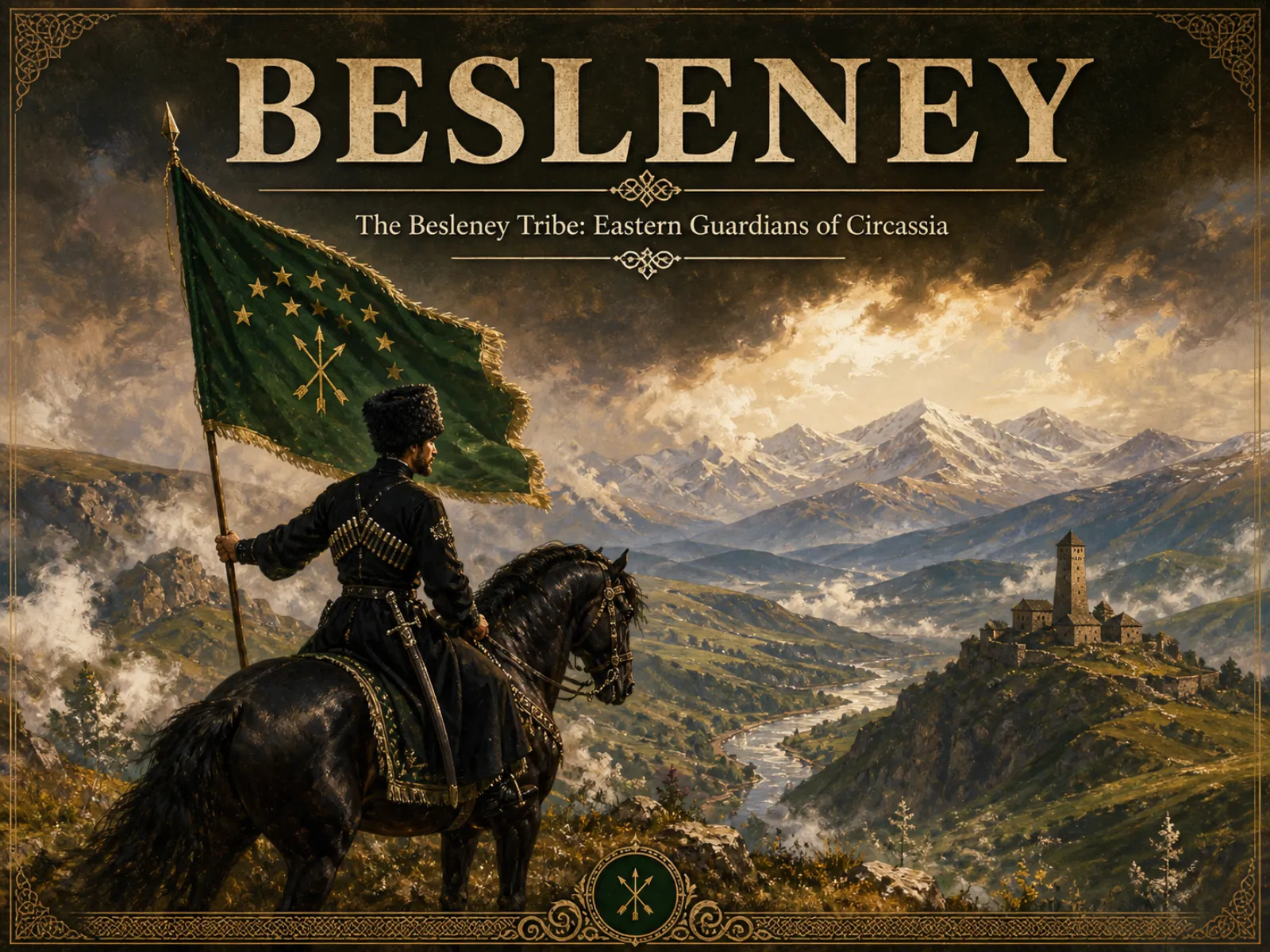
Бэслъэней — the princely line of the Laba and Urup, founded by a son of Inal, scattered in 1864, and still living today in Khodz, Uzunyayla, Amman, and a hundred quieter places across the diaspora.
CircassianWebUpdated: January 202614–16 min readTribe profile≈ 6,800 words
The Besleneys (Адыгэ: Бэслъэней) are a Circassian tribe whose homeland sat on the eastern frontier of historic Circassia, in the upper river valleys of the Laba and the Urup. They are not the largest of the twelve Adyghe peoples, but they are among the oldest princely lines — descendants of Beslan, a son of Prince Inal, whose name they carry into the present day. For five centuries they were the eastern guardians of Circassia: the buffer between the great Kabardian principalities and the open steppes of the Kuban; the guardians of one of the Caucasus's principal east-west passes; and, by reputation, among the most accomplished horse-breeders, hospitality-keepers, and observers of Adyghe Khabze in the entire Adyghe world.
This is the long-form profile of the Besleneys: who they are, where they came from, what their society looked like before 1864, what happened to them in the Russo-Circassian War, where their descendants live today, what their language sounds like, what their tamgas mean, what their famous families are called, and — for those of you reading this with a feeling that your own family story might intersect — how to trace your Besleney ancestry now using surname research, archival records, oral memory, and DNA. The article is ordered roughly chronologically, from origins to the present, with two practical sections at the end on tracing your line and on the genetic markers that tend to appear in Besleney families.
If you only have a minute, the box below is the executive summary. If you have fifteen, keep reading — this is the most complete public profile of the tribe currently online, and it has been built from Wikipedia's Besleney and Principality of Besleney pages, Eiji Miyazawa's Uzunyayla thesis, Shora Nogmov's nineteenth-century chronicle of the Adyghe peoples, Amjad Jaimoukha's 2001 handbook The Circassians, the FamilyTreeDNA Circassian DNA Project, and primary research in Ottoman population registers and Russian military maps.
Besleney at a glance
Adyghe name
Бэслъэней (Besleney)
Founder
Beslan, son of Prince Inal — the great unifier of fifteenth-century Circassia
Date of founding
~1453, on Inal's division of his lands among his sons
Historic homeland
Upper valleys of the Bolshaya Laba, Malaya Laba, and Urup rivers; the eastern foothills of the Northwest Caucasus
Modern Russian territory
Karachay-Cherkessia (centered around the town of Besleney); also parts of Adygea (notably Khodz village) and Krasnodar Krai
Language
Besleney dialect of Kabardo-Cherkess (East Circassian) — transitional features bridging Western Adyghe and Kabardian proper
Closest related tribes
Kabardians, Temirgoy (Chemguy), Hatuqay, Mamkheg — all Inal-line branches
On the Circassian flag
One of the 12 gold stars representing the Adyghe tribes
Largest diaspora today
Uzunyayla (Kayseri, Turkey); also Jordan, Syria, Israel, Germany, the United States
Notable noble lineages
Qanoqo (Къанокъо / Каноковы), Sherdjes (Шэрджэс), Dokhushiko (Дохъушыкъо), Sholokh (Шолэхъу), Berzeg (Бэрзэдж)
Who Are the Besleneys?
The Besleneys are considered a branch of the Eastern Circassian (Kabardian) group — close enough that some 19th-century Russian ethnographers classified them as Kabardian themselves, distant enough that they have always been counted as one of the twelve sovereign Adyghe tribes with a star of their own on the Circassian flag. The truth lies in between: they are a princely Adyghe people who share their founding ancestor with the Kabardians, who carry a distinct dialect, who maintained their own political identity and ruling houses, and whose history runs parallel to the Kabardians but never quite merges with it.
The name Besleney comes from Beslan, a personal name attested in Adyghe royal genealogies. According to the chronicles preserved by Shora Nogmov — the nineteenth-century Kabardian historian whose History of the Adyghe People remains the foundational source on the Inal line — Prince Inal united much of Circassia under a single rule in the early-to-mid 1400s. On his death, his domain was divided among his sons, and the lands east of the main Kabardian principality were granted to Beslan. The descendants of Beslan retained their patronymic identity through every later upheaval, even when Russian, Ottoman, and Soviet administrators tried to dissolve them into wider categories.
In population terms, the Besleneys were always a smaller tribe than the Kabardians or the Shapsugs. Pre-1864 estimates of the Besleney population range from roughly twenty to thirty thousand — a figure that includes the upper Laba villages, the Urup valley settlements, and several mixed Besleney-Abaza communities along the southern foothills. Strategic position, however, mattered more than headcount. The Besleney homeland sat across one of the principal corridors between the Kabardian heartland and the western Adyghe lands, and across the natural route from the Kuban steppe up into the high Caucasus. Whoever controlled that corridor controlled the politics of the eastern Northwest Caucasus, and for several centuries the Besleneys did exactly that.
Their political weight expressed itself diplomatically. Besleney princes were known across the Adyghe world for their judgment in dispute resolution, their fluency in the customs of every neighbouring tribe, and their willingness to host the great khasa — the council assemblies at which Adyghe disputes were arbitrated. To "go to the Besleneys" was, in classical Adyghe usage, a euphemism for seeking arbitration that everyone would accept.
The Three Defining Features
If you had to compress Besleney identity into three features that most distinguish them from their neighbours, those features would be: a dialect that bridges Western Adyghe and Kabardian; a strict aristocratic social order built around a small number of princely (пщы) families; and a famous — perhaps the most famous in Circassia — tradition of horse-breeding that produced the bloodlines later codified as the Kabardian and Karachai-Adyghe horse breeds.
Their dialect is the linguistic feature that ethnographers and family historians most often cite. To a Western Adyghe speaker (Shapsug, Bzhedug, Natukhai), Besleney speech sounds slightly Kabardian; to a Kabardian, it sounds slightly Western. It carries archaic vocabulary, certain vowel substitutions that have disappeared from standard Kabardian, and grammatical forms that are clearly transitional. Linguists today generally classify Besleney as a sub-dialect of Kabardo-Cherkess (the eastern branch of the Adyghe language family), but a number of features place it close to the boundary line.
Place village.jpg here
(traditional family in mountain village — the homeland)
Before 1864 · The Laba homelandDaily life in a Besleney village in the upper Laba valley. The traditional dress (the chokha coat with its silver-tipped cartridge holders, the long woollen papakha hat, the woven women's headdresses), the samovar, the woven carpets, and the stone-and-timber house architecture all survived in the diaspora through carefully kept oral memory and a rare, stubborn refusal to forget.
Historical Territory: The Laba and the Urup
The Besleney homeland was located in the upper valleys of the Laba and Urup rivers, in the foothills of the Greater Caucasus mountains. This territory is now divided across the modern Russian republic of Karachay-Cherkessia, with smaller fringes in Krasnodar Krai and Adygea. The geography is striking: the eastern foothills here rise quickly from the open Kuban steppe to wooded mid-altitude valleys, and from there to alpine meadows and high mountain passes. The river systems — the Bolshaya Laba (Great Laba), the Malaya Laba (Little Laba), and the Urup — flow north out of the high Caucasus and feed into the Kuban basin, defining a series of natural valleys that became the Besleney heartland.
This territory provided natural defenses — the steep valley walls were ideal for the raid-and-retreat warfare at which Circassian horsemen excelled — and abundant pastureland, both on the lower riverbed flats and in the alpine summer pastures. That combination underwrote the Besleney horse-breeding tradition. From at least the seventeenth century onward, Besleney studs produced horses prized across the Caucasus and the Black Sea world: tough, surefooted mounts, capable of long days in mountain terrain, with the endurance and intelligence that made them favoured cavalry mounts in Ottoman, Russian, and Persian service. The lineages preserved in Besleney studs were among the foundation stock of what later became the Kabardin and Karachai horse breeds.
Besleney villages were typically organised around extended-family compounds (лъэпкъ, lepq) of related households sharing pasture, herding rights, and labour for tasks like haymaking and house-building. The largest settlements held a few hundred residents; many were smaller. Each significant village had a khasa meeting place — an open ground or a particularly important guest house used for council deliberations — and at least one prominent kunatskaya, the dedicated guest room that every noble household maintained for the strict observance of Adyghe Khabze hospitality. Pasture was held collectively by the lineage; horses, cattle, and sheep were the principal forms of moveable wealth. Honey, wax, woven carpets, leather, and fine silver and damask weapons rounded out the local economy and were the principal exports traded outward toward the Kuban markets and southward via mountain passes to the Black Sea coast.
The Besleneys' proximity to the Kabardians fostered close cultural and political ties. Intermarriage between noble families was systematic and rule-bound: a Besleney prince could marry only into another princely line, and Kabardian princely houses were the most natural partners. Joint military campaigns were common; so were joint disputes. The chronicles record both alliances and outright wars between Besleney and Kabardian princes through the seventeenth and eighteenth centuries, often arising from the same mechanism: a disputed succession or a contested marriage.
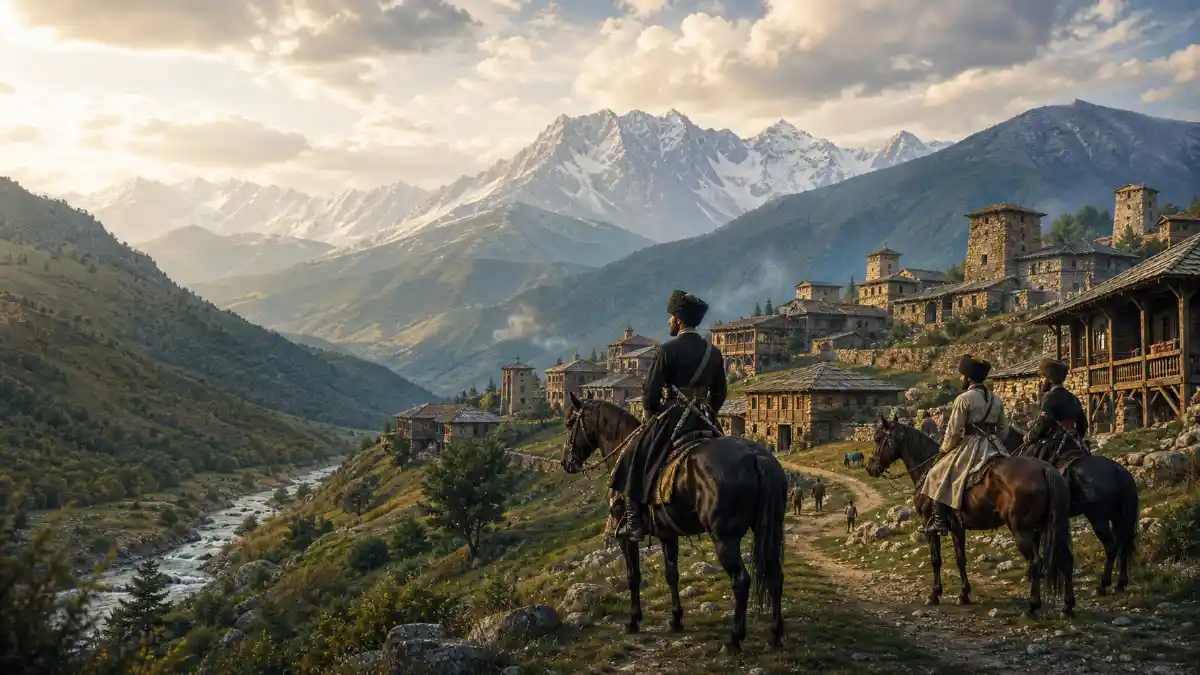
Today, the most concrete surviving anchor of Besleney identity inside the Russian Federation is the town of Besleney (Бэслъэней) in Karachay-Cherkessia. The town carries the tribal name and houses one of the principal communities of Besleney descendants who remained on or near the historic homeland after 1864. Smaller Besleney communities are scattered across other Karachay-Cherkessia and Krasnodar Krai villages, and the Adygea village of Khodz (Хьэкlуж), historically a mixed Besleney-Hatuqay settlement, preserves significant Besleney lineage to this day. These communities — modest in size, never larger than a few thousand people — have been the principal keepers of Besleney dialect, customs, and oral history inside the Russian state across the Soviet period and into the post-Soviet era.
The Besleney Dialect: A Linguistic Bridge
The Besleney dialect occupies a fascinating linguistic position. The Adyghe (Circassian) language family is conventionally divided into two main branches: West Circassian (Adyghe proper, with Shapsug, Bzhedug, Temirgoy, Natukhai, Abzakh sub-dialects) and East Circassian (Kabardo-Cherkess, with Kabardian and Cherkess sub-dialects). The Besleney dialect is classified within East Circassian, but it carries enough features from the western branch that linguists describe it as a transitional or bridge dialect.
What does that look like in practice? A few examples: certain consonant clusters that have simplified in standard Kabardian retain their fuller form in Besleney; particular vowel realisations are closer to Western Adyghe; some lexical items (everyday words for tools, livestock, weather) appear in Western Adyghe forms inside an otherwise Kabardian sentence structure. The result is that Besleney speakers are often understood without effort by both Kabardians and Western Adyghe speakers, while a Kabardian and a Shapsug, speaking only their own dialects, may struggle to communicate at first.
This bridge position is not accidental. The Besleney homeland was the geographical bridge between East and West Circassia, and the dialect reflects that. Inal's division of his lands placed Beslan's people exactly at the junction of the two worlds, and five centuries of intermarriage, trade, and seasonal migration kept that junction alive in the language.
In the diaspora, the Besleney dialect has eroded faster than the wider Adyghe language. Surveys of the Circassian community in Uzunyayla — the heart of the Besleney diaspora in Turkey — show that the dialect is now spoken fluently mainly by elderly residents. Younger generations either speak standard Kabardian (which has become a kind of lingua franca across Eastern Adyghe diaspora communities), Turkish, or both. Preservation efforts are underway: dictionaries, language schools, online courses, and recording projects are documenting the dialect before the last fluent speakers are gone. But the time horizon is short. Within a generation, without active intervention, fluent Besleney speech in the diaspora will likely become a heritage relic rather than a living register.
"A young Besleney man was expected to recite his paternal lineage back seven generations. This was not academic — it determined marriage eligibility, social standing, and your family's role within the tribal structure. Women's lineages were equally respected, though tracked differently through maternal clan connections."— from CircassianWeb's guide to Circassian ancestry
Social Structure: Princes, Nobles, and the Khabze
The Besleneys maintained a feudal social order with princely families (пщы, pshi) governing through a council system rooted in Adyghe Xabze — the unwritten but rigidly observed code of Circassian social, ethical, and ceremonial conduct. The four principal classes, from the top of the social hierarchy to the bottom, were:
ClassAdyghe termRole and obligationsPrincesПщы (Pshi)The ruling line. Held land in trust for the tribe rather than as private property; led in war and external diplomacy; arbitrated internal disputes. Could only marry into other princely houses.Greater noblesУэркъ-тlумэ (Worq-Tlume)Sworn vassals of the Pshi from a long-recognised noble lineage. Provided military command and high judicial roles. Marriage rules nearly as strict as the Pshi.Lesser noblesУэркъ (Worq)The warrior class. Bound by oath to a Pshi or to a Worq-Tlume. Provided the bulk of cavalry levies. Could intermarry among themselves freely but rarely with classes below or above.Free commonersТфокотль (Tfokotl)Free farmers and herders. Bound by Khabze and by tribute obligations to a Pshi or Worq, but not by serfdom in the Russian sense. Could move between lords under defined conditions.DependentsПщылl (Pshilh)Bound household dependents. Smallest class numerically; their position was hereditary and slow to change.
The dominant Besleney princely line, attested across multiple historical sources, was the Qanoqo (Адыгэ: Къанокъо; Russian: Каноковы; common Turkish forms: Kanok, Kanokov, Kanuko). According to the ethnographer Shora Nogmov, a particular Qanoqo prince — following a political dispute — led roughly two hundred families south into the upper Laba valley and established what amounted to an independent Besleney principality there. That migration, dated by Nogmov to the early modern period, is the foundational event of the historically distinct Besleney polity.
Other notable Besleney noble lines — lineages that appear in the diaspora records as recognisable Besleney surnames — include the Sherdjes (Шэрджэс), the Dokhushiko (Дохъушыкъо), the Sholokh (Шолэхъу), the Berzeg (Бэрзэдж), the Hagundoko (Хьэгъундокъуэ), and the Hatko (Хьэткъо). Several of these names also occur in Kabardian or Hatuqay genealogies — a reflection of the close marriage networks across the Inal-line tribes — but in Besleney records they are particularly well-attested.
Marriage Rules and the Cross-Tribal Network
Marriage rules under Khabze were strict and class-bound. A Pshi could marry only into another princely line — ideally a Kabardian Pshi, but Hatuqay, Temirgoy, or other Inal-line princely families were equally acceptable. A Worq family married within its noble class, again often crossing tribal lines. Tfokotl families married Tfokotl. Mixing classes in marriage was rare and disapproved; mixing lines across classes essentially impossible.
The genealogical implication is enormous. Because the same noble families intermarried generation after generation across the Inal-line tribes, a Besleney noble lineage reconstructed today often turns up the same handful of cousin Kabardian, Hatuqay, and Temirgoy houses repeatedly. This is not coincidence; it is the structural signature of a tightly closed aristocratic marriage network. When a Besleney family in Amman discovers, through DNA matching, a third cousin in Nalchik (Kabardian) or Maykop (Adygea), the connection is almost always traceable to a documented marriage between two known noble families three or four generations earlier.
The Adyghe Khabze in Daily Life
Khabze governed everything: how a guest was received and seated, how a young man addressed an elder, how a horse was offered as a gift, how a bride was approached, how a feud was ended. The Besleneys were known across Circassia as particularly strict observers. Visitors to the Laba in the eighteenth and nineteenth centuries — Russian officers, Ottoman emissaries, occasional European travellers — commented repeatedly on the formal precision of Besleney hospitality, the depth of their oral poetry traditions, and the seriousness with which they treated the rules of obligation and reciprocity.
Some of the most rigorous Khabze practices have been preserved best in Besleney diaspora communities, in part because the marriage networks were narrower and the cultural memory more concentrated. A Besleney wedding in Uzunyayla today retains many ceremonial features — specific dance sequences, specific gift exchanges, specific roles for the bride's elder kinswomen — that have weakened or disappeared in larger Circassian communities elsewhere.
The Russo-Circassian War & Besleney Resistance
The Besleneys' eastern frontier position made them an early and persistent target throughout the long Russo-Circassian War (conventionally dated 1763–1864, though the pressures began earlier). The progression was relentless: Russian fortifications along the Kuban line in the late eighteenth century, Russian punitive expeditions into the Laba valley in the first half of the nineteenth, and finally the systematic depopulation campaign of the 1850s and 1860s.
The earlier internal Caucasian politics also shaped Besleney history. In 1739, Greater Kabardia under Prince Qeytuqo Aslanbech, allied with the Kalmyk khan Donduk-Ombo, launched a campaign into the Trans-Kuban region that compelled the Besleneys and the related Abaza-Shkharaua to acknowledge Kabardian authority and accept vassal status. The arrangement was uneasy and partial — the Besleneys retained their princely line, their internal autonomy, and their distinct dialect — but the episode established a pattern in which the Besleney's strategic position made them an object of contestation by every regional power.
Through the early nineteenth century, Besleney warriors fought alongside other Circassian tribes in the long defensive campaign against Russian conquest. Their highland geography gave them tactical advantages in raid-and-retreat warfare, and the Besleney cavalry — mounted on the legendary Laba horses — was remembered in Russian military reports as among the most disciplined and effective in Circassia. Russian sources from the period describe specific Besleney engagements with respect, often noting the order of the cavalry charge and the discipline of the retreat.
The Russian strategic response, after decades of inconclusive campaigns, was scorched earth. Generals Yermolov in the 1820s and Yevdokimov in the 1850s and 1860s pursued a policy of razing villages, burning crops, and systematically expelling civilian populations from contested territory. The Besleney homeland, lying at the eastern edge of unconquered Circassia, suffered intensely under this policy through the 1840s and 1850s. By the late 1850s, the Laba valley — once dotted with thriving Besleney villages, organised pasturage, and famous horse studs — was emptying out.
Pre-Exodus Settlement in Anatolia (1859–1862)
One feature of Besleney history that distinguishes it from the experiences of some other Circassian tribes is the existence of a pre-1864 emigration. Beginning around 1859 — well before the catastrophe of the main expulsion — significant numbers of Besleney families negotiated departure to Ottoman territory, settling primarily on the high Uzunyayla plateau in central Anatolia (in what is today the Pınarbaşı district of Kayseri province). By 1862, more than ten thousand Circassian refugees, including a substantial Besleney contingent, had already been settled in the Uzunyayla region under Ottoman authority.
This earlier migration meant two things. First, some Besleney families experienced a comparatively orderly resettlement, with time to take livestock, household goods, and family papers, and with Ottoman administrators allocating land in advance. Second, the Besleney presence in Uzunyayla pre-dates and is structurally distinct from the post-1864 wave; later Besleney arrivals joined an existing community rather than founding a new one. The genealogical implication is that Besleney families in Uzunyayla today often carry continuous documentation back to the 1859–1862 settlement, which is unusually deep for a Circassian diaspora community.
Place exile.jpg here
(Circassian refugees at an Ottoman port, 1864)
21 May 1864 · The expulsionCircassian refugees, including many Besleney families from the Laba valley, register at an Ottoman port. The Ottoman population registers (Nüfus Defterleri) recorded village of origin, tribal affiliation, household composition, and assigned settlement — making them the single richest source for Besleney family history today.
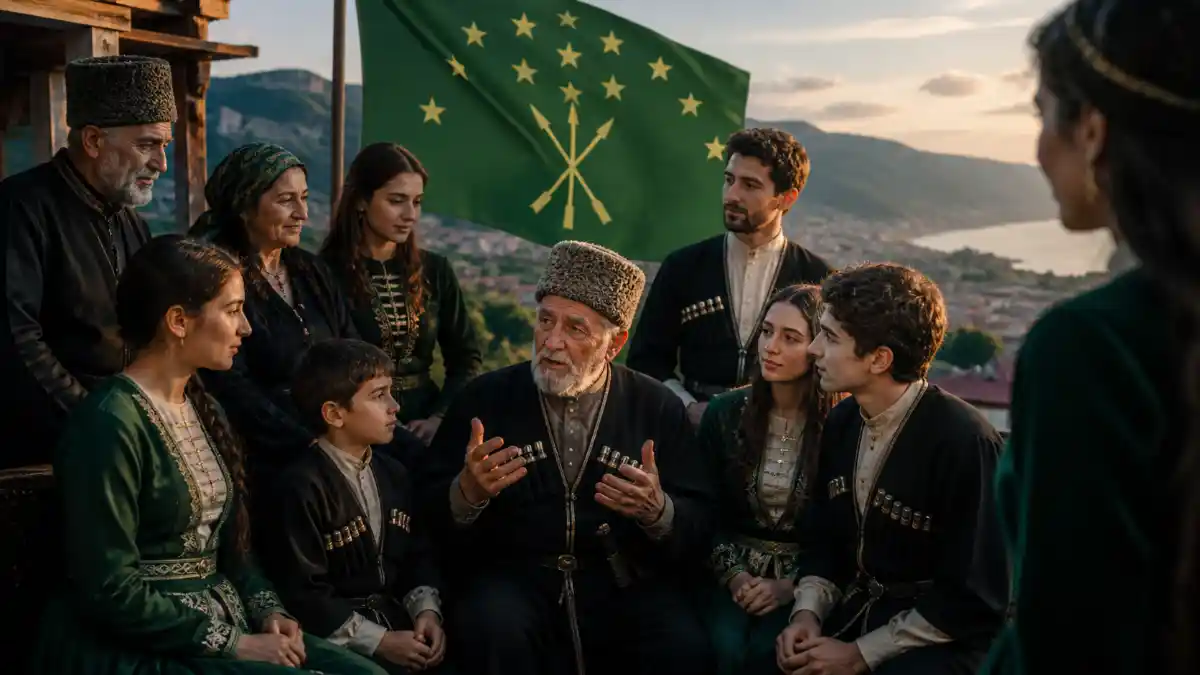
The 1864 Expulsion: A Tribe Scattered
The final defeat of Circassian forces at Krasnaya Polyana on 21 May 1864 — today commemorated each year as the Circassian Day of Mourning — ended the long war. What followed for the Besleneys, as for every Adyghe tribe still on its homeland, was mass deportation. The Imperial Russian Army gave villages weeks, sometimes only days, to gather what they could carry and march to the Black Sea coast for transport to Ottoman territory.
The toll across all Circassian peoples was catastrophic. Conservative estimates suggest 95–97% of the Adyghe population was killed or expelled — the figure varies by source and by methodology, but every serious historian agrees on the scale. For the Besleneys specifically, the proportion expelled was probably even higher than the all-Adyghe average, because their eastern position placed them on direct Russian access routes and made gradual evacuation impossible. The villages of the upper Laba and the Urup were emptied with particular thoroughness.
The Black Sea crossings were brutal. Overcrowded Ottoman ships, disease, drowning when ships sank in winter storms, starvation on the shores. Ottoman archives show the intake of more than a million Caucasian refugees by 1879, with nearly half of them having been found dying on the shores of the Black Sea as a result of disease. Besleney families who survived the crossing arrived in Anatolia, the Balkans, and the Levant carrying not much more than memory: a surname, a tamga symbol, perhaps a piece of metalwork or weaving, and the language.
The Ottoman Records: Your Family's Paper Trail
Ottoman archives at Istanbul — the Nüfus Defterleri, or population registers — recorded the arriving Besleney families in considerable detail. A typical entry from the 1864–1880 registers includes: the family's original village name in the Caucasus, tribal affiliation (sometimes recorded as Besleney specifically, sometimes folded into the broader "Çerkes" / Circassian category), household composition with names and approximate ages, and the Anatolian district to which the family was assigned by Ottoman authorities. Some registers further note the transit port (Trabzon, Samsun, Sinop, Varna) and the date of arrival.
These registers, many still untranslated and only a fraction digitised, remain the single richest documentary source for Besleney family history today. They are held at the Başbakanlık Osmanlı Arşivi (Ottoman State Archives) in Istanbul. Some Uzunyayla-region records have been digitised through scholarly projects; others require in-person research or a professional genealogist.
The Remnant in the Homeland
A small Besleney population remained in the homeland after 1864, primarily concentrated in the Adygea village of Khodz (historically a mixed Besleney-Hatuqay village), the town of Besleney in Karachay-Cherkessia, and a handful of other villages in Karachay-Cherkessia and Krasnodar Krai. This remnant population — never larger than a few thousand — became the principal keepers of the Besleney dialect and local Khabze tradition inside the Russian Empire and, later, the Soviet Union. Their continuous presence on the historic territory provides a vital reference point for diaspora families seeking to identify the specific village of an ancestor.
If your family arrived in Anatolia in the 1860s, your name is almost certainly in the Ottoman Nüfus Defterleri. We can help you find it.
The Besleney Diaspora Today
Besleney communities can be found in Turkey, Jordan, Syria, Israel, the Russian Federation, and a smaller modern diaspora across Europe and North America. The largest concentration by far is in Turkey, with the historic core in Uzunyayla. The communities differ in size, in degree of language preservation, and in their relationship to the homeland.
Turkey: Uzunyayla and Beyond
Uzunyayla, a high plateau in the Pınarbaşı district of Kayseri province in central Anatolia, is the historic heart of the Besleney diaspora and the largest Circassian community in Turkey by some measures. The plateau is home to roughly 10,000 Circassians today, spread across more than 50 villages, with the Kabardians as the largest single group (founders of 41 villages) and the Besleneys, Hatuqay, Mamkheg, and others integrated into those Kabardian-majority villages as separate lineages.
This integration pattern is genealogically important: Besleney families in Turkey often appear in archival records under Kabardian-majority village names, with Besleney identity preserved at the family level rather than the village level. A search that looks only at "Besleney villages" will miss them; you need to read household-level records (the muhtar — village headman — registers, the school records, the conscription lists) to recover Besleney lineage in Uzunyayla.
Beyond Uzunyayla, Besleney communities exist in Tokat, Sivas, Kahramanmaraş, and smaller scattered settlements across central and eastern Anatolia. Most of these communities trace to the 1864 expulsion and the immediate decades after.
Jordan
Jordanian Circassians are among the founders of modern Amman, having been settled in the area by Ottoman authorities in the 1870s and 1880s. The Jordanian Circassian community is smaller than the Turkish one, but it has historically maintained stronger preservation of formal tribal identity — clan names, marriage networks, and Khabze observance have stayed more intact across generations. A Besleney family in Amman is generally easier to trace than one in Turkey, partly because the community is smaller and tighter, partly because Jordan never imposed surname-change legislation comparable to Turkey's 1934 Surname Law.
Besleney families in Jordan are typically settled in Amman, Wadi al-Sir, Naur, and Jerash. Many Besleney descendants have served prominently in the Jordanian Royal Guard — a Circassian regiment with a long association with the Hashemite court — and in Jordanian civil service, business, and the professions.
Syria
Syrian Circassian communities, including Besleneys, were historically present in the Golan Heights (until 1967), in Damascus and its surroundings, and in scattered villages across the central and northern parts of the country. The post-2011 conflict has displaced many of these communities, with significant numbers relocating to Germany, Turkey, and the Russian Federation (some via Adygea-sponsored repatriation programmes). Tracing Syrian Besleney families today often requires working with diaspora associations across multiple countries.
Israel
The Israeli Circassian community is small and concentrated in two villages: Kfar Kama (predominantly Shapsug, with a Besleney minority) and Reyhaniye (predominantly Abzakh). Israeli national archives contain settlement records from the Ottoman period that can be cross-referenced with family histories. The communities are unusually well-documented.
The Russian Federation: Khodz, Besleney, and Karachay-Cherkessia
Inside Russia, the principal Besleney communities are in Khodz village in Adygea, the town of Besleney in Karachay-Cherkessia, and a number of smaller villages across Karachay-Cherkessia and Krasnodar Krai. These communities are the closest contemporary link to the historic Laba homeland; they preserve language, dialect features, and place-knowledge that no diaspora community can match.
The Modern Diaspora
Smaller Besleney communities, generally produced by second-stage migration from Turkey, Jordan, and Syria across the twentieth and twenty-first centuries, exist in Germany, the Netherlands, the United States (with hubs in New Jersey and California), and a number of other Western countries. These newer communities often blend Besleney identity into broader pan-Circassian cultural organisations, making tribal-level genealogy work harder but also creating cross-country networks that are valuable for ancestry research.
Besleney Culture & Identity
The Besleneys are known for their preservation of aristocratic Circassian customs, including elaborate wedding ceremonies, strict guest-host traditions, and oral poetry. Their contribution to Circassian dance and music includes distinctive melodies that reflect their mountain heritage. Among the cultural practices most associated with the Besleneys, several deserve particular attention.
Hospitality (Хьэщlэгъэблагъэ)
The Adyghe principle of khasen — the absolute sanctity of the guest — was observed across all Circassian tribes, but the Besleneys were particularly strict about it. A guest, even an unannounced one, was offered the household's best room (the kunatskaya), the best food, the cleanest clothing, and any practical help required. The host gave precedence in seating, in food service, and in conversation; the guest, in turn, observed reciprocal Khabze rules about when to speak, when to depart, and how to repay the hospitality without insulting the host. A Besleney prince was often judged, by his peers across Circassia, by the quality of his guest-room and the accomplishment of his hospitality. Russian, Ottoman, and European travellers who passed through the Laba valley left written accounts marvelling at the formality and warmth of Besleney reception.
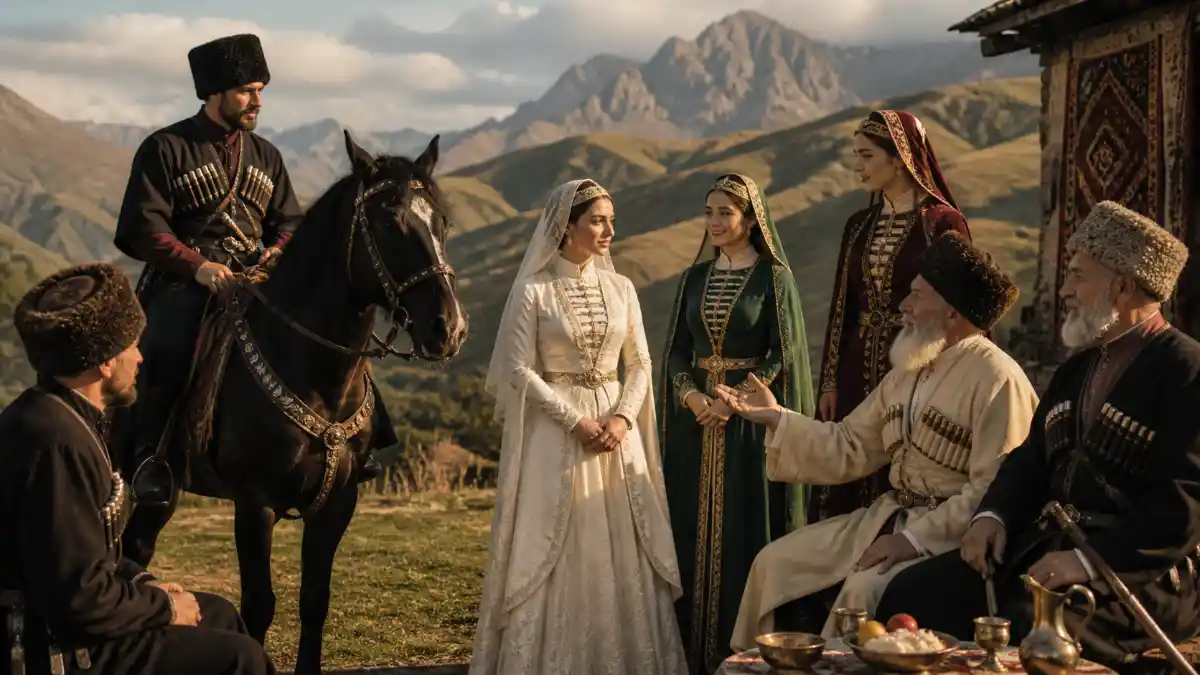
Weddings
Besleney weddings preserved a high-formality version of the broader Adyghe wedding tradition. Key elements included: the prolonged period of betrothal, during which the bride lived in a separate household before joining her husband's family; specific named dances at each stage of the wedding (the Lezginka, the Kafa, and a slower processional sometimes called Wig, performed by the bride and her companions); the giving of specific gifts in specific orders; the recitation of formal poetry by named family elders; and the strict observation of class-appropriate marriage rules. Many of these elements survive today in Uzunyayla and Amman, often in fuller form than in the larger pan-Circassian communities.
Music
The Besleney musical tradition shares its core instruments with the broader Adyghe world — the shichepshin (bowed two-string fiddle), the pkhachich (wooden percussion clappers), the kamyl (long flute) — but specific Besleney melodic styles are recognisable. Mountain-influenced rhythms, slower processional pieces tied to the Laba valley wedding tradition, and a particularly developed body of oral epic poetry (nart-cycle stories rendered with regional variations) characterise the repertoire. Several twentieth-century ethnomusicologists worked with Besleney musicians in Khodz and Karachay-Cherkessia to record the tradition; those recordings are an essential source for cultural revival today.
Horsemanship
The Besleneys' fame in horse-breeding deserves an extended note. The Laba valley was, for several centuries, the source of bloodlines that produced what became known across the Caucasus and the Black Sea world as the finest cavalry mounts. The horses had specific qualities: surefootedness in mountain terrain, endurance over long distances, intelligence in close-quarters work, a temperament suited to the close handling of a Caucasian warrior. After the 1864 expulsion, those bloodlines were partially preserved in the studs of the Adygea, Karachay, and Kabarda republics, and they form part of the foundation stock for the modern Kabardin and Karachai-Adyghe horse breeds. Diaspora Besleney communities, particularly in Turkey, also maintained horse-breeding traditions for decades after settlement, though the practice has faded in the modern era.
Famous Besleney Families and Surnames
Tracing a Besleney family begins with the surname — but Besleney surnames, like all Circassian names, exist in multiple scripts and have been transformed by every host country's naming policies. The original Adyghe-Cyrillic spelling, the Russian-Soviet adaptation, the Ottoman Turkish transliteration, the Latinised form after Turkey's 1934 Surname Law, the Arabic rendering in Jordan and Syria, and the Hebrew transliteration in Israel are five different versions of the same name, and successful Besleney genealogy requires checking all of them.
Notable Noble Lineages
Original (Adyghe)Russian/CyrillicCommon Turkish formsClassКъанокъоКаноковыKanok, Kanokov, KanukoPshi (princely)ШэрджэсШерджесовыŞerces, SherdjesWorq (noble)ДохъушыкъоДохушоковыDokhushiko, DohuşokoWorq (noble)ШолэхъуШолоховыŞolohov, ŞolohuWorqБэрзэджБерзеговыBerzeg, BerzeğWorqХьэгъундокъуэАгундоковыHagundoko, AgundokWorqХьэткъоХатковыHatko, HatkhoTfokotl
If your family carries any of these names — in any script — the probability of Besleney heritage is high. Several patterns help: surnames ending in -okwa / -oko / -uko (-окъуэ / -okuo in Adyghe) often signal a Worq line; names ending in -zedj / -zeg may carry Besleney or wider eastern-Adyghe roots; the prefix Hagun- or Khan- often appears in noble lineages.
Several Besleney surnames carry specific historical traces. The Qanoqo name, for instance, can almost always be tied through Russian and Ottoman records to one of the documented princely households on the upper Laba; the Dokhushiko name appears in early Ottoman Anatolian registers in close association with the Uzunyayla settlement. The CircassianWeb surname database performs the cross-script lookup and ties names to documented historical records where they exist.
Search for your ancestry in our Family Name Database.
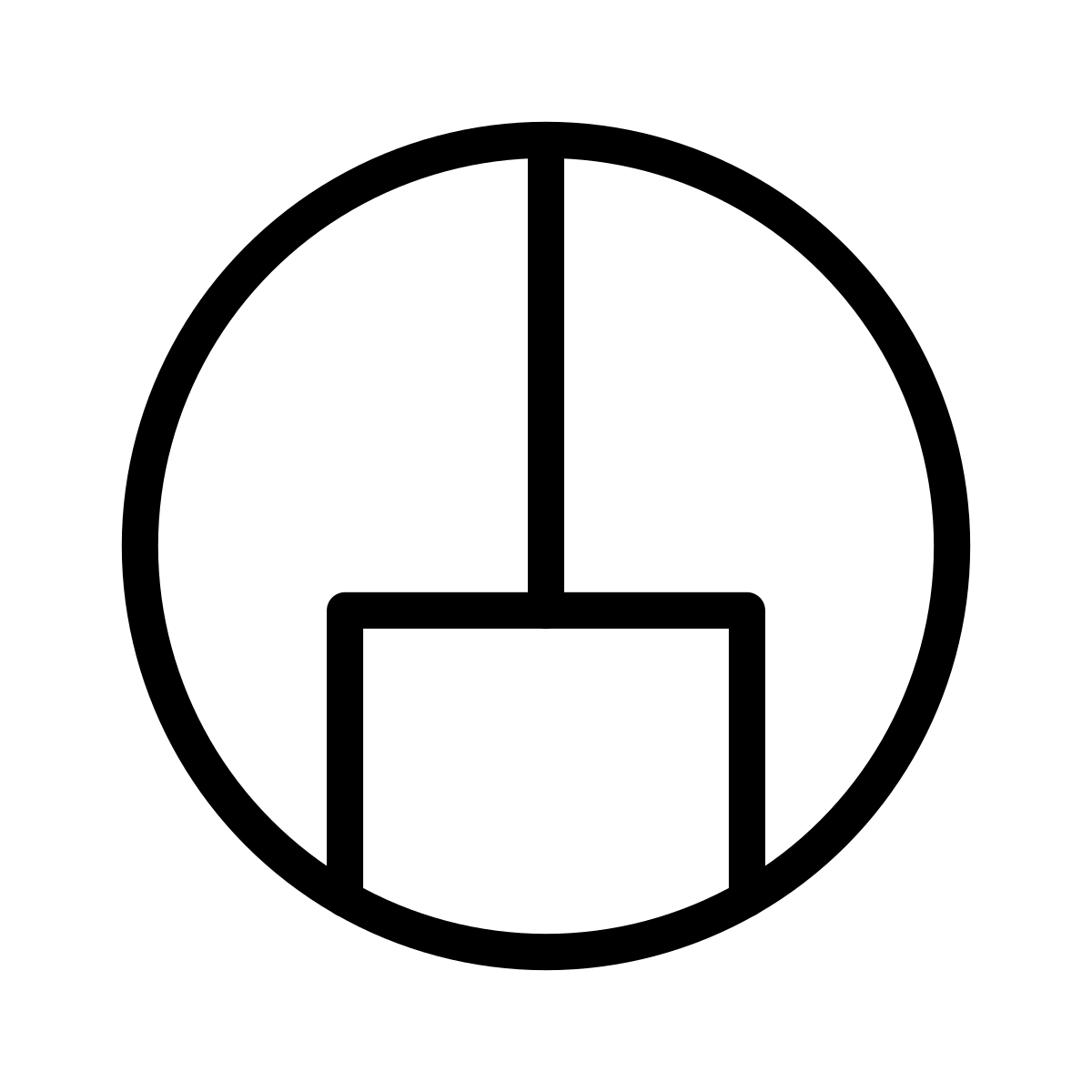
The Besleney Tamga
Besleney clan symbols (tamga) are characterized by elegant geometric patterns that reflect their Eastern Circassian heritage. These symbols continue to be used as identity markers by diaspora communities worldwide. A tamga, in Adyghe usage, was a unique geometric mark used to brand livestock, mark property, identify lineage, and (in some traditions) seal documents. Each clan within a tribe carried its own variant, and within a clan, sub-lineages might add small modifications to distinguish branches.
Besleney tamgas tend to share visual patterns with Kabardian tamgas — a reflection of the shared Inal-line ancestry — often featuring vertical staffs with paired hooks or branches, half-circles oriented toward the cardinal points, and stylised arrowheads. The Qanoqo princely tamga, for example, is documented in multiple ethnographic sources as a vertical staff with two angled cross-pieces; the Sholokh and Sherdjes tamgas show variations on the half-circle motif.
For descendants today, the value of the tamga is that it survives even when written records do not. If your family remembers a symbol — a particular cross, fork, half-circle, or angled line — that mark can identify your exact clan within the Besleney even when the surname has been changed or lost. The CircassianWeb tamga finder compares family-remembered symbols against documented tribal catalogs and can produce a probabilistic identification.
A practical note: tamgas were never written down in the way names were. They survived through being seen — on a saddle blanket, on a doorpost, on a piece of woodwork, on an embroidered cloth. Ask the eldest members of your family whether they remember a household mark. Even a partial drawing on a napkin can be the key that unlocks a five-century lineage.

Tracing Your Besleney Ancestry: A Practical Method
The methodology for Besleney ancestry research follows the broader Circassian genealogy framework, with several Besleney-specific notes. The strongest results come from layering five different sources of evidence rather than relying on any single one.
Step 1 — Elder interviews
Start with the oldest living members of your family. Ask specifically: What was the name of the village your great-grandfather came from? Was it on the Laba or the Urup River? Was it in Karachay-Cherkessia, or in Adygea, or further east toward Kabarda? Elders may remember dialect features — particular pronunciations of common words — that linguists can use to identify Besleney speech patterns. Record everything; even casual memories carry information. Pay attention to small details: which port did the family arrive at? Trabzon? Samsun? Varna? This reveals the migration route and narrows the search area in the Caucasus.
Step 2 — Surname research across five scripts
Run your surname through the Adyghe (Cyrillic), Russian-Soviet, Turkish (Ottoman and Republican), Arabic, and Hebrew variants. Many Besleney families changed names in 1934 under Turkey's Surname Law — the original Adyghe form may differ completely from your current legal surname. The CircassianWeb surname tool performs this cross-script lookup automatically.
Step 3 — Ottoman archive search
For families that arrived in Anatolia between 1859 and 1880, the Ottoman Nüfus Defterleri at the Başbakanlık Osmanlı Arşivi in Istanbul are the primary record. They typically list the original village in the Caucasus, the tribal affiliation, household composition, and the assigned settlement. Some Uzunyayla-region records have been digitised; most still require in-person research or a professional genealogist.
Step 4 — Russian military and census records
Russian military reconnaissance maps from the 1830s to 1860s list Besleney villages along the Laba and Urup by name. Cross-referencing these with family memory of pre-exile village names produces some of the strongest geographical confirmations possible. Records are held primarily at the Russian State Military History Archive (RGVIA) in Moscow and at regional archives in Maykop (Adygea), Cherkessk (Karachay-Cherkessia), and Krasnodar.
Step 5 — DNA testing
For Besleney families, DNA testing serves as a confirmation tool rather than a primary identifier. Y-DNA haplogroups G2a (especially the G-M406 subclade) and J2 are common among eastern Circassians, with R1a appearing at notable frequencies as well; the Besleney pattern overlaps significantly with the Kabardian pattern, reflecting their shared ancestry. CircassianWeb's DNA matching compares your raw data against the 109-record peer-reviewed Circassian reference panel and shows tribal affinity probabilities — useful for distinguishing Besleney from neighbouring eastern groups.
Place modern.jpg here
(elder + granddaughter exploring family tree)
Today · Recovering the lineThree generations meet across a tablet screen. The seven-generation memory tradition that 1864 nearly erased is being rebuilt — one Besleney family at a time, across Turkey, Jordan, Russia, and beyond.
Besleney Genetic Markers
Population genetic studies of Circassians (Balanovsky et al., 2011; Yunusbayev et al., 2012; subsequent FTDNA Circassian DNA Project work) show that the Adyghe peoples carry distinctive frequencies of several Y-DNA haplogroups. The eastern tribes — Kabardians and Besleneys — show patterns that are similar to each other and somewhat distinct from the western Adyghe groups.
G2a (especially G-M406): Common in eastern Circassians, with frequencies in the 20–45% range across various Adyghe samples. This is the principal lineage marker shared with Kabardians and other Inal-line tribes, and it traces directly to pre-Bronze Age populations of the Northwest Caucasus.
J2 (J-M172): Present at notable frequencies; tends to peak in western Adyghe groups but appears across eastern groups including Besleney at meaningful proportions.
R1a: Found at higher frequencies in Kabardian and Besleney samples (12–18%) than in western Adyghe groups. This is one of the markers ethnogeneticists use to distinguish East from West Circassian samples.
mtDNA H, U3, T2: Maternal lineages H, U3, and T2 dominate Adyghe maternal lines, including Besleney. The pattern is broadly shared across the Northwest Caucasus and traces to populations present in the region for thousands of years.
Important caveat: these haplogroup associations are probabilistic and population-level, not individual identity tests. A single G2a result does not "prove" Besleney heritage — it places you within a population pattern consistent with eastern-Circassian ancestry. The most reliable identification comes from combining DNA with surname research and family history. The FamilyTreeDNA Circassian DNA Project, with over 2,800 members as of 2026, is the largest single repository of Circassian Y-DNA data and a valuable resource for any Besleney-descended researcher.
A note on autosomal results. Consumer autosomal DNA tests (AncestryDNA, 23andMe, MyHeritage) have limited Caucasus reference populations. A Besleney-descended user may simply receive a result like "West Asian 38%" or "Caucasian 42%" with no Circassian-specific breakdown. Uploading the raw file to a tribe-aware matcher like CircassianWeb's DNA Heritage Explorer is essential for getting tribal-level resolution.
Notable Besleney Figures
The Besleneys have produced, in proportion to their numbers, an outsized share of military officers, scholars, statesmen, and cultural figures — both in the homeland and across the diaspora. A complete prosopography is beyond the scope of this article, but several figures illustrate the range.
Qanoqo Murat (early 19th century) — Pshi who led a notable phase of the resistance to Russian advances along the Laba in the 1830s and 1840s. Russian military reports of the period describe his cavalry as among the most disciplined Circassian formations they encountered.
Sultan Khan-Girey (1808–1842) — ethnographer and writer of partial Besleney/Hatuqay descent whose 1830s manuscripts on Adyghe customs (Notes on Circassia) are foundational sources for modern Khabze scholarship. His position straddling Russian service and Adyghe identity captures the complicated late-imperial moment.
Modern Russian Federation: Several Besleney-descended figures have served in regional government in Karachay-Cherkessia and Adygea, including senior administrative posts in the late twentieth and early twenty-first centuries.
Diaspora military service: Besleney officers have served prominently in the Jordanian Royal Guard, in the Turkish armed forces, and historically in the Ottoman cavalry. The Royal Circassian Guard in Jordan retains specific Besleney lineages within its officer corps.
Diaspora cultural and academic figures: Several twentieth- and twenty-first-century Adyghe academics, writers, and musicians of Besleney descent have contributed to the scholarly record on the tribe; their work is referenced in the Sources section below.
These individual stories are scattered across multiple national archives and rarely aggregated — one of the goals of CircassianWeb's collaborative family tree is to bring those scattered records into one connected, searchable dataset.
Modern Cultural Revival
Across the late twentieth and twenty-first centuries, several efforts have worked to preserve and revive Besleney identity in the face of assimilation pressures in every host country. These efforts include language preservation projects in Uzunyayla and Khodz, music recording and documentation projects, repatriation programmes (the Adygea republic has supported limited Circassian return migration since the 1990s), academic conferences, and digital community-building.
The internet era has been particularly significant. Diaspora Circassians who would, in earlier generations, have struggled to find more than a handful of fellow Besleney families now connect across continents through dedicated platforms, social media groups, and DNA matching services. The youngest generations are doing something their great-grandparents could only have dreamed of: tracing their lineage forward, generation by generation, until they meet a previously unknown cousin in a previously unknown country, and finding that the Besleney lineage — despite 160 years of scattering — never actually broke. It only stretched.
Your turn
Trace Your Besleney Ancestry Today
The methodology in this article works. We've used it to reunite Besleney families across Turkey, Russia, Jordan, and beyond — starting from a single surname.
1
Build your tree
Start with three names: yourself, a parent, a grandparent.
2
Find your tribe
Match your surname against the Besleney clan database.
3
Upload your DNA
Compare against the Circassian reference panel.
✓ Free forever · ✓ Your data stays yours · ✓ No credit card
Sources & Further Reading
Wikipedia — Besleney and Principality of Besleney.
Eiji Miyazawa, Memory Politics: Circassians of Uzunyayla, Turkey (PhD thesis, available via CircassianWorld).
Shora Nogmov, History of the Adyghe People — the foundational nineteenth-century source on the Inal succession and the founding of Besleney.
Jaimoukha, A. (2001). The Circassians: A Handbook. Palgrave Macmillan.
Balanovsky, O. et al. (2011). "Parallel Evolution of Genes and Languages in the Caucasus Region." Molecular Biology and Evolution, 28(10), 2905–2920.
Yunusbayev, B. et al. (2012). "The Caucasus as an asymmetric semipermeable barrier to ancient human migrations." Molecular Biology and Evolution, 29(1), 359–365.
Richmond, W. (2013). The Circassian Genocide. Rutgers University Press.
Khan-Girey, S. (1830s, modern reprint editions). Notes on Circassia.
Ottoman Nüfus Defterleri — Başbakanlık Osmanlı Arşivi (BOA), Istanbul.
Russian Military Topographic Maps, 1830–1864 — Kuban Regional Archives, Krasnodar; RGVIA, Moscow.
FamilyTreeDNA Circassian DNA Project — familytreedna.com/groups/circassian.
CircassianWeb companion guides: Circassian Ancestry, The 12 Tribes, Tamga Finder, Adyghe Khabze, DNA Heritage Explorer.
Further Reading & References
- Wikipedia: Besleney people
- Britannica: Circassian people
- Britannica: Caucasian War
- JSTOR: Academic articles on the Circassians