The Mamkhegh Tribe: Keepers of Ancient Circassian Traditions
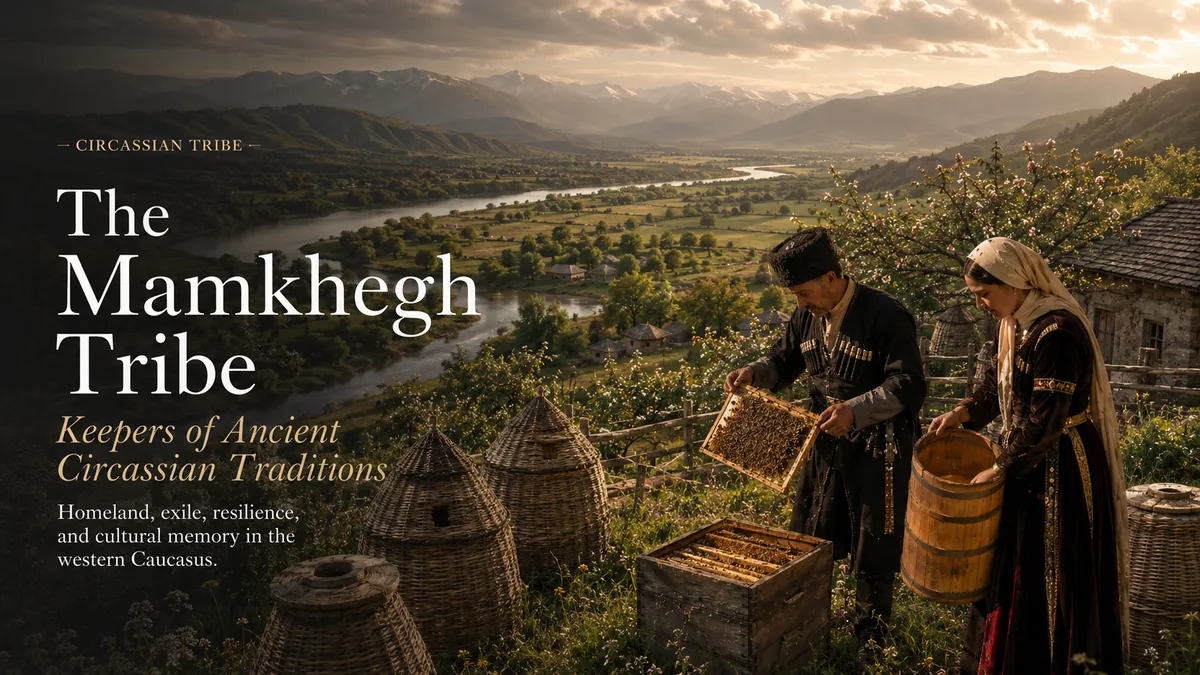
The Mamkhegh Tribe: Keepers of Ancient Circassian Traditions
Мамхыгъ. The small Adyghe tribe that ran itself without princes, governed by elected elders, and still has a single living village in modern Adygea where descendants of the original people remain.
The Mamkheghs (Адыгэ: Мамхыгъ) are one of the twelve Circassian tribes. They were never a large tribe. Their homeland was a compact territory between the Belaya and Kurdzhips rivers, in what is now the Republic of Adygea. They had no princes. They ran themselves through elected elders drawn from the freemen class, which made them, in a phrase that has stuck in the historical literature, a "democratic" tribe in a Caucasus full of feudal aristocracies. They lost most of their population to the 1864 expulsion, and the survivors who stayed in the homeland founded a single village called Mamheg. That village still exists. People with old Mamkhegh names still live in it. The tribe is small. It is not gone.
This article tells the full story of the Mamkhegh: who they were, where they lived, how they governed themselves without an aristocracy, what their language sounded like, what happened to them in the Russo-Circassian War, what happened to the survivors, where their descendants live today (mostly in Turkey, with the small homeland remnant in Adygea), what surnames are associated with the tribe, what their tamga symbols look like, and how to trace your own Mamkhegh ancestry. It also includes the most important single fact in their post-1864 history: in 1884, twenty years after the expulsion, the Russian census counted only 1,258 Mamkheghs left in the Kuban region, with 715 of them in the village of Mamheg. That figure tells you both how close the tribe came to disappearing and how much the survivors held on to.
Sources for this article include Wikipedia's Mamkhegh entry, Amjad Jaimoukha's The Circassians: A Handbook (2001), Russian imperial census records, the Adygea republican archives, and primary material from the Ottoman Nüfus Defterleri.
Mamkhegh at a glance
Adyghe name Мамхыгъ (Mamkhegh, also Mamheg, Mamhig)
Branch Western Circassian (Adyghe proper)
Closest dialect to Temirgoy (Chemguy)
Historic homeland Between the Belaya River and the Kurdzhips River, near modern Maykop in the Republic of Adygea, with extensions into Krasnodar Krai
Government One of the few "democratic" Adyghe tribes, governed by elected elders from the freemen class. No hereditary princely (Pshi) line.
Modern living village Mamheg (Мамхэг), Shovgenovsky District, Republic of Adygea
1884 Russian census 1,258 Mamkheghs remained in the Kuban region, with 715 in Mamheg village
Diaspora Most surviving Mamkhegh families went to the Ottoman Empire after 1864. Today the diaspora is concentrated in Turkey, often integrated into broader Circassian villages.
Closest related tribes Temirgoy, Bzhedug, Hatuqay, Yegerukwai — the Western Adyghe cluster
On the Circassian flag One of the 12 gold stars
Who Are the Mamkhegh?
A small Western Adyghe tribe of the Belaya River basin, distinguished from most other Circassian peoples by the absence of a hereditary princely class. They governed themselves through elected elders.
The Mamkheghs are one of the twelve historic Adyghe tribes recognised on the Circassian flag. They are part of the Western Adyghe cluster, alongside the Temirgoy, the Bzhedug, the Hatuqay, the Yegerukwai, the Shapsug, and the Natukhai. They speak a dialect of West Circassian closely related to Temirgoy. They lived in a compact homeland near the modern city of Maykop in what is today the Republic of Adygea.
Three things made the Mamkhegh distinctive among the Adyghe peoples:
They were small. Pre-1864 estimates put the tribe at perhaps 5,000 to 10,000 people, much smaller than the major Circassian tribes (Kabardians, Shapsug, Abzakh) and at the lower end among the Western Adyghe groups. Some sources put their numbers even lower.
They were "democratic." Unlike most Circassian tribes, the Mamkhegh had no hereditary princely (Pshi) class. Rural administration was in the hands of elected elders drawn from the free commoner class. This made them, in formal political structure, fundamentally different from the Kabardians, Besleneys, Bzhedug, or Hatuqay.
They had a single specific homeland village that survived. After the 1864 expulsion, the small remnant population that stayed in the Caucasus founded the village of Mamheg, which still exists in the Shovgenovsky District of modern Adygea. It is one of the most concrete surviving anchors of any small Adyghe tribe in the homeland.
The democratic feature is the most remarkable single fact about the tribe. In a Caucasus where every major Adyghe people, every Vainakh group, every Daghestani society, and every neighbouring Turkic and Iranian polity was organised around some form of hereditary elite, the Mamkhegh ran themselves on a different model. Decisions about land, justice, war, and external diplomacy were made by elders. Those elders were chosen by the men of the freemen class, not by birth into a princely lineage. The tribe was small enough that the system worked. There were never enough internal conflicts to require a large bureaucracy or a dominant military caste, and the lack of a princely class meant the small Mamkhegh population was not divided between rulers and ruled in the way that other Adyghe communities were.
The historiographical literature usually describes the Mamkhegh, alongside the Shapsug, Abzakh, and Natukhai, as one of the "democratic" Adyghe tribes, in contrast to the "aristocratic" Kabardian, Besleney, Bzhedug, and Hatuqay tribes. The label is imperfect. The Shapsug, Abzakh, and Natukhai had complicated internal histories that included varying noble structures at different periods. But for the Mamkhegh, the term fits. They had no Pshi line. They governed by council. That was their identity through the historical period.
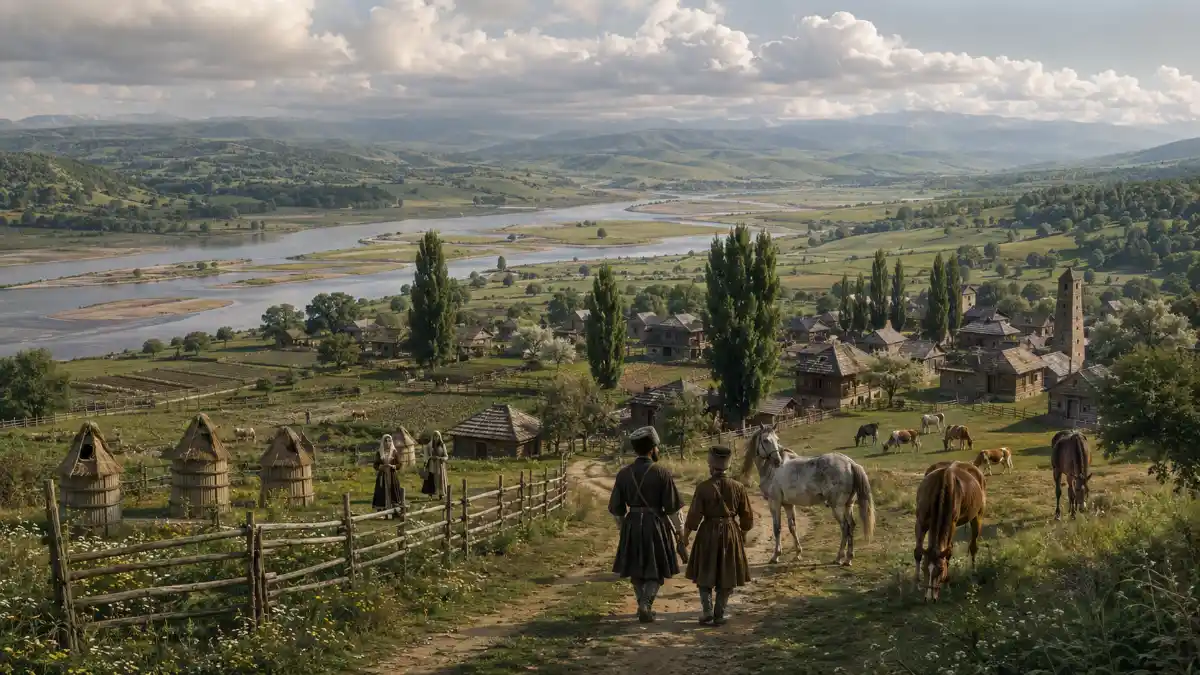
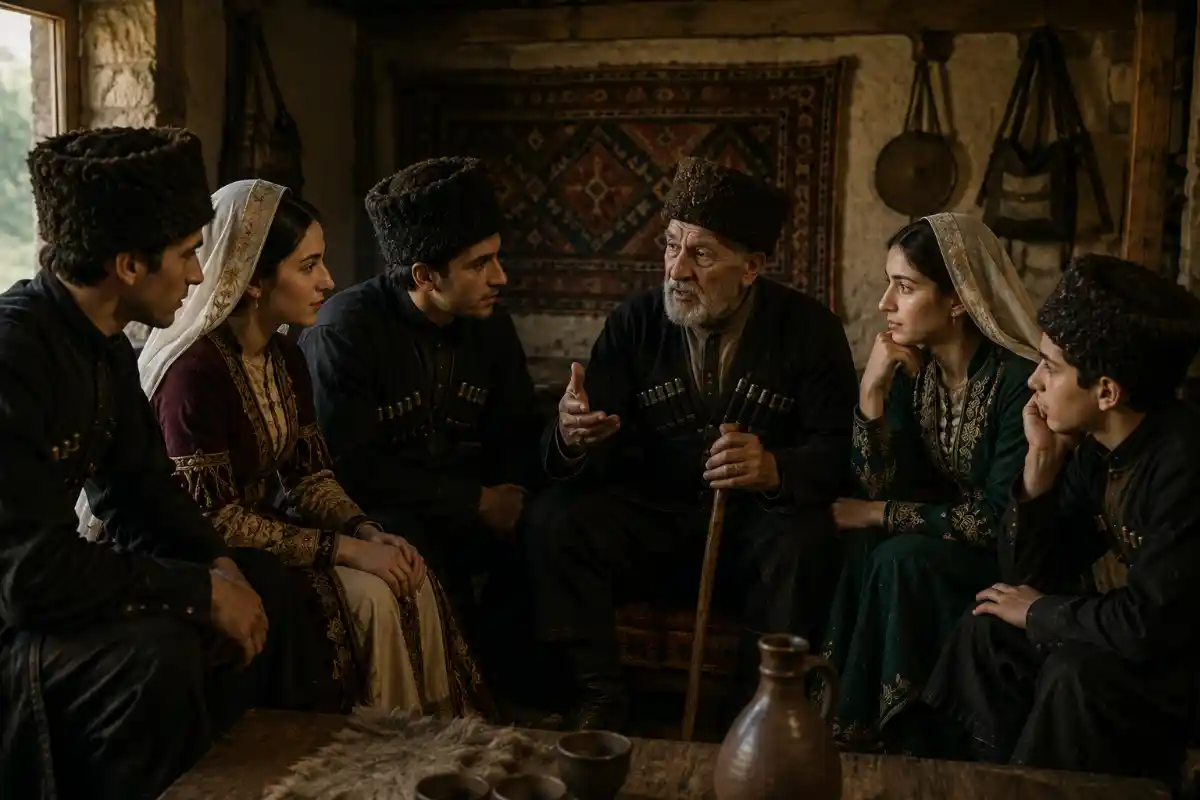
Before 1864 · The Belaya homeland A Mamkhegh household in the Belaya basin. The dress, the carpets, the wooden architecture were shared across the Western Adyghe tribes. What set the Mamkhegh apart was not the daily material culture but the political organisation: no princes, no Worq cavalry levies, no aristocratic marriage networks. Just a small council of elders.
A Tribe Without Princes
The Mamkhegh did not have a hereditary princely (Pshi) class. Rural administration was in the hands of elected elders from the freemen class. This made them politically distinct from most other Adyghe peoples.
The single most important political fact about the Mamkhegh is the one Wikipedia states bluntly and most general histories of Circassia gloss over: "the Mamkhegh did not have the highest class of prince who usually controlled villages, like most Circassian tribes, and rural administration was in the hands of elected elders from the freemen class." That is the structural feature that separates the Mamkhegh from the Kabardians, the Besleneys, the Bzhedug, and the Hatuqay. The Mamkhegh had no Pshi.
What did this mean in practice? Several things, all of which had consequences for the tribe's history.
No Pshi, no Worq
In a typical Adyghe tribe, the Pshi (prince) was the apex of the social pyramid. Below the Pshi sat the Worq (noble) cavalry class, who served the Pshi as sworn vassals and provided the bulk of the tribe's military power. Below the Worq sat the Tfokotl (free commoners) and below them the Pshilh (dependents). Marriage rules tied each class to its own level. The Pshi inherited authority by birth, conducted external diplomacy, led in war, and arbitrated internal disputes.
The Mamkhegh had none of this. Without a Pshi, there was no Worq cavalry class either, since Worq existed by virtue of their bond to a Pshi. Mamkhegh society was organised around the freemen class, with a smaller dependent population at the bottom. There was no aristocratic marriage network with neighbouring tribes, because the Mamkhegh had no aristocrats to participate in that network.
Government by elected elders
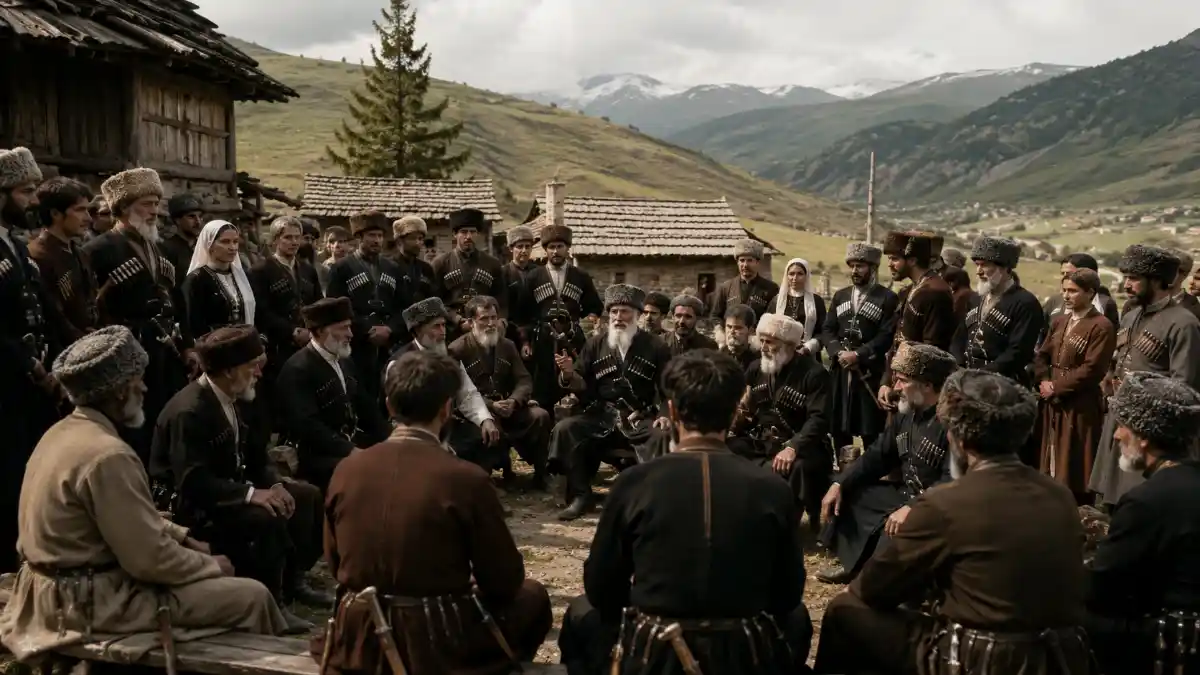
Rural administration in Mamkhegh society was in the hands of elected elders drawn from the freemen class. The election process is not described in detail in the surviving sources, but the general pattern across democratic Adyghe tribes was that men of the freemen class chose particular respected figures to serve as council members for specific tasks (judicial arbitration, land allocation, military command, external diplomacy). The chosen elders served for the duration of the task or for a defined period, and authority returned to the council when the task was complete. There was no lifelong office, no inherited authority, no formal title that distinguished an elder from any other freeman except by election.
For external diplomacy, this meant the Mamkhegh negotiated through delegations of elected elders rather than through a recognised prince. For warfare, it meant militia structures rather than standing princely cavalry. For judicial decisions, it meant council deliberation rather than Pshi adjudication.
Why this happened
The historiographical literature offers several theories about why the Mamkhegh ended up without a Pshi class. None is conclusive. The most commonly cited factors include:
Small size. The Mamkhegh were a small population. A full princely-aristocratic structure of the Kabardian or Bzhedug type required a critical mass of people to support. Below that critical mass, a simpler council government was more practical.
Geographic compactness. The Mamkhegh territory was small and homogeneous. There were no internal regional divisions of the kind that produced distinct princely houses in other tribes.
Historical accident. Adyghe tribal political structures emerged from particular historical sequences that varied tribe by tribe. The Mamkhegh may simply have lost or never developed a princely line, with no specific cause beyond contingency.
Whatever the reason, the result is clear in the historical record. The Mamkhegh ran themselves without princes. That structural fact shaped how they fought, how they negotiated, and how they survived.
The Mamkhegh did not have the highest class of prince who usually controlled villages, like most Circassian tribes. Rural administration was in the hands of elected elders from the freemen class.— Wikipedia, Mamkhegh
The Belaya-Kurdzhips Homeland
A compact territory between the Belaya River and the Kurdzhips River, in what is today the area around the city of Maykop in the Republic of Adygea, with extensions into Krasnodar Krai.
The Mamkhegh homeland was located between the Belaya River (Adyghe: Шхьэгуащэ, Shkhaguashe) and the Kurdzhips River, in what is now the central region of the Republic of Adygea. The territory included the area around modern Maykop, the Adygean capital, and extended both north into the lowland plains south of the Kuban and south into the foothills of the central Caucasus.
This was lowland and foothill country, not high mountain. The Belaya and Kurdzhips river valleys provided fertile agricultural land, sufficient water, and pasture for cattle and horses. The geography supported a settled village economy rather than the seasonal-pasture, transhumance-oriented life of the highland tribes (Shapsug, Abzakh).
What the territory supported
The Mamkhegh economy combined four main activities, characteristic of the broader Western Adyghe lowland economy:
Agriculture. Wheat, millet, and barley on the lowland plains. Maize entered the diet later, in the 18th and 19th centuries.
Animal husbandry. Cattle and horses on the river-valley pastures, with smaller numbers of sheep and goats. Mamkhegh families kept working horses but did not run the kind of large studs that the Kabardians or Besleneys maintained for breeding.
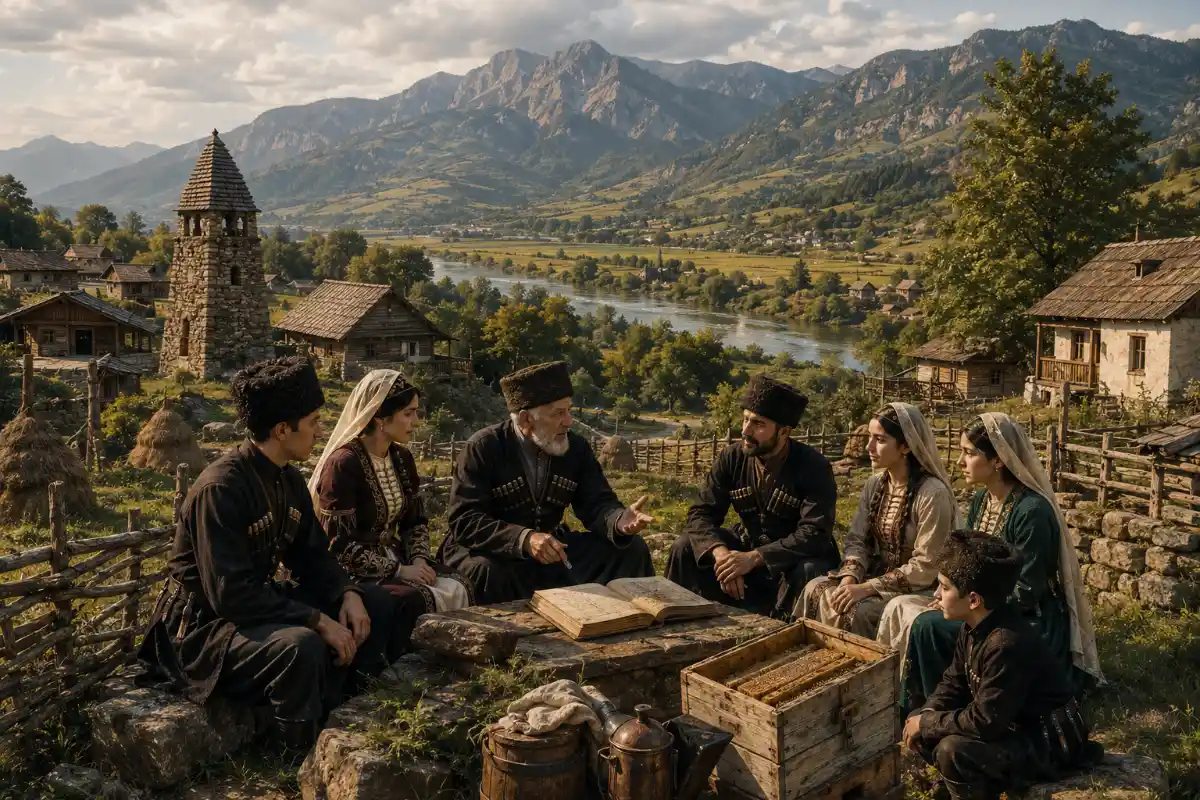
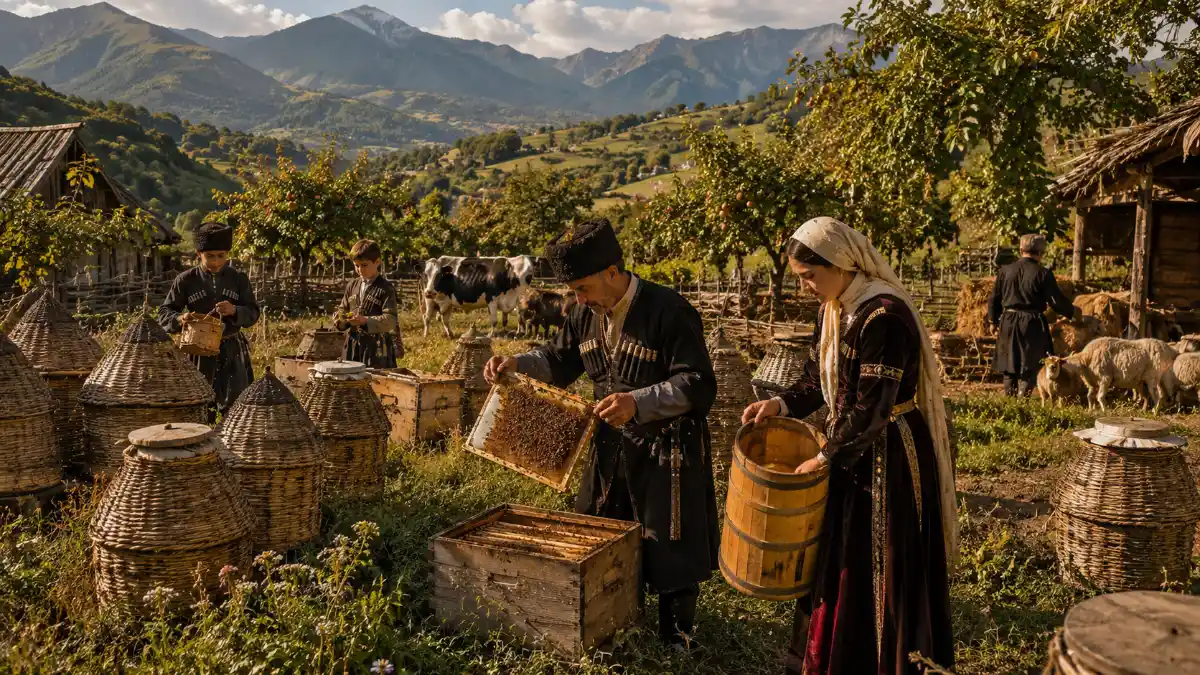
Beekeeping. A traditional Circassian craft, particularly important in the Mamkhegh economy. The forested foothills near the Belaya provided ideal habitat for forest-floor beekeeping, and Mamkhegh honey and wax were minor export products.
Crafts. Weaving, leatherwork, basic metalwork, and woodwork for local consumption.
Neighbours
The Mamkhegh territory was surrounded by larger Adyghe groups:
To the north and west: the Bzhedug, on the Psekups and Afips rivers.
To the west: the Temirgoy, with whom the Mamkhegh shared the closest dialect and cultural similarity.
To the south: the Abzakh, in the highland country toward the Caucasus passes.
To the east: the Yegerukwai and other smaller Adyghe groups.
The Mamkhegh's compact size and the proximity of larger neighbours meant that, for most of their pre-1864 history, the tribe depended on alliances with bigger Adyghe peoples for defence against external threats (Russian, Crimean, Ottoman) and for representation in pan-Adyghe political councils.
Modern administrative location
Today the historic Mamkhegh territory falls primarily within the Republic of Adygea, specifically in and around the Shovgenovsky District (where the village of Mamheg is located) and the area around Maykop. Smaller portions extend into Krasnodar Krai, which surrounds Adygea on all sides.
The Mamkhegh Dialect
A Western Adyghe dialect, closest to Temirgoy. It contained vocabulary specific to the Belaya region and to the agricultural economy of the tribe. Today it survives only in the small homeland village.
The Mamkhegh spoke a dialect of West Circassian (Adyghe proper), classified linguistically as part of the Lowland Adyghe cluster. The closest related dialect is Temirgoy, with which Mamkhegh shares most of its phonological and grammatical features. Some linguists treat Mamkhegh and Temirgoy as a single dialect cluster with sub-variants. Others recognise Mamkhegh as a distinct sub-dialect.
Several features mark off Mamkhegh speech from neighbouring Adyghe varieties:
Vocabulary tied to the Belaya basin. Words for local landscape features, agricultural tools, and beekeeping implements were specific to the Mamkhegh homeland. Some of this vocabulary has not been preserved outside the immediate area and is recoverable today only from elder speakers in Mamheg village.
Subtle phonetic distinctions. Some consonants and vowel realisations differ from standard Temirgoy in ways that remain detectable in the speech of older Mamheg residents.
Council-related lexicon. Because the Mamkhegh political system was different from neighbouring tribes, certain terms for council deliberation, election of elders, and judicial procedures had specific Mamkhegh forms.
In the diaspora, the Mamkhegh dialect has largely been absorbed into broader Western Adyghe speech. Mamkhegh families in Turkey today, where their ancestors mostly went after 1864, generally use a generalised Adyghe form influenced by Temirgoy, Bzhedug, or whichever larger Adyghe community their village shared. Distinct Mamkhegh dialect features survive primarily in two places: the Mamheg village in Adygea, where elder speakers still use them, and in scattered Turkish diaspora villages where Mamkhegh families settled together rather than mixing with other Adyghe groups.
Standard literary Adyghe (used in Adygea schools and publishing) is based on the Lowland Bzhedug-Temirgoy cluster, which is close to Mamkhegh. So a Mamkhegh-descended learner studying standard Adyghe today is, in effect, learning a form very close to ancestral Mamkhegh speech, with the specific Mamheg lexicon preserved in supplementary local materials.
Society Without Aristocracy
The class structure of the Mamkhegh was simpler than that of the aristocratic Adyghe tribes. The freemen class formed the core of the population, with a smaller dependent class. There was no princely or noble level above them.
The class structure of the Mamkhegh was simpler than that of the aristocratic Adyghe tribes because the top two classes (Pshi and Worq) did not exist. The remaining classes were:
ClassAdyghe termRoleFree commonersТфокотль (Tfokotl)The core of Mamkhegh society. Free farmers, herders, craftsmen, beekeepers. Provided the elected elders who governed the tribe. Not bound to any lord.DependentsПщылl (Pshilh)Bound household dependents and serfs. The smallest class.
What the absence of nobility meant
Without a Pshi or Worq class, several features of standard Adyghe social life were either absent or modified in Mamkhegh society:
No aristocratic marriage network. The Mamkhegh did not participate in the cross-tribal marriage circulation among Pshi and Worq families that connected the Kabardian, Besleney, Bzhedug, Hatuqay, and Temirgoy aristocracies. Mamkhegh marriage was internal to the freemen class and to the dependent class, with the natural variation that comes from a small population's marriage choices.
No princely military levy. Mamkhegh military forces were militia of the freemen class, not Worq cavalry. They fought as foot soldiers and as common cavalry, but the disciplined, professionally-trained Worq formations of the Kabardians or Bzhedug had no Mamkhegh equivalent.
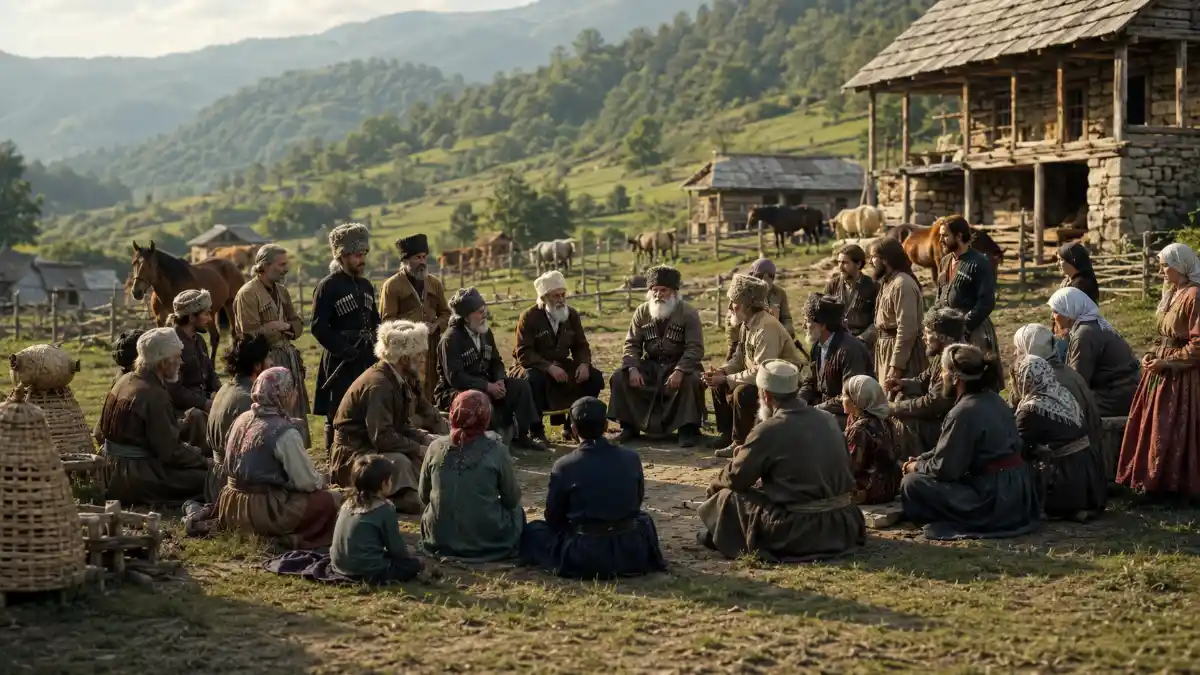
No princely diplomacy. External negotiations were conducted by delegations of elders rather than by Pshi. Other Adyghe tribes did not always know how to engage Mamkhegh diplomacy through familiar princely channels, which sometimes complicated alliance-building.
Different patterns of land tenure. Land in aristocratic Adyghe tribes was held by Pshi houses with vassal Worq attached. In Mamkhegh territory, land was held by freemen households on a more egalitarian pattern, with collective rights to common pasture and forest.
The absence of a Pshi class also meant the Mamkhegh did not produce the named historical princes whose biographies dominate the standard accounts of other Adyghe tribes. Mamkhegh history, in the conventional sense of "named figures who shaped events," is thinner than the histories of larger aristocratic tribes. The collective decisions of council elders left less individual trace in the surviving records.
Adyghe Khabze Without Princes
Adyghe Khabze still applied to Mamkhegh society, but without the princely-aristocratic dimensions. Hospitality, respect for elders, and the broader code of conduct continued in a more egalitarian form.
The Mamkheghs followed Adyghe Khabze, the unwritten code of conduct that governed Adyghe social, ethical, and ceremonial life. Khabze applied to the Mamkhegh in essentially the same way as it applied to other Adyghe peoples, with one important modification: the rules that specifically regulated the princely-aristocratic class did not apply, because there was no princely-aristocratic class.
The features of Khabze that survived intact in Mamkhegh society included:
Hospitality (хэщlэгъэблагъэ). The guest was inviolable. Mamkhegh hosts gave the best room, the best food, and personal protection to any visitor. The kunatskaya (guest room) tradition was observed in Mamkhegh households as in any other Adyghe community.
Respect for elders. Elders had ceremonial precedence in seating, in food service, in conversation, and in ritual contexts. In the Mamkhegh case, this acquired additional weight because the elders were not just respected as a matter of age but were the actual political leadership of the tribe.
Hospitality reciprocity. A guest at one home incurred obligations to receive the host or the host's relatives at a future date. This network of reciprocal hospitality knit Mamkhegh families together internally and connected them to neighbouring Adyghe communities.
Funeral and mourning customs. Mamkhegh observance of the Adyghe mourning code, including specific wailing customs for women and beard-tearing customs for men, paralleled broader Adyghe practice.
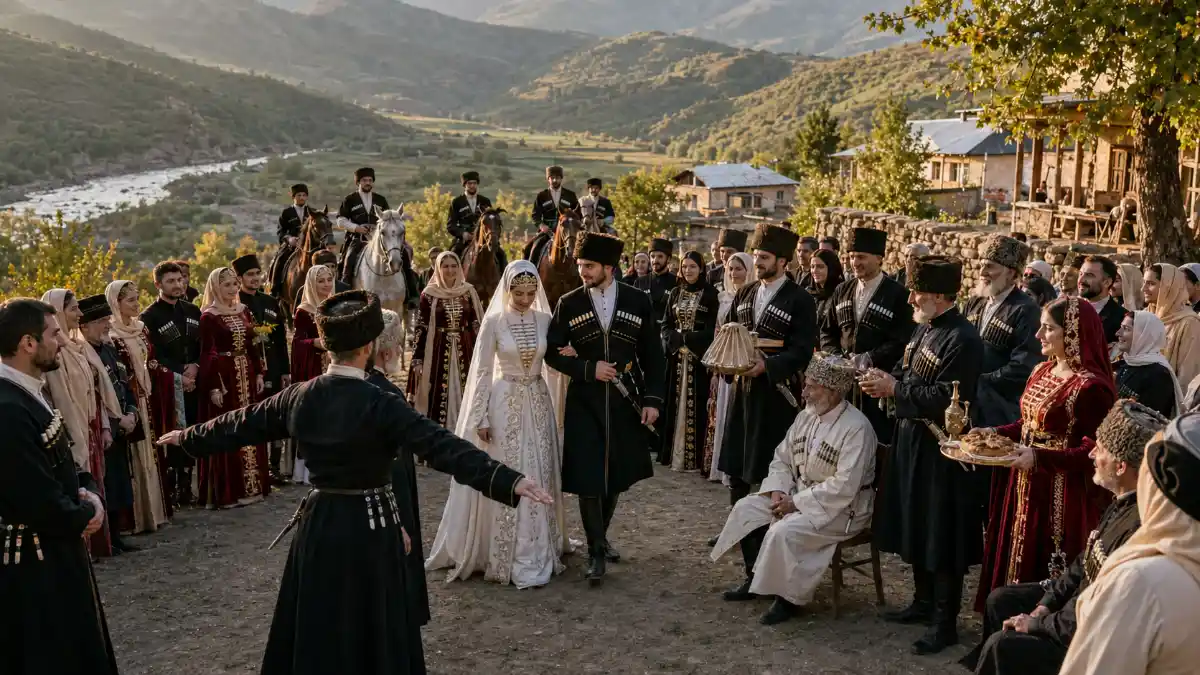
Wedding customs. Long betrothal periods, structured gift exchanges, named dance forms, and formal poetry by family elders all appeared in Mamkhegh weddings as in other Adyghe weddings.
What was different was the marriage rules. Without a Pshi-Worq class structure, the strict class-bound marriage rules that governed aristocratic Adyghe weddings did not apply to the Mamkhegh. Marriage was simpler. There were rules about consanguinity (you could not marry within seven generations of your own line), rules about the betrothal process, rules about the household into which a bride entered, but there was no set of additional rules forbidding marriage between rank levels because there were no rank levels above the freemen class.
One subtle consequence: Mamkhegh genealogies, when reconstructed today, tend to show more endogamy within the Mamkhegh community itself than the genealogies of aristocratic tribes show. The aristocratic tribes intermarried across tribal lines through their princely networks. The Mamkhegh, lacking that network, married mostly within their own freemen class, which was largely co-extensive with the tribe.
The Russo-Circassian War
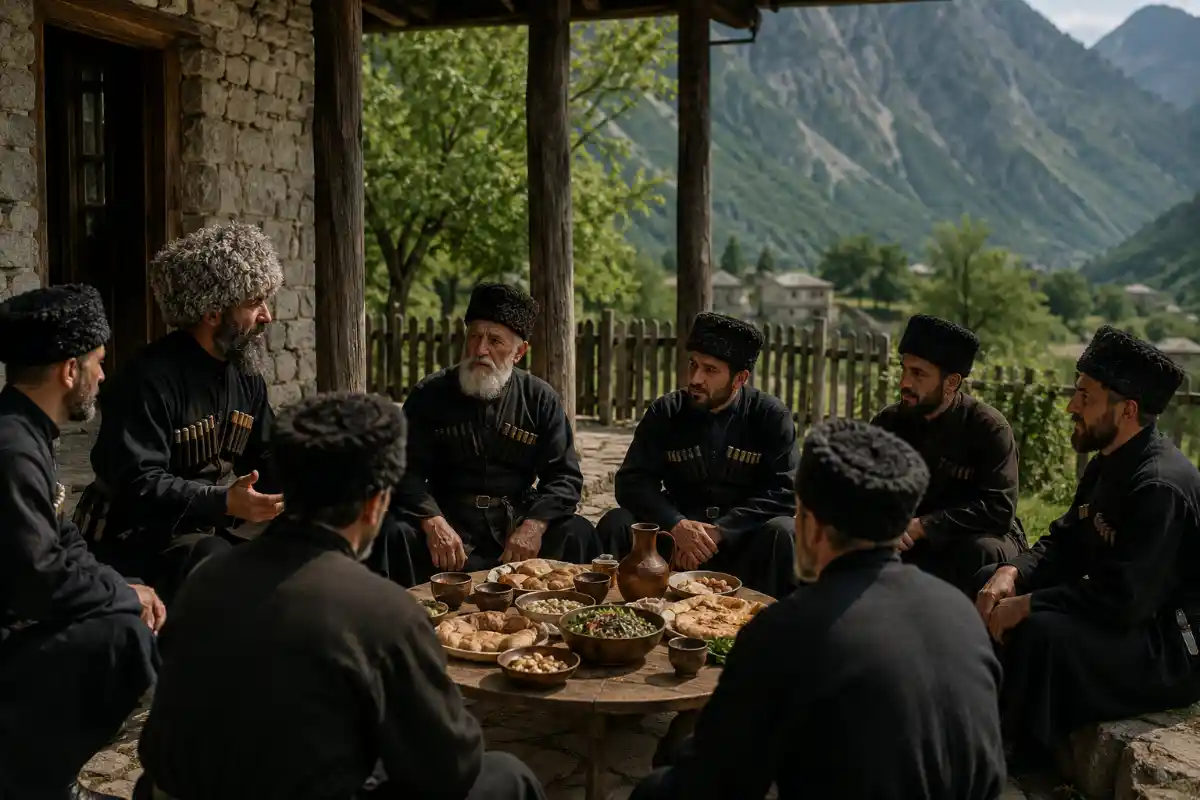
The Mamkhegh participated in the broader Adyghe resistance, organised through their council militia. Their small size meant they fought as part of larger alliances rather than as an independent military power.
The Mamkhegh participated in the Russo-Circassian War (1763-1864) as part of the broader Adyghe resistance to Russian conquest. Their position in the war was shaped by two facts: their small population, which limited their independent military weight, and their political structure, which meant they fought through council-organised militia rather than through princely cavalry.
Alliance-based warfare
For most of the war, the Mamkhegh fought in alliance with their larger neighbours. They contributed warriors to combined operations led by Bzhedug, Temirgoy, or Abzakh formations. The Mamkhegh had no internal capacity to organise major independent military operations. What they could do, and did, was provide additional manpower, local intelligence about Belaya River terrain, and rear-area support to the larger Adyghe military efforts.
Russian military reports from the 1830s, 1840s, and 1850s mention Mamkhegh warriors in the context of broader Adyghe operations, but rarely as a separate force. The references are usually to "Mamkhegh-Temirgoy" or "Mamkhegh-Bzhedug" combined contingents. This is consistent with the tribe's structural position: small enough to fight alongside larger neighbours, distinctive enough to be named separately in some accounts.
Council deliberations under pressure
The Mamkhegh political system, with its reliance on council deliberation, was put under particular stress during the war. Decisions about whether to fight, whether to negotiate, whether to accept Russian terms, and whether to relocate had to be made by elder councils rather than by a single Pshi who could decide unilaterally. The historical record suggests these decisions were sometimes slow and sometimes contentious. There is evidence that different Mamkhegh villages took different positions at different points in the war, with some accepting Russian terms relatively early while others continued resistance.
This kind of decentralised response was characteristic of the democratic Adyghe tribes generally and applied to the Mamkhegh in a particularly compressed form because of their small size. With only a handful of villages, even small differences in council decisions could split the tribe's response across multiple positions.
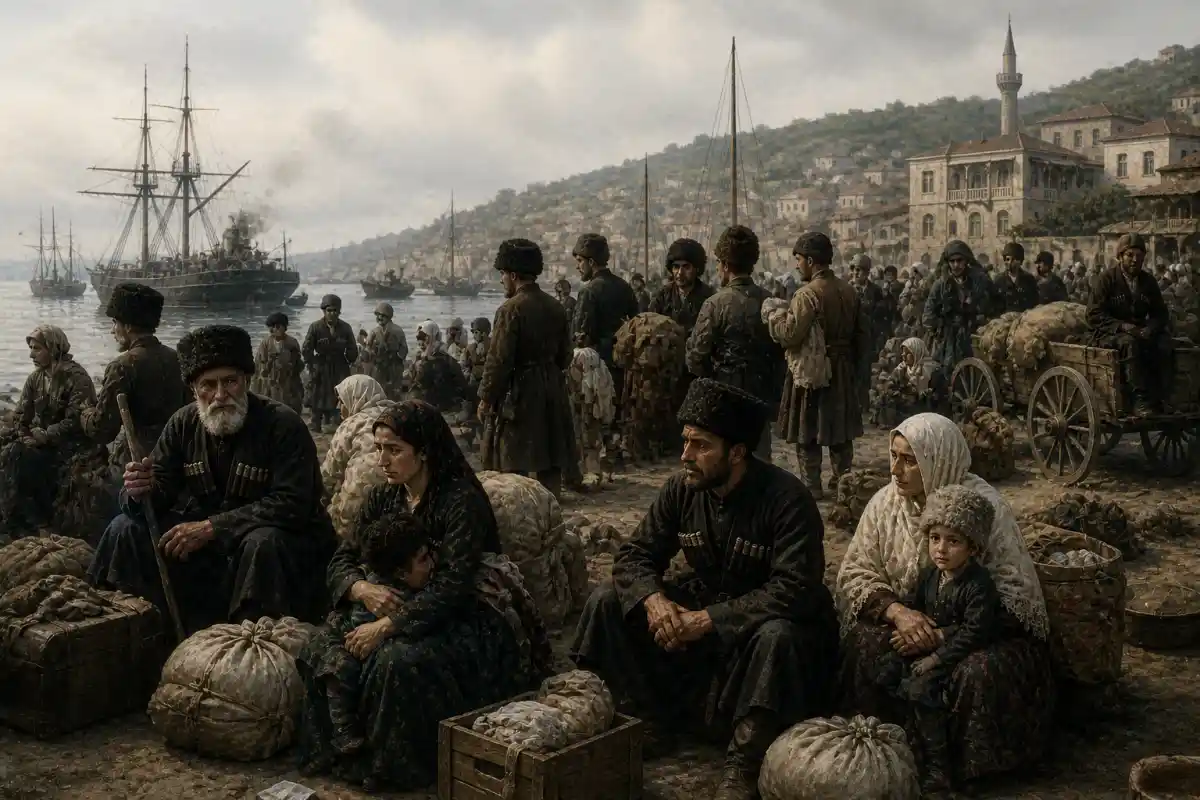
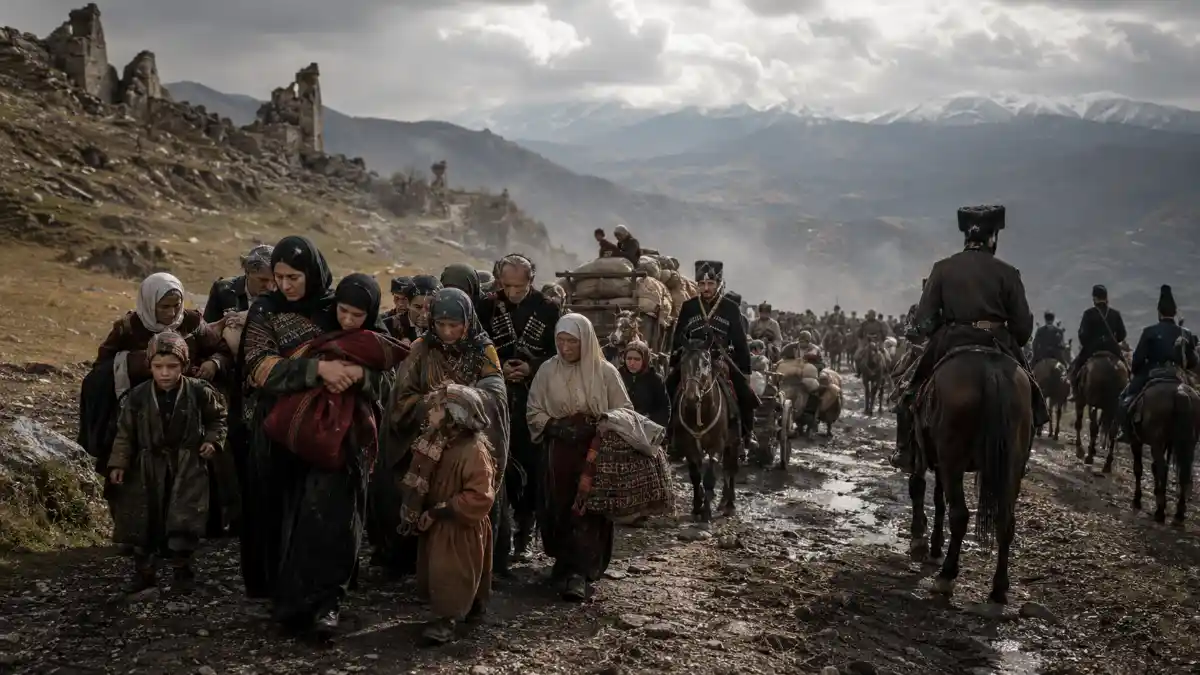
1864 · The expulsion For the Mamkhegh, the expulsion was almost a death sentence as a distinct people. The tribe was small to begin with. Most of the population went to Ottoman territory. Those who remained founded a single village. The 1884 census counted 1,258 Mamkheghs left in the Kuban region.
1864: A Small Tribe Nearly Lost
The 1864 expulsion was particularly devastating for the Mamkhegh because of their small population. Most of the tribe was deported to the Ottoman Empire. The survivors who took Russian citizenship founded a single village.
The end of the Russo-Circassian War in May 1864 brought mass deportation of the surviving Adyghe population to Ottoman territory. The catastrophe is well documented at the level of the broader Adyghe peoples. About 95-97% of the all-Adyghe population was killed or expelled. For small tribes like the Mamkhegh, the consequences were proportionally more devastating.
The Mamkhegh were a small tribe before the war. Russian and Adyghe sources put the pre-1864 Mamkhegh population somewhere in the range of 5,000 to 10,000 people, possibly fewer. After the deportations, the surviving Mamkhegh population in the Russian-controlled Caucasus was reduced to a fraction of that number. The 1884 Russian census, twenty years after the expulsion, counted only 1,258 Mamkheghs in the Kuban region. Most of the remainder had gone to the Ottoman Empire.
The choice between exile and citizenship
For the surviving Mamkhegh population, the choice in 1864 and the years immediately following was binary: either accept Russian citizenship and relocate to a designated lowland village under Russian administration, or join the broader emigration to the Ottoman Empire. Both options carried heavy costs.
Those who accepted Russian citizenship were resettled in a single new village in the Belaya basin lowlands. The village was given the name Mamheg (Мамхэг), preserving the tribal identity in the village name. It was placed under Russian administration, with Russian-appointed local authorities and Russian fiscal obligations. The traditional system of council government by elected elders was formally superseded by Russian administrative structures, though it continued informally for many decades.
Those who chose emigration travelled to Ottoman ports (Trabzon, Samsun, Sinop, Varna) and were resettled by Ottoman authorities in central and northern Anatolia. Mamkhegh families joined the broader muhajir flow and were typically settled in mixed Adyghe villages alongside Bzhedug, Temirgoy, Hatuqay, and other Western Adyghe families.
Why the tribe nearly disappeared
The combination of the deportation and the small starting population meant the Mamkhegh came close to disappearing as a distinct ethnic identity. Several factors compounded the loss:
The diaspora population, settled in mixed Adyghe villages, gradually merged into broader Western Adyghe identity. Many Mamkhegh-descended families in Turkey today identify primarily as "Adyghe" or "Circassian" without preserving the specific Mamkhegh sub-identity.
The Russian-resettled population in Mamheg village was small enough that internal marriage networks were limited. Some Mamkhegh families in the village married into neighbouring Temirgoy or Bzhedug villages, gradually diluting the distinct Mamkhegh identity.
Soviet ethnic categorisation in the 20th century did not always recognise the Mamkhegh as a separate group. Soviet census categories often grouped them under broader Adyghe or Western Adyghe headings, which reduced institutional support for the preservation of Mamkhegh-specific identity.
The fact that the tribe survived at all, that the Mamheg village still exists, that there are people today who identify specifically as Mamkhegh and who can point to a continuous line back to pre-1864 Mamkhegh families, is itself remarkable given how close the tribe came to disappearing.
If your family is Mamkhegh, both your homeland branch in Mamheg village and your diaspora branch likely still exist. We can help you find them.
Search the Mamkhegh registers →
The Mamheg Village
Mamheg (Мамхэг) is a village in the Shovgenovsky District of the Republic of Adygea. It was founded by the Mamkhegh survivors who took Russian citizenship after 1864 and remains the principal living anchor of the tribe today.
The village of Mamheg (Адыгэ: Мамхэг; Russian: Мамхэг) is the principal surviving anchor of the Mamkhegh tribe in the homeland. It was founded by the Mamkhegh survivors who chose Russian citizenship in the immediate aftermath of the 1864 expulsion. The village preserved the tribal name as the place name, and the population through the late 19th and 20th centuries consisted predominantly of Mamkhegh families.
Mamheg sits in the Shovgenovsky District (Шэуджэн район in Adyghe) of the modern Republic of Adygea. The district is one of the rural districts of Adygea, located in the foothill country between the Belaya River basin and the lower Kuban basin. The administrative center of the district is the village of Khakurinokhabl. Mamheg is one of the smaller villages in the district, with a current population of perhaps a few thousand people.
The 1884 numbers
The Russian census of 1884, twenty years after the expulsion, recorded the Mamkhegh population in the Kuban region as 1,258 people. Of those, 715 lived in Mamheg village itself. The remaining 543 lived in scattered locations across the broader Kuban region, mostly in mixed Adyghe villages and a few in Russian or Cossack-administered settlements where they had been allocated land.
The 1884 figure is the single most important statistic in Mamkhegh post-1864 demographic history. It tells you exactly how reduced the tribe was. A pre-war population in the thousands had been compressed to one village of 715 people plus scattered smaller groups. From that starting point, the Mamkhegh population in the homeland has slowly grown over the subsequent 140 years, but the tribe has never recovered its pre-war scale, and its weight relative to other Adyghe peoples has been small throughout the modern period.
Mamheg today
Mamheg today is a working Adyghe village. It has an Adyghe-language school, a council of elders that continues some aspects of the pre-Soviet political structure, a small mosque, and a population that includes people who can trace their ancestry directly to pre-1864 Mamkhegh families. The village preserves elements of Mamkhegh dialect, Mamkhegh wedding customs, and Mamkhegh oral history that have not survived in the diaspora.
For diaspora researchers, Mamheg is the single most important destination for any deep Mamkhegh ancestry investigation. The village administration, the local Adyghe cultural association, and individual elder families maintain records and oral history that connect surviving family lines to specific pre-1864 Mamkhegh households. Visitors are welcomed; the village has hosted return visits from diaspora Mamkhegh families from Turkey and Jordan.
1,258 Survivors: The 1884 Census
In 1884, the Russian imperial census recorded only 1,258 Mamkheghs remaining in the Kuban region. The figure tells you both how close the tribe came to disappearing and how much the survivors held on to.
The single most important documentary anchor for post-1864 Mamkhegh history is the Russian imperial census conducted in 1884. The census recorded ethnic and confessional categories systematically, including for the small Adyghe groups that had survived the deportations. For the Mamkhegh, the census reported:
Total Mamkhegh population in the Kuban region: 1,258 people.
Mamheg village population: 715 people.
Remaining 543 people: scattered across other settlements in the Kuban region, including mixed Adyghe villages and small minorities in larger Russian-administered villages.
What makes this census significant is not just the absolute numbers but what they imply about the post-deportation trajectory of the tribe. A pre-war population in the thousands had been reduced, by 1884, to under 1,300 people. The deportation, the journey to Ottoman territory, the diseases of the journey, the mortality of the early Anatolian settlement, and the casualties of the war itself had together cut the homeland population to a fraction of its pre-war size.
From the 1884 baseline, the homeland Mamkhegh population grew slowly through the late 19th and 20th centuries. By the early Soviet period, the population in Mamheg village had probably reached 1,500-2,000 people. Through the Soviet decades, the village grew further, though Soviet census categories often did not distinguish Mamkhegh from broader Adyghe identity.
What the census tells us about families
The 1884 census also recorded family structure data for many of the families it counted. For the Mamkhegh, this means that anyone today with documented descent from a pre-1864 Mamkhegh family has a reasonable chance of finding that family enumerated in the 1884 census, with names of household members, ages, occupations, and residence within Mamheg village or in another specified settlement.
For diaspora Mamkhegh families, this is particularly useful. A family that emigrated to Ottoman territory after 1864 will not appear in the 1884 Russian census, but the family of a sibling, a cousin, or a parent who stayed and founded a household in Mamheg will. Cross-referencing diaspora oral history with the 1884 enumeration of Mamheg families can sometimes recover the connection between the two branches.
The Mamkhegh Diaspora Today
Most Mamkhegh families in the diaspora live in Turkey, often integrated into broader Adyghe communities. Smaller groups live in Jordan, Syria, and the modern Western diaspora.
Turkey: the largest diaspora
Most Mamkhegh families who emigrated after 1864 went to the Ottoman Empire, and their descendants are now concentrated in Turkey. The diaspora is small in absolute numbers and is typically integrated into broader Western Adyghe villages and communities, rather than living in distinct Mamkhegh settlements.
Specific concentrations of Mamkhegh-descended families in Turkey include:
Mixed Adyghe villages in Kayseri, particularly in the Uzunyayla plateau, where Mamkhegh families share villages with Bzhedug, Temirgoy, and Hatuqay neighbours.
Settlements in Tokat, Sivas, and Çorum, where Mamkhegh families were allocated land alongside other Adyghe groups in the 1860s-1880s.
Coastal Black Sea provinces (Düzce, Sakarya, Samsun), where smaller numbers of Mamkhegh families settled, often again in mixed Adyghe villages.
Urban Adyghe communities in Istanbul, Ankara, and Izmir, drawn from rural diaspora villages through 20th-century internal migration.
Many Turkish Mamkhegh families have lost specific Mamkhegh sub-identity over generations and identify primarily as Adyghe or Çerkes. Recovering specifically Mamkhegh ancestry in Turkey today often requires elder interviews and pre-1934 (pre-Surname Law) family records.
Jordan
A small Mamkhegh community settled in Jordan among the broader Jordanian Circassian population that founded Amman in the 1870s. Mamkhegh families in Jordan are integrated into the wider Circassian community and are often documented in the registers maintained by Jordanian Circassian cultural associations.
Syria
A small Mamkhegh presence existed in Syria, particularly in Damascus and the Golan Heights (until 1967). The post-2011 conflict has displaced these communities, with families relocating to Turkey, Germany, and other destinations.
The modern Western diaspora
Twentieth- and twenty-first-century second-stage migration has produced very small Mamkhegh-descended populations in Germany, the Netherlands, the United States, and other Western countries. These communities are typically integrated into broader Circassian-diaspora organisations rather than maintaining distinct Mamkhegh sub-identity.
Culture, Music & Beekeeping
Mamkhegh culture shares core features with the broader Western Adyghe tradition. Distinctive Mamkhegh elements include particular forms of folk music, oral traditions tied to council government, and a strong tradition of forest-floor beekeeping.
The Mamkhegh shared most of their material and ceremonial culture with the broader Western Adyghe tradition. Their dress (the chokha coat, the papakha hat, women's tall headdresses), their cuisine (Adyghe cheese, halizh pies, shchips sauce, matse soup), their music (shichepshin fiddle, pkhachich percussion, kamyl flute), and their dance forms (Wig, Kafa, Lezginka variants) all overlapped substantially with the Bzhedug and Temirgoy traditions.
Distinctive Mamkhegh elements
Within that shared framework, several elements were particularly developed in Mamkhegh culture:
Folk music tied to council deliberation. The Mamkhegh council tradition produced specific musical and oral forms used at public assemblies. Songs that recorded the deliberations of past councils, oral genealogies of elder families, and ceremonial music for the elder-election process all had specific Mamkhegh forms. Most of this material has been only partially documented and survives mainly in elder memory in Mamheg village.
Beekeeping (бжьам бжьэхуш). The Mamkhegh were known among Adyghe peoples for their well-developed beekeeping tradition. The forested foothill country between the Belaya and the Kurdzhips provided excellent conditions for forest-floor hives, and Mamkhegh honey, beeswax, and mead were minor but valued export products. Specific Mamkhegh techniques for hive construction, smoke management, and honey extraction have been partially documented in Adygea ethnographic literature.
Agricultural specialisation. Mamkhegh families developed particular varieties of wheat, millet, and beans suited to the Belaya basin's micro-climate. Some of these varietal lines may have been preserved through the Soviet period in Mamheg village agricultural practice, though documentation is sparse.
Council-form oral history. Where aristocratic Adyghe tribes preserved their history through princely genealogies and dynastic narrative, the Mamkhegh preserved theirs through council-form oral history: lists of elders, decisions taken at named councils, disputes resolved by named arbitrators. This is a different shape of historical memory and one that is harder to reconstruct from the surviving sources, since written records of council deliberations are rare.
Wedding traditions
Mamkhegh weddings followed the broader Adyghe pattern: a long betrothal, a sequence of formal gift exchanges, named dance forms at each stage, and the recitation of family poetry by elders. The class-bound marriage rules that applied in aristocratic tribes did not apply in Mamkhegh society. Mamkhegh weddings were egalitarian within the freemen class, with rules about consanguinity and clan endogamy but no Pshi-Worq-Tfokotl rank hierarchy.
Cuisine
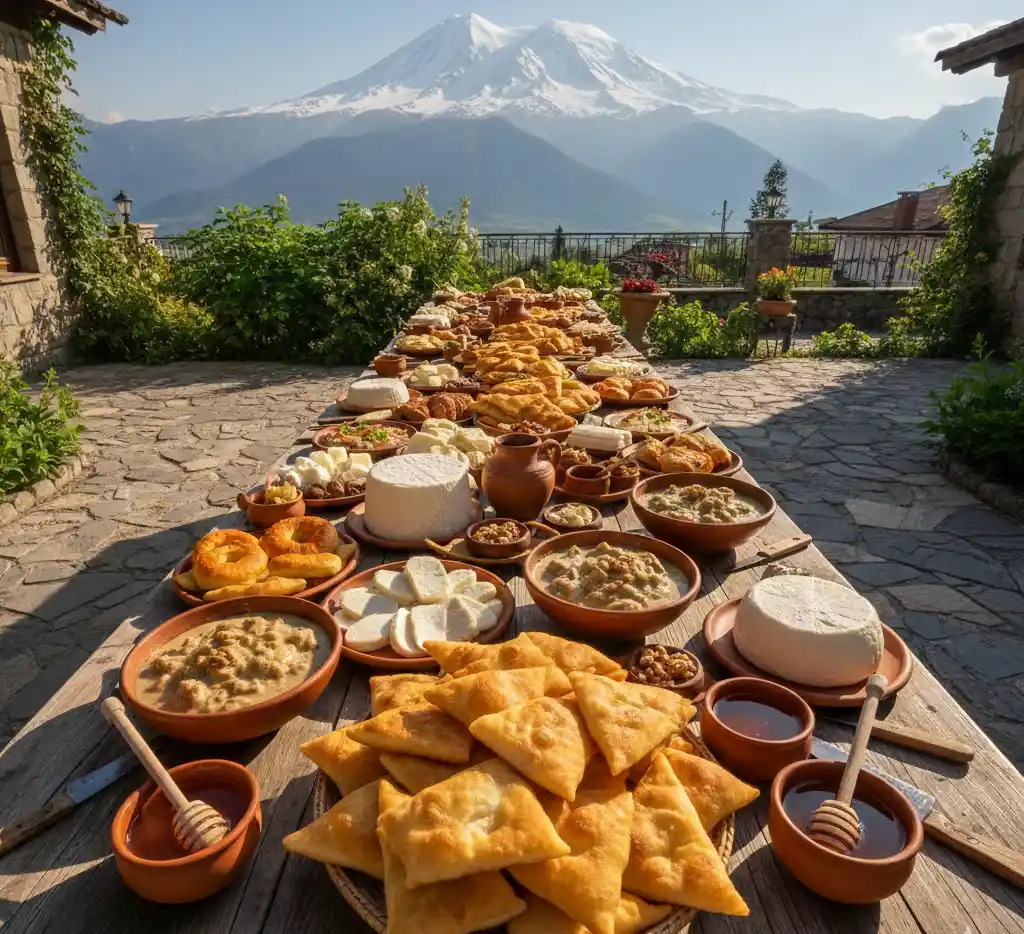
Mamkhegh cuisine reflected the agricultural and beekeeping economy. Honey-sweetened breads and pastries had a particular place in Mamkhegh festive cooking. Standard Adyghe dishes (Adyghe cheese, halizh, shchips, matse) were prepared in regional variations. The Mamkhegh table at a council assembly or a wedding would have looked broadly similar to a Bzhedug or Temirgoy table, with specific local emphasis on honey-based and grain-based dishes.
Mamkhegh Surnames & Clans
Mamkhegh surnames are less well-documented than those of the aristocratic Adyghe tribes, partly because there were no princely or noble lineages to anchor the documentation. Family research depends on the Mamheg village registers and on Ottoman archives.
Tracing a Mamkhegh family today is harder than tracing a Kabardian, Bzhedug, or Besleney family because the documentary record is thinner. The aristocratic tribes had princely and noble lineages that were extensively documented in Russian, Ottoman, and Adyghe sources. The Mamkhegh did not. Their family names are preserved primarily in three places:
The 1884 Russian census, which enumerated Mamheg village families with names and household composition.
The Mamheg village registers maintained continuously through the late imperial, Soviet, and post-Soviet periods.
The Ottoman Nüfus Defterleri, which recorded arriving Mamkhegh families in the 1860s-1880s, often with their original village name and tribal affiliation.
Common Mamkhegh surnames
Documented Mamkhegh surnames include patronymic and topographic forms common in the Western Adyghe tradition. Surnames known to be associated with Mamkhegh families include:
Original (Adyghe)Russian/CyrillicCommon Turkish formsNotesМамхыгъМамхеговыMamheg, MamhigThe tribal name itself, sometimes used as a surnameХьэткъоХатковыHatko, HatkovCross-tribal Adyghe name; some Mamkhegh branchesШэуджэнШовгеновыShovgenovFound in both Bzhedug and Mamkhegh recordsХьэгурэХагуровыHagur, HagurovCross-tribal; some Mamkhegh familiesТэужТеучежевыTeuchezhLocal Mamheg-area family name; also district nameХьэжмэтХажметовыHadjmet, HajmetDocumented Mamkhegh-area surname
Many Mamkhegh families share surnames with neighbouring Bzhedug, Temirgoy, or Hatuqay families, reflecting the shared Western Adyghe naming tradition and the fluid boundaries between small Adyghe tribes through the early modern period. A surname alone is rarely sufficient to identify a family as specifically Mamkhegh. Confirmation usually requires additional evidence: a remembered village of origin (Mamheg or its surroundings), a remembered tribal affiliation, or documented continuous descent through the 1884 Mamheg village register.
The Surname Law and Turkish Mamkhegh families
For Turkish Mamkhegh families, the 1934 Surname Law often replaced the original Adyghe surname with a Turkish form. Common replacement patterns include nature-derived names, place-name-based surnames, and generic "Caucasian" or "Adyghe" identifiers. Recovering the original Mamkhegh surname for a Turkish family today usually requires elder interviews and pre-1934 family records (Ottoman birth certificates, marriage contracts, school enrolment records).
The CircassianWeb surname database performs cross-script lookups for Adyghe surnames including those associated with Mamkhegh families.
The Mamkhegh Tamga
Mamkhegh tamga symbols are among the rarer specimens in the Adyghe heraldic tradition, partly because the tribe had no princely or noble class with the most heavily-documented tamgas. Surviving examples are preserved in the Adygea State Museum.
Like other Adyghe peoples, the Mamkhegh used tamga symbols to brand livestock, mark property, and identify lineage. Mamkhegh tamgas, however, are less well-documented than the tamgas of aristocratic Adyghe tribes. Several reasons explain the gap:
The Mamkhegh had no princely or noble class. The most extensively documented Adyghe tamgas are those of Pshi and Worq lineages, recorded in Russian imperial archives and ethnographic publications. The Mamkhegh, lacking these classes, had only commoner tamgas, which were less systematically documented.
The small population meant fewer tamgas overall. A tribe of perhaps 5,000-10,000 people produced fewer distinct family tamgas than a tribe of 100,000.
The 1864 expulsion took most of the Mamkhegh population, and with them, much of the local knowledge of tamga designs. Tamgas survive when families remember them and pass them down. With most Mamkhegh families displaced into mixed Adyghe diaspora villages, the specific Mamkhegh tamga tradition was partially lost.
What survives
Surviving Mamkhegh tamga records are preserved primarily in the Adygea State Museum in Maykop, in the Adyghe Republican Institute for Humanities Research, and in the village archives of Mamheg itself. Several documented Mamkhegh tamgas show characteristic Western Adyghe features (paired hooks, half-circles, simple geometric forms suitable for branding), with specific local variations.
Recovering the tamga of a specific Mamkhegh family today requires either family memory of the household mark or research in the surviving Mamheg village records. The CircassianWeb tamga finder can match family-remembered symbols against the documented Adyghe catalog including the Mamkhegh examples.
Practical tip Tamgas survived through being seen, not written. Ask the eldest members of your family whether they remember a household mark on a saddle blanket, a doorpost, or a piece of woodwork. Even a partial drawing can match against the documented catalog. For Mamkhegh families in particular, the smaller surviving tamga corpus means that a remembered symbol has a higher chance of identifying a specific family line than for the larger tribes.
Tracing Your Mamkhegh Ancestry
A five-step framework. Mamkhegh-specific notes: the homeland anchor is Mamheg village; the documentary baseline is the 1884 Russian census; and DNA matching is particularly useful given the small reference population.
Step 1. Elder interviews
Start with the oldest members of the family. Mamkhegh-specific questions:
Was the family ever called Mamkhegh, Mamheg, or Mamhig?
Was the village of origin Mamheg, or somewhere in the Belaya basin near Maykop?
Were there elder-council traditions remembered in the family, rather than princely (Pshi) memories?
If the family emigrated to Anatolia, what was the year? The 1860s? Early 1870s?
Step 2. Surname research
Run the surname through Adyghe (Cyrillic), Russian-Soviet, Turkish, Arabic, and Hebrew variants. For Mamkhegh families, the original Adyghe form is often preserved in the Mamheg village registers and may differ substantially from the diaspora legal surname.
Step 3. The 1884 Russian census & Mamheg village registers
For families with documented descent from pre-1864 Mamkhegh, the 1884 Russian imperial census is the single most important documentary anchor. Cross-reference the 1884 Mamheg village enumeration with family oral history. The Adygea republican archive in Maykop holds the relevant records, and the Mamheg village administration maintains continuous registers from the late 19th century forward.
Step 4. Ottoman archives
For families that emigrated to Ottoman territory after 1864, the Ottoman Nüfus Defterleri at the Başbakanlık Osmanlı Arşivi in Istanbul are the primary record. Mamkhegh families typically appear in registers from the 1860s-1880s with notations about their original village in the Caucasus.
Step 5. DNA testing
Y-DNA haplogroups G2a (especially G-M406), J2, and R1b are common in Western Adyghe populations including the Mamkhegh. CircassianWeb's DNA matching compares your raw data against the 109-record peer-reviewed Circassian reference panel. The FamilyTreeDNA Circassian DNA Project, with 2,800+ members, is searchable for direct matches. For Mamkhegh families specifically, the small reference population means that a documented match against another known Mamkhegh family is a particularly strong piece of evidence.
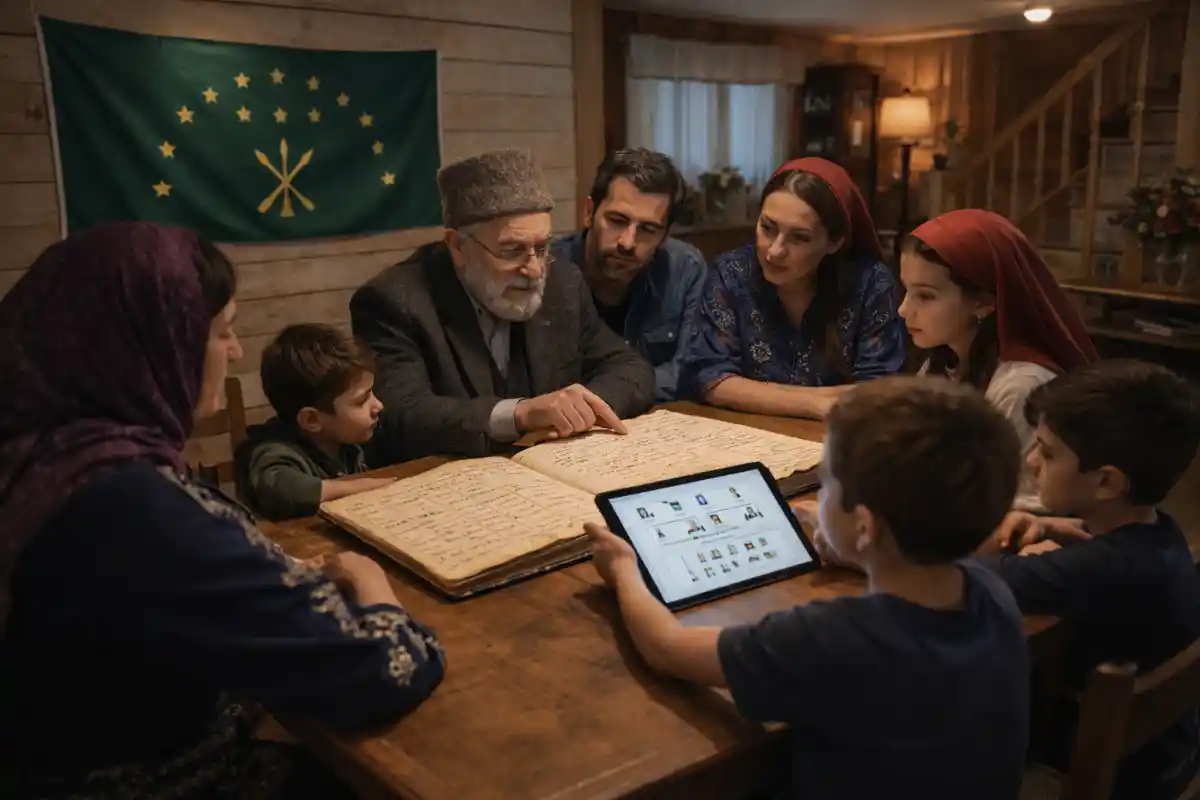
Today · Recovering a small lineage
For Mamkhegh families, a documented connection to Mamheg village is the closest thing to a direct line back to the pre-1864 tribe. The line is small. It is not gone.
Mamkhegh Genetic Markers
Western Adyghe haplogroup patterns apply: G2a, J2, R1b on the paternal side; H, U, T mtDNA on the maternal side. The small reference population means individual matches in the FamilyTreeDNA Circassian Project are particularly informative.
Population genetic studies of Circassians (Balanovsky et al., 2011; Yunusbayev et al., 2012; subsequent FTDNA Circassian DNA Project work) document distinctive haplogroup frequencies across the Adyghe peoples. The Mamkhegh, as part of the Western Adyghe cluster, share the broader Western Adyghe profile.
HaplogroupTypeNotes for MamkheghG2a (G-M406)Y-DNA paternalCommon across all Adyghe; principal lineage marker, traceable to pre-Bronze Age Caucasus populationsJ2 (J-M172)Y-DNA paternalStrong in Western Adyghe samples; meaningful proportion expected in MamkheghR1bY-DNA paternalPresent in Western Adyghe samples; shared with Bzhedug, TemirgoyR1aY-DNA paternalLess common in Western Adyghe than in Eastern (Kabardian/Besleney)H, U, TmtDNA maternalMaternal lineages broadly shared across the Northwest Caucasus
Important caveat The small surviving Mamkhegh population means the published genetic literature has limited Mamkhegh-specific reference samples. Most genetic studies of Western Adyghe peoples include Mamkhegh data only in mixed samples, and tribal-specific haplogroup frequencies for Mamkhegh are estimated rather than directly measured at high precision. For practical purposes, Mamkhegh ancestry can be confirmed through DNA only as part of a Western Adyghe pattern, not as a distinct Mamkhegh-specific signal.
What DNA can do well for Mamkhegh families is identify direct relatives. A documented match between two Mamkhegh-descended individuals (one in the homeland, one in the diaspora; or two diaspora individuals from different countries) is informative because the population is small and shared ancestry is more likely to indicate a recent common ancestor than in a larger tribe.
The FamilyTreeDNA Circassian DNA Project, with 2,800+ members as of 2026, includes confirmed Mamkhegh-descended lineages and is searchable for direct matches.
Notable Figures & Stories
The Mamkhegh produced fewer named historical figures than the larger aristocratic Adyghe tribes. The history that survives is mostly the collective history of councils, villages, and the small founding population of Mamheg.
The Mamkhegh did not produce princes whose biographies dominate the historical record in the way that the Idarov, Atazhukin, or Qanoqo figures do for the Kabardians and Besleneys. The tribe's political structure, with its reliance on collective decision-making by elder councils, meant that authority did not concentrate in named individuals over generations. Historical memory in the Mamkhegh tradition is collective rather than dynastic.
That said, several figures and family lines are preserved in the historical record:
Council elders of the 18th and 19th centuries. Russian and Ottoman diplomatic correspondence occasionally names individual Mamkhegh elders who participated in negotiations or alliances. These figures are preserved in the records of the events they took part in rather than in independent biographical narratives.
The founding population of Mamheg village (1860s). The 1884 Russian census enumerates the original families of Mamheg village. These are the people who chose to stay in the homeland after 1864 and built the village from which the surviving Mamkhegh tribe traces forward. Several surnames preserved in modern Mamheg families trace to the 1864-1880 founding generation.
Soviet-era Adyghe figures of Mamkhegh descent. A number of 20th-century academics, writers, and cultural figures in Adygea trace family origins to Mamheg village. Their work is documented in the Adyghe academic and cultural record, often without explicit identification of their Mamkhegh sub-tribal origin.
Diaspora Mamkhegh families in Turkey and Jordan. Specific family lines that preserved Mamkhegh identity into the diaspora are documented in the registers of Circassian cultural associations in Turkey and Jordan. Most have not produced internationally famous individuals but constitute the continuing thread of Mamkhegh identity in the diaspora.
Story: The founding of Mamheg village
In the months and years immediately following May 1864, the Mamkhegh families who chose Russian citizenship rather than emigration to Ottoman territory faced a forced relocation. Russian authorities had emptied much of the Mamkhegh territory and required surviving families to settle in designated lowland sites under direct Russian administration. The Mamkhegh elders who negotiated for their community insisted on a single condition that has shaped the tribe's history ever since: the new village would carry the tribal name. Whatever else was lost in the deportation, the name would survive on the ground. Russian authorities agreed. The new village was called Mamheg. The 715 Mamkhegh souls counted there in the 1884 census were the first generation of a community that has now lasted more than 160 years. Every Mamkhegh-descended person in the homeland today traces, directly or indirectly, to that first generation.
Story: A Mamkhegh wedding in Anatolia, 1890
Among the Mamkhegh families who emigrated to Ottoman territory after 1864, settling in mixed Adyghe villages, a particular wedding took place in central Anatolia around 1890. The bride was from a Mamkhegh family settled in a Bzhedug-majority village. The groom was from a Mamkhegh family in a Temirgoy-majority village two days' ride away. Both families had retained Mamkhegh oral traditions and identified specifically as Mamkhegh among the broader Adyghe diaspora. The wedding brought together the families in a form that preserved Mamkhegh-specific customs (specific named dances, specific elder-recited poetry, specific cuisine emphasising honey-sweetened dishes) inside the broader Anatolian Adyghe context. Stories of this wedding, recorded in family memory and partially documented by 20th-century Adyghe ethnographers, are an example of how Mamkhegh diaspora identity persisted in the small spaces between larger Adyghe communities. Most Mamkhegh families in Turkey today no longer carry this kind of distinct identity. A few do.
Modern Cultural Revival
Modern Mamkhegh cultural revival is small in scale but real. It is anchored in Mamheg village, in the Adygea republican institutions, and in the small but active diaspora communities that still preserve specific Mamkhegh identity.
Mamkhegh cultural revival operates on a smaller scale than the revivals of larger Adyghe tribes. There is no Mamkhegh State University, no Mamkhegh Folk Dance Ensemble, no separate Mamkhegh-language media. The institutional infrastructure that supports the larger tribes (Kabardin-Balkar State University, Adyghe State University, the Adygea republican press) supports Mamkhegh culture inside its broader Adyghe framework, with Mamkhegh-specific elements as a sub-component.
What does exist for Mamkhegh-specific revival:
Mamheg village cultural programmes. The village administration, the local Adyghe cultural association, and the village school maintain Mamkhegh-specific cultural memory: dialect features, oral history, council traditions, wedding customs, and family genealogies. Some of this material is published locally; some remains in elder memory.
Adygea republican research. The Adyghe Republican Institute for Humanities Research in Maykop conducts ongoing ethnographic and historical research on the smaller Adyghe tribes including the Mamkhegh. Publications from the institute include Mamkhegh-specific material.
Diaspora cultural associations. Some Circassian cultural associations in Turkey and Jordan maintain registers of Mamkhegh-descended families and organise occasional Mamkhegh-specific gatherings. These are small in scale but real.
Repatriation. A very small number of diaspora Mamkhegh-descended families have repatriated to Adygea since the 1990s, sometimes settling in Mamheg village or in nearby villages. The numbers are tiny but symbolically significant.
Digital networks. Social media and family-tree platforms have allowed Mamkhegh-descended individuals worldwide to find each other across borders. For a small tribe with a scattered diaspora, this kind of digital reconnection is particularly valuable.
The continuing existence of Mamheg village, the survival of distinct Mamkhegh identity within the broader Adygea framework, and the small but real diaspora connection together mean that the Mamkhegh tribe, though much smaller than its pre-1864 size, has not disappeared. The line that runs from the pre-deportation tribe through the 1864 founders of Mamheg village to the present-day Mamkhegh-descended families worldwide is unbroken, even if it is thin.
Frequently Asked Questions
The questions readers most often ask about Mamkhegh heritage, identity, and ancestry research.
Are the Mamkhegh a separate Circassian tribe?
Yes. The Mamkhegh are one of the twelve historic Adyghe tribes, recognised on the Circassian flag as one of the twelve gold stars. They are part of the Western Adyghe cluster, related to the Temirgoy, Bzhedug, Hatuqay, and Yegerukwai. They are smaller in population than most of the major Adyghe tribes but maintain a distinct identity, with their own dialect, their own homeland village (Mamheg), and a continuing diaspora.
Why are the Mamkhegh called a "democratic" tribe?
Because they did not have a hereditary princely (Pshi) class, unlike most other Adyghe tribes. Rural administration was in the hands of elected elders from the freemen class. This made them politically distinct from the Kabardians, Besleneys, Bzhedug, and Hatuqay, all of whom were governed by aristocratic Pshi houses. The label "democratic" comes from the historical literature contrasting tribes with elder-council government against tribes with princely government.
Where is the Mamkhegh homeland?
The historic Mamkhegh homeland was located between the Belaya River and the Kurdzhips River, in what is today the central region of the Republic of Adygea, near the city of Maykop. The territory extended into parts of Krasnodar Krai. The principal living anchor today is the village of Mamheg in the Shovgenovsky District of Adygea.
What is Mamheg village?
Mamheg (Адыгэ: Мамхэг) is a village in the Shovgenovsky District of the Republic of Adygea. It was founded by the Mamkhegh survivors who chose Russian citizenship after the 1864 expulsion. The village preserves the tribal name and remains the principal homeland anchor of the tribe today. The 1884 Russian census recorded 715 Mamkheghs living in the village, out of 1,258 total Mamkheghs in the Kuban region. The village is still a working Adyghe village with school, council, and active community.
What was the population of the Mamkhegh after 1864?
The 1884 Russian imperial census, twenty years after the expulsion, recorded 1,258 Mamkheghs in the Kuban region, with 715 of them in Mamheg village. The pre-1864 population had been substantially larger (estimated 5,000-10,000 or more). The deportation, the journey to Ottoman territory, and the casualties of the war reduced the homeland population to under 1,300 people. The diaspora population, settled in Ottoman territory, was larger but is harder to estimate because many families merged into broader Adyghe identity.
What dialect did the Mamkhegh speak?
The Mamkhegh spoke a Western Adyghe dialect closest to Temirgoy. Linguists usually classify Mamkhegh as a sub-variant of the Lowland Adyghe cluster, which also includes Temirgoy and Bzhedug. The dialect contained vocabulary specific to the Belaya basin and to the agricultural-beekeeping economy of the tribe. Today distinctive Mamkhegh dialect features survive primarily in Mamheg village and in scattered diaspora villages where Mamkhegh families settled together.
Where do most Mamkhegh-descended families live today?
Most Mamkhegh-descended families live in Turkey, where their ancestors went after the 1864 expulsion. They are typically integrated into broader Adyghe villages and communities (in Kayseri, Tokat, Sivas, Düzce, Sakarya, and other provinces) rather than living in distinct Mamkhegh settlements. A small homeland community remains in Mamheg village in the Republic of Adygea. Smaller diaspora groups live in Jordan, Syria, Israel, Germany, the Netherlands, and the United States.
What surnames indicate Mamkhegh heritage?
Documented Mamkhegh surnames include the tribal name itself (Мамхыгъ / Mamheg / Mamhig) and family names common to the Mamheg village community: Hatkov, Shovgenov, Hagur, Teuchezh, Hadjmet, and others. Many Mamkhegh surnames are also found in neighbouring Bzhedug, Temirgoy, and Hatuqay communities, which means a surname alone is rarely sufficient. Confirmation usually requires a remembered village of origin, documented descent, or DNA matching.
Can DNA testing confirm Mamkhegh ancestry?
Partially. The Mamkhegh share the broader Western Adyghe Y-DNA profile (G2a, J2, R1b on the paternal side), so a Mamkhegh-specific signal cannot be cleanly separated from neighbouring Bzhedug or Temirgoy patterns. What DNA can do well is identify direct relatives. Because the Mamkhegh are small, a documented match between two Mamkhegh-descended individuals is particularly informative. The FamilyTreeDNA Circassian DNA Project, with 2,800+ members, includes confirmed Mamkhegh-descended lineages and is searchable.
How can I trace my Mamkhegh ancestry?
Five steps: (1) Elder interviews about specifically Mamkhegh memories (council traditions, Mamheg village, the Belaya basin). (2) Surname research across Adyghe Cyrillic, Russian, Turkish, Arabic, and Hebrew variants. (3) The 1884 Russian census and the Mamheg village registers, the most important Mamkhegh-specific documentary anchor. (4) Ottoman Nüfus Defterleri for diaspora families. (5) DNA testing through the FamilyTreeDNA Circassian Project. The most distinctive Mamkhegh-specific evidence is a documented connection to Mamheg village.
How can I visit the Mamkhegh homeland?
The Republic of Adygea is accessible from Krasnodar International Airport (about 90 minutes' drive to Maykop, the capital) or from Maykop directly via flights from Moscow. Mamheg village in the Shovgenovsky District is within an easy day-trip from Maykop. The Adygea State Museum in Maykop, the village administration in Mamheg, and the Adyghe Republican Institute for Humanities Research can help connect diaspora visitors with local family lines and historical records.
How is Mamkhegh identity different from broader "Adyghe" or "Circassian" identity?
"Circassian" is the broadest term, covering all twelve Adyghe tribes. "Adyghe" is the self-designation that covers the same group. "Mamkhegh" is the specific tribal sub-identity. A person can identify simultaneously as Adyghe, as Circassian, and as Mamkhegh. The Mamkhegh-specific layer is meaningful because of the distinct political structure (no princes), the specific homeland (Mamheg village), and the small but documented continuous community since 1864.
What happened to the Mamkhegh political system after 1864?
The Russian state imposed standard imperial administrative structures on the surviving Mamkhegh community in Mamheg village. The traditional council of elected elders was formally superseded by Russian-appointed local authorities. Informally, however, the council tradition continued for many decades, and elements of it survive into the present day in the village. Soviet-era administrative reorganisation further changed the formal political structures, but local Adyghe self-government continued in modified form. Today Mamheg village is part of the Russian Federation administrative system, with elected village leadership operating under Russian law.
Is there a Mamkhegh language being preserved?
The Mamkhegh dialect is preserved primarily in Mamheg village and in some diaspora communities. Standard literary Adyghe (taught in Adygea schools) is based on the Lowland Bzhedug-Temirgoy cluster, which is close to Mamkhegh, so a Mamkhegh-descended learner studying standard Adyghe is in effect learning a form very close to ancestral Mamkhegh. Specific Mamkhegh dialect features are documented in academic publications from the Adyghe Republican Institute for Humanities Research and survive in elder speech in Mamheg.
Trace Your Mamkhegh Ancestry Today
The Mamkhegh tribe is small. The line back to Mamheg village is real. We can help you find it.
1 Build your tree Start with three names: yourself, a parent, a grandparent.
3 Find your tribe Match your surname against the Mamkhegh clan database.
5 Upload your DNA Compare against the Circassian reference panel.
Upload free → ✓ Free forever · ✓ Your data stays yours · ✓ No credit card
Sources & Further Reading
Wikipedia: Mamkhegh, Circassians, Republic of Adygea.
Wikipedia: Russo-Circassian War and Circassian Genocide.
Jaimoukha, A. (2001). The Circassians: A Handbook. Palgrave Macmillan.
Natho, K. (2009). Circassian History. Xlibris Corporation.
Richmond, W. (2013). The Circassian Genocide. Rutgers University Press.
Russian imperial census, 1884. Kuban regional records.
Adygea Republican Archive, Maykop. Mamheg village registers, late 19th-20th c.
Adyghe Republican Institute for Humanities Research, Maykop. Ethnographic publications on small Adyghe tribes.
Adygea State Museum, Maykop. Tamga catalog and ethnographic collections.
Balanovsky, O. et al. (2011). "Parallel Evolution of Genes and Languages in the Caucasus Region." Molecular Biology and Evolution, 28(10), 2905-2920.
Yunusbayev, B. et al. (2012). "The Caucasus as an asymmetric semipermeable barrier to ancient human migrations." Molecular Biology and Evolution, 29(1), 359-365.
Ottoman Nüfus Defterleri, Başbakanlık Osmanlı Arşivi (BOA), Istanbul.
FamilyTreeDNA Circassian DNA Project: familytreedna.com/groups/circassian.
CircassianWeb companion guides: Circassian Ancestry, The 12 Tribes, Besleney Tribe, Bzhedug Tribe, Kabardian Tribe, Tamga Finder, Adyghe Khabze, DNA Heritage Explorer.
Further Reading & References
- Wikipedia: Mamkhegh people
- Britannica: Circassian people
- Britannica: Caucasian War
- JSTOR: Academic articles on the Circassians