Circassians Today: The State of the Nation and What Comes Next
Most writing about Circassians looks backwards — to 1864, to the Black Sea ports, to the ships. That history matters, and we have covered it in depth. But a nation is not only what happened to it. It is also what it is doing right now, this year, with the people and institutions it currently has. This article is an attempt at an honest, current assessment: what is measurable, what is contested, and what the next ten years actually depend on.
1. Where the nation actually stands
Any serious discussion has to begin with a caveat: there is no reliable global census of Circassians. Estimates for the worldwide Adyghe population range from roughly 3 to 7 million, and the spread is not sloppiness — it reflects a real methodological problem. In Turkey, ethnicity is not recorded in the census. In Jordan and Syria, community estimates rest on association membership and family knowledge. In Russia, the census counts Adyghe, Kabardian, Cherkes and Shapsug as four separate nationalities, which fragments a single people into statistical categories that no Circassian family thinks in.
The consequences of that are not academic. A nation that cannot count itself cannot plan: it cannot size a language programme, forecast how many teachers it needs, or prove its scale to a government or a funder. The single most useful, least glamorous project in Circassian public life today would be a credible, ethically run global demographic survey. See our overview of the Circassian diaspora by country for the best current figures.
What is not contested: the clear majority of Circassians live outside the homeland, and Turkey holds the largest community by a wide margin. That single fact should shape every strategy that follows.
2. The homeland: three republics, one people, no shared administration
Circassians in the North Caucasus live under three separate republics of the Russian Federation — Adygea, Kabardino-Balkaria and Karachay-Cherkessia — plus the Shapsug communities of the Black Sea coast in Krasnodar Krai, which have no republic of their own at all.
This is the structural fact of contemporary Circassian life in the Caucasus. Three republics means three education ministries, three cultural budgets, three sets of local politics, three different balances with a titular neighbour (Balkars, Karachays, ethnic Russians). A curriculum decision in Nalchik does not travel to Maikop. A youth programme in Cherkessk has no automatic counterpart on the coast. Even where officials cooperate warmly, no institution has a mandate over the whole people.
In the 1990s, some activists proposed solving this by merging the republics into a single Circassia. That project failed politically and is not on any realistic agenda today. What replaced it is quieter and, arguably, more practical: coordination without unification — shared textbooks, joint festivals, common orthographic work, cross-republic youth exchange. The gap between what is possible and what is actually being done here remains the largest unexploited opportunity in the homeland.
3. The language question is now a demographic question
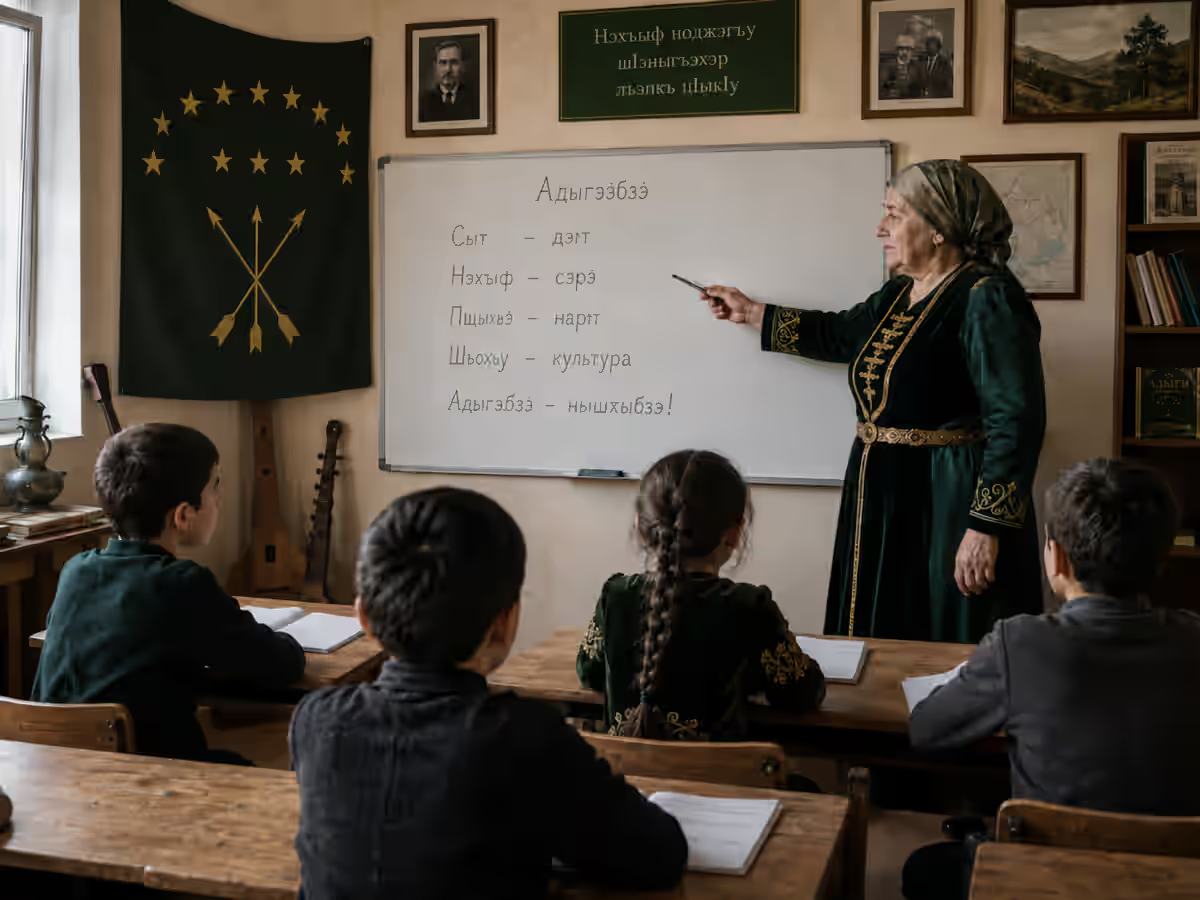
Adyghe and Kabardian are both classified by UNESCO as vulnerable, and the trend line in the diaspora is worse than in the homeland. The mechanism is well understood and depressingly consistent across countries: grandparents are fluent, parents understand but answer in the majority language, children are passive at best. Once transmission breaks in a single generation, it almost never repairs itself spontaneously.
Two things have changed recently, one bad and one good. The bad: in Russia, native-language instruction has been squeezed into elective status in practice, so Circassian language classes increasingly compete with exam-relevant subjects and lose. The good: for the first time, the diaspora has technical means that do not depend on any state — online tutoring across time zones, keyboard layouts, speech recordings, searchable dictionaries, children's content. Our Circassian language platform and the Adyghabze preservation guide exist for exactly this reason.
The realistic target for the next decade is not universal fluency. It is a critical mass of families raising children with the language as a first or strong second language, concentrated enough to sustain schools, media and marriage networks. That is a number in the tens of thousands, not millions — which makes it achievable, and makes failure a choice rather than a fate.
4. Repatriation: the distance between a symbol and a system
Return to the homeland — repatriation — has been the emotional centre of Circassian politics for thirty years. It is also where the gap between rhetoric and mechanism is widest.
The concrete picture as of 2025 is sobering. Kabardino-Balkaria's resettlement programme for Adyghe from abroad was designed for about 20 families over three years, and human rights defenders in the republic report that it is underused — not because the cap is binding, but because the conditions to make moving viable do not exist. The deeper obstacle is legal: Russian-speaking "compatriots" receive citizenship through a simplified route, while members of indigenous peoples abroad generally do not.
That asymmetry became a public fight in 2025. When a draft federal law "On Repatriation to the Russian Federation" appeared with a mandatory Russian-language requirement for applicants, more than eighty activists, cultural figures and human rights defenders from across the North Caucasus signed an appeal to the Russian president asking that it not be adopted in that form. Their argument was constitutional: Article 68 recognises the right of the republics to their own state languages, so requiring Russian — and only Russian — of returning descendants of indigenous peoples is discriminatory in effect.
Meanwhile, the honest reading of diaspora behaviour is that appetite for permanent return has fallen. Younger Turkish, Jordanian and Western Circassians increasingly frame their relationship to the homeland as one of visits, study, marriage, business and cultural investment rather than emigration. The lived experience of Syrian Circassians who did return after 2011 — documented in academic work on their reception in Adygea and Karachay-Cherkessia — was one of bureaucratic difficulty absorbed largely by local Adyghe families rather than by the state.
The strategic conclusion is uncomfortable but clarifying: a policy built entirely on mass return is not a plan. A policy built on mobility — easy multi-year visits, recognised heritage status, homeland universities recruiting diaspora students, dual-track careers — matches what people are actually willing to do.
5. Syria: the most important change of the last two years
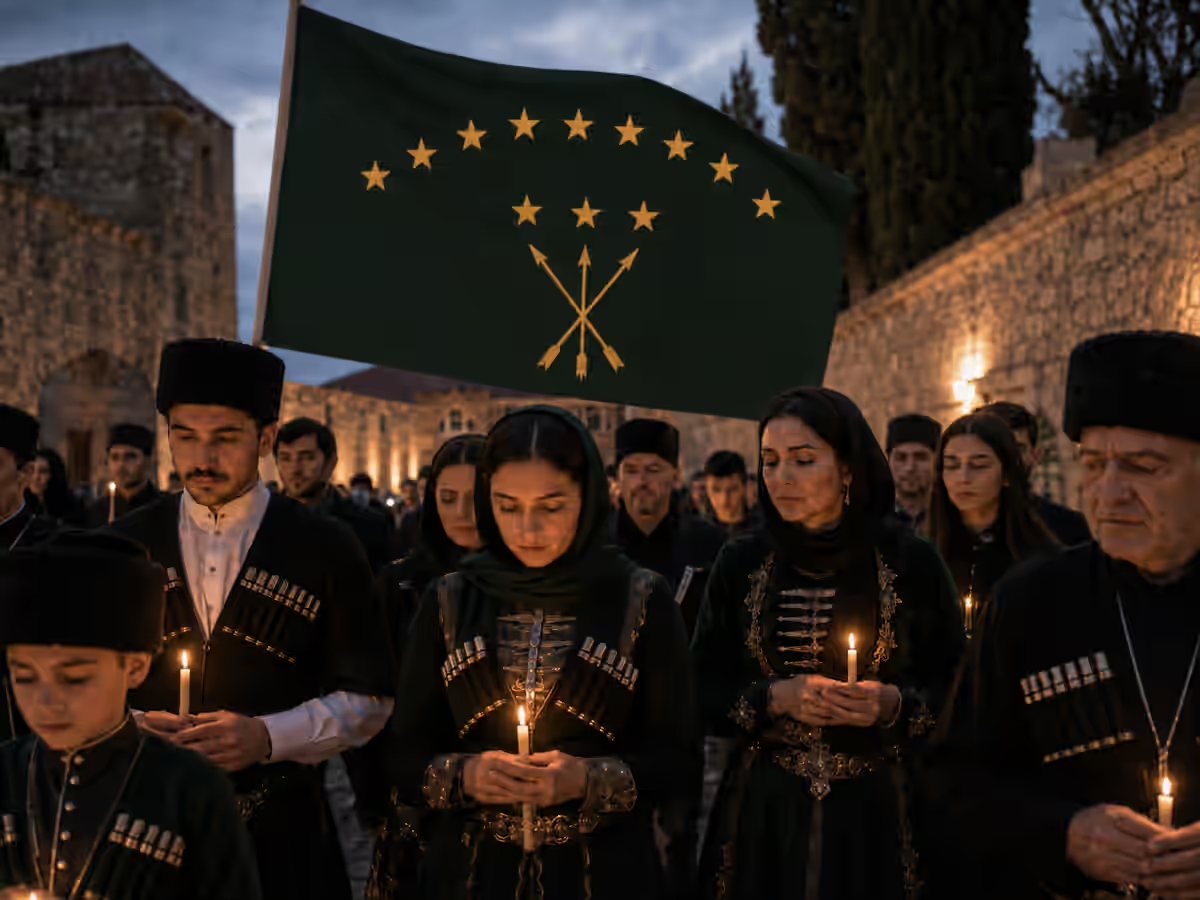
The single largest shift in Circassian public life recently did not happen in the Caucasus. It happened in Damascus.
On 21 May 2025, several hundred Circassians marched publicly near Umayyad Square, in fur hats and heavy coats in the spring heat, under the green flag with twelve stars and three arrows. It was the first public commemoration of the Day of Mourning in Syria in more than half a century. Under the previous, Russia-aligned government, the Circassian story of exile had been politically inconvenient and was effectively suppressed.
What follows from that is being worked out now: language classes restarting, associations re-forming, a generation openly negotiating what it means to be both Syrian and Circassian while the state itself renegotiates its relationships with Russia and Israel. For a community that had shrunk dramatically through war and emigration, this is not a return to the pre-2011 status quo — it is the construction of something new, under scrutiny, with very few resources. Read our background on Circassians in Syria.
The lesson for everyone else is that political openings arrive suddenly and are usually short. Communities that had documents, teachers, recordings and organisational skeletons ready were able to act in weeks. Those that did not, could not.
6. Turkey, Jordan, Israel: three different bargains
The diaspora is often discussed as one thing. It is not; it is a set of very different bargains with very different states.
- Turkey — the demographic centre of the nation, with hundreds of villages and a dense network of associations (dernek), federations and language courses. Its challenge is not permission but scale and urbanisation: village Adyghabze is strong, city Adyghabze is thin, and rural depopulation moves people from the first to the second.
- Jordan — a small community with disproportionate institutional depth: schools, a charitable association, historical proximity to the state and its founding. Its challenge is intermarriage and the arithmetic of a small population, not hostility.
- Israel (Kfar Kama and Rehaniya) — the most successful language-retention case in the entire diaspora, because Adyghabze is taught in school from the first grade in a village that stayed compact. It proves the mechanism works when concentration plus schooling exist together.
- Europe, the Gulf and the United States — the newest layer, small, highly educated, digitally fluent, and currently the main source of funding, software and international advocacy capacity.
Any global strategy that ignores these asymmetries will fail, because it will ask each community for the thing it cannot give.
7. So are Circassians uniting — or not?
Honest answer: they are integrating informationally far faster than they are integrating institutionally.
Informationally, the change is dramatic. A wedding in Kayseri, a dance competition in Nalchik and a language class in Amman are watched by the same audience within hours. Family-tree research now crosses borders that states never opened; a surname in Jordan gets matched to a village in Adygea by a database rather than by an elder's memory. This is genuinely new, and it is the deepest form of unity the nation has had since 1864.
Institutionally, progress is real but early. New coordinating bodies have appeared — notably the Circassian National Assembly (CNA), formed as an international coalition of diaspora organisations and civil-society groups after a series of international conferences, which in December 2025 sent formal letters to the heads of the Circassian republics proposing cooperation on language, heritage protection, education and youth work, explicitly on a non-oppositional basis. Whether such outreach produces working programmes or polite silence is one of the genuinely open questions of the next few years.
The realistic ceiling is not a single global authority. It is a federated network: shared standards (orthography, curricula, archival formats), shared infrastructure (dictionaries, genealogy, media), and local autonomy on politics — because the political constraints in Maikop, Ankara, Amman and Damascus are irreconcilable and always will be. Our strategy piece on Circassian unity develops this framework in detail.
8. What the next ten years actually depend on
Not on sentiment. On five measurable things:
- Child speakers. How many children under ten are being raised with Adyghabze at home, and where are the clusters? Everything cultural is downstream of this.
- Teachers. A trained, paid, credentialed cadre of language teachers — including online — is the bottleneck, and it is a funding problem more than a political one.
- Documentation. Elders' recordings, village histories, surname and tamga records, photographs. This has a hard deadline set by human lifespans.
- Mobility, not only return. Visa-light heritage travel, university places, remote work and business links that let people live between homeland and diaspora instead of choosing once and forever.
- Institutional continuity. Organisations that outlive their founders, with successors, records and budgets. Most Circassian initiatives die of founder-dependence, not of opposition.
Notice what is absent from that list: recognition declarations, online arguments about borders, and disputes over who represents whom. Those consume most of the nation's public attention and almost none of its actual capacity.
9. What this means for you
If you are Circassian and reading this, the useful contributions are unglamorous and available today: record your family tree while the people who remember are still here, learn or reactivate the language even imperfectly, record an elder on your phone this month, join a local association and take on one boring administrative task, and — if you can — fund a teacher rather than an event.
The nation survived the worst thing that can happen to a people. The current question is narrower and harder: whether it will choose to be a living, self-documenting, self-teaching community in the twenty-first century, or a beautifully remembered one.
10. Work, money and why the economy decides the language question
Every cultural debate in the Circassian world eventually turns into an economic one. A family decides which language its children will master by looking at where the salaries are, and in Adygea, Kabardino-Balkaria and Karachay-Cherkessia the salaries are in Russian. The same logic operates in the diaspora: in Amman, Istanbul and Kayseri the professional ladder is climbed in Arabic and Turkish. No amount of exhortation reverses that; only creating work in which the language has value does.
This is why the most consequential Circassian projects of the next decade are likely to look commercial rather than cultural: publishing houses that pay authors, children's media studios, tourism businesses in the mountain republics that hire local guides, craft and food producers with export channels, translation and software work done remotely from Maykop or Nalchik. A teacher with a stable income is cultural infrastructure. A festival is not.
There is a second-order effect that is rarely discussed. The republics export their most educated young people to Moscow, St Petersburg, Krasnodar and abroad, and cultural continuity leaves with them. Any serious plan has to answer a blunt question: what job exists in Nalchik for a 26-year-old with a good degree? Until that has an answer, the language curve and the emigration curve will keep pointing the same way.
11. The digital generation: real capacity, unclear direction
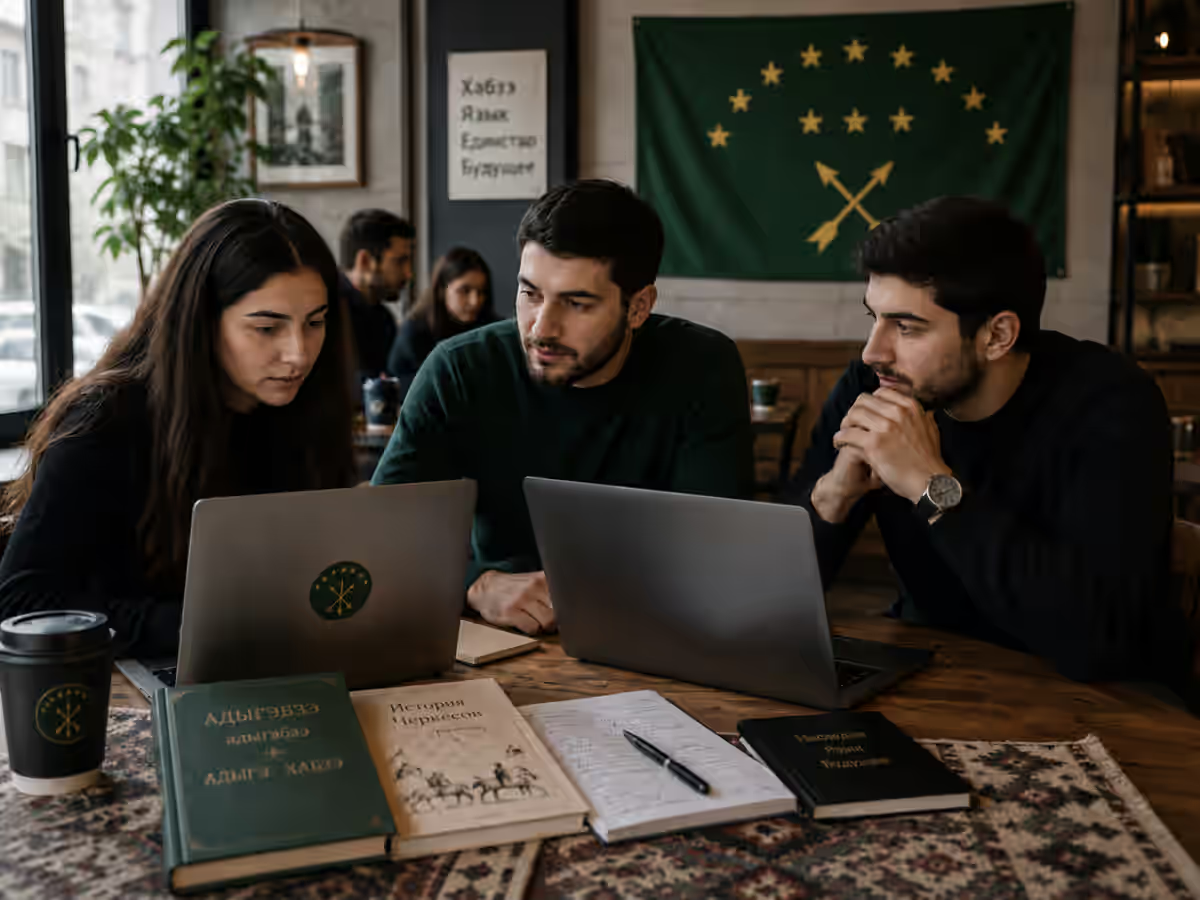
The generation now in its twenties is the first in Circassian history to be born into a single shared information space. A dance video from Amman is watched in Nalchik the same evening; a surname question posted in Turkish is answered in Russian and Adyghe within hours; young people who will never meet in person share dialect notes, family records and archival scans. In practical terms, the diaspora and the homeland now have a common public sphere for the first time since 1864.
What that sphere has not yet produced is durable institutions. Attention is abundant and cheap; follow-through is scarce and expensive. Online mobilisation has proved effective at three things — commemoration, rapid response to insults or erasure, and locating relatives — and largely ineffective at the slower work of school curricula, endowments, teacher training and archives. The gap between the two is the single most useful place for effort right now, because the audience already exists.
A useful test for any new initiative: would it still function if its founder went silent for a year? Projects that pass that test are rare and disproportionately valuable.
12. Xabze, faith and the question of what is actually being preserved
Ask ten Circassians what defines the nation and most will name Adyghe Xabze — the ethical and social code — before they name language or territory. That is a meaningful answer, because Xabze survived the deportation better than institutions did: respect for elders, restraint in speech, hospitality as obligation, the conduct expected at weddings and funerals. It travelled in families, and families crossed borders.
It is also where the sharpest internal debate now sits. In parts of the diaspora and the homeland, religious identity has become the primary frame, and some practices once regarded as Circassian custom are now contested as un-Islamic; elsewhere, secular urban life has thinned the same practices from the other direction. Both processes remove the same things: the etiquette of the ceremonies, the dances, the role of the elder, the specific music.
The honest position is that Xabze is not a museum object and never was — it changed across four centuries and will keep changing. The question worth asking is narrower: which parts are load-bearing? Most people, when pressed, name the same three: obligation to guests and neighbours, deference to elders, and the discipline of not humiliating others in public. Those can survive translation into any language and any city. The dances and dialects cannot survive neglect.
13. What we still do not know — and why that matters
An honest state-of-the-nation account has to include its own blind spots. Four gaps are large enough to change conclusions:
- Real speaker numbers. Census self-identification is not fluency. Nobody has run a proper proficiency survey across the republics and the main diaspora centres.
- Diaspora demography. Estimates for Turkey range across millions because no state counts by ethnicity. Planning on a number you cannot verify produces confident, wrong strategies.
- Return intentions. We know how many returned; we do not reliably know how many considered it and why they stopped — visas, language requirements, jobs, or family opposition.
- Youth attitudes. There is almost no comparative data on what 18–30-year-olds in Nalchik, Amman, Istanbul and Berlin actually intend regarding language transmission to their own children.
These are answerable questions. A single well-designed multilingual survey, run once and repeated every five years, would tell the nation more than a decade of argument. That is the kind of unglamorous project this article is arguing for.
Where the conversation stands: positions on the record
Rather than paraphrase the community's mood, here is what identifiable actors have actually said or done on the record — the reader can weigh them directly.
- Activists across the North Caucasus, May 2025. More than 80 signatories publicly urged that the draft repatriation law not be adopted in its proposed form, objecting in particular to a Russian-language requirement that would exclude many descendants of the deported. Reported by Caucasian Knot, 5 May 2025.
- Prospective returnees, 2025. Reporting on repatriation records a cooling of enthusiasm: bureaucracy, unrecognised qualifications and employment prospects — not sentiment — are the cited obstacles. Caucasian Knot, 22 May 2025.
- Syria's Circassians, 2025–26. After decades of silence, the community held its first public May 21 commemoration in around fifty years and began organising openly. New Lines Magazine, 7 January 2026.
- Circassian National Assembly, December 2025. Wrote officially to the Head of Adygea seeking engagement on repatriation and heritage questions — an attempt at institutional, not rhetorical, contact. Published letter, 19 December 2025.
- Academic assessment of the Syrian return. A peer-reviewed study of Syrian Circassians in southern Russia concluded that integration outcomes depended far more on documents, housing and work than on cultural closeness. Korotayev, Issaev, Ivanov & Shishkina, Europe-Asia Studies 76:4 (2024).
Your turn. This article deliberately avoids speaking for anyone. If you are Circassian — in the homeland, in Turkey, Jordan, Syria, Israel, Europe or the Americas — leave your own assessment in the comments below: what your family's language situation actually is, whether you would return under realistic conditions, and what you think the next ten years require. Where readers disagree with the analysis above with evidence, we update the article and say so.
Frequently asked questions
How many Circassians are there today?
Nobody knows precisely. Roughly 700,000–800,000 live in the North Caucasus republics, and diaspora estimates range from about two million to more than five million, with Turkey by far the largest community. The spread exists because no state counts ethnicity consistently and self-identification varies by generation. Any single confident figure you see is an estimate presented as a fact.
Is the Circassian language actually dying?
It is declining, not dead. UNESCO classifies Adyghe and Kabardian as vulnerable. The decisive indicator is not the total number of speakers but intergenerational transmission — whether parents raise children in the language — and by that measure the trend is negative in most urban settings, homeland and diaspora alike. Reversal is technically possible; it requires paid teachers, children's media and a reason to use the language beyond sentiment.
Can diaspora Circassians move back to the homeland?
In practice it is difficult but not impossible. Kabardino-Balkaria has run a small programme resettling roughly twenty families at a time, and a repatriation law has been drafted, but the process is bureaucratic and a proposed Russian-language requirement would exclude many descendants. Most people who explore return cite documents, recognition of qualifications and employment as the real barriers.
Are Circassians united today?
Informationally, yes to a degree unimaginable thirty years ago. Institutionally, barely. There is no single representative body accepted across the republics and the diaspora, and the three republics sit in different administrative structures. Coordination happens project by project, which is slower but also more durable than it looks.
Why are Circassians split across three republics?
Soviet administrative design. Adygea, Kabardino-Balkaria and Karachay-Cherkessia were drawn so that Circassians form separate populations in each, paired with other nationalities, with different official languages, curricula and budgets. The effect is that there is no single jurisdiction where the nation is a straightforward majority with unified policy.
What happened in 1864, and is it recognised as genocide?
The Russian-Circassian War ended in 1864 with mass deportation and death; the great majority of the population was expelled to the Ottoman Empire. Georgia recognised it as genocide in 2011; Russia does not. Read more in our account of the 1864 catastrophe.
Do Circassians in different countries speak the same language?
They speak two closely related literary languages — Adyghe (West Circassian) and Kabardian (East Circassian) — plus many dialects. Speakers can usually make themselves understood across the divide with effort. In the diaspora, the dialect a family retains usually reflects which tribe was deported to which region.
What is Adyghe Xabze?
The traditional Circassian code of conduct: obligations of hospitality, respect for elders, restraint in speech, and the etiquette governing weddings, funerals and public life. It travelled with families across borders more successfully than institutions did, which is why many people name it before language when asked what makes a Circassian.
How can I find my Circassian family or tribe?
Start with the surname and the village of origin, then work outward. Our Circassian surnames database, family tree builder, DNA heritage tools and tamga records exist for exactly this, and the people search connects families separated by the deportation.
What is the most useful thing one person can do?
Record an elder this month, on a phone, in the language. It is the only task on the list with a deadline set by human lifespans, and it cannot be delegated, funded or postponed.
Is there any realistic optimism here?
Yes, but it is specific rather than general. A nation that lost most of its population and territory still maintains living communities on four continents, two literary languages, an intact ethical tradition and — new in this decade — a shared information space. That is a working base. What it lacks is not spirit but institutions, and institutions are buildable.
Sources and further reading
- Caucasian Knot — "Repatriation to Russia loses its appeal for Circassians abroad" (22 May 2025)
- Caucasian Knot — "Activists from NCFD demand not to adopt draft law on repatriation" (5 May 2025)
- New Lines Magazine — "Syria's Circassian Community Is Finding Its Voice" (7 January 2026)
- Circassian National Assembly — official letter to the Head of the Republic of Adygea (19 December 2025)
- Korotayev, Issaev, Ivanov & Shishkina, "A Troubled Return to the Homeland: Syrian Circassians in Southern Russia", Europe-Asia Studies 76:4 (2024)
Population figures in this article are ranges, not counts, and are presented as such deliberately. Where sources disagree, we have said so rather than choosing the most flattering number.