The Shapsug Tribe: Guardians of the Black Sea Coast
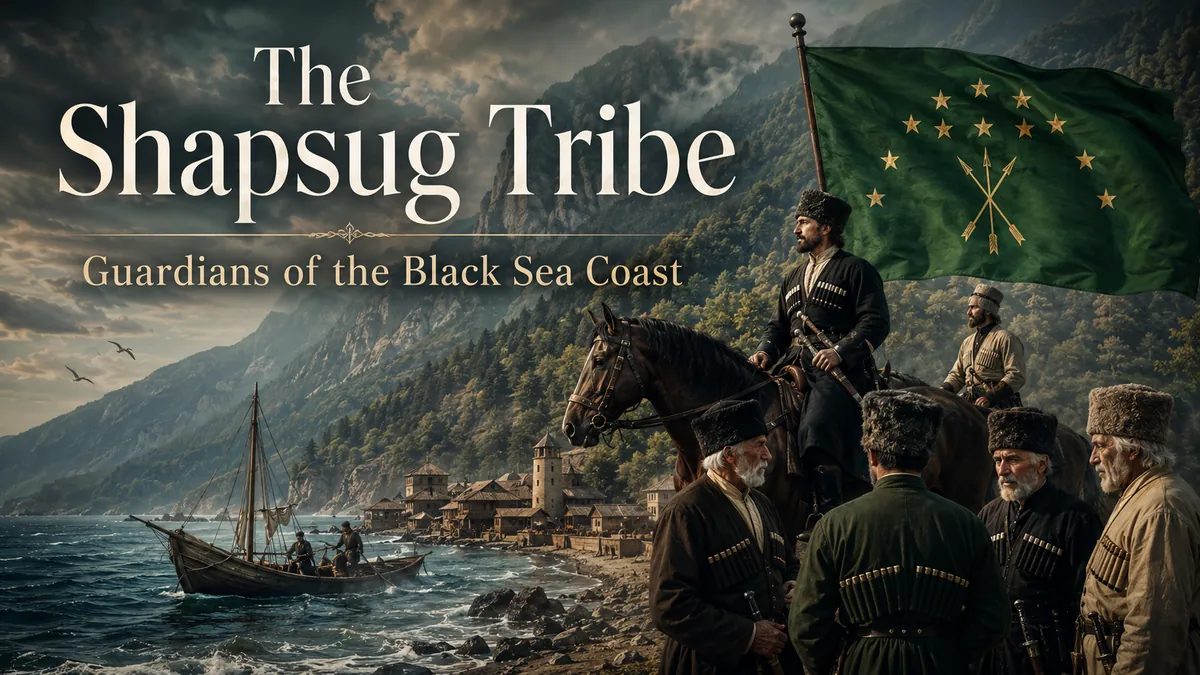
The Shapsug Tribe: Guardians of the Black Sea Coast
The Shapsugs (Адыгэ: Шапсыгъ) were one of the largest and most democratic of the twelve Circassian tribes. Their homeland ran along the western Black Sea coast of Circassia, from modern-day Tuapse in the south to beyond Anapa in the north, with their mountain settlements reaching deep into the western foothills of the Greater Caucasus.
What set them apart from most of their Adyghe neighbors was not just where they lived, but how they governed themselves. The Shapsugs had no hereditary princes. They made their decisions in open assemblies. They fought for their land with a stubbornness that became legendary across the Caucasus, and they paid a price for it that few peoples in modern history have paid.
This is the full story of who they were, how they lived, what they lost, and what survives.
Related reading: The 12 Circassian Tribes, Circassian Family Tree, Circassian Culture.
Quick facts
Native name: Шапсыгъ (Shapsyg, plural Shapsygher)
Other forms: Shapsoughs, Sapsugh, Chapsough, Çapsığ
Tribal family: West Circassian (Adyghe)
Homeland: Black Sea coast and western foothills, from Tuapse to Anapa
Pre-1864 population: Estimated over 300,000
Population today: Around 10,000 in the Lazarevsky District near Sochi; larger communities in Turkey, Jordan, Germany, and Israel
Religion: Sunni Islam (Hanafi) with pre-Islamic Adyghe traditions still present
Language: Shapsug dialect of Adyghe (West Circassian)
Government: Tribal democracy through council (khase) — one of the few Circassian tribes without hereditary princes
Status: The only Circassian community still living on the original Black Sea coast of their ancestral homeland
Who are the Shapsugs?
The Shapsugs were one of the four or five Circassian tribes whose size and military strength made them central to the political life of the western Caucasus. They were also one of the most unusual.
Three things set them apart from most other Adyghe tribes:
No hereditary princes. While the Kabardians, Temirgoys, Bzhedugs, and Besleneys all had pshi (princely) families that held formal political authority, the Shapsugs had abolished, or never accepted, that kind of inherited rule. Authority among the Shapsugs came from age, from proven leadership, and from public consent.
Decisions made in open assembly. Major questions of war, peace, and policy were decided by the khase — a council that, in the Shapsug case, was open to free men in good standing rather than restricted to a hereditary elite.
A coastal homeland. Most Adyghe tribes lived inland, in the river valleys and plains. The Shapsugs lived on the sea. Their fishing villages, their port settlements, and their direct trade with the Ottoman Black Sea ports shaped a way of life that was different from the rest of the Adyghe world.
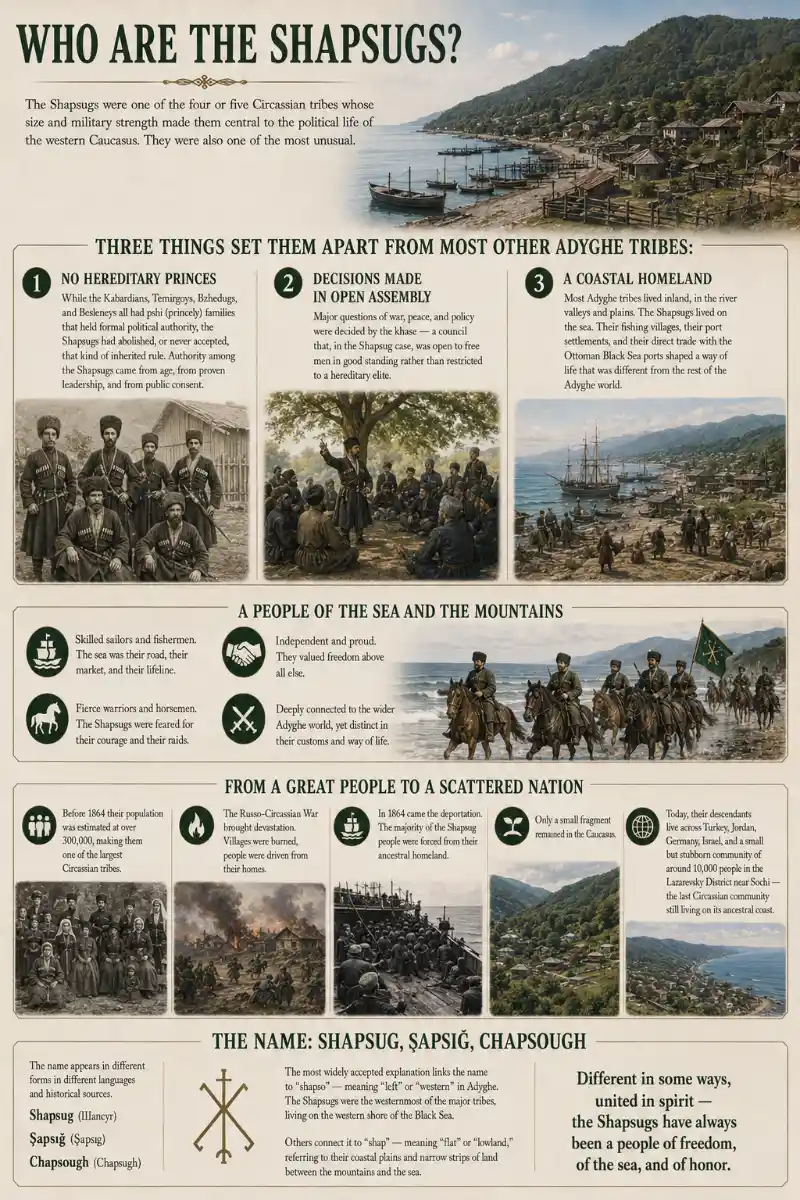
Before 1864 their population was estimated at over 300,000, making them one of the largest Circassian tribes. After the war and the deportation, only a small fragment remained in the Caucasus. Today, the descendants of the surviving population live across Turkey, Jordan, Germany, Israel, and a small but stubborn community of around 10,000 people in the Lazarevsky District near Sochi — the last Circassian community still living on its ancestral coast.
The name: Shapsug, Şapsığ, Chapsough
The same tribe has been written half a dozen different ways depending on who was doing the writing. Here is what each form means.
Shapsyg (Шапсыгъ)
This is the Adyghe form, written today in Cyrillic. It is the name the people use for themselves. The exact etymology is uncertain. The most common explanation traces it to a founding ancestor or clan grouping, although a few scholars have proposed topographical origins linking it to a feature of the coastal landscape.
Shapsug
The most common English spelling, derived from Russian transliteration. This is the form you will see in nearly all academic literature in English.
Şapsığ
The standard modern Turkish spelling, used by the large Shapsug diaspora communities in Turkey.
Sapsoug, Chapsough, Tcheghapsough
Older European travel-writing forms, mostly French and German. They appear in nineteenth-century accounts of the Caucasus and in early Ottoman correspondence.
Quick reference
In Adyghe contexts: Шапсыгъ
In English academic writing: Shapsug
In Turkey: Şapsığ
In older European sources: Chapsough or Sapsugh
The tribe is one cultural community across all these spellings. The variation reflects the languages of the people who wrote about them, not any real difference in identity.
Origins and early history
The deep origins of the Shapsugs are difficult to pin down, like those of all the Circassian tribes. The best current understanding pieces together oral tradition, archaeological evidence, and the scattered references in medieval and early modern documents.
Adyghe oral tradition places the formation of the Shapsugs as a distinct tribal community in the late medieval period, probably between the fourteenth and sixteenth centuries. Before that, the people who would become the Shapsugs were part of the broader Adyghe and proto-Adyghe population that had lived along the Black Sea coast and the foothills of the Caucasus for at least a thousand years.
The Mongol invasions of the thirteenth century disrupted the older political structures of the region. The centuries that followed were a period of slow reorganization, with new tribal groupings forming around new leadership and around the realities of changing trade routes and population movements. The Shapsugs emerged from this process as a distinct community, organized along democratic lines that may have reflected older Adyghe traditions or may have been a response to specific historical conditions in the coastal zone.
By the fifteenth and sixteenth centuries, the Shapsugs appear by name in Genoese trading records. The Genoese ran a network of trading posts along the Black Sea coast, and Shapsug traders are mentioned as suppliers of wax, hides, grain, and slaves and as buyers of Italian textiles, weapons, and salt. The records are fragmentary and the names are mangled, but they confirm that by this point the Shapsugs were a recognized political and economic community.
Under the Crimean Khanate's loose suzerainty over the western Caucasus in the sixteenth and seventeenth centuries, the Shapsugs maintained a complicated, often hostile relationship with their Tatar neighbors. They raided Crimean territory, were raided in turn, and occasionally participated in joint military operations when the politics aligned. None of this amounted to formal subjugation. The Shapsug coast was too rugged, the population too dispersed, and the social organization too decentralized for any outside power to control it through normal means.
The arrival of the Ottoman Empire as a significant presence on the Black Sea, starting in the late fifteenth century, drew the Shapsugs into wider patterns of trade and diplomacy. Ottoman ports at Trabzon and Sinop became the main destinations for Shapsug exports. Ottoman religious and political influence gradually flowed back along the same routes, eventually contributing to the spread of Islam in the area.
Russian engagement with the Shapsugs began in the late sixteenth century with sporadic diplomatic contact, but Russia did not become a serious factor in Shapsug life until the eighteenth century, when southern expansion by the Russian state began to bring its frontiers within striking range of the western Caucasus.
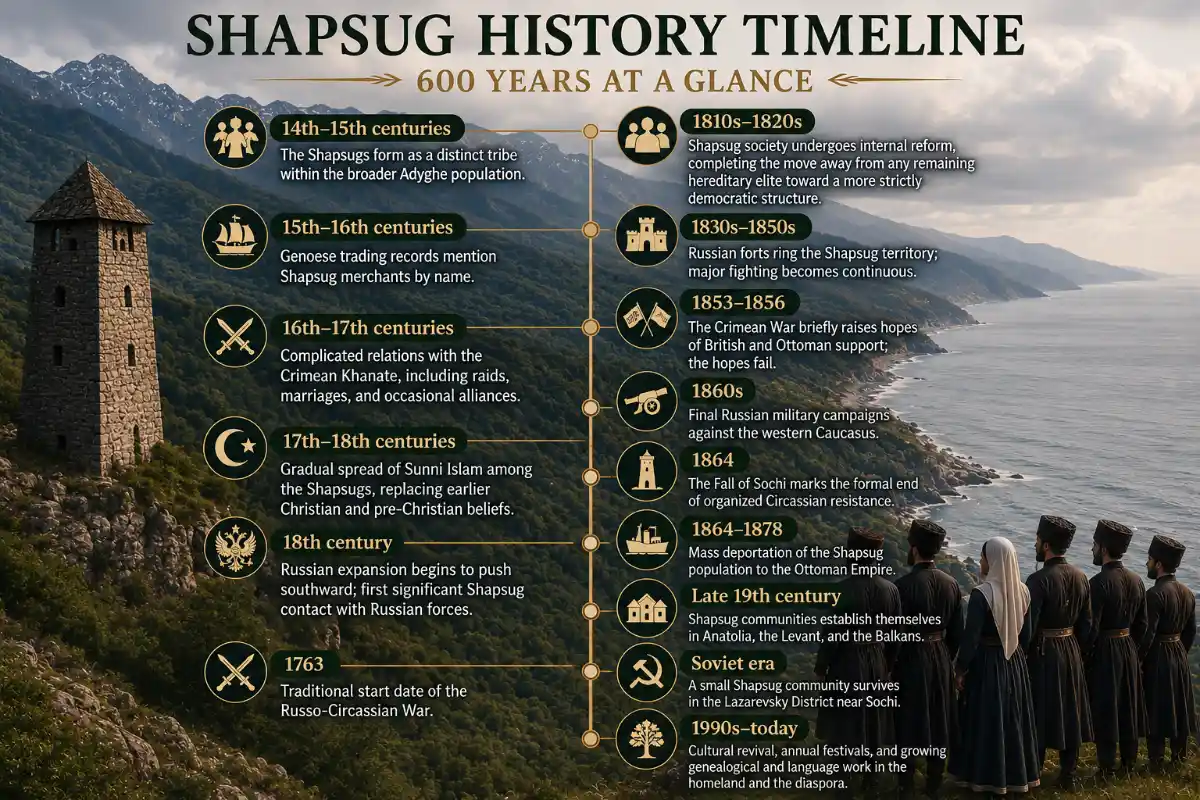
Timeline: 600 years at a glance
14th–15th centuries. The Shapsugs form as a distinct tribe within the broader Adyghe population.
15th–16th centuries. Genoese trading records mention Shapsug merchants by name.
16th–17th centuries. Complicated relations with the Crimean Khanate, including raids, marriages, and occasional alliances.
17th–18th centuries. Gradual spread of Sunni Islam among the Shapsugs, replacing earlier Christian and pre-Christian beliefs.
18th century. Russian expansion begins to push southward; first significant Shapsug contact with Russian forces.
1763. Traditional start date of the Russo-Circassian War.
1810s–1820s. Shapsug society undergoes internal reform, completing the move away from any remaining hereditary elite toward a more strictly democratic structure.
1830s–1850s. Russian forts ring the Shapsug territory; major fighting becomes continuous.
1853–1856. The Crimean War briefly raises hopes of British and Ottoman support; the hopes fail.
1860s. Final Russian military campaigns against the western Caucasus.
1864. The Fall of Sochi marks the formal end of organized Circassian resistance.
1864–1878. Mass deportation of the Shapsug population to the Ottoman Empire.
Late 19th century. Shapsug communities establish themselves in Anatolia, the Levant, and the Balkans.
Soviet era. A small Shapsug community survives in the Lazarevsky District near Sochi.
1990s–today. Cultural revival, annual festivals, and growing genealogical and language work in the homeland and the diaspora.
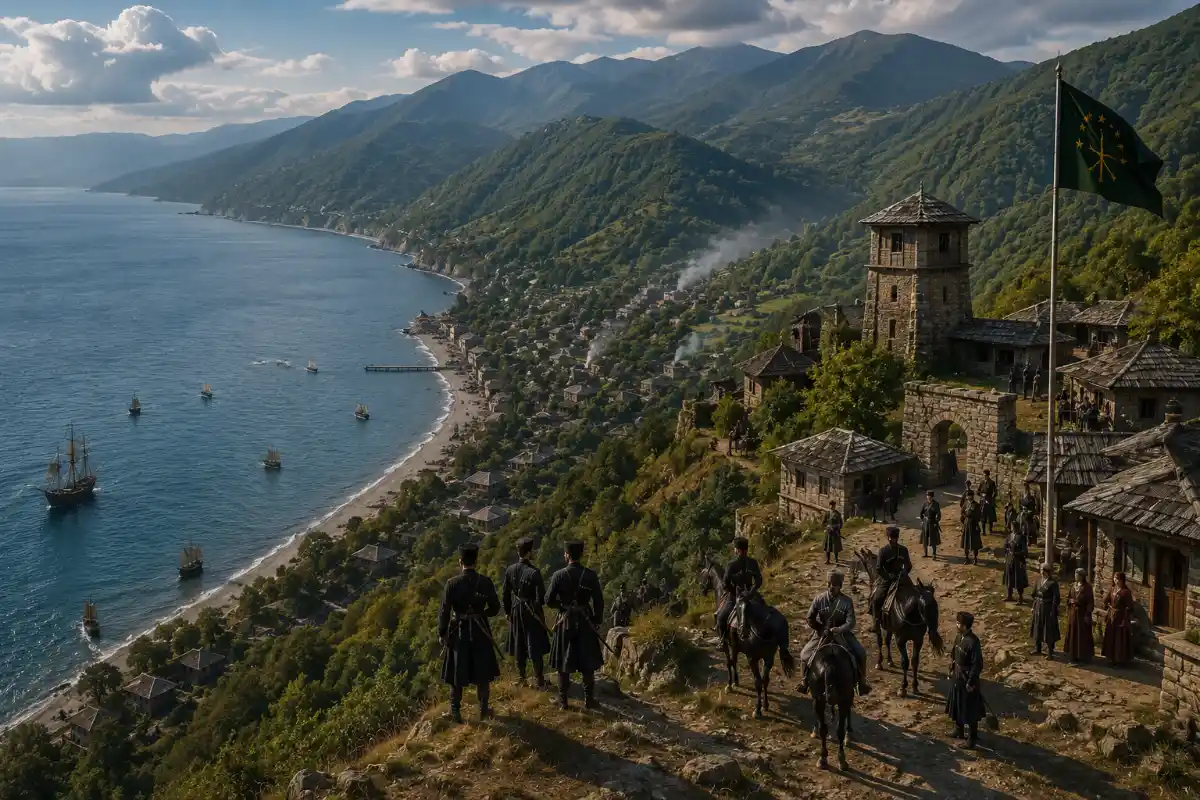
Where the Shapsugs lived
The Shapsug homeland covered a strip of coast and a band of foothills that stretched from around modern-day Tuapse in the south to beyond Anapa in the north. Inland, the territory extended into the western foothills and lower slopes of the Greater Caucasus. The total area was roughly comparable in size to a small European country.
The coast
The Shapsug coastline was, and is, one of the most beautiful stretches of the Black Sea littoral. It is also one of the most difficult.
The coastal plain is narrow, in places almost nonexistent, with mountains rising steeply from the water.
Numerous small rivers cut down through the foothills to the sea, creating short valleys and isolated coves.
Natural harbors are rare. The few that exist were the sites of the major Shapsug coastal settlements.
The climate is humid subtropical, much warmer than the interior of Adyghe territory, with long mild summers and rainy winters.
The foothills and mountains
Inland from the coast, the country rose quickly into mixed forest and then into the higher peaks of the western Caucasus.
Beech, oak, and chestnut forests covered the lower foothills.
Higher up, fir and spruce predominated.
Mountain pastures opened above the treeline and were used for summer grazing.
The terrain was a defensive asset. The narrow valleys, dense forests, and steep slopes made the area extraordinarily difficult for invading armies.
Key rivers
The Shakhe. One of the larger Shapsug rivers, with a valley that ran inland from the coast.
The Ashe. Important for the southern Shapsug settlements.
The Pshada. Another major coastal river, with significant Shapsug villages along its course.
The Kuban tributaries. Several rivers flowing north from the Shapsug mountains eventually joined the Kuban system, putting the Shapsugs in indirect contact with the steppe.
Settlement pattern
Shapsug villages were typically small, dispersed, and built into the landscape rather than imposed upon it.
Most villages had between 20 and 100 households.
Houses were built of timber and wattle-and-daub, with shingle or thatch roofs.
The terrain meant that villages were often strung out along ridges or river terraces rather than clustered around a single center.
Larger settlements existed at the natural ports along the coast, where trade with Ottoman and Crimean merchants brought concentrated population and wealth.
The Greater and Lesser Shapsugs
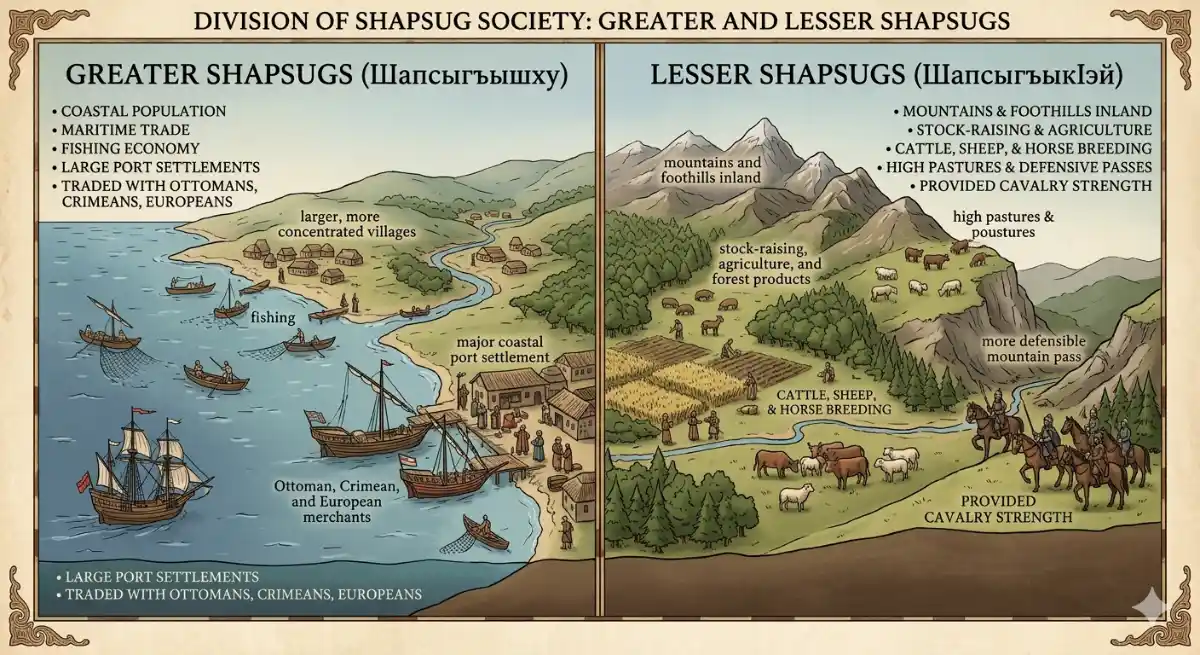
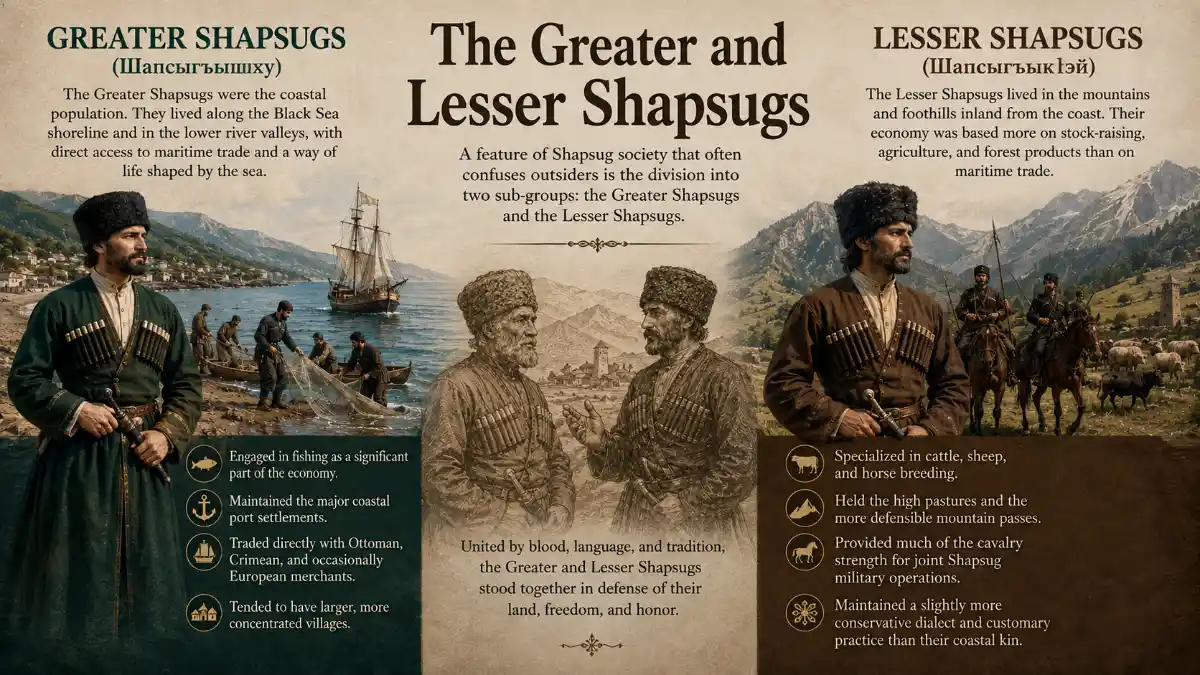
A feature of Shapsug society that often confuses outsiders is the division into two sub-groups: the Greater Shapsugs and the Lesser Shapsugs.
Greater Shapsugs (Шапсыгъышху)
The Greater Shapsugs were the coastal population. They lived along the Black Sea shoreline and in the lower river valleys, with direct access to maritime trade and a way of life shaped by the sea.
Engaged in fishing as a significant part of the economy.
Maintained the major coastal port settlements.
Traded directly with Ottoman, Crimean, and occasionally European merchants.
Tended to have larger, more concentrated villages.
Lesser Shapsugs (Шапсыгъыкӏэй)
The Lesser Shapsugs lived in the mountains and foothills inland from the coast. Their economy was based more on stock-raising, agriculture, and forest products than on maritime trade.
Specialized in cattle, sheep, and horse breeding.
Held the high pastures and the more defensible mountain passes.
Provided much of the cavalry strength for joint Shapsug military operations.
Maintained a slightly more conservative dialect and customary practice than their coastal kin.
Relations between the two
The Greater and Lesser Shapsugs considered themselves one tribe and intermarried freely. Their councils sometimes met jointly and sometimes separately. They went to war together against external enemies and occasionally feuded internally over the kind of small disputes — pasture rights, cattle theft, marriage disagreements — that any closely related community generates.
The distinction matters for genealogical research today. Diaspora families who can identify their pre-exile origin as Greater Shapsug or Lesser Shapsug have a head start on locating their original village and connecting with the right oral-tradition stream.
The 12 Circassian tribes — where Shapsugs fit
The Adyghe nation is made up of twelve historical tribes. The Shapsugs are one of them, and they are usually counted among the four or five most important by population and political weight.
The full list, grouped by general region:
Western coast and foothills
Shapsugs
Natukhays
Zhaney
Hatuqwai
Central plains and foothills (modern Adygea)
Temirgoys
Bzhedugs
Mokhosh
Yegerukhay
Mamkhegh
Mountain belt
Abdzakhs
Eastern (Kabarda region)
Kabardians
Besleneys
The Shapsugs were the southernmost and the most clearly coastal of the major tribes. They had close ties of marriage and council with the Natukhays to their north, the Abdzakhs in the mountains to their east, and the Ubykhs (a related but linguistically distinct group) to their south.
Society and the question of democracy
The Shapsug social structure is one of the most discussed features of their history, because it stood out so clearly from the patterns common across the rest of the Caucasus.
The principal classes
Free commoners (тфэкъо). The bulk of the Shapsug population. They held land, raised livestock, paid limited dues, and participated in the tribal assemblies.
Nobles (уэркъ). A distinct class, although less powerful among the Shapsugs than in the princely tribes. Shapsug nobles held more land and more influence than commoners, but they did not rule. By the early nineteenth century, their power had been significantly curbed by Shapsug democratic reforms.
Dependents and slaves. Household servants and unfree workers, often captives from raids or purchases from the regional slave trade.
What the Shapsugs did not have
Most Adyghe tribes were organized around hereditary princely families (pshi) who held formal authority and stood at the top of the social hierarchy. The Temirgoys had the Boletoko line. The Bzhedugs had the Khamish and Cherchen lines. The Kabardians had multiple princely dynasties whose internal politics shaped the entire eastern Adyghe world.
The Shapsugs had none of this. Either they had abolished their princes at some earlier point, or they had never accepted hereditary princely rule in the first place. The historical record is not clear on which. What is clear is that by the late eighteenth and nineteenth centuries, the Shapsugs were governed by their councils, not by any individual or family with inherited authority.
The democratic reforms
In the early nineteenth century, the Shapsugs went through a period of internal reform that further weakened the nobility and strengthened the role of the free commoner assembly. Several major nobles who tried to assert traditional aristocratic privileges were stripped of their status or driven out of the tribe entirely. By the time of the major Russian campaigns, Shapsug society had reached something close to full political equality among free men, with public decisions made openly and authority derived from age, wisdom, and demonstrated capability rather than from descent.
This was unusual not just in Caucasian terms but in nineteenth-century European terms as well. Travelers from Europe who reached Shapsug territory in the 1820s and 1830s wrote with amazement about the political system they observed.
Women's lives
As elsewhere in the Adyghe world, most accounts of Shapsug life were written by men about men. What we can reconstruct about Shapsug women's lives suggests that within the household they exercised real authority, that they ran the dairy, the loom, the kitchen, and the kitchen garden, and that they maintained the inter-household visiting networks that knit the community together. Public behavior was governed by strict codes of modesty, but the codes operated symmetrically on both sexes, and the absolute subordination found in some neighboring societies was not a feature of Shapsug life.
Marriage was negotiated between families. Bridewealth was substantial. Weddings were elaborate multi-day events. Mother-in-law authority over young brides was real but not unlimited, and the figure of the strong matriarch governing an extended household is a familiar one in Shapsug oral tradition.
Government: the khase
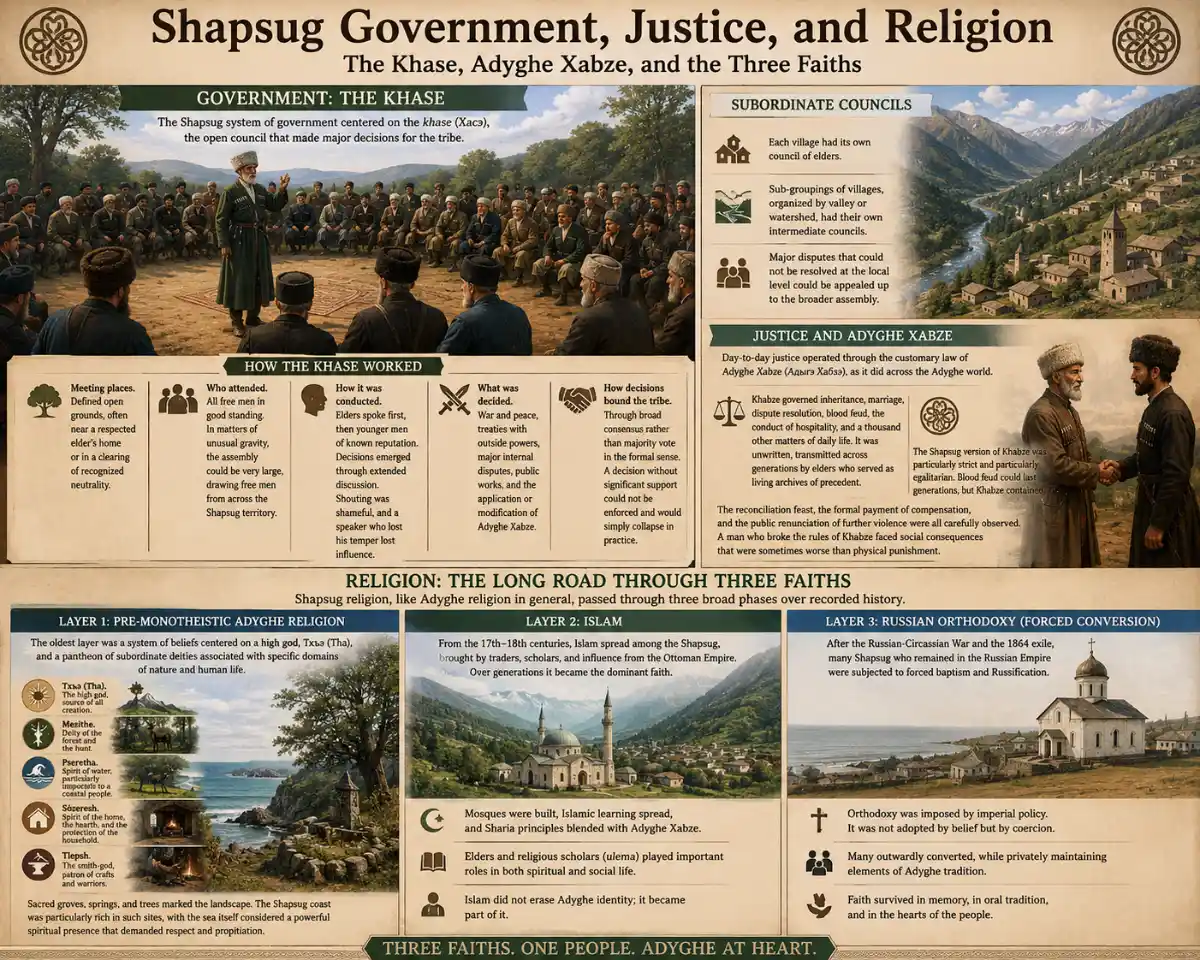
The Shapsug system of government centered on the khase (Хасэ), the open council that made major decisions for the tribe.
How the khase worked
Meeting places. Defined open grounds, often near a respected elder's home or in a clearing of recognized neutrality.
Who attended. All free men in good standing. In matters of unusual gravity, the assembly could be very large, drawing free men from across the Shapsug territory.
How it was conducted. Elders spoke first, then younger men of known reputation. Decisions emerged through extended discussion. Shouting was shameful, and a speaker who lost his temper lost influence.
What was decided. War and peace, treaties with outside powers, major internal disputes, public works, and the application or modification of Adyghe Xabze.
How decisions bound the tribe. Through broad consensus rather than majority vote in the formal sense. A decision without significant support could not be enforced and would simply collapse in practice.
Subordinate councils
Beyond the great khase, smaller councils handled local matters. Each village had its own council of elders. Sub-groupings of villages, organized by valley or watershed, had their own intermediate councils. Major disputes that could not be resolved at the local level could be appealed up to the broader assembly.
Justice and Adyghe Xabze
Day-to-day justice operated through the customary law of Adyghe Xabze (Адыгэ Хабзэ), as it did across the Adyghe world. Khabze governed inheritance, marriage, dispute resolution, blood feud, the conduct of hospitality, and a thousand other matters of daily life. It was unwritten, transmitted across generations by elders who served as living archives of precedent.
The Shapsug version of Khabze was particularly strict and particularly egalitarian. Blood feud could last generations, but Khabze contained a parallel set of rituals for ending it. The reconciliation feast, the formal payment of compensation, and the public renunciation of further violence were all carefully observed. A man who broke the rules of Khabze faced social consequences that were sometimes worse than physical punishment.
Religion: the long road through three faiths
Shapsug religion, like Adyghe religion in general, passed through three broad phases over recorded history.
Layer 1: Pre-monotheistic Adyghe religion
The oldest layer was a system of beliefs centered on a high god, Тхьэ (Tha), and a pantheon of subordinate deities associated with specific domains of nature and human life.
Тхьэ (Tha). The high god, source of all creation.
Mezithe. Deity of the forest and the hunt.
Pseretha. Spirit of water, particularly important to a coastal people.
Sözeresh. Spirit of the home, the hearth, and the protection of the household.
Tlepsh. The smith-god, patron of crafts and warriors.
Sacred groves, springs, and trees marked the landscape. The Shapsug coast was particularly rich in such sites, with the sea itself considered a powerful spiritual presence that demanded respect and propitiation.
Layer 2: Christianity
Christianity reached the western Caucasus during the Byzantine period and lingered for centuries in syncretic forms. Stone churches were built between the eighth and twelfth centuries, with several known sites in Shapsug territory. By the time of the major sources of the early modern period, Christianity had largely faded as an organized religion, although traces of it persisted in vocabulary, calendar practices, and certain rituals.
Layer 3: Sunni Islam
The conversion of the Shapsugs to Sunni Islam was a gradual process that stretched across the seventeenth, eighteenth, and early nineteenth centuries.
Crimean Tatar influence was probably the initial vector.
Ottoman missionary activity intensified the process in the eighteenth century.
Conversion came earliest among nobles and merchants who had the most contact with the Muslim world.
Mass conversion of the commoner population was largely complete by the early nineteenth century.
Even at the time of the Russian conquest, pre-Islamic practices were still visible in Shapsug life — particularly in marriage rituals, harvest celebrations, and the persistence of sacred springs and groves.
The form of Islam that took root was the Hanafi school, the same school dominant in Ottoman lands. There was no significant Shia presence and no major Sufi tariqat organization in the western Caucasus during this period. Religious leadership was carried by mullahs trained in Crimea or Anatolia.
The connection between Islam and resistance to Russia was real but should not be overstated. The Shapsugs fought Russia primarily to defend their land, their political independence, and their way of life, not as religious warriors in the sense that Imam Shamil's movement in the eastern Caucasus understood the term. Religious solidarity was one factor in a much larger pattern of resistance.
The Shapsug language
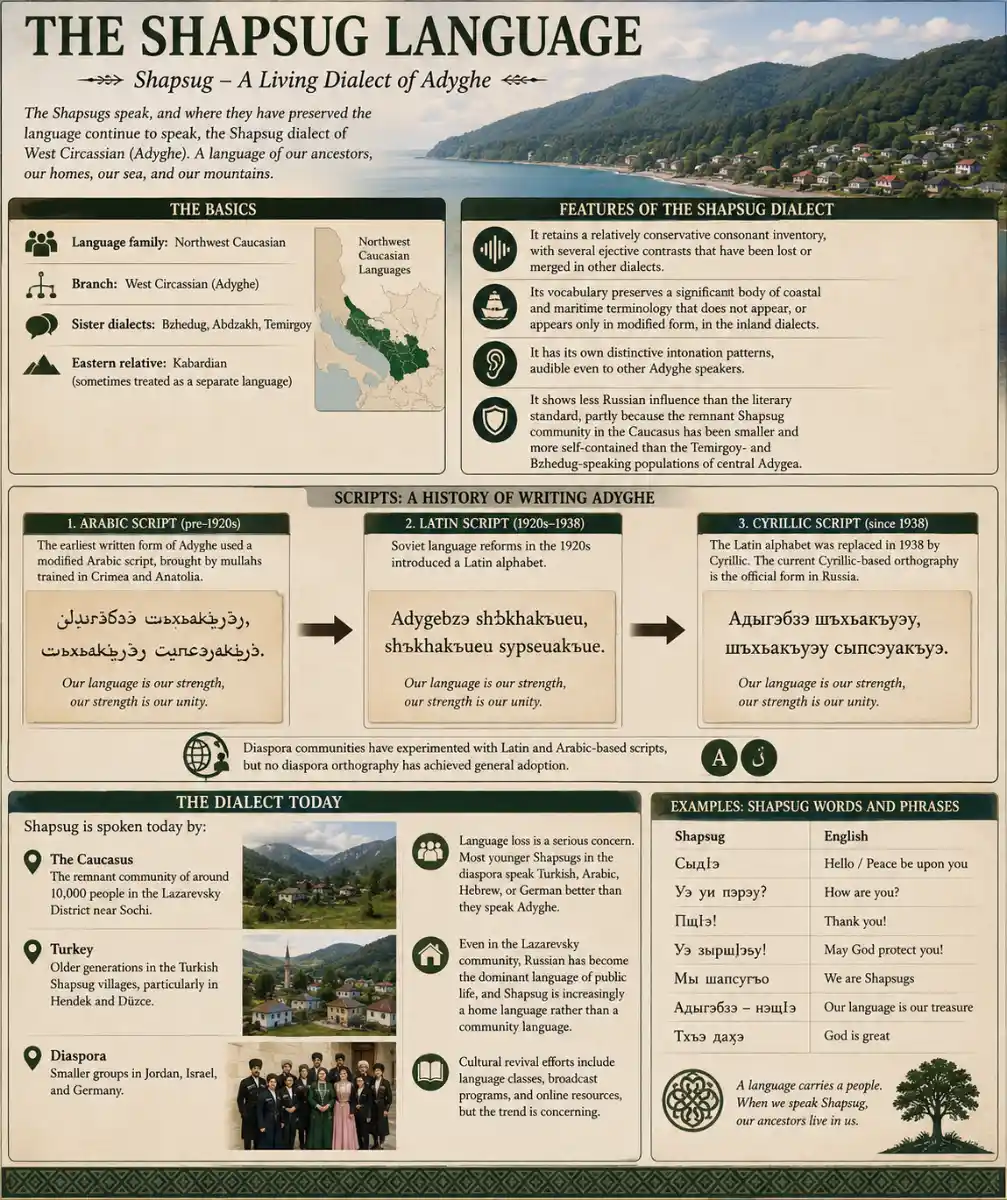
The basics
The Shapsugs speak, and where they have preserved the language continue to speak, the Shapsug dialect of West Circassian (Adyghe).
Language family: Northwest Caucasian
Branch: West Circassian (Adyghe)
Sister dialects: Bzhedug, Abdzakh, Temirgoy
Eastern relative: Kabardian (sometimes treated as a separate language)
Features of the Shapsug dialect
The Shapsug dialect has several features that linguists have studied closely:
It retains a relatively conservative consonant inventory, with several ejective contrasts that have been lost or merged in other dialects.
Its vocabulary preserves a significant body of coastal and maritime terminology that does not appear, or appears only in modified form, in the inland dialects.
It has its own distinctive intonation patterns, audible even to other Adyghe speakers.
It shows less Russian influence than the literary standard, partly because the remnant Shapsug community in the Caucasus has been smaller and more self-contained than the Temirgoy- and Bzhedug-speaking populations of central Adygea.
Scripts
The earliest written form of Adyghe used a modified Arabic script, brought by mullahs trained in Crimea and Anatolia.
Soviet language reforms in the 1920s introduced a Latin alphabet, replaced in 1938 by Cyrillic.
The current Cyrillic-based orthography is the official form in Russia.
Diaspora communities have experimented with Latin and Arabic-based scripts, but no diaspora orthography has achieved general adoption.
The dialect today
Shapsug is spoken today by:
The remnant community of around 10,000 people in the Lazarevsky District near Sochi
Older generations in the Turkish Shapsug villages, particularly in Hendek and Düzce
Smaller groups in Jordan, Israel, and Germany
Language loss is a serious concern. Most younger Shapsugs in the diaspora speak Turkish, Arabic, Hebrew, or German better than they speak Adyghe. Even in the Lazarevsky community, Russian has become the dominant language of public life, and Shapsug is increasingly a home language rather than a community language. Cultural revival efforts include language classes, broadcast programs, and online resources, but the trend is concerning.
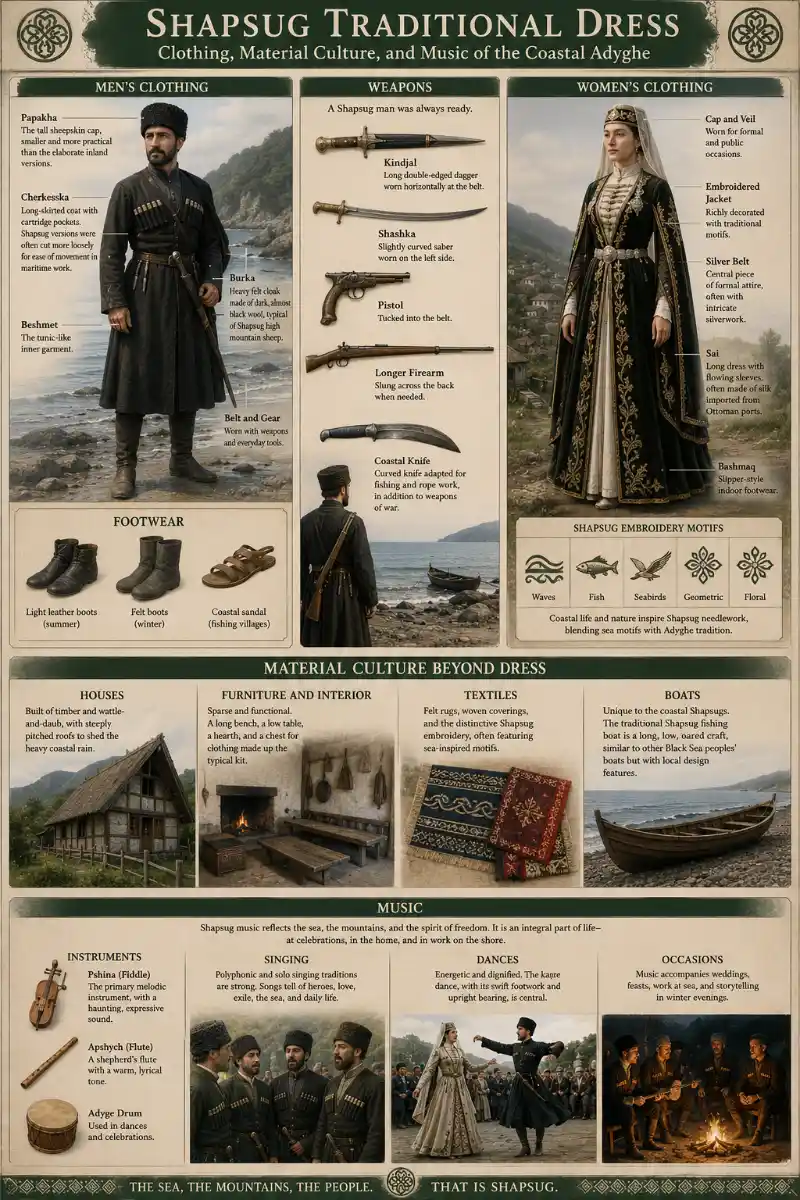
Traditional dress
Men's clothing
The basic male outfit was the same as elsewhere in the Adyghe world, with some Shapsug touches:
Cherkesska. The long-skirted coat with cartridge pockets across the chest. The Shapsug version was sometimes cut slightly more loosely than the central Adyghe form, to allow for the heavier work involved in maritime activities.
Beshmet. The tunic-like inner garment.
Burka. The heavy felt cloak. Shapsug burkas were often made of the dark, almost black wool that was characteristic of the high mountain sheep.
Papakha. The tall sheepskin cap, often slightly smaller and more practical in form than the elaborate dress papakhas of the inland tribes.
Footwear. Light leather boots in summer, felt boots in winter, and a distinctive coastal-style sandal worn in fishing villages.
Weapons
A Shapsug man going out in public would typically carry:
Kindjal. The long double-edged dagger worn horizontally at the belt.
Shashka. The slightly curved saber on the left side.
Pistol. Tucked into the belt.
Longer firearm. Slung across the back when needed.
Coastal Shapsugs sometimes carried a particular form of curved knife adapted for fishing and rope work, in addition to the standard weapons of war.
Women's clothing
Sai. The long dress with flowing sleeves, often made of silk imported from the Ottoman ports.
Bashmaq. Slipper-style indoor footwear.
Silver belt. A central piece of formal attire.
Embroidered jacket.
Cap and veil for formal and public occasions.
Shapsug embroidery patterns included motifs drawn from the coastal environment — wave patterns, fish, seabirds — alongside the standard geometric and floral patterns of the broader Adyghe tradition.
Material culture beyond dress
Houses. Built of timber and wattle-and-daub, with steeply pitched roofs to shed the heavy coastal rain.
Furniture. Sparse and functional. A long bench, a low table, a hearth, and a chest for clothing made up the typical kit.
Textiles. Felt rugs, woven coverings, and the distinctive Shapsug embroidery work, often featuring the sea-inspired motifs mentioned above.
Boats. Unique to the coastal Shapsugs. The traditional Shapsug fishing boat was a long, low, oared craft, similar to the boats of other Black Sea peoples but with local design features.
Music
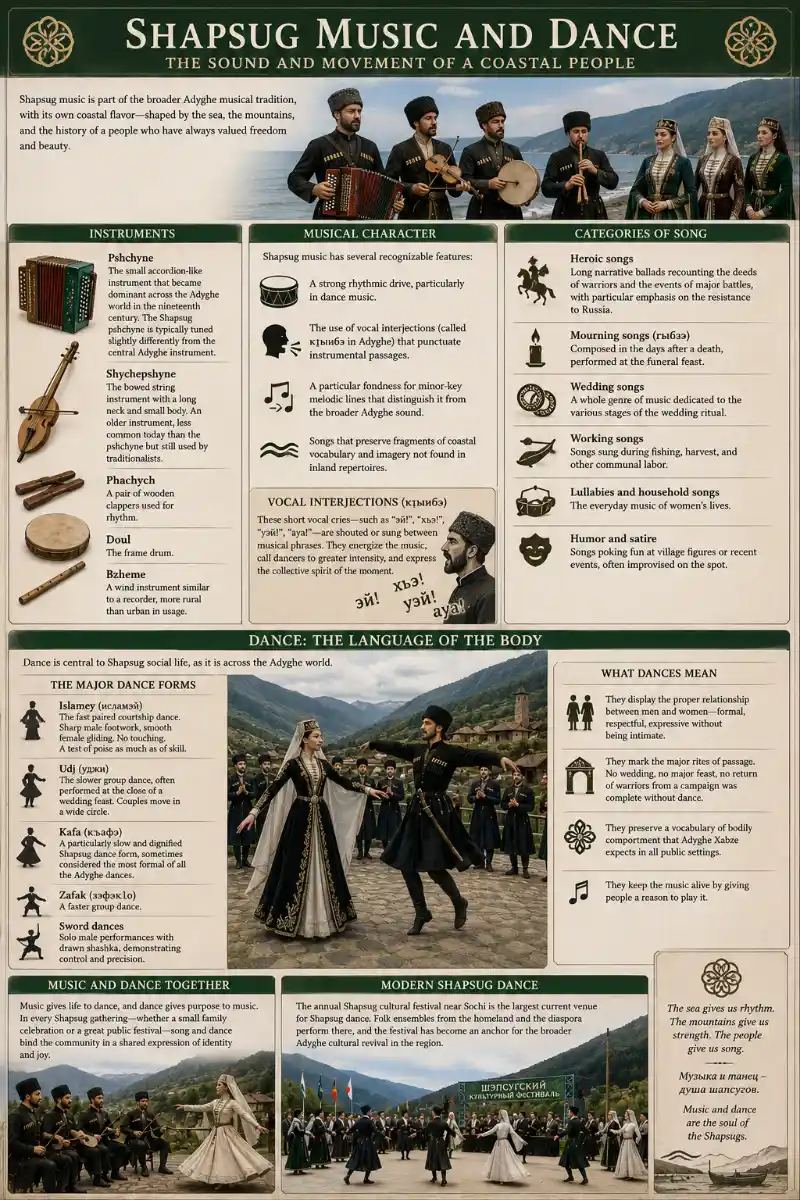
Shapsug music is part of the broader Adyghe musical tradition, with its own coastal flavor.
Instruments
Pshchyne. The small accordion-like instrument that became dominant across the Adyghe world in the nineteenth century. The Shapsug pshchyne is typically tuned slightly differently from the central Adyghe instrument.
Shychepshyne. The bowed string instrument with a long neck and small body. An older instrument, less common today than the pshchyne but still used by traditionalists.
Phachych. A pair of wooden clappers used for rhythm.
Doul. The frame drum.
Bzheme. A wind instrument similar to a recorder, more rural than urban in usage.
Musical character
Shapsug music has several recognizable features:
A strong rhythmic drive, particularly in dance music.
The use of vocal interjections (called кӏыибэ in Adyghe) that punctuate instrumental passages.
A particular fondness for minor-key melodic lines that distinguish it from the broader Adyghe sound.
Songs that preserve fragments of coastal vocabulary and imagery not found in inland repertoires.
Categories of song
Heroic songs. Long narrative ballads recounting the deeds of warriors and the events of major battles, with particular emphasis on the resistance to Russia.
Mourning songs (гыбзэ). Composed in the days after a death, performed at the funeral feast.
Wedding songs. A whole genre of music dedicated to the various stages of the wedding ritual.
Working songs. Songs sung during fishing, harvest, and other communal labor.
Lullabies and household songs. The everyday music of women's lives.
Humor and satire. Songs poking fun at village figures or recent events, often improvised on the spot.
Dance
Dance is central to Shapsug social life, as it is across the Adyghe world.
The major dance forms
Islamey (исламэй). The fast paired courtship dance. Sharp male footwork, smooth female gliding. No touching. A test of poise as much as of skill.
Udj (уджи). The slower group dance, often performed at the close of a wedding feast. Couples move in a wide circle.
Kafa (къафэ). A particularly slow and dignified Shapsug dance form, sometimes considered the most formal of all the Adyghe dances.
Zafak (зэфэкӏо). A faster group dance.
Sword dances. Solo male performances with drawn shashka, demonstrating control and precision.
What dances mean
Dances are not just entertainment. They carry layered meanings:
They display the proper relationship between men and women — formal, respectful, expressive without being intimate.
They mark the major rites of passage. No wedding, no major feast, no return of warriors from a campaign was complete without dance.
They preserve a vocabulary of bodily comportment that Adyghe Xabze expects in all public settings.
They keep the music alive by giving people a reason to play it.
Modern Shapsug dance
The annual Shapsug cultural festival near Sochi is the largest current venue for Shapsug dance. Folk ensembles from the homeland and the diaspora perform there, and the festival has become an anchor for the broader Adyghe cultural revival in the region.
Oral literature and folklore
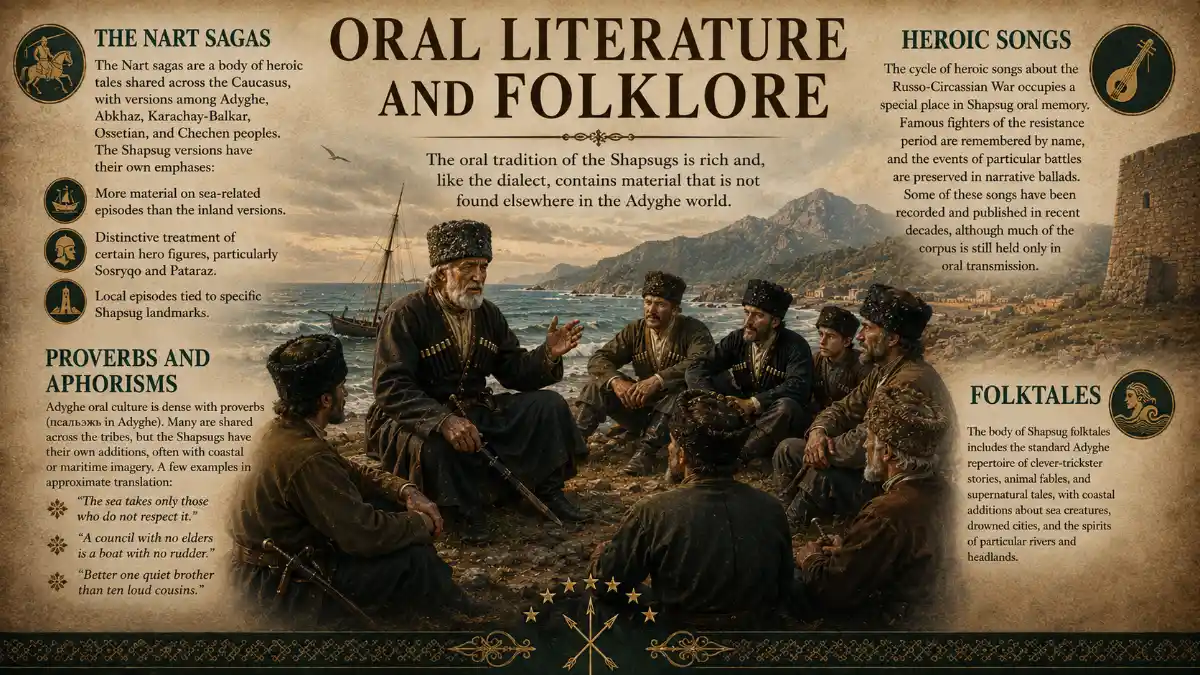
The oral tradition of the Shapsugs is rich and, like the dialect, contains material that is not found elsewhere in the Adyghe world.
The Nart sagas
The Nart sagas are a body of heroic tales shared across the Caucasus, with versions among Adyghe, Abkhaz, Karachay-Balkar, Ossetian, and Chechen peoples. The Shapsug versions have their own emphases:
More material on sea-related episodes than the inland versions.
Distinctive treatment of certain hero figures, particularly Sosryqo and Pataraz.
Local episodes tied to specific Shapsug landmarks.
Heroic songs
The cycle of heroic songs about the Russo-Circassian War occupies a special place in Shapsug oral memory. Famous fighters of the resistance period are remembered by name, and the events of particular battles are preserved in narrative ballads. Some of these songs have been recorded and published in recent decades, although much of the corpus is still held only in oral transmission.
Proverbs and aphorisms
Adyghe oral culture is dense with proverbs (псалъэжь in Adyghe). Many are shared across the tribes, but the Shapsugs have their own additions, often with coastal or maritime imagery. A few examples in approximate translation:
"The sea takes only those who do not respect it."
"A council with no elders is a boat with no rudder."
"Better one quiet brother than ten loud cousins."
Folktales
The body of Shapsug folktales includes the standard Adyghe repertoire of clever-trickster stories, animal fables, and supernatural tales, with coastal additions about sea creatures, drowned cities, and the spirits of particular rivers and headlands.
Cuisine
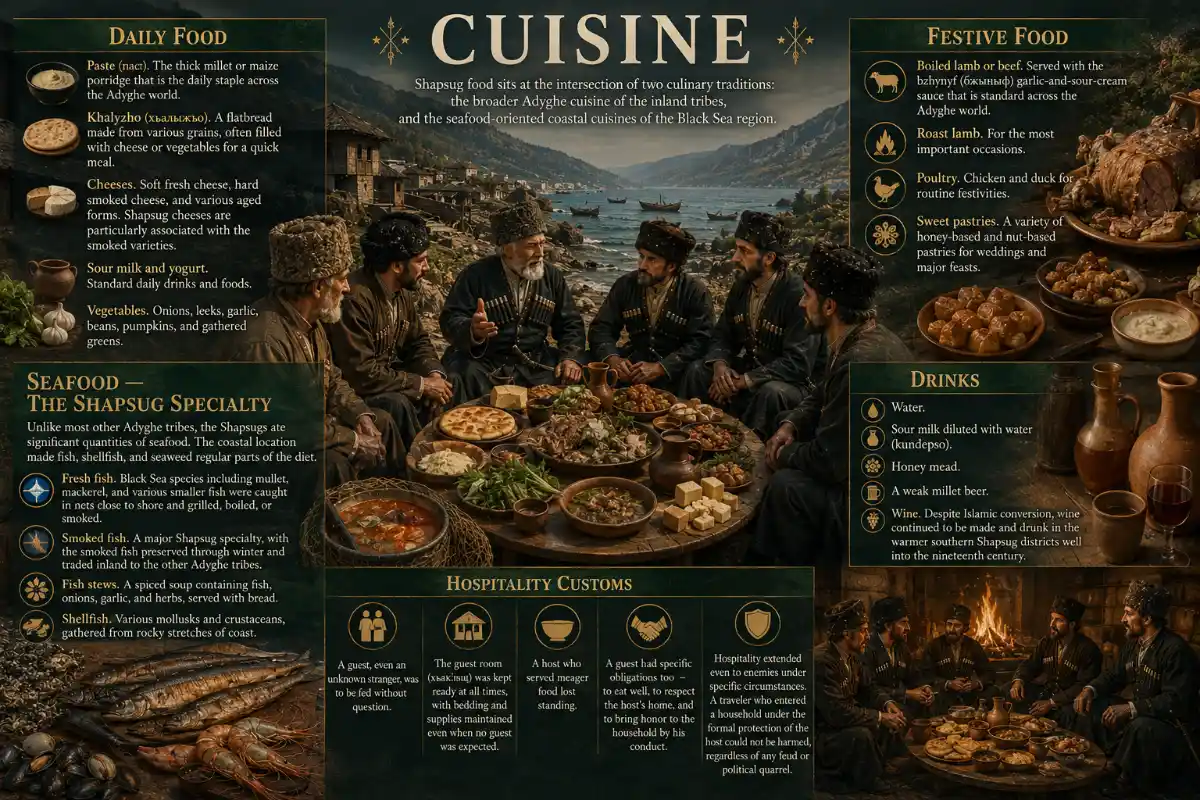
Shapsug food sits at the intersection of two culinary traditions: the broader Adyghe cuisine of the inland tribes, and the seafood-oriented coastal cuisines of the Black Sea region.
Daily food
Paste (паст). The thick millet or maize porridge that is the daily staple across the Adyghe world.
Khalyzho (хьалыжъо). A flatbread made from various grains, often filled with cheese or vegetables for a quick meal.
Cheeses. Soft fresh cheese, hard smoked cheese, and various aged forms. Shapsug cheeses are particularly associated with the smoked varieties.
Sour milk and yogurt. Standard daily drinks and foods.
Vegetables. Onions, leeks, garlic, beans, pumpkins, and gathered greens.
Seafood — the Shapsug specialty
Unlike most other Adyghe tribes, the Shapsugs ate significant quantities of seafood. The coastal location made fish, shellfish, and seaweed regular parts of the diet.
Fresh fish. Black Sea species including mullet, mackerel, and various smaller fish were caught in nets close to shore and grilled, boiled, or smoked.
Smoked fish. A major Shapsug specialty, with the smoked fish preserved through winter and traded inland to the other Adyghe tribes.
Fish stews. A spiced soup containing fish, onions, garlic, and herbs, served with bread.
Shellfish. Various mollusks and crustaceans, gathered from rocky stretches of coast.
Festive food
Boiled lamb or beef. Served with the bzhynyf (бжыныф) garlic-and-sour-cream sauce that is standard across the Adyghe world.
Roast lamb. For the most important occasions.
Poultry. Chicken and duck for routine festivities.
Sweet pastries. A variety of honey-based and nut-based pastries for weddings and major feasts.
Drinks
Water.
Sour milk diluted with water (kundepso).
Honey mead.
A weak millet beer.
Wine. Despite Islamic conversion, wine continued to be made and drunk in the warmer southern Shapsug districts well into the nineteenth century\
Hospitality customs
The Adyghe code of hospitality reached one of its most developed forms among the Shapsugs.
A guest, even an unknown stranger, was to be fed without question.
The guest room (хьакӏэщ) was kept ready at all times, with bedding and supplies maintained even when no guest was expected.
A host who served meager food lost standing.
A guest had specific obligations too — to eat well, to respect the host's home, and to bring honor to the household by his conduct.
Hospitality extended even to enemies under specific circumstances. A traveler who entered a household under the formal protection of the host could not be harmed, regardless of any feud or political quarrel.
Military tradition and the warrior code
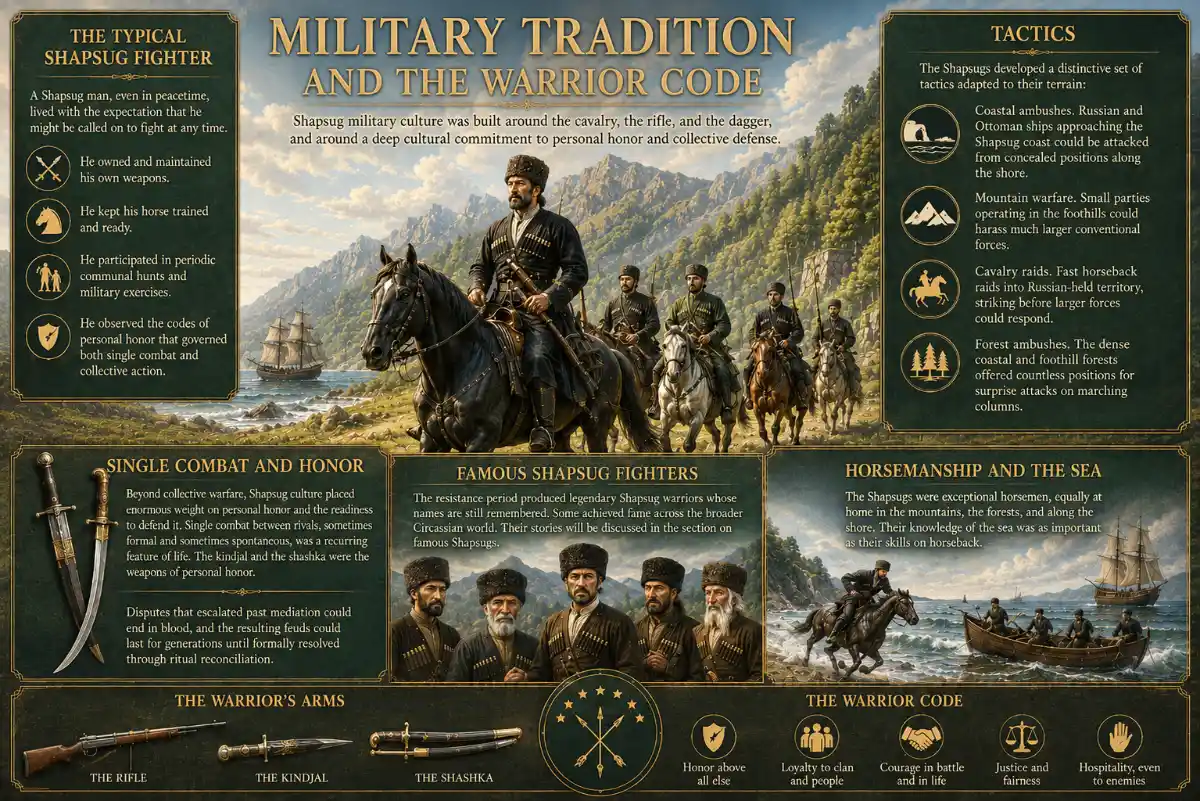
Shapsug military culture was built around the cavalry, the rifle, and the dagger, and around a deep cultural commitment to personal honor and collective defense.
The typical Shapsug fighter
A Shapsug man, even in peacetime, lived with the expectation that he might be called on to fight at any time.
He owned and maintained his own weapons.
He kept his horse trained and ready.
He participated in periodic communal hunts and military exercises.
He observed the codes of personal honor that governed both single combat and collective action.
Tactics
The Shapsugs developed a distinctive set of tactics adapted to their terrain:
Coastal ambushes. Russian and Ottoman ships approaching the Shapsug coast could be attacked from concealed positions along the shore.
Mountain warfare. Small parties operating in the foothills could harass much larger conventional forces.
Cavalry raids. Fast horseback raids into Russian-held territory, striking before larger forces could respond.
Forest ambushes. The dense coastal and foothill forests offered countless positions for surprise attacks on marching columns.
Single combat and honor
Beyond collective warfare, Shapsug culture placed enormous weight on personal honor and the readiness to defend it. Single combat between rivals, sometimes formal and sometimes spontaneous, was a recurring feature of life. The kindjal and the shashka were the weapons of personal honor. Disputes that escalated past mediation could end in blood, and the resulting feuds could last for generations until formally resolved through ritual reconciliation.
Famous Shapsug fighters
The resistance period produced legendary Shapsug warriors whose names are still remembered. Some achieved fame across the broader Circassian world. Their stories will be discussed in the section on famous Shapsugs.
Horsemanship and the sea
The Shapsugs combined two traditions that are rare to find together: serious horse culture and serious maritime culture.
Horse breeding
Like all the Adyghe, the Shapsugs bred and prized horses.
The standard Adyghe saddle horse, ancestral to the modern Kabardian breed, was found among the Shapsugs in good numbers.
Lesser Shapsugs in the mountains specialized in mountain breeds adapted to the rough terrain.
A Shapsug cavalryman's relationship with his horse was as close as anywhere in the Caucasus.
Maritime tradition
Unique among the major Adyghe tribes, the Shapsugs had a real maritime tradition:
Fishing in coastal waters and short-range voyages to Ottoman and Crimean ports.
A class of skilled boat-builders working in the natural harbors along the coast.
A vocabulary of nautical terms preserved in the Shapsug dialect.
Songs and oral traditions about the sea, including stories of particular voyages, storms, and rescues.
The maritime tradition was severely damaged by the Russian naval blockade during the late phase of the war and effectively ended with the deportation. Shapsug fishermen in the modern Lazarevsky community have revived some of the old practices in recent decades, but the deep cultural complex that surrounded the sea in the pre-1864 period is largely lost.
The Russo-Circassian War
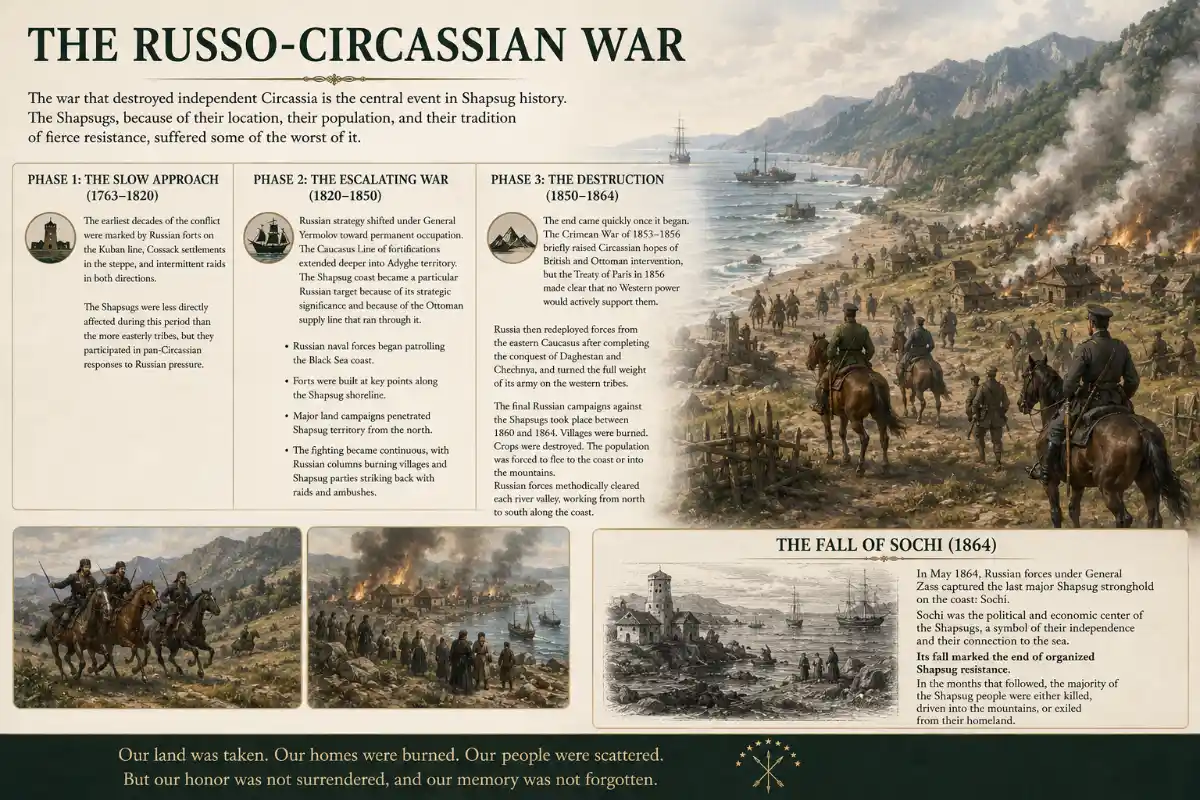
The war that destroyed independent Circassia is the central event in Shapsug history. The Shapsugs, because of their location, their population, and their tradition of fierce resistance, suffered some of the worst of it.
Phase 1: The slow approach (1763–1820)
The earliest decades of the conflict were marked by Russian forts on the Kuban line, Cossack settlements in the steppe, and intermittent raids in both directions. The Shapsugs were less directly affected during this period than the more easterly tribes, but they participated in pan-Circassian responses to Russian pressure.
Phase 2: The escalating war (1820–1850)
Russian strategy shifted under General Yermolov toward permanent occupation. The Caucasus Line of fortifications extended deeper into Adyghe territory. The Shapsug coast became a particular Russian target because of its strategic significance and because of the Ottoman supply line that ran through it.
Russian naval forces began patrolling the Black Sea coast.
Forts were built at key points along the Shapsug shoreline.
Major land campaigns penetrated Shapsug territory from the north.
The fighting became continuous, with Russian columns burning villages and Shapsug parties striking back with raids and ambushes.
Phase 3: The destruction (1850–1864)
The end came quickly once it began. The Crimean War of 1853–1856 briefly raised Circassian hopes of British and Ottoman intervention, but the Treaty of Paris in 1856 made clear that no Western power would actively support them. Russia then redeployed forces from the eastern Caucasus after completing the conquest of Daghestan and Chechnya, and turned the full weight of its army on the western tribes.
The final Russian campaigns against the Shapsugs took place between 1860 and 1864. Villages were burned. Crops were destroyed. The population was forced to flee to the coast or into the mountains. Russian forces methodically cleared each river valley, working from north to south along the coast.
The Fall of Sochi (1864)
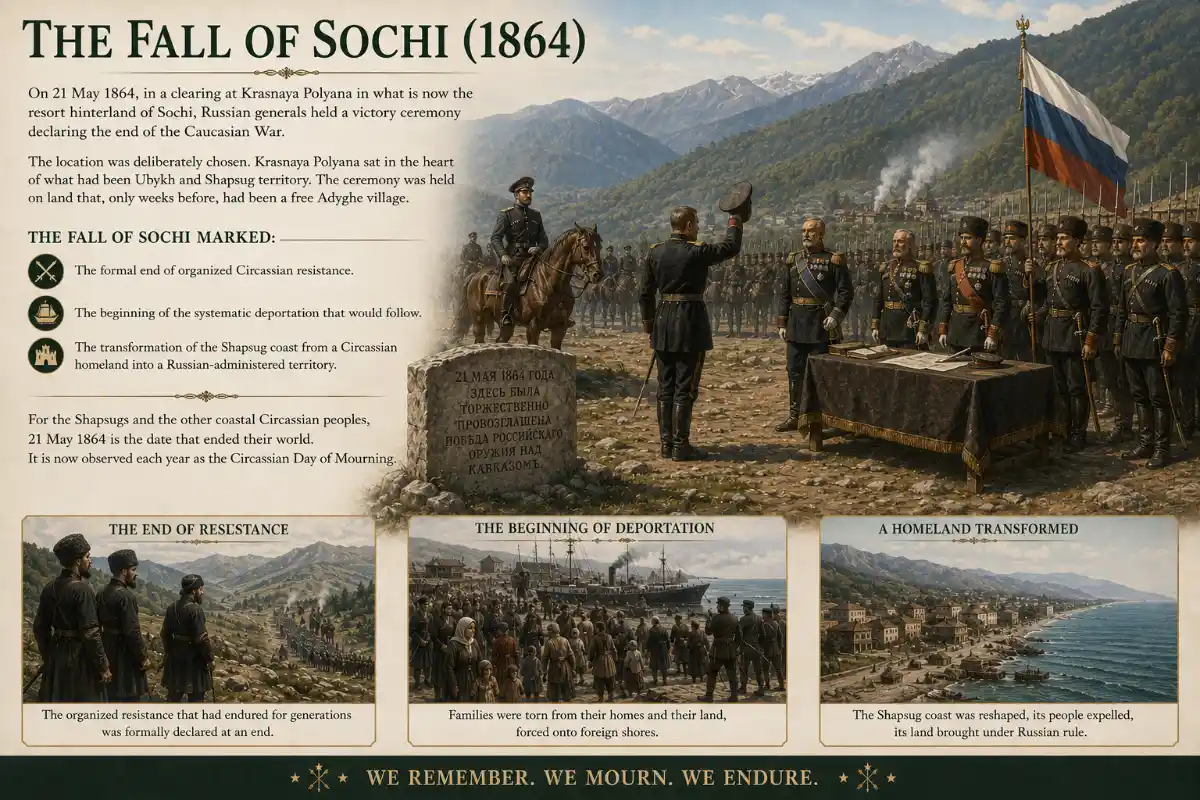
On 21 May 1864, in a clearing at Krasnaya Polyana in what is now the resort hinterland of Sochi, Russian generals held a victory ceremony declaring the end of the Caucasian War.
The location was deliberately chosen. Krasnaya Polyana sat in the heart of what had been Ubykh and Shapsug territory. The ceremony was held on land that, only weeks before, had been a free Adyghe village.
The Fall of Sochi marked:
The formal end of organized Circassian resistance.
The beginning of the systematic deportation that would follow.
The transformation of the Shapsug coast from a Circassian homeland into a Russian-administered territory.
For the Shapsugs and the other coastal Circassian peoples, 21 May 1864 is the date that ended their world. It is now observed each year as the Circassian Day of Mourning.
Exile and the muhajirs
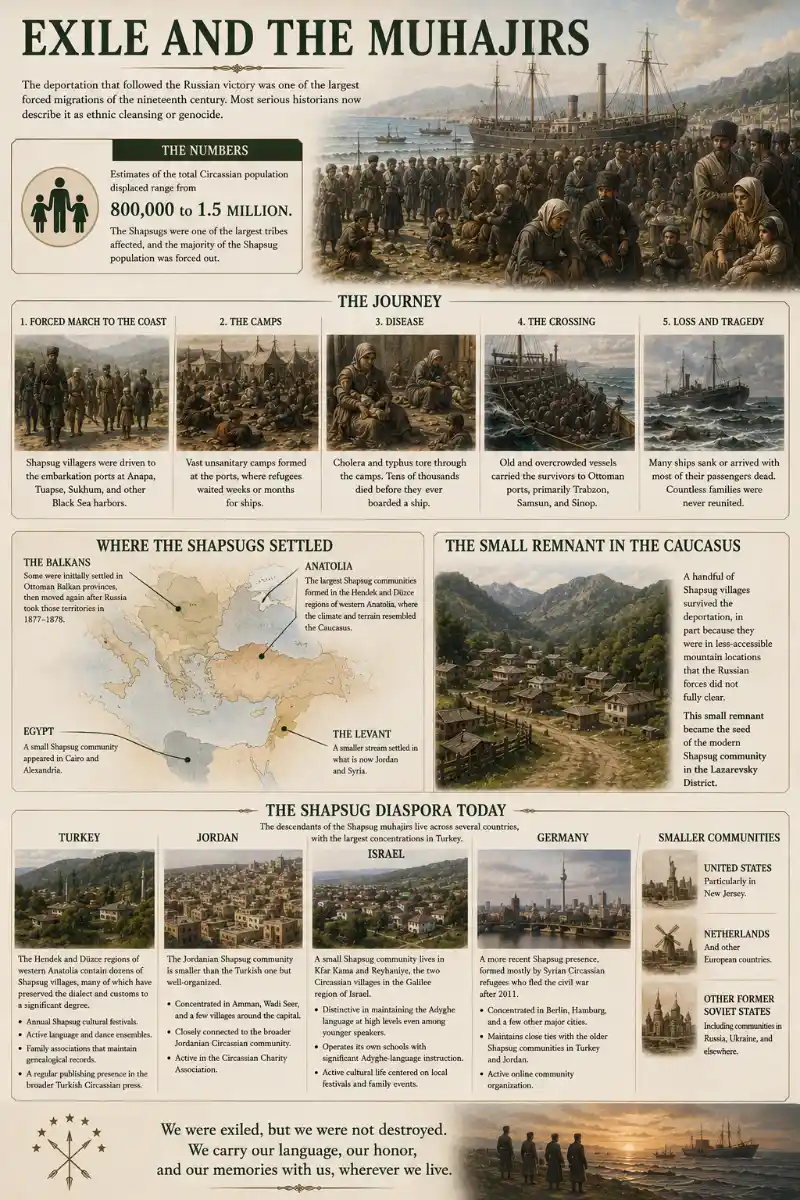
The deportation that followed the Russian victory was one of the largest forced migrations of the nineteenth century. Most serious historians now describe it as ethnic cleansing or genocide.
The numbers
Estimates of the total Circassian population displaced range from 800,000 to 1.5 million. The Shapsugs were one of the largest tribes affected, and the majority of the Shapsug population was forced out.
The journey
Forced march to the coast. Shapsug villagers were driven to the embarkation ports at Anapa, Tuapse, Sukhum, and other Black Sea harbors.
The camps. Vast unsanitary camps formed at the ports, where refugees waited weeks or months for ships.
Disease. Cholera and typhus tore through the camps. Tens of thousands died before they ever boarded a ship.
The crossing. Old and overcrowded vessels carried the survivors to Ottoman ports, primarily Trabzon, Samsun, and Sinop. Many ships sank or arrived with most of their passengers dead.
Where the Shapsugs settled
Anatolia. The largest Shapsug communities formed in the Hendek and Düzce regions of western Anatolia, where the climate and terrain resembled the Caucasus.
The Balkans. Some Shapsugs were initially settled in Ottoman Balkan provinces, then moved again after Russia took those territories in 1877–1878.
The Levant. A smaller stream settled in what is now Jordan and Syria.
Egypt. A small Shapsug community appeared in Cairo and Alexandria.
The small remnant in the Caucasus
A handful of Shapsug villages survived the deportation, in part because they were in less-accessible mountain locations that the Russian forces did not fully clear. This small remnant became the seed of the modern Shapsug community in the Lazarevsky District.
The Shapsug diaspora today
The descendants of the Shapsug muhajirs live across several countries, with the largest concentrations in Turkey.
Turkey
The Hendek and Düzce regions of western Anatolia contain dozens of Shapsug villages, many of which have preserved the dialect and customs to a significant degree.
Annual Shapsug cultural festivals.
Active language and dance ensembles.
Family associations that maintain genealogical records.
A regular publishing presence in the broader Turkish Circassian press.
Jordan
The Jordanian Shapsug community is smaller than the Turkish one but well-organized.
Concentrated in Amman, Wadi Seer, and a few villages around the capital.
Closely connected to the broader Jordanian Circassian community.
Active in the Circassian Charity Association.
Israel
A small Shapsug community lives in Kfar Kama and Reyhaniye, the two Circassian villages in the Galilee region of Israel.
Distinctive in maintaining the Adyghe language at high levels even among younger speakers.
Operates its own schools with significant Adyghe-language instruction.
Active cultural life centered on local festivals and family events.
Germany
A more recent Shapsug presence, formed mostly by Syrian Circassian refugees who fled the civil war after 2011.
Concentrated in Berlin, Hamburg, and a few other major cities.
Maintains close ties with the older Shapsug communities in Turkey and Jordan.
Active online community organization.
Smaller communities
Shapsugs also live in:
The United States, particularly in New Jersey
The Netherlands and other European countries
Other former Soviet states
The remnant community in Lazarevsky
The Lazarevsky District is one of the seven districts of the city of Sochi, located along the Black Sea coast just north of the city center. It contains about 14 villages that retain a significant Shapsug population, with the total Shapsug count in the district at about 10,000 people.
What makes this community unique
It is the only Circassian community still living on the original Black Sea coast.
Its members are the direct descendants of those few Shapsug families who escaped the 1864 deportation.
It has maintained the Shapsug dialect at a higher level than most diaspora communities.
It hosts the annual Shapsug cultural festival, which draws Circassians from across Russia and the diaspora.
Modern life
The community lives in an area that has become one of Russia's premier resort destinations, with consequences that are complicated.
Tourism brings income and visibility.
It also brings development pressure on traditional villages.
The 2014 Winter Olympics in Sochi raised global awareness of the Circassian presence and drew international attention to the unresolved questions about the 1864 deportation.
The community has been pushing for greater official recognition of its status, its language, and the events that produced it.
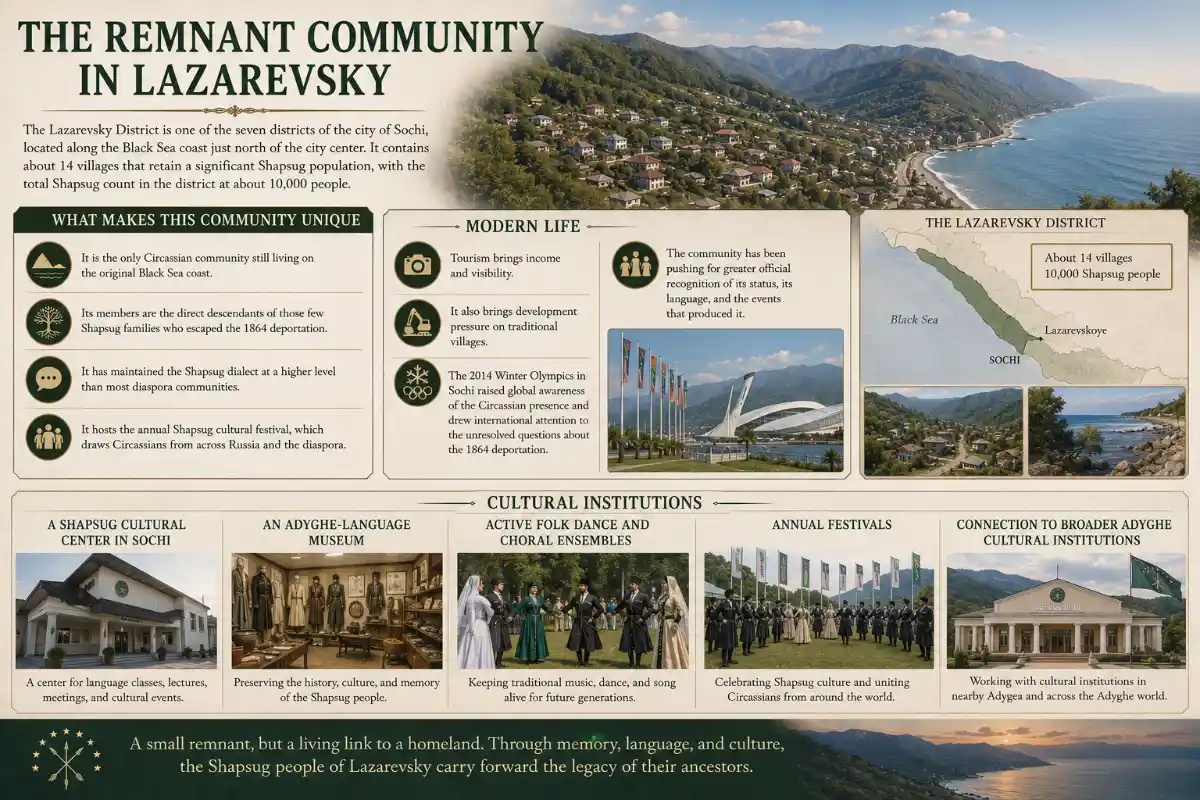
Cultural institutions
A Shapsug cultural center in Sochi
An Adyghe-language museum
Active folk dance and choral ensembles
Annual festivals
Connection to broader Adyghe cultural institutions in nearby Adygea
Famous Shapsugs
Some Shapsugs by birth, others closely associated with the tribe through service and family ties, stand out in the historical record.
Hawduko Mansur
A senior Shapsug military leader during the major Russian campaigns of the 1840s and 1850s. Hawduko commanded coastal defenses against Russian naval forces and was respected across the Circassian world for his discipline and his refusal to compromise with Russian authorities. He is the subject of numerous heroic songs.
Sefer Bey Zan
A Natukhay by birth but closely tied to the Shapsugs through marriage and military service, Sefer Bey served as the chief Circassian envoy to the Ottoman court during the Crimean War. He spent significant time among the Shapsugs organizing local levies and negotiating supply arrangements. His diplomatic memoranda are key sources for understanding the politics of the western Caucasus in the 1850s.
Hajj Berzeg Kerantukh
A leader of the late phase of the resistance who commanded combined Shapsug, Natukhay, and Ubykh forces in the final operations against Russia. After the deportation he became a major figure in the Ottoman Circassian community.
Tlestan Aubla
A Shapsug nobleman whose career exemplified the contradictions of the late period. He served at different points as a resistance commander and as a negotiator with Russian authorities. His memoirs, written in exile, are one of the few first-person accounts of the war from a Circassian perspective.
The Akhejak family
A Shapsug noble lineage that produced several notable military and political figures during the resistance period. Descendants of the Akhejak line are documented today in Turkey, Jordan, and the Lazarevsky community.
Modern figures
The contemporary Shapsug diaspora has produced writers, scholars, artists, and political figures across multiple countries. The full biographical catalogue would run to many pages, and Adyghe cultural associations in Adygea, Turkey, and Jordan continue to compile and update such records.
Notable Shapsug families and clans
The full Shapsug genealogical tradition is complex, partially oral, and still being reconstructed. Some of the major lineages include:
Hawduko (Хьаудыкъу). Associated with military leadership during the resistance.
Berzeg (Бэрзэдж). A widespread Shapsug name with branches in multiple diaspora communities.
Tsey (Цей). A historic Shapsug family name.
Akhejak (Ахэджак). A noble lineage that produced multiple figures of regional significance.
Aubla (Аублэ). Connected to the Tlestan figure mentioned above.
Khatkhu (Хьатху). Found across several Adyghe tribes including the Shapsugs.
Shogen (Шъогъэн). A name with deep Shapsug roots and broad diaspora distribution.
Natkho (Натхъу). Historically associated with the Natukhays but with Shapsug branches as well.
If your family name resembles any of these, or appears in lists of historical Shapsug families, you may have Shapsug ancestry. The section on tracing ancestry below explains how to investigate further.
The Shapsug tamga
A tamga (тамгъэ) is a small abstract heraldic symbol that identifies a family or clan. Every major Shapsug family had one.
Where Shapsug tamgas appeared
Branded on horses and cattle
Carved into gravestones
Painted on shields and battle banners
Engraved on weapons and silverware
Stamped on important documents
Cut into the gateposts of family compounds
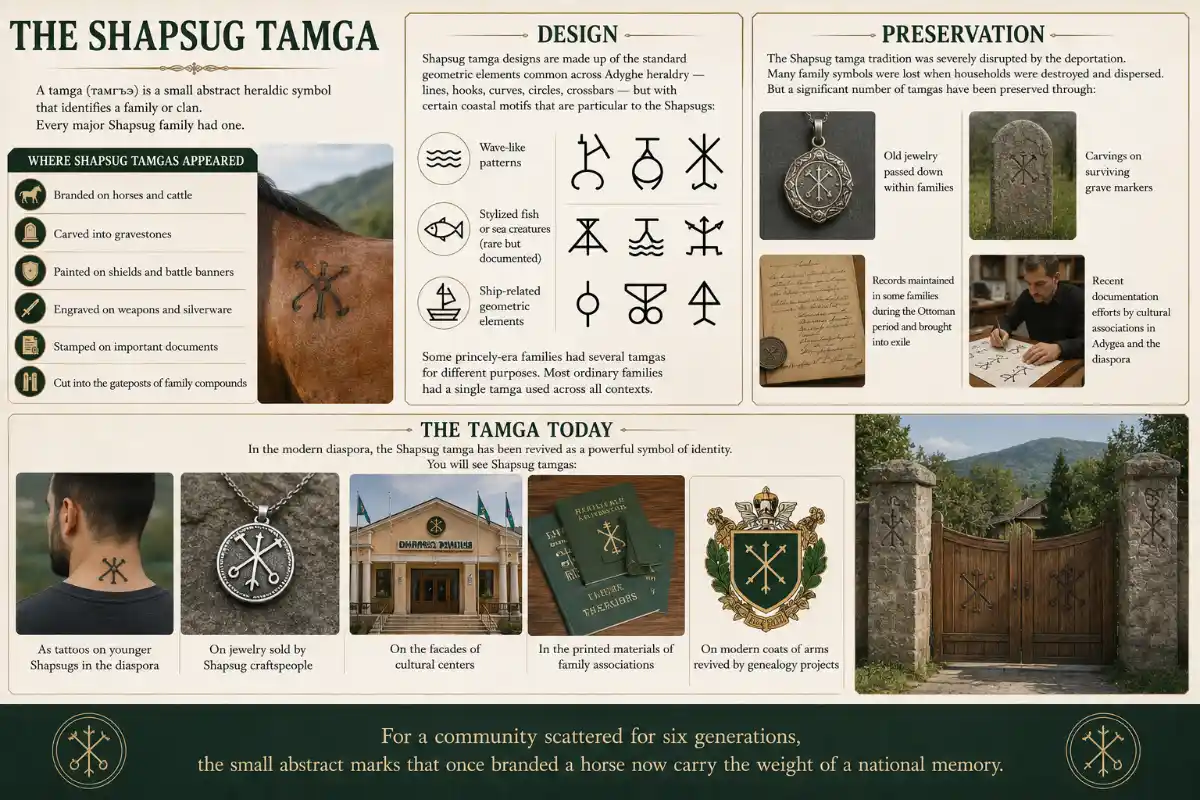
Design
Shapsug tamga designs are made up of the standard geometric elements common across Adyghe heraldry — lines, hooks, curves, circles, crossbars — but with certain coastal motifs that are particular to the Shapsugs:
Wave-like patterns
Stylized fish or sea creatures (rare but documented)
Ship-related geometric elements
Some princely-era families had several tamgas for different purposes. Most ordinary families had a single tamga used across all contexts.
Preservation
The Shapsug tamga tradition was severely disrupted by the deportation. Many family symbols were lost when households were destroyed and dispersed. But a significant number of tamgas have been preserved through:
Old jewelry passed down within families
Carvings on surviving grave markers
Records maintained in some families during the Ottoman period and brought into exile
Recent documentation efforts by cultural associations in Adygea and the diaspora
The tamga today
In the modern diaspora, the Shapsug tamga has been revived as a powerful symbol of identity. You will see Shapsug tamgas:
As tattoos on younger Shapsugs in the diaspora
On jewelry sold by Shapsug craftspeople
On the facades of cultural centers
In the printed materials of family associations
On modern coats of arms revived by genealogy projects
For a community scattered for six generations, the small abstract marks that once branded a horse now carry the weight of a national memory.
Modern cultural revival
Since the late 1980s, Shapsug cultural life has gone through a real revival, both in the homeland and the diaspora.
In the Lazarevsky community
The annual Shapsug Festival, held in late summer, draws thousands of Shapsugs from Russia and abroad.
Language classes in several schools.
Folk dance ensembles that perform locally and internationally.
A growing scholarly output on Shapsug history and language.
Ongoing pressure for recognition of the Shapsug as a separately enumerated indigenous people within the Russian Federation.
In Turkey
Multiple village-level cultural associations.
Regular language courses, although attendance is uneven.
Active publishing of Shapsug-themed material in Turkish.
Annual events tied to 21 May (Circassian Day of Mourning).
Growing online presence connecting younger generations.
In Jordan, Israel, and Germany
Smaller-scale cultural events.
Family-level transmission of customs.
Integration with broader Circassian cultural institutions.
Recent attention to digital genealogy and family-tree work.
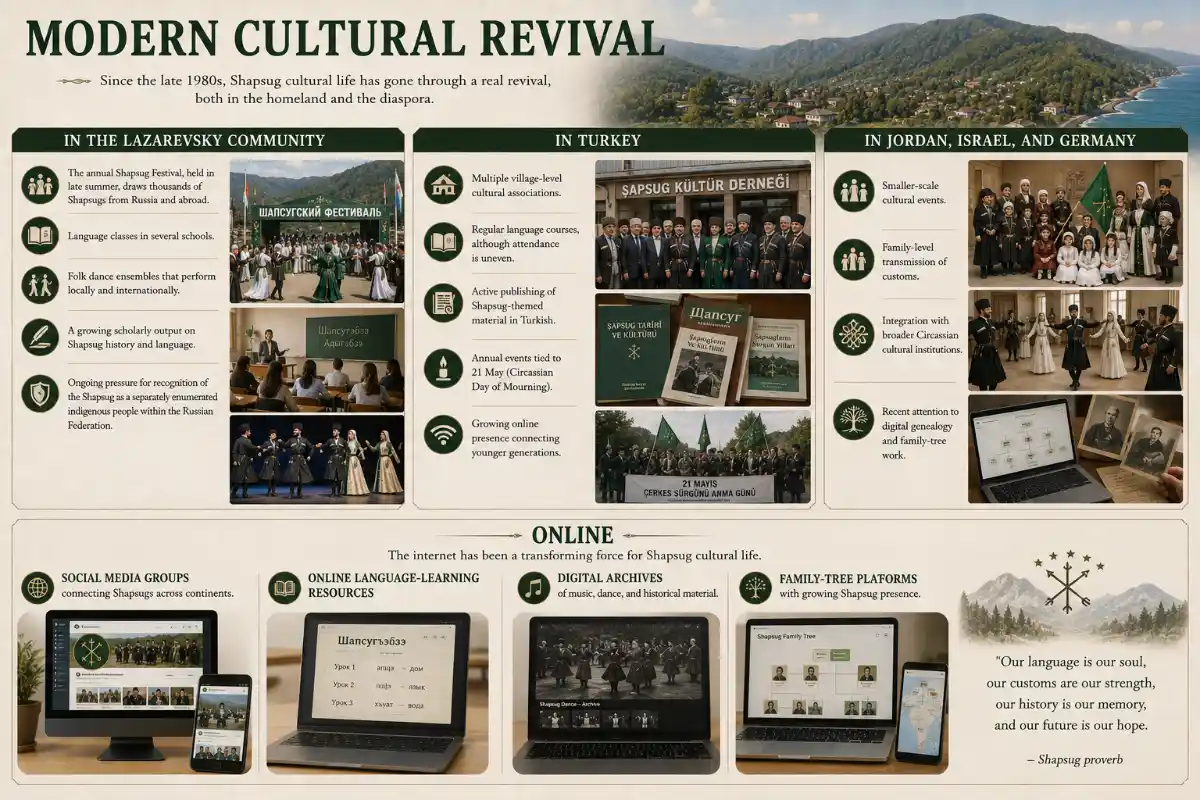
Online
The internet has been a transforming force for Shapsug cultural life.
Social media groups connecting Shapsugs across continents.
Online language-learning resources.
Digital archives of music, dance, and historical material.
Family-tree platforms with growing Shapsug presence.
How to trace Shapsug ancestry
If you suspect you have Shapsug roots, here is a practical approach.
Step 1: Talk to your elders
Begin with the oldest living relatives you can reach. Ask about:
The family surname in its original form, before any diaspora adaptations.
Tribal identity. Specifically: Shapsug, Şapsığ, or Chapsough.
Sub-group identity, if known. Greater (coastal) or Lesser (mountain) Shapsug?
Original village in the Caucasus.
Migration story: which port, which year, which first settlement.
Names of grandparents and great-grandparents.
Old photographs, documents, jewelry, or items with family symbols.
Record the conversations. Take notes. Sit with more than one elder if possible.
Step 2: Check your surname
Compare your surname against published lists of historical Shapsug families. Look for:
Original Adyghe form of the name.
Tribal affiliation in available records.
Variant spellings (Turkish, Arabic, Russian, Hebrew).
Other families with the same or similar names.
If your surname does not appear in any database right away, try variant spellings and ask the broader Shapsug community for help.
Step 3: Identify your tamga
If your family has preserved a tamga, photograph it and compare against catalogues. Likely sources include:
Old jewelry, particularly rings and pendants.
Carvings on family grave markers.
Stamps on inherited documents.
Drawings in old family books.
Step 4: Build a tree
Start with yourself and work outward and backward. For each ancestor, record:
Full name in original and diaspora forms.
Dates and places of birth, marriage, and death.
Tribal and sub-tribal affiliation.
Original Caucasus village.
Migration history.
Step 5: Use archives (advanced)
Ottoman population registers for diaspora settlement-era records.
Russian archives for those who stayed in the Caucasus.
Jordanian land grants for the late nineteenth-century settlement wave.
Soviet-era census data.
Some of this work needs specialist researchers fluent in Ottoman Turkish, Russian, or Adyghe.
Step 6: Connect with the community
Shapsug cultural associations exist in:
The Lazarevsky District (Sochi)
Maikop (general Adyghe institutions)
Istanbul, Ankara, and the major Turkish Shapsug villages
Amman
Berlin and other European cities
New Jersey and other diaspora locations
Joining one of these communities is often the fastest way to find living cousins and to get help with the harder parts of the research.
Step 7: Share and contribute
When you have built something meaningful, share it. Add to public databases (with permissions you control). Record older relatives. Pass the tree to the next generation. Adyghe genealogy is a shared inheritance, not a private hobby.
Frequently asked questions
Who are the Shapsugs?
One of the twelve Circassian tribes. Native name Шапсыгъ. Historical homeland on the western Black Sea coast and adjacent mountains. Today the descendants live in Turkey, Jordan, Israel, Germany, Russia, and elsewhere, with a small remnant community of about 10,000 people in the Lazarevsky District near Sochi.
Why were the Shapsugs called democratic?
Because, unlike most other Adyghe tribes, they did not have hereditary princes. Major decisions were made in open councils (khase) of free men, and authority depended on age, demonstrated leadership, and public consent rather than inherited rank.
What does the name mean?
The exact etymology is uncertain. The most common explanation traces it to an early founder or clan grouping. A few scholars have suggested topographical origins, but the founder-name theory is the more widely accepted one.
Where did the Shapsugs live?
Along the Black Sea coast from modern-day Tuapse in the south to beyond Anapa in the north, and inland into the western foothills of the Greater Caucasus.
What is the difference between Greater and Lesser Shapsugs?
The Greater Shapsugs were the coastal population, while the Lesser Shapsugs lived in the mountains and foothills inland. The two groups intermarried freely and considered themselves one tribe, but their economies and customs differed in detail.
Are the Shapsugs Muslim?
Most Shapsugs today identify as Sunni Muslim (Hanafi school). The conversion was gradual, taking place between the seventeenth and early nineteenth centuries. Pre-Islamic Adyghe customs continue to influence daily life.
What happened to them in 1864?
The Russian Empire completed its conquest of the western Caucasus and carried out a mass deportation of the Adyghe population, including most of the Shapsugs. Most serious historians describe this as ethnic cleansing or genocide.
Where do Shapsugs live today?
The largest communities are in Turkey (Hendek, Düzce, and other Anatolian areas), with significant populations in Jordan, Israel, Germany, and elsewhere. About 10,000 Shapsugs live in the Lazarevsky District near Sochi, the only Circassian community still on its original Black Sea coast.
What language do they speak?
The Shapsug dialect of West Circassian (Adyghe). It is closely related to the other West Circassian dialects (Bzhedug, Abdzakh, Temirgoy) and more distantly to Kabardian.
Is the Shapsug dialect endangered?
Yes. Use is declining in the diaspora and slowly declining in the Lazarevsky community as well. Cultural revival efforts, language classes, and broadcast programming are working against the trend.
What is the Shapsug Festival?
An annual cultural event held near Sochi each summer, drawing Shapsugs from across Russia and the global diaspora. It features dance, music, food, exhibitions, and cultural activities. It has become one of the major anchors of contemporary Shapsug identity.
What is the Circassian Day of Mourning?
21 May, the anniversary of the Russian victory ceremony at Krasnaya Polyana in 1864. Observed each year by Circassians worldwide in memory of the victims of the war and the deportation.
Are there Shapsug villages I can visit?
Yes. The Lazarevsky District near Sochi contains the only Shapsug villages on the ancestral homeland. Several of the Anatolian Shapsug villages in Hendek and Düzce welcome visitors. Travel to all of these is straightforward with planning.
How do I find out if I am Shapsug?
Start with family oral tradition. Ask older relatives about tribal identity, sub-group identity (Greater or Lesser Shapsug), and original village. Compare your surname against published Adyghe surname lists. Connect with Shapsug cultural associations in your country or the broader region.
What is a tamga?
A small abstract heraldic symbol used by Circassian families to mark property and identify lineage. Shapsug families had their own tamgas, and the tradition has been revived in the modern diaspora as a marker of identity.
Has the Circassian deportation been recognized as genocide?
Some governments and parliaments, notably Georgia in 2011, have recognized it as genocide. Russia has not. International recognition remains a major cause among Circassian activists.
Resources and further reading
Books in English
Walter Richmond, The Northwest Caucasus: Past, Present, Future (2008)
Walter Richmond, The Circassian Genocide (2013)
Charles King, The Ghost of Freedom: A History of the Caucasus (2008)
Various academic essays in the journals of Caucasian studies
Books in Russian
Publications of the Adyghe Republican Institute of Humanitarian Studies (ARIGI), Maikop
L. I. Lavrov's classic ethnographies of the Adyghe
Specialized studies of Shapsug history and culture published in recent decades
Documentation of Shapsug folklore and oral tradition
Books in Turkish
Publications of the Kafkas Vakfı (Caucasus Foundation), Istanbul
Studies of the Anatolian Shapsug villages, particularly Hendek and Düzce
Memoirs and family histories from Turkish Shapsug authors
The journal Nart
Online resources
CircassianWeb and related cultural sites
Online language-learning material for Adyghe
Shapsug-focused social media communities
Digital archives of music and dance recordings
Archives
Russian state archives in Moscow and Saint Petersburg
Ottoman archives in Istanbul, particularly for the resettlement period
Local Anatolian provincial archives for village-level records
The Lazarevsky District local archives
Language learning
Adyghe grammars and dictionaries
Online courses and apps focused on West Circassian
Adyghe-language YouTube channels and podcasts
University programs at Maikop and elsewhere
Cultural associations to know
Shapsug Cultural Center, Lazarevsky District (Sochi)
Kafkas Vakfı, Istanbul
Circassian Charity Association, Amman
The Adyghe associations of Kfar Kama and Reyhaniye in Israel
Diaspora associations in Germany, the Netherlands, and the United States
Cultural legacy
The Shapsugs are a tribe that survived. Not whole, not on their own land, not in anything like their pre-1864 numbers. But survived.
They lost their warriors. They lost their coastal villages. They lost most of their territory. They lost their independence. They were forced into ships at the Black Sea ports and sent across to a Muslim empire that did not know what to do with them. The ones who escaped, the small remnant in the mountains above Sochi, kept the language and the customs alive in tiny villages that the world rarely noticed.
And yet today, six generations after the catastrophe, the Shapsugs are still here.
They are here on the original coast in the Lazarevsky community, the only Circassian people still living on the Black Sea homeland of their ancestors.
They are here in the villages of Hendek and Düzce, where children still speak some Adyghe and the old dance steps are taught.
They are here in Amman and Kfar Kama and Berlin and New Jersey, in family memory and at the annual gatherings, in the work of cultural associations, in the slow, patient genealogical work of families who refuse to forget.
The annual festival near Sochi has become an unlikely act of collective resistance. Every year more people come. Every year the younger generation pushes a little harder to learn the language. Every year the conversation about who the Shapsugs are, and what they survived, gets a little louder.
The story of the Shapsugs is not finished. It is being lived, right now, in three continents.
Шапсыгъ. Guardians of the Black Sea coast. The democratic tribe. The people who would not surrender, and the people who would not, in the end, be forgotten.
Their names are still here. Their songs are still being sung. Their tamgas still mark the gravestones of their dead and the necklaces of their grandchildren. Their dance is still danced. The story continues.
And every Shapsug today, in any country and in any language, carries forward a small piece of what was almost lost.