The Natukhai Tribe: Circassian Lords of the Black Sea Coast
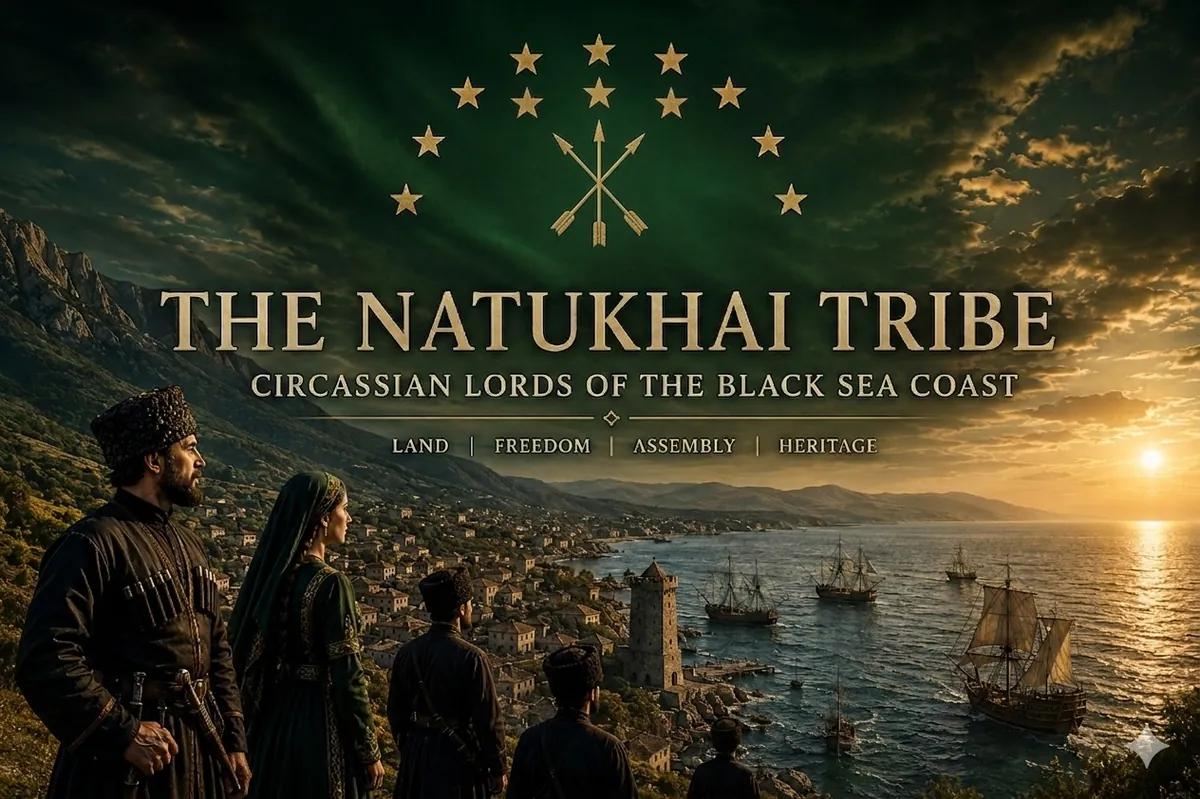
The 12 Circassian Tribes · Natukhai
The Natukhai Tribe: Circassian Lords of the Black Sea Coast
Натхъуадж. The maritime Adyghe people who ruled the coast from Anapa to Tsemez, governed themselves by elected assembly, traded with the Mediterranean for centuries, and lost their entire homeland to Russian conquest in 1864.
CircassianWebUpdated: January 202622–26 min readTribe profile
The Natukhai (Адыгэ: Натхъуадж; sometimes Natkhuaj, Natukhaj, Natkhwaj) were one of the twelve Circassian tribes. They lived along the Black Sea coast of the northwestern Caucasus, in a strip of territory that ran roughly from Anapa in the north to Tsemez (modern Novorossiysk) in the south. Inland, their lands extended into the foothills of the Caucasus mountains. They were one of the largest Adyghe peoples before 1864, with population estimates running between two hundred thousand and two hundred and forty thousand at the start of the nineteenth century. They were governed by elected assemblies (Хасэ / Khasa), not by hereditary princes. They were maritime in a way no other Circassian tribe was, with fishing fleets, coastal trade, and centuries of contact with the Ottoman Empire and the wider Mediterranean. Their main port stood on the site of ancient Sindica, a place that had handled coastal commerce since classical antiquity.
And they lost everything. The Russian conquest of the Black Sea coast was the first phase of the broader Russo-Circassian War, and the Natukhai homeland was the first Adyghe territory to fall under direct Russian military pressure. By 1864, the deportations had emptied almost the entire coastal strip. The land was given to Russian, Ukrainian, Greek, and Armenian settlers. The cities of Anapa, Novorossiysk, Gelendzhik, and the smaller resort towns that today form Russia's southern Black Sea coast were built on what had been Natukhai land. The tribe survived only in the diaspora, primarily in Turkey, where Natukhai families settled alongside other Adyghe refugees in central and northern Anatolia.
This is the long-form profile of the Natukhai. It covers who they were, what their coastal homeland looked like, how their democratic assembly system worked, what their dialect sounded like, how their maritime economy connected the Adyghe world to the Mediterranean, the long Russian campaign against the coast that ended in 1864, the catastrophic completeness of the expulsion, the cities and resort towns that now occupy their former villages, the diaspora, the surviving surnames, the tamga tradition, the genetic markers, and a five-step framework for tracing your own Natukhai ancestry. Sources include Wikipedia's Natukhai entry, Amjad Jaimoukha's The Circassians: A Handbook (2001), Walter Richmond's The Circassian Genocide, primary material from Russian and Ottoman archives, and the FamilyTreeDNA Circassian DNA Project.
If your family identifies as Natukhai, this article is for you. If you suspect Natukhai heritage from a half-translated surname, a remembered Black Sea port name, or a grandparent's reference to "Anapa" or "the coast" or "Sindica," the framework here will help you confirm or rule it out.
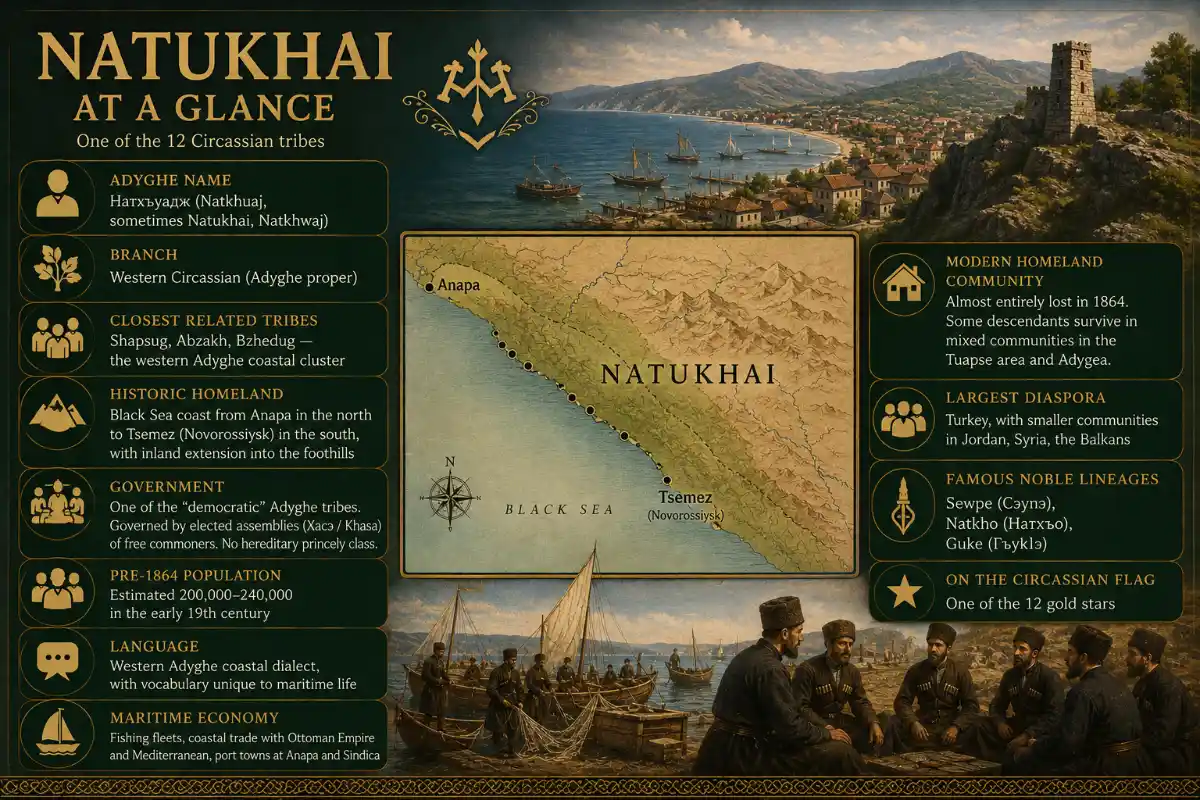
Natukhai at a glance
Adyghe name
Натхъуадж (Natkhuaj, sometimes Natukhai, Natkhwaj)
Branch Western Circassian (Adyghe proper)
Closest related tribes Shapsug, Abzakh, Bzhedug — the western Adyghe coastal cluster
Historic homeland Black Sea coast from Anapa in the north to Tsemez (Novorossiysk) in the south, with inland extension into the foothills
Government One of the "democratic" Adyghe tribes. Governed by elected assemblies (Хасэ / Khasa) of free commoners. No hereditary princely class.
Pre-1864 population Estimated 200,000-240,000 in the early 19th century
Language Western Adyghe coastal dialect, with vocabulary unique to maritime life
Maritime economy Fishing fleets, coastal trade with Ottoman Empire and Mediterranean, port towns at Anapa and Sindica
Modern homeland community Almost entirely lost in 1864. Some descendants survive in mixed communities in the Tuapse area and Adygea.
Largest diaspora Turkey, with smaller communities in Jordan, Syria, the Balkans
Famous noble lineages Sewpe (Сэупэ), Natkho (Натхъо), Guke (Гъукlэ)
On the Circassian flag One of the 12 gold stars
Who Are the Natukhai?
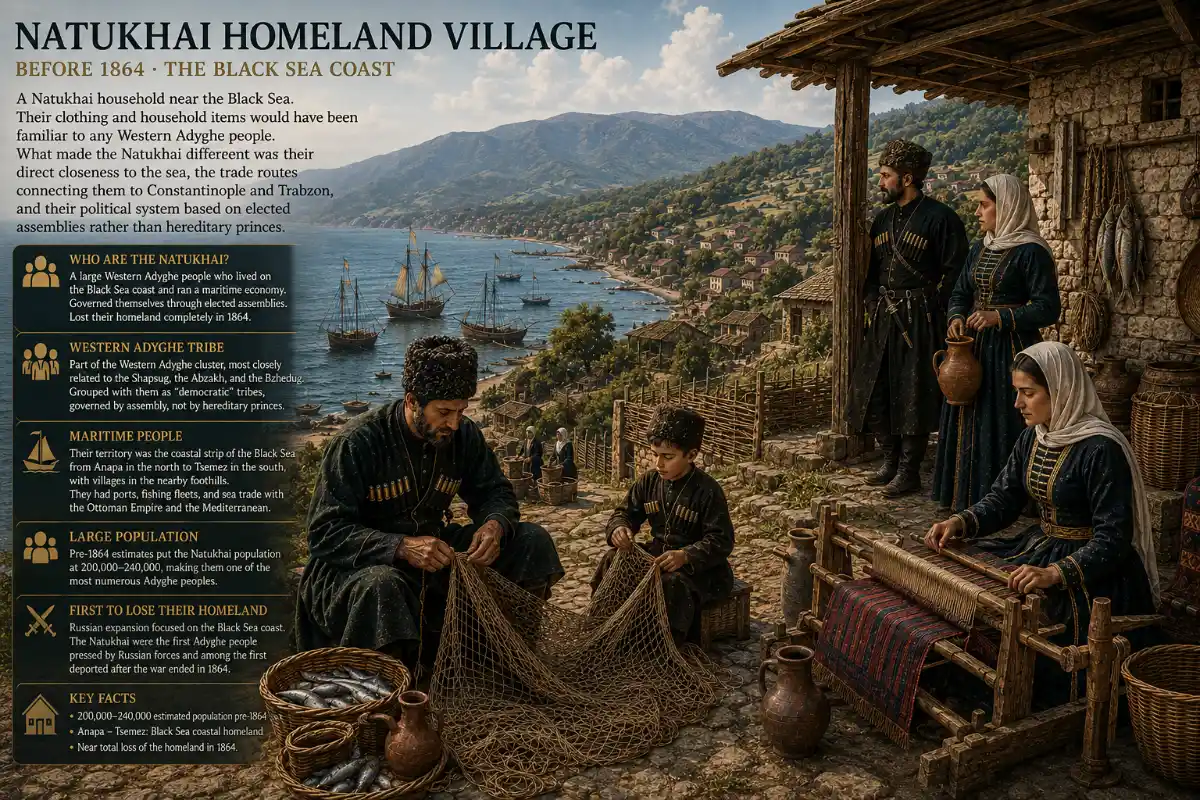
A large Western Adyghe people who lived on the Black Sea coast and ran a maritime economy. Governed themselves through elected assemblies. Lost their homeland completely in 1864.
The Natukhai are one of the twelve historic Adyghe tribes recognised on the Circassian flag. They were part of the Western Adyghe cluster, related most closely to the Shapsug, the Abzakh, and the Bzhedug. They are sometimes grouped with the Shapsug and Abzakh under the broader label of "democratic" Adyghe tribes, because all three governed themselves by assembly rather than by hereditary princes. Among the Adyghe peoples, the Natukhai were distinctive in three ways:
They were maritime. Their territory was the Black Sea coastal strip from Anapa down to Tsemez, with smaller inland villages in the immediate foothills. Most other Adyghe tribes lived inland in river basins or in the high mountains. The Natukhai had ports, fishing fleets, and direct sea access to the Ottoman Empire and the wider Mediterranean.
They were large. Pre-1864 estimates put the Natukhai population at 200,000-240,000, making them one of the most numerous Adyghe peoples. Among the western tribes, they were rivalled only by the Shapsug and the Abzakh.
They were the first to lose their homeland. Russian military planning in the late 18th and early 19th centuries focused on securing the Black Sea coast. That meant the Natukhai were the first Adyghe people pressed by Russian expansion, and they were among the first to be deported when the war ended.
200-240k Estimated pre-1864 population
Anapa — Tsemez Black Sea coastal homeland
Near total Loss of the homeland in 1864
The name and where it comes from
The name Natukhai (Натхъуадж in Adyghe Cyrillic) is sometimes given a folk etymology connecting it to the Adyghe word натхъуэ (eyebrow / eye area) plus a tribal suffix, but no firm linguistic reconstruction is universally accepted. The form Natukhaj appears in 19th-century European travel accounts, while Natkhuaj is the standard modern Adyghe transliteration. Russian sources typically used Натухайцы. Ottoman sources usually grouped them under the broader Çerkes (Circassian) label without separate sub-tribal designation.
Among the Adyghe peoples themselves, the Natukhai were distinctive enough to be counted as a separate tribe across all sources, with their own dialect, their own assembly tradition, and their own territory clearly bounded by the coast and the foothills. The label "Natukhai" in the historical record is thus consistent and unambiguous, even when Russian and Ottoman administrators sometimes lumped them with the Shapsug.
Before 1864 · The Black Sea coastA Natukhai household near the Black Sea. The dress and the household items would be familiar to any Western Adyghe people. What set the Natukhai apart was the immediate proximity of the sea, the trade routes that connected them to Constantinople and Trabzon, and the political system that governed them through elected assemblies rather than hereditary princes.
The Black Sea Coast Homeland
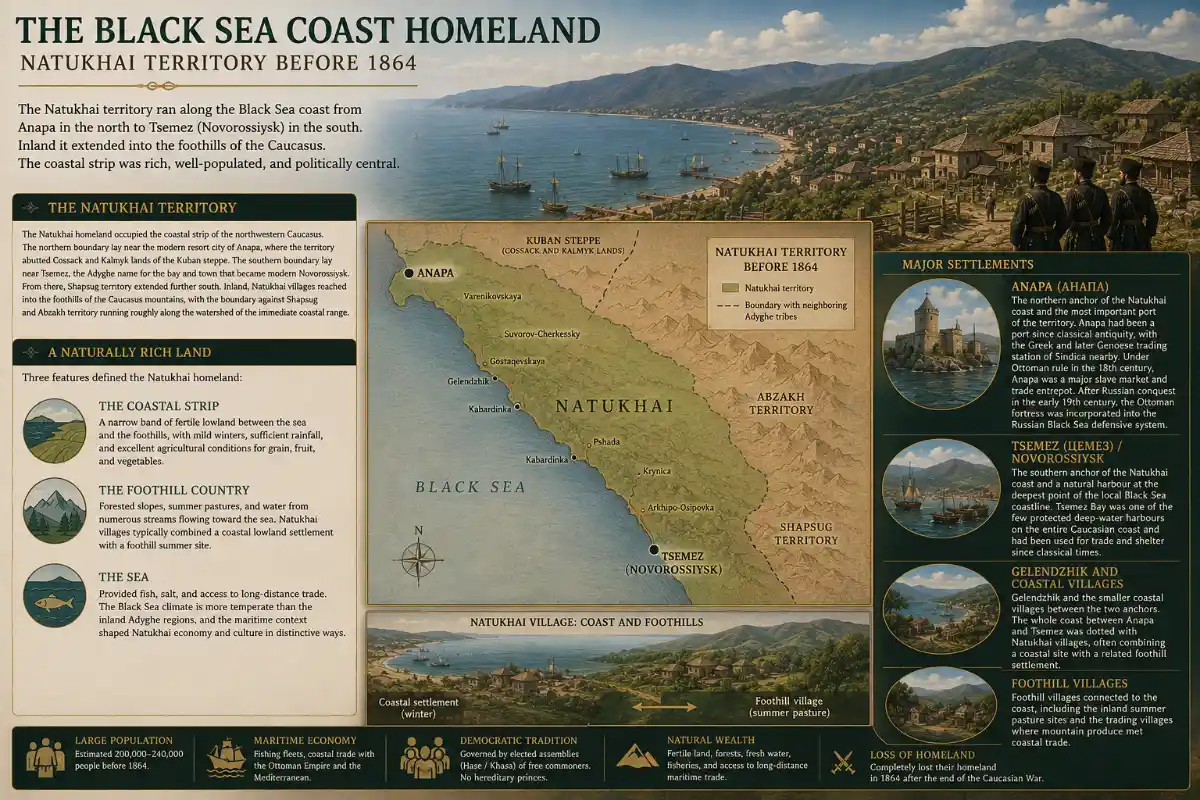
The Natukhai territory ran along the Black Sea coast from Anapa in the north to Tsemez (Novorossiysk) in the south. Inland it extended into the foothills of the Caucasus. The coastal strip was rich, well-populated, and politically central.
The Natukhai homeland occupied the coastal strip of the northwestern Caucasus. The northern boundary lay near the modern resort city of Anapa, where the territory abutted Cossack and Kalmyk lands of the Kuban steppe. The southern boundary lay near Tsemez, the Adyghe name for the bay and town that became modern Novorossiysk. From there, Shapsug territory extended further south. Inland, Natukhai villages reached into the foothills of the Caucasus mountains, with the boundary against Shapsug and Abzakh territory running roughly along the watershed of the immediate coastal range.
The territory was naturally rich. Three features defined it:
The coastal strip itself, a narrow band of fertile lowland between the sea and the foothills, with mild winters, sufficient rainfall, and excellent agricultural conditions for grain, fruit, and vegetables.
The foothill country, with forested slopes, summer pastures, and water from numerous streams flowing toward the sea. Natukhai villages typically combined a coastal lowland settlement with a foothill summer site.
The sea itself, which provided fish, salt, and access to long-distance trade. The Black Sea climate is more temperate than the inland Adyghe regions, and the maritime context shaped Natukhai economy and culture in distinctive ways.
Major settlements
The Natukhai had several significant settlements that served as economic and political centers:
Anapa (Анапа). The northern anchor of the Natukhai coast and the most important port of the territory. Anapa had been a port since classical antiquity, with the Greek and later Genoese trading station of Sindica nearby. Under Ottoman rule in the 18th century, Anapa was a major slave market and trade entrepot. After Russian conquest in the early 19th century, the Ottoman fortress was incorporated into the Russian Black Sea defensive system.
Tsemez (Цемез) / Novorossiysk. The southern anchor of the Natukhai coast and a natural harbour at the deepest point of the local Black Sea coastline. Tsemez Bay was one of the few protected deep-water harbours on the entire Caucasian coast and had been used for trade and shelter since classical times.
Gelendzhik and the smaller coastal villages between the two anchors. The whole coast between Anapa and Tsemez was dotted with Natukhai villages, often combining a coastal site with a related foothill settlement.
Foothill villages connected to the coast, including the inland summer pasture sites and the trading villages where mountain produce met coastal trade.
A Democratic Tribe: The Khasa
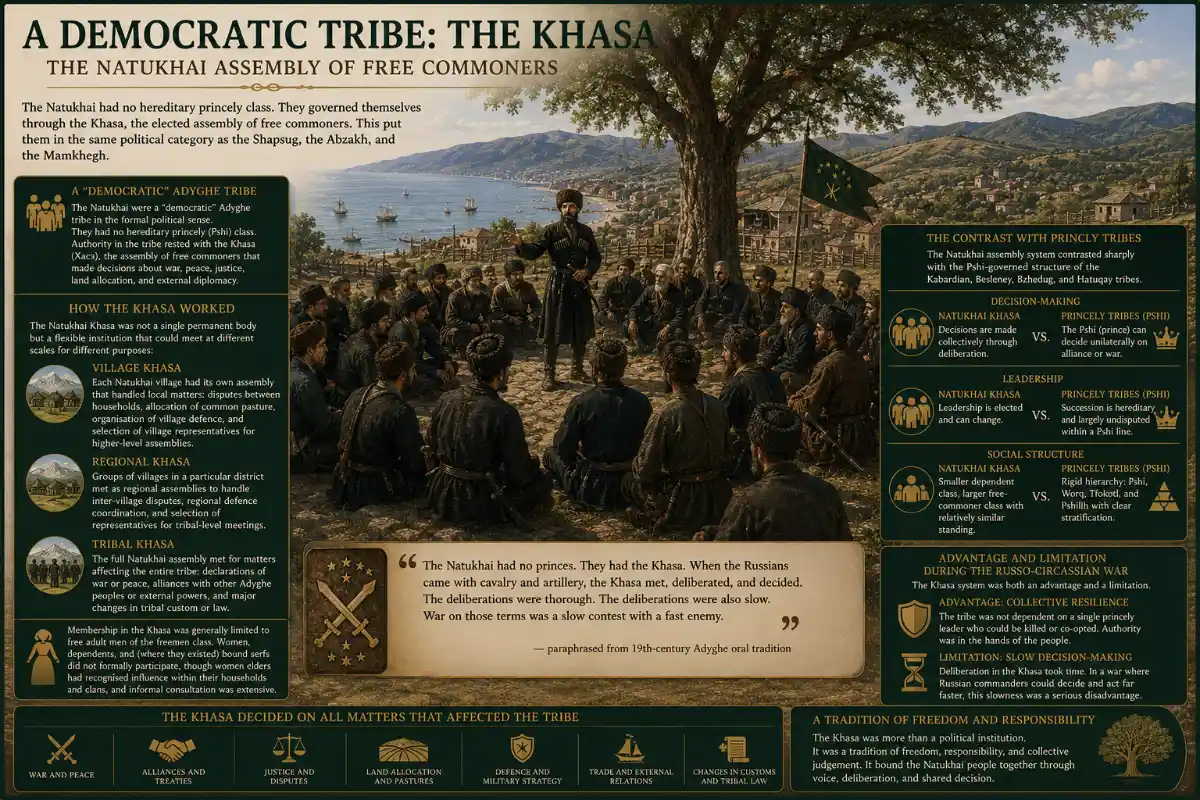
The Natukhai had no hereditary princely class. They governed themselves through the Khasa, the elected assembly of free commoners. This put them in the same political category as the Shapsug, the Abzakh, and the Mamkhegh.
The Natukhai were a "democratic" Adyghe tribe in the formal political sense. They had no hereditary princely (Pshi) class. Authority in the tribe rested with the Khasa (Хасэ), the assembly of free commoners that made decisions about war, peace, justice, land allocation, and external diplomacy.
How the Khasa worked
The Natukhai Khasa was not a single permanent body but a flexible institution that could meet at different scales for different purposes:
Village Khasa. Each Natukhai village had its own assembly that handled local matters: disputes between households, allocation of common pasture, organisation of village defence, and selection of village representatives for higher-level assemblies.
Regional Khasa. Groups of villages in a particular district met as regional assemblies to handle inter-village disputes, regional defence coordination, and selection of representatives for tribal-level meetings.
Tribal Khasa. The full Natukhai assembly met for matters affecting the entire tribe: declarations of war or peace, alliances with other Adyghe peoples or external powers, and major changes in tribal custom or law.
Membership in the Khasa was generally limited to free adult men of the freemen class. Women, dependents, and (where they existed) bound serfs did not formally participate, though women elders had recognised influence within their households and clans, and informal consultation was extensive.
The contrast with princely tribes
The Natukhai assembly system contrasted sharply with the Pshi-governed structure of the Kabardian, Besleney, Bzhedug, and Hatuqay tribes. Where a Kabardian Pshi could decide unilaterally on alliance or war, a Natukhai Khasa had to deliberate. Where Kabardian succession was hereditary and largely undisputed within a Pshi line, Natukhai leadership was elected and could change. Where Kabardian society was rigidly stratified between Pshi, Worq, Tfokotl, and Pshilh, Natukhai society had a much smaller dependent class and a much larger free-commoner class with relatively similar standing.
For the Natukhai during the Russo-Circassian War, this assembly system was both an advantage and a limitation. The advantage was that it produced collective resilience: the tribe was not dependent on a single princely leader who could be killed or co-opted. The limitation was that it produced slow decision-making in a war where Russian commanders could decide and act far faster than any Natukhai assembly could deliberate.
The Natukhai had no princes. They had the Khasa. When the Russians came with cavalry and artillery, the Khasa met, deliberated, and decided. The deliberations were thorough. The deliberations were also slow. War on those terms was a slow contest with a fast enemy.— paraphrased from 19th-century Adyghe oral tradition
The Natukhai Dialect
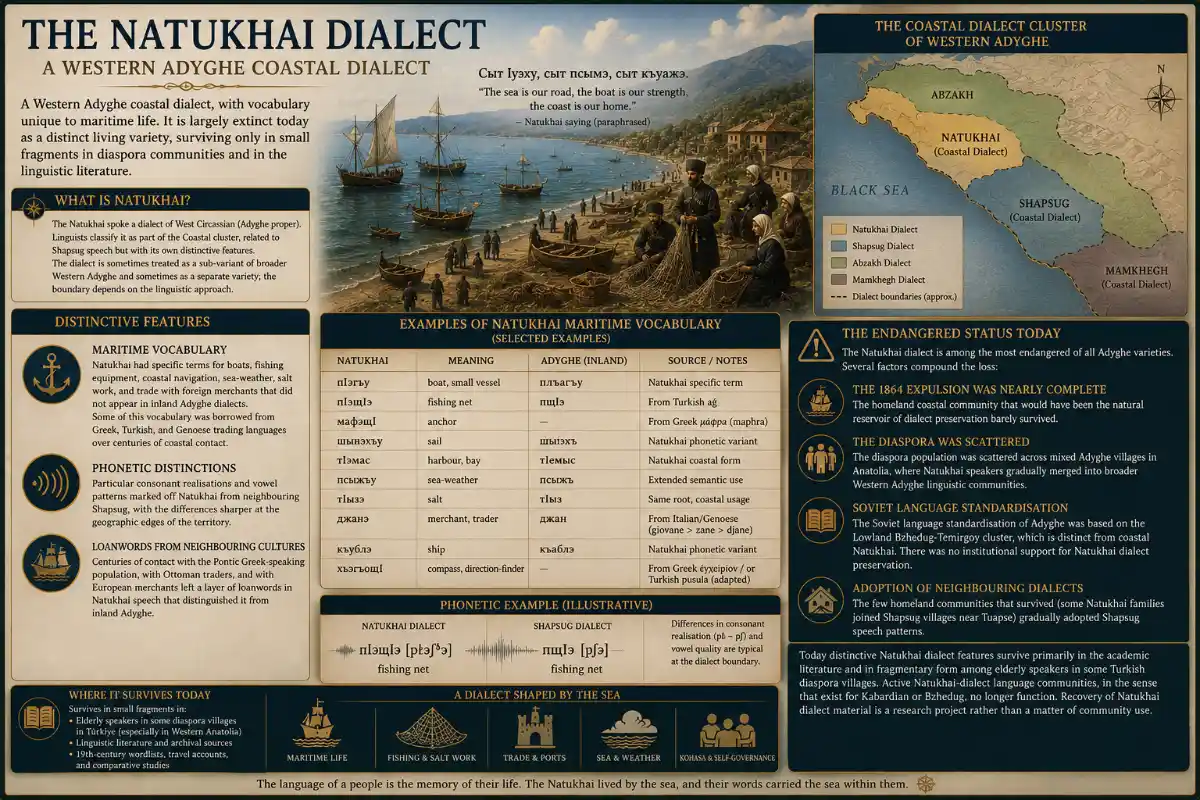
A Western Adyghe coastal dialect, with vocabulary unique to maritime life. It is largely extinct today as a distinct living variety, surviving only in small fragments in diaspora communities and in the linguistic literature.
The Natukhai spoke a dialect of West Circassian (Adyghe proper). Linguists classify it as part of the Coastal cluster, related to Shapsug speech but with its own distinctive features. The dialect is sometimes treated as a sub-variant of broader Western Adyghe and sometimes as a separate variety; the boundary depends on the linguistic approach.
The most distinctive features of Natukhai speech were tied to the maritime economy:
Maritime vocabulary. Natukhai had specific terms for boats, fishing equipment, coastal navigation, sea-weather, salt work, and trade with foreign merchants that did not appear in inland Adyghe dialects. Some of this vocabulary was borrowed from Greek, Turkish, and Genoese trading languages over centuries of coastal contact.
Phonetic distinctions. Particular consonant realisations and vowel patterns marked off Natukhai from neighbouring Shapsug, with the differences sharper at the geographic edges of the territory.
Loanwords from neighbouring cultures. Centuries of contact with the Pontic Greek-speaking population, with Ottoman traders, and with European merchants left a layer of loanwords in Natukhai speech that distinguished it from inland Adyghe.
The endangered status today
The Natukhai dialect is among the most endangered of all Adyghe varieties. Several factors compound the loss:
The 1864 expulsion was nearly complete. The homeland coastal community that would have been the natural reservoir of dialect preservation barely survived.
The diaspora population was scattered across mixed Adyghe villages in Anatolia, where Natukhai speakers gradually merged into broader Western Adyghe linguistic communities.
The Soviet language standardisation of Adyghe was based on the Lowland Bzhedug-Temirgoy cluster, which is distinct from coastal Natukhai. There was no institutional support for Natukhai dialect preservation.
The few homeland communities that survived (some Natukhai families joined Shapsug villages near Tuapse) gradually adopted Shapsug speech patterns.
Today distinctive Natukhai dialect features survive primarily in the academic literature and in fragmentary form among elderly speakers in some Turkish diaspora villages. Active Natukhai-dialect language communities, in the sense that exist for Kabardian or Bzhedug, no longer function. Recovery of Natukhai dialect material is a research project rather than a matter of community use.
Maritime Heritage and Trade
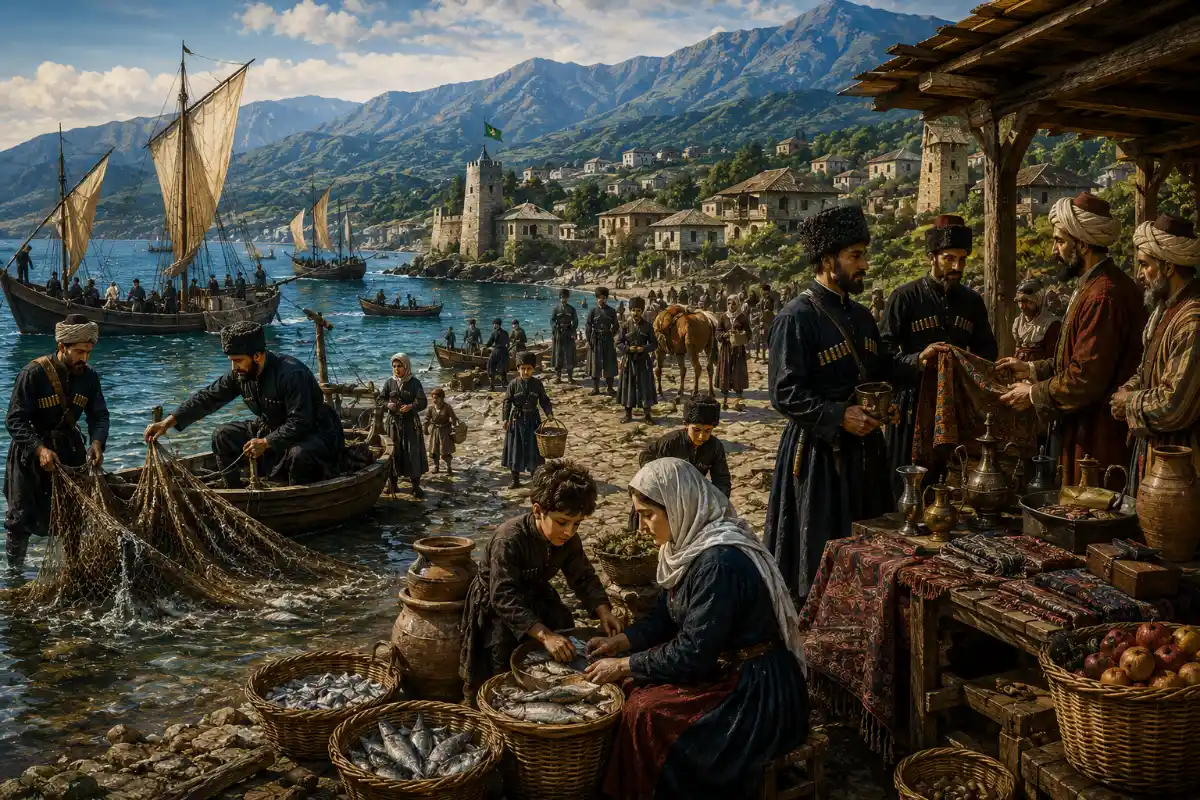
The Natukhai economy combined coastal fishing, sea trade, and inland agriculture. Their ports connected the Adyghe world to the Ottoman Empire and beyond, and made them one of the wealthier Adyghe peoples before the Russian conquest.
The Natukhai economy was distinctive among Adyghe peoples because of the maritime element. Inland Adyghe tribes had rural agriculture, livestock, and limited overland trade. The Natukhai had all of those plus the sea. The maritime economy added several dimensions:
Fishing
The Natukhai maintained fishing fleets along the Black Sea coast. Fishing was both subsistence and commercial. The Black Sea provided sturgeon, herring, anchovy, mullet, and other species that supplemented agricultural diet and produced a marketable surplus. Salt processing, important for fish preservation in the pre-refrigeration era, was a related Natukhai craft. Fishing villages had specific community structures, with shared boats and shared catch arrangements that reflected the collective nature of coastal fishing operations.
Coastal trade
Natukhai ports were active in coastal trade with Ottoman ports across the Black Sea (Sinop, Trabzon, Constantinople). The trade goods exchanged included:
Adyghe products to the Ottoman markets: grain, timber, honey, beeswax, livestock, leather, and (in earlier periods) slaves taken in raids or trade. The slave trade dimension is a difficult part of the historical record. The Crimean Khanate and the Ottomans were both consumers of Caucasian slaves, and Adyghe involvement in this trade was extensive through the 17th and 18th centuries before declining sharply in the 19th.
Ottoman and Mediterranean products to the Adyghe interior: textiles, weapons, gunpowder, manufactured goods, salt (where local production was insufficient), and luxury items.
European products that reached the Black Sea coast through Genoese and later Ottoman intermediaries: metal goods, processed textiles, glass, and other items that travelled from Italy and the wider Mediterranean to the Caucasian coast.
The Natukhai role in this trade made them comparatively wealthier than inland Adyghe peoples. Coastal villages had access to imported goods that mountain villages did not. The trade also gave the Natukhai a distinctive cosmopolitan dimension. Generations of contact with foreign traders meant that the tribe had multilingual elements and a level of familiarity with the Mediterranean world that other Adyghe peoples lacked.
Connection to the Ottoman Empire
The Natukhai relationship with the Ottoman Empire was particularly important because of the coastal proximity. Ottoman authorities considered the Caucasian coast nominally part of their sphere of influence, and Natukhai chieftains corresponded with Ottoman officials, accepted occasional Ottoman titles and gifts, and at moments cooperated with Ottoman military operations against Russian advances.
This relationship was uneven. The Natukhai never accepted formal Ottoman rule. Ottoman authority in Natukhai territory was limited to the immediate vicinity of the Anapa fortress and a few other coastal points. But the symbolic and practical importance of the Ottoman connection was significant, and it shaped Natukhai response to Russian expansion in the late 18th and early 19th centuries.
Sindica: An Ancient Port
The site of the modern city of Anapa was, in classical antiquity, the Greek trading port of Sindica. The Natukhai homeland sat on top of one of the oldest documented commercial sites on the Black Sea coast.
The site of the modern city of Anapa, the northern anchor of the Natukhai homeland, has been a port for more than two thousand years. In classical antiquity, the area was known as Sindica, the territory of the Sindi people, an Indo-European or partially Iranian-speaking population that the Greeks of Athens and Miletus contacted from the 6th century BCE onwards.
The Greek trading station at Sindica handled commerce in grain, fish products, wine, olive oil, slaves, and luxury goods. The Bosporan Kingdom, which controlled the Crimean side of the strait connecting the Black Sea to the Sea of Azov, had close ties to Sindica through the 4th and 3rd centuries BCE. Archaeological remains in the modern Anapa area include classical Greek and Roman material that documents the long continuity of coastal commerce on the site.
The relationship between the ancient Sindi and the later Adyghe peoples is debated. Some scholars see linguistic and material continuities suggesting that the Adyghe (or proto-Adyghe) populations were already present in the area in classical times. Others propose that the Adyghe arrived later, displacing or absorbing the Sindi over the early medieval period. The historical sources are not detailed enough to settle the question.
What is clear is that by the early Ottoman period, the area around modern Anapa was Adyghe (specifically Natukhai) territory, and the port site that the Greeks had called Sindica was operating as a Natukhai-controlled trading point. The Genoese, who maintained Black Sea trading stations from the 13th to 15th centuries, had a presence in the area, and Genoese commercial documents reference local trade arrangements with Adyghe coastal communities. The Ottoman conquest of the Crimean Khanate in the late 15th century brought the broader region under nominal Ottoman influence, and the fortress at Anapa became Ottoman in the 18th century.
The continuity of commerce
The continuity of commerce on the Sindica site across more than two thousand years gives the Natukhai homeland a depth of history unusual for the Adyghe peoples. Where most Adyghe tribal histories begin in the late medieval period with the Inal succession or with similar 14th-15th century origin legends, the Natukhai coast sits on a much longer commercial history that connected the Adyghe world to the Mediterranean for far longer than written Circassian history records.
For modern Natukhai descendants, this depth has practical implications. The historical record connects Natukhai families not just to the pre-1864 coastal communities but, indirectly, to one of the oldest sites of Black Sea trade. The 1864 deportation broke the continuous Adyghe occupation of the site, but the place itself has remained a coastal trading hub through the modern Russian, Soviet, and post-Soviet periods.
Society and Adyghe Khabze
Natukhai society was organised around the freemen class, with a smaller dependent class. Adyghe Khabze applied to the Natukhai in modified form, without the princely-aristocratic dimensions that governed Kabardian or Bzhedug society.
Natukhai society shared core features with the broader Adyghe world but lacked the stratified princely structure of the eastern Adyghe peoples. The basic class structure was simpler:
ClassAdyghe termRoleFree commonersТфокотль (Tfokotl)The core of Natukhai society. Free farmers, fishers, traders, craftsmen. Members of the Khasa and the source of elected leadership. Not bound to any lord.WorqУэркъWhere Worq existed in Natukhai society, they were a relatively small noble class with limited authority compared to the eastern Adyghe Worq. Some sources describe an absence of formal Worq class in Natukhai society; others describe a small noble component without princely (Pshi) leadership above them.DependentsПщылl (Pshilh)Bound household dependents and serfs. Smaller than in princely tribes. Some dependents were captives from raids or trade who had been integrated into Natukhai households.
Adyghe Khabze in Natukhai practice
The Natukhai followed Adyghe Khabze, the unwritten code of conduct that governed Adyghe life. The features of Khabze that applied to Natukhai society included:
Hospitality. Natukhai households offered the same elaborate hospitality as other Adyghe peoples. The kunatskaya tradition was observed, and the obligations of host to guest were strictly enforced. Coastal Natukhai hospitality had specific maritime dimensions: ships and crews seeking shelter or provisioning were given Khabze-protected status, and Natukhai port towns were known for the reliability of their shelter to friendly traders.
Respect for elders. Natukhai elders had ceremonial precedence and political weight. Because the Khasa system depended on elected leaders selected partly for age and experience, elders had practical political authority that complemented their ceremonial standing.
Wedding customs. Long betrothal periods, structured gift exchanges, and named dance forms appeared in Natukhai weddings as in other Adyghe communities. The class-based marriage rules of the eastern Adyghe peoples did not apply, since the Natukhai did not have the same rank structure.
Funeral and mourning customs. Standard Adyghe mourning practices were observed, with regional variations specific to coastal communities.
Russian Expansion: The First Front
The Black Sea coast was the first Adyghe territory to face Russian military pressure. Russia wanted the coast for strategic reasons. The Natukhai were the first major Adyghe tribe in the path of that expansion.
The Natukhai homeland was the first Adyghe territory to face Russian military pressure, and the Russian campaign against the Natukhai shaped the broader Russo-Circassian War from the start. Several factors made the Black Sea coast the priority Russian target:
Strategic geography. Russian control of the Black Sea coast was essential for Russian naval strategy in the 18th and 19th centuries. The coast provided naval bases, ports for merchant trade, and the ability to project power into the Ottoman Empire and the Mediterranean.
Ottoman threat reduction. The Ottoman fortress at Anapa, while small, was the symbolic anchor of Ottoman influence on the Caucasian coast. Russian conquest of Anapa would remove this Ottoman foothold and consolidate Russian control of the northern Black Sea coast.
Slave trade suppression. Russian propaganda of the era, addressed both to European opinion and to internal Russian audiences, framed the Caucasian war partly as a moral campaign against the slave trade that operated through Black Sea ports. The Natukhai coast was central to this trade in the Adyghe context.
Settlement opportunities. The fertile coastal strip was attractive for Russian, Ukrainian, and other settler populations. Russian planners saw the eventual settlement of the Caucasian coast with loyal subjects as a long-term strategic goal.
The early campaigns
Russian military operations against the Natukhai homeland began in earnest in the late 18th century. The first major Russian capture of Anapa occurred in 1791 under Field Marshal Gudovich, but the fortress was returned to the Ottomans by treaty. Subsequent Russian captures (1807, 1828) eventually consolidated Russian control of the Anapa fortress, although the surrounding Natukhai territory remained outside direct Russian administration for decades afterwards.
From the 1820s, Russian strategy shifted to building a continuous line of fortresses along the coast (the so-called Black Sea Coastal Line), each garrisoned and connected by patrols and naval support. The line aimed to isolate the Natukhai (and Shapsug, Ubykh) coastal populations from sea trade and from Ottoman support, and to provide a base for operations into the foothills.
The Coastal Line was operationally difficult. The fortresses suffered from disease, supply problems, and frequent attacks by Adyghe forces. But over the course of the 1830s and 1840s, the line gradually achieved its strategic purpose: cutting the Natukhai off from sea trade, from Ottoman support, and from coordinated movement along the coast.
The Russo-Circassian War
For nearly a century, the Natukhai resisted Russian conquest of the coast. Their assembly system organised collective defence. Their cavalry attacked Russian fortifications. Their fishing and trading economy was systematically dismantled by Russian naval operations.
The Natukhai were among the most active resistors of Russian conquest throughout the broader Russo-Circassian War (conventionally dated 1763-1864). Several features of Natukhai resistance stand out:
Coordinated defence through the Khasa
The Khasa system organised collective Natukhai military responses. Tribal-level Khasa decisions coordinated operations across multiple Natukhai villages and, at moments, with neighbouring Shapsug and Abzakh forces. The famous all-Adyghe Khasa councils that occurred during peaks of resistance, including the 1840s assemblies that coordinated Western Adyghe responses to Russian advances, included Natukhai delegates as core participants.
Cavalry and naval operations
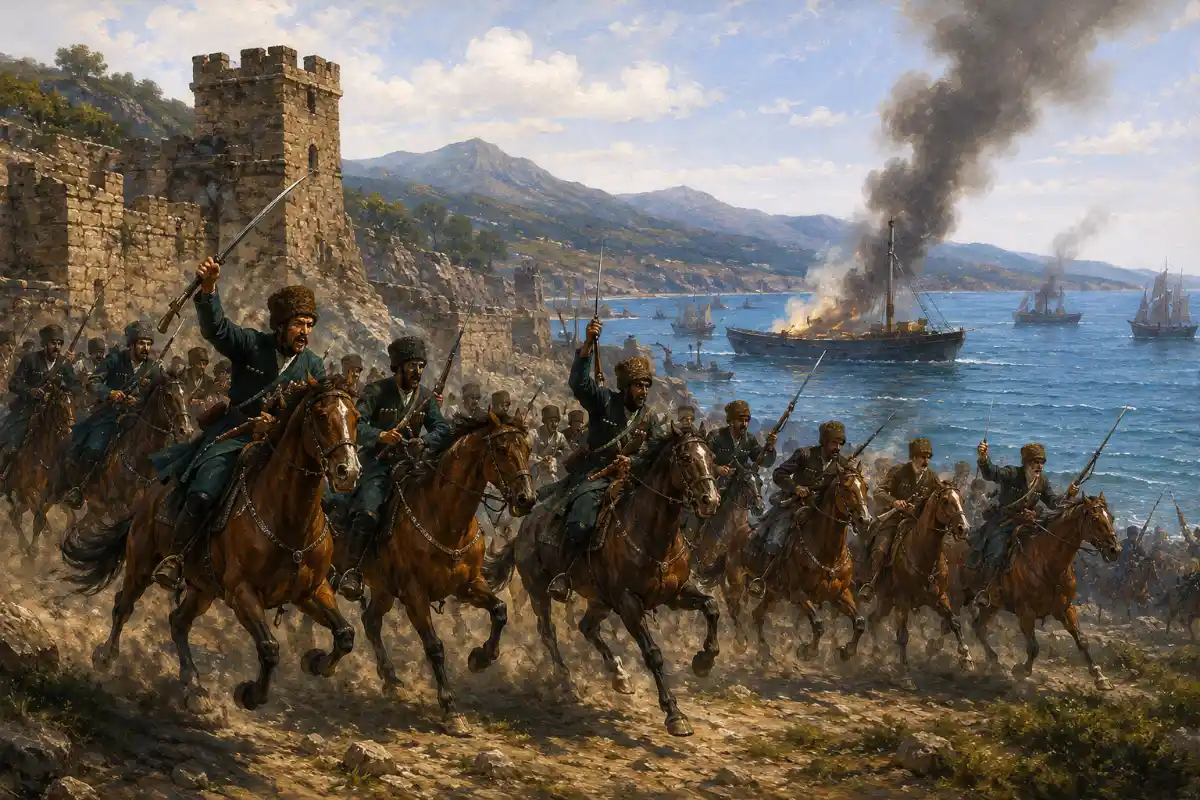
Natukhai cavalry attacked Russian Coastal Line fortresses repeatedly through the 1830s and 1840s, sometimes in coordinated multi-tribe operations and sometimes independently. Natukhai naval and amphibious operations also occurred, with fishing fleets converted to military use and small landing operations against Russian positions. Russian military reports from the Coastal Line period mention Natukhai forces specifically in this maritime dimension, which other Adyghe tribes lacked.
Cooperation with Imam Shamil's broader resistance
The Natukhai had limited but real connections with the broader Caucasian resistance organised under Imam Shamil in the eastern Caucasus. The geographic distance between the Natukhai coast and Shamil's Daghestan-Chechnya base made full coordination impractical, but symbolic and occasional practical alliances did exist. The 1840s and 1850s saw periodic Natukhai-Shamil coordination, including diplomatic exchanges and shared strategic framing of the Caucasian war as a single struggle.
The economic war
Russian operations against the Natukhai coast had a strong economic dimension. Russian naval forces interdicted Natukhai fishing and trading vessels. Russian fortresses cut overland trade routes between Natukhai villages and the wider Adyghe interior. Russian destruction of Natukhai villages systematically eliminated the agricultural and craft base of the tribe. The combined effect, accumulated over decades, was the gradual impoverishment of Natukhai society and the erosion of the resource base that supported continued resistance.
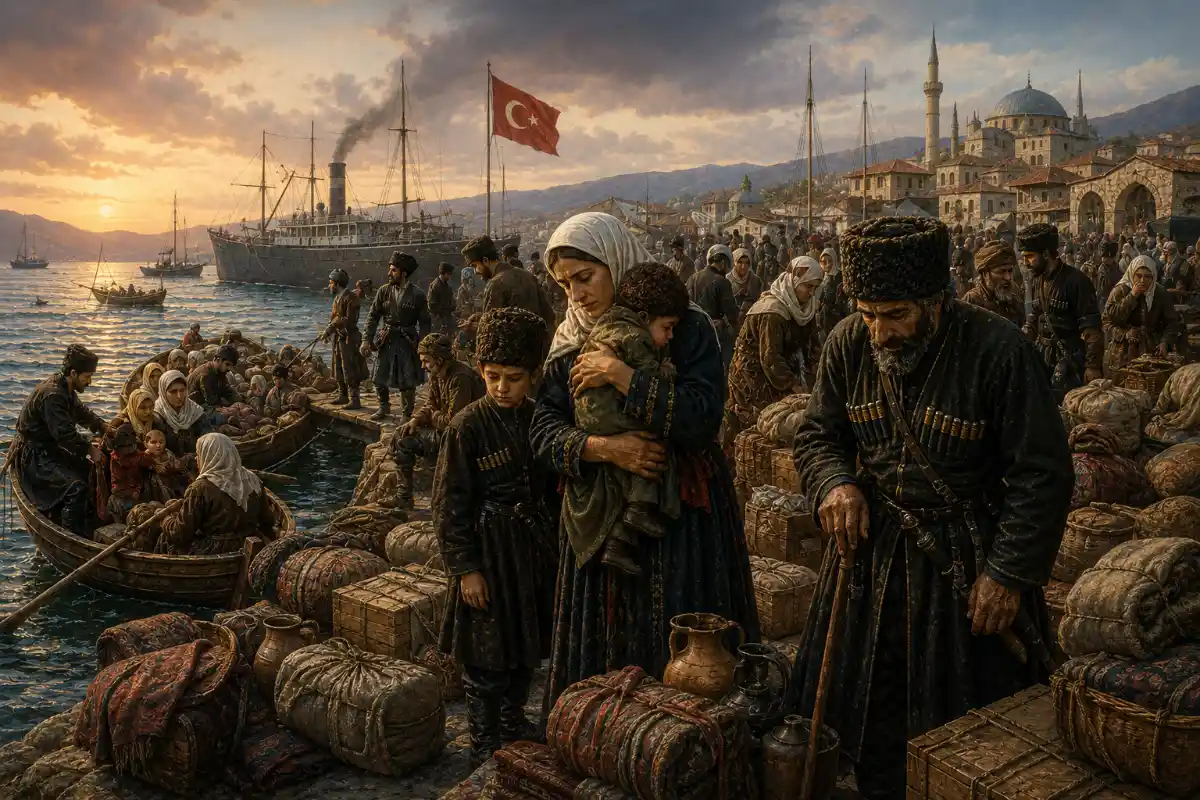
Place exile.jpg here
(Refugees at Ottoman port, 1864)
1864 · The catastropheFor the Natukhai, the deportation was nearly total. The coast they had inhabited for at least a thousand years was emptied. Families went to Ottoman ports, and the lands they left were given to settlers. The cities of Anapa, Novorossiysk, and Gelendzhik now stand on what had been Natukhai villages.
The 1864 Catastrophe
The Natukhai homeland was emptied almost completely in 1864. Of all twelve Adyghe tribes, the Natukhai suffered one of the most thorough deportations. The land was given to Russian, Ukrainian, and other settlers.
The end of the Russo-Circassian War in May 1864 brought mass deportation of the surviving Adyghe population. For the Natukhai, the deportation was nearly total. The combination of factors that made the coast strategically essential for Russia (good harbours, mild climate, fertile soil, easy settler access) also made the coast the priority for thorough emptying: Russian planners wanted the Natukhai gone so that Russian, Ukrainian, Greek, Armenian, and other settlers could occupy the land.
The Russian state offered the Natukhai the same binary choice it offered other deported Adyghe populations: relocate to a designated lowland area under Russian administration, or emigrate to the Ottoman Empire. For the Natukhai, the practical balance of these options was different from other tribes. The lowland resettlement offers were typically far from the coast and provided Adyghe communities with land that bore no relationship to the coastal economy in which Natukhai families had lived for generations. The Ottoman emigration option, while traumatic, offered the prospect of resettlement in regions where the Adyghe could form recognisable communities.
Most Natukhai chose emigration. Of the pre-1864 population estimated at 200,000-240,000, the great majority went to Ottoman territory. A small minority accepted Russian terms and were resettled in inland villages, where they were typically integrated into mixed Adyghe communities (with Shapsug, Abzakh, or other Western Adyghe groups). The distinct Natukhai homeland community on the coast simply ceased to exist.
~95%+ Of Natukhai homeland population displaced
Near total Loss of the Natukhai distinct homeland identity
Coastal strip Resettled by Russian, Ukrainian, Greek, Armenian colonists
The Black Sea crossings
The Black Sea crossings of 1864 were brutal for all deported Adyghe peoples. For the Natukhai, the crossings had a particular irony: the same sea that had connected their ancestors to the Mediterranean for centuries was now the route of forced exile to Anatolia and the Balkans. Overcrowded Ottoman ships, disease, drowning, starvation on the shores: the standard catalogue of the Adyghe deportation applied to the Natukhai with full force.
Ottoman archival records show the intake of Caucasian refugees by 1879 exceeding one million, with Natukhai families among them. The exact Natukhai proportion is hard to determine because Ottoman administrators did not always record sub-tribal identity. Many Natukhai families appear in Ottoman registers simply as "Çerkes" (Circassian) without sub-tribal specification. Cross-referencing Ottoman registers with family oral history and with surviving Russian records is necessary to identify specifically Natukhai families in the diaspora.
If your family is Natukhai, almost certainly your ancestors went to Ottoman territory in the 1860s. The Ottoman Nüfus Defterleri are the primary record. We can help you find them.
Cities Built on Natukhai Land
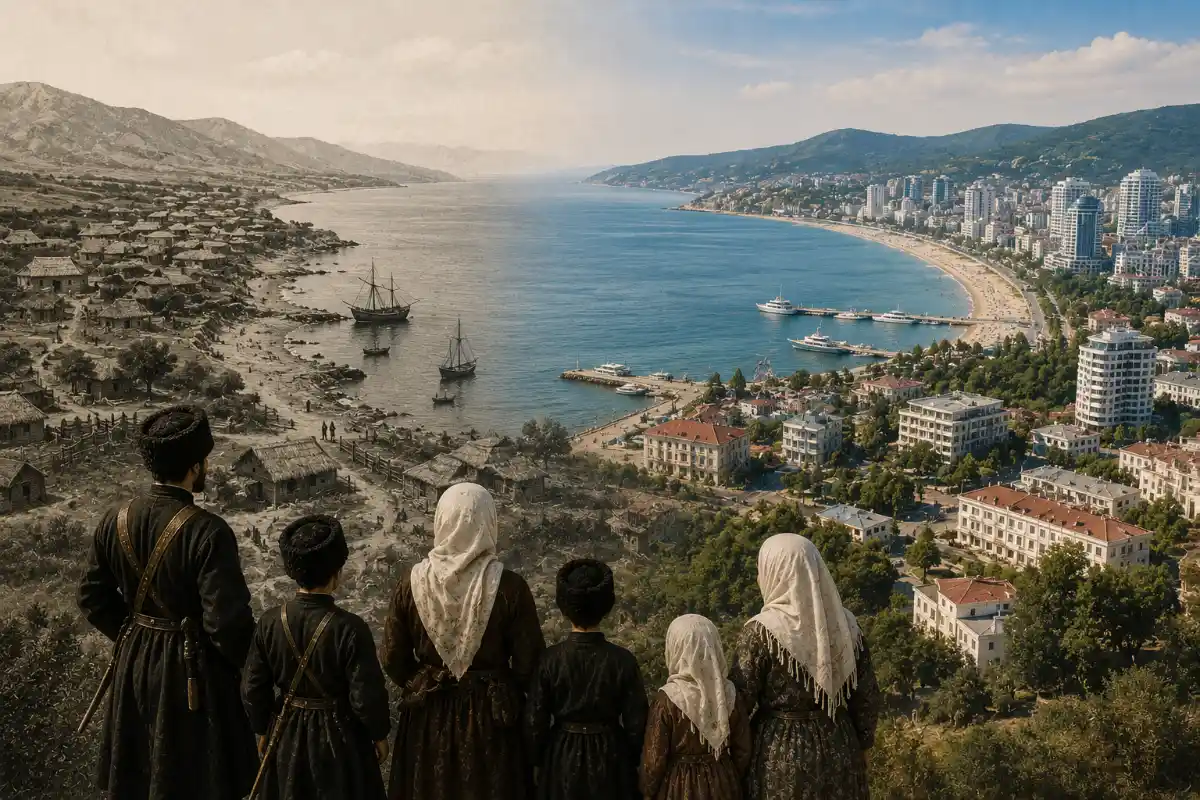
The Russian and Ukrainian settlement of the empty Natukhai coast in the late 19th century created the modern cities of Anapa, Novorossiysk, Gelendzhik, and the chain of resort towns that today form Russia's southern Black Sea coast.
The empty Natukhai coast was rapidly resettled by Russian and other colonist populations after 1864. Russian state policy actively encouraged settlement: land grants, tax exemptions, and military protection were offered to settlers willing to take up coastal lands. The waves of settlement that followed produced the modern Russian Black Sea coast as it exists today.
Anapa
The northern anchor of the Natukhai coast, with its ancient Sindica site and the Ottoman fortress, became the modern Russian resort city of Anapa. The Russian state developed Anapa from the late 19th century as a port and later, more importantly, as a holiday resort. The mild climate, sandy beaches, and warm sea made it a natural Russian Riviera destination. Through the Soviet period and into the post-Soviet era, Anapa grew into one of Russia's most popular domestic tourism destinations, with a current population of over 80,000 and millions of seasonal visitors. The city sits on what had been a chain of Natukhai coastal villages for at least a millennium.
Novorossiysk
The southern anchor of the Natukhai coast, the site of Tsemez Bay, became the modern Russian port city of Novorossiysk. Founded as a Russian fortress in 1838 during the Coastal Line construction, Novorossiysk developed in the late 19th century into a major Russian commercial port, taking advantage of the deep-water harbour at Tsemez Bay. Today Novorossiysk is one of Russia's most important Black Sea ports, with a population over 270,000 and major oil terminal, naval, and commercial functions. The port operations sit on the harbour that had been Natukhai for centuries before 1864.
Gelendzhik and the resort coast
Gelendzhik, between Anapa and Novorossiysk, was a small Natukhai coastal settlement that became a Russian fortress on the Coastal Line and then a resort town in the late 19th and 20th centuries. The string of smaller resort towns along the coast (Divnomorskoye, Kabardinka, Arkhipo-Osipovka, and others) all sit on former Natukhai village sites.
The continuing absence
None of these modern cities and towns has a significant Natukhai population today. The Russian, Ukrainian, Greek, and Armenian settlers who occupied the post-1864 coast formed the demographic core of the modern population, joined by later Soviet-era and post-Soviet migrants. The Natukhai homeland exists only as place-names (some Adyghe place-names survived in Russian transliteration), as occasional museum exhibitions on pre-1864 history, and as the awareness, among descendant communities in Turkey, that the Russian resort cities they may have visited as tourists were once their family villages.
The Natukhai Diaspora
Most surviving Natukhai families went to Ottoman territory after 1864. Today the diaspora is concentrated in Turkey, with smaller communities in Jordan, Syria, the Balkans, and the modern Western diaspora.
Turkey: the largest diaspora
The Natukhai diaspora in Turkey is the largest of the post-1864 communities. Natukhai families were settled by Ottoman authorities across Anatolia, often in mixed Adyghe villages alongside Shapsug, Abzakh, and Bzhedug families. Specific concentrations include:
Düzce, Sakarya, Adapazarı, Hendek. Northwestern Anatolian provinces inland from the Black Sea coast, where Natukhai families form part of substantial mixed Western Adyghe communities. The geography (coastal-plain to foothill, similar to the Natukhai homeland) attracted Natukhai settlement.
Samsun, Çarşamba, Bafra. Black Sea coastal Anatolian provinces, where coastal Natukhai families settled in conditions superficially similar to their pre-1864 homeland.
Kayseri (Uzunyayla). The high plateau in central Anatolia, where Natukhai families settled in mixed Adyghe villages alongside the dominant Kabardian community.
Çorum, Tokat, Sivas, Kahramanmaraş. Smaller Natukhai-descended populations in central and southeastern Anatolian provinces.
Istanbul, Ankara, Izmir. Major urban Natukhai populations, drawn from rural diaspora villages through 20th-century internal migration.
The Natukhai diaspora in Turkey has, in most cases, gone through the universal experience of Turkish Adyghe identity: surname change in 1934 under the Surname Law, language attrition across generations, urban migration in the late 20th century, and a recent generation of cultural revival in connection with broader Adyghe organisations. The specific Natukhai sub-identity is less actively maintained than the broader Adyghe identity in most Turkish communities, partly because the Natukhai homeland itself was lost so completely.
Jordan
A smaller Natukhai community settled in Jordan among the broader Jordanian Circassian population. Natukhai families in Jordan are integrated into the wider Circassian community, which also includes Kabardians, Shapsugs, Abzakh, and Bzhedug.
Syria
Syrian Natukhai families historically lived in Damascus, the Golan Heights (until 1967), and several rural villages. The post-2011 conflict has displaced these communities, with families relocating to Turkey, Germany, and elsewhere.
The Balkans
Some Natukhai families were settled by Ottoman authorities in the Balkans (particularly Bulgaria) in the 1860s-1870s. The Russo-Turkish War of 1877-1878 and the subsequent political reorganisation of the Balkans displaced these communities, with most families moving onward to Anatolia or further into the Ottoman Empire. A small Balkan Natukhai presence may remain in some communities, though documentation is sparse.
Modern Western diaspora
Twentieth- and twenty-first-century second-stage migration has produced small Natukhai-descended communities in Germany, the Netherlands, the United States, and other Western countries. These communities are typically integrated into broader Circassian organisations.
Famous Natukhai Surnames & Clans
Natukhai surnames are documented partially in Russian and Ottoman archives and in oral history preserved by diaspora families. Common Natukhai-associated names include Sewpe, Natkho, Guke, and several others.
Tracing a Natukhai family today is harder than tracing a Kabardian or Bzhedug family because the Natukhai homeland community was effectively lost in 1864, which meant that the continuous documentary tradition that supports research into surviving tribes was broken. Natukhai surnames are preserved in three main places:
Russian imperial archives, particularly records from the Coastal Line period (1830s-1860s) and the immediate post-deportation period (1864-1880).
Ottoman Nüfus Defterleri, which recorded arriving Natukhai families in the 1860s-1880s, although often without specific sub-tribal identification.
Oral history preserved by diaspora families, particularly in mixed Adyghe villages in Turkey where Natukhai families maintained sub-tribal awareness.
The Natukhai Maritime Tamga
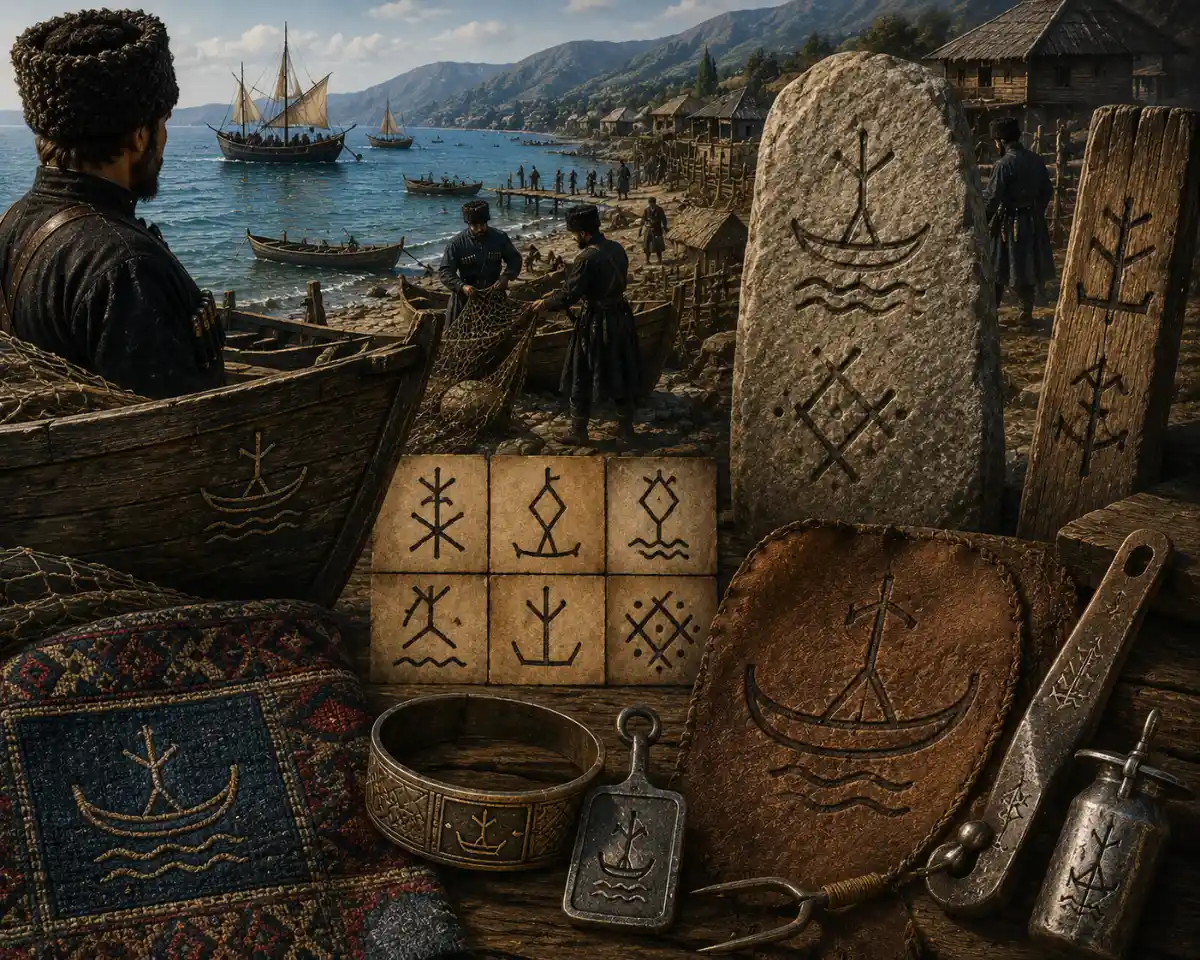
Natukhai tamga symbols often incorporated maritime motifs, reflecting the tribe's coastal life. They were used to mark boats, fishing equipment, and coastal property in addition to standard livestock and gravestone uses.
Natukhai tamga symbols share the broad geometric vocabulary of Adyghe heraldry but show particular features tied to the coastal economy. Russian and Adyghe ethnographers who documented Natukhai tamgas in the 19th and early 20th centuries noted several distinctive elements:
Maritime motifs. Some Natukhai tamgas incorporated stylised forms suggesting boats, anchors, fishing tools, or wave-like patterns. These were less common than in the heraldic traditions of true seafaring peoples but more frequent than in inland Adyghe tamgas.
Multiple-use marks. Natukhai tamgas were used to mark boats and fishing equipment (in addition to the standard livestock branding and property marking that all Adyghe tribes practiced). The need to mark boats and fishing gear gave Natukhai tamga tradition a distinctive practical dimension.
Coastal property. Salt-works, fishing weirs, and coastal trade points were marked with family tamgas, in a way that inland Adyghe peoples did not have to consider.
Surviving Natukhai tamga records
The 1864 deportation broke much of the continuous Natukhai tamga tradition, since the families who emigrated to Ottoman territory typically lost their boats and fishing gear before departure and could not maintain the practical marking traditions that had supported tamga preservation. What survives today exists primarily in:
The 19th-century Russian ethnographic literature, which documented some Natukhai tamga designs before the deportation.
The Adygea State Museum and other regional museums, which hold tamga catalogues that include some Natukhai material.
Diaspora family memory, where particular family marks were preserved in oral tradition or on heirlooms.
Recovering the tamga of a specific Natukhai family today is challenging. The combination of catastrophic homeland loss, the disruption of tamga-marked physical objects (boats and fishing gear that did not survive emigration), and the absence of a continuous homeland community to preserve oral tamga memory means that Natukhai tamga research is among the hardest of any Adyghe tribe.
Practical tip For Natukhai-descended families, the most likely surviving tamga reference is on woven textiles, embroidered cloths, or metalwork (jewellery, weapons) that travelled with families to Ottoman territory in the 1860s. Ask older family members about embroidery patterns, doorpost marks remembered from older generations, or any geometric symbols associated with the family. These are the most likely surviving markers of pre-1864 Natukhai identity.
Tracing Your Natukhai Ancestry
A five-step framework. Natukhai-specific notes: the homeland anchor is the historical Black Sea coast, with no surviving homeland community to draw on. Most research depends on Ottoman archives and on diaspora family records.
Step 1. Elder interviews
Start with the oldest living members of the family. Natukhai-specific questions:
Was the family ever called Natukhai, Natkhuaj, or Natkho?
Did anyone remember the family being from the Black Sea coast, from Anapa, from Tsemez (Tsemez Bay), or from the area now called Novorossiysk?
Were there assembly-government memories rather than princely (Pshi) memories?
If they emigrated to Anatolia, what was the year? The 1860s? Did the family travel by sea?
Are there fishing or maritime traditions remembered in the family?
Step 2. Surname research
Run the surname through Adyghe (Cyrillic), Russian, Turkish, Arabic, and Hebrew variants. Natukhai-specific note: many original Adyghe surnames have been replaced or transliterated in Turkey and other diaspora destinations. Recovering the original form often requires pre-1934 family records.
Step 3. Ottoman archives
For Natukhai families that emigrated to Ottoman territory after 1864, the Ottoman Nüfus Defterleri at the Başbakanlık Osmanlı Arşivi in Istanbul are the primary record. Most Natukhai families appear in registers dated 1864-1880, often with notations about their original village in the Caucasus.
Step 4. Russian imperial archives
Russian imperial records from the Coastal Line period (1830s-1860s) document Natukhai villages and resistance activity. The Kuban Regional Archive in Krasnodar and the Russian State Military History Archive (RGVIA) in Moscow hold relevant material. The records that document the 1864 deportation operation include some family-level data on Natukhai populations.
Step 5. DNA testing
Y-DNA haplogroups G2a (especially G-M406), J2, and R1b are common in Western Adyghe populations including the Natukhai. CircassianWeb's DNA matching compares your raw data against the 109-record peer-reviewed Circassian reference panel. The FamilyTreeDNA Circassian DNA Project, with 2,800+ members, is searchable for direct matches. For Natukhai specifically, DNA matching is particularly valuable because the documentary record is thinner: a confirmed match against another Natukhai-descended individual is one of the strongest pieces of evidence available.
Place modern.jpg here
(elder + grandchild)
Today · Recovering a coastal lineageFor Natukhai-descended families, the homeland coast no longer carries a Natukhai community. The line back to the pre-1864 tribe runs through Ottoman archive records, through diaspora family memory, and through DNA. The line is thinner than for tribes that kept their homeland. It is not gone.
Natukhai Genetic Markers
Western Adyghe haplogroup patterns apply: G2a, J2, R1b on the paternal side; H, U, T mtDNA on the maternal side. The lost homeland population means that Natukhai-specific reference data is particularly thin in the published literature.
Population genetic studies of Circassians (Balanovsky et al., 2011; Yunusbayev et al., 2012; subsequent FTDNA Circassian DNA Project work) document distinctive haplogroup frequencies across the Adyghe peoples. The Natukhai, as part of the Western Adyghe cluster, share the broader Western Adyghe profile.
HaplogroupTypeNotes for NatukhaiG2a (G-M406)Y-DNA paternalCommon across all Adyghe; principal lineage marker, traceable to pre-Bronze Age Caucasus populationsJ2 (J-M172)Y-DNA paternalStrong in Western Adyghe samples; particularly common in coastal populations including the NatukhaiR1bY-DNA paternalPresent in Western Adyghe samples; shared with Bzhedug, Temirgoy, ShapsugH, U, TmtDNA maternalMaternal lineages broadly shared across the Northwest Caucasus
Important caveat The lost Natukhai homeland population means the published genetic literature has limited Natukhai-specific reference samples. Most genetic studies of Western Adyghe peoples include Natukhai data only in mixed samples. Tribal-specific haplogroup frequencies for Natukhai are estimated rather than directly measured at high precision. For practical purposes, Natukhai ancestry can be confirmed through DNA only as part of a Western Adyghe pattern, not as a distinct Natukhai-specific signal.
What DNA can do well for Natukhai families is identify direct relatives. A documented match between two Natukhai-descended individuals (across diaspora destinations) is informative because the population is small and shared ancestry is more likely to indicate a recent common ancestor than in a larger tribe. The FamilyTreeDNA Circassian DNA Project is searchable for these direct matches.
Notable Figures & Stories
The Natukhai produced fewer named historical figures than aristocratic Adyghe tribes. The history that survives is largely the collective history of councils, coastal villages, and the resistance that ended in 1864.
The Natukhai assembly system meant that authority did not concentrate in named individuals over generations. Historical memory in the Natukhai tradition is collective rather than dynastic. The named figures preserved in the record are typically those who participated in significant events of the Russo-Circassian War, recorded by Russian, Ottoman, or European observers.
The 18th-century Anapa khans. The Ottoman fortress at Anapa was held in the late 18th century by a sequence of Adyghe-affiliated commanders, some of whom carried Natukhai backgrounds. Their names appear in Russian and Ottoman diplomatic correspondence.
The 1830s-1840s assembly leaders. Russian military reports name individual Natukhai elders and assembly-elected commanders who led specific operations against the Coastal Line. These figures are preserved in the records of the events rather than in independent biographical narratives.
The deputies to the all-Adyghe Khasa councils. When the Western Adyghe peoples organised joint assemblies during peaks of resistance (notably the 1840s), Natukhai delegates participated. Some are named in the surviving records.
Modern diaspora figures. Twentieth-century Adyghe academics, writers, and cultural figures of Natukhai descent have contributed to broader Adyghe scholarship and cultural revival, often without explicit identification of their Natukhai sub-tribal origin.
Story: The fishing fleet that became a fleet of war
In the 1830s, as Russian Coastal Line fortresses began to constrain Natukhai economic life, a number of Natukhai fishing villages along the coast between Anapa and Gelendzhik converted parts of their fishing fleets to military use. Small boats that had carried nets and salt were modified to carry warriors with rifles. The fleets attacked Russian supply ships and Coastal Line fortresses from the sea, sometimes in coordination with overland Natukhai cavalry assaults. The operations were not large by the standards of formal naval warfare. They were tactical and persistent. Russian commanders complained in their reports about the difficulty of patrolling a coast where every fishing village could become an attacking base. The Natukhai converted-fleet operations are one of the few examples of Adyghe naval warfare in the historical record. They ended only with the systematic destruction of Natukhai coastal villages in the late 1850s and early 1860s.
Story: The last Khasa assembly
Adyghe oral tradition preserved by 19th-century diaspora elders described a final all-Western Adyghe Khasa assembly in 1864, held somewhere in the foothill country between the Natukhai coast and the Shapsug mountain region. Delegates from the Natukhai, Shapsug, Abzakh, and Ubykh peoples met to discuss whether to accept the Russian deportation terms or to continue resistance. The assembly deliberated for several days. The decision, when it came, was that resistance had become impossible. The Khasa accepted the inevitability of emigration. In Adyghe memory, this final assembly is the formal end of the Western Adyghe political tradition, the moment at which the assembly-government system that had organised tribal life for centuries reached its last collective decision. The setting and exact participants of the assembly are debated. The decision and its weight are remembered.
Modern Cultural Revival
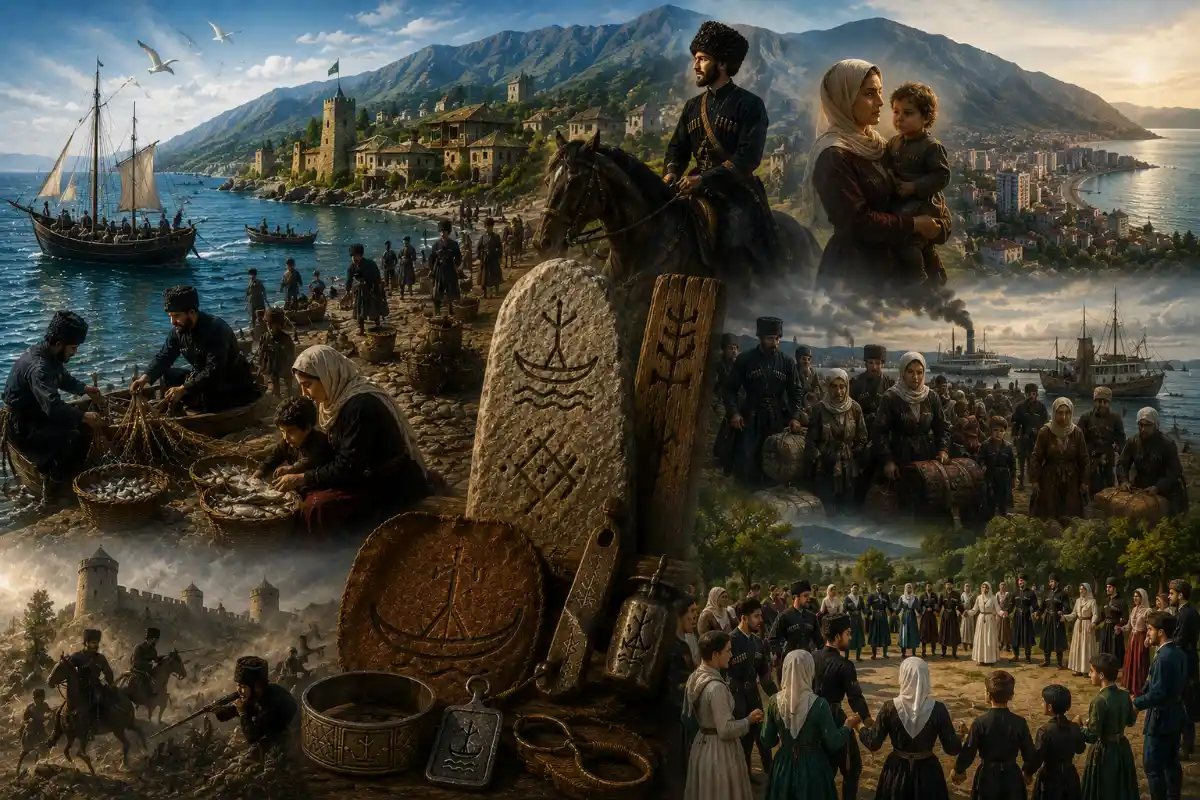
Natukhai cultural revival is small-scale, since there is no homeland community to anchor it. Most of the work is done by diaspora associations and by academic researchers documenting the lost coastal culture.
Modern Natukhai cultural revival faces a particular challenge: the homeland community is effectively gone. Where Kabardian, Bzhedug, or Mamkhegh revival can draw on continuous homeland populations, language schools, and republican institutions, Natukhai revival has to operate without a homeland anchor.
What does exist:
Academic research. Russian, Adyghe, and Western academics have conducted ongoing research on pre-1864 Natukhai history, language, and culture. The Adyghe Republican Institute for Humanities Research in Maykop, the Krasnodar State University, and several international academic projects have produced scholarship that documents the lost coastal society. This research is the foundation for any modern revival of Natukhai-specific identity.
Diaspora cultural associations. Some Circassian cultural associations in Turkey and Jordan maintain awareness of Natukhai sub-tribal identity, organise occasional Natukhai-specific gatherings, and support family-tree documentation. The scale is small but real.
Memorial events. The 21 May Circassian Day of Mourning, observed annually by Circassians worldwide, has particular weight for Natukhai-descended communities because the date marks the formal end of the war that destroyed the Natukhai homeland.
Some Adygea-based programmes. A small number of Natukhai-descended families have repatriated to Adygea since the 1990s, though there is no Natukhai-specific village or community to which they can return. Repatriated families typically settle in mixed Adyghe villages.
Digital networks. Social media and family-tree platforms have allowed Natukhai-descended individuals worldwide to find each other across borders. For a tribe whose homeland was lost so completely, this digital reconnection is particularly valuable.
The Natukhai story is, in some ways, the most extreme case of Adyghe loss. Other tribes have at least a homeland village or a republican institution to anchor identity. The Natukhai have neither. What survives is the documentary record, the diaspora memory, and the awareness, particularly strong on May 21 each year, that the Russian resort coast that today welcomes millions of holidaymakers was once a busy Adyghe homeland with a thousand-year continuity now broken.
Frequently Asked Questions
The questions readers most often ask about Natukhai heritage, identity, and ancestry research.
Where was the Natukhai homeland?
The Natukhai homeland was on the Black Sea coast of the northwestern Caucasus, running from Anapa in the north to Tsemez Bay (modern Novorossiysk) in the south, with inland extension into the foothills. Today the area is part of Krasnodar Krai in the Russian Federation. The territory now hosts the cities of Anapa, Novorossiysk, Gelendzhik, and a string of smaller resort towns, all built on what was Natukhai land before 1864.
Why are the Natukhai called a "democratic" tribe?
Because they had no hereditary princely (Pshi) class, unlike most other Adyghe tribes. They governed themselves through the Khasa, the elected assembly of free commoners. This put them in the same political category as the Shapsug, the Abzakh, and the Mamkhegh, in contrast to the "aristocratic" Kabardian, Besleney, Bzhedug, and Hatuqay tribes.
What was the Natukhai population before 1864?
Estimates put the Natukhai population at 200,000-240,000 in the early 19th century, making them one of the largest Adyghe peoples. After the 1864 deportation, the homeland population was reduced to nearly zero, with surviving families almost entirely emigrating to Ottoman territory.
Are the Natukhai related to the Shapsug?
Yes. The Natukhai are most closely related to the Shapsug, with whom they shared the Black Sea coast and a similar Western Adyghe coastal dialect. The two tribes were adjacent (Shapsug territory lay south of Natukhai territory along the coast) and shared the democratic assembly tradition. They were natural allies during the Russo-Circassian War. Today some surviving Natukhai descendants are part of mixed Shapsug-Natukhai communities in Turkey and elsewhere.
Is the Natukhai language still spoken?
The Natukhai dialect is among the most endangered of all Adyghe varieties. The 1864 deportation broke the homeland community that would have preserved it, and the diaspora population has gradually merged into broader Western Adyghe linguistic communities. Distinct Natukhai dialect features survive primarily in the academic literature and in fragmentary form among elderly diaspora speakers. Active Natukhai-dialect language communities, in the sense that exist for Kabardian or Bzhedug, no longer function.
What surnames indicate Natukhai heritage?
Documented Natukhai surnames include Sewpe (Сэупэ), Natkho (Натхъо), Guke (Гъукlэ), Mehosh, Bedanok, Hatkov, and Shalaho, among others. Many of these names also appear in neighbouring Shapsug, Abzakh, or Bzhedug families, so a surname alone is rarely sufficient. Confirmation usually requires a remembered village of origin (somewhere on the Black Sea coast between Anapa and Tsemez), documented continuous descent, or DNA matching.
What was Sindica?
Sindica was an ancient Greek trading port at the site of modern Anapa, in the Natukhai homeland. It was named for the Sindi people, an Indo-European population that the Greeks contacted from the 6th century BCE onwards. The port handled Black Sea commerce in grain, fish, wine, and other goods for more than two thousand years. By the early Ottoman period, the area was Adyghe (Natukhai) territory. The continuity of commerce on the site connects the Natukhai homeland to one of the oldest documented Black Sea trade routes.
What cities were built on Natukhai land?
After the 1864 deportation, the empty Natukhai coast was resettled by Russian, Ukrainian, Greek, and Armenian colonists. The cities and resort towns built on what had been Natukhai villages include Anapa, Novorossiysk, Gelendzhik, Divnomorskoye, Kabardinka, and Arkhipo-Osipovka, among others. None of these places has a significant Natukhai population today.
Where do Natukhai descendants live today?
The largest Natukhai diaspora is in Turkey, where Natukhai families settled in mixed Adyghe villages across northwestern, central, and Black Sea coastal Anatolia after 1864. Specific concentrations include Düzce, Sakarya, Adapazarı, Hendek, Samsun, Bafra, Çorum, Tokat, and Kayseri. Smaller communities live in Jordan, Syria, Israel, the Balkans, Germany, the Netherlands, and the United States.
Can DNA testing confirm Natukhai ancestry?
Partially. The Natukhai share the broader Western Adyghe Y-DNA profile (G2a, J2, R1b on the paternal side), so a Natukhai-specific signal cannot be cleanly separated from neighbouring Shapsug or Abzakh patterns. What DNA can do well is identify direct relatives. The FamilyTreeDNA Circassian DNA Project, with 2,800+ members, includes confirmed Natukhai-descended lineages. For Natukhai-specifically, where the documentary record is thin, DNA matching is especially valuable.
What was the maritime economy of the Natukhai?
The Natukhai combined coastal fishing, sea trade, and inland agriculture. Their fishing fleets operated along the Black Sea coast. Their ports (especially Anapa and Tsemez) connected the Adyghe world to the Ottoman Empire and the wider Mediterranean. They traded grain, timber, honey, leather, and historically slaves to the Ottoman markets, and received textiles, weapons, and manufactured goods in return. The maritime dimension made them comparatively wealthier than inland Adyghe peoples and gave them a distinctive cosmopolitan element.
Why was the 1864 deportation so complete for the Natukhai?
Because the Natukhai homeland was strategically essential for Russian planning. The fertile coastal strip with good harbours was attractive for Russian, Ukrainian, and other settler populations. Russian officials wanted the Adyghe gone so that settlers could occupy the land, and the geographic features that made the coast valuable also made it relatively easy to control once the deportations began. The combination of strategic priority, settler appeal, and military feasibility produced the most thorough Adyghe expulsion of any single tribe in 1864.
How can I trace my Natukhai ancestry?
Five steps. (1) Elder interviews about Black Sea coast or assembly-government memories. (2) Surname research across Adyghe Cyrillic, Russian, Turkish, Arabic, and Hebrew variants. (3) Ottoman Nüfus Defterleri at the Başbakanlık Osmanlı Arşivi in Istanbul, the most important documentary anchor for diaspora Natukhai families. (4) Russian imperial archives (Kuban Regional Archive in Krasnodar; RGVIA in Moscow) for Coastal Line and deportation-period documents. (5) DNA testing through the FamilyTreeDNA Circassian Project. The CircassianWeb DNA Heritage Explorer also provides matching against the 109-record Circassian reference panel.
Is there a Natukhai village in the homeland today?
No, not in the sense that exists for Mamheg (Mamkhegh) or the Adygea Bzhedug villages. Some surviving Natukhai-descended families live in mixed communities in the Tuapse area and elsewhere in Krasnodar Krai or Adygea, but there is no dedicated Natukhai village. The 1864 deportation was thorough enough that no continuous Natukhai homeland community survived to anchor a single village identity.
Trace Your Natukhai Ancestry Today
The Natukhai homeland was lost. The line back to the pre-1864 tribe is real. We can help you find it.
1 Build your tree Start with three names: yourself, a parent, a grandparent.
3 Find your tribe Match your surname against the Natukhai clan database.
5 Upload your DNA vCompare against the Circassian reference panel.
6 Upload free → ✓ Free forever · ✓ Your data stays yours · ✓ No credit card