Circassian History: Ancient Adyghe Roots, Caucasus Homeland & Diaspora
The Ancient Roots of the Circassian People
The Circassians — known in their own language as Adyghe (Адыгэ) — are one of the oldest indigenous peoples of the Caucasus region. Archaeological evidence places their ancestors in the Northwest Caucasus as early as the 4th millennium BCE, making Circassian civilization one of the most ancient continuous cultures in Europe and Western Asia.
Their homeland, Circassia, stretched along the northeastern coast of the Black Sea from the Taman Peninsula in the west to modern-day Abkhazia in the south, and inland across the fertile valleys of the Kuban River to the Greater Caucasus ridge. This strategic geography — bridging Europe and Asia — shaped every chapter of Circassian history.
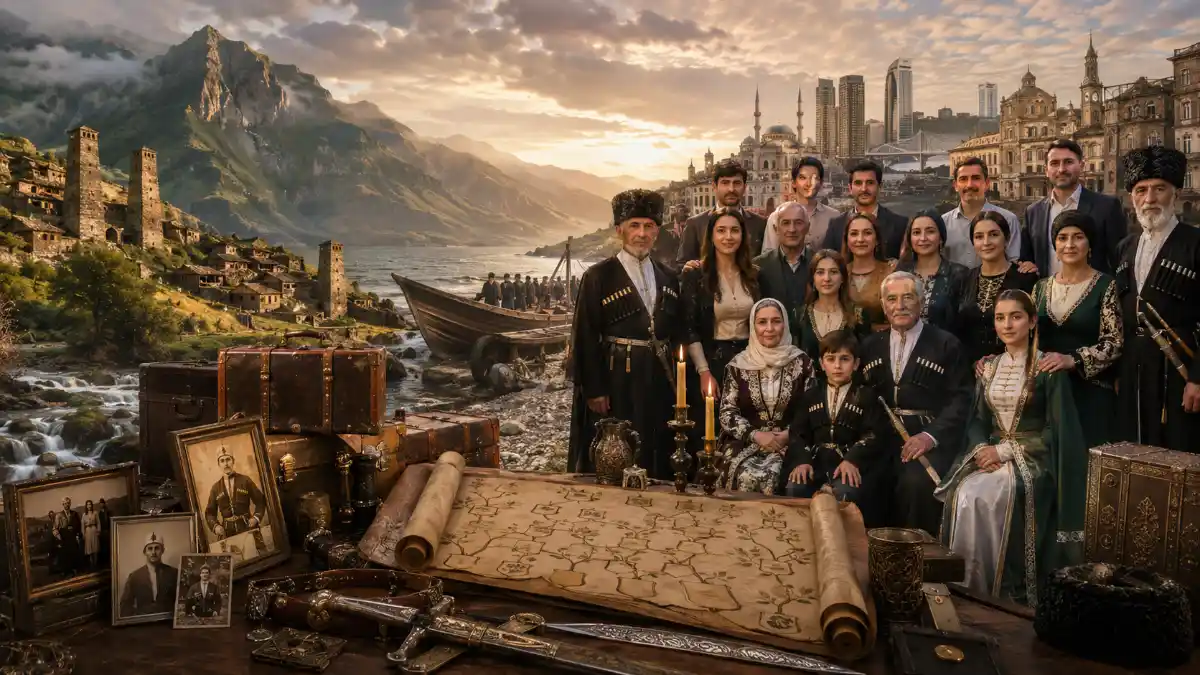
The Maeotians and Sindians: Circassian Ancestors in Antiquity
Greek historians including Herodotus and Strabo documented the peoples of the northeastern Black Sea coast — the Maeotians, Sindians, and Kerketians — whom modern scholars identify as proto-Circassian populations. These communities maintained trade networks with Greek colonies such as Phanagoria and Hermonassa, exchanging grain, honey, and wax for Mediterranean goods.
The Sindian kingdom (5th–4th century BCE) minted its own coins and maintained diplomatic relations with the Bosporan Kingdom, demonstrating a level of political sophistication that contradicts later colonial narratives about Caucasian peoples.
The Medieval Circassian Kingdoms
By the medieval period, Circassian political organization had evolved into a sophisticated system of principalities and tribal federations. The most prominent among these were:
Zikhia — A powerful coastal federation that dominated Black Sea trade routes from the 6th to 15th centuries
Kasogiya — Referenced in Russian chronicles as a formidable Caucasian state that clashed with Kievan Rus' prince Mstislav in 1022
The Circassian Mamluks — From the 13th century onward, Circassian warriors rose to become the ruling elite of Egypt and the Levant
The Circassian Mamluk Dynasty of Egypt (1382–1517)
Perhaps the most remarkable chapter in Circassian history abroad was the Burji Mamluk dynasty. Circassian warriors, originally brought to Egypt as military slaves, rose through the ranks to seize the sultanate itself. For 135 years, Circassian sultans ruled Egypt, Syria, Palestine, and the Hejaz — making it the most powerful Muslim state of its era.
Sultan Barquq (1382–1399) established the dynasty, and Sultan Qaitbay (1468–1496) presided over its cultural golden age, commissioning mosques, madrasas, and fortifications that still stand in Cairo today. The dynasty ended only with the Ottoman conquest in 1517.
Xabze: The Circassian Code of Ethics
Central to Circassian identity throughout history has been Адыгэ Хабзэ (Adyghe Xabze) — an unwritten but deeply codified system of ethics, social conduct, and governance that regulated every aspect of life. Often compared to the Japanese Bushido or the chivalric codes of medieval Europe, Xabze was far more comprehensive:
Напэ (Nape) — Honor and dignity, the supreme virtue
ЦIыхугъэ (Ts'ykhughe) — Humanity and compassion toward all people
ЛIыгъэ (L'yghe) — Courage and valor, not merely physical but moral
Гуащэгъэшхо — Hospitality so sacred that a host was expected to defend a guest with their life
Нэхъыжь — Deep respect for elders and ancestral wisdom
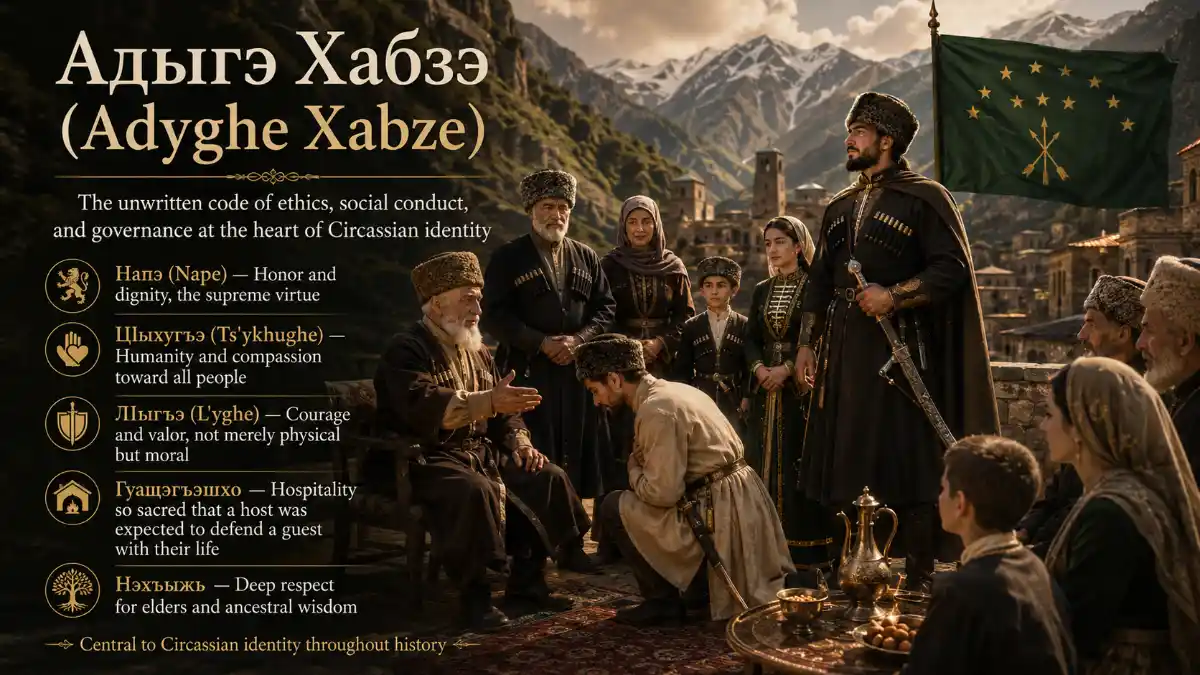
Xabze governed everything from conflict resolution to marriage customs, environmental stewardship to diplomatic protocol. European travelers of the 18th and 19th centuries — including Edmund Spencer, James Bell, and David Urquhart — wrote extensively about the sophistication of Circassian social organization.
The Russo-Circassian War (1763–1864)
The defining trauma of Circassian history was the century-long Russo-Circassian War — one of the longest conflicts in modern history. Beginning with the construction of Russian military lines along the Kuban River in 1763, the war escalated through decades of resistance, treaties, betrayals, and scorched-earth campaigns.
Key Phases of the War
Phase 1 — Early Resistance (1763–1829): Circassian tribes united intermittently to repel Russian incursions. The Treaty of Adrianople (1829) between Russia and the Ottoman Empire ceded Circassian lands — without Circassian consent — to Russia, though actual control remained contested.
Phase 2 — Organized Resistance (1829–1859): Leaders like Haji Berzeg Kerantukh and the Natukhai leader Sefer Bey Zanuko organized pan-Circassian resistance. European powers, particularly Britain, offered intermittent diplomatic support but ultimately failed to intervene militarily.
Phase 3 — Final Conquest (1859–1864): After the surrender of Imam Shamil in the eastern Caucasus in 1859, Russia concentrated its full military force on Circassia. General Nikolai Yevdokimov implemented a strategy of systematic destruction — burning villages, destroying crops, and forcing mass deportation.
The Battle of Sochi and the Fall of Circassia (May 21, 1864)
On May 21, 1864, Russian forces held a victory parade in the Circassian village of Kbaada (modern-day Krasnaya Polyana near Sochi), marking the formal end of Circassian resistance. This date is commemorated annually by the global Circassian diaspora as a day of mourning.
The Circassian Genocide and the Great Exile (1864–1870)
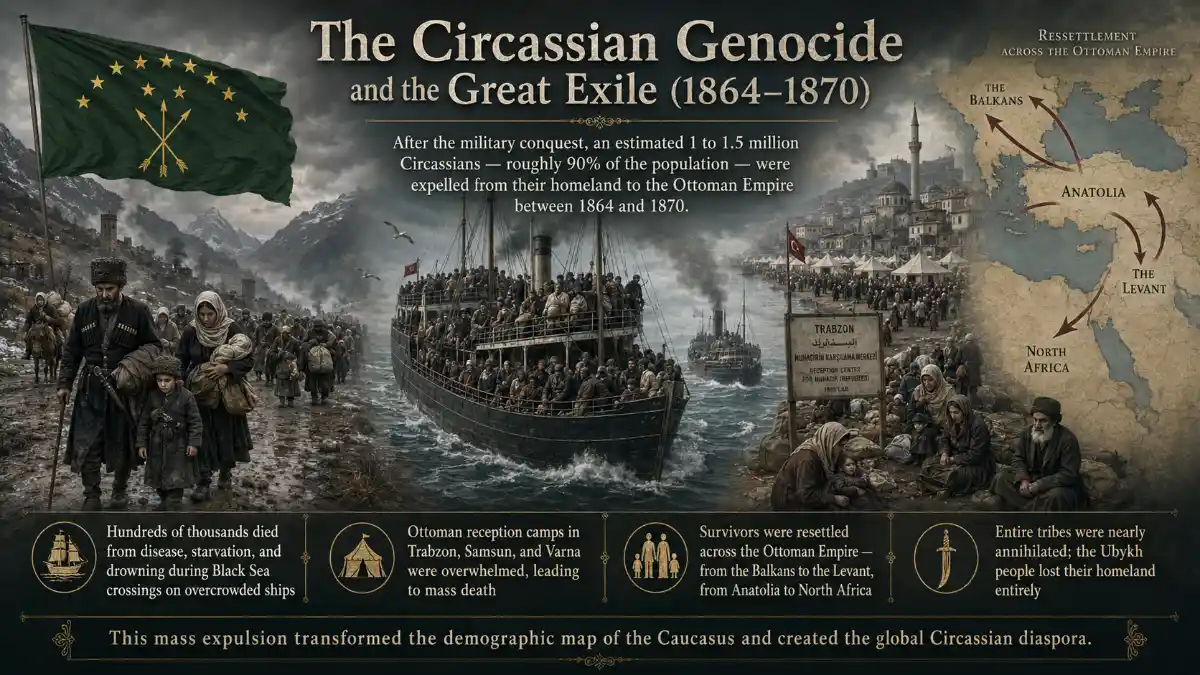
What followed the military conquest was one of the largest ethnic cleansing operations of the 19th century. An estimated 1 to 1.5 million Circassians — roughly 90% of the total population — were expelled from their homeland to the Ottoman Empire between 1864 and 1870.
The deportation was catastrophic:
Hundreds of thousands died from disease, starvation, and drowning during Black Sea crossings on overcrowded ships
Ottoman reception camps in Trabzon, Samsun, and Varna were overwhelmed, leading to mass death
Survivors were resettled across the Ottoman Empire — from the Balkans to the Levant, from Anatolia to North Africa
Entire tribes were nearly annihilated; the Ubykh people lost their homeland entirely
This mass expulsion — recognized as genocide by Georgia (2011) and several other bodies — fundamentally transformed the demographic map of the Caucasus and created the global Circassian diaspora.
The Global Circassian Diaspora
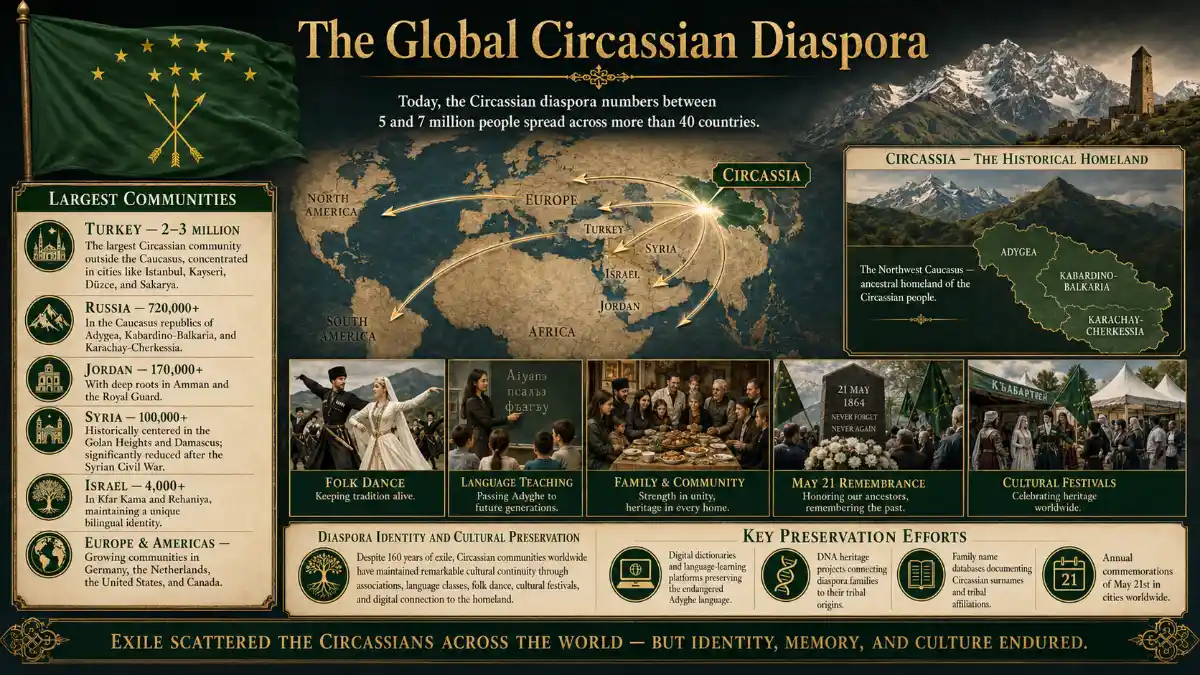
Today, the Circassian diaspora numbers between 5 and 7 million people spread across more than 40 countries. The largest communities are found in:
Turkey — 2–3 million, the largest Circassian community outside the Caucasus, concentrated in cities like Istanbul, Kayseri, Düzce, and Sakarya
Russia — 720,000+ in the Caucasus republics of Adygea, Kabardino-Balkaria, and Karachay-Cherkessia
Jordan — 170,000+, with deep roots in Amman (founded with significant Circassian participation) and the Royal Guard
Syria — 100,000+ (significantly reduced after the Syrian Civil War), historically centered in the Golan Heights and Damascus
Israel — 4,000+ in the villages of Kfar Kama and Rehaniya, maintaining a unique bilingual identity
Europe & Americas — Growing communities in Germany, the Netherlands, the United States, and Canada
Diaspora Identity and Cultural Preservation
Despite 160 years of exile, Circassian communities worldwide have maintained remarkable cultural continuity. Circassian associations in Turkey, Jordan, Germany, and the United States organize language courses, folk dance troupes, and cultural festivals. The internet and social media have accelerated cultural exchange between diaspora communities and the Caucasus homeland.
Key preservation efforts include:
Digital dictionaries and language-learning platforms preserving the endangered Adyghe language
DNA heritage projects connecting diaspora families to their tribal origins
Family name databases documenting thousands of Circassian surnames and their tribal affiliations
Annual commemorations of May 21st in cities worldwide
10 Pivotal Events in Circassian History
These ten milestones span millennia and define the arc of Circassian civilization — from ancient sovereignty to modern resilience.
1. Ancient Caucasus Civilizations (4000+ BCE)
The Maeotian, Sindian, and Kerketian cultures flourished along the northeastern Black Sea coast. Archaeological sites at Maikop and throughout the Kuban region reveal sophisticated metallurgy, agriculture, and trade networks with Greek colonies — establishing Circassians among the oldest peoples of the Caucasus.
2. The Circassian Mamluks Rule Egypt (1382–1517)
Circassian warriors of the Burji dynasty governed Egypt, Syria, and the Hejaz for 135 years. Sultan Barquq established the dynasty; Sultan Qaitbay built monuments that still define Cairo's skyline. This era represents the peak of Circassian political power on the world stage.
3. The Battle of Sochuips / Bziyuko (1796)
A decisive battle where Circassian forces defeated a coalition army, demonstrating the military effectiveness of united tribal defense and becoming a symbol of Circassian sovereignty and martial prowess.
4. The Treaty of Adrianople (1829)
The Ottoman Empire ceded Circassian lands to Russia without Circassian consent — an act that intensified resistance but also isolated the Circassian cause from potential Ottoman military support.
5. The Russo-Circassian War (1763–1864)
A century of resistance against Russian imperial expansion. Despite fierce defense of their homeland, Circassian forces were ultimately overwhelmed by the Russian military machine, culminating in the fall of Sochi on May 21, 1864.
6. The Fall of Sochi — May 21, 1864
The Russian victory parade at Kbaada (Krasnaya Polyana) marked the end of organized Circassian resistance. This date is now the annual Day of Mourning for Circassians worldwide — a symbol of loss, endurance, and the demand for historical justice.
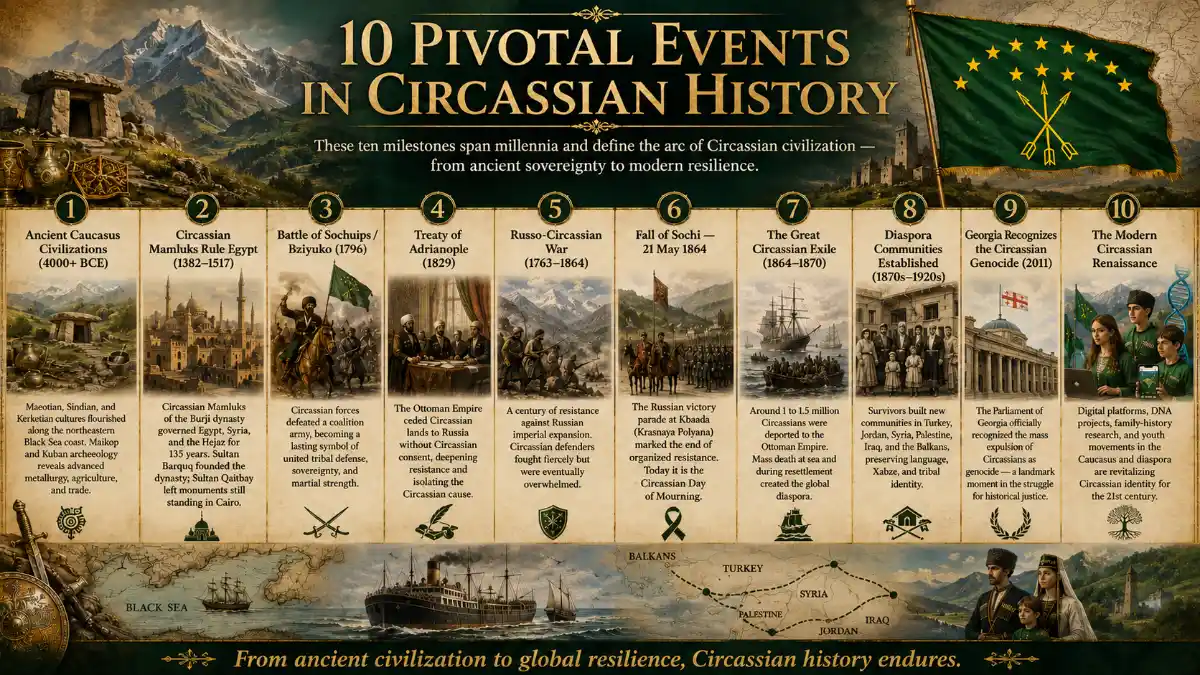
7. The Great Circassian Exile (1864–1870)
The forced deportation of approximately 1–1.5 million Circassians to the Ottoman Empire — one of the largest ethnic cleansing events of the 19th century. Hundreds of thousands perished during the crossing and resettlement. The exile created the global Circassian diaspora.
8. Circassian Diaspora Communities Established (1870s–1920s)
Survivors built new communities across the Ottoman Empire and beyond — in Turkey, Jordan, Syria, Palestine, Iraq, and the Balkans. These communities preserved language, Xabze, and tribal identity while adapting to new homelands.
9. Georgia Recognizes the Circassian Genocide (2011)
The Parliament of Georgia became the first state body to officially recognize the mass expulsion of Circassians as genocide — a landmark moment in the international campaign for historical recognition and justice.
10. The Modern Circassian Renaissance
Today, a global cultural renaissance is underway. Digital platforms document endangered languages and family histories. DNA projects reconnect diaspora families to their tribal origins. Youth movements in Turkey, Jordan, Europe, and the Caucasus are revitalizing Circassian identity for the 21st century — ensuring that a 5,000-year civilization continues to thrive.
The Circassian Homeland Today
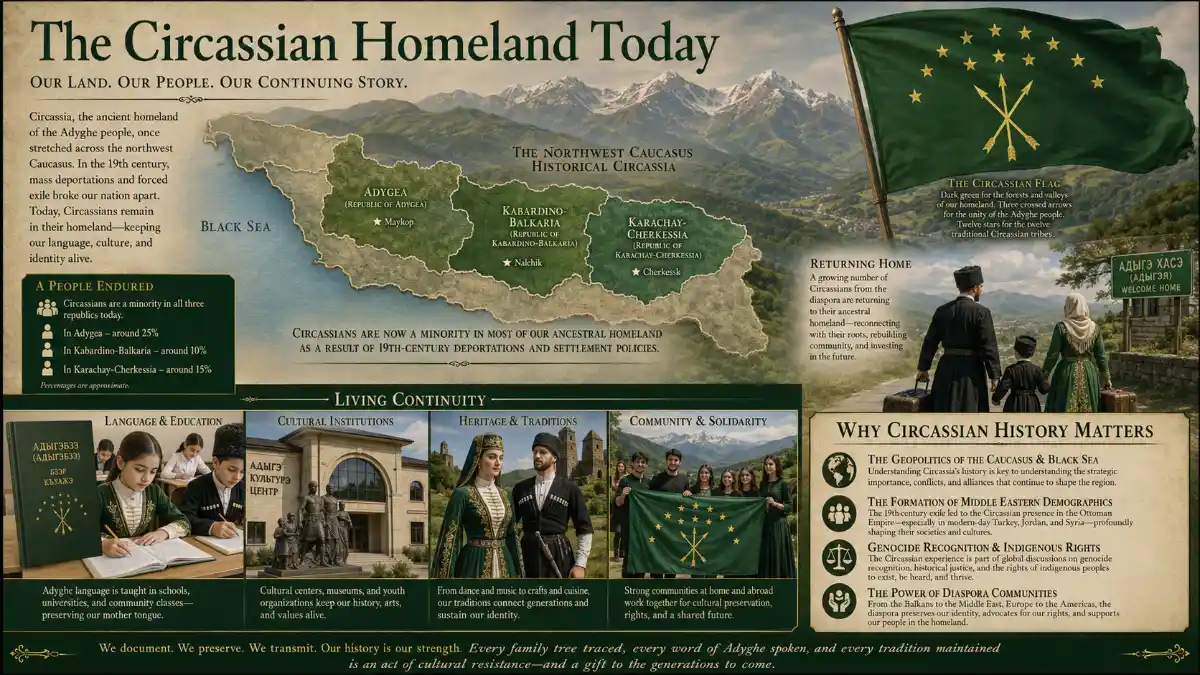
In the Caucasus, the three Russian republics of Adygea, Kabardino-Balkaria, and Karachay-Cherkessia constitute the remnants of historical Circassia. Though Circassians are a minority in their own homeland — a consequence of the 19th-century deportations — these republics maintain Circassian language education, cultural institutions, and a growing repatriation movement.
The question of return remains central to Circassian political discourse, with diaspora organizations advocating for recognition of historical injustices and the right of return for descendants of those expelled.
Why Circassian History Matters
The Circassian story is not merely a regional history — it is a case study in the resilience of indigenous peoples, the consequences of imperial expansion, and the power of cultural preservation across generations of exile. Understanding Circassian history provides essential context for:
The geopolitics of the Caucasus and Black Sea region
The formation of Middle Eastern demographics (particularly in Turkey, Jordan, and Syria)
Global discussions on genocide recognition and indigenous rights
The role of diaspora communities in cultural preservation
As the global Circassian community enters its third century of diaspora, the imperative to document, preserve, and transmit this history has never been greater. Every family tree traced, every word of Adyghe spoken, and every tradition maintained is an act of cultural resistance — connecting the present to a civilization that has endured for over five millennia.
The Ancient Roots of the Circassian People
The Circassians — known in their own language as Adyghe (Адыгэ) — are one of the oldest indigenous peoples of the Caucasus region. Archaeological evidence places their ancestors in the Northwest Caucasus as early as the 4th millennium BCE, making Circassian civilization one of the most ancient continuous cultures in Europe and Western Asia.
Their homeland, Circassia, stretched along the northeastern coast of the Black Sea from the Taman Peninsula in the west to modern-day Abkhazia in the south, and inland across the fertile valleys of the Kuban River to the Greater Caucasus ridge. This strategic geography — bridging Europe and Asia — shaped every chapter of Circassian history.
The Maeotians and Sindians: Circassian Ancestors in Antiquity
Greek historians including Herodotus and Strabo documented the peoples of the northeastern Black Sea coast — the Maeotians, Sindians, and Kerketians — whom modern scholars identify as proto-Circassian populations. These communities maintained trade networks with Greek colonies such as Phanagoria and Hermonassa, exchanging grain, honey, and wax for Mediterranean goods.
The Sindian kingdom (5th–4th century BCE) minted its own coins and maintained diplomatic relations with the Bosporan Kingdom, demonstrating a level of political sophistication that contradicts later colonial narratives about Caucasian peoples.
The Medieval Circassian Kingdoms
By the medieval period, Circassian political organization had evolved into a sophisticated system of principalities and tribal federations. The most prominent among these were:
Zikhia — A powerful coastal federation that dominated Black Sea trade routes from the 6th to 15th centuries
Kasogiya — Referenced in Russian chronicles as a formidable Caucasian state that clashed with Kievan Rus' prince Mstislav in 1022
The Circassian Mamluks — From the 13th century onward, Circassian warriors rose to become the ruling elite of Egypt and the Levant
The Circassian Mamluk Dynasty of Egypt (1382–1517)
Perhaps the most remarkable chapter in Circassian history abroad was the Burji Mamluk dynasty. Circassian warriors, originally brought to Egypt as military slaves, rose through the ranks to seize the sultanate itself. For 135 years, Circassian sultans ruled Egypt, Syria, Palestine, and the Hejaz — making it the most powerful Muslim state of its era.
Sultan Barquq (1382–1399) established the dynasty, and Sultan Qaitbay (1468–1496) presided over its cultural golden age, commissioning mosques, madrasas, and fortifications that still stand in Cairo today. The dynasty ended only with the Ottoman conquest in 1517.
Xabze: The Circassian Code of Ethics
Central to Circassian identity throughout history has been Адыгэ Хабзэ (Adyghe Xabze) — an unwritten but deeply codified system of ethics, social conduct, and governance that regulated every aspect of life. Often compared to the Japanese Bushido or the chivalric codes of medieval Europe, Xabze was far more comprehensive:
Напэ (Nape) — Honor and dignity, the supreme virtue
ЦIыхугъэ (Ts'ykhughe) — Humanity and compassion toward all people
ЛIыгъэ (L'yghe) — Courage and valor, not merely physical but moral
Гуащэгъэшхо — Hospitality so sacred that a host was expected to defend a guest with their life
Нэхъыжь — Deep respect for elders and ancestral wisdom
Xabze governed everything from conflict resolution to marriage customs, environmental stewardship to diplomatic protocol. European travelers of the 18th and 19th centuries — including Edmund Spencer, James Bell, and David Urquhart — wrote extensively about the sophistication of Circassian social organization.
The Russo-Circassian War (1763–1864)
The defining trauma of Circassian history was the century-long Russo-Circassian War — one of the longest conflicts in modern history. Beginning with the construction of Russian military lines along the Kuban River in 1763, the war escalated through decades of resistance, treaties, betrayals, and scorched-earth campaigns.
Key Phases of the War
Phase 1 — Early Resistance (1763–1829): Circassian tribes united intermittently to repel Russian incursions. The Treaty of Adrianople (1829) between Russia and the Ottoman Empire ceded Circassian lands — without Circassian consent — to Russia, though actual control remained contested.
Phase 2 — Organized Resistance (1829–1859): Leaders like Haji Berzeg Kerantukh and the Natukhai leader Sefer Bey Zanuko organized pan-Circassian resistance. European powers, particularly Britain, offered intermittent diplomatic support but ultimately failed to intervene militarily.
Phase 3 — Final Conquest (1859–1864): After the surrender of Imam Shamil in the eastern Caucasus in 1859, Russia concentrated its full military force on Circassia. General Nikolai Yevdokimov implemented a strategy of systematic destruction — burning villages, destroying crops, and forcing mass deportation.
The Battle of Sochi and the Fall of Circassia (May 21, 1864)
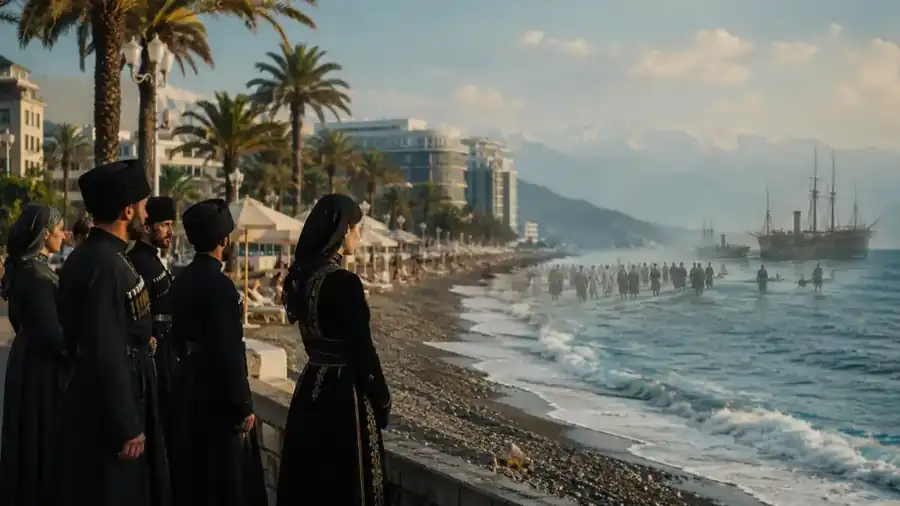
On May 21, 1864, Russian forces held a victory parade in the Circassian village of Kbaada (modern-day Krasnaya Polyana near Sochi), marking the formal end of Circassian resistance. This date is commemorated annually by the global Circassian diaspora as a day of mourning.
The Circassian Genocide and the Great Exile (1864–1870)
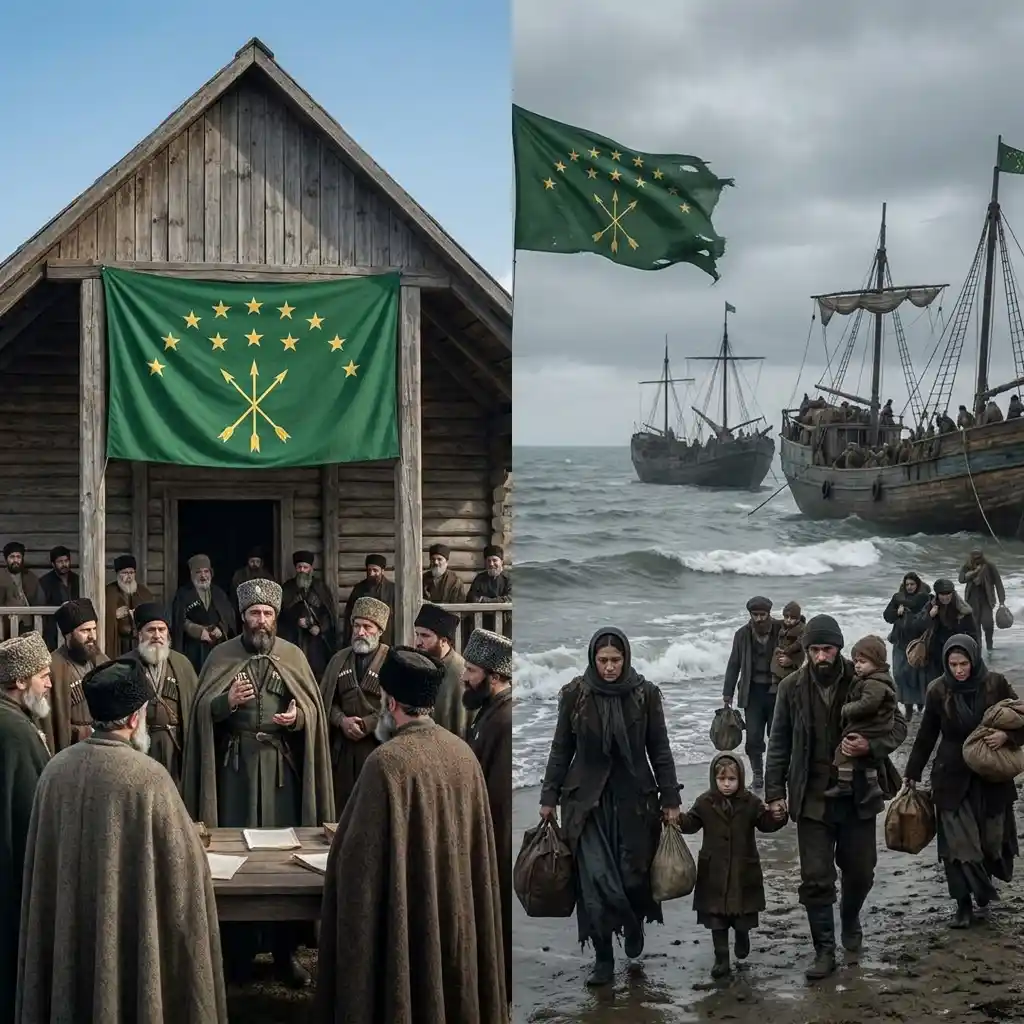
What followed the military conquest was one of the largest ethnic cleansing operations of the 19th century. An estimated 1 to 1.5 million Circassians — roughly 90% of the total population — were expelled from their homeland to the Ottoman Empire between 1864 and 1870.
The deportation was catastrophic:
Hundreds of thousands died from disease, starvation, and drowning during Black Sea crossings on overcrowded ships
Ottoman reception camps in Trabzon, Samsun, and Varna were overwhelmed, leading to mass death
Survivors were resettled across the Ottoman Empire — from the Balkans to the Levant, from Anatolia to North Africa
Entire tribes were nearly annihilated; the Ubykh people lost their homeland entirely
This mass expulsion — recognized as genocide by Georgia (2011) and several other bodies — fundamentally transformed the demographic map of the Caucasus and created the global Circassian diaspora.
The Global Circassian Diaspora
Today, the Circassian diaspora numbers between 5 and 7 million people spread across more than 40 countries. The largest communities are found in:
Turkey — 2–3 million, the largest Circassian community outside the Caucasus, concentrated in cities like Istanbul, Kayseri, Düzce, and Sakarya
Russia — 720,000+ in the Caucasus republics of Adygea, Kabardino-Balkaria, and Karachay-Cherkessia
Jordan — 170,000+, with deep roots in Amman (founded with significant Circassian participation) and the Royal Guard
Syria — 100,000+ (significantly reduced after the Syrian Civil War), historically centered in the Golan Heights and Damascus
Israel — 4,000+ in the villages of Kfar Kama and Rehaniya, maintaining a unique bilingual identity
Europe & Americas — Growing communities in Germany, the Netherlands, the United States, and Canada
Diaspora Identity and Cultural Preservation
Despite 160 years of exile, Circassian communities worldwide have maintained remarkable cultural continuity. Circassian associations in Turkey, Jordan, Germany, and the United States organize language courses, folk dance troupes, and cultural festivals. The internet and social media have accelerated cultural exchange between diaspora communities and the Caucasus homeland.
Key preservation efforts include:
Digital dictionaries and language-learning platforms preserving the endangered Adyghe language
DNA heritage projects connecting diaspora families to their tribal origins
Family name databases documenting thousands of Circassian surnames and their tribal affiliations
Annual commemorations of May 21st in cities worldwide
10 Pivotal Events in Circassian History
These ten milestones span millennia and define the arc of Circassian civilization — from ancient sovereignty to modern resilience.
Ancient Caucasus Civilizations (4000+ BCE) — The Maeotian, Sindian, and Kerketian cultures flourished along the northeastern Black Sea coast. Archaeological sites at Maikop and throughout the Kuban region reveal sophisticated metallurgy, agriculture, and trade networks with Greek colonies.
The Circassian Mamluks Rule Egypt (1382–1517) — Circassian warriors of the Burji dynasty governed Egypt, Syria, and the Hejaz for 135 years. Sultan Barquq established the dynasty; Sultan Qaitbay built monuments that still define Cairo's skyline.
The Battle of Sochuips / Bziyuko (1796) — A decisive battle where Circassian forces defeated a coalition army, demonstrating the military effectiveness of united tribal defense.
The Treaty of Adrianople (1829) — The Ottoman Empire ceded Circassian lands to Russia without Circassian consent — an act that intensified resistance but also isolated the Circassian cause.
The Russo-Circassian War (1763–1864) — A century of resistance against Russian imperial expansion, culminating in the fall of Sochi on May 21, 1864.
The Fall of Sochi — May 21, 1864 — The Russian victory parade at Kbaada marked the end of organized Circassian resistance and the beginning of the annual Day of Mourning.
The Great Circassian Exile (1864–1870) — The forced deportation of approximately 1–1.5 million Circassians to the Ottoman Empire — one of the largest ethnic cleansing events of the 19th century.
Circassian Diaspora Communities Established (1870s–1920s) — Survivors built new communities across the Ottoman Empire and beyond — in Turkey, Jordan, Syria, Palestine, Iraq, and the Balkans.
Georgia Recognizes the Circassian Genocide (2011) — The Parliament of Georgia became the first state body to officially recognize the mass expulsion of Circassians as genocide.
The Modern Circassian Renaissance — A global cultural renaissance underway today, with digital platforms, DNA projects, and youth movements revitalizing Circassian identity for the 21st century.
The Nart Sagas: A Mythology That Predates Homer
Long before Circassians converted to Islam or Christianity, they sustained one of the ancient world's great mythological cycles: the Нарт Хъуэхъу (Nart Sagas). This oral epic tradition — shared in varying forms with Abkhazians, Ossetians, Abazins, and Chechens — centers on a race of demigod heroes called the Narts, whose deeds, tragedies, and moral dilemmas map a complete pre-monotheistic worldview.
Scholars including Georges Dumézil have argued that the Nart Sagas are among the oldest living mythological traditions in Eurasia, predating the Homeric epics and preserving Indo-European and pre-Indo-European motifs erased elsewhere by the spread of literacy and monotheism.
The Prometheus Connection
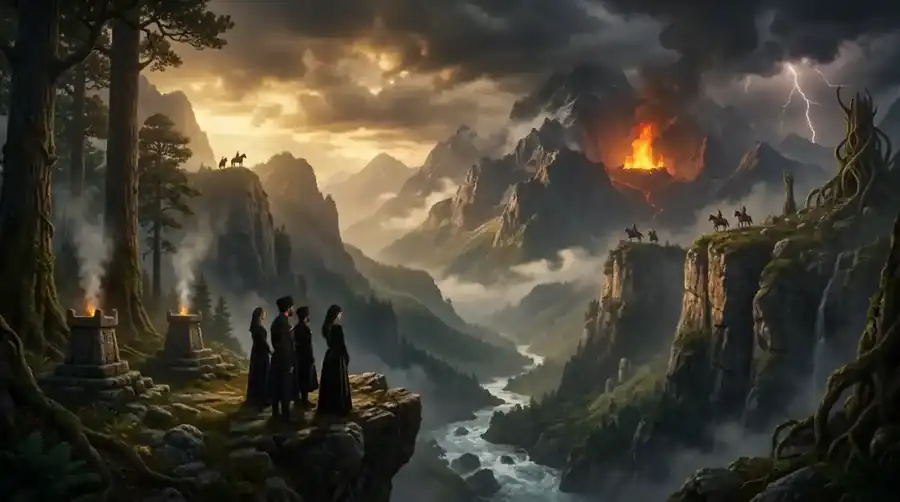
Among the most striking features of the Nart Sagas is the figure of Насрен Жаче (Nasren Zhathe) — a culture hero who steals fire from the gods and is punished by being chained to a mountain in the Caucasus, where an eagle devours his liver each day, only for it to regenerate by night. The parallel with the Greek myth of Prometheus — whom Hesiod places in the Caucasus — is so precise that scholars have debated the direction of influence for over a century. The dominant contemporary view is that the Caucasian tradition is the source, not the borrowing: Greek colonists on the Black Sea coast encountered the Nart oral tradition and brought a version of it westward. Prometheus may be, in origin, a Circassian hero.
Sosruco: The Fire-Bringer
The central Nart hero in the Circassian tradition is Сосрыкъуэ (Sosruco) — born from stone after a divine spark, invulnerable except in his thighs, a trickster and champion who steals fire from the sky to give to humanity. His story carries unmistakable parallels not only to Prometheus but to Achilles (the vulnerable heel becoming the vulnerable thigh), to Cú Chulainn of Irish mythology, and to the Norse Sigurd. Dumézil spent decades arguing that these parallels reflect a shared proto-Indo-European mythological grammar — and that the Nart Sagas preserve it in the most complete surviving form.
The Nart Sagas were never written down until the 19th century. They survived exclusively through oral performance — sung by specialist bards called Джэгуакlуэ (Jeguakwe) at community gatherings. The exile of 1864 nearly destroyed this tradition entirely; the recovery and transcription of surviving Nart texts in the 20th century is one of the quiet heroic acts of Circassian cultural history.
The Circassian Amazons: Where the Legend May Have Been Born
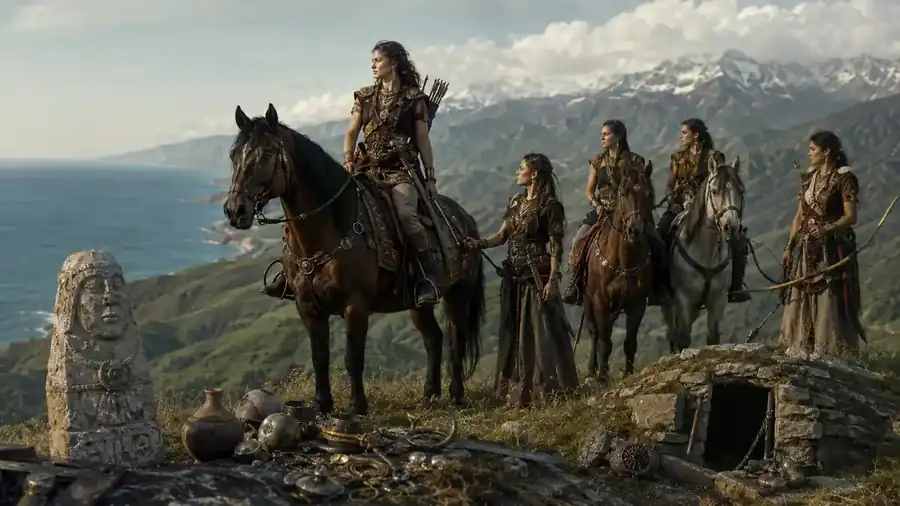
Ancient Greek and Roman writers consistently located the Amazons — the mythical race of warrior women — in the region of the eastern Black Sea and the Caucasus. Herodotus places them northeast of the Black Sea among the Sauromatians; Strabo locates them in the Caucasian foothills. Modern archaeologists excavating Scythian and related burial mounds (kurgans) across the Eurasian steppe have found a striking number of female skeletons buried with weapons — bows, swords, and armor — consistent with active combat roles.
The Circassian women's tradition of active social agency, the documented cases of women taking up arms during the Russo-Circassian War, and the geographic precision of ancient Amazon-placement in the Northwest Caucasus have led some scholars to suggest that Greek encounters with the proto-Circassian Maeotian and Sindian peoples — where women of the warrior class did participate in combat and ride horses — formed the factual nucleus around which the Amazon myth grew. The Amazons may not have been myth. They may have been Circassian ancestors.
The Late and Complex Islamization of Circassia
One of the most consequential — and least understood — facts about Circassian history is this: the Circassians did not become Muslim until surprisingly late, and the process was incomplete, contested, and deeply ambivalent.
Prior to the 16th century, most Circassians practiced a syncretic indigenous religion called Хабзэ Хэкlэ (Habze Heke) — sometimes called "Adyghe Habze" or simply the pre-Islamic tradition. It blended remnants of Byzantine Christianity (which had spread along the Black Sea coast from the 6th to 10th centuries), elements of older animist and polytheist belief, and the moral-cosmological framework of Xabze itself. Sacred groves, thunder gods (Шыблэ / Shibla), and a pantheon of nature deities were venerated alongside a nominal Christian identity in some regions.
Ottoman influence brought Sunni Islam beginning in the 16th century, but mass Islamization of Circassian tribes — particularly in the interior — did not occur until the 17th and 18th centuries, and in some areas was still incomplete when the Russo-Circassian War began in the 1760s. The Kabardians converted earlier than the coastal tribes; the Shapsugs and Natukhai held onto syncretic practices well into the 19th century.
The Russian imperial strategy explicitly exploited this: Russian commanders noted in military dispatches that some Circassian tribes were "barely Muslim" and attempted to use Christian Ossetian and Georgian intermediaries to peel coastal tribes away from resistance alliances. It largely failed — but it reveals that the Circassian-Russian war was not straightforwardly a Muslim resistance to Christian empire. It was a national resistance in which religion was secondary to land, identity, and Xabze.
An even stranger irony: Russian authorities baptized some captured Circassian chiefs as a condition of peace deals in the early phases of the war — producing a generation of Circassian nobles who were nominally Orthodox Christian while their communities fought under Islamic banners.
The "Circassian Beauty" Trade: A Paradox of Survival and Exploitation
Circassian women held a specific and disturbing place in the imagination of the Ottoman and broader Islamic world from the 15th through 19th centuries. They were considered, by wide cultural consensus, the most beautiful women in the world — a stereotype so entrenched that it became a near-scientific claim in 18th-century European anthropology, with figures like Johann Friedrich Blumenbach citing Circassian facial structure as the ideal type of "Caucasian" beauty (from which the now-obsolete racial category "Caucasian" derives its name).
This reputation had brutal material consequences. A significant trade in Circassian women — sold into Ottoman harems — operated for centuries, and what makes this history uniquely painful is that the trade was not entirely forced. Some Circassian noble families voluntarily placed daughters in Ottoman imperial service, viewing palace entry as a path to prestige, wealth, and political influence. Daughters who rose through the harem hierarchy could become Haseki Sultanas (imperial favorites) or mothers of future sultans — and thereby patrons of their families and tribes back in Circassia.
Several Ottoman sultans had Circassian mothers. The power dynamics of the imperial harem meant that Circassian women occasionally wielded extraordinary influence over the Ottoman state — influencing appointments, directing trade concessions, and, in at least one documented case, preventing a military campaign against Circassian tribes by leveraging personal access to the sultan.
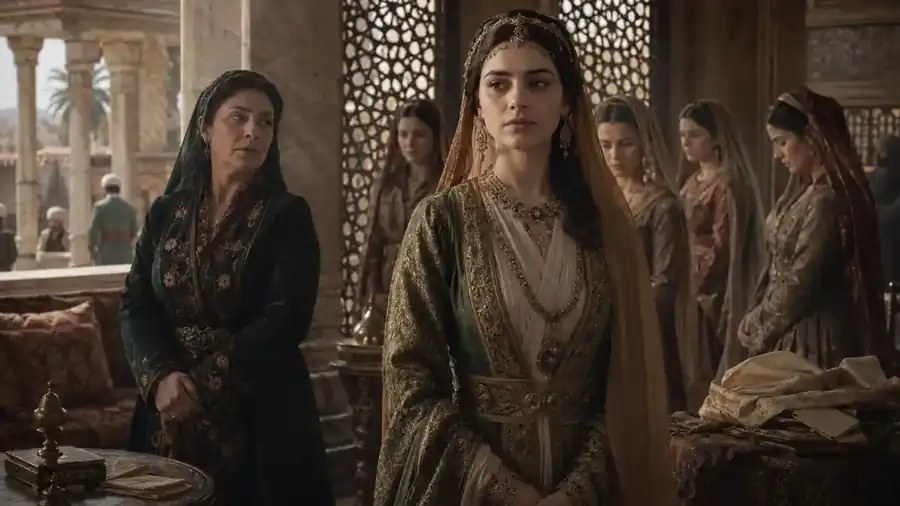
The paradox — a community whose women were prized for beauty to the point of exploitation, yet who extracted political advantage from that very exploitation — resists easy moral categorization. It reveals a society navigating colonial-adjacent power structures with considerable sophistication.
The British Schooner Vixen and the Almost-War of 1836
In November 1836, a British merchant schooner called the Vixen sailed from Constantinople into the Black Sea carrying salt — and was immediately seized by a Russian warship near the Circassian coast at Sudjuk-Kale (modern Novorossiysk).
This was not a routine maritime incident. The Vixen had been deliberately sent by David Urquhart, a passionate pro-Circassian British diplomat and writer, as a calculated provocation designed to force a diplomatic crisis between Britain and Russia over the legal status of the Circassian coast. Urquhart's argument was that Russia had claimed sovereignty over Circassian territory via the Treaty of Adrianople (1829) — but since Circassians had never consented to that treaty and still controlled their own coastline, the Russian blockade of Circassian ports was illegal under international law. The Vixen seizure was meant to make Britain choose: accept Russian sovereignty over Circassia, or contest it.
The British government, under Palmerston, ultimately backed down — issuing a formal protest but accepting Russia's explanation that the Vixen had violated legitimate customs regulations. The decision was bitterly controversial in Britain, where a substantial pro-Circassian lobby in Parliament had hoped for intervention.
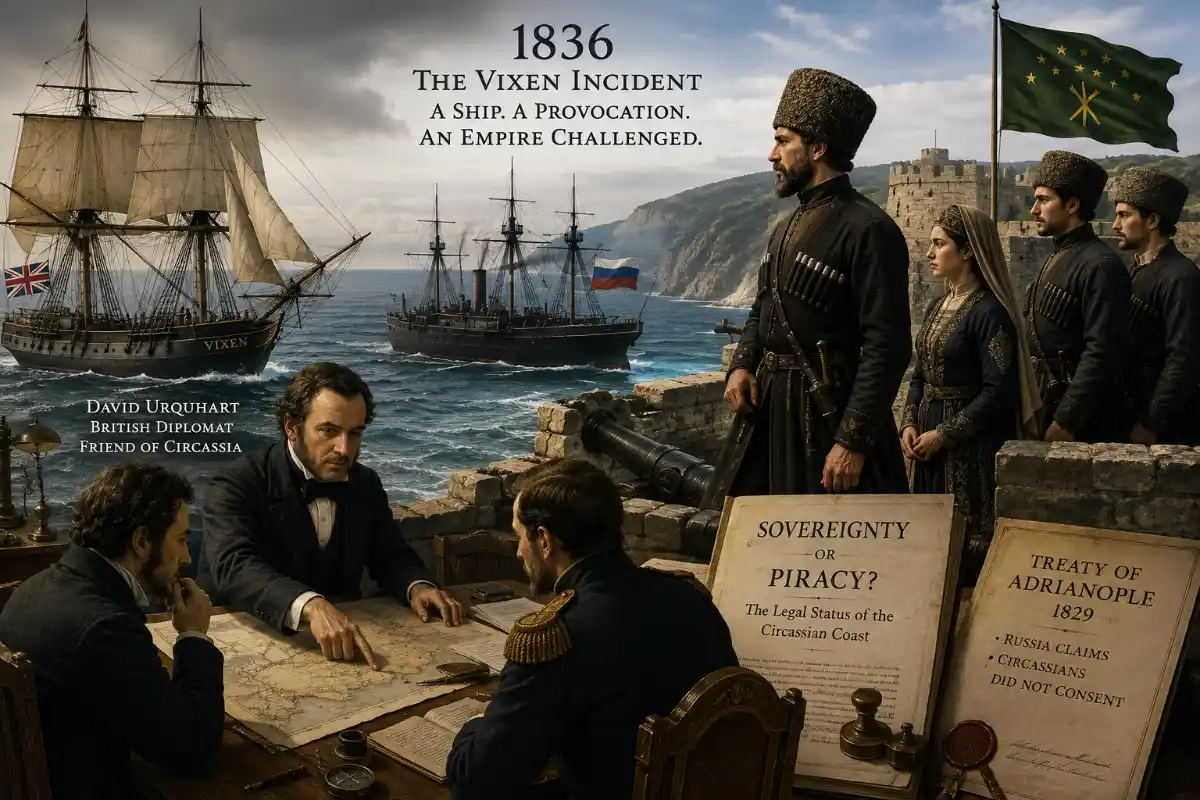
Had Britain escalated, the Russo-Circassian War might have become an international conflict two decades before the Crimean War. Instead, the Vixen affair faded into diplomatic history — remembered in Britain largely as a footnote, but in Circassian historiography as the moment when the West was given the choice to save Circassia and declined.
The Polish-Circassian Alliance: Rebels United Against the Tsar
In the 1830s and 1840s, an unlikely alliance formed between Circassian resistance leaders and Polish political exiles — both peoples actively fighting or organizing against Russian imperial power.
After the failed Polish uprising of 1830–31, thousands of Polish officers fled westward into exile in France, Britain, and the Ottoman Empire. A subset of these — committed to the principle that any blow against Russia served Polish independence — made their way to Circassia to offer their military expertise to the resistance.
Polish officers brought knowledge of European fortification techniques, artillery handling, and military organization to Circassian tribal commanders who were formidable in guerrilla warfare but lacked formal siege capability. The collaboration produced functioning artillery emplacements and improved defensive earthworks in several Circassian strongholds during the 1840s.
The most active coordinator of this effort was Michał Czajkowski (Sadyk Pasha) — a Polish exile who operated between Constantinople and the Caucasian front, working to supply and advise Circassian forces with Ottoman and British awareness. Adam Mickiewicz, Poland's national poet, wrote with deep sympathy about the Circassian cause from Paris, framing it explicitly as a parallel struggle to Polish national survival.
This Polish-Circassian solidarity is almost entirely absent from mainstream histories of either people — a forgotten chapter in which the 19th century's colonized tried to save each other.
The Circassian Alphabet: A Century of Failed Scripts
The history of attempts to create a written form of the Adyghe language is a story of politics overriding linguistics — and of a people denied the tool of literacy at precisely the moment they most needed it.
For centuries, Adyghe had no written form. The oral tradition of the Nart Sagas and the Jeguakwe bards meant that literacy was not culturally necessary. But as Russian imperial pressure intensified in the 19th century, the need for a written language — for diplomacy, for documentation, for the preservation of legal codes and histories — became urgent.
Several serious attempts were made:
1820s — Arabic Script: Early Circassian scholars attempted to adapt the Arabic alphabet to Adyghe phonology. The problem was fundamental: Arabic has 28 consonant letters; Adyghe has roughly 58 consonants. The adaptation required so many diacritical additions that the system became impractical.
1840s — Bersegh's Cyrillic Adaptation: The Kabardian scholar Shora Nogma and later Bersegh Pachev developed Arabic and Cyrillic-based writing systems that gained limited use among educated Kabardian nobles. These were never standardized or officially adopted.
1920s — The Soviet Latin Alphabet: After the Russian Revolution, Soviet linguists created a Latin-based Adyghe alphabet as part of the USSR's "latinization" policy for non-Slavic languages. This alphabet was genuinely functional — it handled the complex consonant inventory reasonably well — and was used in schools, newspapers, and early literature in Adygea and Kabardino-Balkaria through the late 1920s.
1936–38 — Forced Cyrillicization: Stalin's cultural reversal replaced Latin scripts across the Soviet Union with Cyrillic, for reasons more political than linguistic. The Adyghe Cyrillic alphabet adopted then remains the official writing system in Russia today — but it requires numerous digraphs (two-letter combinations) to represent single Adyghe consonants, making it cumbersome for fluent Adyghe speakers.
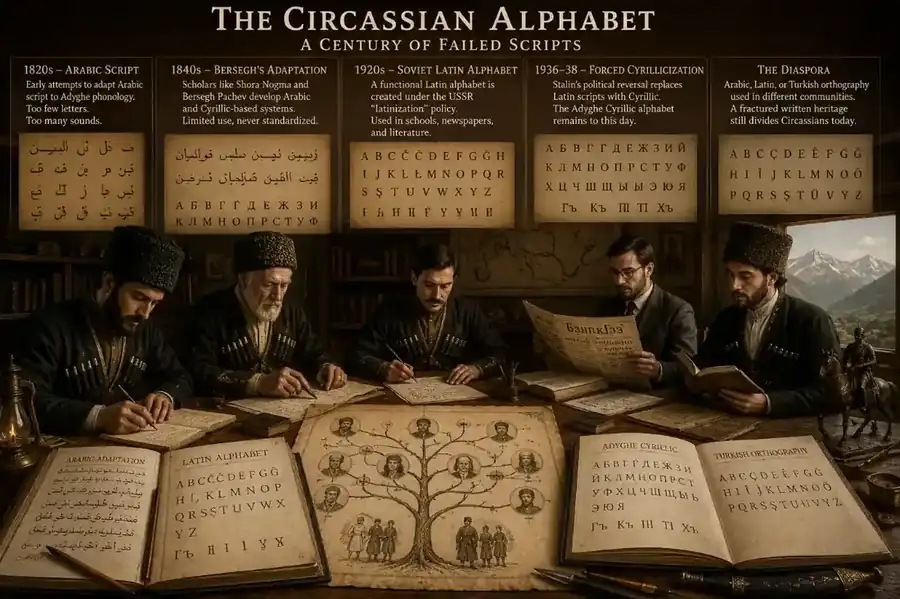
The diaspora, outside Soviet control, used Arabic script, then various Latin adaptations, then often simply Turkish orthography in the Turkish diaspora. The result: Circassians in the homeland and Circassians in the diaspora cannot easily read each other's written materials — a fracture imposed by 20th-century political decisions that continues to complicate cultural reunification.
The Circassian Role in the 1925 Syrian Great Revolt — and Its Aftermath
The Great Syrian Revolt of 1925–1927 against French Mandate rule is remembered primarily as a Druze-led uprising that expanded into a broader Syrian national movement. What is rarely discussed is the Circassian community's deeply divided response — and what that division reveals about the impossible position of diaspora communities navigating colonial power structures.
A significant portion of the Syrian Circassian community, settled in the Golan Heights and around Damascus since the 1870s, served in French Mandate auxiliary cavalry units — the Troupes spéciales du Levant — precisely because French authorities, like Ottoman authorities before them, specifically recruited Circassians for their military reputation. These were not ideological collaborators; they were a stateless refugee community, 60 years removed from their homeland, that had learned to survive by offering military service to whatever sovereign power controlled the territory they inhabited.
When the revolt began, Circassian cavalry units were deployed against Arab and Druze rebels — including in the brutal suppression of the Damascus uprising of October 1925, when French artillery and Circassian auxiliary forces bombarded parts of the old city. The event left a stain on Circassian-Arab relations in Syria that persisted for generations and was explicitly raised during the Syrian Civil War nearly a century later, when Syrian Circassians faced accusations of historical complicity rooted in 1925.
The 1925 episode illuminates the structural trap of diaspora existence: a people with no state, no right of return, and no political leverage had no mechanism to act on collective principle. Individual Circassian families in Syria faced the choice of serving the Mandate power or risking the community's precarious tolerated status. Many served. Some refused. None could do what a sovereign people might have done — opt out entirely.
The Ubykh: A Language That Died of Exile
The Ubykh people occupied the Black Sea coast between the Shapsug and Abkhazian territories. Their language, also called Ubykh, was not merely a Circassian dialect — it was a separate though related language within the Northwest Caucasian family, and it possessed the largest consonant inventory of any language ever documented: 84 consonants. It was phonologically unlike anything else on Earth, and linguists who studied it described the experience of listening to fluent Ubykh speech as hearing a language that sounded almost entirely constructed from consonant clusters, with vowels functioning almost as brief interruptions.
The Ubykh were expelled in their entirety in 1864. Not a single Ubykh family remained in Circassia. They settled primarily in Turkey — in and around the village of Haci Osman near Orhaneli in Bursa province — and maintained their language in isolation for several generations, even as surrounding Circassian communities gradually shifted to Turkish.
By the mid-20th century, Ubykh had dwindled to a handful of elderly speakers. The French linguist Georges Dumézil began documenting Ubykh in the 1930s, working intensively with the last fluent speakers over several decades. His primary informant in the final years was Tevfik Esenç, a farmer who became, by attrition, the last native speaker of Ubykh on Earth. Esenç was aware of his position. He cooperated extensively with Dumézil's documentation work and is recorded as having said, in Turkish: "It is a pity that Ubykh will die with me."
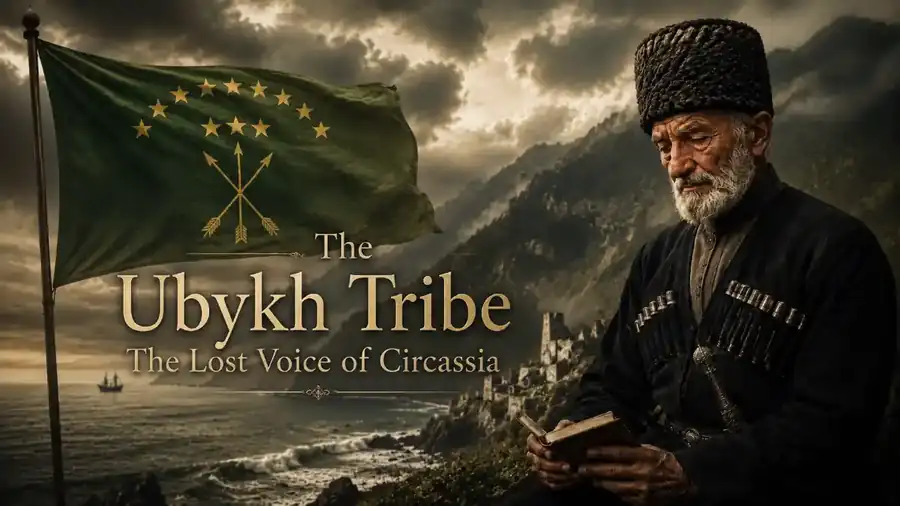
Tevfik Esenç died on October 7, 1992, in Hacı Osman village. With him died a language that had survived 84 consonants, the Caucasian mountain winter, the Russian Empire, and 130 years of exile — but could not survive the disappearance of a community. His grave in Turkey is, in a precise sense, the grave of a language.
The Amman Paradox: Refugees Who Built a Capital
When Circassian refugees began arriving in Transjordan in 1878, the site of present-day Amman was known as Rabbath Ammon — a place of ruins. The ancient Ammonite, Hellenistic, and Byzantine city had been abandoned for centuries. Ottoman surveyors described it as uninhabited and largely desolate.
The Circassian settlers — primarily Shapsug and Kabardian refugees — chose the ruins deliberately. They were people without a homeland building on the bones of another lost city. They cleared the Roman ruins, dug irrigation channels from the Zarqa River, planted orchards and grain fields, and constructed the first permanent buildings of what would become the capital of a kingdom.
When Emir Abdullah I of the Hashemite dynasty arrived in 1921 to establish the Emirate of Transjordan, he found a functioning Circassian agricultural town as the largest settlement in the region. He made it his capital. The Circassians who had built it became the personal guard of the Hashemite royal family — a relationship so foundational that it persists unchanged to the present day.
There is a particular irony here that Circassian historians note with precision: a people expelled from their homeland by an empire built the capital of a new state with their bare hands, and were rewarded with permanent institutional status in a country that was never theirs. Jordan is not Circassia. But the Circassians of Amman built it — and the stones of the Roman forum they cleared to make space for their farms still lie in the city center, visible to any tourist who visits the Citadel.
The Genetic Evidence: What DNA Has Revealed
Modern genetic studies have added a new dimension to Circassian historical understanding — and in several cases have confirmed, complicated, or overturned traditional historical narratives.
Y-chromosome studies of Circassian men in the Caucasus and diaspora have found a distinctive genetic signature associated with the Northwest Caucasus that is clearly distinguishable from surrounding populations. Circassians show relatively low levels of the steppe-associated haplogroups (R1a, R1b) common in Slavic and West European populations, and relatively high levels of haplogroup G2a — a lineage associated with some of the earliest farming populations of the ancient Near East and Caucasus. This is consistent with the archaeological evidence placing proto-Circassian populations in the Northwest Caucasus since at least the 4th millennium BCE.
Diaspora genetic studies have found that Circassian communities in Turkey, Jordan, and Israel remain genetically cohesive despite 160 years of exile and varying degrees of intermarriage with surrounding populations. The diaspora communities are significantly more genetically similar to each other than to their non-Circassian neighbors — a finding that quantifies the remarkable cultural endogamy that Xabze's marriage customs enforced across generations and continents.
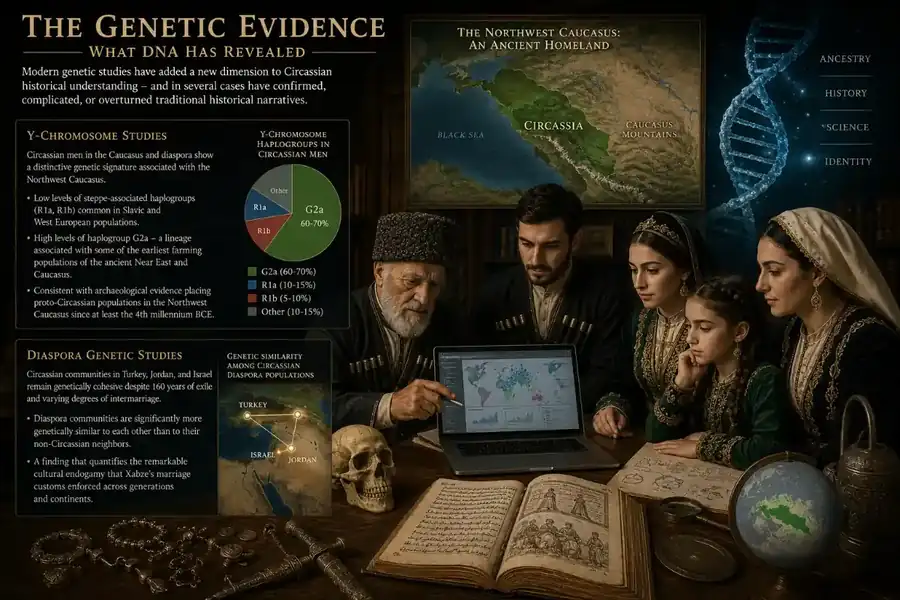
Most poignantly, DNA matching projects run by diaspora organizations have begun reconnecting families separated across the 1864 exile. Circassians in Turkey and Jordan who have lost all oral record of their tribal origins have been matched, via DNA databases, with Circassian families in the Caucasus who preserved genealogical records. In documented cases, DNA has reunited family lines that had been lost to each other for five or six generations — the genetic record outlasting the obliteration of oral memory.
The Circassian Homeland Today
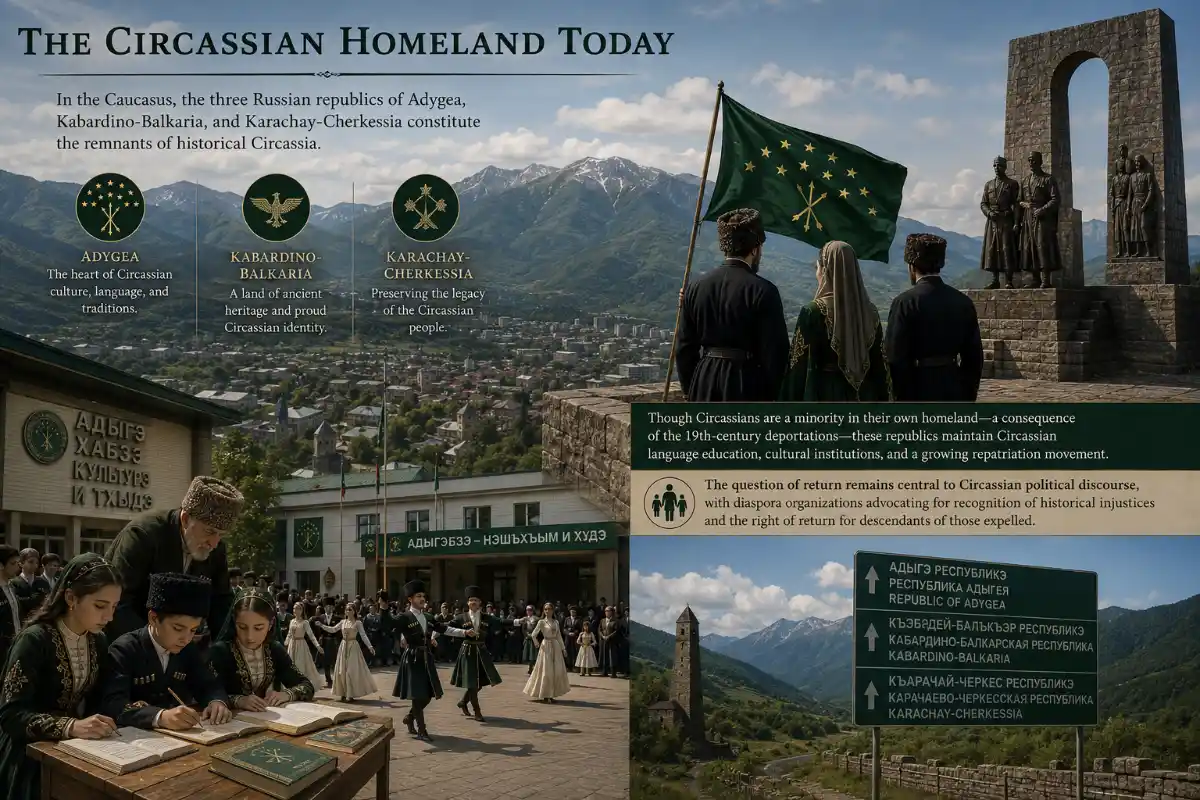
In the Caucasus, the three Russian republics of Adygea, Kabardino-Balkaria, and Karachay-Cherkessia constitute the remnants of historical Circassia. Though Circassians are a minority in their own homeland — a consequence of the 19th-century deportations — these republics maintain Circassian language education, cultural institutions, and a growing repatriation movement. The question of return remains central to Circassian political discourse, with diaspora organizations advocating for recognition of historical injustices and the right of return for descendants of those expelled.
Frequently Asked Questions (FAQ)
Who are the Circassians? The Circassians — known in their own language as the Adyghe — are an indigenous people of the Northwest Caucasus, one of the oldest continuous civilizations in the region. Today they form a global diaspora of 5–7 million people across more than 40 countries, the result of the 19th-century Russian conquest and forced deportation from their homeland.
What is the difference between "Circassian," "Adyghe," and "Kabardian"? "Circassian" is the umbrella term used internationally for the Adyghe people and their related tribes. "Adyghe" is the people's own name for themselves in their language and specifically refers to the Western Circassian dialect and its speakers. "Kabardian" refers to the Eastern Circassian dialect and the Kabardian tribal confederation — the largest Circassian tribal group. All share a common ancestry, cultural code (Xabze), and related languages.
What happened to the Circassians in 1864? Following a century-long war of resistance against Russian imperial expansion, Circassian forces were decisively defeated in 1864. What followed was one of the largest forced deportations of the 19th century: approximately 1 to 1.5 million Circassians — roughly 90% of the population — were expelled from their homeland to the Ottoman Empire. Hundreds of thousands died during the crossing and resettlement. This event is recognized as genocide by Georgia and several other bodies.
Has the Circassian genocide been officially recognized? The Parliament of Georgia officially recognized it in 2011. Several municipal governments in other countries have passed recognition resolutions. Russia — the state responsible for the expulsions — denies the genocide characterization. Turkey, home to the world's largest Circassian diaspora, has not formally recognized it. International advocacy continues.
Where do most Circassians live today? The largest community — 2 to 3 million — lives in Turkey. Approximately 720,000 live in the three Circassian republics of Russia (Adygea, Kabardino-Balkaria, Karachay-Cherkessia). Significant communities also exist in Jordan (170,000+), Syria (reduced by the civil war), Israel, Germany, the United States, and across the former Ottoman world.
What is Adyghe Xabze? Xabze (Адыгэ Хабзэ) is the Circassian code of ethics, social conduct, and governance — an unwritten but deeply codified system comparable to Japanese Bushido or European chivalry, but far more comprehensive. It governed honor, hospitality, treatment of women, conflict resolution, relations between tribes, and diplomatic protocol. It remains central to Circassian cultural identity worldwide.
Is the Circassian language endangered? Both primary Circassian languages — Adyghe and Kabardian — are classified as vulnerable to endangered. Language transmission has declined significantly in Turkey and parts of the diaspora. Active revitalization efforts are underway, including digital language-learning platforms, community schools, and university programs in the Caucasus republics.
Can members of the diaspora return to the Caucasus? There is no formal legal right of return for Circassian diaspora members. Russia has accepted some repatriates on a case-by-case basis, and a small repatriation movement exists. However, bureaucratic obstacles and political resistance from the Russian government have limited large-scale return. The right of return remains one of the central demands of Circassian diaspora advocacy organizations.
What are the 12 Circassian tribes? The major Circassian tribes include the Kabardians, Shapsugs, Bzhedugs, Temirgoys, Natukhai, Abzakhs, Ubykhs, Mamkhegs, Hatuqwais, Besleneys, Yegeruqwais, and Zhaney. Each tribe had distinct territorial identities, dialects, and social structures, though all were united by the Adyghe language family and Xabze. The Ubykh people, whose language was distinct from but related to Adyghe, were entirely exiled and are today virtually extinct as a language community.
What role did Circassians play in founding Amman, Jordan? When Circassian refugees arrived in the region in the 1870s and 1880s, the site of modern Amman was largely uninhabited ruins. Circassian settlers — primarily from the Shapsug and Kabardian tribes — rebuilt and populated the city, establishing the agricultural and urban foundations of what would become the Jordanian capital. Their descendants remain a respected community in Jordan, with representation in government and the royal guard.
Resources: Further Reading and Research
Academic Books
"A Long Goodbye: The Soviet Withdrawal from Afghanistan" (note: for Caucasus context, see below)
Walter Richmond, "The Circassian Genocide" (Rutgers University Press, 2013) — the most comprehensive English-language academic treatment of the 1864 expulsion and its classification as genocide
Amjad Jaimoukha, "The Circassians: A Handbook" (Routledge, 2001) — an encyclopedic reference covering history, culture, language, and diaspora communities
Paul B. Henze, "Circassian Resistance to Russia" — a foundational essay on the military history of the Russo-Circassian War
Moshe Gammer, "Muslim Resistance to the Tsar: Shamil and the Conquest of Chechnia and Daghestan" (Frank Cass, 1994) — essential context for the wider Caucasian resistance to Russian expansion
Kemal Karpat, "Ottoman Population 1830–1914" — covers the demographic impact of Circassian resettlement in the Ottoman Empire
Online Resources
Circassian World — comprehensive English-language portal for Circassian news, history, and diaspora affairs
CircassianWeb — cultural and historical resource with articles on tribes, surnames, language, and diaspora communities
The Jamestown Foundation — North Caucasus Analysis — regular analytical reports on political developments in the Circassian republics and diaspora
Adyghe Language Resources — ELDP Archive — linguistic documentation of the Adyghe language family
The Circassian Cultural Institute — New Jersey-based organization; resources on genocide recognition and cultural education
Documentaries and Media
"The Circassians" (Al Jazeera English) — a documentary exploring Circassian identity, the genocide, and modern diaspora life
"Adyghe: The Last Language" (various Caucasus film productions) — short documentary series on Adyghe language endangerment and revitalization in Turkey
Circassian Heritage Foundation YouTube Channel — archival footage, cultural performances, and historical lectures
Academic Journals
Central Asian Survey — peer-reviewed journal publishing regularly on Caucasus history and politics
Caucasus Survey — dedicated to scholarly research on the South and North Caucasus regions
Iranian and Caucasian Studies — covers the broader cultural and historical context of Circassian civilization
Advocacy and Community Organizations
International Circassian Association (ICA) — ica.adygnet.ru
KAFFED (Federation of Circassian Associations in Turkey) — kaffed.org
Circassian Cultural Institute (USA) — circassian.org
Adyghe Khase (Adygea) — umbrella cultural-political organization in the Caucasus republics
This article is part of the CircassianWeb historical series. For related reading, see: Circassian Tribes · Circassian Language · Circassian Traditions · Circassian Diaspora · Circassian Surnames