Circassian Alphabet: Guide to Adyghe Script
Writing down one of the world's most phonetically complex languages was never just a technical challenge — it was political. Every alphabet proposed for Circassian carried the weight of empire, identity, and the question of who gets to define a people's voice.
The Circassian Alphabet: A Journey Through Writing Systems
The Circassian language is one of the world's most linguistically unique languages, and its alphabet reflects a complex history of cultural interaction, suppression, and revival. Understanding the Circassian alphabet is essential to understanding how our community has preserved its identity across centuries of displacement and empire.
The Linguistic Foundation: What Makes Circassian Special
Circassian is an agglutinative language, meaning that word endings and suffixes carry grammatical information rather than relying on word order. This makes it fundamentally different from Indo-European languages like English, Russian, or Arabic. The language is also characterized by a complex system of vowel and consonant harmony, where the choice of vowels and consonants in one part of a word affects the entire word structure.
With approximately 3 million speakers worldwide, most concentrated in the Russian republic of Adygea, the language faces an ongoing challenge: maintaining native speakers in diaspora communities where younger generations increasingly adopt their host countries' languages.
The Dialects: Regional Variations of Circassian
The Circassian language is not monolithic. The main dialects include:
Adyghe (West Circassian) — The most widely spoken dialect, primarily in the Northwest Caucasus
Kabardian (East Circassian) — Spoken in the Caucasus region and among diaspora communities
Abaza — A closely related language with significant mutual intelligibility
Shapsug — A dialect with unique features and historical significance
Ubykh — A historically important dialect, though nearly extinct today
While these dialects have unique characteristics, native speakers can generally understand one another, demonstrating the underlying linguistic unity of the Circassian language family.
The Ancient Writing Systems: From Greek to Georgian
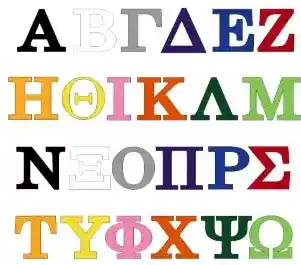
The Greek Alphabet (4th Century AD)
The first known writing system used to write Circassian was the Greek alphabet, introduced to the Caucasus region by Christian missionaries in the 4th century AD. However, the Greek alphabet was fundamentally ill-suited for the sounds of the Circassian language. The language contains numerous consonant clusters and pharyngeal sounds that Greek letters could not accurately represent. As a result, the Greek writing tradition was abandoned relatively quickly.
The Georgian Alphabet (19th Century)
In the 19th century, the Georgian alphabet was adapted to write the Circassian language. The Georgian script, which has been used to write the Georgian language for over 1,500 years, consists of 33 letters and offered better phonetic representation for Circassian sounds. During this period, numerous Circassian-language books and newspapers were published using the Georgian script, creating important literary records of the language.
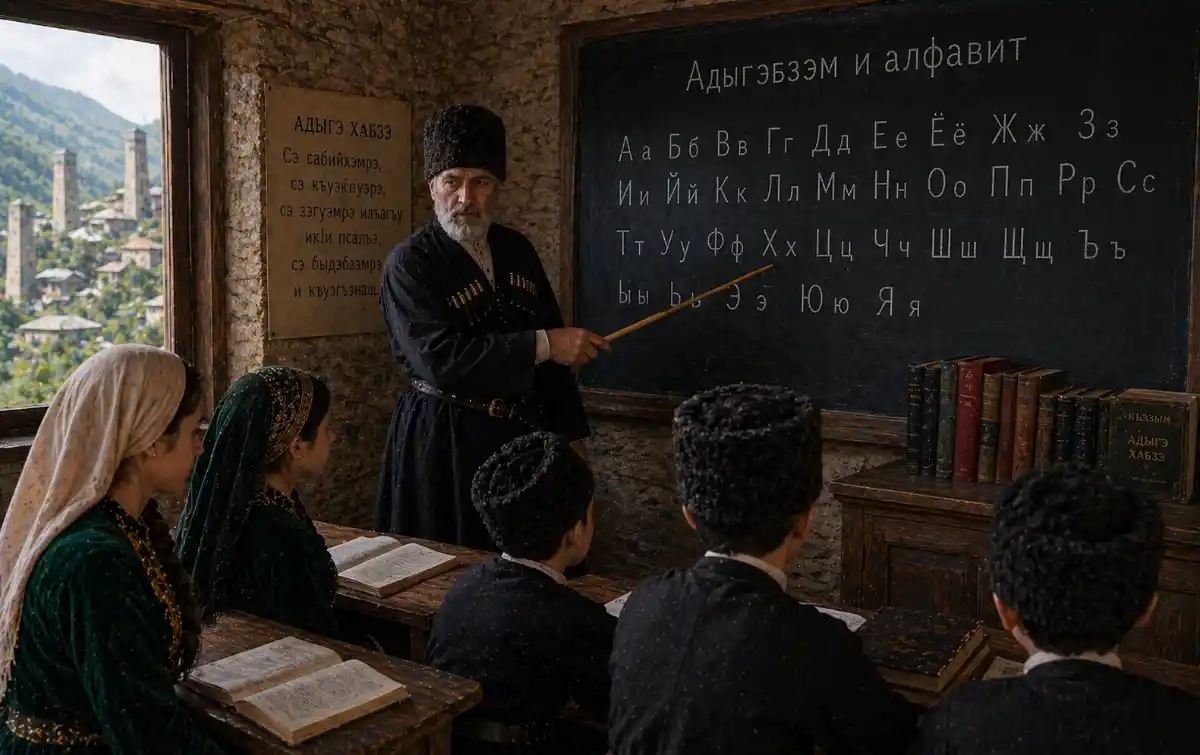
The Cyrillic Era: Standardization Under Soviet Rule
The Cyrillic alphabet was introduced to the Caucasus region in the 19th century and became the official writing system for Circassian during the Soviet era. Based on the Greek alphabet, Cyrillic consists of 33 letters and is used to write Russian, Ukrainian, Serbian, and numerous other languages. For the Circassian community, this represented a significant shift—both a standardization of the written language and a political assertion of Soviet authority.
Today, the Cyrillic version of the Circassian alphabet remains the standard in Russia and among older diaspora generations. However, this standardization came at a cultural cost: the suppression of earlier writing traditions and the implicit pressure to align Circassian literacy with Russian education systems.
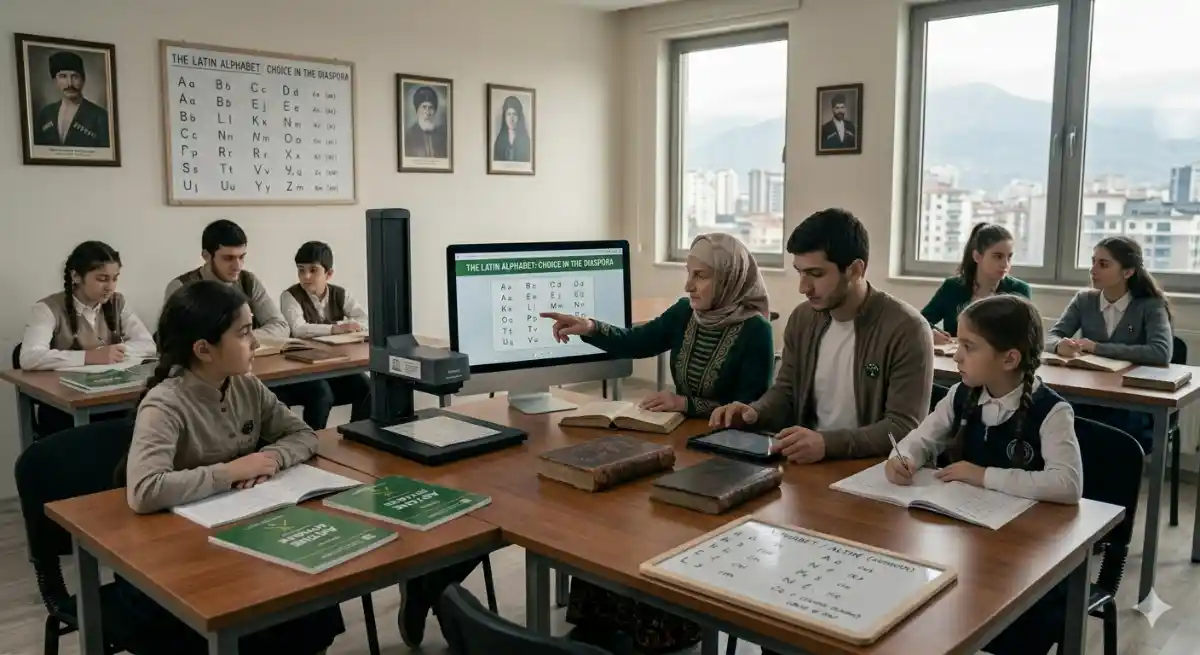
The Latin Alphabet: Choice in the Diaspora
In diaspora communities, particularly in Turkey and Jordan, where many Circassians fled after the 19th-century genocide and exile, the Latin alphabet has been adopted for writing Circassian. The Latin script, consisting of 26 letters supplemented with diacritical marks, offers advantages for diaspora communities whose younger members are more familiar with Latin letters through their education in host countries.
This choice of writing system reflects a practical reality: alphabet selection is not merely linguistic—it is political and social, reflecting where Circassians live and which educational systems they access.
The Linguistic Richness: Sounds That Shape Identity
Consonant Clusters and Pharyngeal Sounds
One of the most distinctive features of the Circassian language is its rich inventory of consonant sounds, including several that do not exist in major world languages. These include:
Pharyngeal consonants — Deep throat sounds rarely found outside Caucasian and Semitic languages
Ejective consonants — Consonants produced with a sharp release of air from the lungs
Complex consonant clusters — Multiple consonants in sequence without vowels between them
These sounds are not mere phonetic curiosities—they are central to how meaning is conveyed in Circassian. The loss of these sounds in diaspora communities represents a genuine linguistic loss.
Vowel and Consonant Harmony
Circassian employs an intricate system of vowel and consonant harmony, where the vowels and consonants in the first part of a word determine which vowels and consonants can appear later in the word. This is a feature shared with languages like Turkish and Hungarian, but the specifics of Circassian harmony make it uniquely complex.
Preservation Efforts and Modern Learning
The Endangered Language Crisis
Over the centuries, the Circassian language has faced systematic suppression:
Russian Imperial Era — Active suppression of Circassian in favor of Russian
Soviet Union — Language subordinated to Russian in education and public life
Modern Diaspora — Younger generations adopt host country languages, reducing native speakers
UNESCO classifies Circassian as an endangered language. Without concerted effort, many linguistic features unique to Circassian risk being lost within a generation.
Community and Educational Initiatives
Despite these challenges, efforts to preserve and revive the Circassian language are underway:
Language classes in diaspora communities and cultural centers
Online resources and digital language platforms making learning accessible
Family language transmission — Parents teaching children at home
Cultural events that celebrate and normalize speaking Circassian
Academic research documenting the language for future generations
If you want to connect with your heritage, learning the Circassian language is one of the most direct paths. Many community organizations offer classes, and digital tools have made self-study increasingly feasible. Platforms like family trees can help you trace your linguistic and cultural roots.
The Choice of Alphabet: Language, Identity, and Politics
The history of the Circassian alphabet is ultimately a history of power. Each writing system—Greek, Georgian, Cyrillic, Latin—represents different empires, ideologies, and choices made by the community about where we belong and how we preserve ourselves.
Greek and Georgian represent pre-modern, pre-imperial Circassian literacy
Cyrillic represents Soviet standardization and the assertion of Russian cultural dominance
Latin represents diaspora adaptation and the choice to integrate with Western education systems
Understanding these choices helps us understand who we are today—a people geographically dispersed, linguistically diverse, yet united by shared heritage.
Conclusion: Preserving the Language for Future Generations
The Circassian alphabet is not merely a technical system for writing words. It is a record of our history, our resilience, and our struggle to maintain identity across displacement and empires. Each writing system tells a story of that moment in our history.
Whether you encounter Circassian written in Cyrillic, Latin, or Georgian script, you are connecting with the same rich, complex language that has carried Circassian culture through centuries. The alphabet you choose to learn depends on your community and goals—but the act of learning itself is what matters most.
Learning the Circassian language is an act of cultural preservation, identity affirmation, and connection to your ancestors. If you are interested in learning more about your Circassian heritage, consider exploring our community directory to find language classes, cultural centers, and community organizations near you.
Explore Your Circassian Heritage
Frequently Asked Questions
What alphabet do Circassians use?
Circassians in Russia use a Cyrillic-based alphabet adopted in the 1930s. Historically, Arabic and Latin scripts were also used. Diaspora communities often use Latin transliteration for digital communication.
How many letters are in the Circassian alphabet?
The Western Circassian (Adyghe) alphabet has 66 letters, while the Eastern (Kabardian) alphabet has 59 letters — reflecting one of the world's most complex phonological systems.
Why does Circassian need so many letters?
Circassian languages have an exceptionally large number of consonant distinctions — including ejectives, uvulars, and pharyngealized sounds — that require unique letter combinations to represent accurately.
Sources & References
Jaimoukha, A. (2001). The Circassians: A Handbook. Curzon.
Richmond, W. (2013). The Circassian Genocide. Rutgers University Press.
Natho, G. (2009). Circassian Culture and Folklore: Traditions and Practices of the Circassian People. McFarland & Company.
Balanovsky, O. P. (2011). The Circassian Anthropology: A Study of the Adyghe People. Institute of Archaeology (Russian Academy of Sciences).
Kaya, M. (2005). Yesterday's Gone: The Circassians of the North Caucasus and the Turkish Diaspora. Aydinlari Matbaacilik.
Shami, A. (1998). Circassians in Jordan: Culture, History, and Identity. Dar Al-Amal.
Henze, P. B. (1992). Circassia: Genocide and the Caucasian Holocaust. University of Chicago Press.
Paris, C. (1974). The Adyghe Language: Grammar and Vocabulary. Mouton.
Colarusso, J. (2001). Nart Sagas from the Northwest Caucasus: Abkhaz and Circassian Stories. Princeton University Press.