The Ubykh: The Lost Voice of Circassia
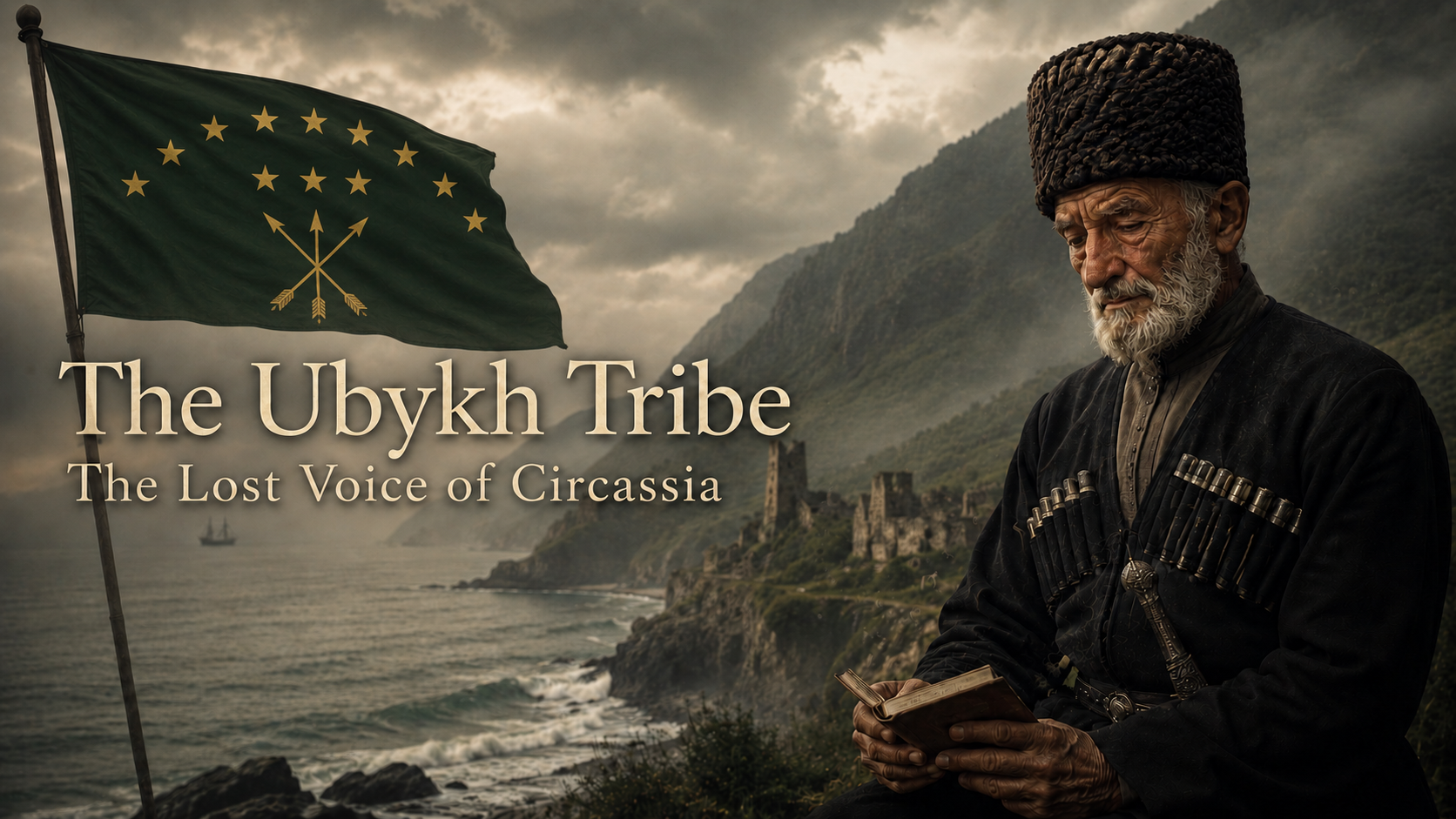
The Ubykh: The Lost Voice of Circassia
There is a particular kind of silence that follows the death of a language. It is not the silence of a forest at night or a room before dawn. It is heavier than that, because it carries inside it the shape of things that can no longer be said. When Tevfik Esenç died on October 7, 1992, in the small Turkish village of Hacı Osman, that kind of silence settled over the world. He was eighty-eight years old. He was the last person alive who could speak Ubykh fluently, and when he closed his eyes for the last time, an entire way of seeing, naming, and describing the world closed with him.
This is the story of the Ubykhs, the Circassian people who once lived along a stretch of the Black Sea coast that today most people know only because of a Winter Olympics. It is a story of mountains, of cousins and clans, of a language that put a record into the books for sheer phonetic complexity, of a war that ended on a meadow in May, of ships and refugee camps and villages built from memory, of one old man with a careful voice working alongside a French scholar to write down everything that could still be written down. It is a story that should be better known.
If you have heard of the Ubykhs at all, it was probably in passing, perhaps in a footnote about endangered languages, perhaps tucked into a longer history of the Caucasus. The Ubykhs themselves have always lived a little in the shadow of their larger Circassian and Abkhaz neighbors. But shadows are not absences. The Ubykh story stands on its own, and it deserves to be told slowly, with patience, with a willingness to sit with its losses and its remarkable threads of continuity.
Who Were the Ubykhs
The Ubykhs called themselves Twáxə, or Pekh, or by names that varied between dialects and from one village to another. The name "Ubykh" itself comes from how their Abzakh Circassian neighbors referred to them, Wəbəx, and over time that label stuck both in Russian (Убых) and in the wider European literature. In Turkish, the language of their long exile, they often go by Ubıh. Whatever they were called by others, they knew themselves as one people, bound by language, by kinship, by a particular relationship to a particular piece of coast and mountain.
Geographically and culturally, the Ubykhs sat at a crossroads. To their west lived the Shapsug, one of the great Circassian (Adyghe) tribes. To their east lived the Abkhaz, with whom they shared mountain passes, trade routes, and a long history of intermarriage. The Ubykh language itself, although a distinct branch of the Northwest Caucasian family, sat right between Circassian and Abkhaz in the same way the Ubykhs sat geographically between the Adyghe peoples and the Abkhazians. Linguists sometimes describe Ubykh as the bridge in the Northwest Caucasian family, the form that retained the most of the phonological richness of the proto-language. Politically and socially, however, the Ubykhs identified themselves as part of the Circassian world. They participated in Circassian assemblies, they fought in Circassian armies, they followed Circassian etiquette codes, they wore Circassian dress. When the Russo-Circassian War came to its climax, the Ubykhs were among the staunchest defenders of the Circassian homeland.
Estimates of the Ubykh population before their exile vary widely, but most reasonable accounts put them somewhere between forty thousand and a hundred thousand people in the early nineteenth century. They lived in villages and homesteads scattered along the coast and up into the foothills, raising livestock, growing fruit and grain, fishing the sea, trading along the coast, and maintaining the elaborate web of obligations and honor that organized Circassian society.
They were not a kingdom. There was no Ubykh emperor or grand prince. Instead, society was organized around clans (lineages) and villages, with councils of elders, with princes and nobles in some areas, with a strong tradition of customary law called Adyghe Khabze that governed nearly every aspect of daily life. The Ubykhs had no written tradition of their own. Their poetry, their genealogies, their stories of the founding of villages, their accounts of battles and raids and weddings, all of it was carried in memory and passed on by voice. This is a fact worth pausing on. When such a culture loses its language, it does not lose only the words. It loses the way of remembering itself.
The Land They Loved
Anyone who has stood on the eastern Black Sea coast knows that it is one of the more striking landscapes on earth. The Greater Caucasus range plunges almost directly into the sea. Within a few hours you can climb from subtropical beaches lined with palms and citrus orchards into alpine meadows and onto glaciated peaks. The slopes are steep and forested. Streams cut deep gorges. There are mineral springs and karst caves and stretches of coastal plain where the soil is rich and the climate, sheltered by the mountains, is gentler than its latitude would suggest.
This was the Ubykh homeland. It ran roughly from the Shakhe River in the north to the Khosta River in the south, a coastal strip about a hundred kilometers long, with mountainous interior reaching back into ridges and passes that connected to the upper valleys of the Caucasian watershed. The biggest settlements clustered around what are now Sochi, Dagomys, Lazarevskoye, Loo, and Adler. The Ubykh capital, if you can call it that, was a place called Sasha or Soche, the same name that, in its Russified form, gave us Sochi.
The land shaped Ubykh life in a way that is hard to overstate. The sea was a road. It connected Ubykh villages to other Circassian settlements up and down the coast, to the Crimean Tatars across the water, to the Ottoman ports of Sinop and Trabzon, and through them to the wider world of the eastern Mediterranean. Boats came and went carrying timber, honey, walnuts, hazelnuts, wax, hides, weapons, salt, cloth, and people. Ubykh boys often grew up learning to handle a boat almost as soon as they could walk.
The mountains were a fortress. Behind every coastal village lay valleys and ridges that could be defended against any invader. Trails wound up into pasturage where families took their flocks in summer. The forests gave them timber, game, and a deep store of nuts and fruits. Walnuts in particular were so abundant that Ubykh villages were sometimes described by outsiders as buried in walnut groves.
Then there were the gardens, the terraced plots near every house where families grew maize and beans and squash, kept small orchards of figs, pomegranates, apples, pears, and quinces, raised tobacco for trade after the eighteenth century, kept hives of bees, and tended grapevines that climbed over trellises. The Ubykh diet was rich and varied, blending what came out of the sea, what came down from the mountains, and what came up from the soil.
People often forget how green and lush the western Caucasus is. Travelers from drier climates were sometimes astonished by it. One nineteenth century visitor described riding for days under a canopy of beech and chestnut and oak, with streams running clear over stones, and meadows so thick with wildflowers that the air was heavy with their scent. That visitor was describing a landscape that, within a generation, would become almost empty of the people who had shaped it.
A Society Built on Honor and Kin
To understand Ubykh life, you have to understand something about Circassian customary law, the Khabze. It was not a written code. It was not enforced by any state. It was a complex inherited body of practices and expectations that defined how you greeted a stranger, how you treated a guest, how you spoke to your elders, how a young man addressed a young woman, how disputes were resolved between families, how blood feuds were handled, how marriages were arranged, how cattle were exchanged, how weapons were carried, how horses were trained, how war was waged, and how peace was made.
Hospitality was at the very center of it. A guest in a Ubykh house was sacred. You fed him, you protected him, you sat with him, even if he was your worst enemy. Travelers who passed through Ubykh country in the nineteenth century, including Russian officers and European adventurers, often left amazed accounts of being received with elaborate courtesy in even the poorest cottages. To offer food to a stranger was not optional. To turn one away was so deep a violation that, in some interpretations, the household was considered shamed for a generation.
Honor was the other governing principle. Personal dignity, family reputation, and the right way to behave in every imaginable circumstance were taken with a seriousness that today we can barely imagine. There were entire elaborate systems of etiquette for how to stand in the presence of an older man, how to address a married woman versus an unmarried girl, how to drink toasts at a feast, how to ride a horse into a village, how to leave a house, how to take leave of one's host, how to speak about the dead. To violate these conventions was not a minor faux pas. It could damage your family's standing for years.
There was a class structure. The Ubykhs had princes (called pshi by their Adyghe neighbors), nobles (work), and free commoners (tlfqotl), with serfs and a small number of slaves at the bottom. The nobility lived by a code that emphasized martial skill, generosity, and a careful kind of pride. They trained their sons in horsemanship and in the use of the saber and the long flintlock rifle. They expected their daughters to be raised in seclusion until marriage, in households where every detail of dress and bearing was carefully managed.
Boys were often raised away from their birth families through the institution of atalykhood, a kind of fostering. A noble family might send its son to be raised in the household of a vassal or an ally, partly to cement alliances, partly to give the boy a tougher upbringing away from a doting mother. He returned home as a young man, his bonds with his foster family lasting his entire life. Atalykhood ran across class lines and across tribal lines. An Ubykh boy might be raised among Shapsugs or Abkhaz. This was one of the ways that the larger Circassian world was knit together, family by family, generation by generation.
Religion among the Ubykhs followed a long arc. In the earliest layers there was a pre-Christian, pre-Islamic system of beliefs that we can only partially reconstruct, a system with sacred groves, with respect for certain natural sites, with figures who governed thunder and the hunt and the herds. Christianity came in waves from the Byzantine south and the Georgian east, and there were periods, particularly during the late medieval era, when the Ubykhs were nominally Christian. From the sixteenth century onward, Islam spread through the Caucasus along trade and political lines, brought by the Crimean Khanate and the Ottoman Empire. By the time of their exile, the Ubykhs were largely Muslim, and the language had absorbed a layer of Arabic and Turkish vocabulary that reflected their religious life. Yet older beliefs persisted, mingling with Islamic practice. Sacred trees were still respected. Certain springs were still visited for healing. The form of the religion changed, but the depth of the religious feeling, the willingness to see the world as alive with meaning, remained.
Women's lives in Ubykh society were constrained by the standards of any modern reader, yet they were also more textured than the simple picture of patriarchy suggests. A married woman ran her household with real authority. She controlled her own dowry property. She received guests of her own. In matters of textile production, food storage, the upbringing of small children, and the management of seasonal labor, her word was often final. Older women held a status close to that of senior men. In some Circassian traditions a respected grandmother could break up a fight, intercede in a feud, or speak directly in a council. The Ubykhs shared in these traditions.
A Language Like No Other
It is here that we have to slow down. The Ubykh language deserves more than a paragraph. It deserves a chapter of its own, perhaps a book, because what was lost when the language died was not just another local tongue. It was something close to a marvel.
Most languages of the world get along with a fairly modest set of consonants. English has about twenty-four. Spanish has fewer. Even languages famous for their consonant clusters, like Russian or Polish, typically have somewhere between thirty and forty consonant phonemes. The Caucasus, however, is home to a small group of languages with consonant inventories that would seem impossible if they had not been documented in painstaking detail. The most famous of these is Ubykh.
Linguists who studied Ubykh in the twentieth century identified eighty-four consonant phonemes. Some analyses, depending on how you treat certain marginal sounds, push that count up to eighty-seven. For comparison, this means that Ubykh had more than three times as many consonants as English. It also means that, although the language had only two true vowel phonemes in its core inventory, the consonant system was so rich that words and meanings were carried almost entirely by consonant distinctions.
To get a sense of what this means, consider that Ubykh distinguished between four different kinds of "k" sound: plain, palatalized, labialized, and pharyngealized. It distinguished velar from uvular consonants, and within each it had ejective forms, where the air comes out under glottalic pressure. It had whole sets of consonants formed by pressing the tongue against different parts of the roof of the mouth, with the lips rounded or unrounded, with the airflow released sharply or gently. There were sounds in Ubykh that simply do not occur in most other languages of the world, and that take adult learners months of practice even to recognize, let alone produce.
Why did Ubykh end up with such an extreme inventory? The honest answer is that we do not entirely know. The Northwest Caucasian family in general tends toward consonant heaviness. Ubykh seems to have pushed the tendency further, perhaps because of the historical merger of certain vowel distinctions into consonant distinctions, perhaps because of long contact with other Caucasian and non-Caucasian languages. There is also the simple fact that languages do what they do. A speech community can sustain a phonological system of remarkable complexity as long as children are still learning it from infancy. The brain handles it. The mouth handles it. It is only when transmission breaks down that the system collapses.
The grammar of Ubykh was also distinctive. It was an ergative language, like its Circassian and Abkhaz cousins, which means that it marked the subjects of transitive and intransitive verbs in different ways from how Indo-European languages do. It was polysynthetic in important respects, packing into a single verb form information that English would distribute across several words. A single Ubykh verb could carry, simultaneously, indications of the subject, the object, the indirect object, the time, the place, the manner, whether the action was completed or ongoing, whether the speaker had witnessed it directly, and several other categories. To translate such a verb into English you often needed an entire sentence. To translate it into French or German you often needed two.
The lexicon of Ubykh, the vocabulary itself, was deeply tied to the landscape and the way of life of the Ubykh people. There were elaborate distinctions of relationship: words for an older brother, a younger brother, an older sister, a younger sister, a brother's son, a sister's son, and many more, each with their own term. There were dozens of words for different kinds of horse, distinguished by color, gait, age, and temperament. There were elaborate vocabularies of the forest and the sea, of weapons, of weaving, of the patterns and ornaments embroidered on belts and bridles. When the language died, all of that classification, all of that careful naming of a particular world, went into silence.
It bears repeating, because it is sometimes easy to romanticize: the loss of a language is the loss of a way of perceiving. Speakers of Ubykh did not simply have words for things that other languages also have words for. They had a system of distinctions, of category boundaries, of metaphors and idioms, that was built up over many generations of people living in a particular place and doing particular things. To learn Ubykh as a child was to learn to see and to think in a way no other set of speakers thought. We cannot recover that. We can study Dumézil's notes, we can play recordings, we can train students to read transcriptions, but the lived language is gone.
Trade Winds and Ottoman Ties
For centuries before the Russian conquest, the Ubykhs were not isolated. They were players in a complex world of trade, diplomacy, and occasional warfare that connected the Caucasus to the Black Sea basin and beyond.
The Genoese came first in this story, or at least are the first who left written records of substantial dealings with the Caucasian coast. Italian trading colonies dotted the shore in the late medieval period, dealing in slaves, hides, beeswax, timber, and grain. The Ubykhs, like their neighbors, sold to these merchants and bought from them. After the Ottomans took Constantinople in 1453 and gradually closed the Black Sea to outside shipping, Genoese influence faded, and Ottoman influence rose in its place.
The Ottoman Empire never directly ruled the Ubykh country. The mountains were too rugged, the people too independent, the strategic stakes not quite high enough for a full military occupation. Instead, the Ottomans established a kind of soft hegemony along the coast, building fortified ports at places like Anapa and Sukhum (modern Sukhumi), maintaining trade relations, recognizing local princes, and gradually spreading Islam through religious and political ties. The Crimean Khanate, an Ottoman vassal state, played a particularly active role in Circassian affairs, including among the Ubykhs. Crimean troops sometimes campaigned in the Caucasus. Circassian troops sometimes campaigned in Crimean service.
A great deal of the Black Sea trade in this period involved human beings. The slave trade, which the Ottoman Empire absorbed in vast quantities, drew much of its supply from the Caucasus and from the Slavic lands to the north. The Circassians, including the Ubykhs, were both victims and participants in this trade. Captives taken in raids and feuds were sold down to the coastal markets and shipped on to Constantinople. Circassian slaves, especially women, were highly valued at the Ottoman court, where many of them ended their careers as influential wives of sultans and mothers of princes. There is no clean moral story to tell here. The trade was brutal and exploitative. It also created political and family ties between the Caucasus and Istanbul that proved important when the great exodus came in the 1860s.
Ottoman pashas and emirs married Circassian women. Circassian boys were sometimes sent to be raised at Ottoman courts. Ottoman armies recruited Circassian cavalry. Religious teachers came up from Anatolia to the Caucasus and back again. By the early nineteenth century, when the Russian advance began in earnest, the Ubykhs and other Circassians had a strong sense that, whatever happened in the mountains, there was a sympathetic power to the south that might receive them if the worst came to the worst.
The Russians Come
The Russian Empire reached the Caucasus in stages. In the late eighteenth century, under Catherine the Great, Russian armies pushed past the line of the Kuban River and established forts and cossack settlements along the northern foothills. The Treaty of Kuçuk Kaynarca with the Ottomans in 1774 gave Russia substantial new rights in the Black Sea region. By the early nineteenth century, Russian columns were active across the Caucasus, fighting Persian and Ottoman armies, annexing Georgian and Armenian territories, and pushing into the lands of Caucasian mountain peoples one valley at a time.
The eastern half of the Caucasus, the lands of the Chechens, Dagestanis, Avars, and others, became the famous theater of the Murid Wars in the 1830s, 1840s, and 1850s, led by the Imam Shamil. That conflict captured most of the European attention at the time. Shamil's resistance was dramatic, prolonged, and eventually crushed in 1859. The western Caucasus, the Circassian lands including Ubykh territory, was a different story. It did not have a single charismatic leader uniting the tribes. It had a confederation of fiercely independent communities, often quarreling with each other, sometimes uniting for a major campaign, always defending their own villages and valleys with whatever forces they could muster.
The Russian government's policy in the western Caucasus shifted over the decades but always pointed in the same direction: the lands of the Circassians, including the strategically important Black Sea coast, had to be brought under firm imperial control. The Black Sea coast in particular was a major concern because it was where the Ottomans landed weapons, where British and other foreign agents sometimes appeared with offers of support, and where the Circassians could still receive supplies and reinforcements from the south.
In the 1830s and 1840s, the Russians built a chain of small forts along the Black Sea coast. These outposts were often badly supplied, plagued by malaria, and harassed by Circassian fighters. The Crimean War of 1853 to 1856 forced the Russians to abandon many of them temporarily. After the war ended, the imperial government decided that piecemeal pacification was not working. It launched a sustained military and political campaign to break the Circassian confederation once and for all.
The strategy that emerged under generals like Yevdokimov was brutal in its simplicity. Russian columns moved into Circassian valleys, defeated whatever forces opposed them, and then destroyed the villages, the orchards, the storerooms, and the livestock. Survivors were given a choice: they could move to the malarial lowlands of the Kuban steppe, where the soil was alien and the climate hostile, or they could leave for the Ottoman Empire. There was no third option. The mountains were to be emptied of the people who had lived in them.
The Ubykhs were among the last to fall. Their geography helped them. The coastal strip from the Shakhe to the Khosta was harder to attack than some inland valleys, because supplies could come in by sea and the terrain favored ambush. But Russian forces, growing year by year in numbers and firepower, gradually closed the noose. By 1863 the campaigns in the western Caucasus had become almost continuous, and by the spring of 1864 the war was reaching its end.
The Battle of Qbaada
In May of 1864, Russian troops converged on a high mountain meadow called, in Russian, Krasnaya Polyana, "Red Glade," and in Circassian Qbaada. It lay in the upper valley of the Mzymta River, in the mountainous interior of Ubykh country, today inside the boundaries of the Sochi National Park. Several Russian columns advanced from different directions, surrounding the last organized resistance of the Circassian and Ubykh fighters.
On May 21, 1864, after final skirmishes, the Russian commander, Grand Duke Mikhail Nikolaevich, the youngest brother of Tsar Alexander II, held a formal parade and a thanksgiving service at Qbaada. From the Russian point of view, this was the moment that ended the long Caucasian war. A medal was struck. Reports were sent to the capital. Officers received decorations. The day was officially declared a victory.
From the Circassian point of view, this day is something else entirely. It is the day on which the long defense of the homeland was finally broken. It is the day on which the future of an entire people changed. It is the day from which the great exile is dated. To this day, May 21 is observed by Circassians around the world as a day of mourning and remembrance. Black flags are raised. Names are read aloud. Stories are told. Songs are sung that have a particular cadence reserved for grief.
For the Ubykhs, May 21 also marks something more specific. The battle was fought on their land. The end of organized resistance happened in their valleys. The choice that followed, between settling on the steppes under Russian rule or boarding ships for the Ottoman Empire, was put to them as well as to their Adyghe and Abaza neighbors. The Ubykhs, as a people, chose almost unanimously to leave.
The reasons are not hard to understand. The Russian government had made clear that the coast itself, the Ubykh heartland, was to be reorganized for Russian and cossack settlement. Continuing to live on their own land under imperial rule was simply not on offer. To accept resettlement to the steppes meant losing the sea, the mountains, the orchards, the houses, the graves. It meant becoming peasants in a flat country under the eye of officials who did not speak their language. The southern alternative, however dangerous, offered the dignity of a Muslim sovereign and the possibility of staying together as a community.
There was also the simple fact of fear. Russian forces in the previous years had been associated with massacres, with the burning of villages, with the deaths of many noncombatants. Whether the rumors that flew through the valleys in the spring of 1864 were entirely accurate or not, they shaped the decisions of frightened families. To stay was to risk what had already happened in places further north. To go was at least to choose.
Ships, Beaches, and the Great Death
What followed has been called many things. The Circassian Genocide. The Great Catastrophe. The Tsitsekun in Adyghe. Some scholars still hesitate over the word "genocide" and prefer terms like "ethnic cleansing" or "deportation." Whatever name you put on it, the scale of the suffering is not in dispute.
Between 1864 and 1867, somewhere between 500,000 and one million Circassians left their homeland. Some estimates run higher. The exact number will never be known, because the records are incomplete and the dead were often uncounted. What is clear is that the western Caucasus, which had been densely populated by Circassians and Ubykhs and related peoples, was effectively emptied of those populations in the space of a few years. Russian, Ukrainian, and Cossack settlers moved into the abandoned valleys. Greek and Armenian communities arrived along the coast. The Circassian villages, the orchards, the carefully maintained terraces, the watch towers and the cemeteries, were left behind or destroyed.
The Ubykhs, perhaps thirty to forty thousand strong by some estimates at the moment of exile, left almost in their entirety. Some accounts say a tiny handful of Ubykhs remained behind, hidden or absorbed into other communities, but for practical purposes the homeland was depopulated. They were, and this is a fact worth stating clearly, the only Circassian tribe to be entirely expelled, with no remaining community in the homeland.
The journey itself was a horror. People walked from inland villages down to the coast, carrying what they could. They waited on beaches for ships that did not always come or that came in too small numbers to take everyone. They were exposed to weather, to hunger, to disease. Outbreaks of typhus, smallpox, and dysentery moved through the crowded encampments. The dead were buried hastily, sometimes not buried at all.
The ships themselves were often inadequate. Old freighters, fishing boats, anything that could be hired or commandeered, were pressed into service to carry refugees across the Black Sea. They were overloaded. Sanitation on board was poor or nonexistent. Voyages that should have taken days sometimes took weeks, with passengers crammed below decks. Many ships sank. Others arrived with a significant fraction of their passengers dead.
On the Ottoman side, the receiving ports could not cope. Trabzon, Samsun, Sinop, Varna, Constanta, and Constantinople itself were overwhelmed. Refugees were piled into makeshift camps along the shore. Disease tore through them. Ottoman officials, struggling to cope with a crisis of unprecedented scale, scrambled to find food, shelter, and somewhere to send people. Eventually, batches of refugees were resettled in the interior of Anatolia, in the Balkans (then still Ottoman), in Syria, in Jordan, in Iraq. Wherever there was empty or under-cultivated land that the empire wanted to populate, Circassians and Ubykhs were sent.
It is estimated that, of the total number of Circassians and other Caucasian peoples who left in this great expulsion, somewhere between a third and a half died during the journey or within the first year of resettlement. The figures for the Ubykhs in particular are not separately recorded. But there is every reason to believe that they shared in the catastrophe at least as deeply as any of their neighbors, perhaps more so, because their entire community was uprooted at once.
A Diaspora Takes Shape
The Ubykhs who survived the journey were settled in clusters across the Ottoman Empire. The largest concentrations ended up in what is today northwestern Anatolia, in particular around the towns of Manyas and Gönen in Balıkesir Province, and in the Hendek and Akyazı districts of Sakarya Province. Smaller communities ended up in the Düzce area, in Bursa, in Bilecik, and in scattered villages elsewhere in Anatolia. A small Ubykh presence also developed in what is now Jordan and Syria, where Circassian communities were settled by the Ottomans as a kind of buffer against bedouin raids.
In Anatolia, the Ubykhs typically settled near other Circassian groups, most often near Abzakh, Shapsug, Hatuqway, or Kabardian villages. In some cases they founded their own villages, in others they shared villages with their Adyghe cousins. They built houses in the styles they remembered. They tried to plant orchards and gardens like the ones they had left behind. They worked, often as farmers and tobacco growers, in landscapes that were similar to their old home in some respects but different in others. The light was harsher. The seasons were drier. The sea, when they were near it, was a Black Sea but a different stretch of it, viewed from the opposite shore.
They preserved much of their culture. They kept their dances, including the elegant kafe and the energetic udj, performed at weddings and gatherings. They kept their distinctive courtship etiquette, in which young men and women met at gatherings under the strict but goodwilled supervision of elders. They kept the long fluted ceremonial coats with their rows of cartridge pockets across the chest. They kept the dagger, the kindjal, that hung from every man's belt. They kept their genealogies, often memorized in long lists that an elder could recite at a wedding to remind the family of who had married whom in generations past.
They did not, however, keep the language, at least not for long. In the very first generation, the older people spoke Ubykh as they always had. Their children, born in the new country, grew up speaking Ubykh at home but also Turkish in the street and the marketplace. The grandchildren learned more Turkish and less Ubykh, often picking up Adyghe as well from intermarriage with other Circassian groups. By the fourth generation, the great-grandchildren of those who had come across in 1864 typically did not speak Ubykh at all, or knew only a few words.
There were structural reasons for this. The Ottoman Empire and its Turkish Republic successor were not multilingual nation states in the modern sense. Turkish was the language of state, of school, of the army, of administration. Children who went to school went to Turkish-language schools. Boys who served in the military served in Turkish-speaking units. Local languages were tolerated but not supported, and during certain periods, particularly in the early decades of the Turkish Republic, they were actively discouraged. In some Circassian villages, children were punished for speaking their own language at school. The pressure to assimilate was real and often deliberate.
Within the Circassian diaspora, a particular dynamic accelerated the loss of Ubykh in particular. The Ubykhs were a numerical minority within the Circassian community. They lived among Adyghe speakers and increasingly used Adyghe as a kind of intra-Circassian lingua franca. Many Ubykh families became bilingual in Ubykh and Adyghe in the first generation, and then in Adyghe alone in the second. Adyghe held on in the diaspora longer than Ubykh did, partly because there were more speakers and partly because of community institutions that supported it. But Ubykh, with no large speaker base anywhere in the world, had no comparable support. It quietly fell out of use, generation by generation.
By the early decades of the twentieth century, fluent Ubykh speakers were getting hard to find. By mid century, they were rare. By the 1980s, they could be counted on one hand. By the early 1990s, Tevfik Esenç was alone.
The Linguists Find Them
The fate of the Ubykh language might have been worse, in one specific sense. It might have died without anyone outside the community noticing. As it happened, a number of careful scholars found it in time to record at least a substantial part of what it had been.
The first systematic linguistic attention came in the late nineteenth and early twentieth centuries, from a handful of researchers who realized that something extraordinary was sitting in the villages of Anatolia. Adolf Dirr, the German-Russian linguist, did early work on Caucasian languages and was aware of the Ubykh situation. Various Russian and Soviet scholars compiled wordlists. But the towering figure in Ubykh studies, the man whose name will always be paired with Tevfik Esenç's, was the French Indo-Europeanist and historian of religions Georges Dumézil.
Dumézil was not a Caucasian language specialist by training. He was a scholar of comparative religion, famous for his theories about the trifunctional structure of ancient Indo-European societies. But he had a deep interest in language for its own sake, and he had taught for several years at the University of Istanbul in the 1920s and 1930s. There, he met Circassians and learned of the Ubykh community. He began visiting Ubykh villages, recording speakers, taking notes, learning the language himself, and publishing his findings in a long series of articles and books.
Dumézil's work on Ubykh is one of those scholarly accomplishments that becomes more impressive the more you look at it. He published grammars, lexicons, texts, etymological notes, comparative studies relating Ubykh to other Northwest Caucasian languages, transcriptions of folktales, proverbs, songs, and ritual phrases. He worked with multiple speakers across decades. He maintained relationships with Ubykh families. He carried in his head, in his notebooks, and in his published volumes much of what we now know about the language.
His most important collaborator was Tevfik Esenç. They met in the 1950s, when Esenç was already a middle aged man and one of the strongest speakers of his generation. They worked together for the rest of Esenç's life. Esenç visited France several times, was recorded extensively, sat through long sessions of elicitation, patiently answered question after question about how to say this, how to say that, what the difference was between this construction and that one, how a story was told in the old days. Dumézil and Esenç became, in effect, a single research project. The language of a whole people, near its end, was being captured by two men in a room.
There were others, of course. The Norwegian linguist Hans Vogt produced a substantial Ubykh dictionary. The British linguist George Hewitt and others worked on Northwest Caucasian comparative studies that involved Ubykh data. Turkish scholars of Circassian descent contributed at various times. But Dumézil and Esenç remain the central figures. Without them, our knowledge of Ubykh would be vastly thinner.
Tevfik Esenç
It is worth taking a moment to look more closely at Tevfik Esenç himself, because in him, the story of a language becomes the story of a person. He was born in 1904 in the village of Hacı Osman, in Manyas district, Balıkesir Province, Turkey. His ancestors had come over from the Caucasus forty years earlier, in the great exile. He grew up speaking Ubykh at home with his parents and grandparents. He learned Turkish at school. He learned Adyghe from neighbors and friends, particularly Hakuchi Ubykh, the dialect that some scholars classified as transitional to Adyghe. He served in the Turkish military. He worked in various jobs, eventually serving as a muhtar, a kind of village headman, in his community.
Esenç had a remarkable consciousness of his own situation. He understood that he was among the last fluent speakers of his language. He understood what that meant. He treated his collaboration with Dumézil as a serious responsibility, not as a curiosity. He worked patiently, slowly, carefully. When Dumézil published his major volumes, Esenç sometimes traveled to Paris to sit with him and go through the proofs.
Photographs of Esenç from the last decades of his life show a man with a long, thoughtful face, often dressed in a plain shirt and jacket, sometimes with the traditional Caucasian wool hat. There is in those photographs a quality that is hard to describe. He looks like a man carrying something heavy and trying to set it down gently.
He gave interviews in his later years, when journalists and scholars began to grasp what was about to happen. In one of these interviews he made the statement that has been quoted ever since. He said, in effect, that he was the last person who could speak Ubykh well, and that when he died, the language would die with him. He said it without self pity. He had the matter of fact tone of someone reporting a fact that he had lived with for a long time.
He had several children. They knew some Ubykh, but not the whole language. They were native speakers of Turkish. By the time Esenç was an old man, even the remaining speakers in nearby villages were so few, so scattered, and so old themselves that they could no longer use the language in any natural way. There was no one in the village to speak Ubykh with about the weather. There was no one to gossip with in Ubykh about the marriage of a niece. The social fabric that supports a living language had been thinned to a thread, and the thread eventually broke.
He died on October 7, 1992. He was eighty-eight. The newspapers, the few that noticed at all, ran short notices. Linguistic journals printed obituaries. The Caucasus diaspora press took note. Most of the world did not know. The language was gone.
What Survives in the Recordings
Dumézil's archive of Ubykh recordings, materials, and transcriptions remains the central resource for any serious study of the language. Smaller archives at the Hans Vogt collection in Norway, in Russian institutes, and in private hands fill in additional material. There are hours of audio recordings of Tevfik Esenç speaking, telling stories, reciting proverbs, demonstrating grammatical contrasts. There are written transcriptions in linguistic notation that allow scholars to read the sounds even where they cannot hear them.
What can be done with this archive? Quite a lot, as it happens, although nothing that can bring the language back to life in the full sense.
Linguists continue to study the recordings. New analyses come out periodically, often correcting or extending Dumézil's pioneering work. Doctoral theses are written. Conference papers are presented. Comparative work, relating Ubykh to Adyghe and Abkhaz, has progressed substantially since the 1990s, partly because better data on those related languages has become available. We now understand more clearly than we did how Ubykh's extraordinary phonological inventory fits into the family, what it preserved, what it innovated.
For the Ubykh diaspora community, the archive is something else: a treasure. Recordings of Esenç speaking Ubykh have been distributed online, on YouTube, on community websites. Young Ubykhs in Turkey and elsewhere who have an interest in their heritage can hear, in his voice, the language their great-grandparents spoke. They can compare it to the Turkish or Adyghe they speak themselves. They can pick up phrases, learn songs, attempt small reconstructions of what a daily exchange in Ubykh might have sounded like.
A handful of activists and amateur linguists have attempted to teach basic Ubykh vocabulary and phrases, using the archival material. Online lessons have appeared. Self study materials have circulated. None of this constitutes a revival of the language in any serious sense. The speakers of these reconstructed phrases are not native speakers; they are people who have learned a small set of expressions by rote. They do not think in Ubykh. They do not dream in Ubykh. But they know that there was such a thing as Ubykh, and they want their children to know it too.
On Revival, Realistically
It is tempting, when one has spent some time with the story of a dead language, to imagine that it might be revived. Hebrew, after all, was revived. Welsh, Irish, and Basque have undergone significant revitalization. Cornish, declared dead in the eighteenth century, has been brought back by a community that decided it wanted Cornish back. Why not Ubykh?
The honest answer is that the Ubykh case is harder than any of those. Hebrew had a continuous tradition of written use as a liturgical and scholarly language. There were thousands of texts. There were Hebrew speakers, in a sense, all along, even if they had stopped speaking it as a daily language. There was also a state project, the Zionist movement, that put enormous institutional muscle behind the revival. Welsh, Irish, and Basque had millions of speakers at one point and still had hundreds of thousands of speakers when the revival began. Cornish, although it had died as a native language, had a fairly thin but workable corpus of texts and a small community of enthusiasts.
Ubykh has, by comparison, a thinner corpus and almost no living connection. There are no Ubykh inscriptions. There are no Ubykh manuscripts. There is the work of Dumézil and the other linguists, recordings of a handful of speakers, transcriptions of folktales and proverbs, and that is essentially it. There is no Ubykh state and no realistic political project around Ubykh. The Ubykh diaspora is small, scattered, and largely embedded in Adyghe-speaking or Turkish-speaking communities.
This does not mean nothing can be done. It means that what can be done is necessarily different from full revival in the Hebrew sense. It might look like a heritage project, in which a vocabulary of a few hundred to a few thousand words is taught to people who want to know it. It might look like an academic field, in which serious students learn to read Dumézil's transcriptions and engage with the recordings. It might look like a cultural practice, in which Ubykh names, Ubykh songs, Ubykh phrases of greeting and farewell are used at weddings and gatherings as marks of identity. None of that brings the language back as a living thing in a community. All of it keeps the memory alive and gives later generations a foothold from which they might do more if they wish.
Identity Without a Tongue
What does it mean to be Ubykh today, when no one speaks Ubykh anymore? This is a real question and the answers are interesting.
For most of the Ubykh diaspora in Turkey, the answer is something like this. You know that your family came from a particular village or set of villages in the eastern Black Sea coast. You know the name of that village, often in both Russian and Circassian forms. You know the family names of your relatives. You know the tamga, the family signature, that your ancestors used to brand their cattle and mark their property. You know that you are Ubykh and not Adyghe, even if you speak Adyghe better than your grandparents did, even if your grandmother's first language was Turkish.
Identity, in other words, has become a matter of inheritance, of stories, of family memory, rather than of daily linguistic practice. This is not unusual in the world. Many ethnic identities operate that way. Most Italian Americans, after all, do not speak Italian. Most Irish Americans do not speak Irish. The identity has shifted from a practiced language to a remembered one, from a culture you breathe to a culture you observe and honor at certain times.
But there is also a particular intensity in the Ubykh case, because the loss is so total. The Adyghe in the diaspora can at least look back at their relatives in the Caucasus, in the Republic of Adygea, the Kabardino-Balkaria, the Karachay-Cherkessia, where Adyghe is still spoken by hundreds of thousands of people, where there are Adyghe schools, newspapers, theaters, television channels. They can travel, they can correspond, they can hear their language being used in something like its full range. The Ubykh diaspora has no such anchor. The homeland is gone. The native speakers are all dead. The language exists only in archives.
This has led, in some Ubykh families, to a kind of mournful pride. Yes, we lost the most. Yes, we are gone. But we are here, and we know who we are. The Ubykh tamgas are still drawn, still tattooed in some cases, still embroidered onto family heirlooms. The names are remembered. The May 21 commemoration is observed with particular feeling in Ubykh families, because for them, the day represents an exile that was, uniquely, total.
In recent decades, a number of Ubykh descendants have made pilgrimage journeys back to Sochi and the surrounding coast. They walk the beaches. They climb the hills. They look for the sites of villages that no longer exist. They photograph rivers and meadows. They take soil home in jars to set on the family shrine, the place where photographs of dead ancestors are kept. Some of them are politically active in Circassian causes and call on the Russian Federation to acknowledge the events of the nineteenth century. Others are content to honor their heritage privately. Both are recognizable Ubykh stances.
The Tamga
A tamga is a kind of family or clan signature. The word is Turkic in origin but the practice is widespread across the Eurasian steppes, the Caucasus, and parts of Central Asia. Among the Ubykhs and other Circassians, the tamga was used to mark cattle, horses, property, weapons, and sometimes seals and documents. Each clan, sometimes each major lineage within a clan, had its own design. The designs were typically abstract, made up of lines, curves, dots, and a small number of recognizable forms suggesting hooks, crescents, and crosses.
Ubykh tamgas are documented in historical records, in collections made by ethnographers in the nineteenth and twentieth centuries, and in family memory. They form a kind of visual alphabet of Ubykh identity. To see your family's tamga drawn on a wall or carved on a piece of wood is, for an Ubykh descendant who knows the system, a moment of recognition. That is mine. That is who my people are.
In the diaspora today, tamgas have been adopted as logos for community organizations, motifs for tattoos, designs for jewelry. They are sometimes printed on T-shirts and flags. They appear in social media profiles. They serve as a way of signaling Ubykh identity that does not depend on knowing the language. Anyone who sees the tamga and knows what it is knows where you stand.
There is something fitting in the survival of these symbols. The Ubykhs lost their land, their language, much of their material culture, and most of their numbers. They did not lose, entirely, the marks of their lineage. The tamgas persist as a kind of stubborn assertion: we may not speak the words anymore, but we still know whose mark this is.
Folklore and the Voice of the Old
One of the things that comes through most clearly when you read Dumézil's collected Ubykh texts is the voice of an oral culture. The proverbs, the folktales, the ritual phrases for weddings and funerals, the formulaic blessings and curses, all have the rhythm of a tradition that lived in speech, not on paper.
Ubykh proverbs are often short, dense, hard to translate without losing their flavor. They share, with Circassian proverbs more generally, a fondness for paradox, for understatement, for sly humor at the expense of the proud and powerful. A typical Ubykh proverb might run something like, in rough translation, "The hand that strikes will tire before the head that endures." Another might say, again in rough translation, "A guest enters by the door and is welcomed; a sorrow enters by the chimney and stays." The exact wording is impossible to reproduce in English without losing the rhythm and the particular density of the original, but the flavor comes through.
The Ubykh folktale corpus, as recorded by Dumézil, includes hero tales, animal fables, etiological stories explaining how a certain mountain came to be a certain shape, and exchanges between the trickster figures common to Caucasian oral tradition. The Nart sagas, the great body of heroic literature shared across the Caucasus, are present in Ubykh in a particularly rich form. The Narts are a race of legendary heroes and heroines who lived in some former age, performed great feats, fought monsters, fell in love, made foolish mistakes, and eventually passed out of the world. Every Northwest Caucasian people has its own version of the Nart sagas, and the Ubykh version preserved certain details and figures that are less prominent in the Adyghe or Abkhaz versions.
To read these stories is to glimpse what the language carried. Heroes have particular epithets that pun on their names. Animals speak in characteristic phrases. Honor is offered and withdrawn in ritualized exchanges that have to be quoted exactly to make sense. There are jokes about the foolish brother and the wise younger sister. There are tragedies about the prince who broke his oath. There are explanations of why the bear walks on all fours and why the eagle has a white head. All of this is in Dumézil's books, transcribed in linguistic notation that requires patience to read, translated into French, occasionally into other languages.
Some of these stories have made their way into wider Circassian oral and literary tradition. Adyghe storytellers know certain Nart episodes that are clearly Ubykh in origin. Diaspora communities sometimes perform shortened versions at cultural events. But the language itself, the specific Ubykh language with its eighty four consonants and its dense polysynthetic verbs, is no longer the medium in which these stories are heard. They have been translated. They live, but in another voice.
Religion and the Cycle of Life
Religious life among the Ubykhs, as among other Circassians, shifted over the centuries. By the late nineteenth century, when ethnographers were actively recording the community, Islam was the dominant religion, but layers of older belief and practice persisted alongside Islamic observance.
Marriage among the Ubykhs followed elaborate customary procedures that, while overlaid by Islamic legal forms, retained much of the older Circassian etiquette. The negotiation of a marriage involved go-betweens, exchanges of gifts, formal visits, and a complex sequence of agreements between families. Bride price was usually paid in cattle, horses, weapons, or other valuables. The wedding itself was a multi-day affair with feasting, dancing, ceremonial speeches, and a careful choreography of who sat where and who spoke to whom.
Childbirth, naming, the first cutting of the hair, the first riding lesson, the entry into manhood, all had their own rituals. A boy's name might be changed several times in his early life, sometimes informally, to confuse evil spirits that were thought to take interest in promising children. A girl's seclusion within the family compound during adolescence was a marked transition. The teaching of customary etiquette, the Khabze, was a parental and communal responsibility taken with the utmost seriousness.
Death rituals likewise mixed Islamic and older practice. The body was washed and buried according to Islamic custom, but the mourning that followed had distinctive Circassian features. Women lamented in a particular ritual style. Men gathered to recite genealogies and praise the deceased. Memorials were held at fixed intervals after the death. Stones were carved with the family tamga and placed at the grave. In some Ubykh families, a man's horse was led behind his coffin or kept in a particular way for a fixed period after his death.
In exile, much of this slowly thinned. Islamic practice in the diaspora became more standardized, more in line with the surrounding Turkish or Arab community. Some of the older Circassian rituals were preserved at weddings and funerals, but the elaborate sequences of customary law tended to be simplified. Today, Ubykh descendants in Turkey participate in Turkish Muslim religious life, often with elements of Circassian custom layered on for marriages, funerals, and major holidays.
Music and Dance
The Circassian musical tradition is one of the more distinctive in the Caucasus, and the Ubykhs participated fully in it. The principal instruments were the pkhachich, a kind of wooden clapper held in the hand; the shichepshyne, a two-stringed bowed instrument; and the accordion, which became widely adopted in the nineteenth and twentieth centuries and is now closely associated with Circassian music in popular imagination.
The dances are precise, beautiful, and demanding. The kafe is a slow, dignified couple dance in which a man and a woman move toward and away from each other in carefully timed steps, never touching, the man with his arms held high or akimbo, the woman with her arms lowered and her steps small and gliding. The udj is faster and more group oriented, with circling, breaking off into pairs, and considerable footwork. Wedding dances can go on for hours, with new partners and new musicians rotating in.
Ubykh musical and dance traditions, as far as we can reconstruct them, were essentially shared with the broader Circassian culture but with some local variation in melody, song text, and dance figures. In the diaspora, these traditions have been preserved in cultural associations, in performing groups, in the elaborate weddings that remain central to Circassian community life. Younger people in Turkish cities sometimes take up Circassian dance as a way of connecting with their heritage. The dances are taught in clubs and at summer camps. Performances are held at festivals.
It is in moments like these, watching young people in carefully made costumes performing the kafe at a wedding in Hendek or Düzce, that one can see the persistence of Ubykh and broader Circassian identity most clearly. The dancers may not speak the old language. They may not know all the genealogies. They may have grown up watching Turkish television and listening to Turkish pop music. But the dance is theirs, and they perform it with seriousness and pride.
Food at the Table
A few words on food are in order, because what people eat says a great deal about how they live. The Ubykh diet, like the Circassian diet generally, combined dairy products, lamb and chicken, wheat and corn, walnuts, beans, plums and apples, honey, and a wide repertoire of cheeses and pickles. Distinctive dishes include the chechen-style cheese pies, the haluyzhe, a chicken or lamb dish with walnut sauce, and shipsh, a stew of corn meal cooked thick and eaten with cheese, meat, or fermented dairy.
In the diaspora, Circassian food has merged with Turkish cuisine in interesting ways. Some dishes are essentially preserved unchanged. Others have absorbed Turkish ingredients or techniques. The walnut sauce, in particular, has become a signature of Circassian-Turkish cuisine and is widely known in Turkey today as Çerkez tavuğu, "Circassian chicken." It is on the menu in many traditional Turkish restaurants. Few of the diners eating it know that they are eating a dish brought across the Black Sea by refugees in 1864.
This kind of quiet, unannounced cultural transmission is the way diaspora communities often persist. They feed their neighbors. Their neighbors, without quite realizing what has happened, adopt some of their dishes. A name on a menu becomes a small monument to a vanished people.
Numbers and Demography
How many Ubykhs are there today? The honest answer is that no one really knows. Turkish censuses do not record ethnicity in any consistent way. Estimates by community organizations and academic researchers vary widely. A reasonable guess might be that between ten thousand and forty thousand people in Turkey today identify as Ubykh in some sense, either as a primary identity or as a heritage they acknowledge alongside a broader Circassian or Turkish identity. Smaller numbers exist in Jordan, Syria, and the broader Circassian diaspora in Europe and North America.
These figures are uncertain not just because of poor recordkeeping but because identity itself is fluid. Many Ubykhs in Turkey identify simply as Circassian or Turkish in daily life and remember their Ubykh background only at family gatherings or commemoration days. Some descendants of Ubykhs have lost the connection entirely. Others, particularly in the recent revival of interest in heritage identities, have rediscovered an Ubykh background through genealogical research or family stories that had been quietly preserved.
In the homeland, the Russian Federation's territory along the eastern Black Sea coast that was once Ubykh country today has essentially no Ubykh population. Sochi is a major Russian city and resort. The mountains and valleys are filled with Russian and Armenian and Greek residents, with some Caucasian groups in surrounding areas, but no Ubykh community to speak of. The 2014 Winter Olympics, held on what was once Ubykh land, made the area internationally famous. The opening and closing ceremonies referred briefly to the various peoples who had lived in the region, but the specific story of the Ubykh exile was not part of the public narrative.
This silence has been a sore point for Circassian activists. The 150th anniversary of the deportation, falling in 2014, coincided precisely with the Olympics, and various Circassian organizations argued that the Russian government should at least acknowledge the history of the area before holding a celebratory international event there. The acknowledgment did not come. The games went forward. The Circassian commemoration was held quietly, in churches, mosques, and community halls, around the world.
Why This Story Matters
It is fair to ask why anyone should care about the Ubykhs in particular, given how many other peoples have been displaced and how many other languages have died over the past century. The world has plenty of small tragedies. Why this one?
There are several answers. Some are scholarly. The Ubykh language was, objectively, one of the most interesting human languages ever documented. Its phonological inventory pushed the boundaries of what was thought possible in human speech. Its grammatical structures challenged categories that linguists had assumed were stable. Studying it taught us something about the range of variation our species is capable of. Losing it impoverished the human library of cognitive possibilities.
Other answers are historical. The Russo-Circassian War and the exile that followed was one of the great population movements of the nineteenth century. It reshaped the demography of the Black Sea region. It contributed to political and ethnic dynamics in the Ottoman Empire and its successor states that are still playing out today. Understanding what happened to the Ubykhs, and to the broader Circassian community of which they were part, is essential to understanding much of modern Caucasian and Turkish history.
And some answers are moral. The Ubykhs were a people who lived for many generations on a particular stretch of coast and mountain. They built lives, families, traditions, and a remarkable language. They were forced out of their homeland in conditions that killed many of them and tore apart their society. They survived, in fragments, in a diaspora that has continued to remember them and to claim them. Their story is one of the more striking examples in modern history of what happens when a small people stands in the path of an empire. It is worth knowing for its own sake, not because it carries some grand abstract lesson, but because it actually happened, to actual people, and was witnessed and recorded.
In an age when small peoples and small languages continue to disappear, often quietly, often without much attention, the Ubykh story serves as a kind of reference point. It shows what total loss looks like. It shows what kinds of memory can survive that loss. It shows the importance of documentation, of scholarship, of community persistence. It also shows, with painful clarity, how much can vanish in a single human lifetime if circumstances align against it.
The Specific Sadness of October 7, 1992
The day Tevfik Esenç died was an ordinary day in most respects. The news did not lead the international papers. Most of his neighbors were occupied with their own lives. The world did not stop. But for anyone paying attention to the small but real chord that the death of a language strikes, the day was unforgettable.
In one specific sense, Ubykh did not stop existing on October 7, 1992. The recordings remained. The transcriptions remained. The grammars and dictionaries remained. A linguistics student in Paris or Tokyo or Moscow could open Dumézil's book that very evening and read Ubykh words. In that sense, the language was alive in a form, the form of a written and recorded archive.
In another sense, the language did stop on that day. There was no longer a single human being on earth who could compose a new sentence in Ubykh from the resources of fluent native intuition. No one could be asked what something would have sounded like, what the right idiom was for a particular situation, what one would say in such and such a moment. The language ceased to be a living tool of thought. It became, instead, a record.
These two senses are not in conflict. They simply describe different ways in which a language can be in the world. A language that is only a record is not the same thing as a language that is a tool of fluent thought. The transition between them is a serious event, even when it is sometimes a quiet one.
For the Ubykh diaspora, the transition meant the closing of a chapter. They had known that the language was endangered. They had known that Esenç was the last. When the news came, it confirmed what they had been preparing themselves for. Some held memorial gatherings. Others simply sat with it. A few wrote letters to newspapers or began campaigns for some form of memorial or commemoration. The slow work of identity without language, which had been going on for many decades, was now formally and finally the only kind of Ubykh identity that there was.
Sochi 2014 and the Modern Caucasus
When Russia hosted the Winter Olympics in Sochi in 2014, the geography of the games was almost a map of the Ubykh homeland. The mountain venues were in the valleys of what had been Ubykh country. The coastal venues were on what had been Ubykh beaches. The opening ceremony took place on land that, 150 years before, had been emptied of its people by force.
Activists from the Circassian diaspora, including many Ubykh descendants, organized international protests, online campaigns, and public statements ahead of the games. They asked, in various ways, for the International Olympic Committee, for the Russian Federation, for the world media, to acknowledge that the games were being held on the site of a great deportation. They proposed memorial events. They suggested moments of silence. They asked for the inclusion of Circassian themes in the cultural program.
The response was muted. Some media outlets ran stories about the Circassian objections. A few Olympic athletes made statements. The Russian government did not formally recognize the deportation or apologize. The games proceeded as planned. The eyes of the world were on the athletes, the medals, the political controversies of the moment, not on the ghosts of villages that had not stood for six generations.
This was, in its way, another quiet loss. A moment when a wider acknowledgment might have been possible came and went without that acknowledgment. The Circassian commemoration of May 21 has continued to grow in the years since, with public events in Istanbul, Amman, Berlin, New Jersey, and elsewhere. Awareness has crept upward. But the symbolic linkage between the Olympic celebration and the silent valleys was not made on the world stage that year. For many in the diaspora, the games felt like a missed opportunity at best, and an erasure at worst.
Other Voices, Other Endings
It is worth, finally, looking outward. Ubykh is not the only language to have ended in the past century. Dozens of indigenous languages have gone silent in the Americas. Languages have died in Australia, in Africa, in Siberia, in the Pacific. UNESCO maintains a list of endangered and extinct languages that runs into the hundreds. Each one had its own community, its own stories, its own last speakers, its own specific texture of loss.
Some of these languages had more advance warning than Ubykh did. Some less. Some were documented heroically by linguists and community members working against the clock. Some passed with little record. The Ubykh case stands out partly because of the language's extraordinary linguistic features and partly because of the brilliance of the documentation effort, which sets it apart as one of the better recorded extinct languages of the modern era.
This raises a question that any reader who follows the situation of small languages today has to wrestle with. Documentation is valuable. It can be lifesaving for a language, in the sense that it preserves materials that future generations can use. But documentation is not the same thing as transmission. A language that is documented but not transmitted to children is a language that will die, however excellent the dictionary. A language that is poorly documented but spoken every day at home will live, although future scholars will struggle to study it.
For Ubykh, the documentation was excellent and the transmission failed. The question for languages still alive today is whether the balance can be maintained on both sides. Communities can decide to keep speaking their own languages, to teach them to their children, to use them at home and in school. States can decide to support those efforts or to obstruct them. Linguists can decide to spend time among speakers, recording, transcribing, helping to develop teaching materials. None of this is straightforward. All of it requires sustained will.
The Ubykh case offers a sober lesson. A people with a strong sense of identity, a rich oral literature, an extraordinary language, and a recognizable culture can still lose its language in three or four generations under sufficient pressure. The pressure does not have to be extermination. It can be displacement followed by the ordinary forces of integration into a larger society. It can be schools, jobs, marriages, the slow drift of generations. The end can come quietly, in a village in Anatolia, on a particular autumn day, with the world looking elsewhere.
What Comes Next
The story is not over, in the sense that the descendants of the Ubykhs are still alive and still maintaining a sense of who they are. New books are being written. New researchers are working with the Dumézil archives, sometimes adding new analyses, sometimes correcting old ones. New cultural initiatives appear in the Turkish Ubykh community from time to time, ranging from online vocabulary lessons to documentary films to memorial gatherings.
The Republic of Adygea, the small Russian federal subject that is the official home of the Adyghe in the modern Russian Federation, has at times been suggested as a place where Ubykh memory could be officially honored. There are no Ubykhs living in Adygea, strictly speaking, but the cultural ties are close, and some Adyghe institutions have hosted Ubykh themed events. Whether this can deepen into something more substantial, perhaps a research center or a memorial site, remains to be seen.
In the academic world, the work goes on. Several universities in Europe, Russia, Turkey, and the United States have specialists in Northwest Caucasian languages who include Ubykh in their teaching and research. Doctoral dissertations on Ubykh phonology and morphology continue to appear. The Dumézil archive is gradually being digitized. There is talk of a major online resource that would make recordings, transcriptions, and translations available to anyone with an interest.
In the diaspora, perhaps most importantly, the slow work of keeping the memory continues. Young Ubykh-descended Turks attend Circassian cultural associations. They learn the dances. They eat the food. They listen to recordings of their great-grandfathers' language. They marry, often within the Circassian community, sometimes with explicit attention to maintaining Ubykh connections in the family. They have children. They tell those children where their ancestors came from. The story continues, in fragments and threads.
It is not a triumphant story. It cannot be made into one without falsifying what happened. The losses are real. The language is gone. The villages on the eastern Black Sea coast were emptied a long time ago, and the people who returned, as visitors, are not the people who lived there before. There is no Ubykh nation to be reconstituted. There is no Ubykh school to be reopened. The chain of native speakers cannot be re-forged.
What there is, instead, is memory, and the practices that keep memory alive. A name passed down in a family. A tamga drawn on a piece of paper. A song sung at a wedding. A recording of an old man's voice. A book on a shelf in a research library. A grave in a Turkish village. A meadow in the mountains above Sochi. A May 21 black flag. A patient student of the Caucasus, reading slowly through Dumézil's transcriptions, learning the difference between two consonants that no one will ever speak in conversation again.
These are not nothing. They are also not the people who once stood on the beach at Sasha and watched the sun set over a Black Sea that had not yet been crossed, in either direction, by what was coming.
A Closing Note
I do not know what the right way is to end an account of the Ubykhs. The temptation is to reach for something grand: a sweeping reflection on memory, or a call to action, or a prediction about future revivals. None of those feels right. The story does not invite that kind of ending.
Instead, perhaps, it is enough to say this. A people lived on a coast. They had a language. The language was extraordinary. They lost the coast, and then they lost the language. A French scholar and a Turkish villager saved what could be saved. Their descendants remember. The world should know about them.
There is a recording of Tevfik Esenç telling a story, recorded by Dumézil some time in the 1960s or 1970s. The recording is short, perhaps a minute or two. In it you hear his voice, careful and unhurried, navigating the long Ubykh consonant clusters with the ease of a man who has been speaking the language his entire life. You do not need to understand a word of what he is saying to feel the cadence, the assurance, the depth of a tradition that is being passed, in this particular moment, through this particular human being, to a microphone that is going to outlast him by a great many years.
When the recording ends, there is a small click as the tape stops. After that, silence. That silence is what we have left of Ubykh. The silence and everything that came before it.
If you sit with that silence for long enough, you start to hear, inside it, the people who once lived in that silence and made it speak.
That is the Ubykh story. That is what survives.
It is, in the end, the only kind of survival a lost voice can have.