Russo-Circassian War (1763–1864): Black Sea, Resistance and Exile
Heritage · War & History
The Russo-Circassian War & the Black Sea: 101 Years of Resistance, Empire, and Exile
CircassianWeb·April 29, 2026·25 min read·Heritage
For the Circassian people, the Black Sea was never just a body of water. It was a highway, a trading partner, a military frontier — and ultimately, the route of their greatest tragedy. The war that destroyed Circassia lasted 101 years. It ended not with a negotiated peace but with the destruction of an entire civilization — carried across the same sea that had connected them to the world for three thousand years.

The Adyghe people — indigenous to the northwestern Caucasus — built one of the most distinctive civilizations in the ancient world. Their traditions, Xabze code of conduct, language, and art survived 101 years of war and 160 years of diaspora.
Part I: The Black Sea — Three Thousand Years of Connection
The Black Sea has been a crossroads of civilizations for at least three millennia. Greek colonists established trading posts along the Circassian coast as early as the 6th century BCE. Greek colonies at Gorgippia (modern Anapa), Hermonassa, and other coastal sites became hubs for exchanging grain, honey, wax, and hides from the Circassian interior for wine, olive oil, pottery, and metalwork from the Mediterranean. This relationship lasted centuries and left its mark on Circassian material culture.
In the 13th and 14th centuries, Genoese traders established commercial outposts along the Black Sea coast. What began as exploitation of the slave trade produced one of history's stranger outcomes: Circassian slaves sold into the Mamluk Sultanate of Egypt rose through the military hierarchy to establish the Burji Mamluk dynasty that ruled Egypt from 1382 to 1517. Sultans with Circassian names — Barquq, Faraj, Inal, Qaitbay — ruled from Cairo. A people taken from the Black Sea coast ended up governing the most powerful state in the medieval Arab world.
From the 16th century onward, the Ottoman Empire and Russia engaged in a long-term contest for control of the Black Sea. The Treaty of Küçük Kaynarca (1774) gave Russia a stronger Black Sea position — signed without Circassian consent about Circassian territory. The Circassians treated it as irrelevant. They had never submitted to Ottoman authority. They saw no reason to accept a Russian claim derived from Ottoman surrender.
Part II: Who Circassia Was Before Russia Came
The Adyghe people occupied the northwestern Caucasus: the Black Sea coastal strip, the fertile Kuban River basin, and the mountain valleys stretching south toward the main Caucasus range. Before the Russian conquest began in earnest, historians estimate between one and four million people lived across this territory, organized into twelve major tribes.
The largest were the Kabardians in the east; the Shapsugs, Natukhai, Abzakhs, Bzhedugs, and Temirgoys occupied the center and west; the Ubykh held the southern mountain zone. Each tribe governed itself through a council — the Xase. Adyghe Xabze, the unwritten code of conduct, governed every interaction: how guests were received, how disputes were resolved, how warriors conducted themselves in battle, how elders were treated. British traveler James Stanislaus Bell described a society of dignity, discipline, and sophisticated social organization. J.A. Longworth published his observations in A Year Among the Circassians (1840) — one of the most detailed Western accounts of pre-conquest Circassian life ever written.
Part III: Why Russia Came — The Imperial Calculus
Russia did not invade Circassia because of any particular grievance with the Circassians. Russia invaded because Circassia sat between Russia and the Black Sea. Access to warm-water ports was the primary driver. Strategic control of the Caucasus corridor between the Black and Caspian Seas was the second. Fertile land in the Kuban River basin for Cossack resettlement was the third. Religion provided the justification — as Circassians converted to Islam, Russian rhetoric reframed the conflict as a Christian-vs-Muslim struggle.
The rescript of June 25, 1861 — signed by Tsar Alexander II — stated plainly that the goal was to "utterly force out the hostile mountaineers from the fertile countries they occupy and settle on the latter a Russian Christian population forever." This was not military conquest language. It was ethnic replacement language.
Part IV: The War — Phase by Phase
Phase One: The Opening Moves (1763–1790)
On July 17, 1763, Russian forces established a fortress at Mozdok in eastern Circassian territory. Kabardian prince Misost Bematuqo Hatokhshoqo organized the first formal resistance in 1764. The Circassians raided supply lines, ambushed columns in mountain passes, and withdrew into terrain the Russians couldn't follow without catastrophic losses. By 1774, the Ottoman Empire had signed Küçük Kaynarca without consulting the Circassians. The fighting continued regardless.
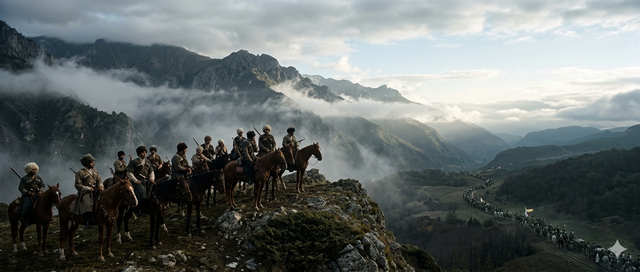
Circassian fighters commanded the high ground — using terrain, speed, and knowledge of the mountain passes to resist a much larger imperial force for over a century. Their guerrilla tactics imposed enormous costs on the Russian army year after year.
Phase Two: Systematic Terror (1817–1840)
The appointment of General Alexei Yermolov as Caucasus commander in 1816 marked a turning point. His strategy was systematic destruction: burn the villages, cut the crops, fell the forests, starve the population into submission. Between 1805 and 1807, more than 280 Circassian villages were burned. Under Yermolov, the population of Kabarda fell from 350,000 in 1763 to only 37,000 in 1817 — an 89% decline in 54 years.

Circassian fighters used the mountain terrain with extraordinary skill — ambushing Russian columns in canyon passes, raiding supply lines, and retreating into valleys the Russian army could not navigate without catastrophic casualties.
The Circassians adapted. The Abzakh and Shapsug tribes in the western mountains were particularly effective. Russian casualty rates were high enough that service in the Caucasus was dreaded by officers and enlisted men alike. Leo Tolstoy, who served as a Russian officer in the region, later reported that Russian soldiers attacked Circassian village houses at night — a detail that reveals how the war was actually conducted, far from any recognized battlefield.
The Vixen Affair: How Close Britain Came to War Over Circassia (1836)
The most dramatic single episode involving the Black Sea was the Vixen Affair of 1836 — an incident that nearly brought Britain and Russia to war over Circassian sovereignty. Scottish diplomat David Urquhart organized a supply mission to Circassian fighters. The British schooner Vixen, laden with a cargo of salt, sailed bound for Circassia. On November 25, 1836, the Russian military brig Ajax detained it in the Circassian Bay of Soudjouk-Kale (modern Novorossiysk).
The reaction in London was explosive. Russia was threatened with war. Tsar Nicholas I ordered the army and fleet into raised battle readiness. Karl Marx himself later wrote a detailed account of the affair. War did not come. Britain backed down without a continental ally willing to fight. The Vixen was confiscated, renamed the Soudjouk-Kale, and reportedly became the best sailer in the Russian Black Sea fleet. Circassia was abandoned — again — by a European power that had publicly proclaimed its concern.
Phase Three: The Crimean War and False Hope (1853–1856)
The Crimean War raised Circassian hopes to their highest point. The Ottoman Empire dispatched Prince Sefer Bey Zanuko back to Circassia as civil and military governor. Muhammad Amin, Imam Shamil's representative, had been working to unite western Circassian tribes. Their rivalry divided Circassian command at a critical moment. The Treaty of Paris (1856) ended the Crimean War without any provision for Circassian independence. Shamil surrendered in 1859. All Russian military attention turned west.
Phase Four: The Final Extermination (1860–1864)
By 1860, Russia deployed 100,000 troops against a final Circassian force of 20,000. The last commanders watched from the ridges as the empire's final campaign closed in from all four directions — the hundred-year war reaching its inevitable military conclusion.
Count Dmitri Milyutin, appointed Minister of War in 1861, implemented a three-part strategy: scorched earth at scale — burning every village and destroying every crop in the path of advancing forces. Forced displacement toward the sea — civilians were driven toward the Black Sea coast with nowhere to go except the water. Simultaneous colonization — between 1861 and 1862, 35 Cossack stanitsas were established on cleared Circassian land with 5,480 families resettling former Circassian territory while deportations were still ongoing.
📽 Documentary: Circassian Genocide — How Russia Took Over the Caucasus — Kings & Generals, 2023. A comprehensive documentary on the Russo-Circassian War, the 1864 genocide, and its legacy.
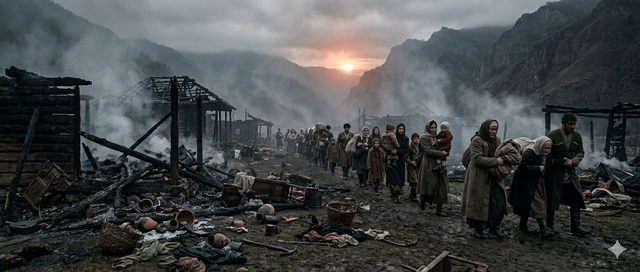
Russian forces burned every village in their path — a deliberate policy of destroying the agricultural base that sustained Circassian resistance. What couldn't be conquered militarily was starved into submission. General Yermolov's strategy, refined over decades, reached its most brutal implementation in 1860–1864.
The final battle came in May 1864 at Qbaada, near the Black Sea coast. Twenty thousand Circassian fighters faced 100,000 Russian troops with artillery advancing from four sides. On May 21, 1864, Russian officers assembled in the valley for a military parade. They celebrated. They gave speeches. They drank toasts to the Tsar. On the Black Sea beaches below the mountains, the survivors of Circassia were dying.

A Circassian family walks through the ruins of their homeland toward the Black Sea coast. Behind them: the mountains their ancestors had defended for a century. Ahead: ships, uncertainty, and for hundreds of thousands — death.
Part V: The Black Sea as the Route of Exile — 1864
What happened on the Black Sea coast in 1864 was one of the largest maritime humanitarian catastrophes of the 19th century — and it took place almost entirely out of sight of the European press. The deportation ports — Tuapse, Sochi, Anapa, Gelendzhik, and Novorossiysk — became sites of mass death before a single ship had sailed. Dense masses of ragged men, women, and children literally covered the seashore. There was no food, no shelter, no medical care.

A lone Circassian fighter watches as thousands of his people march toward the Black Sea and the ships that will carry them into exile. The Black Sea — which had connected Circassians to the ancient world for 3,000 years — became the final road out of Circassia.
The ships that came were insufficient and unsuitable. Vessels designed for cargo were packed with human beings. Water was inadequate. Food was nonexistent. Disease — cholera, typhus, dysentery — spread with terrifying speed. Storms battered the overloaded vessels. Bodies were thrown overboard daily during the crossing. German historian Karl Friedrich Neumann estimated that of 1.5 million Circassian exiles who attempted to reach Anatolia, more than 500,000 died during the journey. Ottoman archives document nearly one million migrants entering Ottoman territory by 1879, with nearly half found dying on the shores upon arrival.

Hundreds of thousands of Circassians crowded the Black Sea coast waiting for ships that came too slowly and in too small numbers. British Ambassador Henry Bulwer wrote from Istanbul urging his government to charter ships immediately — without more vessels, innocent civilians would simply be left to die on the shore.
British Ambassador Henry Bulwer wrote from Istanbul on May 25, 1864 — four days after the Russian parade — urging his government to send ships. Eight Greek vessels, one Moldavian, one German, and one British vessel helped with transportation at various points. It was not enough. The irony is haunting: the same sea that had connected Circassians to the ancient world for three thousand years — the sea of Greek merchants, Genoese traders, Ottoman allies — became the instrument of their separation from everything they had known.

Night on the Black Sea shore, 1864. Circassian families camped on the beach — some for days, some for weeks — waiting for ships that came too few and too late. This is the image that Circassians carry across 160 years of diaspora memory: the fires in the darkness, the ships silhouetted against the water, the Caucasus mountains looming behind them for the last time.
The Ubykh, who had fought hardest and longest, were entirely expelled. Their language — documented with up to 84 consonants, one of the most phonetically complex ever recorded — died with their last native speaker, Tevfik Esenç, in Turkey in 1992. A language spoken in the Caucasus for millennia disappeared within a single human lifetime of the deportation.
Part VI: The Evidence
The Russo-Circassian War and its genocidal conclusion are not contested history in terms of whether they happened. The evidence is extensive, and much of it comes from Russian imperial sources themselves.
Key documents: Alexander II's rescript (June 25, 1861) explicitly orders removal of Circassians to make room for Russian settlers. The Main Staff of the Caucasus Army's records show 418,000 people forced to leave between 1861 and 1864. The Russian census of 1897 recorded approximately 150,000 Circassians remaining — one tenth of the pre-war minimum population. British Ambassador Bulwer's May 25, 1864 dispatch proves the British government was fully informed of the deportation and its conditions in real time.
On April 9, 1864 — six weeks before the Russian victory parade — Circassian leaders signed and dispatched a formal petition to Queen Victoria: "In the name of God, the Most Compassionate, the Most Merciful. Our most humble Petition to Her Magnificent Majesty the Queen and Emperor of England is to the effect that — It is now more than eighty years since the Russian Government is unlawfully striving to subdue and annex to its dominions Circassia, which since the creation of the world has been our home and our country." The petition was received. No military intervention followed.
Part VII: Key Figures of the War
Circassian Leaders
Misost Bematuqo Hatokhshoqo — organized the first formal resistance in 1764. Prince Sefer Bey Zanuko (d. 1860) — the most prominent Circassian political and diplomatic leader, maintaining contact with Istanbul, London, and Paris. His death in 1860 removed the most experienced Circassian diplomat at the critical moment. Muhammad Amin — Imam Shamil's representative in Circassia. Haji Qerandiqo Berzedj — head of the last Circassian parliament (1861), which organized the petition to Queen Victoria.
Russian Commanders
General Alexei Yermolov — architect of systematic terror (1816–1827). Count Dmitri Milyutin — organized the final strategy of simultaneous deportation and colonization. General Nikolai Yevdokimov — operational commander of the 1860–1864 campaign.
Western Advocates
David Urquhart (1805–1877) — Scottish diplomat who designed the Circassian national flag (green with twelve gold stars and three crossed arrows, still in use today) and organized the Vixen mission. Imam Shamil (1797–1871) — his decades of northeastern resistance drew Russian military resources that might otherwise have concentrated on the Circassians earlier.
Part VIII: Why Circassia Lost
The Circassians held Russia at bay for 101 years. The answer to why they ultimately lost is complex. The resource disparity eventually proved crushing — 100,000 troops with artillery against 20,000 fighters. The absence of sustained outside support was decisive — Britain, France, and the Ottoman Empire offered sympathy but chose accommodation whenever real commitment was required. Decentralization that made conquest difficult also made unified defense impossible. The scorched-earth strategy broke the economic base: fighters could endure military casualties indefinitely, but the destruction of food supplies made civilian survival impossible. And finally — the sea that had been a lifeline became a trap.
Part IX: Russia's Denial — Then and Now
During the war, Russian generals called Circassians "mountaineer bandits" and "rebels." In the Soviet period, the Caucasian War was minimized as the "peaceful voluntary entry of mountain peoples into Russia." In the post-Soviet period, Russia's ambassador to Turkey described the genocide as a "beautiful legend" that was, in reality, a "defensive act" by the Russian Empire. Kabardino-Balkaria has been required to celebrate the "460th anniversary of its voluntary entry into Russia" — a historical fiction built on a 16th-century diplomatic contact. The evidence that contradicts this narrative is extensive and comes largely from Russian sources. Russia denies it anyway.
Part X: The Black Sea in Circassian Memory Today
The 2014 Sochi Winter Olympics — held on the same coast where the 1864 deportation was executed — brought international attention to the unresolved legacy. Circassian activists used the global spotlight to call for genocide recognition. The Russian government dismissed the protests. Every May 21, Circassians gather at coasts around the world — in Jordan, Turkey, Israel, Germany, the United States — and face the water that their ancestors crossed in the other direction, 160 years ago. They remember. They remain.
Conclusion
The Russo-Circassian War was fought over the Black Sea — over its ports, its trade routes, its strategic depth, its eastern shore. For Russia, it was a prize worth 101 years of war and the deliberate destruction of a civilization. For Circassians, it was the defense of the land where their people had lived for thousands of years.
The Black Sea connected Circassia to the ancient world, to Byzantine Christianity, to Genoese commerce, to the Mamluk courts of Egypt. It brought Ottoman allies and British sympathizers. And in 1864, it carried the survivors of Circassia away from everything they had known.
Five million Circassians live today in fifty countries — most descended from people who crossed that sea. The Russo-Circassian War tried to end the Adyghe people. It failed.
Sources & References
Richmond, Walter. The Circassian Genocide. Rutgers University Press, 2013.
Richmond, Walter. The Northwest Caucasus: Past, Present, Future. Routledge, 2008.
King, Charles. The Ghost of Freedom: A History of the Caucasus. Oxford University Press, 2008.
King, Charles. The Black Sea: A History. Oxford University Press, 2004.
Ascherson, Neal. Black Sea: The Birthplace of Civilisation and Barbarism. Vintage, 2007.
Jaimoukha, Amjad. The Circassians: A Handbook. Palgrave Macmillan, 2001.
Bell, James Stanislaus. Journal of a Residence in Circassia. London, 1840.
Longworth, J.A. A Year Among the Circassians. London: Henry Colburn, 1840.
Urquhart, David. The Portfolio: A Collection of State Papers. London, 1837.
Marx, Karl. "The Story of the Life of Lord Palmerston," 1853.
Alexander II. Imperial Rescript on Settlement of the North Caucasus, June 25, 1861.
Bulwer, Henry. British Ambassador's dispatch from Istanbul, May 25, 1864.
"A Petition from Circassian Leaders to Her Majesty Queen Victoria," April 9, 1864.
Ottoman Imperial Archives — migration records, 1864–1879.
Russian Imperial Census, 1897.
"The Circassian resistance to Russian conquest represents one of the most remarkable military campaigns in the history of guerrilla warfare. A decentralized confederation of tribes held off a European empire for over a century using terrain, tactics, and a code of conduct that made every fighter a voluntary defender of his community."
Jaimoukha's handbook remains the most comprehensive reference on Circassian history, culture, and language written in English.
Source: The Circassians: A Handbook, Palgrave Macmillan, 2001
Frequently Asked Questions
What started the Russo-Circassian War?
The formal beginning dates to July 17, 1763, when Russian forces established a fortress at Mozdok in eastern Circassian territory. The core causes were Russia's drive for Black Sea access, control of the Caucasus corridor between the Black and Caspian Seas, and the desire for fertile Kuban River farmland for Cossack resettlement.
Why was the Black Sea so important in this conflict?
The Black Sea formed the entire western border of Circassia. Controlling its eastern shore was Russia's primary strategic objective from Peter the Great onward. The sea was also the route of Ottoman support for Circassian fighters, the cause of the Vixen crisis of 1836, and ultimately the route of the 1864 deportation — transforming from a Circassian lifeline into an exile route within a single year.
Why did the war last 101 years?
Circassia's decentralized tribal structure meant there was no single point of defeat; the mountainous terrain gave defenders enormous tactical advantages; Circassians were exceptional guerrilla fighters; and Russian attention was frequently diverted to other conflicts. The resource disparity eventually proved decisive, but only after a century of resistance.
What happened to Circassians who were deported via the Black Sea?
Hundreds of thousands perished during the crossing or immediately after arriving on Ottoman shores. Ships were overcrowded and disease-ridden. Ottoman archives record nearly one million arrivals by 1879, with nearly half found dying on the shores. Survivors settled primarily in Turkey, Jordan, Syria, and the Balkans. Their descendants — estimated at five million today — form the global Circassian diaspora.
Is the war recognized internationally as genocide?
Georgia formally recognized the events as genocide in 2011. Kabardino-Balkaria's parliament condemned it in 1992; Adygea's in 1996. Russia officially denies it. International recognition remains limited but is the focus of active diaspora advocacy, particularly around annual May 21 commemorations worldwide.
What was the Ubykh language, and why did it disappear?
The Ubykh were a Circassian-related people who occupied the mountain zone near modern Sochi. They were entirely deported in 1864 and never permitted to return. Their language — documented with up to 84 consonants, one of the most phonetically complex ever recorded — survived in Turkish exile for one more generation. Its last native speaker, Tevfik Esenç, died in Turkey in 1992 — a direct casualty of the 1864 deportation, 128 years later.
Your History Is Not Lost
The Russo-Circassian War created the global diaspora. CircassianWeb exists to help you reconnect with what was carried across the Black Sea — your family tree, your tribal roots, your DNA heritage, your identity.

Your history is not lost. CircassianWeb — the first digital platform for Circassian genealogy, family trees, DNA heritage, and diaspora connection. Built for the 5 million Circassians living across 50+ countries. www.circassianweb.com