Abaza and Circassians: One Caucasian World, Distinct Identities
Understanding the relationship between Abaza, Abkhaz, Adyghe, Kabardian, Ubykh, and the wider Northwest Caucasian family
Introduction: Why This Question Keeps Coming Up
There is a moment that happens in almost every serious Circassian cultural gathering — in Amman, in Istanbul, in Nalchik, in New Jersey — when someone gestures toward the green flag with the golden bow and twelve stars and asks a question that sounds simple but isn't: "Are the Abaza Circassian?"
The person asking is usually not trying to start an argument. They grew up knowing Abaza families in the same village, the same street, the same diaspaora neighborhood. They attended the same haflas. They heard the same old stories about the mountains, the exile, the ships. They noticed that the languages sound related. They noticed that the histories overlap in ways that feel too close for coincidence. So they asked.
The question deserves a real answer — not a diplomatic dodge, not a brief tribal list, and not the kind of reductive answer that satisfies no one and confuses everyone.
This article is that real answer.
The short version: Abaza are not one of the twelve Circassian tribes. But they are also not outsiders. They are the closest neighbors the Circassians have — linguistically, historically, geographically, and culturally. They share enough that the connection is real and worth honoring. They are distinct enough that erasing one identity into the other would be wrong and would do a disservice to both peoples.
To understand why, you need to understand who the Circassians are, who the Abaza are, what the Northwest Caucasian world actually looked like before the Russian conquest, and what the Russo-Circassian War and the mass exile of 1864 did to all of it.
That is what this article covers.
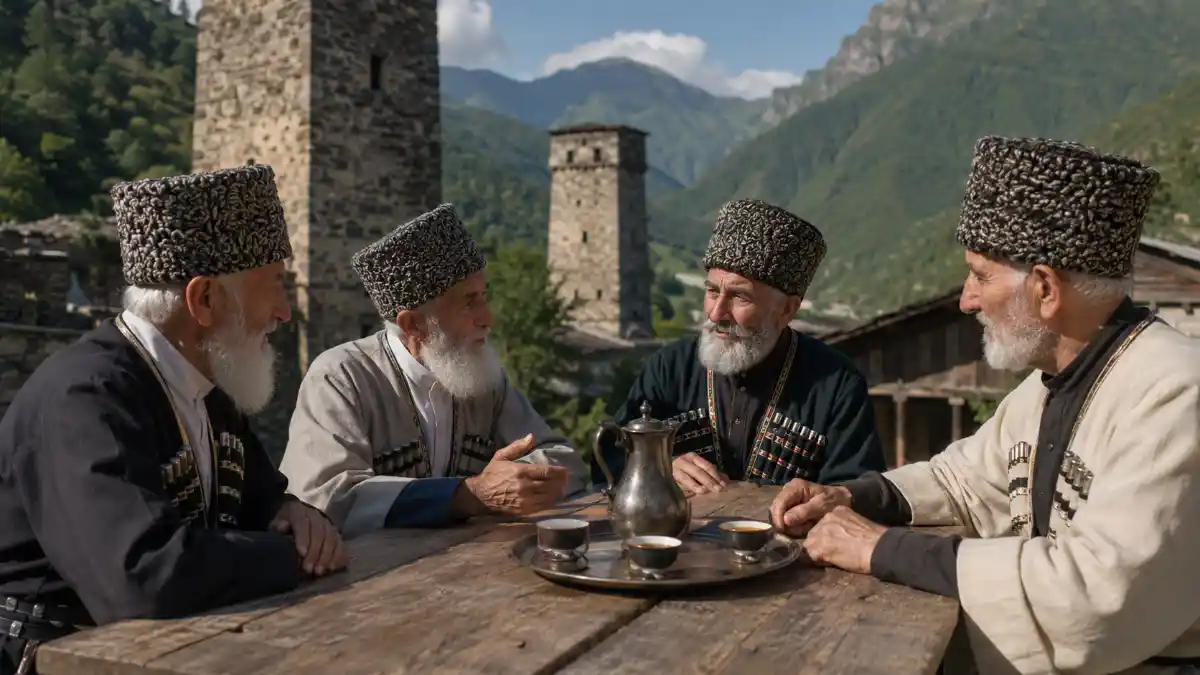
Part One: Who Are the Circassians?
The Name and the People
The word "Circassian" is the name that Europeans and later Russians used to describe the indigenous people of the Northwest Caucasus who called themselves Adyghe. The two words are not quite synonyms, though they are often used interchangeably. "Adyghe" is the people's own name for themselves — the name they used before European cartographers and diplomats arrived with their own vocabulary. "Circassian" came into widespread use in maps and diplomatic correspondence from roughly the fifteenth century onward and stuck.
The Adyghe are among the oldest known inhabitants of the Caucasus. Archaeological and linguistic evidence places their ancestors in the region for at least four thousand years, and many scholars argue the presence is considerably older than that. Their homeland, which they called Adygea or simply the Adyghe lands, stretched from the Taman Peninsula in the northwest down through the foothills and plains east of the Black Sea coast, across the high mountain ridges, and into the broad flat steppe toward the Kuban River in the north and east.
At the height of Circassian territorial and political influence — roughly the fifteenth through seventeenth centuries — this was a large, densely populated, and militarily formidable region. The Circassians were known across the Middle East and the Mediterranean world as extraordinary warriors and, because of the slave trade and the Ottoman elite military system, as high-status soldiers, administrators, and members of ruling households from Egypt to Constantinople. The Mamluk sultans of Egypt were of Circassian origin. The bodyguard units of the Ottoman sultans drew heavily from the Caucasus. Circassian women were considered extraordinarily beautiful by the standards of the era and were purchased, traded, and sought after in courts from Morocco to India — a grim reality that sits alongside any account of Circassian prestige with uncomfortable weight.
The Adyghe Language
The Adyghe language is the native tongue of the Circassian people and one of the more remarkable human languages ever documented.
It belongs to the Northwest Caucasian language family. This is a family that has no demonstrated genealogical relationship to any other language family on earth — not to Indo-European, not to Semitic, not to Turkic, not to anything spoken in neighboring regions. It is genuinely its own thing.
Adyghe phonology is famous among linguists for its consonant inventory. Depending on the dialect and how you count, the language has somewhere between 48 and 84 consonant phonemes — some analyses go higher. The vowel system, by contrast, is tiny: some analyses of certain dialects recognize as few as two or three phonemes that function like vowels in the traditional sense. This is an almost unheard-of ratio. Most of the world's languages either have a moderately large vowel system or a moderately large consonant system. Adyghe went the other direction and maximized one while nearly eliminating the other.
The grammar is polysynthetic and heavily verb-centered. A single Adyghe verb can carry information about the subject, the direct object, the indirect object, the location of the action, the direction of the action, the aspect, the tense, the mood, and the social relationship between the speaker and the listener. What English expresses in a sentence, Adyghe often expresses in a single word. Linguists who work on typological diversity frequently cite Adyghe as one of the most morphologically complex languages documented.
There are two main literary forms: Adyghe (sometimes called Western Adyghe or just Adyghe) and Kabardino-Cherkess (sometimes called Eastern Adyghe or Kabardian). They are different enough that speakers of one do not always understand speakers of the other without prior exposure, but linguists generally classify them as dialects or closely related varieties of the same language rather than separate languages. The question of how to classify them is partly linguistic and partly political.
In the Circassian national identity, Kabardian is considered an essential part of the Adyghe/Circassian people. Linguistically, however, some academic references use a distinction between Western Adyghe and Kabardian/Eastern Circassian, treating them as two standards or branches within the same Circassian linguistic continuum.
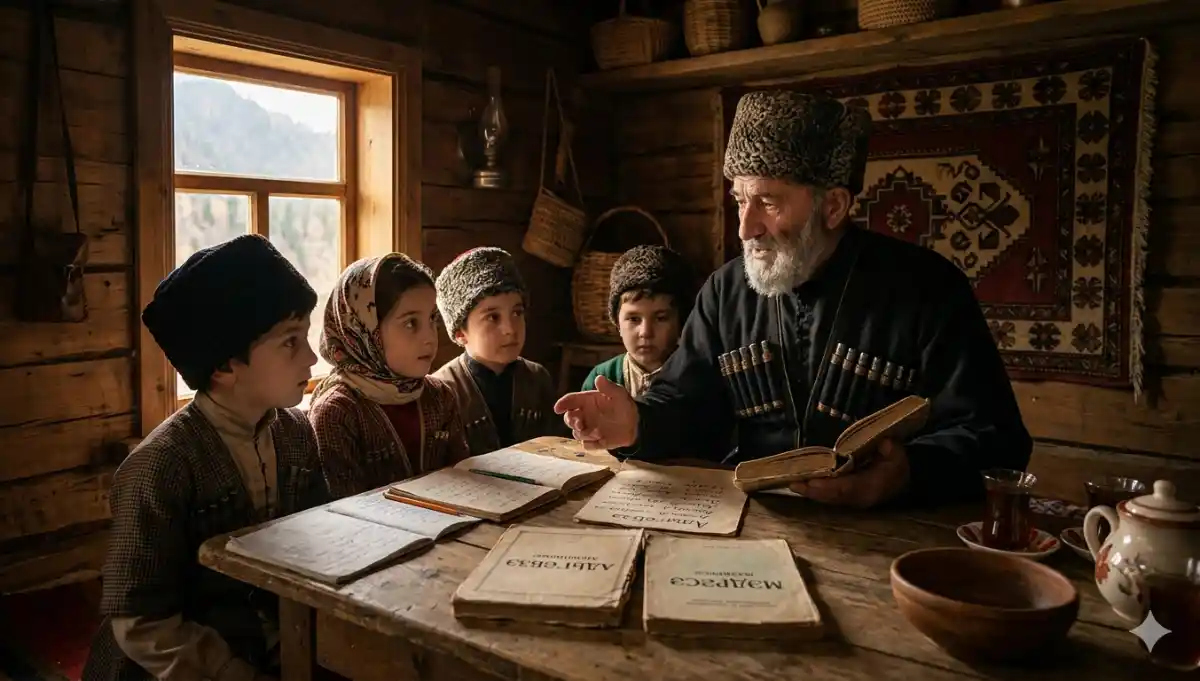
The Twelve Tribes
The Circassian flag — green with a golden bow and twelve gold stars — is one of the most recognizable symbols in the Caucasian diaspora world. The twelve stars represent the twelve major tribes, sometimes called twelve peoples or twelve subdivisions of the Adyghe nation. The flag design was historically attributed to General Sefer-bey Zanoko (also known as Tseref Bey), who used a version of it in the nineteenth century during the resistance against Russia, though the full details of its history and origins are debated.
The twelve tribes are:
Abzakh — one of the most populous and widely distributed of the Circassian tribes, living in the mountain forests and foothills of what is now the western part of the Krasnodar region. The Abzakh were among the fiercest and longest-holding of the resistance forces against the Russian advance and suffered catastrophic losses in the 1860s. Most surviving Abzakh were deported to the Ottoman Empire.
Shapsug — the Shapsug homeland was along the Black Sea coast and in the forests behind it, a territory that is now largely absorbed into the Sochi region and the western Krasnodar Krai. The Shapsug are notable today as the only Circassian group with a recognized administrative territory inside Russia — the Shapsug National District, though it exists more on paper than as a living homeland. The Shapsug were also heavily deported in 1864.
Kabardian — the Kabardians are the easternmost of the major Circassian groups and geographically the most isolated from the Black Sea coast. Their territory in the central and eastern Caucasus foothills survived the 1864 deportations with somewhat less catastrophic population loss than the western tribes, partly because of earlier treaty relations and partly because of geography. The Kabardino-Balkarian Republic in Russia today is named partly for them. They speak Kabardian, the eastern form of Adyghe.
Bzhedug — a tribe of the lowland and foothill zone near the Kuban River delta. The Bzhedug had closer and earlier contacts with Russian settlement and were among the groups that reached accommodation with Russian administration somewhat earlier than the highland tribes, though this did not spare their population from profound disruption.
Natukhai — their territory was around the Taman Peninsula and the lower Kuban region — land that is now some of the most Russified territory in the North Caucasus. The Natukhai were almost entirely deported in the 1860s. As a living community in Russia, they essentially ceased to exist. Their descendants are in Turkey and Jordan.
Temirgoy (also called Chemguy or Kemgoy) — a significant tribe whose territory lay in the central foothills. The Temirgoy maintained considerable internal social organization and were known for their aristocratic structures.
Besleney — related closely to the Kabardians and sometimes considered a branch of the same group, the Besleney occupied territory in the upper Kuban area, near what is now Karachaevo-Cherkessia.
Hatuqwai — a smaller tribe of the Kuban lowlands.
Mamkhegh — one of the smaller groupings, sometimes considered a subtribe or closely affiliated group.
Yegeruqwai — also among the smaller groupings; much of what is known about them comes from nineteenth-century Russian ethnographic accounts and oral traditions preserved in the diaspora.
Zhaney (also Zhaneyev or Jane) — a tribe of the coastal lowlands, largely destroyed or absorbed during the Russian advance.
Ubykh — the Ubykh are sometimes listed as one of the twelve Circassian tribes and sometimes not, depending on the source and the framework being used. Linguistically, the Ubykh language is closely related to Adyghe but distinct enough that most specialists classify it as its own branch within the Northwest Caucasian family, equidistant from both Adyghe and Abkhaz-Abaza. The Ubykh homeland was on the Black Sea coast between the Shapsug and Abkhaz territories. They were entirely deported in 1864 and their language — one of the most phonologically complex ever documented, with 84 consonant phonemes — became extinct in 1992 with the death of Tevfik Esenç in Turkey.
These twelve tribes shared language in its various dialectal forms, shared the social code called Xabze (or Adyghe Xabze), shared a common history of resistance, and shared the catastrophic experience of the 1864 exile. They are the twelve stars on the Circassian flag.
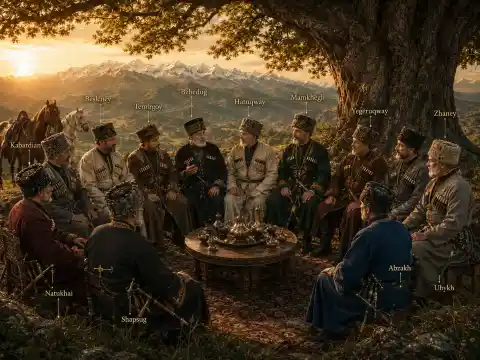
Adyghe Xabze: The Code of Life
To understand Circassian identity, you have to understand Adyghe Xabze — the system of customs, ethics, and social conduct that governed life in the mountains and that Circassians in the diaspora still refer to and try to maintain.
Xabze is not a written legal code. It has no single founding text. It developed over centuries as an oral tradition maintained by community elders, passed down through the oral memory of each tribe, refined through practice and adjudication in village councils. It covers almost every domain of social life: greetings and hospitality, conduct in warfare, relations between elders and youth, gender conduct, mourning, weddings, mediation of disputes, and the treatment of guests.
The hospitality rules are among the most widely known. A Circassian host was expected to provide for any guest, known or unknown, for three days and three nights without question. To ask a guest's business before offering food and shelter was considered a breach of etiquette. The safety of a guest was the responsibility of the host — sometimes at personal risk. This was not merely a custom of convenience. It was a moral foundation.
The treatment of elders was equally codified. Standing when an elder enters a room, giving way on a path, not speaking before an elder without permission, maintaining physical composure and restraint in the presence of older people — these were not suggestions. They were how you demonstrated your membership in the community.
Xabze has no direct equivalent in most Western ethical systems. It is something between a code of honor, a set of religious-adjacent practices, and a community constitution. Non-Circassians who have spent time in Circassian communities often describe it as the most defining feature of the culture — more defining even than the language, because the language was lost by many diaspora families while Xabze survived as a living practice.
Part Two: Who Are the Abaza?
A Distinct People
The Abaza are a Northwest Caucasian people who are distinct from the Circassians — distinct in language, in internal tribal organization, in origin narrative, and in the precise geography of their historical homeland. They are not a branch of the Circassian nation. They are a separate people.
That said, they are the Circassians' closest neighbors in the Northwest Caucasian world, and the relationship between the two peoples — over centuries of shared territory, shared threats, shared exile, and shared diaspora communities — is close enough that confusion between them is understandable. The confusion exists partly because of proximity, partly because of shared elements of material culture, and partly because both peoples ended up in the same Ottoman territories after the 1864 deportations.
The Abaza speak a language called Abaza, which belongs to the Abkhaz-Abaza branch of the Northwest Caucasian family. Encyclopaedia Britannica notes that the Abaza language is related to Abkhaz, Adyghian (Adyghe), Kabardian, and Ubykh, and places it within the Abkhazo-Adyghian language group — which is the broader Northwest Caucasian family. Within that family, the most precise division is usually: the Circassian branch (Adyghe and Kabardian), the Abkhaz-Abaza branch, and Ubykh as its own distinct position between them.
The Abaza language is closely related to Abkhaz — close enough that linguists generally classify them as two dialects or very closely related languages of the same branch. A speaker of Abaza and a speaker of Abkhaz have significant but not total mutual intelligibility. They are not the same language, but they are close. Compare this to the relationship between Adyghe and Kabardian, or perhaps between Portuguese and Spanish — two distinct things that clearly came from the same root.
Where the Abaza Came From
The Abaza are believed to have migrated northward from the western Caucasus mountains and the Black Sea coast over several centuries, settling eventually in what is now the eastern part of Karachaevo-Cherkessia and the western part of Kabardino-Balkaria. Their migration story is connected to pressure from neighboring groups and to the general fluidity of population movement in the Caucasus during the medieval and early modern periods.
Historically, the Abaza were divided into two main subgroups: the Tapanta (lowland Abaza, who settled in the Kuban region foothill zone) and the Ashkharua (highland Abaza, who lived in the mountains). These two groups had somewhat different lifestyles, economies, and social structures, though both spoke varieties of Abaza and shared core cultural practices.
By the eighteenth and nineteenth centuries, Abaza communities were living alongside Circassian communities in ways that created genuine cultural and social overlap. Intermarriage happened. Alliance structures developed. The Abaza and the Kabardians, in particular, had a long history of political relations — sometimes cooperative, sometimes tense, but always aware of each other.
The Abaza Homeland Today: Karachaevo-Cherkessia
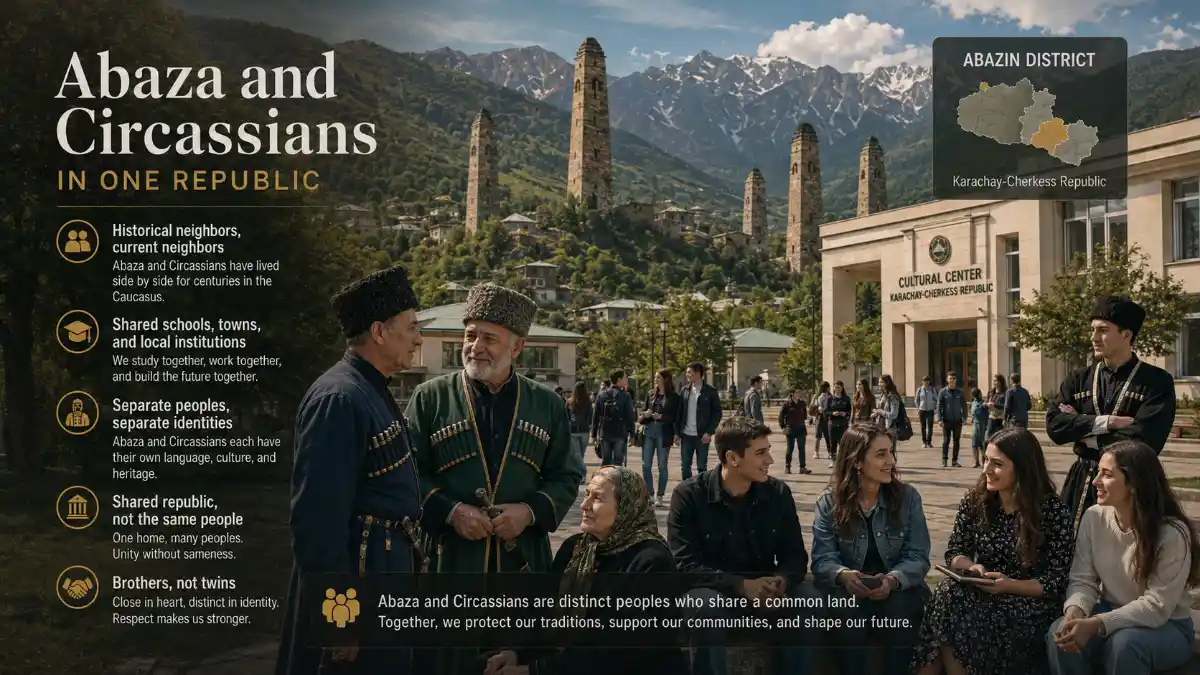
One detail that explains why Abaza and Circassian identities are so often linked in the modern world is simple: they share the same republic.
Karachay-Cherkessia — the Karachay-Cherkess Republic in southern Russia — is today home to several officially recognized peoples, especially Karachays, Cherkess/Circassians, Russians, Abazins, and Nogais. The Abaza people, known in Russian administrative usage as Abazins, are one of the indigenous peoples of the republic. They live mainly in a number of villages in Karachay-Cherkessia, including the Abazin District and nearby areas. The Abazin District was created in 2006 after local advocacy and a referendum, while its administrative structures were fully formed in the following years.
This matters for understanding the Circassian-Abaza relationship because the two peoples are not only historical neighbors — they are current neighbors. They live under the same regional government, send children to schools in the same towns, and participate in the same local political and cultural space. Cherkess and Abaza communities in Karachay-Cherkessia interact in daily life, while their languages and cultural organizations exist within the same regional framework.
And yet, even within this shared republic, the distinction between Cherkess and Abaza is formally recognized. They are listed as separate peoples. They have separate cultural identities, separate historical narratives, and separate community institutions. The Abazin District itself reflects the recognized presence of the Abaza people in their homeland.
This shared republic is one reason why the question “Are the Abaza Circassian?” keeps arising — and one more reason why the answer requires care. They live side by side today, just as they did in the mountains centuries ago. Neighbors, not the same people. Brothers, not twins.
The Abaza Language in Detail
The Abaza language shares several of the features that make its relatives so striking to outside linguists. Like Adyghe, it has a large consonant inventory and a small vowel inventory. Like Abkhaz, it has a polysynthetic grammatical structure where verbs carry enormous amounts of information. The Abaza spoken today is written in a version of the Cyrillic alphabet modified with additional characters to represent sounds that have no equivalent in Russian.
Two main dialects of Abaza are recognized: Tapanta (also called Bzyb-Abaza or lowland Abaza) and Ashkharua (highland Abaza). The Tapanta dialect is generally considered the basis for the modern literary language.
The language has been under severe pressure for over a century. The Soviet period brought policies that simultaneously formalized some minority languages (creating written standards, publishing limited materials) while suppressing others. Abaza got a written form and some educational materials, but the dominant languages of instruction and administration — Russian, then Russian — consistently pushed Abaza toward the margins. Today the language is spoken by roughly 50,000 to 60,000 people in Russia, primarily in Karachaevo-Cherkessia, and by diaspora communities in Turkey, Syria, Jordan, and elsewhere. UNESCO classifies it as vulnerable.
The diaspora population is harder to count. Estimates vary widely, but there are significant Abaza communities in Turkey (where they are sometimes called Abaza Turks), in Jordan, in Syria (though the Syrian war displaced many of them), and smaller communities in other countries.
Abaza Culture and Identity
The Abaza have their own cultural code — sometimes called Abaza Xabze or Xabze in the same broad tradition as the Circassian version. The similarities between Abaza and Circassian cultural codes are significant: the same emphasis on hospitality, the same hierarchical respect for elders, the same restraint and composure as social ideals, the same oral memory tradition. This is not coincidence. These are neighboring peoples who have been in contact for centuries, and cultural exchange goes both directions across a border that was never really a hard line.
The Abaza historically practiced both Islam and pre-Islamic indigenous religion. Like the Circassians, they converted to Islam gradually over the sixteenth through eighteenth centuries, largely through Ottoman influence. Like the Circassians — and like the Abkhaz — the Islam they adopted tended to overlay rather than completely replace older spiritual practices. The combination is sometimes called "mountain Islam" by outside observers, though Abaza and Circassian practitioners themselves have varying views on that framing.
Famous Abaza Figures
Karamurzin (Muhammed-Girey) — an eighteenth-century Abaza military leader who played a role in the complicated politics of the central Caucasus during the period of Russian expansion. His story is caught up in the alliances and betrayals of that era.
Musa Ekzekov — a contemporary Abaza figure, businessman and former head of the World Abaza Congress, who has been instrumental in advocacy for Abaza language preservation and diaspora connections. He has funded cultural centers, language programs, and repatriation support.
Akhmet Abaza — a nineteenth-century Russian-empire official of Abaza origin. His career in the imperial administration is a reminder that not all Caucasian peoples' histories with Russia were exclusively defined by warfare and exile — some individuals navigated the system, for various reasons, with varying degrees of agency and compulsion.
Fevzi Abaza — a Turkish musician of Abaza descent whose work has helped preserve and popularize Abaza folk music in Turkey.
The Abaza diaspora in Turkey has produced politicians, academics, artists, and athletes — most of whom are known by Turkish names and Turkish public identities, with Abaza heritage as a secondary or background identity that the diaspora revival movements of the late twentieth and early twenty-first centuries have worked to bring forward.
Part Three: The Northwest Caucasian World
A Family of Languages
To understand the Circassian-Abaza relationship, you need the broader picture of what the Northwest Caucasian language family actually is.
The Northwest Caucasian family — sometimes called Abkhazo-Adyghian or the Northwest Caucasian group — is one of three indigenous language families of the Caucasus region. The other two are the Northeast Caucasian family (which includes Chechen, Ingush, and the Dagestani languages) and the Kartvelian family (Georgian and its relatives). None of these three families are related to each other. None of them are related to Indo-European, Semitic, Turkic, or any other major language family. The Caucasus is a linguistic island, or rather a set of three linguistic islands, each going back to the deep pre-historical past of the region.
Within the Northwest Caucasian family, linguists typically recognize three main branches:
Circassian (Adyghe-Kabardian): This is the branch that includes Adyghe (Western Circassian), Kabardian (Eastern Circassian), and their dialects. These are the languages of the Circassian/Adyghe people and the twelve tribes of the flag.
Abkhaz-Abaza: This is the branch that includes Abkhaz (spoken primarily in Abkhazia on the Black Sea coast) and Abaza (spoken in the North Caucasus). These are very closely related — some linguists treat them as one language with two major dialects.
Ubykh: Ubykh occupied a position between Circassian and Abkhaz-Abaza and was in some ways an intermediate or transitional member of the family. It is now extinct. The last native speaker, Tevfik Esenç, died in 1992. Before his death, French linguist Georges Dumézil spent decades working with him to document the language. What Dumézil and others produced — recordings, texts, grammatical analyses — is the only Ubykh that now exists.
The relationship between these branches is roughly analogous to the relationship between the Romance languages. Spanish and Portuguese are more closely related to each other than either is to French; French is more closely related to Italian than to Romanian; but all of them are Romance and all of them descend from Latin. In the Northwest Caucasian case: Adyghe and Kabardian are most closely related to each other (like Spanish and Portuguese), Abkhaz and Abaza are most closely related to each other (like, perhaps, Spanish and Catalan), and Ubykh was in its own position relating to both branches but distinct from each.
This shared family membership is real and important. It means that the Circassian languages and the Abaza language are genuinely related — they descended from a common ancestral language at some point in the deep past. But "related" and "same" are different things. French and Romanian are related. You would not mistake a French speaker for a Romanian speaker.
Shared History: The Caucasus Before Russia
Before the Russian Empire's systematic conquest of the Caucasus — which began seriously in the eighteenth century and became catastrophically violent in the nineteenth — the Northwest Caucasus was a mosaic of peoples.
Circassian tribes occupied the central and western areas from the mountains to the coast and the steppe. The Abaza lived in the more eastern mountain areas and foothill zones. The Ubykh had their narrow but densely populated coastal strip between Shapsug and Abkhaz territories. The Abkhaz were to the south, in the territory that is now Abkhazia. The Nogai Tatars were nomadic on the northern steppe. Karachay and Balkar people lived in the high mountain valleys to the east of Circassian territory. Chechens and Ingush were farther east still.
These peoples were not politically unified. There was no Circassian state in the European sense — no king, no bureaucracy, no standing army, no written law code. The political unit was the tribe, and within the tribe, the village. Relations between tribes ranged from alliance to rivalry. The same was true of relations between the Circassians and their Abaza and Abkhaz neighbors — sometimes alliance and intermarriage, sometimes conflict over land or cattle or prestige.
What unified the Northwest Caucasian peoples — to the extent anything did — was a shared ecological situation (mountain life, forests, vertical transhumance agriculture), shared cultural codes that had developed through long contact (the Xabze tradition in various forms), shared religious transition (from pre-Islamic indigenous religion to Islam, largely over the sixteenth through eighteenth centuries), and eventually, shared threat.
The Russian threat was the great unifier. When Russian forces began pushing into the Caucasus in earnest, the peoples of the Northwest Caucasus found themselves facing a power of a different order than any previous threat. The tribal council system, the code of personal honor, the tradition of raiding and counter-raiding — none of it was adequate to resist an industrial-era state with professional armies, artillery, and a coherent strategy of conquest through population removal.
The Russo-Circassian War and the Exile of 1864
The Russo-Circassian War — sometimes dated from the late eighteenth century to 1864, though the periodization is debated — was not a single war but a series of campaigns, sieges, retaliations, and systematic operations that extended over roughly one hundred years. It was the longest war Russia fought in the nineteenth century. The Russian commander who finally completed the conquest of the Western Caucasus, General Yevdokimov, did so through a strategy of razing villages, destroying food supplies, and forcing populations toward the coast where they faced the choice of accepting Russian authority, relocating to the Kuban steppe under Russian administration, or leaving.
Most left.
The mass exile of 1864 — the Circassian Genocide as many Circassians and an increasing number of governments and scholars call it — was the largest single forced population movement in Caucasian history. Over a period of roughly two to three years in the early 1860s, with 1864 as the year when the western campaigns concluded, somewhere between 500,000 and 1.5 million people were expelled from the Caucasus. The range is wide because the documentation is incomplete — Russian records are inconsistent, Ottoman records are inconsistent, and the chaotic conditions of the deportation itself meant that many deaths happened at sea or in Ottoman reception camps without any record at all.
Those expelled were primarily Circassians — Abzakh, Shapsug, Natukhai, and the other western and coastal tribes suffered most — but also Abaza, Ubykh, and some Abkhaz, particularly from the Abkhaz population that had supported the resistance.
They were put on ships, mostly Ottoman ships, and transported across the Black Sea to Anatolia and later dispersed through the Ottoman Empire. Many died during the crossing. Many more died in the reception camps from disease, starvation, and exposure. The Ottoman Empire, which had encouraged the immigration for its own strategic and demographic reasons, was poorly prepared for the actual scale of what arrived.
Those who survived settled in Anatolia, in the Balkans (before those territories were lost to the empire), in Syria, in Palestine, in Jordan, in Libya. Their descendants live in those places today. The largest diaspora population is in Turkey. Jordan has the largest Circassian community relative to the host country's population — Circassians in Jordan served as the royal guard and have historically been considered part of the national security establishment.
The Abaza went through this same exile. Many ended up in Turkey, in the same general areas as Circassian deportees, and in Jordan and Syria alongside them. This is part of why their identities blur in the diaspora — they came on the same ships, settled in the same villages, attended the same mosques, buried their dead in the same cemeteries.
Part Four: Why the Confusion Exists — and Why It Makes Sense
Proximity Created Overlap
The Abaza and Circassian peoples lived next to each other for centuries before the Russian conquest. In the Caucasus, "next to each other" often meant literally in neighboring valleys or on either side of a mountain ridge. Trade happened. Intermarriage happened. Cultural borrowing happened in both directions.
The Abaza who settled in the foothill zone, particularly the Tapanta, had extensive contact with Kabardian communities. Joint raiding parties, political alliances, shared oral traditions — these things create genuine cultural convergence without erasing distinct identity. An Abaza elder and a Kabardian elder in the eighteenth century would have recognized each other's cultural codes, understood each other's values, and probably found significant common ground. They would also have been clearly aware that they were not the same people.
The Ottoman Diaspora Mixed Everyone Together
The exile changed the geography entirely.
Before 1864, the separation between Abaza territory and Circassian territory, while not absolute, was real. They had their zones, their tribal land claims, their village structures in their specific areas. After 1864, all of that was gone. Deportees were settled by Ottoman authorities according to Ottoman strategic logic — which was less about preserving ethnic geography than about securing borders, developing agricultural land, and populating buffer zones against potential Russian or European pressure.
The result was mixed villages. Circassian families from different tribes ended up together. Abaza families ended up in villages alongside Kabardian families. Ubykh families ended up near Shapsug families. The tribal distinctions that had defined identity in the mountains blurred under the pressure of displacement, mortality, and Ottoman assimilation policy.
In Turkey, which received the largest share of deportees, there was steady pressure to become Turkish — to speak Turkish publicly, to take Turkish names, to integrate into the Ottoman and later Turkish republican national identity. Many families did so over two or three generations. Their Circassian or Abaza heritage became background knowledge, spoken at home if at all, practiced in attenuated form, increasingly invisible to the outside world.
The Circassian and Abaza revival movements that began in the late twentieth century — roughly from the 1980s onward, with acceleration after the Soviet collapse in 1991 — worked against this assimilation tendency. Language classes, cultural centers, diaspora organizations, and the internet all contributed to a renewed interest in maintaining and recovering distinct identities. But the recovery happened in a landscape where the communities were already thoroughly mixed, where intermarriage across Circassian-Abaza lines had been going on for generations, and where the shared experience of exile and diaspora had become the dominant collective memory.
In that context, the question "Are the Abaza Circassian?" is not ignorance. It is the logical result of a century and a half of shared displacement.
Shared Cultural Elements
An outside observer visiting a Circassian gathering and an Abaza gathering in, say, Turkey or Jordan would notice striking similarities. The music — the pshina, the accordion, the specific dance rhythms — overlaps substantially. The dance style itself, the controlled, upright posture, the footwork, the emphasis on dignity of movement, looks very similar across Circassian and Abaza traditions.
The hospitality customs look similar. The social hierarchies look similar. The food — certain types of bread, certain cheese preparations, certain boiled meat dishes — overlaps substantially.
This is not because the Abaza are Circassian or the Circassians are Abaza. It is because centuries of contact and the shared experience of displacement created genuine convergence, on top of whatever underlying similarities the two peoples may have had from deeper historical connections.
The similarities are real. They do not erase the differences. Both things are true simultaneously.
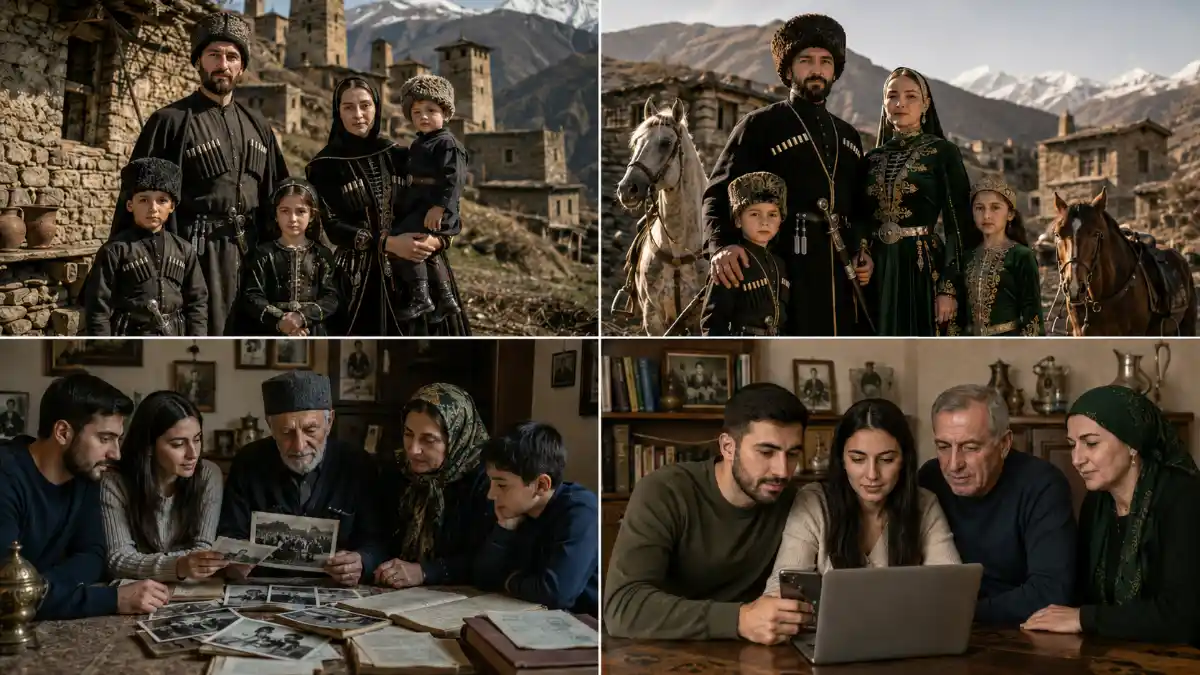
Part Five: Famous People and Figures from Both Worlds
Circassian Figures of Historical Importance
Sefer-bey Zanoko (Tseref Bey, 1789–1859) — military commander, political leader, and diplomat of the Circassian resistance. He traveled to Europe seeking international support for the Circassian cause, met with politicians in England and France and the Ottoman court, and was central to the resistance organization of the 1840s and 1850s. He is the figure most associated with the formal use of the Circassian flag. His death came before the final catastrophe of 1864.
Imam Shamil (1797–1871) — technically a Chechen/Avar religious and military leader of the Naqshbandi Sufi order, Shamil's thirty-year resistance against Russia in the Northeast Caucasus ran parallel to the Northwest Caucasian resistance and was deeply intertwined with it. Circassian fighters were aware of Shamil; Shamil was aware of the Circassian situation. Their simultaneous resistance was the greatest coordinated challenge to Russian Caucasian expansion. Shamil surrendered in 1859, five years before the final western campaigns concluded.
Ismail Berkok (1888–1961) — a Shapsug historian born in the Ottoman Empire who produced one of the most important early Circassian historical narratives in Turkish, "Tarihte Kafkasya" (The Caucasus in History). His work was undertaken without access to Russian archives and with limited access to Western scholarship, relying heavily on oral tradition and Ottoman sources. Its limitations are real, but its importance in the diaspora intellectual tradition is considerable.
Yusuf Kizilkaya (1941–2018) — a Turkish politician and intellectual of Circassian origin who was one of the founders of the Federation of Caucasian Associations in Turkey. He spent decades working on Circassian cultural rights, language preservation, and the campaign for international recognition of the 1864 events as genocide.
Maryam Kabarda — this is not a single historical figure but a name that appears in various Circassian folk traditions, representing the idealized Circassian woman — educated, composed, dignified, capable. The name is used in poetry, in songs, in naming practices. It is an example of how Circassian identity gets carried in cultural memory rather than just in formal historical record.
Nart Sagas — the great oral epic tradition of the Circassians (and of related Northwest Caucasian peoples, including the Abaza and the Abkhaz and the Ossetes). The Nart sagas are a cycle of stories about a race of ancient heroes — the Narts — who lived in the mythological Caucasus before the current age. The sagas deal with heroism, loyalty, treachery, love, death, divine intervention, and the relationship between the human world and supernatural powers. They are one of the great oral literary traditions of the world and were collected and studied by scholars including the French comparativist Georges Dumézil, who argued for connections between Nart traditions and ancient Indo-European mythological cycles. That argument remains debated, but the sagas themselves — in Circassian, Abaza, Abkhaz, Ossetian, and other versions — are extraordinary.
Circassian Figures in the Wider World
Sultan Baybars (1223–1277) — the fourth Sultan of the Mamluk dynasty in Egypt and one of the most effective military commanders of the medieval Islamic world. Baybars was of Cuman (Turkic) origin, not Circassian, but the Mamluk system that he operated within and that later sultans represented was the context in which Circassian Mamluks rose to prominence. The Circassian Mamluk sultanate (Burji dynasty) began in 1382 and lasted until 1517. In this period, Egypt was effectively ruled by a Circassian military elite — men taken from the Caucasus as boys, trained in Cairo as soldiers, and rising through merit and court politics to the highest positions. They maintained their Circassian identity, spoke Circassian among themselves, and kept cultural connections to the Caucasus.
Al-Ashraf Qa'it Bay (1416–1496) — one of the most celebrated of the Circassian Mamluk sultans of Egypt, known for his building projects (the Qaitbay Citadel in Alexandria, the Qaitbay mausoleum in Cairo), his resistance to Ottoman expansion, and his long reign of over twenty-eight years. His name is given to major monuments still standing in Egypt and Jerusalem.
Turgut Özal (1927–1993) — the eighth President of Turkey and a transformative figure in modern Turkish economic and political history. Özal's family origins included a Circassian grandmother, though he was Turkish by national identity and his heritage was mixed. His case is a reminder that Circassian diaspora ancestry runs through many Turkish families in ways that are not always publicly acknowledged.
Rauf Orbay (1881–1964) — Ottoman naval commander, political figure, and one of the key figures of the Turkish War of Independence, of Circassian descent. His career and eventual falling out with Atatürk (Orbay was exiled twice) is a complicated story of loyalty, nationalism, and the ambiguous position of Circassian identity within the early Turkish Republic.
Abaza Figures
Temryuk Idarov — a sixteenth-century Kabardian prince (his name appears in some sources as Adyghe, in others the Abaza connection is noted through kinship) whose daughter Kuchenei became the second wife of Tsar Ivan the Terrible of Russia, taking the name Maria. This dynastic marriage is evidence of how the Caucasian peoples — including Kabardian and Abaza nobles — navigated relations with the expanding Russian state through the traditional tool of marriage alliance. Maria died young, but the connection left traces in Russian court culture.
The Abaza Sultans of Egypt — the Mamluk system brought people from across the Caucasus, not only Circassians. Abaza individuals are documented in Mamluk court records, though they are less prominent in the historical narrative than their Circassian counterparts.
Musa Ekzekov (contemporary) — already mentioned above. Worth repeating because he is among the most significant contemporary Abaza public figures, having invested substantially in Abaza language documentation, cultural preservation, and diaspora network building. The World Abaza Congress, which he has led, is among the more active diaspora organizations in the post-Soviet Caucasian NGO landscape.
Part Six: The Question of the Flag
What the Twelve Stars Mean
The Circassian flag is green with a golden bow and twelve gold stars arranged in a specific pattern. The green represents Islam and nature. The golden bow represents an old symbol of Circassian craftsmanship and martial culture. The twelve stars represent the twelve major tribes.
The tribes represented are the twelve listed earlier in this article. Abaza is not among them. This is not a political statement against the Abaza. It is simply a description of the Adyghe tribal confederation — the peoples who shared the Adyghe identity and whose internal divisions and commonalities the flag was designed to represent.
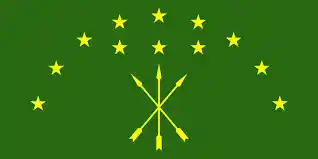
The flag of the Republic of Adygea
Some alternative interpretations and some diaspora traditions offer different counts or slightly different tribal lists, because the historical record of exactly which tribes were counted as twelve and which were considered subtribes or affiliated groups is not perfectly consistent. But the core twelve tribes in most versions are consistently Adyghe/Circassian tribes. Abaza, as a distinct Northwest Caucasian people, has its own identity and its own symbols.
The Abaza have their own flag — a red flag with a pattern of white triangles and other geometric elements, representing their own identity. The existence of an Abaza flag does not mean the Abaza are not connected to the Circassian world. It means they have their own identity within the broader Northwest Caucasian family.
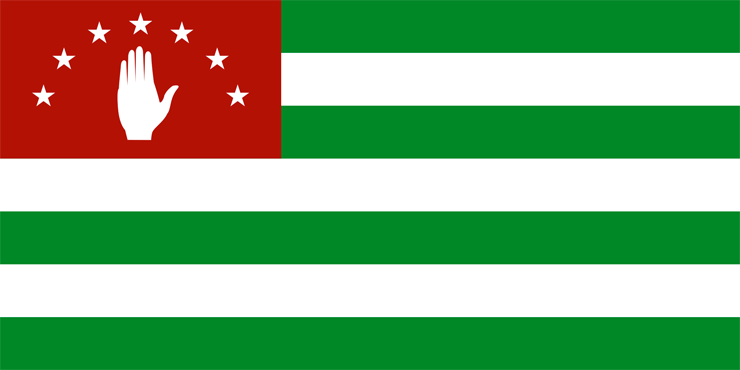
Modern flag of the Republic of Abkhazia
Why This Matters for Identity Politics
The question of who is included in "Circassian" has real stakes in the contemporary world.
In Russia, the administrative divisions created and maintained over the Soviet and post-Soviet period mean that "Circassian" identity intersects with complex questions of which republic a person comes from, which official nationality category they check on a form, and what political rights and cultural protections apply to them. Kabardians in Kabardino-Balkaria have different formal status from Adyghe in the Adygeia Republic from Cherkess in Karachaevo-Cherkessia — even though these are all variants of the same Adyghe/Circassian people, divided by Soviet administrative convenience. The Abaza in Karachaevo-Cherkessia have their own separate administrative category.
In the diaspora, the question matters for community organization, cultural funding, political advocacy, and intergenerational identity transmission. If a diaspora organization defines itself as "Circassian" and interprets that narrowly to mean only Adyghe tribal descendants, it may exclude Abaza community members who have been part of the same social fabric for generations. If it defines "Circassian" broadly as a catch-all for Northwest Caucasian diaspora, it may create confusion about the distinct Abaza identity that Abaza intellectuals and activists have worked hard to preserve and articulate.
Neither extreme serves anyone well. The nuanced answer — close family, distinct identity, shared world — is harder to communicate but more accurate and more respectful.
Part Seven: Language Preservation and the Shared Crisis
A Family of Endangered Languages
All the Northwest Caucasian languages are endangered to varying degrees.
Kabardian is probably in the best position numerically — roughly 500,000 speakers in Russia and diaspora, with some institutional support including schools and media in Kabardino-Balkaria. Adyghe is in a similar position with around 300,000 speakers and institutional presence in the Republic of Adygeia.
Abkhaz, spoken in Abkhazia, has somewhere around 120,000 speakers and the unusual situation of being an official language of a partially recognized state — one that has Russian support, Georgian opposition, and a complex political status that affects both the language's public prestige and its educational resources.
Abaza has around 50,000 to 60,000 speakers. Karachaevo-Cherkessia has Abaza-language schools, radio, and some publishing, but the language is under serious pressure from Russian. The diaspora Abaza, particularly in Turkey, often have partial competence at best — they understand more than they can produce, the youngest generations frequently have no Abaza at all, and the revival movements face the familiar problem that language classes for diaspora youth work best when there is an immersive community to support them.
Ubykh is already gone. The last speaker died thirty years ago. What remains is documentation — tapes, transcriptions, grammatical analyses, a dictionary. Linguists can reconstruct how it sounded, what its grammar was, what its words meant. But it cannot be revived as a living language without a community to speak it, and that community was destroyed in 1864.
The loss of Ubykh is a preview of what could happen to Abaza if current trends continue, and a warning for Adyghe and Kabardian if diaspora communities do not find ways to transmit the language to the next generation.
What Revival Efforts Look Like
Across the Northwest Caucasian diaspora, language and cultural revival takes several forms.
In Turkey, organizations like the Federation of Caucasian Associations have run language classes, produced textbooks, and created cultural spaces. The results are mixed — attendance is sometimes strong, sometimes thin, and the gap between wanting to preserve the language and actually using it daily is wide.
In Jordan, the Circassian Charity Association and the Circassian Cultural Club have been active for decades, maintaining cultural practices including dance troupes, cultural events, and some language education. The Jordanian Circassian community's close relationship with the Jordanian state — dating from the Circassians' role as royal guard troops from the founding of the emirate — gives them unusual stability and resources compared to Circassian communities in more marginal diaspora positions.
In the United States, the International Circassian Council and various regional organizations have worked on connecting diaspora communities, and the internet has accelerated this work dramatically. Online forums, social media groups, YouTube channels teaching Adyghe and Kabardian, and platforms like CircassianWeb have made it possible for diaspora members to learn about their heritage in ways that were impossible a generation ago.
For the Abaza specifically, the World Abaza Congress and associated organizations have worked on Abaza language documentation, teaching materials, and diaspora connection. The effort to digitize oral histories before the last fluent speakers of older generations die is particularly urgent.
Part Eight: The Careful Answer
After all of this — the linguistics, the history, the tribal structures, the exile, the diaspora mixing, the cultural overlap — the question "Are the Abaza Circassian?" deserves a full and honest answer.
The Abaza are not Circassian in the sense of being one of the twelve tribes of the Adyghe confederation. They do not speak an Adyghe dialect. They have their own internal tribal structure, their own historical narrative, their own political organizations, their own flag, and their own community institutions. No serious scholar of Caucasian history or linguistics would classify the Abaza as a Circassian tribe.
But the Abaza are also not strangers to the Circassian world. They are the Circassians' closest neighbors in language — their languages share a common ancestor within the Northwest Caucasian family, even if the branches diverged far enough that speakers cannot simply understand each other. They are close neighbors in history — living adjacent to Circassian territories for centuries, sharing political alliances, sharing the experience of Russian conquest, sharing the ships of the 1864 exile, and sharing the Ottoman and post-Ottoman diaspora. They share cultural practices — versions of the same hospitality code, related music and dance traditions, similar social hierarchies, the Nart epic tradition. They share the experience of being Northwest Caucasian peoples whose homeland was taken, whose populations were expelled, and whose languages are now fighting for survival.
The closest analogy that works for a Western reader: the Abaza are to the Circassians roughly what the Portuguese are to the Spanish in the broader Iberian world. Related, historically intertwined, sharing deep cultural and linguistic roots, having gone through overlapping historical experiences — but distinct nations with distinct languages and identities, neither of which should be absorbed into the other.
Or perhaps more precisely: they are like two branches of the same large extended family. Close enough that the family feeling is real. Distinct enough that each branch has its own name, its own story, its own pride.
Part Nine: Why Respect for Distinct Identities Matters
The Politics of Inclusion and Erasure
There is a well-meaning but ultimately harmful tendency in diaspora communities under pressure to consolidate identities. When a community is small, when the host country is indifferent or hostile to minority cultures, when the younger generation is assimilating faster than the elders would like — the temptation to simplify is strong. "We are all Caucasians. We are all Mountain People. We are all Circassian."
The simplification feels like solidarity. And there is a form of solidarity in it. But it comes at a cost.
When Abaza identity is folded into Circassian identity — even with good intentions — the Abaza language stops being taught as Abaza. Abaza oral histories get retold as Circassian oral histories. The specific Abaza relationship to their homeland, their specific sites of memory, their specific tribal traditions, disappear into a generalized "Circassian" narrative that was not originally theirs. After a generation or two, the Abaza component of the identity is not preserved — it is absorbed and eventually lost.
The same risk runs in reverse. If Circassian organizations define "Circassian" in ways that are too exclusive, they may cut off Abaza community members who have been part of the same social world for generations and who have a genuine claim to the shared Northwest Caucasian heritage.
The right approach is neither absorption nor exclusion. It is parallel recognition: Circassian identity for Circassians, Abaza identity for Abaza, and a shared sense of Northwest Caucasian kinship that does not require erasing either.
What This Looks Like in Practice
In a diaspora cultural center, it looks like having Abaza language materials alongside Adyghe language materials. Having Abaza folk songs alongside Circassian folk songs. Knowing which dances are specifically Abaza and which are specifically Kabardian, even when they look similar.
In genealogy and family history work — the kind of work that CircassianWeb exists to support — it means knowing not to assume that an Abaza ancestor is automatically Circassian. An Abaza family tree needs to be traced through Abaza tribal structures, Abaza village records where they exist, and Abaza diaspora community networks. The data sources overlap with Circassian sources in some cases, but they are not identical.
In the advocacy context — whether that is advocating for recognition of the 1864 Genocide, advocating for cultural rights in Russia, or advocating for diaspora community support — it means being precise about which peoples are speaking and which peoples' experiences are being described. The deportations of 1864 affected primarily Circassians and Ubykh, with significant Abaza and some Abkhaz participation. Describing this as a "Circassian" event alone is partly true and partly incomplete.
Frequently Asked Questions
Q: Are Abaza people Circassian?
No, not in the strict sense. Abaza are a distinct Northwest Caucasian people with their own language, history, and identity. They are not one of the twelve Adyghe tribes represented on the Circassian flag. However, they are closely related to Circassians through shared regional history, linguistic family membership, and cultural connections. Think of them as the closest neighbors and distant relatives of the Circassian people rather than as members of the Circassian nation.
Q: What is the linguistic relationship between Abaza and Adyghe?
They belong to the same broader language family — Northwest Caucasian — but to different branches within it. Adyghe (and its variant Kabardian) is the Circassian branch. Abaza is in the Abkhaz-Abaza branch. These branches are related the way, say, Spanish and Romanian are related — both Romance languages, but not mutually intelligible. Encyclopaedia Britannica groups Abaza with Abkhaz, Adyghian, Kabardian, and Ubykh in the Abkhazo-Adyghian language group.
Q: Did Abaza people participate in the 1864 exile?
Yes. The deportations of the 1860s affected not only the twelve Circassian tribes but also Abaza communities, Ubykh, and some Abkhaz populations. The mass exile was a Northwest Caucasian catastrophe, not exclusively a Circassian one. Abaza diaspora communities in Turkey, Jordan, and Syria descend from these deportees.
Q: What are the twelve tribes on the Circassian flag?
The twelve stars typically represent: Abzakh, Shapsug, Kabardian, Bzhedug, Natukhai, Temirgoy, Besleney, Hatuqwai, Mamkhegh, Yegeruqwai, Zhaney, and Ubykh (though the exact list varies slightly by source). Abaza is not among these twelve tribes.
Q: Is Ubykh the same as Circassian?
No. Ubykh was a distinct Northwest Caucasian language and people, linguistically positioned between Circassian and Abkhaz-Abaza. They are sometimes counted as one of the twelve Circassian tribes in certain formulations, but linguistically and ethnically they were distinct. The Ubykh language became extinct in 1992.
Q: How many Abaza people exist today?
Estimates vary. There are approximately 50,000 to 60,000 Abaza speakers in Russia, primarily in Karachaevo-Cherkessia. Diaspora populations in Turkey, Jordan, Syria, and elsewhere add significantly to the total. Overall diaspora estimates range widely — some sources suggest 200,000 to 300,000 Abaza-descended people globally, though not all speak the language or maintain strong community connections.
Q: Why do Circassian and Abaza cultural practices look so similar?
Because centuries of geographic proximity, political alliance, intermarriage, and shared exile created genuine cultural convergence. Both peoples also descend from the same broad Northwest Caucasian cultural world, where hospitality codes, social hierarchies, oral tradition, and related music and dance forms developed through long mutual contact. The similarities are real but do not make the peoples identical.
Q: Do the Abaza have their own flag?
Yes. The Abaza flag is a blue background with geometric patterns, representing Abaza identity. It is distinct from the Circassian flag.
Q: How is Abaza different from Abkhaz?
Abaza and Abkhaz are the two languages of the Abkhaz-Abaza branch of the Northwest Caucasian family. They are the most closely related languages in the family — some linguists treat them as dialects of one language, others as two closely related languages. A speaker of one can understand significant portions of the other with some exposure. The main difference is geographic: Abkhaz is spoken primarily in Abkhazia on the Black Sea coast (a partially recognized state), while Abaza is spoken in the North Caucasus, primarily in Karachaevo-Cherkessia.
Q: Was the Northwest Caucasian world politically unified before the Russian conquest?
No. There was no unified Northwest Caucasian state or political structure. The political unit was the tribe and, within the tribe, the village. Relations between tribes — and between peoples — ranged from alliance to conflict. What unified them was shared culture, shared ecological situation, and eventually the shared threat of Russian conquest.
Q: How can diaspora members learn more about distinguishing Circassian and Abaza heritage in genealogy?
Start with what is known: family oral tradition about tribal affiliation, village of origin, language spoken at home, family names. Abaza family names often differ from Circassian family names in recognizable ways, though there is overlap. DNA heritage testing can identify broad regional origins but cannot reliably distinguish between Circassian and Abaza ancestry given their genetic proximity. Community networks — particularly diaspora organizations specific to Abaza or to specific Circassian tribes — are often the best source of genealogical knowledge. CircassianWeb's family tree and diaspora connection tools can help identify community members with relevant knowledge.
Q: What happened to the Ubykh language?
The Ubykh language died with Tevfik Esenç, its last native speaker, in 1992 in Turkey. He had spent decades working with French linguist Georges Dumézil and other researchers to document the language. Audio recordings, grammatical analyses, and dictionaries exist. The language had 84 consonant phonemes — the largest inventory ever recorded in a human language. The Ubykh people were entirely deported from the Caucasus in 1864 and assimilated into Turkish and Circassian diaspora communities over the following generations. The loss of Ubykh is one of the most documented cases of language death in modern history and a stark warning about what can happen to other small languages without community transmission.
Q: Should Abaza people attend Circassian cultural events?
This is a social and personal question more than a political one. Given the shared history, overlapping cultural practices, and the reality that many diaspora families are of mixed Circassian-Abaza heritage, attendance at each other's events is common and natural. The key is knowing which community is which and not assuming that either is a subset of the other. A well-run Circassian cultural event that welcomes Abaza guests while maintaining clarity about Circassian identity serves everyone better than an event that either excludes Abaza attendees or pretends the distinction does not exist.
Resources and Further Reading
Books and Academic Works
Jaimoukha, Amjad M. — The Circassians: A Handbook (RoutledgeCurzon, 2001). The most comprehensive English-language reference on Circassian history, culture, language, and diaspora. Essential for anyone doing serious work on the topic. Covers tribal structures, Adyghe Xabze, the Russo-Circassian War, and diaspora communities in depth.
Richmond, Walter — The Circassian Genocide (Rutgers University Press, 2013). A scholarly examination of the events of the 1860s and the argument for classifying them as genocide. Richmond draws on Russian archival sources and provides the most rigorous English-language analysis of casualty figures and Russian policy intent.
Allen, W.E.D. and Muratoff, Paul — Caucasian Battlefields: A History of the Wars on the Turco-Caucasian Border, 1828–1921 (Cambridge University Press, 1953, reprinted). An older work but still valuable for its detailed military history of the Caucasian campaigns.
Dumézil, Georges — Légendes sur les Nartes and related works. Dumézil spent decades working on the Nart sagas and on the Northwest Caucasian languages, including extended documentation sessions with Tevfik Esenç on Ubykh. His comparative mythology work is controversial but his linguistic documentation is invaluable. Much of it is in French.
Colarusso, John — Nart Sagas from the Caucasus: Myths and Legends from the Circassians, Abazas, Abkhaz, and Ubykhs (Princeton University Press, 2002). An English-language collection of Nart sagas from multiple Northwest Caucasian traditions, with linguistic and comparative notes. One of the best ways to see both the shared traditions and the distinct voices across the family.
Hewitt, B.G. (George) — numerous academic works on the Abkhaz language and Abkhazian identity, including Abkhaz (Croom Helm, 1979) and Georgian: A Structural Reference Grammar. Hewitt is one of the leading Western specialists on the Abkhaz-Abaza branch of Northwest Caucasian.
Chirikba, Viacheslav — academic papers and works on the Abkhaz-Abaza linguistic group. Chirikba is a native Abkhaz speaker and one of the most authoritative scholars on the branch.
Online Resources
CircassianWeb.com — the leading multilingual digital platform for Circassian genealogy, family trees, DNA heritage, and cultural content. Supports six languages including Adyghe. The family tree and diaspora connection tools are among the most developed available for Northwest Caucasian heritage research.
The Circassian Cultural Institute (circassian.org, USA) — maintains articles, documents, and advocacy materials on Circassian history and diaspora issues.
World Abaza Congress (abaza.org) — the main organizational hub for Abaza diaspora and homeland community advocacy, with information on language preservation programs, cultural events, and community news.
Caucasus Survey — an academic journal covering social sciences, history, and politics of the Caucasus region. Contains peer-reviewed articles on Northwest Caucasian peoples, languages, and post-Soviet identity politics.
SOAS University of London's Endangered Languages project — contains audio documentation and linguistic analysis of several Northwest Caucasian languages including Abaza.
Documentaries and Media
"Circassian: The Forgotten Genocide" — various documentary films and short videos are available on YouTube and through cultural organizations documenting the 1864 events. Quality varies but the medium makes the history accessible in ways that academic texts do not always achieve.
Circassian folk music and dance recordings — extensive archives exist on YouTube, on diaspora organization websites, and through Russian regional broadcasting archives. The Kabardino-Balkar State Ensemble recordings and the Adyghe State Ensemble recordings are among the more systematically documented. Abaza folk music recordings are available through the World Abaza Congress and through Karachaevo-Cherkessia regional broadcasting.
Conclusion: Two Names, One World
The question of whether the Abaza are Circassian turns out to be a question about how identity works — how it holds together under pressure, how it gets transmitted across generations and across oceans, and how different peoples can be genuinely close without being the same.
The answer is precise: the Abaza are not Circassian. The twelve stars on the green flag represent twelve Adyghe tribes, and Abaza is not among them. The Abaza have their own language, their own flag, their own history, their own community organizations, and their own proud identity that does not require borrowing another people's name.
And the answer is also generous: the Abaza are not strangers. They share the Northwest Caucasian world, the linguistic family, the historical catastrophe of Russian conquest, the experience of exile, the Ottoman diaspora villages, the cultural codes of hospitality and honor that developed over centuries of living as neighbors. They participated in the Nart epic tradition. Their dead lie in the same cemeteries. Their grandmothers danced at the same haflas.
The right approach — the historically accurate and humanly respectful approach — is to hold both truths at once. Preserve the distinction. Honor the connection. Call the Abaza by their own name. Call the Circassians by theirs. Know enough about both peoples to understand why they are close, why they sometimes get confused, and why the confusion, though understandable, does not serve either community well in the long run.
The Northwest Caucasus produced extraordinary peoples. The mountains that shaped them were hard and beautiful. The languages they spoke were among the most complex human beings have ever made. The cultural codes they lived by asked more of people than most ethical systems dare to. The exile they suffered was one of the worst in modern history, and it has not been adequately acknowledged by the world.
All of that history belongs to the Circassians as Circassians. All of it belongs to the Abaza as Abaza. The sharing of a world — even a world made partly of loss — is not diminished by maintaining the names correctly.
This article was researched and written for CircassianWeb.com as part of the Heritage and Identity series. CircassianWeb supports Circassian genealogy, family trees, DNA heritage, and diaspora connection in six languages including Adyghe. For genealogy tools, family tree building, and diaspora community resources, visit circassianweb.com.
Citation Note
Primary sources used in the preparation of this article include Encyclopaedia Britannica entries on Abaza language and people, Circassian history, and Northwest Caucasian linguistics; Amjad Jaimoukha's The Circassians: A Handbook (RoutledgeCurzon, 2001); Walter Richmond's The Circassian Genocide (Rutgers University Press, 2013); John Colarusso's Nart Sagas from the Caucasus (Princeton University Press, 2002); academic papers on Northwest Caucasian linguistics from B.G. Hewitt and Viacheslav Chirikba; and oral history traditions maintained by diaspora community organizations including the World Abaza Congress and Federation of Caucasian Associations (Turkey).