1864: The Year Circassia Ended — Before and After
Introduction
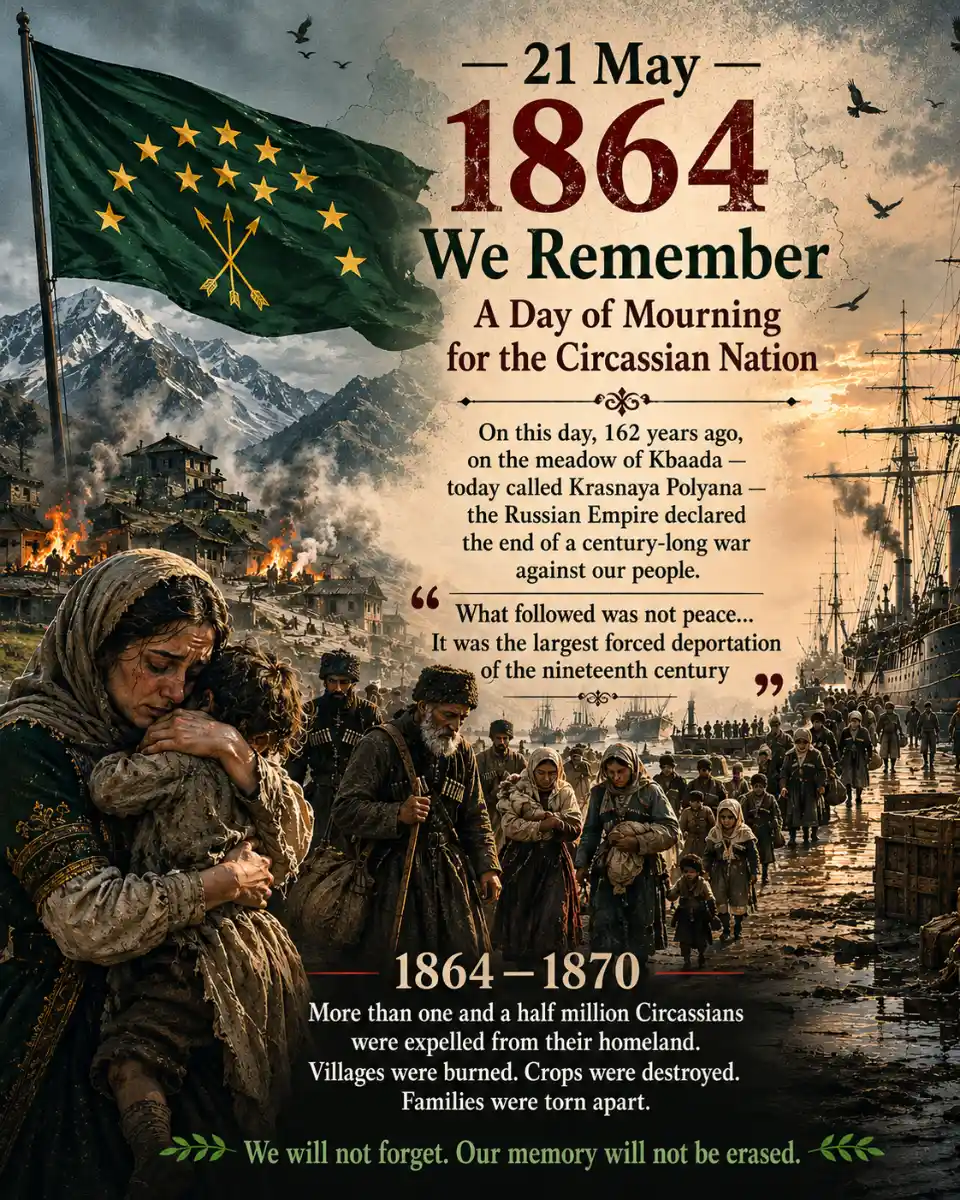
A single year changed everything. During the spring and summer of 1864, the Adyghe people lost their homeland, two-thirds of their population, and almost every village they had ever built. This is not the story of a lost battle or an occupation. It is the story of the complete emptying of a land in which a people had lived for thousands of years. This article focuses on what happened in that specific year: the four years that set it up (1860–1864), the six months in which the genocide took place (March–August 1864), and the decade and a half that followed and shaped the fate of the survivors (1864–1879).
Learn more in our main guide: The Circassian Genocide
Part One: What Set the Stage for 1864 (1860–1863)
The Surrender of Shamil and the Freeing of the Eastern Front
On August 25, 1859, Imam Shamil surrendered in the Daghestani village of Gunib to General Baryatinsky after a quarter century of leading the resistance of the peoples of the Eastern Caucasus. He climbed a tall rock on the besieged mountain, raised his hands, and surrendered his sword. It was an ordinary day in the distant mountains, but it changed the fate of the Circassians a thousand kilometers to the west.
Shamil's surrender meant that one hundred thousand Russian soldiers stationed in the east were now free to move westward. The Caucasian front went from two fronts to one. The Eastern Caucasus was "pacified," as the Russian documents put it. And the Western Caucasus — that is, Circassia — became the last stronghold still resisting.
The Death of Sefer Bey Zanuqo
In February 1860, six months after Shamil's surrender, Prince Sefer Bey Zanuqo died in his camp near the Adyghum River. Zanuqo was the last political leader who tried to unify Circassia under a single command. The Sublime Porte had sent him to the land of his ancestors during the Crimean War. He tried, he failed, he waited for supplies that never came, he was betrayed by the Treaty of Paris in 1856, and he died still hoping.
He was buried in a modest grave. According to Circassian accounts, his death was concealed for days to prevent the collapse of the fighters' morale. But the news spread, and with it collapsed one of the last pillars of hope for a military victory.
The Sochipe Council and the Declaration of the "Circassian Government"
In June 1861, deputies of the remaining tribes (Shapsugh, Abadzakh, Ubykh, and what remained of the Natukhay) gathered in the village of Sochipe in the southern mountains. It was a desperate meeting. The Russians were advancing from three directions, villages were being burned daily, and supplies were scarce. But in that session, the deputies decided on something unprecedented in Circassian history: the formation of the first central national government of Circassia.
Hadji Qirandqu Berzeg was chosen as head of the government. An official seal of the new state was created. A brief constitution was drafted. Diplomatic missions were sent to Istanbul, London, and Paris demanding recognition. It was a bold attempt, but it came decades too late.
No state recognized it. The Ottoman Sublime Porte ignored it to avoid provoking Russia. Britain and France, which had been at war with Russia only five years earlier, did not respond. The Russian Empire itself did not even acknowledge its existence, and ordered its forces to accelerate operations.
The Decree of June 25, 1861
On almost the same day that the Sochipe parliament was meeting, Tsar Alexander II was signing in Saint Petersburg one of the most damning documents of imperial Russia's intentions in the Caucasus. The imperial decree states literally:
"The objective is the forced expulsion of the hostile mountaineers from the fertile lands they occupy, and the permanent settlement there of Christian Russian populations."
This is not the language of war in the traditional sense. It is not the language of occupation. This is the language of explicit demographic replacement, signed by the Tsar of Russia, preserved in the imperial archives to this day. Every criterion in the UN Convention's definition of genocide (1948) is present in this sentence: "forced expulsion," "permanent," replacement of "mountaineers" with "Christian Russian populations."
The Appointment of Milyutin as Minister of War
In November 1861, Count Dmitry Milyutin was appointed Minister of War. He was a well-educated military officer, a graduate of staff academies, who had worked in the Caucasus for years and knew the field firsthand. He set himself a clear and public goal: to end the "Circassian question" within four years.
Milyutin's strategy rested on three simultaneous pillars.
First, scorched earth. The old policy of Yermolov, but expanded and made more systematic. Every village burned. Every field destroyed. Every forest cut down. Nothing left for the fighters to live on.
Second, forced deportation. The population would be driven to the Black Sea ports to be loaded onto ships bound for the Ottoman Empire. They would not be given the option of remaining on their land. Anyone who refused would be killed.
Third, simultaneous resettlement. Cossack, Russian, and Ukrainian settlers would be brought from the north and placed in the emptied lands before deportation was even complete, to prevent any possible return.
The Cossack Settlement Began Before Deportation Was Complete
Russia began implementing the resettlement pillar three years before deportation was finished. In 1861 and 1862, Russian authorities established 35 Cossack settlements on the emptied Circassian lands of the Kuban basin. Each settlement received:
A plot of farmland of 30 dessiatins per family (about 33 hectares)
A house ready to live in, often built from the stones of demolished Circassian villages
Agricultural tools and livestock from army supplies
A five-year tax exemption
A decade-long exemption from military service
The Cossacks who settled in these villages were not strangers. Many of them had fought the Circassians for decades. They knew the land. They knew the names of the rivers and valleys. And they would settle there for a century and a half. Their descendants are still there today in Krasnodar Krai.
The Massacres of 1862 and 1863
The two years preceding the final genocide were filled with smaller massacres that have not entered the records of the major academies. Some of what is known:
In August 1862, a Russian force besieged the village of Mikhaylovsk in the Abadzakh tribal lands. After three weeks of siege, the soldiers stormed the village. All adult men were killed, and women and children were carried north. The Russian archive records the "cleansing of the operational area." Circassian memory speaks of 2,000 dead.
In November 1862, 28 Shapsugh villages in the Pshib Valley were burned in a single week, on direct orders from General Yevdokimov. The inhabitants who fled to the mountains died of cold during the winter.
In March 1863, the last fortresses of the Abadzakh tribe fell in the southern mountains. The Abadzakh were the most resistant of all tribes. Their fall meant that not a single Circassian stronghold remained in the inland valleys.
By the autumn of 1863, Russian activity was concentrated on the coast. Yevdokimov's forces began to encircle the Ubykh, Zhaney, and southern Natukhay tribes, who were closest to the sea and who would become the first to be deported.
The Ubykh — A Particular Fate
Among all the Circassian tribes, the fate of the Ubykh was the most horrific. A relatively small tribe (estimates range between 60,000 and 80,000 people), they inhabited the coastal area around present-day Sochi. Their language was one of the most phonologically complex in the world (84 consonant sounds). Their culture was distinct from the rest of the Adyghe.
Russia chose the Ubykh for complete deportation, with no exceptions, with no offer of resettlement in the north, with no option other than the ships. The Russian archive justifies this with "the closeness of the coast to the Ottoman Empire and the ease of transport." The truth is that the area was of high strategic value, and emptying it completely was easier than subjugating its population.
By the end of 1863, the entire Ubykh tribe was under siege. The mountains ahead of them were burned, and the coast behind them was blockaded. All that was left for them was to wait.
Part Two: 1864 — The Year Itself
January: Preparation
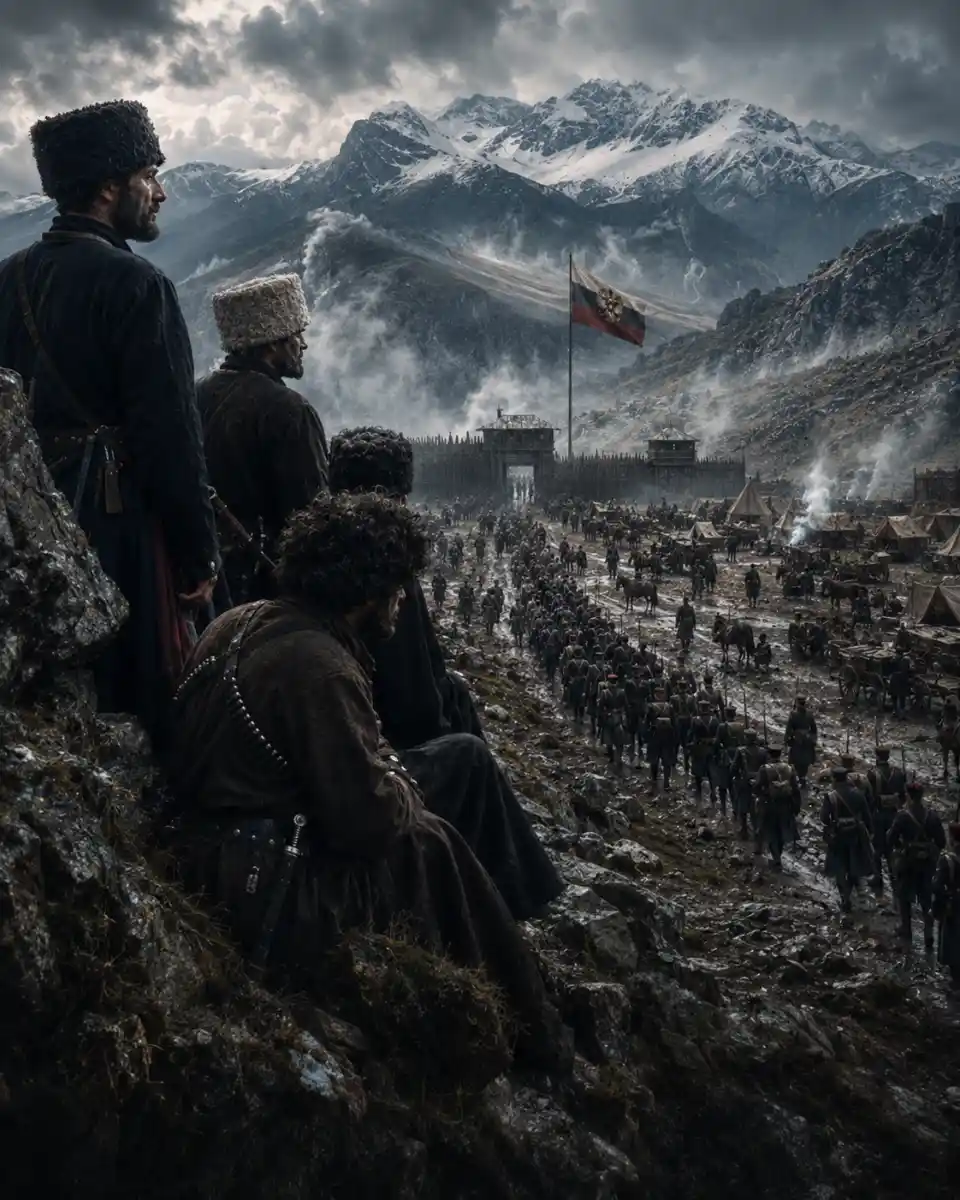
The year 1864 began with Russia having everything ready. The final operations plan had been drawn up in the summer of 1863 and distributed to field commanders. Military divisions were mobilized. Supplies were stockpiled. The Ottoman ships contracted to transport the deportees had begun arriving at the ports.
In January 1864, General Yevdokimov, commander of operations on the right flank, issued the final operations order. The full text is preserved in the Russian Military Archive. His instructions to officers: "No prisoners. No negotiation. No exceptions. Every resident of the coast will be deported by the end of summer. Every village will be burned before its inhabitants leave."
February: The Encirclement Begins
In February 1864, three major Russian divisions began to encircle the remaining Circassian areas:
First Division: From north to south, descending from the foothills toward the coast.
Second Division: From east to west, driving the Abadzakh tribes from their mountain strongholds.
Third Division: From the west, advancing along the coast to cut supply lines.
The tactic was simple and methodical: encircle the valleys, burn the villages, drive the population toward the coast. The burned villages were recorded in daily reports submitted by officers to their command. The numbers piled up: 12 villages one day, 18 the next, 25 the day after.
March: The Khodz Valley Massacre
On March 12, 1864, three Russian battalions surrounded the Khodz Valley. The valley was a gathering point for thousands of Circassian families who had fled their burned villages and taken refuge in this mountain location. Most of them were women, children, the elderly, and the wounded. The number of fighters among them did not exceed a few hundred.
The Russian soldiers entered the valley at dawn. No opportunity to surrender was offered. No civilian was allowed to leave. The forces moved from both sides, closed the encirclement, and then began systematic killing. The operation lasted three days.
The official report of General Geyman, who commanded the operation, mentioned "1,500 dead mountain fighters." Circassian oral testimonies passed down through generations speak of more than 6,000 victims, most of them women and children. Researcher Walter Richmond, who has studied the Russian archive in depth, leans toward the Circassian figure and considers the true number to be close to 7,000.
General Geyman wrote in his report to Yevdokimov a week after the operation: "There is no one left to dispute the land with us." This sentence, in the original document, sums up briefly the philosophy of the entire operations.
April: The Last Hope's Petition
On April 9, 1864, six weeks before the Russian victory celebration, what remained of the Circassian leadership met in a secret place in the mountains and drafted an official petition addressed to Queen Victoria of Britain. The text remains preserved in the British National Archives at Kew.
The petition asks Britain to "mediate to save a people being exterminated on the shores of the Black Sea." It reminds Britain of its role in the Crimean War. It notes that British ships still cross the Black Sea. It requests "any form of humanitarian intervention, even if it does not extend to military intervention."
The petition was sent via Istanbul with the help of a sympathetic Ottoman diplomat. It reached London at the end of May 1864, that is, days after the Russian victory celebration. The British Ambassador in Istanbul, Sir Henry Bulwer, sent a telegram to London on May 25, 1864, describing the situation on the Circassian coast and requesting directives. The directives never came. The British fleet remained far away. The petition was buried in the Foreign Office archive, where it stayed for a century and a half before researchers discovered it.
May: The Days of the Great Genocide
The month of May 1864 is the week the Circassians preserve in their collective memory forever. In this month the major events were concentrated:
May 18: The Fall of the Last Ubykh Stronghold
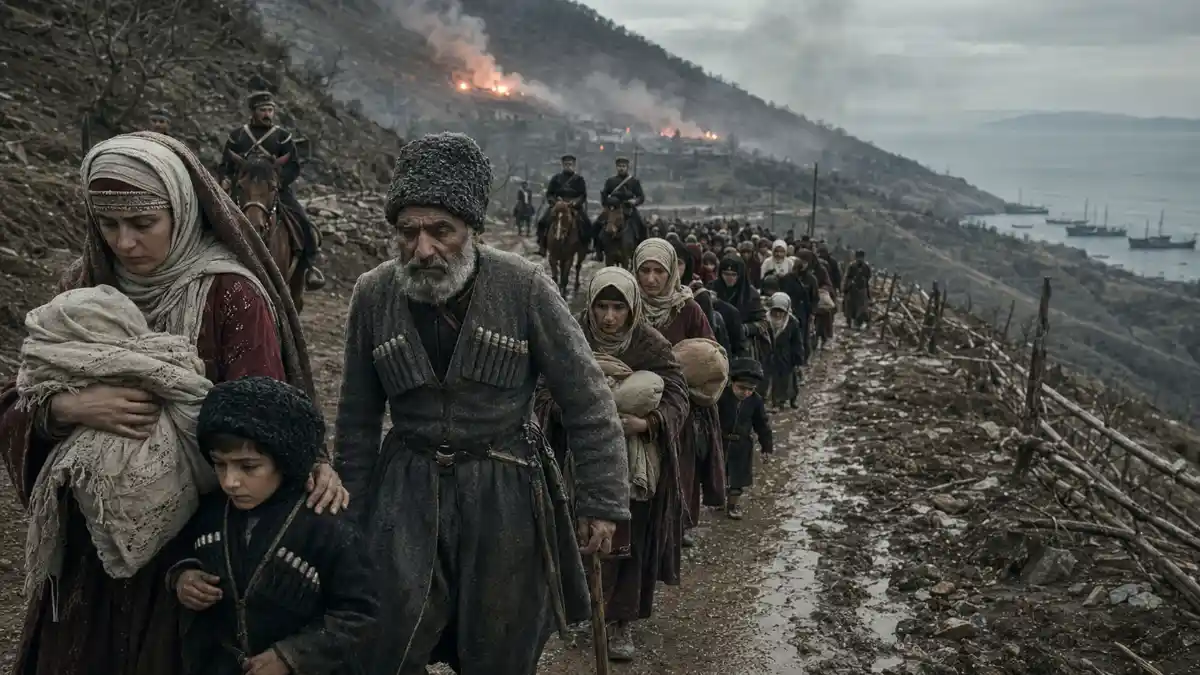
On May 18, the old Sochi fortress fell, the last stronghold of the Ubykh tribe. The defenders resisted for two full days. When the fortress fell, no one from its garrison remained alive. The women and children who had been inside were immediately driven to the shore.
May 21: The Qbaada Valley Celebration
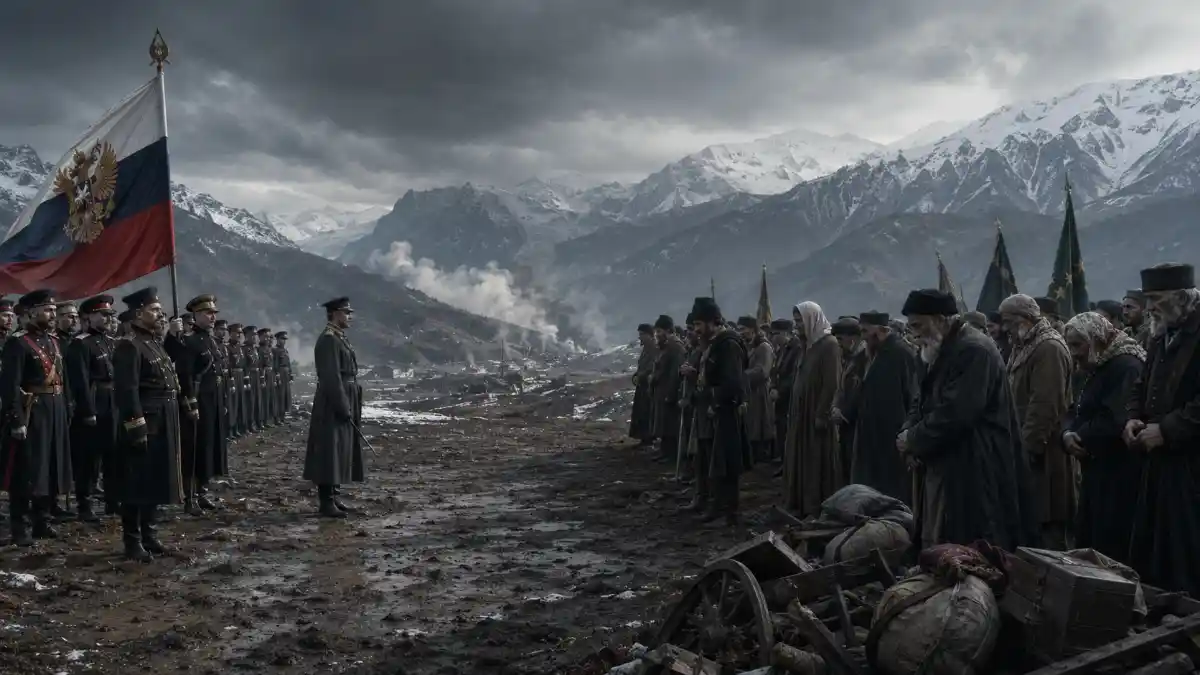
On May 21, 1864, Russian officers gathered in the Qbaada Valley. The army had chosen the location carefully. Qbaada (known today as Krasnaya Polyana, near Sochi) was a historic stronghold of the southern tribes and the center of major Khase (tribal council) meetings. Holding the celebration in this very valley was a symbolic message: an end not only to the war, but to everything the valley had represented in independent Circassian authority.
The celebration was led by Grand Duke Mikhail Nikolayevich, brother of Tsar Alexander II, and Viceroy of the Caucasus. Officers in their formal uniforms, decorated horses, imperial flags. A military parade was held. The Orthodox priest celebrated a thanksgiving mass for the victory. The Grand Duke gave a brief speech thanking the army "that had ended the longest war in the history of the Empire." Toasts were raised to the Tsar's health. Celebratory shots were fired.
An official decree was issued declaring "the end of the Caucasian War" and designating May 21, 1864, the official day of victory.
In the very same hours that the Grand Duke was giving his speech, about 15,000 Circassians of the Ubykh tribe were packed onto the beach at Sochi, only a few kilometers away. There were no ships. They were waiting.
May 21 Evening: The Sochi Beach Massacre
On the evening of May 21, when the ceremony at Qbaada ended, orders reached the local commander at Sochi to "clean up the beach." There were not enough ships to carry the crowds. And senior officers were expected to visit the beach in the following days. The solution: drive the people into the sea.
The Colonel in charge ordered the soldiers to advance on the crowds with bayonets. Those who resisted were killed. Those who fled toward the water drowned. Those who remained were forced into a narrow corner between mountain and beach.
Russian Colonel Ivan Zasumsky, who took part in the operation, wrote a letter to his brother in Moscow two weeks later. The letter is preserved in a family archive found in 1987, with excerpts later published:
"A scene I had not seen the likes of in my military life. The water screams. The beach is silent. Mothers swim with their children on their backs, and then they disappear. Old men sit in the sand and do not move. I wish I could forget what I saw today. But I will not forget."
The number of victims on that one night was never precisely counted. Researchers' estimates range between 3,000 and 8,000.
June: The Ports Fill Up
In June 1864, the seven major ports of the Circassian coast became scenes that defy description. The ports were:
Tuapse: The largest deportation center for the northern Circassians.
Sochi: The deportation center for the Ubykh and southern tribes.
Anapa: An ancient port, used for the deportation of the Natukhay.
Gelendzhik: An additional center for the northern coast.
Novorossiysk: The largest in capacity.
Adler: Near the southern border with the Abkhaz.
Vardane: A small port for the inland tribes.
At each port, tens of thousands of people piled up. No food. No drinking water. No doctors. No shelter. Those who arrived first waited weeks. Those who arrived later found the beaches strewn with the bodies of those who had come before them.
The Ottoman ships came drop by drop. The Sublime Porte had not anticipated this number, and its commercial fleet was of limited capacity. Each ship carried multiples of its capacity: ships designed for 300 people were packed with 1,000 and 1,200.
The London Times correspondent who visited Tuapse in July 1864 wrote:
"Along a two-mile stretch of beach, without interruption, a heaped pile of bodies. Some die slowly, some scream, some no longer scream. Mothers carry children dead for two days. Dogs sniff the bodies. The Russian soldiers stand at a distance in their shining helmets, smoking, waiting."
The Toll of June Alone
Official Russian reports record the deportation of 118,000 Circassians during the month of June 1864 alone. The Ottoman archive records the arrival of about 89,000 on the Anatolian coasts in the same month. The difference (about 29,000) represents mostly those who died on the voyage or on the beaches before boarding.
July: The Peak
The month of July 1864 was the peak of deportation in terms of numbers. The heat was at its worst, the ships in constant motion, the epidemics at their height.
Typhus spread first in Tuapse, then in Sochi, then in every port. Cholera followed. Dysentery was everywhere. No doctors. No medicine. No quarantine. Bodies were left where they fell, sometimes for days, before orders were given to move them to the sea.
In July alone, Russian authorities deported more than 144,000 Circassians by official figures. Independent researchers place the actual figure at 175,000 if those who died on the way to the ports are counted.
Conditions on the Ships
The chartered ships were mostly Ottoman, but some were Greek, Romanian, or from the various Black Sea traders. They were commercial vessels designed to carry goods: wheat, wool, timber, coal. Their holds were dark, cramped, and unventilated. People were crammed into them at numbers three or four times their capacity.
The voyage from Tuapse to Trabzon across the Black Sea normally takes 3 to 5 days in good conditions. In 1864, it took a week or more due to overcrowding and conditions. On every ship, between 5% and 30% of passengers died during the crossing. Bodies were thrown into the sea the moment they died, to prevent the spread of epidemics.
Greek captain Nikolai Stavropoulos, who commanded a ship transporting deportees between Sochi and Trabzon, wrote in his diary, later published:
"We set sail with 820 passengers. We arrived with 611. More than a fifth of the people died at sea. We did not stop to bury anyone. We threw the bodies into the water as if they were spoiled crates. I will not forget the faces of the mothers who watched their children thrown overboard. There was no other choice."
August: The End of Official Deportation
By mid-August 1864, most of the ports had been emptied of the original crowds. The population that had been gathered on the beaches in May and June was either deported, dead, or dispersed in the mountains.
On August 20, 1864, the Russian command announced "the end of the main deportation operations." The official count of the authorities: 418,000 people were deported between 1861 and 1864, most of them in the months of March–August 1864. This figure is preserved in the Russian War Ministry documents.
But the operations did not actually stop. During the following three years (1864–1867), the deportation of small groups continued, of those who had fled to the mountains and returned, or those who had hidden in caves and were later found. And during 1867–1879, an additional number was deported, estimated between 300,000 and 500,000 (according to the Ottoman archive).
The Number of Victims in 1864 Alone
Researchers' estimates of the number of victims in 1864 alone:
American historian Walter Richmond: between 600,000 and 800,000 victims if one counts those killed in battles, in the land deportation, on the beaches, on the ships, and in the first months after arrival.
German historian Karl Friedrich Neumann (writing in 1880): "more than half a million."
Circassian historian Qamti Shawkentiko: 750,000 direct victims.
Official Russian figures: "civilian losses not exceeding 70,000," which exclude those who died on the ships and beaches on the grounds that they "died after leaving imperial territory."
The modern academic consensus: in 1864 alone, between 600,000 and 800,000 Circassians died. This is more than half the population that existed at the start of that year.
Part Three: What Happened After 1864 (1864–1879)
Arrival in Anatolia
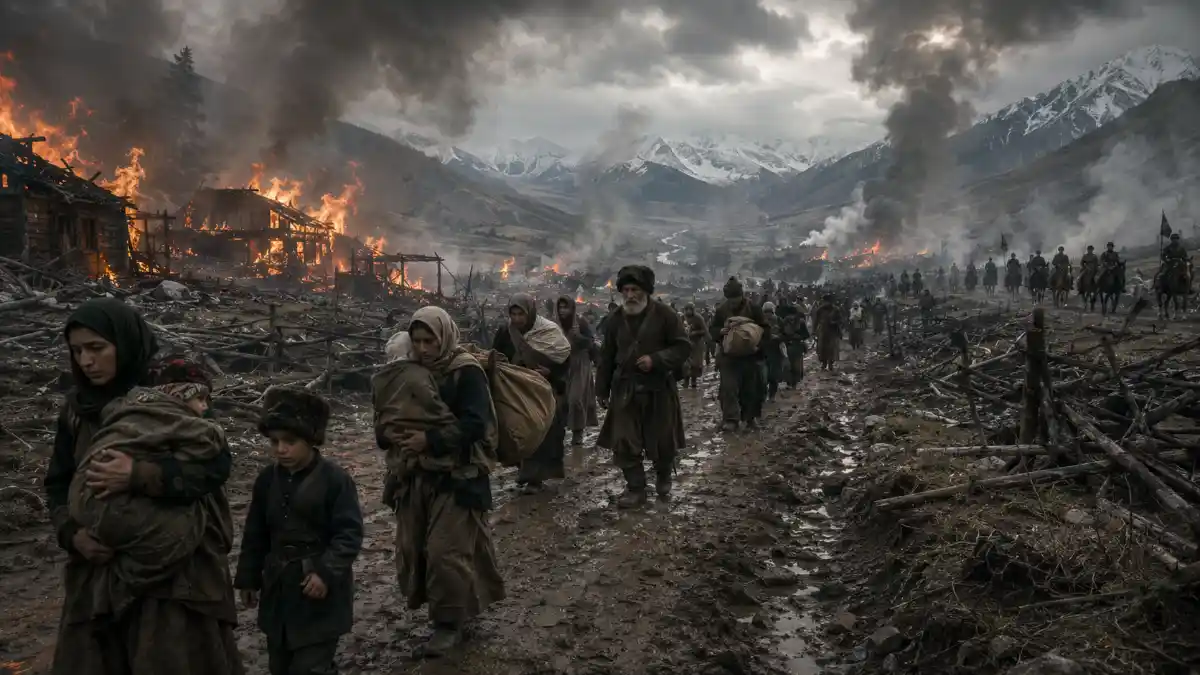
The Ottoman shores at Trabzon, Samsun, Sinop, and Istanbul were not ready for what came to them. The Sublime Porte accepted the deportees ideologically (they were Muslims serving its demographic and military interests), but it was not logistically prepared. The Ottoman ports saw, in 1864 alone, the arrival of about 400,000 refugees, that is, twice the population of Trabzon itself.
Refugee camps stretched along the coast. The typhus and cholera that had struck them on the voyage continued to kill them after their arrival. The Ottoman archive records more than 200,000 deaths in the first six months after arrival, that is, roughly half of those who survived the crossing.
French doctor Émile Pierre, who served with the Ottoman medical mission in Trabzon, wrote in a report to the French Foreign Ministry:
"Every morning I go to the beach and count the new bodies. An average of 200 deaths per day in Trabzon alone. There are not enough burial facilities. The bodies are thrown into mass pits, or some are burned in fire. A scene from hell. I wonder how the world did not intervene."
Distribution Across the Ottoman Empire
The Sublime Porte set up a plan to distribute the survivors across its vast lands. The logic was twofold: to relieve pressure on the coastal regions, and to use the Circassians to settle barren lands or to strengthen the Muslim demographic in areas of conflict.
The geographic distribution, approximately:
Central and Eastern Anatolia: About 45% of the survivors. The Kayseri and Adana areas and the center received the largest concentrations. They founded hundreds of villages that still carry the names of their tribes.
The Levant (Syria, Jordan, Palestine): About 25%. The Sublime Porte distributed them across lands in eastern Jordan, the Hauran, and the Golan to settle them and to confront the rebellious Bedouin tribes.
Iraq: About 5%. Small groups in Mosul and Kirkuk.
The Balkans (Bulgaria, Serbia, Bosnia, Kosovo): About 15%. The Sublime Porte used them as a Muslim demographic force against the rebellious Christian Slavic peoples. This policy would backfire on the Circassians after 1878 (see below).
Egypt: A small percentage (about 3%), joining the old Mamluk community.
Libya and the Maghreb: Very small groups.
Remaining in Western Anatolia and Istanbul: About 7%.
The Founding of Villages
In each settlement area, new Circassian villages were founded. The structure was nearly uniform: families from the same tribe or from neighboring villages in the Caucasus gathered in a single location. The villages were named after their original villages in the Caucasus, or after their tribes.
In Jordan, Amman itself, which had been an abandoned village before 1878, was founded by Circassians of the Shapsugh and Kabardian tribes. So too were Jerash, Zarqa, Russeifa, Suwailih, Wadi al-Seer, and a number of other villages. The Circassian community in Jordan would play a central role in the founding of the modern Jordanian state.
In Syrian Sham, villages were founded in the Golan, the Hauran, Homs, and Hama. Many of them still exist today, although the Syrian war after 2011 dispersed their populations once again.
In Anatolia, more than 1,000 Circassian villages were founded. The Adana and Kayseri regions alone contain more than 300 villages. Many of them carry names such as "Cherkesköy" (Village of the Circassians) or "Adygköy" (Village of the Adyghe).
The Balkan Tragedy 1877–1878
One of the most tragic chapters of the Circassian diaspora is what happened in the Balkans after the Russo-Ottoman War of 1877–1878. The Sublime Porte had settled hundreds of thousands of Circassians in the Balkans (Bulgaria, eastern Serbia, Bosnia, Kosovo) to use them as a Muslim demographic counterweight. When Russia defeated the Ottomans in the 1877–1878 war, the Treaty of San Stefano and then the Berlin Congress of 1878 imposed the evacuation of the Circassians from the Balkans.
These people were forced into a second migration within 14 years of the first. The difference this time was that the evacuation was to the south, to Anatolia and the Levant. About 100,000 additional Circassians died in this second migration, according to the Ottoman archive.
The Circassians who had built villages and fields in the Balkans lost everything once again. They arrived in Anatolia and the Levant exhausted, poor, looking for new land to settle. Many of them settled in Jordan and Syria. Amman itself received two waves of migrants: in 1864 from the Caucasus directly, and in 1878 from the Balkans.
Russian and Cossack Settlement in Circassia
At the same time that the Circassians were dying in the diaspora, their land was being settled by new populations. Between 1864 and 1879, Russia settled the Circassian lands with hundreds of thousands of Cossacks, Russians, Ukrainians, Germans, and Bulgarians.
Documented numbers from the Russian records:
1864–1870: 87,000 new Cossack settlers in Kuban.
1870–1879: 145,000 additional settlers, most of them from southern Ukraine.
1879–1897: Continued settlement until the total of new arrivals on Circassian land reached more than 700,000.
In the 1897 census, Russia counted only 150,000 Circassians still on their ancestral land, compared with more than 1.5 million new settlers. The ratio had completely reversed: from 90%+ Circassians before the war to less than 10% after.
Place Names Are Changed
As part of completing the demographic replacement, most Circassian place names were changed to Russian ones. The villages that remained standing (sometimes rebuilt on top of their ruins) were given Cossack names or named after Russian generals. The rivers, the mountains, the valleys, all were renamed in Russian.
Among the most notable changes:
"Yekaterinodar" (named after Catherine II) replaced the original Circassian village name on the site, then "Krasnodar" in the Soviet era.
"Novorossiysk" (New Russia) replaced the original Circassian "Tsemez."
"Armavir," named after a region in Armenia, was given to give the land a new "colonial" identity.
The name-erasing process was not completed everywhere. Some rivers and valleys kept their original Circassian names, either for their musical beauty or for the difficulty of changing them. But the cities, villages, and new settlements were all given Russian names.
Very Limited Returns
During 1865–1870, some Circassian families attempted to return secretly to their lands. The few who succeeded in reaching them found their villages destroyed and their lands settled by Cossacks. The imperial decision was firm: no return. Those who were caught were either deported again or imprisoned.
In 1867, the Caucasus Bureau issued an official decision prohibiting any Circassian return to the former lands. The decision remained in effect throughout the tsarist period and extended into the Soviet era.
The Toll of the Decade and a Half After 1864
By 1879, 15 years had passed since the genocide. The reckoning was harsh by every measure:
Between 1.2 and 1.5 million Circassians had died (in battle, deportation, ships, or the early months in the diaspora).
700,000 to 900,000 people had been forced into permanent exile.
About 150,000 only remained on their ancestral land, mostly in the eastern region (Kabarda), far from the coast.
More than 1,800 Circassian villages were wiped from existence (Russian records mention 800; independent estimates place the number at 1,800).
The Ubykh language, one of the most complex in the world, lost its connection with the land and was on its way to extinction.
The demographics of the area were completely replaced and became ethnically Russian by more than 90%.
Part Four: The Legacy of 1864 — How the Year Stayed Alive
May 21 as a Day of Remembrance
On every May 21 since the early twentieth century, Circassians around the world gather to commemorate the day of the Qbaada Valley. The date is not random: it is the very same day on which the Russians celebrated their victory. Turning the empire's victory day into a day of mourning for the victims is a form of symbolic resistance.
In Jordan, an annual march is held from a square built in memory of the date. In Turkey, Circassian associations gather in Istanbul, Adana, and Kayseri. In Kabardino-Balkaria and Adygea within Russia, people gather despite official pressures. In Israel, the Circassians of Kfar Kama and Reyhaniyye gather. In Europe and America, the small communities organize events in the capitals of their countries.
The Seven Ports as Sites of Pilgrimage
The seven deportation ports — Tuapse, Sochi, Anapa, Gelendzhik, Novorossiysk, Adler, Vardane — have become symbolic pilgrimage sites for the children of the diaspora. Every year, hundreds of Circassians visit these sites, stand on the beaches their ancestors stood on, look toward the sea that carried them away.
In 2014, when the Sochi Winter Olympics were held, the matter became political. The very location that was the site of a people's massacre became the stage of a global Olympic celebration. The Circassian "No Sochi 2014" campaigns demanded recognition of the historic site before its conversion into a sporting festival. The Olympic Committee did not respond. The games went ahead. But the Circassian question reached a global discussion it had not reached before.
Georgia's Recognition in 2011
On May 20, 2011, on the eve of the 147th anniversary of the Qbaada celebration, the Georgian Parliament voted on a resolution officially recognizing "the Circassian Genocide committed by the Russian Empire against the Circassian people." Georgia was the first state in the world to take this step.
Georgia's motives were multiple. Politically, it was in a sharp dispute with Russia since the 2008 war. And because Russia supported the separation of Abkhazia and South Ossetia from Georgia, Tbilisi saw in recognizing the Circassian Genocide a useful diplomatic blow. But the political motives do not negate the value of the recognition. For the first time, a sovereign state placed its official seal on what the Circassians call their Nakba.
Russia's Continued Denial
Moscow has not backed down. In 2014, before the Sochi Olympics, Russia's ambassador to Turkey, Vladimir Ivenkov, described the events as "a beautiful myth with no basis." Modern Russian school textbooks dedicate no more than a paragraph to 1864 and mention it under the general heading "the joining of the Caucasus to Russia."
In Russian official media, what happened in 1864 is presented either as "voluntary migration" chosen by the Circassians themselves to join their Muslim brothers in the Ottoman Empire, or as "a necessary security measure" against "hostile tribes." Tsar Alexander II's decree, which explicitly orders the "forced expulsion of the mountaineers," is ignored or reinterpreted.
Limited Return in the Twenty-First Century
After the collapse of the Soviet Union, Russia partially opened the door for Circassian return. In 1992, it issued a law allowing those who could prove Circassian descent to obtain Russian citizenship. But the conditions were complex, the land was not returned to its owners, and the return was largely symbolic.
In 2011, when the Syrian war began, Russia received about 1,500 Syrian Circassians as a special humanitarian case. These people returned to the Republic of Kabardino-Balkaria, where they were received by their cousins. But the policy was not generalized. The rest of Syria's Circassians fled to Jordan, Turkey, and Europe.
Today, about 720,000 Circassians live in Russia's three republics (Adygea, Kabardino-Balkaria, Karachay-Cherkessia), while about 4 million live in the diaspora. The ratio is the opposite of what it was before 1864.
Conclusion
The year 1864 was not just a year in the history of a people. It was the year in which the people's very existence on their own land ended. What happened in the six months between March and August of that year is one of the most methodical and efficient operations in the history of genocide: a people of a few million lost three-quarters of its number, the rest were forced into permanent migration, and the demographics of an entire country were replaced within years.
What distinguishes the Circassian 1864 from other genocides is not only the scale and the methodology, but also its subsequent absence from world memory. The Armenians have a state that demands recognition. The Jews have states and research and museums. The Rohingya have daily media coverage. The Circassians have five million people scattered across fifty countries, an oral memory, and a handful of academic books that have started to appear only in the twenty-first century.
But memory has not died. On every May 21, when Circassians stand in Amman, Istanbul, Kfar Kama, Amsterdam, and New Jersey and look toward the Black Sea, they are reconnecting a circle that was broken in that year. A single year changed everything. But 162 years after it, the story is not over.
Voices on 1864
Walter Richmond
"1864 is not a year in Circassian history. It is the year. Everything before it was prelude, and everything after it was diaspora. Reducing 101 years of war to a single event may be a reduction, but it is accurate in meaning."
The Circassian Genocide, Rutgers University Press, 2013
Charles King
"When the researcher looks into the Russian archive for 1864, one thing astonishes him: efficiency. It was not a random extermination operation, but an operation planned with academic military precision. Everything was documented: the numbers of deportees, the number of villages burned, the distribution of new settlers. As though it were an engineering project."
The Ghost of Freedom, Oxford University Press, 2008
Ivan Drozdov (Russian General, 1864)
"The sight of the march I have not forgotten in my entire life. Along the road we saw the bodies of children and old men. We carried orders, and we carried them out, but I would not carry them out if I saw that scene again."
Drozdov's memoirs, published posthumously
Ivan Zasumsky (Russian Colonel, evening of May 21, 1864)
"A scene I had not seen the likes of. The water screams. The beach is silent. I wish I could forget."
Family letter, discovered 1987
Frequently Asked Questions about the Events of 1864
Why specifically the year 1864?
The year 1864 was the climax and conclusion of a long process. Imam Shamil's surrender in 1859 freed the Russian army to focus on the Circassian front. Milyutin's appointment as Minister of War in 1861 and the Tsar's decree in June of the same year set up the plan. The two years 1862 and 1863 saw the implementation of the early stages. And in 1864, the final implementation was concentrated into a short period (March–August) that ended everything.
What exactly was the celebration of May 21, 1864?
It was an official military celebration in the Qbaada Valley (modern Krasnaya Polyana near Sochi) chaired by Grand Duke Mikhail Nikolayevich, brother of the Tsar. Officers of the Russian Caucasian Army participated, speeches were given, a thanksgiving mass was held for the victory, and an official decree was issued declaring "the end of the Caucasian War." The site was chosen because it was a historic stronghold of the Circassian tribes and a center of Khase (tribal council) meetings.
How many died in 1864 alone?
Estimates range between 600,000 and 800,000 victims in that single year, according to academic consensus. This includes those killed in the final battles, during the march from villages to ports, on the beaches awaiting ships, on the overcrowded ships during the crossing, and in the first months after arrival on Ottoman coasts.
How many were deported?
Official Russian figures cite 418,000 people deported between 1861 and 1864. Ottoman figures cite the arrival of about 400,000 on the coasts in 1864 alone, then about double this number during the 1864–1879 period. Independent researchers estimate that the total number of those forcibly deported (not those who migrated voluntarily) is between 700,000 and 900,000.
Which ports did the Circassians embark from?
Seven major ports: Tuapse, Sochi, Anapa, Gelendzhik, Novorossiysk, Adler, Vardane. All of these ports are on the eastern coast of the Black Sea, in what is now Krasnodar Krai. Sochi and Tuapse were the most used.
What were the ships that transported the deportees?
Commercial vessels chartered from the Ottoman Sublime Porte, and from Greek and Romanian maritime traders. Ships designed for carrying grain and wool, into which people were packed at numbers many times their capacity. A ship of 300-person capacity carried 1,000 to 1,200. There was no clean water, food, ventilation, or medical care.
What was the death rate on the ships themselves?
Researchers' estimates and contemporary testimonies agree that the death rate on each ship was between 5% and 30%. Greek captain Nikolai Stavropoulos wrote in his diary that his ship set sail with 820 passengers and arrived with 611, a 25% loss. Bodies were thrown directly into the sea to prevent the spread of epidemics.
Who was militarily responsible for the genocide?
The main responsible parties were:
Tsar Alexander II: The political decision-maker, signatory of the decree of June 25, 1861.
Grand Duke Mikhail Nikolayevich: Viceroy of the Caucasus and chair of the victory celebration.
Dmitry Milyutin: Minister of War and architect of the three-pronged strategy.
Nikolai Yevdokimov: Field commander of operations on the right flank, directly responsible for the deportation orders.
Ivan Geyman: Commander of operations in the south, responsible for the Khodz Valley massacre.
None of them was put on trial. They all died decorated and honored with titles and estates.
Where did the survivors go?
Central and Eastern Anatolia (45%), the Levant including Jordan, Syria, and Palestine (25%), the Balkans (15%), Iraq (5%), Egypt (3%), Western Anatolia and Istanbul (7%). The Balkan Circassians were subjected to a second migration after the 1877–1878 war and most of them were moved to Anatolia and the Levant.
Has any state recognized the 1864 events as a genocide?
Yes: Georgia alone (May 20, 2011) officially as a state. Inside Russia, the Kabardino-Balkaria parliament issued a resolution in 1992 and the Adygea parliament issued a resolution in 1996. The Russian Federation denies it. The major Western states (USA, UK, France, Germany) have not recognized it. Circassian associations regularly submit recognition petitions to European and American parliaments, but they have not succeeded so far.
Do the Circassians today have the documents of the genocide?
Yes, and many of them. The Tsar's decree is preserved in the Russian Imperial Archive. The records of the General Staff of the Caucasian Army are preserved in Moscow. The Ottoman archive (in the Ottoman Prime Ministry in Istanbul) contains thousands of documents on the arrival of the refugees. The Circassian petition to Queen Victoria is preserved in the British National Archives at Kew. The testimonies of the Russian generals themselves (Drozdov, Velyaminov, Yermolov) are in published memoirs. The evidence is complete. What is missing is the political will to acknowledge.
Who was Hadji Qirandqu Berzeg?
President of the first and last central Circassian government, formed in the Sochipe Council in June 1861. He was among those who tried to unify the tribes in the face of the Russian invasion. When Circassia collapsed, he migrated with the survivors to the Ottoman Empire and died there around 1872. His official seal (the seal of the Circassian government) is preserved in a historical museum in Turkey.
What was the Khodz Valley massacre?
A Russian military operation in March 1864 against thousands of Circassian families gathered in the Khodz Valley after fleeing from burned villages. Three Russian battalions surrounded the valley and killed most of those in it. General Geyman's official report mentioned 1,500 dead. Circassian testimonies speak of 6,000 to 7,000. Most of the victims were women, children, and the elderly.
What was the Sochi beach massacre?
An operation on the evening of May 21, 1864, the very day on which the Russians celebrated their victory in the Qbaada Valley. Russian soldiers were ordered to "clean up" Sochi beach of about 15,000 Ubykh Circassians who were gathered there awaiting ships that did not arrive in sufficient numbers. People were driven into the sea with bayonets. Those who resisted were killed, and those who entered the water drowned. Estimates of the victims range between 3,000 and 8,000 on that single night.
Who were the Ubykh and why did they disappear completely?
A southern coastal Circassian tribe that inhabited the area around present-day Sochi. Their number before 1864 was between 60,000 and 80,000. Russia chose to deport them entirely without exception. About half died in the deportation, and the rest reached Anatolia. Their Ubykh language (84 consonant sounds) was one of the most complex in the world. It became extinct with the death of the last native speaker, Tevfik Esenç, in Turkey in 1992.
Did any Circassian return to his homeland after 1864?
Individual attempts occurred between 1865 and 1870, but the Russian authorities issued an official decision in 1867 prohibiting return. The few who arrived found their villages destroyed and their lands held by the Cossack settlers. After the collapse of the Soviet Union, the door was opened symbolically for return (the citizenship law of 1992), but the conditions are complex and the land was not returned. Between 2011 and 2015, about 1,500 of Syria's Circassians returned as a special humanitarian case.
What is the effect of the genocide on Circassian culture today?
Enormous. More than 80% of Circassians today live outside their original homeland. The Circassian language is endangered (UNESCO classifies it as "endangered"). Many of the 12 tribes have lost their sub-language or are about to. The Khabze code is still preserved but is changing rapidly in the diaspora. The Abkhaz and Ubykh have almost disappeared as independent linguistic identities. But memory remains alive, and May 21 each year preserves it.
How many Circassians remain on their ancestral land today?
About 720,000 Circassians live in three republics inside Russia: Adygea (Western Kabarda), Kabardino-Balkaria, and Karachay-Cherkessia. These are the descendants of those who remained and were not deported (mostly Eastern Kabardians who were farther from the direct deportation line). They are minorities in their republics; ethnic Russians are the majority. Circassian is taught officially in the schools, but it is in retreat against Russian in daily use.
Appendix: Month-by-Month Timeline of 1864
Date Event January 1864 Yevdokimov issues the final operations order February 1864 Three Russian divisions begin to encircle the remaining Circassian areas March 12, 1864 Khodz Valley massacre (1,500–7,000 killed) March 1864 The last Abadzakh strongholds in the southern mountains fall April 9, 1864 The Circassian leaders' petition to Queen Victoria May 18, 1864 The last Ubykh stronghold falls (the old Sochi fortress) May 21, 1864 morning The Russian victory celebration in the Qbaada Valley May 21, 1864 evening The Sochi beach massacre (3,000–8,000 killed) May 25, 1864 British Ambassador Bulwer's telegram from Istanbul about the situation June 1864 118,000 Circassians deported officially (in one month) July 1864 Peak of deportation: 144,000 people, spread of typhus and cholera August 20, 1864 Russia announces the end of main deportation operations End of 1864 Ottoman archive records arrival of more than 400,000 refugees
Appendix: The Seven Deportation Ports
Port Circassian Name Tribes Deported From It Tuapse Tuapse Shapsugh, Natukhay Sochi Sshache Ubykh, Zhaney Anapa Anapa Natukhay, Northern Shapsugh Gelendzhik Khulizhi Natukhay Novorossiysk Tsemez All tribes (largest capacity) Adler Mzymta Zhaney, Southern Ubykh Vardane Bardane Inland mountain tribes
Sources and References
Academic Books on 1864 in Particular
Richmond, Walter. The Circassian Genocide. Rutgers University Press, 2013. (The first reference book, chapters 5–7 dedicated to 1864.)
Richmond, Walter. The Northwest Caucasus: Past, Present, Future. Routledge, 2008.
King, Charles. The Ghost of Freedom: A History of the Caucasus. Oxford University Press, 2008. (Chapter 7 on the years 1859–1864.)
King, Charles. The Black Sea: A History. Oxford University Press, 2004.
Henze, Paul B. The North Caucasus Barrier: The Russian Advance Toward the Muslim World. Hurst, 1992.
Shenfield, Stephen D. "The Circassians: A Forgotten Genocide?" in The Massacre in History, ed. Mark Levene. Berghahn Books, 1999.
Essential Archival Documents for 1864
Alexander II. Imperial Rescript on Settlement of the North Caucasus, June 25, 1861. (Russian Imperial Archive, Saint Petersburg.)
Bulwer, Henry. British Ambassador's dispatch from Istanbul, May 25, 1864. (British National Archives, Kew.)
Petition of the Circassian Leaders to Queen Victoria, April 9, 1864. (British National Archives.)
Ottoman Imperial Archives, migration records 1864–1879. (Ottoman Prime Ministry Archive, Istanbul.)
General Staff records of the Caucasian Army, 1860–1864. (Russian Military Historical Archive, Moscow.)
Drozdov, Ivan. Воспоминания о Кавказе (Memoirs of the Caucasus). Moscow, published 1877.
Contemporary Testimonies (1864)
Neumann, Karl Friedrich. Russland und die Tscherkessen. Stuttgart, 1880.
The Times of London — reports from Tuapse and Sochi, summer 1864.
Bell, James Stanislaus. Journal of a Residence in Circassia. London, 1840 (background before 1864).
Recent Research and Articles
Richmond, Walter. "The Circassian Genocide: A Crime Against Humanity Demanding Recognition", Journal of Genocide Research, 2008.
Geçal, Lara. "The Forgotten Genocide: The Circassian Diaspora and the Politics of Memory", Patterns of Prejudice, 2014.
Visual Sources
Circassian Genocide: How Russia Conquered the Caucasus. Kings & Generals, 2023.
Arabic-Language Sources
Jaimoukha, Amjad. The Circassians: A Comprehensive Guide. Arabic translation, Amman, 2010.
Barber, Mohamed Awad. The Circassians in Jordan. Amman, 1995.
1864 is not a date that ended. It is a memory that still pulses through five million Circassians around the world. CircassianWeb exists to help you reconnect with what crossed the Black Sea: your family tree, your tribal roots, your genetic heritage, and your identity.