שבט ה-Yegeruqway: האומנים החקלאים של צ'רקסיה

The Yegeruqway: Tribe of the Fertile Valleys
Some peoples are remembered for the kings they crowned. Others are remembered for the cities they built, the armies they raised, the books they wrote. The Yegeruqway were not remembered for any of those things, and yet they were remembered. They were remembered for orchards. They were remembered for fields that gave back what was planted in them, and a little more besides. They were remembered for a way of working that drew neighbors out of their houses on the same morning, with the same shared purpose, to help each other gather in a crop before the weather turned. They were remembered for the sound of laughter coming up through walnut groves at the end of a long day, and for the long communal meals that followed, and for songs that praised not battles or princes but the patience of the seasons and the steady honesty of the soil.
This is the story of the Yegeruqway, one of the twelve recognized Circassian tribes, a people whose contributions to Adyghe culture far outweighed their numbers, and whose particular gift to the wider Circassian world was a way of living with land. It is also the story, like every Circassian story, of a homeland left behind, a journey across the Black Sea, a diaspora settled in valleys that were similar enough to the old country to be worked but not similar enough to feel like home. It is a story that begins in the lowlands of the western Caucasus and continues in the fertile basins of Anatolia and the Jordan River, in farmhouses where the rhythm of the agricultural year still resembles, in faint outline, the rhythm of the year their ancestors knew.
The Yegeruqway have not been written about as much as some of their larger Circassian cousins. There is a reason for that. They were a smaller tribe, and smaller tribes leave smaller paper trails. But the absence of newspaper headlines and great political dramas does not mean an absence of history. It often means a more particular and more textured kind of history, lived close to the ground, lived in the slow turning of plowed earth and the patient grafting of fruit trees and the elaborate hospitality offered to anyone who arrived at the gate. That is the kind of history the Yegeruqway carried.
Who the Yegeruqway Were
In the standard reckoning of the twelve Circassian tribes, the Yegeruqway (Адыгэ: Еджэркъуай, sometimes transliterated as Yejerquay, Yegerukay, Egerukay, or in Turkish form Cerketuay) hold a particular place. They belonged to what scholars often describe as the western or Kyakh group of the Adyghe peoples, the broad family of tribes that spoke and continues to speak the Adyghe (West Circassian) language. They were neighbors and cousins to the Bzhedug, the Temirgoy (Kemirgoy), the Hatuqway, and the Mamkhegh. They participated in the same confederation, followed the same body of customary law (Adyghe Khabze), wore the same general style of dress, danced the same dances, sang in the same musical idioms, and saw themselves as part of a single people called the Adyghe.
What set them apart, in the eyes of their neighbors, was a combination of three things. First, their political organization. The Yegeruqway were one of the so-called democratic or "free" tribes, organized under a system the Adyghe called tfekho. There were no hereditary princes (pshi) ruling over them. There were respected nobles (work) and notable elders, but political authority rested in elected councils that decided collective matters by consensus. Second, their geography. The Yegeruqway lived in a particularly fertile pocket of the western Caucasus, in lowlands and gentle foothills with rich alluvial soil, and this shaped almost everything about their daily lives. Third, their reputation. They were known across Circassia for the quality of their farming, their orchards, and their livestock. When traveling Adyghe wanted to compare a hardworking farmer to the best of his profession, they sometimes said, in effect, that the man worked like a Yegeruqway.
These three threads were not separate. They were braided together. The Yegeruqway were able to commit themselves to careful long-term cultivation precisely because their political system did not extract heavy tribute from them. They were able to invest themselves in their land because their land rewarded the investment. And they were able to develop a reputation for agricultural skill because both the political and the geographic conditions allowed it. Take away any one of these threads and you do not get the Yegeruqway as their neighbors knew them.
It is worth pausing on that word "democratic," because it is easy to misread in a modern context. The Yegeruqway were not running elections in the way a contemporary republic does. There were no political parties, no secret ballots, no constitutions. What there was, instead, was a tradition in which adult free men gathered, talked, listened to elders, weighed opposing arguments, and arrived at collective decisions through a long process of deliberation. Important decisions might require unanimity, or near unanimity. Smaller matters might be resolved more quickly, with a few respected speakers carrying the day. It was a form of self-government that depended heavily on shared norms, on the ability of community members to read each other accurately, and on a deep respect for the elders who carried the institutional memory of the group. It worked because the community was small enough for everyone to know everyone, and because the body of customary law gave a shared framework within which to argue.
The Yegeruqway were small even by Circassian standards. Estimates of their population in the early nineteenth century vary, but a figure of perhaps ten to twenty thousand people in the decades before the great deportation is a reasonable range. They lived in clusters of villages, each village made up of extended households connected by kinship, with surrounding fields, gardens, and woodland that the village worked together. Their territory was not vast. You could ride across the central Yegeruqway lands in a day. But every part of those lands had been shaped by generations of careful agricultural attention.
The Land They Worked
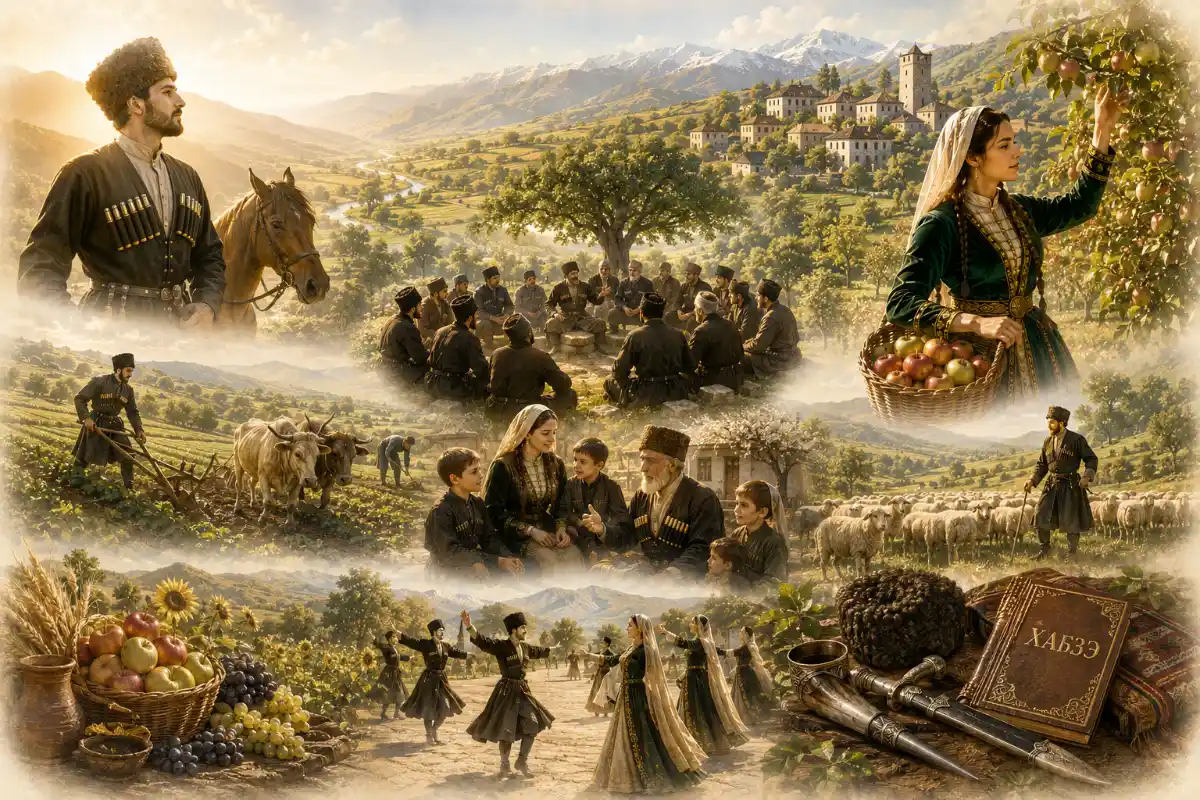
The Yegeruqway homeland sat in the lowlands and lower foothills of the northwestern Caucasus, in what is today the Republic of Adygea (Адыгея) within the Russian Federation, with some adjacent territory in the Krasnodar Krai. To the south and east the Greater Caucasus mountains rose toward snow-capped ridges. To the north stretched the broad steppe that eventually opens onto the Russian plain. The Yegeruqway lived in the middle band, where the soil is deep and the rainfall regular and the climate kinder than either the high mountains or the open steppe.
This middle band is one of the most agriculturally rich parts of the entire Caucasus. The major rivers of the region, including the Laba and its tributaries, the Belaya, the Kuban downstream, and a network of smaller streams, carry sediment down from the mountains and deposit it across the lowland valleys. Over thousands of years, that sediment built up into thick layers of fertile loam that holds water well, releases nutrients steadily, and rewards almost any kind of attentive cultivation. Wheat grew here. Maize, once introduced in the post-Columbian period, grew very well. Millet, sorghum, barley, oats, all flourished. The orchards of apples, pears, plums, cherries, and quinces gave good fruit. The grapevines, in some valleys, gave reliable wine.
Beyond the row crops and orchards, there were forests on the slopes that gave timber, game, nuts (especially walnut and hazelnut, both abundant in the western Caucasus), wild fruit, mushrooms, and the famous Caucasian honey gathered by both wild bees and managed hives. The Yegeruqway, like other Circassian peoples, made considerable use of the forest. They were not only farmers but also foresters in a practical sense, taking from the woods what could be taken and leaving the woods themselves intact. They knew which trees gave the best charcoal, which gave the best handles for tools, which gave the best wood for the long-burning fires that warmed their homes through winter nights.
The climate was favorable. Summers were warm but rarely scorching. Winters were cold enough to allow the land to rest, with snowfall that fed the streams in spring. Frost dates were predictable. Rainfall was distributed across the year in a pattern that suited grain cultivation. Yegeruqway farmers, like good farmers anywhere, kept the rhythms of their year tightly synchronized with the local weather. They knew when to plow, when to sow, when to weed, when to harvest, when to thresh, when to dry, when to store. The knowledge was practical and detailed and passed from father to son, mother to daughter, neighbor to neighbor, by direct observation and by a thousand small corrections offered in the field.
The land was held in a pattern that combined household ownership with strong communal use rights. Each family had its own house and house compound, and certain fields and orchards that belonged to that household and were worked by it. But there were also commons. Pastures used by the village were managed collectively. Forests were communal resources. The rivers were everyone's. Boundary stones marked where one family's land ended and another's began, but the boundaries were softened by a constant flow of small loans, exchanges, and shared labor that made strict ownership less rigid than it might appear on a map.
In the spring, the Yegeruqway lowlands turned green almost overnight. The willows along the riverbanks leafed out. The fruit trees blossomed. The fields were plowed and sown with the spring crops. By midsummer the wheat stood waist-high and the orchards were heavy with fruit. By autumn the storerooms filled with apples and pears and walnuts and dried plums and jars of preserved honey and rounds of cheese and casks of cured meat. By winter the fires were lit early and the long stories began, told over evening meals, while the snow piled up outside and the wind moved through the bare branches.
That was Yegeruqway country. That was the land they would have to leave.
The Tfekho System
The political structure of the Yegeruqway deserves its own treatment, because it is one of the most distinctive features of how this tribe lived and how it differed from some of its neighbors.
The wider Circassian world was divided, broadly, between aristocratic tribes and democratic tribes. The aristocratic tribes, like the Kabardians, the Bzhedug, the Beslenei, and the Temirgoy, were organized around hereditary princely houses. A prince (pshi) and his noble retainers held considerable power, including the right to collect tribute, the right to call the men of the tribe to military service, the right to settle disputes at a high level, and the right to negotiate with outside powers. Beneath the princely class were lesser nobles, free commoners, and various dependent classes including serfs and a small number of slaves. The system was hierarchical and the hierarchy was very visible in daily life.
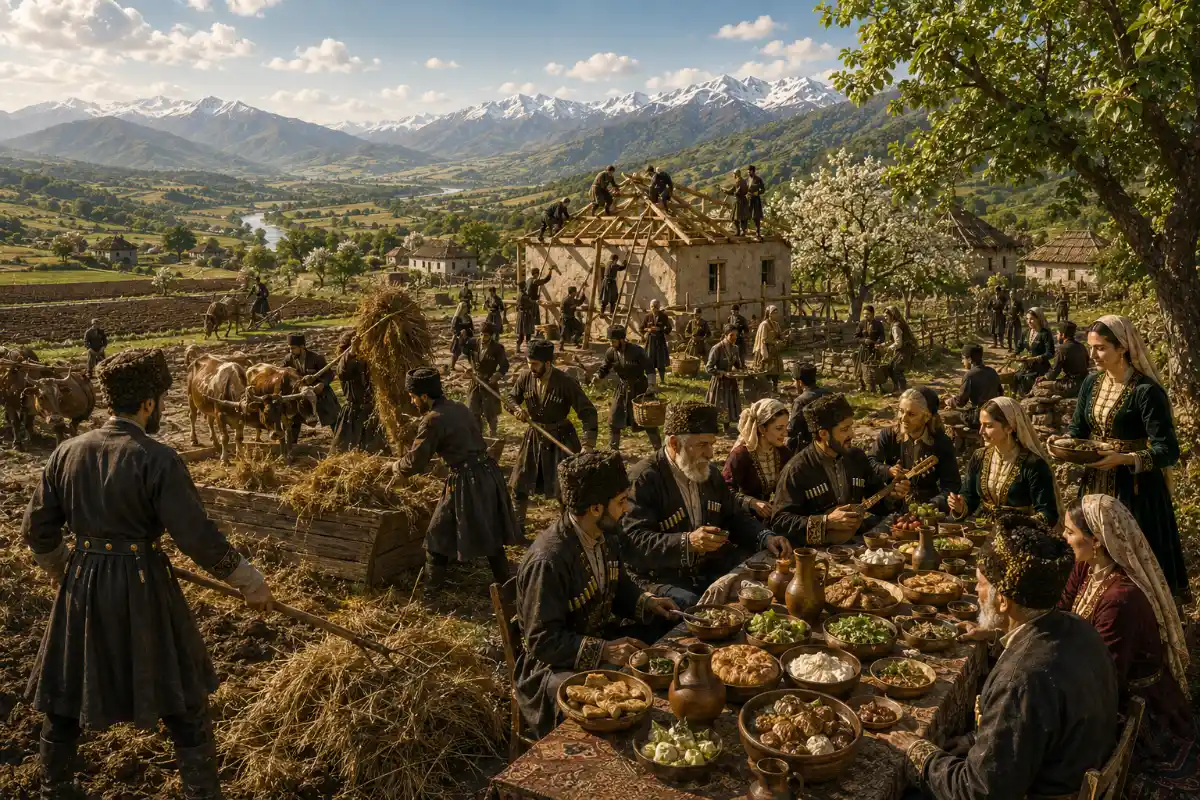
The democratic tribes, by contrast, including the Yegeruqway along with the Shapsug, the Abzakh, the Natukhai, the Hatuqway, and the Mamkhegh, had thrown off or never accepted princely rule. In some cases, oral tradition spoke of historical moments when ordinary commoners had risen against the princes and either driven them out or forced them into a much reduced role. By the early nineteenth century, the democratic tribes had no princes ruling them at all. Decisions were made through assemblies of free men called khasa.
A khasa might be local, made up of the men of a single village or cluster of villages, or it might be larger, drawing in representatives from across the tribe for major decisions. The khasa met outdoors when weather permitted, often in a particular grove or meadow set aside for the purpose. Discussions could go on for hours or days. Older men spoke first, by custom, but anyone who had earned the right to speak through past service or recognized wisdom could rise and offer his views. Decisions were not voted on in the modern sense. They were arrived at through a long process of speech and consultation until a consensus emerged, or, when no consensus was possible, the matter was tabled.
The tfekho system, as practiced by the Yegeruqway, had several characteristic features. It placed strong weight on the authority of elders. It recognized the existence of nobles (work) and gave them a certain respect, but it did not allow them to extract tribute or impose their will on the assembly. It treated free commoners as full participants in the political life of the community, with the right to speak, the right to be heard, and the right to dissent. It used customary law as the basic framework for resolving disputes, and it relied on the testimony of witnesses and the wisdom of experienced mediators rather than written codes or formal courts.
There were certain offices, though they were not titles in any modern bureaucratic sense. The thamada was the chief speaker or master of ceremonies at gatherings, the one who knew when to call a discussion to order, when to invite the next speaker, when to declare that a decision had been reached. Respected elders served as judges in disputes, often gathering small groups of mediators to investigate and propose settlements. War leaders were chosen on the basis of demonstrated skill and were obeyed during campaigns but did not retain authority once the campaign was over.
This kind of political organization placed a heavy burden on the social fabric. It required people to be able to talk to each other across kinship lines. It required them to accept the outcome of long deliberations even when those outcomes did not exactly match their preferences. It required a deep familiarity with the customary law that governed almost every situation that might arise. Among the Yegeruqway, this fabric was strong enough that the tfekho system functioned for many generations. The tribe was small enough and tightly knit enough that the assemblies actually worked.
This is not to romanticize the system. There were disputes that festered. There were quarrels between leading families. There were occasions when one faction's view prevailed over another's through sheer persistence or louder voices. There were inequalities of wealth and influence that affected who got listened to. But within those limits, the Yegeruqway managed something that not many premodern peoples managed at all: a stable, self-governing community life without hereditary rulers, sustained across many generations.
A People Who Knew the Soil
What did Yegeruqway farmers actually do that made them so respected by their neighbors? The answer has several parts.
They knew their soils. Caucasian valley soils vary widely over short distances. A field on a slight rise might drain well and warm up early in spring, while a field a hundred meters away in a slight depression might hold water and stay cold into late spring. The Yegeruqway farmer knew his land plot by plot, and matched crops to soils with a precision that came from generations of observation. He knew which corner of which field would give the best wheat, which gave the best beans, which was suitable only for pasture, which had to be left fallow longer than the others.
They knew their seasons. The agricultural year in the western Caucasus is divided into distinct phases, each with its own demands. Plowing was done in autumn for winter wheat, again in early spring for spring crops. Sowing followed plowing within a window of days that depended on soil temperature and rainfall. Weeding had to begin almost as soon as the seedlings were up, and continue regularly until the crop was tall enough to shade out competitors. Harvest came in a rush, sometimes with whole villages in the fields at once, and threshing followed almost immediately so that the grain would not be lost to weather or pests.
They knew their orchards. Circassian orchards were not haphazard collections of fruit trees. They were carefully managed groves, with trees of different ages and varieties planted in rough rows, pruned annually, grafted to combine the best qualities of different stocks, and cared for through the year with attention to every stage of the growth cycle. Apples, pears, plums, cherries, apricots, peaches in some warmer pockets, quinces, mulberries, figs in protected areas, all had their place. The Yegeruqway were noted for the variety of their orchards and for the practice of grafting, which allowed them to maintain prized fruit varieties across generations.
They knew their animals. Yegeruqway households kept cattle for milk, meat, leather, and traction. They kept sheep for wool, milk, and meat. They kept goats for milk and brush control. They kept horses for transportation, war, and prestige. They kept chickens, ducks, geese, and sometimes turkeys. They kept bees in carefully constructed hives. The management of these animals was a year-round activity, with rhythms of breeding, calving, lambing, weaning, milking, sheering, slaughter, curing, and tanning that demanded steady attention.
They knew their tools. Circassian farming tools were simple but effective. Wooden plows with iron tips were drawn by oxen. Sickles and scythes brought in the hay and grain. Wooden flails threshed the grain on hard-packed threshing floors. Sieves and winnowing baskets separated the grain from the chaff. Quern stones ground the grain into flour. Pruning hooks shaped the orchard trees. Each tool had a name, a maintenance cycle, and a proper way of being used and stored.
They knew the value of careful storage. Caucasian winters are not as harsh as some, but they are long enough to require substantial food reserves. Yegeruqway households built granaries, smokehouses, root cellars, and storage pits with care. They preserved fruits by drying, by storing in straw, by pickling, by cooking down into thick fruit cheeses. They preserved meat by salting, smoking, and drying. They preserved dairy by aging into hard cheeses, by churning into butter that was then clarified and stored, by fermenting into yogurts. By the time the snows came, a well-run Yegeruqway household had food enough for the family, the household guests who would surely come through the winter, and the animals.
They knew the importance of seeds. Saving seed from the best plants of each harvest was a careful practice. Seeds were stored in ways that protected them from moisture and pests. Varieties were maintained for their particular qualities. Trading seeds with neighboring villages and with travelers brought in new strains and helped maintain genetic diversity. The Yegeruqway, like all good traditional farmers, understood that next year's harvest was prepared for in this year's seed selection.
All of this knowledge was not abstract. It lived in the bodies and habits of the people who carried it. A Yegeruqway boy learned to read the sky for weather signs by walking the fields with his father from the time he could walk. He learned to handle a horse by being put on one before he was tall enough to mount unaided. He learned to use a scythe by being given a small one as a child and gradually graduating to a man-sized blade. A Yegeruqway girl learned to manage poultry, dairy, garden, kitchen, and household stores by the same kind of long apprenticeship at her mother's and grandmother's sides. By the time these children reached adulthood, they carried in their bodies a complete agricultural education that no modern textbook could fully reproduce.
The Shihaf: Working Together
One of the most distinctive features of Yegeruqway agricultural life, and of Circassian life more broadly, was the institution of communal labor called shihaf (шIыхьаф). This was the practice of neighbors gathering to help each other with major seasonal tasks, especially planting, harvesting, threshing, and the construction of new buildings.
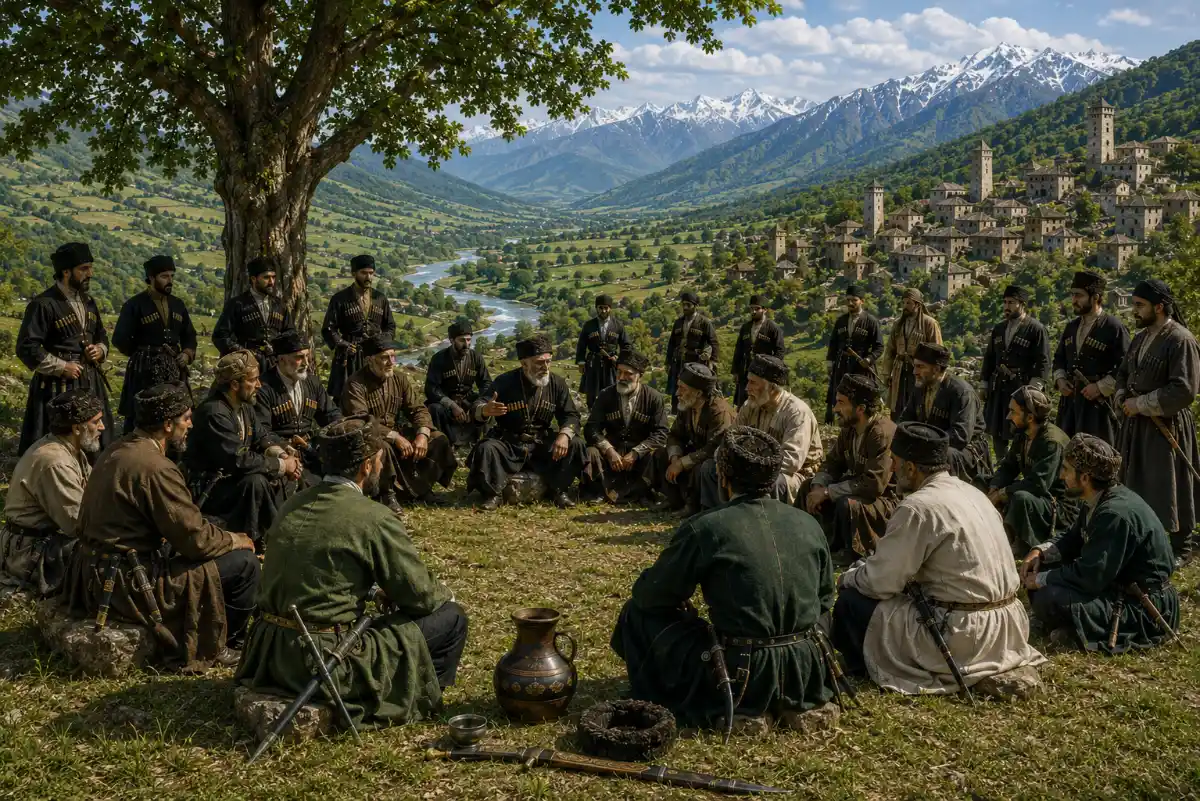
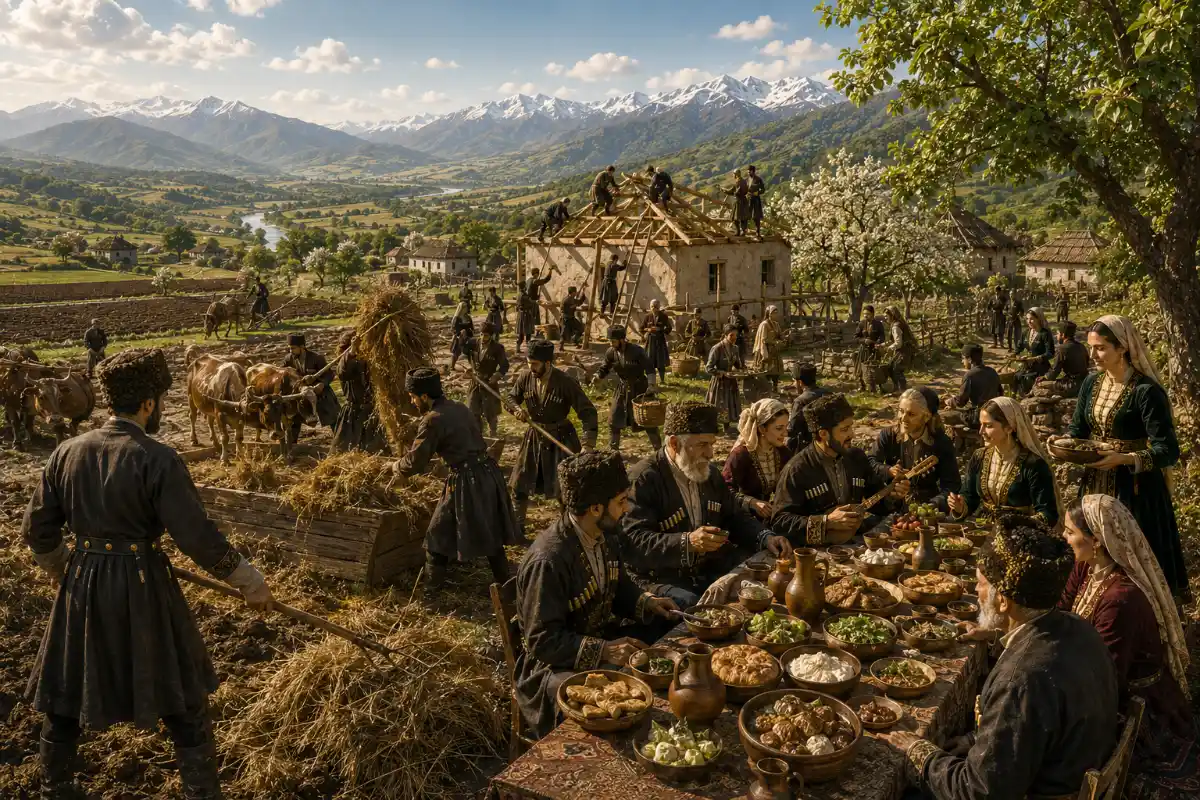
The shihaf worked like this. A household that faced a large task, more than its own members could manage in the available time, would put out word in the village that help was needed on a particular day. Neighbors, kin, and friends would arrive in the morning, often bringing their own tools, sometimes bringing their own animals. The host household would feed them, give them direction, and provide whatever materials were needed. The work would begin, and would be done as a collective effort with everyone working in coordination. By the end of the day, the task would be substantially advanced, often completed.
In return, the host household took on the obligation to help any of those who had come, in their turn, when those families had their own large tasks. There was no formal accounting. No one wrote down debts and credits. The system worked through the ongoing knowledge of who had helped whom and through a strong shared norm that you did not skip out on a shihaf to which you had been invited. To do so was a serious breach of social custom.
The shihaf was more than just labor. It was a social event. The host household, knowing that it was responsible for feeding the workers, prepared substantial meals: meat dishes, grain dishes, dairy dishes, fresh vegetables in season, sometimes specialty foods. There would be music. The day would be punctuated by breaks for refreshment and conversation. The young people would have a chance to work alongside each other and meet, in the slightly relaxed setting of communal work, peers from other households. Older people would sit with each other during the breaks and exchange news. By the time the work was done, the village had not only finished a task but had also reinforced the social bonds that made the village a community.
There were many forms of shihaf. There was shihaf for plowing. There was shihaf for sowing. There was shihaf for the wheat harvest. There was shihaf for the corn harvest. There was shihaf for threshing. There was shihaf for grape gathering and wine making. There was shihaf for the construction of a new house or barn, where the wooden frame would be raised and the walls of woven branches plastered with clay all in a single concentrated burst of communal effort. There was shihaf for shearing sheep. There was shihaf for the autumn slaughter and meat preservation. There was shihaf for almost any task large enough to warrant it.
Yegeruqway shihaf was particularly noted for its careful organization. The host household worked out in advance who would be invited, how the work would be divided, what tools and materials would be needed, what food would be served. The thamada of the day, often the senior man of the host household, directed the work with a light touch, keeping things moving but not over-managing. The norms of mutual respect that governed all Circassian social life were observed strictly: no one was demeaned, no one was overworked, no one was left without food or refreshment, no one was sent home in the dark.
Outside observers, including Russian officials and European travelers who passed through Circassia in the nineteenth century, often commented on the shihaf with something between admiration and bafflement. They had no equivalent in their own societies. They were used to systems in which labor was either bought, or extracted from serfs, or organized through formal village councils with written rules. The Circassian shihaf was none of these things. It was a fluid, informal, intensely social way of mobilizing collective effort, anchored in customary expectations and personal relationships.
The decline of the shihaf in the diaspora is one of the quieter casualties of the exile. In the new settlements in Anatolia, the conditions that supported shihaf were partly preserved and partly disrupted. Many villages were resettled together, with the same households living near each other as they had in the homeland, and shihaf continued for many decades, especially around the major agricultural tasks. But the slow expansion of cash economies, of wage labor, of mechanization, and of the simple drift of families away from agriculture into trades and cities, gradually eroded the practice. Today the shihaf survives mostly as a memory, occasionally enacted at cultural festivals or as a deliberate exercise in heritage preservation, but no longer as the central organizing institution of agricultural life.
For the Yegeruqway in their homeland, however, the shihaf was something more than an economic arrangement. It was the daily expression of the Adyghe Khabze in agricultural form: the principle that no one stands alone, that obligation flows in all directions, that work and feast are bound together, that the village is a single body whose members are responsible for each other.
Khabze in the Yegeruqway Way
The Adyghe Khabze, the unwritten customary law of the Circassians, governed almost every aspect of Yegeruqway life. It is impossible to describe Yegeruqway society without engaging with it, because so much of what was distinctive about how the Yegeruqway lived flowed from how they interpreted and embodied this body of tradition.
The Khabze was not a code. There was no Yegeruqway lawbook. The tradition existed in the practice of its bearers, in the way elders demonstrated proper conduct, in the corrections gently offered by parents to children, in the songs and stories that praised certain behaviors and criticized others. It was learned, not memorized. A person who had been raised properly knew the Khabze the way a fluent speaker knows the grammar of his language, not as a list of rules but as a felt sense of what was right and wrong in a given situation.
Hospitality stood at the center of it. A Yegeruqway household treated guests with elaborate care. A stranger who arrived at the gate, whatever the hour, whatever his condition, was welcomed in. He was given the place of honor at the meal. He was fed before the household ate. His horse was stabled, his weapons hung in the place of honor, his needs anticipated before he had to ask. He was protected within the household even from his enemies. The duration of his stay was at his discretion. When he left, he departed with provisions and good wishes, and the household took satisfaction in having received him well.
There were elaborate rules about who spoke first in any gathering, who sat where, who took the first sip of a shared cup, who toasted whom, what topics were appropriate at a meal and what topics were not. The proper way to greet someone older was to stand, remove your hat, and use the appropriate honorific. The proper way to greet someone younger was to acknowledge him warmly but without standing. Men and women in mixed gatherings observed careful conventions about how to address each other, how to look or not look at each other, when to speak and when to listen.
Honor and shame ran through everything. A man's honor depended on his conduct, on his family's reputation, on his ability to fulfill his obligations and meet his promises. A breach of honor was serious. A grave breach might require formal restitution to the offended party, mediated by elders, and might leave a stain on a family's reputation for years. A woman's honor was likewise carefully guarded, and family members took strong responsibility for protecting it. There were elaborate rituals for accepting apologies, for reconciling enemies, for repairing breaches that had occurred.
Yegeruqway interpretation of the Khabze tended, in some accounts, toward the slightly less formal and more practical end of the Circassian spectrum. While the Kabardian and Bzhedug nobility maintained codes of court etiquette that were almost baroque in their complexity, the Yegeruqway, being a democratic tribe of working farmers, tended toward a version of the Khabze that emphasized the obligations of neighbors, the practices of communal labor, the rituals of agricultural festivity, and the everyday courtesies of village life. This is a matter of degree, not of kind. The Yegeruqway observed the same broad code as their cousins. But they tended to live it in a key suited to their particular circumstances.
Adyghe Khabze gave their lives a deep coherence. From dawn to nightfall, from birth to burial, the right way to behave in each situation was, at least in principle, well known. This did not mean people always behaved well. It meant that when they failed to behave well, both they and those around them knew it. The community had a shared standard against which to measure conduct, and that shared standard was internalized so deeply that it functioned almost like an additional sense.
Marriage, Family, and the Order of Things
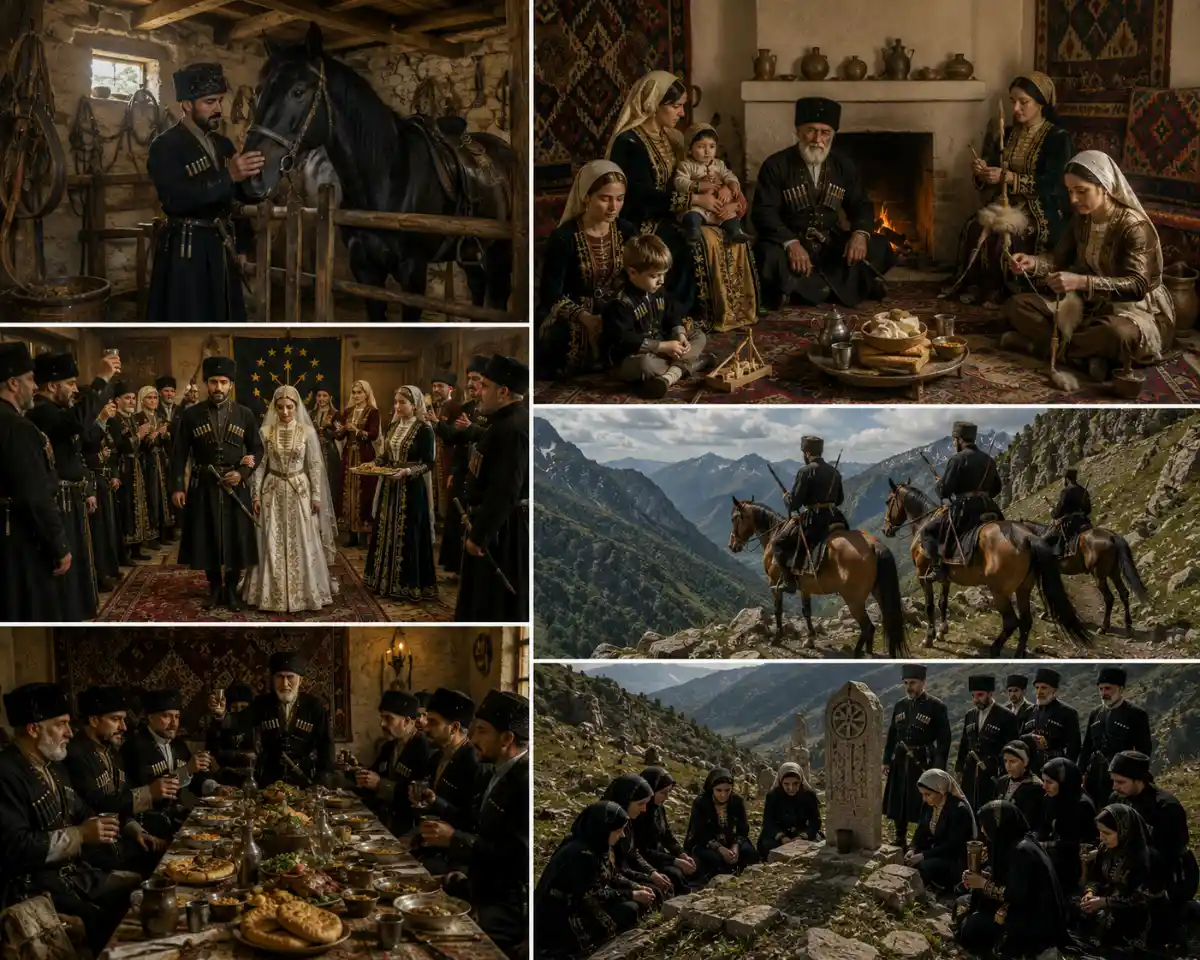
A Yegeruqway wedding was a major event, often involving several hundred people and lasting several days. The customary procedures for arranging a marriage were elaborate and required the participation of multiple families across an extended network of kin.
The process typically began with the young people themselves taking an interest in each other, sometimes at one of the village gatherings where young men and women could meet under the watchful but supportive eyes of their elders. If interest seemed mutual, the families would be informed. Discreet inquiries would begin between intermediaries. The status, reputation, and economic condition of both families would be considered. If preliminary indications were favorable, formal proposals would follow.
There was a bride price (vase) negotiated between the families, paid in cattle, horses, weapons, and household goods. There was a counter-gift from the bride's family. There were elaborate rituals around the bride leaving her father's house, her stay at an intermediate household before going to her husband's family, her formal entry into the husband's household, and the long sequence of celebrations and visits that followed.
The wedding itself involved feasting at multiple households over multiple days. There were specific roles for everyone, with elaborate seating arrangements and orders of toasting. There were songs that were sung only at weddings, dances that were performed in particular sequences, jokes and ritualized exchanges that were expected to take place at certain moments. The whole event reinforced both the joining of two families and the broader fabric of community ties.
Once married, a Yegeruqway couple lived within the husband's family compound, often as part of an extended household that included the husband's parents, brothers, and their families. The wife had her own quarters, her own kitchen, her own livestock under her management, her own zone of authority. The mother-in-law typically directed the joint household until she chose to step back, at which point authority passed to the senior daughter-in-law.
Children were welcomed and treated with affection. Boys grew up in the male sphere of farming and herding and horsemanship. Girls grew up in the female sphere of household management, garden work, dairy, textile production, and cooking. There was crossover. Girls helped in the fields at busy times. Boys helped with smaller domestic tasks. But the broad division of labor was clear and was internalized early.
Naming traditions varied across Circassian tribes, with the Yegeruqway typically using a combination of given names drawn from the Adyghe stock, sometimes with Arabic-derived names entering through Islamic influence. Family names were patronymic, identifying lineage and clan. Some Yegeruqway clan names became widely known and were carried into the diaspora, where they remain markers of identity to this day.
Death was met with elaborate mourning rituals. The body was washed, prepared, and buried within a day, in accordance with Islamic custom as it had been adopted in the post-Ottoman period, but the mourning that followed had distinctively Circassian features. Women lamented in ritualized chants. Men gathered to recite the deceased's genealogy and praise his deeds. There were memorial gatherings at fixed intervals after the death. Stones were carved with the family tamga and placed at the grave. The deceased's possessions might be distributed according to customary patterns, with particular items going to particular relatives.
What They Ate
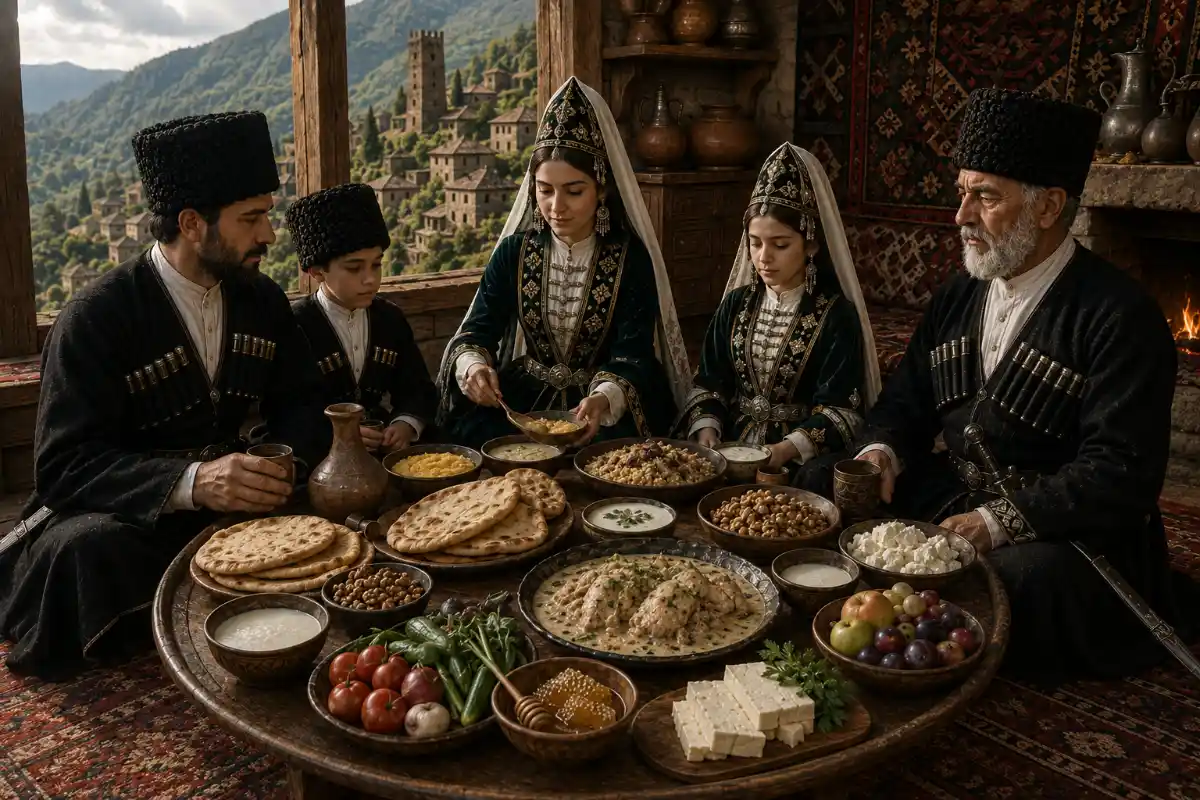
The Yegeruqway table reflected their land. Grains, particularly maize and wheat, formed the base of most meals. Maize was prepared in many forms: as porridge, as the thick boiled cornmeal called pasta or basta that served as a kind of bread, as flatbreads cooked on hot stones. Wheat was ground into flour for baking and was also boiled into pilafs.
Meat was central but not constant. Lamb and chicken were the most common meats. Beef appeared at major feasts. Game was eaten when available, particularly deer, wild boar, and various game birds, though Islamic prohibitions later constrained some categories. Fish was eaten by households near rivers. A particular Circassian specialty was lyy haluyzh, a sauce of pounded walnuts, garlic, salt, and broth, served over poached or boiled chicken. The sauce traveled with the Circassians into exile and became known across the Ottoman world as Çerkez tavuğu, "Circassian chicken," a dish that is now featured in many traditional Turkish restaurants.
Dairy was abundant. Fresh milk, soured milk products like the yogurt drink the Adyghe called shyu, butter, and a wide variety of cheeses appeared at almost every meal. The famous Adyghe cheese (Adyghe matekho or, in its modern marketed form, Adygeyski syr) is a soft, fresh white cheese eaten plain, fried in pieces, or used as a stuffing. Aged cheeses were also produced, harder and more pungent, kept for winter and for travel.
Honey was the major sweetener. Yegeruqway beekeeping was a developed art, with hives kept in dedicated apiaries near orchards and meadows, and honey gathered seasonally and stored in clay or wooden vessels. Honey appeared on the table at the end of meals, drizzled on dairy products or used to sweeten porridges.
Vegetables and fruits depended on the season. In summer there were fresh tomatoes (after their introduction from the Americas), cucumbers, beans, squashes, onions, garlic, leeks, cabbage, peppers. In autumn the gardens gave a final flush of root vegetables and the orchards yielded apples, pears, plums, walnuts. In winter, preserved fruits and pickled vegetables appeared on the table along with dried beans and storage roots. In spring, the first green shoots of wild greens were gathered eagerly, since they were a welcome change from the heavy winter diet.
Drink at meals was usually water or one of the soured milk beverages. On special occasions there was beer brewed from millet or from honey, called maxsyme. There was also a kind of fruit wine made from grapes, plums, or apples in pockets where grape cultivation was successful. The introduction of strict Islamic observance in the nineteenth century reduced the production and consumption of alcoholic drinks among many Circassian families, but the older traditions persisted in some forms, particularly around weddings and major festivals.
Meals were taken in a particular order, with hierarchical seating and toasting rituals that varied by occasion. At a formal feast, the head of the household or the senior guest sat at the head of the table or the foot of a low circular tray (anye). The toasts proceeded around the company in order, with each toast giving its giver the chance to honor a particular person, event, or principle. The food appeared in courses, with the meat and main dishes followed by sweeter foods at the end.
The table, in Yegeruqway life as in all Circassian life, was a primary site of culture transmission. The elaborate etiquette of who sat where, who spoke when, who served whom, was a daily lesson in the Khabze. Children watched and learned. Outsiders, when received as guests, were given a courteous instruction in the customs without being made to feel awkward about their ignorance. The table was where the community renewed itself, meal by meal, generation by generation.
Songs of the Field
The Yegeruqway, like other Circassians, had a deep tradition of folk music and song, but their particular contribution to the broader Adyghe repertoire was a set of songs and song-types associated with agricultural life.
There were planting songs, sung in the fields during the spring sowing, often in call-and-response form, with a leader calling out a phrase and the workers answering. The songs kept the work coordinated, kept the pace steady, gave the workers something to occupy their minds while their hands carried on with the repetitive task. The lyrics ranged from invocations for a good harvest to comic verses about the laziness of certain neighbors to longer ballad-like sections that told the stories of legendary harvests, legendary droughts, legendary farmers.
There were harvest songs, sung at the gathering of wheat and corn. These tended to be more triumphant in tone, marking the successful completion of the year's main work. They were also more elaborately rhythmic, often timed to the swing of the scythe or the throw of the threshing flail.
There were grinding songs, sung at the quern stones by the women who turned them by hand to grind grain into flour. The slow rhythm of the quern lent itself to long, narrative songs, sometimes melancholy, sometimes humorous, that helped pass the hours of this tedious but essential work.
There were songs for the orchard and the bee garden. There were lullabies sung at the cradle. There were funeral laments. There were wedding songs, with their own distinct tunes and lyrics. There were songs for the warrior leaving on campaign, and for the warrior returning. There were songs for the horse and the rider, since horsemanship was so central to Adyghe life.
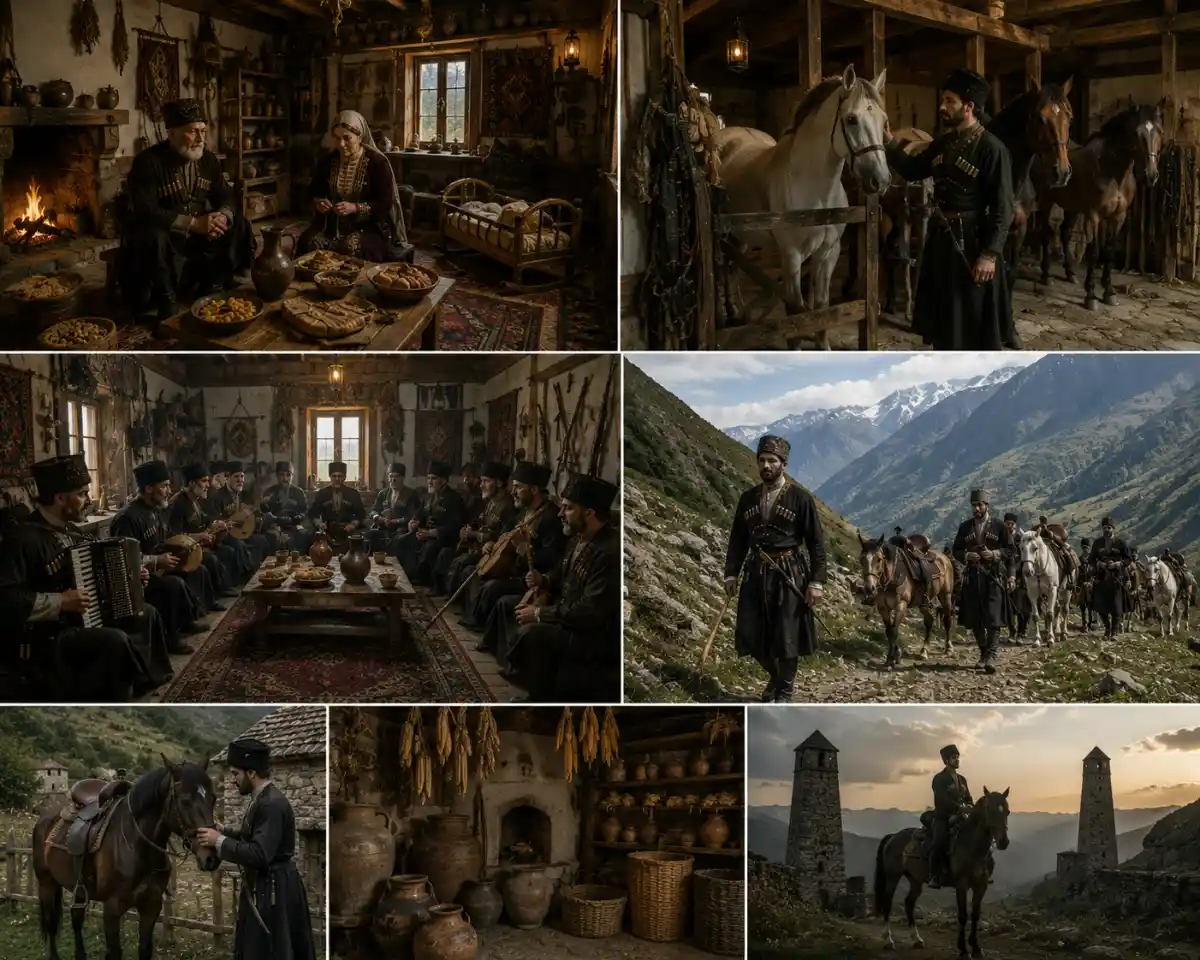
The instruments that accompanied these songs included the pkhachich (clappers), the shichepshyne (a two-stringed bowed instrument), the kamyl (a kind of flute), and, in the nineteenth century, the accordion, which became enormously popular across the Caucasus and is now closely associated with Circassian music in popular imagination.
A Yegeruqway folk songbook, if such a thing had ever been comprehensively compiled, would have given a vivid picture of life in this community. We have fragments. Soviet-era ethnographers collected some of the songs from older speakers in Adygea in the twentieth century. Diaspora researchers have collected others from Turkish and Jordanian villages. The full corpus is no longer accessible, since many of the songs were never written down and have been lost with the generations that sang them. But what remains gives us a sense of a musical culture deeply tied to the soil and to the working year.
Material Culture: What They Made
The Yegeruqway, like all Circassian tribes, produced a rich material culture, much of it tied to the practical demands of agricultural and pastoral life.
Their houses were typically built of wood and clay, with woven walls of branches or reeds plastered with mud or clay, and roofs of thatch or wooden shingles. The houses were single-story, often L-shaped or U-shaped, with a central living area and rooms branching off. The central room had a hearth, with a chimney constructed of wood and clay. Around the hearth were benches and low platforms covered with felt rugs and cushions. The walls were hung with weapons, family heirlooms, and ornamental textiles.
Their textiles were produced almost entirely within the household, with women doing the spinning, weaving, dyeing, and embroidery. Wool from the household's own sheep was processed into yarn and woven into cloth. Flax was grown and processed into linen. Cotton, when it could be obtained through trade, was incorporated. The cloth was dyed with vegetable dyes that gave a characteristic palette of warm browns, reds, ochres, and indigo blues.
Clothing followed broadly Circassian patterns. Men wore the cherkesska, the long fitted coat with rows of cartridge pockets across the chest, over a linen shirt and woolen trousers. They wore felt or wool hats, leather belts with characteristic buckle work, and soft leather boots. They carried a long dagger (kindjal) in a sheath at the belt. Women wore long dresses with fitted bodices and full skirts, ornamented with elaborate embroidery and silver belt clasps. They wore distinctive tall hats for special occasions, with veils that could be drawn forward.
Yegeruqway embroidery was particularly noted in some accounts. Women of the leading families maintained elaborate traditions of decorative needlework, with stylized floral and geometric motifs, gold and silver thread on velvet for festive garments, and intricate patterns on cuffs, collars, hems, and head coverings. Embroidered items were prized as gifts and as part of the bride's dowry.
Wooden craft was extensively practiced. Bowls, spoons, ladles, cups, churn dashers, looms, plows, ox yokes, wagon parts, and countless other items were made of wood by household craftsmen or by specialist artisans within the village. Particular kinds of decorative carving appeared on wooden chests, doorposts, and household furnishings.
Leather craft was also important. Boots, belts, saddles, bridles, harness, weapon sheaths, drinking vessels, and storage bags were made of leather, often tooled with decorative patterns. The Caucasian saddle, with its high pommel and characteristic shape, was a particular point of Adyghe pride.
Metal work was practiced by specialist smiths who served particular villages or groups of villages. They produced the iron parts of tools, the steel for daggers and knives, the silver ornamentation for belts and harness, the cartridge work for the chest pockets of men's coats. Some Circassian smiths achieved wide reputations and their work was sought by neighbors across the region.
The Yegeruqway, being a smaller tribe, did not specialize in large-scale production for export to the same degree as some of their cousins. Their craft production was oriented mainly toward their own household needs and toward modest trade with neighboring tribes. But the quality of what they produced was generally respected, particularly their orchard products and their preserved foods, which traveled well and were valued by traders.
Religion: Older Layers Under the Crescent
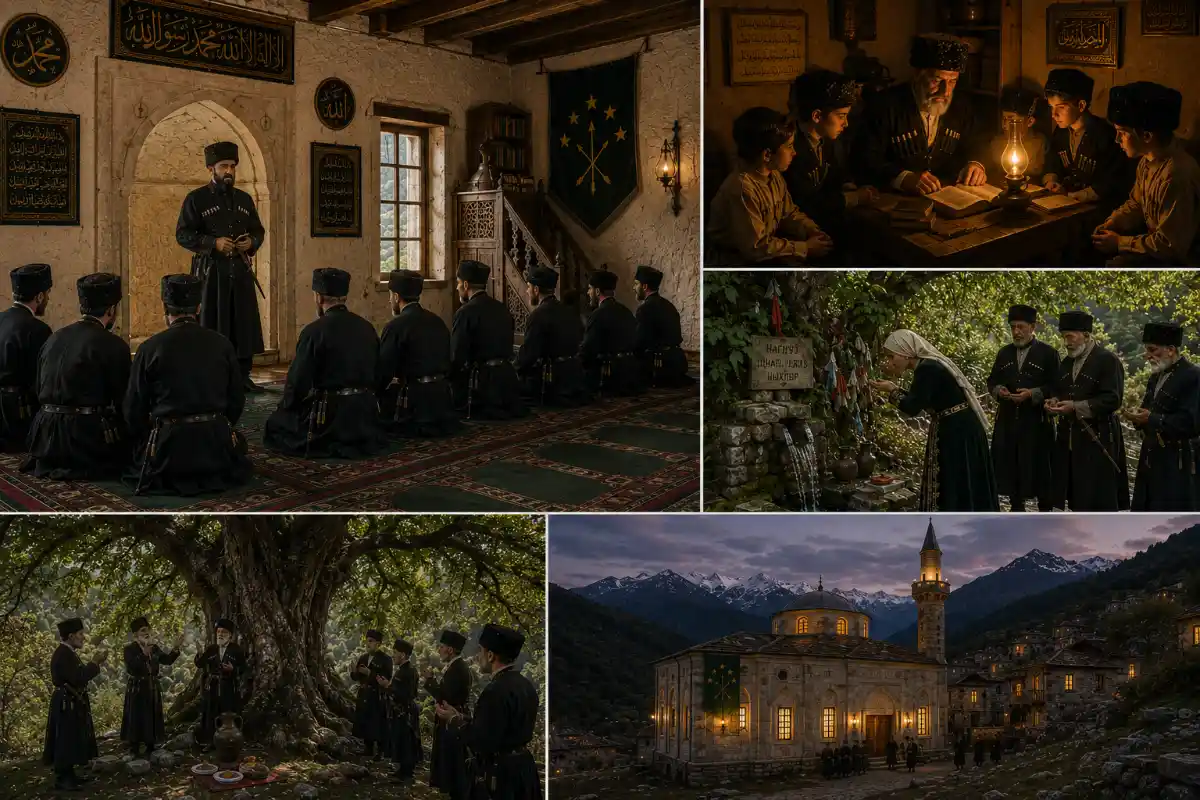
By the early nineteenth century, when systematic ethnographic accounts of the Yegeruqway begin, they were Muslim. Islam had spread into the western Caucasus in waves from the sixteenth century onward, brought by the Crimean Khanate, by Ottoman religious teachers, and by intra-Circassian missionary activity. The Yegeruqway had adopted Islamic observance like their neighbors, with mosques in the larger villages, with imams who led prayers and taught children to read Arabic, with the standard observances of Ramadan, daily prayer, and pilgrimage where possible.
But Islam had not erased the older religious layer. Beneath and alongside the Islamic practice, traces of an older Caucasian religious world persisted. Sacred groves were still recognized in some areas. Particular springs were visited for healing. Certain trees were respected as having spiritual significance. Older blessing formulas were still used at planting and harvest. There were echoes of a polytheistic past in which various figures had been recognized as patrons of different aspects of life: Thaghalej for fertility, Sozeresh for cattle, Mezitha for forests, and so on.
The blending of these layers was characteristic of Caucasian Islam more generally. The conversion to Islam had been gradual, had varied by region and by family, and had not been accompanied by any systematic effort to root out earlier practices. So a Yegeruqway household might pray five times a day, fast through Ramadan, observe Islamic burial customs, and still recognize, with no sense of contradiction, that certain springs and certain trees had a power that the village should respect.
Religious life was deeply intertwined with the agricultural calendar. The major festivals of the Islamic year were observed, but so were older seasonal markers tied to planting, harvest, and the turning of the year. The first plowing of spring was accompanied by certain rituals and blessings. The completion of the harvest was marked by a celebration. The killing of the first lamb of spring or the slaughter of the autumn animals each had its observances.
In the diaspora, this layered religious life simplified considerably. Among Ubykh and Adyghe families in Turkey, Jordan, and elsewhere, Islamic observance became more standardized, more aligned with the practices of the surrounding Muslim societies. The older Caucasian layer faded, though traces survived in family lore, in certain blessings used at weddings, in particular customs around the agricultural year that were adapted to the new climates and crops.
Yegeruqway families today, like other Circassian families in the diaspora, generally identify as Muslim and observe Islam in forms that vary by region and by family. The older Caucasian religious world is no longer accessible to them as living practice, but it lives on in elements of folklore and in the memories of certain elderly informants who could, decades ago, recall the names and stories of the older figures.
The Coming of the Russians
To understand what happened to the Yegeruqway, it is necessary to understand something of the broader Russo-Circassian War that engulfed their world in the nineteenth century.
The Russian Empire had been expanding southward for two centuries before it reached the western Caucasus. By the late eighteenth century, Russian forces had established themselves along the line of the Kuban River, with fortified posts and Cossack settlements on the steppe side of the river. From there, the imperial military looked southward at the Circassian lands across the river, and over the decades that followed, Russian policy moved steadily toward the goal of bringing those lands under direct imperial control.
The Circassians, including the Yegeruqway, resisted this advance fiercely. The mountainous interior of the western Caucasus was ideal terrain for guerrilla warfare. Russian columns that pushed across the Kuban into Circassian valleys often found themselves bogged down in difficult country, harassed by mobile bands of Adyghe horsemen who knew every trail and every ambush site. For decades, the war was a slow grinding affair, with Russian fortified posts established and abandoned, with truces negotiated and broken, with no decisive engagement that could end the conflict in either direction.
The Yegeruqway, despite their small size and their primarily agricultural orientation, were drawn into the war. They sent fighters when needed. They sheltered their warriors of neighboring tribes during retreats. They contributed to the inter-tribal councils that tried to coordinate resistance. They also bore the consequences when Russian columns reached their territory, which they did with increasing frequency from the 1830s onward.
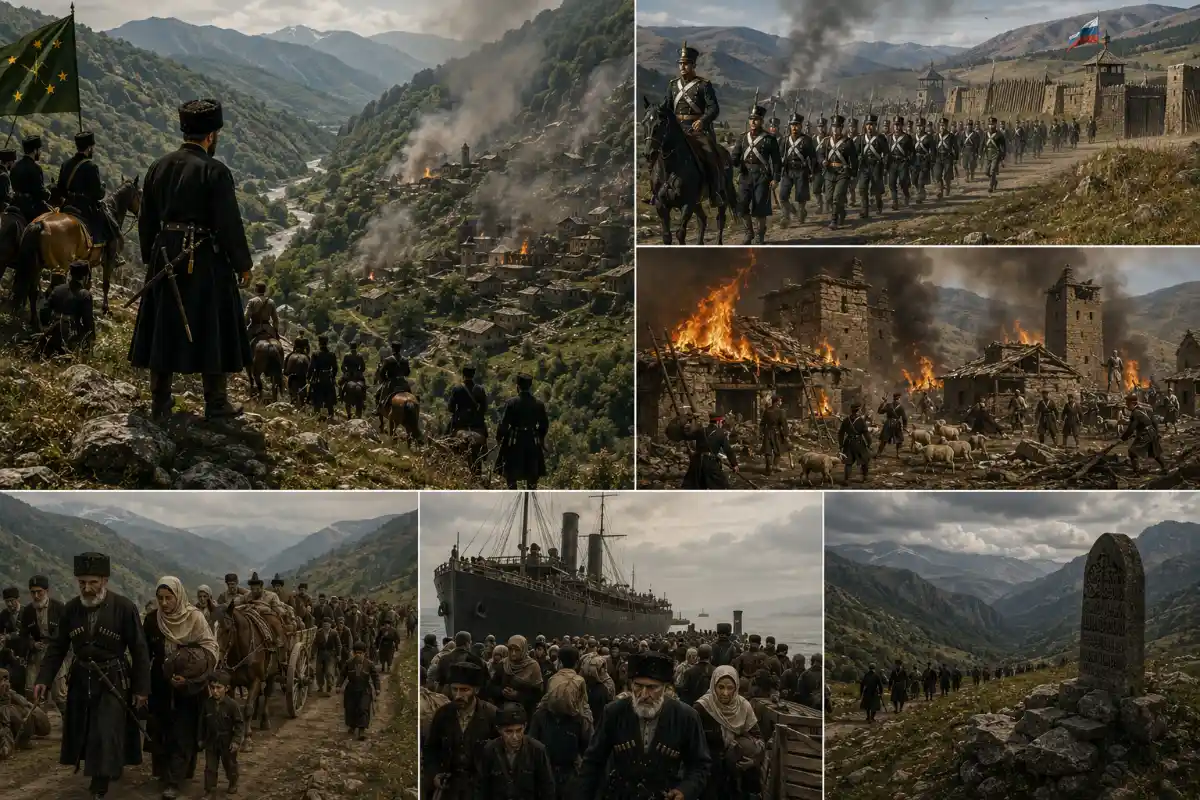
The Russian strategy, particularly under generals like Yermolov earlier and Yevdokimov later, evolved over the decades toward a more systematic and ruthless approach. Punitive expeditions burned villages, destroyed orchards, drove off livestock. The civilian population was forced to choose between submission to Russian authority and flight to the mountains, with the latter increasingly difficult as Russian forces tightened their grip. The aim, in the words of some Russian officials, was to make the Circassian lands either Russian or empty.
For the Yegeruqway in particular, the destruction of orchards was an especially devastating tactic. Orchards represent decades of investment. A fruit tree planted today will not give a full crop for ten or fifteen years. Burning an orchard, or cutting it down for firewood, destroys the work of generations. When Russian columns moved through Yegeruqway country in the 1840s and 1850s, they targeted not only the people but the trees, and the loss of these orchards was felt as a particular blow to a people whose identity was so tied to careful long-term cultivation.
By 1862 and 1863, the war was nearing its end. Russian forces had broken the back of organized Circassian resistance in valley after valley. The remaining tribes faced a stark choice. They could either accept resettlement to lands designated for them on the Russian-controlled steppe to the north, where the climate and soil were unfamiliar and the conditions harsh, or they could emigrate to the Ottoman Empire. Many tribes, including substantial numbers of Yegeruqway, chose the latter.
The Battle of Qbaada in May 1864, fought in the lands of the Ubykh further south along the coast, is conventionally taken as the formal end of the Circassian resistance. But the deportation had been underway for years by then, and continued for years afterward. The Yegeruqway were part of this larger movement, swept up in a process that emptied much of the western Caucasus of its Adyghe population.
The 1864 Deportation
The forced emigration of the Circassians in the 1860s is one of the major population movements of nineteenth century history. Estimates of the total number who left vary, but figures of 500,000 to 1.5 million are commonly cited, with the higher end including not only those who actually arrived in the Ottoman Empire but those who died on the way.
For the Yegeruqway, the deportation was particularly painful because of their small size. A small tribe loses more, proportionally, in any catastrophic event. Where larger tribes like the Kabardians or the Shapsug retained substantial populations both in the homeland and in the diaspora, the Yegeruqway found themselves split into fragments. Some families managed to remain in the western Caucasus, settling in territories that the Russian authorities allowed Adyghe populations to inhabit. Others were dispersed across the Ottoman Empire, scattered among other Adyghe groups and gradually merged into the broader Circassian diaspora.
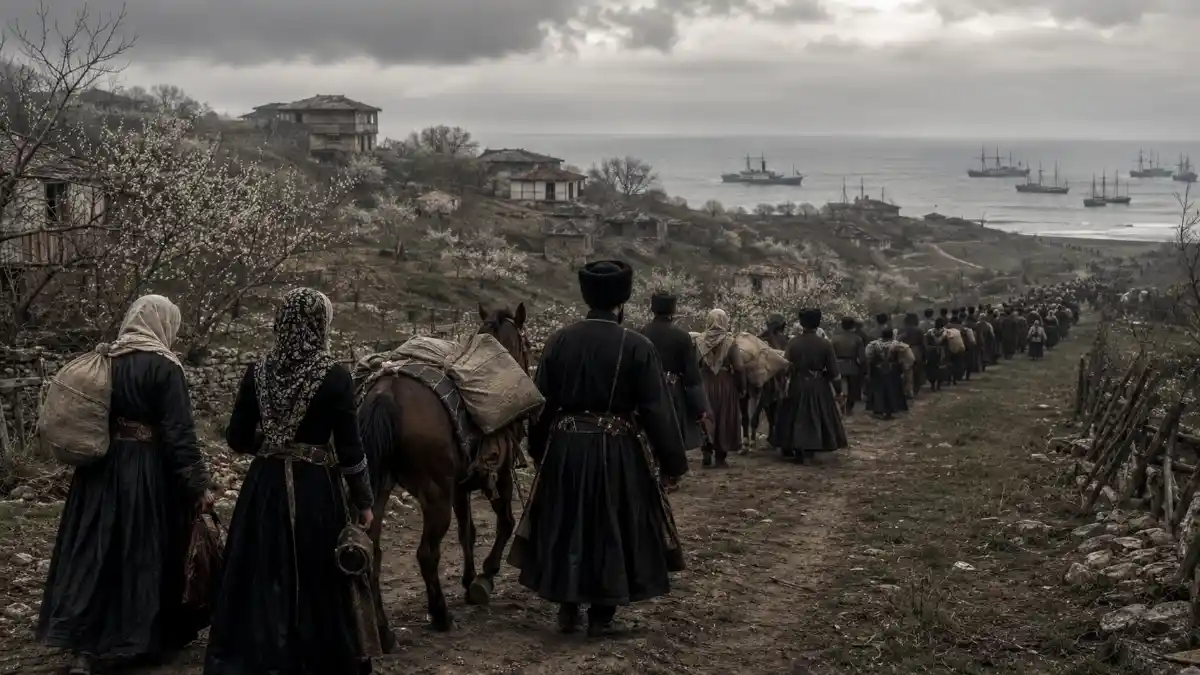
The journey itself followed the same pattern as for other Circassian tribes. Families walked from their inland villages toward the Black Sea coast, carrying what they could, leaving behind houses, orchards, livestock, grain stores, the graves of their parents. They gathered at coastal points, waiting for ships that came when they came. They were crowded onto vessels often inadequate for their numbers. They crossed the Black Sea, sometimes in good weather and sometimes in storms, sometimes with adequate food and water and sometimes without. They arrived at Ottoman ports overwhelmed by the scale of the arrivals.
Disease moved through the refugee population at every stage. Typhus, cholera, smallpox, dysentery. Children and the elderly died in particular numbers. By some estimates, between a third and a half of those who set out from the Caucasus did not survive the first year of resettlement. Yegeruqway families that arrived in Ottoman territory found themselves placed in resettlement zones along with other Circassians, in lands the Ottoman authorities wanted to populate.
Those who remained in the Caucasus faced their own losses. They watched neighbors leave. They were resettled to lands not always their own. The Russian government redistributed Circassian territories to incoming Russian, Ukrainian, Cossack, Armenian, and Greek settlers. The character of the western Caucasus changed within a generation, from a heavily Adyghe region to one in which the Adyghe were a minority within their own historical homeland. Within the small territory that eventually became the Republic of Adygea, Yegeruqway and other Adyghe communities persisted, but the broader landscape was no longer theirs.
Diaspora Settlements
In the Ottoman Empire, Yegeruqway refugees were settled in various locations alongside other Circassian groups. The main concentrations developed in north-central Anatolia, in regions like Kayseri, Tokat, Amasya, and Sivas, and in northwestern Anatolia, in regions like Bursa, Bilecik, Adapazarı (Sakarya), Düzce, Bolu, and Eskişehir. Smaller communities ended up in the Aegean region, in Çanakkale and Balıkesir, and in various pockets across central and eastern Anatolia.
Beyond Anatolia, Circassian and therefore Yegeruqway communities were established in the Levant. The Ottoman government, faced with the security challenges of frontier regions, settled groups of Circassians along strategically important corridors, particularly in what became Jordan (Amman, Wadi al-Seer, Naur, Sweileh, Jerash, Russeifa), in Syria (around Quneitra, in the Golan Heights region, and in Damascus province), and in smaller numbers in Iraq and what became Israel. The Circassians of Amman, in particular, played a foundational role in the establishment of the modern Jordanian capital.
For the Yegeruqway specifically, the agricultural orientation of the tribe shaped where they settled and what they did once they got there. They tended to gravitate toward locations with good farming potential. In the Anatolian heartland, they took up wheat farming, animal husbandry, and the gradual development of orchards in the climates and soils that allowed it. In Jordan, they helped develop the agricultural systems that supported the growing settlements along the eastern margin of the great rivers. They were sometimes employed by Ottoman officials and later by independent state authorities as cadres of skilled farmers who could improve land that local populations had been unable to exploit fully.
Yegeruqway villages in Turkey often took on a distinctive character. Houses were built in styles that recalled the homeland, with the central living room around a hearth, the U-shaped or L-shaped layouts, the careful attention to the surrounding garden and the productive trees. Orchards were planted as soon as conditions allowed. Where possible, livestock was raised in patterns similar to those of the western Caucasus. The Anatolian climate did not allow exact replication of the homeland's agricultural system, but it allowed enough that Yegeruqway families could practice their inherited skills.
In Jordan, conditions were more challenging. The drier climate, the heavier reliance on irrigation, the different soil chemistry, all required adaptation. But Yegeruqway and other Circassian settlers proved adaptable. They took up new crops where appropriate. They learned new techniques from local farmers. They contributed to the agricultural development of a region that, before their arrival, had been more pastoral than cultivated. Today, the Circassian community of Jordan retains a strong sense of agricultural heritage, even though most members now work in urban professions.
Within these new settlements, Yegeruqway families typically integrated with other Adyghe groups. Marriages crossed tribal lines. Children grew up speaking a more generalized form of Adyghe rather than specifically Yegeruqway speech. The distinct tribal identity, while remembered, became less salient in daily life. Most Circassians in the diaspora today identify primarily as Circassian or Adyghe, with their specific tribal origin known but secondary.
The Yegeruqway, being a smaller tribe, were particularly affected by this process. Their identity as a distinct group within the Adyghe diaspora became thinner over the generations. A Yegeruqway family in Turkey today may know that their ancestors were Yegeruqway, may know the family name and possibly the tamga, may know roughly which village in the Caucasus the family came from, but may otherwise live a daily life that is hard to distinguish from that of other Circassian families in their region.
This is not unique to the Yegeruqway. It is a general pattern of diaspora life: identities consolidate over generations into broader categories. The fine grain becomes less visible. The Circassian identity persists. The Yegeruqway identity is present but less prominent. This is a fact about how memory works across generations, not a failure of any particular community.
The Tamga
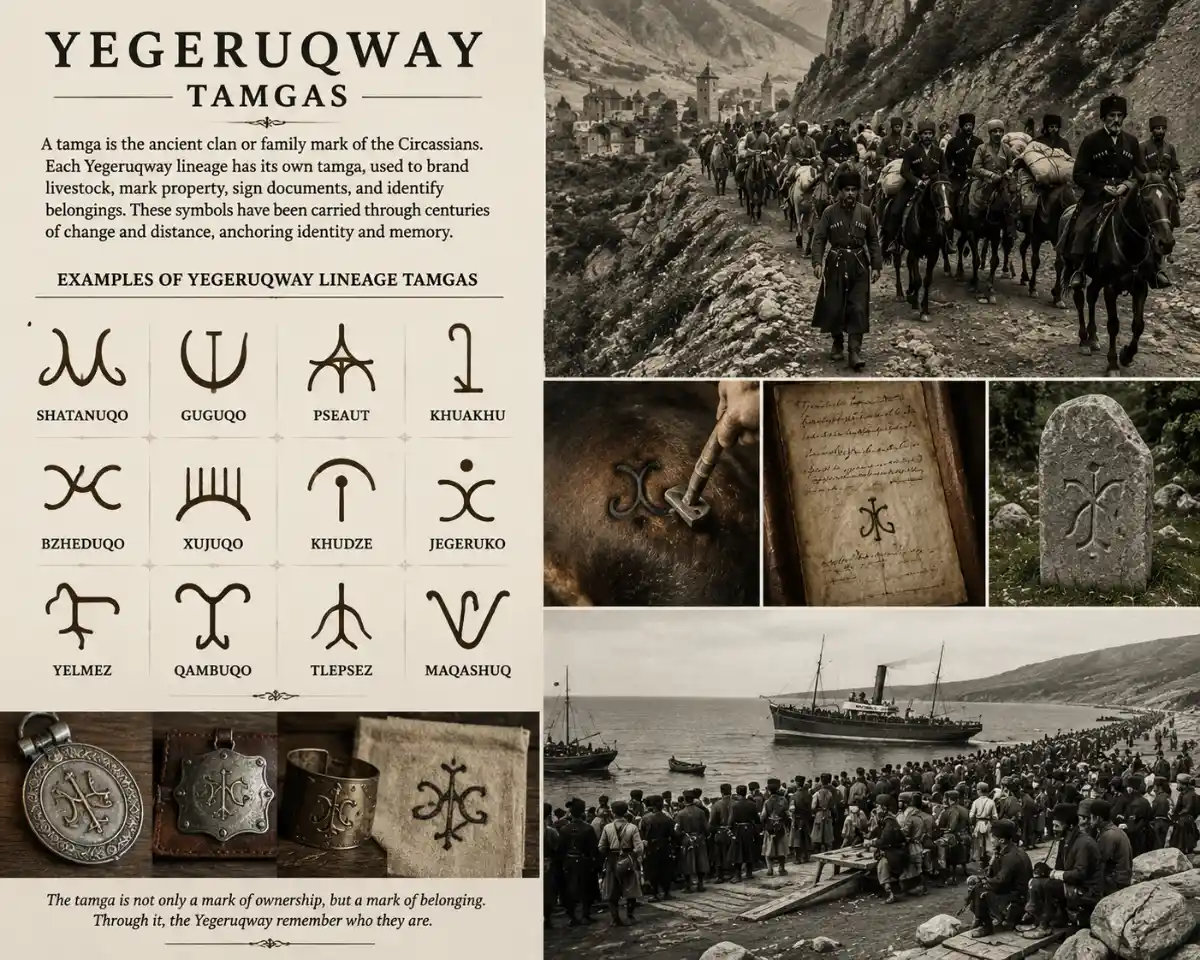
A tamga, in Caucasian and Turkic tradition, is a clan or family signature. Each Circassian clan, and within larger clans each major lineage, had its own distinct tamga design. These were typically abstract patterns made up of curved and straight lines, hooks, crescents, dots, and other elements. They were used to brand cattle, mark property, sign documents, and identify family belongings.
Yegeruqway tamgas are documented in archival collections and remain a vital element of identity for diaspora families. Each major Yegeruqway lineage has its own design, which can be traced back through nineteenth century records and, in some cases, through oral tradition to earlier centuries. The tamgas are simple enough to be carved on a stone, branded on the flank of an ox, or embroidered on a piece of cloth, but distinctive enough to identify a family across generations.
In the diaspora today, Yegeruqway tamgas appear on family heirlooms, on jewelry, on tattoos in some cases, on the printed material of cultural associations, on the gravestones of older members. Some families maintain very specific knowledge of which tamga belongs to their lineage. Others have lost the specific design but retain a more general awareness that their family had one. Online resources, including various tamga archives maintained by Circassian cultural organizations, have made it easier in recent years for diaspora members to look up and reconnect with their family tamgas.
The persistence of the tamga is interesting for what it tells us about how communities preserve themselves. Languages can be lost. Clothing styles can fall out of use. Particular crafts can be abandoned. But certain abstract symbols, transmitted as part of family memory, can outlast almost everything else. The tamga is small, easy to carry, easy to teach to a child, easy to recognize. It anchors identity in something that does not require fluency in a language or knowledge of an elaborate customary code. You see your family's tamga, and you know who you are.
For the Yegeruqway specifically, the tamga has an additional resonance because of the agricultural heritage of the tribe. Many of the recorded Yegeruqway tamgas use motifs that some scholars have read as referring to agricultural implements, plowed furrows, sheaves of grain, the curves of pruning hooks. Whether these readings are historically accurate or later interpretations is a question for specialists. But the meaningful association between the tribe's identity and its relationship to the land is part of how the tamga has been understood by its bearers.
Cultural Festivals and the Calendar of Celebration
The Yegeruqway calendar, in its homeland form, was rich with festivals that combined agricultural milestones, Islamic observances, and older Caucasian seasonal markers.
The agricultural year began, in symbolic terms, with the first plowing of spring. This was an occasion for blessings and small ceremonies. Particular households might mark the moment with the slaughter of an animal for a communal meal. The plow and the oxen were honored as the instruments that opened the year's productive work.
The major work seasons followed. Spring planting, summer hay-making and weeding, autumn harvest and threshing, late autumn fruit gathering and preservation, winter slaughter and meat curing. Each of these periods had its own characteristic rhythm and its own associated celebrations.
The grape harvest, where grapes were grown, was a particularly festive occasion. Whole villages gathered, the work was done in a few intense days, and the evenings were given over to feasting and music. Even when wine was not the goal, the preservation of grapes as raisins or as syrups was an occasion for community.
The first lamb of spring, the first calf of the year, the first new cheese of the dairy season, each of these had its small observances. A household that received a new son or daughter celebrated with neighbors. A household that completed a new house held a feast of consecration.
Beyond the agricultural cycle, the Islamic festivals were observed. Eid al-Fitr at the end of Ramadan brought a great burst of communal celebration, with new clothes for the children, feasting, visiting, and exchange of gifts. Eid al-Adha brought the sacrifice of animals, the distribution of meat to neighbors and the poor, and another major feast. The Prophet's birthday was marked. Friday prayers gathered the men of the village at the mosque.
Wedding celebrations were the largest gatherings of all, often lasting three days or more, with multiple households hosting different stages of the event. Births, naming days, the first hair-cuttings of children, all had their associated festivities.
Funeral observances were solemn but extensive. The community gathered for the burial, for the meals in the deceased's house in the days following, for the periodic memorial gatherings at fixed intervals after the death. The death of a major elder might be marked by visits from representatives of distant villages and by speeches that recounted the deceased's contributions to the community.
In the diaspora, much of this calendar has thinned. Islamic festivals are still observed, of course. Weddings are still major events, often with deliberate effort to incorporate Circassian dances and music. Funerals retain some Caucasian characteristics. But the agricultural cycle is no longer the underlying frame for most diaspora families, who work in cities or in non-agricultural rural sectors. The first plowing of spring is, for most Yegeruqway descendants today, not an event in their year.
Cultural associations in Turkey, Jordan, and elsewhere have made deliberate efforts to revive some of these older festivals, often around the anniversary of the 1864 deportation (May 21), around the anniversaries of significant cultural figures, or as part of broader Caucasian heritage events. These efforts have mixed success. They preserve elements of the older tradition, but they do not, and cannot, restore the underlying way of life that gave the tradition its meaning.
The Place Called Home
For Yegeruqway descendants today, what is home? The answer varies by person and by family.
For some, home is the village in Turkey where their parents and grandparents lived after 1864, where they themselves grew up, where the rhythms of their childhood took shape. The Caucasus is a place they have heard of, perhaps visited once or twice, but it is not where their actual lives have been lived. Home is Anatolia. Home is the particular landscape of Sakarya or Düzce or Kayseri where their family settled.
For others, home has a more complex layered quality. There is the Anatolian or Jordanian village where the family has lived for five or six generations. There is also, holding a kind of ghostly priority, the Caucasian homeland from which the family was driven. To be Yegeruqway, in this layered understanding, is to belong simultaneously to two places, neither of which fully holds you. The Anatolian home is real and present but not where the deeper identity is rooted. The Caucasian home is rooted but not present.
Some descendants have made the journey back. Tourism to Adygea and the broader Circassian regions of the western Caucasus has grown substantially since the end of the Soviet era. Diaspora visitors arrive, look up the villages of their ancestors, photograph rivers and meadows, sometimes locate distant relatives who descended from the families that stayed behind. For some, the journey is emotionally powerful and reorienting. For others, it confirms the distance, the irretrievability of what was lost.
A small Yegeruqway community has persisted in Adygea throughout the post-deportation period. Their numbers are modest. They have lived as a small community within the larger Adyghe population of the republic, maintaining their family lineages and a certain awareness of their tribal identity. Some Yegeruqway villages in Adygea retain names that recall the original tribal designation. Family names in current use in the republic can be traced to Yegeruqway lineages.
For diaspora descendants who reconnect with these communities, there is a sense of finding family they had not known they had. The Yegeruqway in Adygea sometimes welcome diaspora visitors as cousins long missing, with the elaborate Circassian hospitality that still operates in those villages. Marriages have occasionally been arranged between diaspora and homeland families, knitting back together strands that had been severed for many generations.
But for most Yegeruqway descendants in the diaspora, home remains the place where their grandparents settled, where their parents grew up, where their own lives are lived. The Caucasus is a part of the family story, an anchor for identity, an occasional destination, but not where they actually live or expect to live.
What Yegeruqway Heritage Means Today
To identify as Yegeruqway today, in any of the communities where descendants live, means several things at once.
It means belonging to a particular family lineage with traceable roots in a specific tribal group within the Adyghe peoples. It is a fact about your ancestry, a piece of information that can be located in family records, in tamga archives, in the oral traditions of older relatives.
It means participating, often actively, in the broader Circassian identity that has formed in the diaspora over the past century and a half. Circassian cultural associations, festivals, dance groups, music ensembles, language classes, charitable organizations, political advocacy groups, all of these provide spaces in which Yegeruqway descendants come together with descendants of other Adyghe tribes to maintain a shared sense of who they are.
It means carrying, in some form, the cultural inheritance of a particular way of life. Even when the specific agricultural practices have been lost, even when the daily round of village work has been replaced by urban professions, certain ways of thinking about family, hospitality, work, and community persist. Yegeruqway descendants in Turkey often note that they feel a particular pull toward agricultural work, toward small-scale farming, toward the keeping of orchards and small flocks, even when their immediate context is urban. Whether this is genuine cultural inheritance or a kind of imagined nostalgia is a question that probably has no single answer.
It means living with a particular history of loss. Every Yegeruqway descendant knows, in some form, the story of 1864. Some carry it lightly, as a fact of family history. Others carry it with great emotional weight, particularly around the anniversary observances on May 21. The trauma of the deportation is now several generations distant, but it persists as a foundational element of Circassian identity, including Yegeruqway identity.
It means being part of a transnational community. Yegeruqway descendants live in Turkey, Jordan, Syria, Israel, Germany, the United States, Russia, and many other countries. They communicate with each other across these borders, often through social media platforms and online forums dedicated to Circassian heritage. They marry across these borders. They visit each other. They share family histories and reconnect lineages that had been separated for generations.
For young Yegeruqway today, particularly those born and raised in the diaspora, the question of identity is often complex. They may feel themselves to be primarily Turkish or Jordanian or German, with Circassian heritage as one strand among others. They may speak the language of their host country natively and Adyghe only partially or not at all. They may have lost detailed knowledge of the tribal distinctions that mattered to their grandparents. But they often retain a sense, sometimes faint and sometimes intense, of belonging to a people with a particular history and a particular kind of dignity.
Yegeruqway heritage: symbols, stories, and legacy
What the Yegeruqway Gave
If you ask what the Yegeruqway gave to the broader Circassian world, the answer is several things.
They gave agricultural skill. Their methods of cultivation, their attention to orchards, their management of livestock, all of these spread across the Adyghe tribes by example and by direct teaching. When Yegeruqway farmers visited or settled among other Circassians, they often brought new techniques and new attention to old techniques. In the diaspora, this skill carried into the new settlements, where Yegeruqway and other Circassian farmers helped transform the agricultural potential of regions in Anatolia and the Levant.
They gave the institution of shihaf, or at least gave it a particularly developed form. While communal labor practices existed across all Circassian tribes, the Yegeruqway version, with its careful organization, its associated festivity, and its emphasis on equality among participants, served as a model of how the principle of mutual aid could be operationalized in daily life.
They gave the tradition of tfekho governance. Along with the other democratic Circassian tribes, the Yegeruqway maintained a system of self-government without hereditary princes, a system that worked through assemblies, deliberation, customary law, and consensus. This tradition was part of the broader Adyghe political inheritance and contributed to the larger Circassian discussion about authority and community.
They gave songs and folk traditions tied to agricultural life. While much of this corpus is now fragmentary, what survives provides texture and depth to the broader Adyghe folk tradition. Yegeruqway harvest songs, planting songs, orchard songs, and grinding songs are recognizable elements within the larger body of Circassian folklore.
They gave specific families and lineages whose descendants continue, today, to contribute to Circassian community life in many countries. The names persist. The tamgas persist. The stories of particular ancestors persist. Each generation that carries forward this inheritance is part of the answer to what the Yegeruqway gave.
They gave, perhaps most importantly, an example of how a small people could live with quiet dignity. The Yegeruqway were never powerful in the way some of their neighbors were. They produced no great khan or sultan. They built no fortress city. They commanded no large army. What they did was farm well, govern themselves well, treat their guests well, and pass on, generation after generation, a coherent way of life that nourished its members and contributed to the broader culture they belonged to. That is not nothing. In many ways, it is more than what most peoples manage.
On Smallness
There is a thought worth sitting with at the end of this account. The Yegeruqway were small. Their lands were modest. Their population was modest. Their political influence on the wider Adyghe world was modest. In the histories of the great Caucasian wars, they appear, when they appear, in the second or third paragraph rather than the first.
And yet, their story is not less important for being small. The history of a small farming tribe is, in some ways, more representative of how most human beings actually have lived than the history of any imperial capital. Most people, through most of human history, have not been kings or generals or great philosophers. They have been farmers, herders, weavers, cooks, parents, neighbors. They have worked the soil their ancestors worked. They have raised children to do the same. They have lived in communities small enough to know each other, governed by customs grown out of long experience, sustained by the rhythms of the seasons and the patience of cultivation.
The Yegeruqway lived a version of this universal human life in a particular Caucasian valley. They did it well, for many generations. When they were forced out, they carried what they could with them and reconstructed a portion of their way of life in new countries. They have continued, through the years of dispersal, to honor what their ancestors built and to pass on what they could to their own children.
If we want to understand the human condition, we have at least as much to learn from peoples like the Yegeruqway as from any empire that ever drew lines on a map. The dignity of patient work, the durability of community, the quiet endurance of identity across generations of upheaval, these are things worth studying. The Yegeruqway, in their modest and unassuming way, embodied them.
A Closing Word
The article that began as a short note on the Yegeruqway has grown, in the telling, to something longer. That is appropriate. A people deserves more than a paragraph. A way of life deserves more than a footnote.
The Yegeruqway homeland lies in the lowlands of what is now the Republic of Adygea. The summer there is green and the rivers run clear. There are orchards in some valleys, though many fewer than there were two hundred years ago. There are farms, though most are now organized along very different principles from the ones the Yegeruqway knew. There are villages, though most are inhabited by populations who arrived after the deportation rather than before.
The Yegeruqway diaspora lives mostly in Turkey, with smaller populations in Jordan and in other countries. Their daily lives are lived in the rhythms of the modern Turkish or Jordanian world, with families gathered around televisions and phones rather than around fires and threshing floors. But the memories persist. The names persist. The tamgas persist. The May 21 commemorations persist.
If you sit at a Turkish dinner table where a Yegeruqway family is hosting you, you will likely be served Circassian chicken with walnut sauce. The host will pour your tea before pouring his own. He will ask after your family before discussing his own. He will mention, in passing, perhaps in response to a question, that his great-great-grandfather came over from a particular village in the western Caucasus in the year of the great exile. He may not say much more about it than that. But the way he holds himself, the way he serves his guests, the way he treats the food on the table, all of these carry forward something that has not entirely been lost.
That is the Yegeruqway story. A people whose homeland was taken, whose population was scattered, whose specific tribal identity has faded into a broader Circassian identity in the diaspora, but whose particular contribution to the Adyghe inheritance lives on in the practices and memories of their descendants. They were the tribe of the fertile valleys. They were the people who knew how to farm. They were small, but they were durable. And they are still here, in their grandchildren, doing their best to honor what they were given.
FAQs
Who were the Yegeruqway?
The Yegeruqway were one of the twelve recognized Circassian tribes. They were a smaller Adyghe tribe, but their cultural contribution was much larger than their numbers, especially in farming, orchards, livestock, and village life.
Where was the Yegeruqway homeland?
Their homeland was in the lowlands and gentle foothills of the northwestern Caucasus, mainly in what is now the Republic of Adygea and nearby parts of Krasnodar Krai.
What made the Yegeruqway special?
They were known as skilled farmers and orchard keepers. Their fertile valleys, careful cultivation methods, and communal labor traditions gave them a strong reputation among neighboring Circassian tribes.
Did the Yegeruqway have hereditary princes?
No. The Yegeruqway belonged to the democratic or “free” Circassian tribes. Their society was organized through councils, elders, consensus, and customary law rather than hereditary princely rule.
What happened to the Yegeruqway after 1864?
Like other Circassian tribes, many Yegeruqway families were displaced during the mass deportations after the Russo-Circassian War. Some remained in the Caucasus, while many settled in the Ottoman Empire, especially in Anatolia and parts of the Levant.
Contribute information, photos, documents, corrections, or family/community stories:
https://circassianweb.com/volunteer