שבט הטמירגוי (Chemguy): לוחמים של הקווקז המרכזי
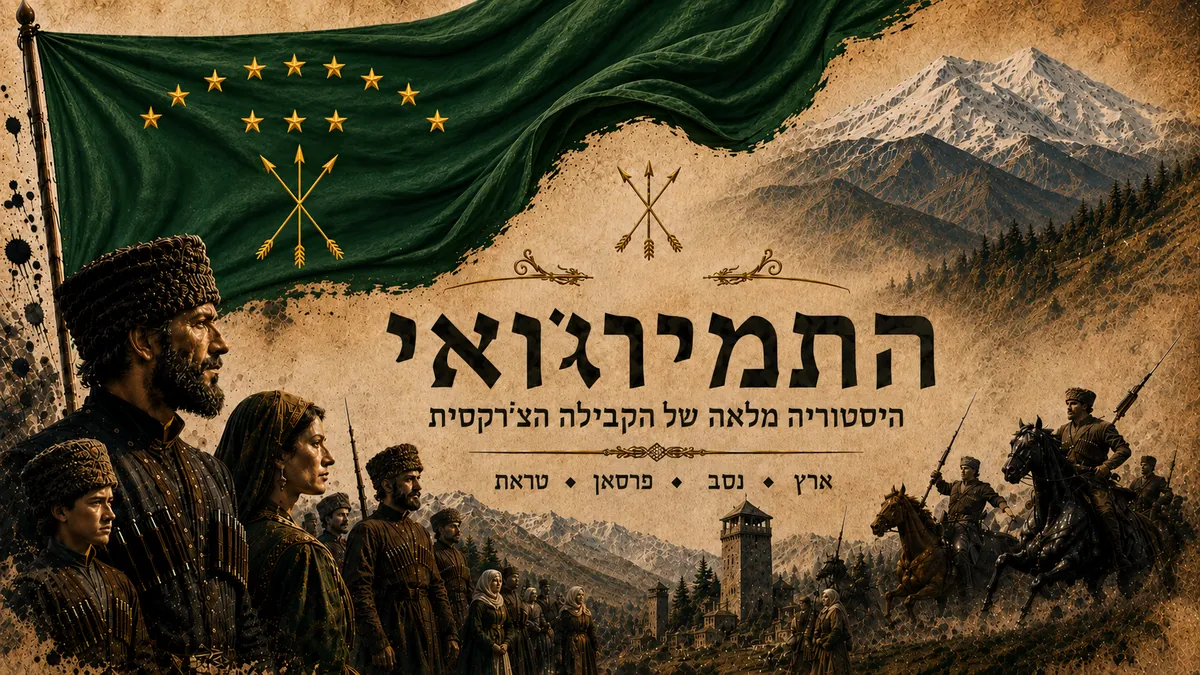
The Temirgoys: A Comprehensive History of the Kemguy Circassian Tribe
The Temirgoys (Адыгэ: Кlэмгуй), known among themselves as the Kemguy and sometimes spelled Chemguy in older European sources, are one of the twelve historical Circassian tribes. Their homeland sat in the central part of the North-West Caucasus, on the rolling plains and foothills between the Laba and Belaya rivers. Today, that land falls inside the Republic of Adygea in the Russian Federation, although the people themselves are scattered across three continents.
For most of the eighteenth and nineteenth centuries, the Temirgoys were one of the four or five tribes that mattered most in any conversation about Circassian politics. They were not the largest tribe, nor were they the wealthiest in raw numbers of cattle and horses. What they had was geography, lineage, and a particular kind of military reputation. They sat between the western coastal Circassians and the eastern Kabardians, which meant that no one moved an army across the central Caucasus without thinking about the Temirgoys first. Their princes were related by marriage to almost every other princely house in the region, and their cavalry was respected even by enemies who hated them.
This article walks through who the Temirgoys were, where they came from, how they organized their lives, what happened to them during the long Russian conquest of the Caucasus, and what remains of them today. The story is not simple. Parts of it are still argued over by historians in Maikop, Istanbul, and Amman. Where the record disagrees with itself, this article tries to say so rather than smoothing it over.
Etymology and the question of the name
The name "Temirgoy" is the form Russian sources used in the eighteenth and nineteenth centuries, and it is the name that stuck in most Western historical writing. The tribe's own name for itself is Kemguy, written Кlэмгуй in modern Adyghe orthography. The two names are not quite interchangeable, and the difference between them is part of the story.
"Temirgoy" almost certainly comes from a Turkic compound. The first element is "temir," meaning iron, and the second is most often read as "goy" or "köy," which in different Turkic languages can mean village, clan, or settlement. So the name approximately means "iron clan" or "people of iron." This kind of name is consistent with how Crimean Tatar and Nogai sources tended to describe their northern Caucasian neighbors during the period when the Crimean Khanate exerted real political influence over the region. The name passed from Tatar usage into Russian, and from Russian into European cartography, where it became fixed.
"Kemguy" is an internal Adyghe term, and the etymology is less settled. The most common explanation traces it to a personal name, possibly that of an early prince or founder. Other accounts link it to topographical features, although those readings are weaker. Whatever its origin, the word "Kemguy" carries a different emotional weight inside the Adyghe-speaking community than "Temirgoy" does. It is the name people use when they want to claim the tribe as their own rather than describe it from the outside.
Older European travel literature contains a third spelling, "Chemguy" or "Tcheghemguy," which is just an attempt to render the Adyghe pronunciation in French or English orthography. In Ottoman Turkish documents, the tribe usually appears as "Kemirköy" or simply "Kemirgoy," with the Turkish-speaking exile communities continuing to use that form into the early twentieth century. Modern Turkish-language sources have largely standardized on "Çemguy."
Origins and early history
The deep origins of the Temirgoys, like those of most Circassian tribes, are difficult to pin down. Adyghe oral tradition places the formation of the tribe in the late medieval period, sometime between the thirteenth and fifteenth centuries, although the people who came to be called Temirgoys had certainly been living in the central Caucasus much earlier than that under different names and in different political configurations.
Most modern historians of Circassia accept that the Temirgoys emerged as a distinct political community out of the broader Kasogian or Adyghe population that inhabited the steppe-forest border zone of the northwestern Caucasus during the period of Mongol and post-Mongol fragmentation. The Mongol invasions of the thirteenth century shattered the older Alanian and proto-Circassian polities, and the centuries that followed saw a slow re-knitting of the population around new princely lineages. The Temirgoys were one of the results.
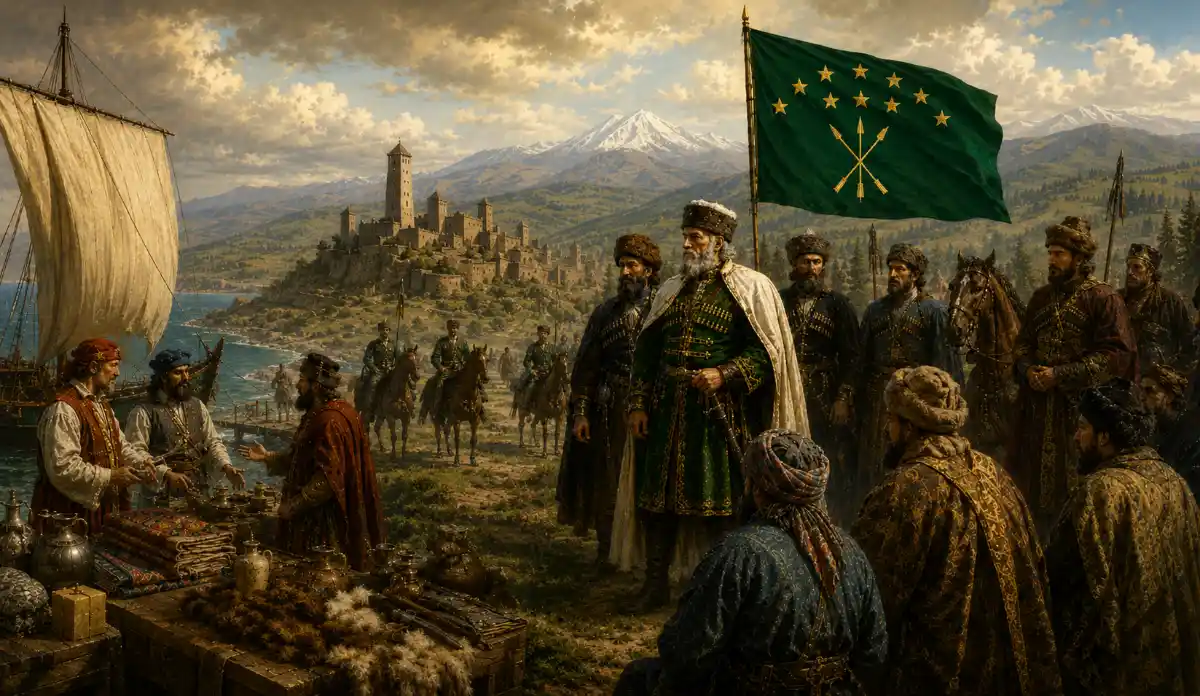
By the early sixteenth century, the tribe is mentioned by name in Genoese trading records from the Black Sea coast. The Genoese maintained a network of small trading posts at Matrega (modern Taman) and along the Kuban estuary, and they traded grain, slaves, wax, and furs with the Circassian interior. Temirgoy nobles appear in these records as buyers of Italian textiles and weapons. A few are mentioned by personal name, although the spellings are mangled and it is hard to match them confidently with later Adyghe genealogies.
When the Crimean Khanate consolidated its grip on the northern Black Sea region in the late fifteenth and sixteenth centuries, the Temirgoys were among the Circassian tribes drawn into a complicated, often hostile, relationship with the khans. Crimea raided the Caucasus for slaves, and the Temirgoys raided back. Some Temirgoy princes married into the Giray dynasty, and some Crimean princes spent parts of their youth fostered in Temirgoy households under the atalyk system. None of this added up to formal subjugation. It was something more like a long, exhausting feud punctuated by occasional alliances against the Russians, the Kalmyks, or each other.
Russian sources begin to mention the Temirgoys regularly in the late sixteenth and early seventeenth centuries, usually in the context of diplomatic missions sent from Moscow to negotiate with various Circassian princes. Tsar Ivan IV's marriage to Maria Temryukovna, daughter of a Kabardian prince, in 1561 was a turning point in Russian-Circassian relations, but it pulled the Russians more strongly into the politics of the eastern Circassian tribes than the western ones. The Temirgoys remained at the edge of Russian awareness, more rumored than known, for another century and a half.
Relations with neighboring tribes and powers
The Temirgoys did not exist in isolation, and a fair amount of what we know about them comes from how their neighbors talked about them. Their immediate Adyghe neighbors were the Bzhedugs to the west, the Abadzakhs to the south in the foothill forests, the Mokhosh and the Egerukai to the east, and the Besleney further east still. The Kabardians, the largest and most politically organized of the Circassian groupings, sat to the east beyond the Laba and the upper reaches of the Kuban tributaries. To the north, across the Kuban itself, lay the open steppe where Nogai herders moved with the seasons and Crimean Tatar raiding parties rode in and out at will. To the south, beyond the main Caucasus range, lay the Abkhaz, the Svans, and the Georgians.
With the Bzhedugs, relations were close, intermarried, and frequently competitive. The two tribes shared a long border along the Pshish river, a similar dialect, and a similar political structure, and Bzhedug and Temirgoy princely families had been marrying back and forth for centuries. They also fought each other regularly, in disputes over pasture, over cattle theft, over insults real or imagined. The fighting was usually limited and ritualized, although in the late eighteenth century a particularly bitter feud between two princely lines led to several years of more sustained warfare.
With the Abadzakhs, the relationship was different. The Abadzakhs lived in the densely forested foothills to the south, and their political structure was unusual among the Circassians for its limited princely power and its strong tradition of free peasant assemblies. The Temirgoy nobility looked down on the Abadzakhs as social inferiors, and the Abadzakhs returned the contempt by treating Temirgoy princes as overdressed bullies. Despite this, the two tribes cooperated closely during the long resistance to Russia, and Abadzakh refugees were sheltered in Temirgoy villages on more than one occasion when Russian columns penetrated the foothills.
With the Kabardians, the relationship was older, more formal, and more uneasy. The Kabardians considered themselves the senior branch of the Adyghe people, and Kabardian princely lineages claimed a kind of moral primacy that the western tribes did not always accept. Marriages between Temirgoy and Kabardian princely houses were diplomatic events of major significance, and the bridewealth and gifts that accompanied them were on a scale that occupied entire communities for months. Political coordination between the two groupings was limited and difficult, partly because of geography and partly because Kabardian princes were drawn into the Russian orbit much earlier than the western tribes were.
With the Crimean Khanate, relations swung between hostile and ceremonial, depending on the decade and the personalities involved. The khans treated the Caucasus as a tributary zone in their formal documents, although the actual collection of tribute was sporadic and often had to be enforced by raids. Temirgoy princely households sent occasional embassies to Bakhchisaray, exchanged gifts with the Giray family, and provided contingents of cavalry for some Crimean military operations. None of this prevented Crimean slave-raids into Temirgoy villages or Temirgoy raids on Crimean territory in retaliation. The whole system rested on a kind of mutual irritation that both sides accepted as normal.
With the Russians, the relationship started slowly and ended catastrophically. The first contacts were diplomatic, in the sixteenth and seventeenth centuries, and consisted mostly of mutual gift-giving and a few formal alliances against shared enemies. The eighteenth century saw the steady creep of Russian fortifications southward, and by the time of Catherine the Great the relationship was clearly tipping toward open conflict. The story of the long war that followed is told elsewhere in this article. What is worth noting here is that the Temirgoy princes seem to have understood, earlier than some of their counterparts among other tribes, that the Russian advance was not just another raid pattern but a fundamentally different kind of threat. Some of them tried to organize broader Adyghe cooperation against it. They mostly failed.
Territory and the land itself
The Temirgoy homeland was one of the more agriculturally productive corners of the Caucasus. The plains between the Laba and Belaya rivers, sloping gently south toward the foothills of the main range, are covered in deep black-earth soils that hold moisture well and produce reliable grain harvests in any year that does not bring extreme drought or frost. The river valleys themselves were lined with mixed oak and beech forest, which provided timber, pannage for pigs, and cover for hunting. Above the forest belt, the foothills opened into rich summer pastures.
The major rivers of the territory each had their own character and their own role in Temirgoy life. The Laba, called the Лабэ in Adyghe, formed the rough eastern boundary of the tribe and was both a barrier and a meeting place. The Belaya, known as Шъхьэгуащэ, ran through the heart of the territory and was considered something close to a sacred river, with several pre-Islamic shrines along its banks that survived into the eighteenth century. The Pshish, smaller and more turbulent, drained the western edge of the homeland and connected the Temirgoys to their Bzhedug neighbors.
The capital, or what passed for one in a society where political authority was always partly mobile, was a settlement that European sources usually call Temirgoyhabl. The "habl" suffix in Adyghe means simply "settlement" or "village," and Temirgoyhabl was less a capital city in any modern sense than a large fortified compound that grew up around the residence of the senior princely line. It contained workshops, storehouses, a guesthouse for traveling nobles, and a council ground where the tribal assembly met. The site was destroyed during the Russian conquest, and although its approximate location is known, no significant archaeological excavation has ever been carried out there.
Outside the capital, the Temirgoy population lived in a network of villages of varying sizes. The largest were home to a few hundred families and were typically built around a princely or noble household. Smaller settlements were essentially extended-family compounds with a shared cattle yard and granary. Houses were built of wattle and daub on timber frames, with steeply pitched thatched roofs. The interiors were divided into men's and women's quarters, with a separate room kept ready for guests. The guest room, called the хьакlэщ, was sacred ground in Adyghe custom, and the obligations of hospitality that surrounded it were taken with absolute seriousness.
Agriculture in the Temirgoy lands centered on millet, barley, and wheat, with maize spreading rapidly after its introduction from Ottoman territories in the seventeenth century. Vineyards were maintained in the southern, warmer parts of the territory, and the wine produced there was traded to the coastal ports. Horse breeding was a particular specialty, and Temirgoy horses had a reputation among Caucasian horsemen that survived into the late nineteenth century. The Kabardian breed, which is now considered the standard Caucasian saddle horse, drew heavily on Temirgoy bloodstock.
Social structure
Temirgoy society was organized into a layered hierarchy that historians often describe as feudal, although the comparison to medieval European feudalism is loose at best. The Adyghe system had its own internal logic and its own vocabulary, and applying European categories too strictly tends to mislead more than it clarifies.
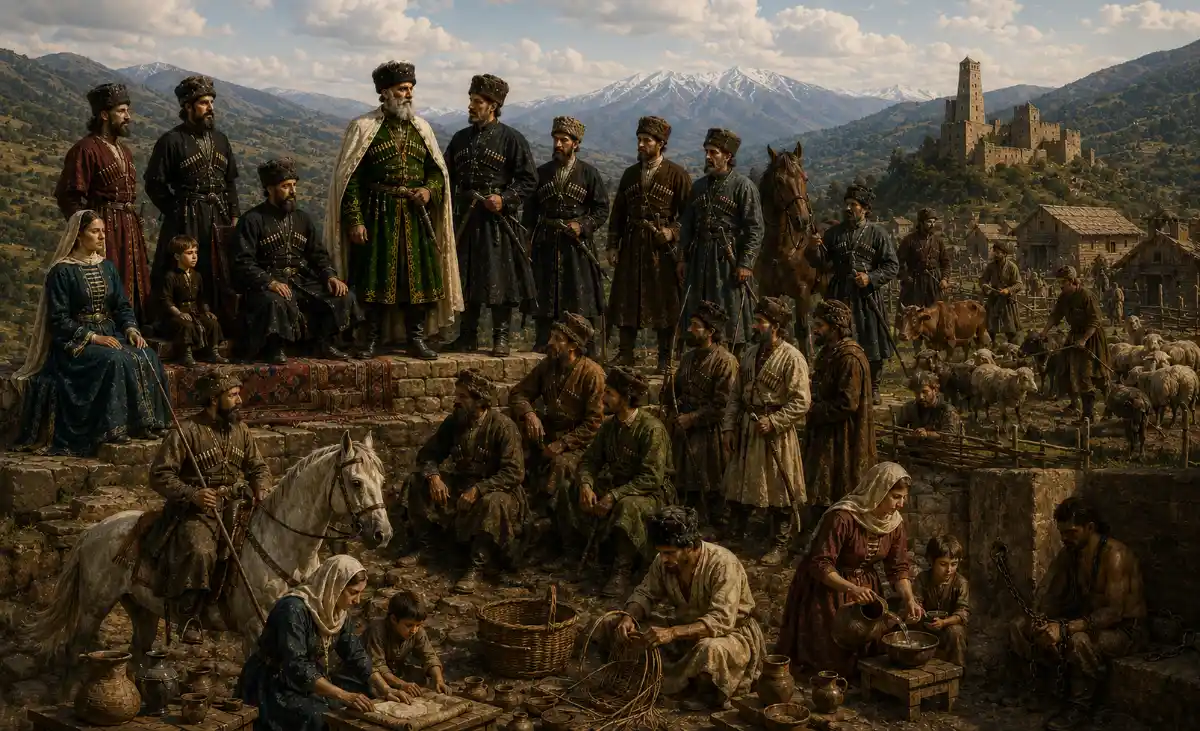
At the top of the hierarchy were the princes, called пщы (pshi). The Temirgoys had several princely lineages, but one, the Boletoko or Болэтыкъо line, held the position of senior prince and acted as the public face of the tribe in dealings with outsiders. The princely class was defined by descent. A man was a prince because his father and grandfather had been princes, and the line was traced patrilineally with great precision. Princely women carried high status but did not rule in their own names, although in practice some princesses exercised significant influence within their households and over their sons.
Below the princes were the nobles, called уэркъ (work, plural уэркъхэр). The noble class was itself stratified into several grades, from the immediate retainers of the princely households down to the lesser nobility who held only modest land and a small number of dependents. The nobles were the warrior class in the most direct sense. Their primary obligation was to provide armed service to their prince, and their primary social capital was their reputation in war and in feast.
The free commoners, called тфэкъо or sometimes тлъфэкъо, made up the bulk of the population. They were not serfs in the Russian or Polish sense. They held their own land, owned their own livestock, paid limited dues to the princely or noble household to which they were attached, and could in principle leave one patron and seek another, although in practice this happened rarely. Free commoners served in the cavalry alongside the nobles in time of war, although they typically went on lesser horses and with lighter equipment.
Below the commoners were several gradations of dependent and unfree people. The lowest of these were household slaves, often captives taken in raids against neighboring peoples or purchased from Crimean and Ottoman markets. Slavery in the Caucasus was a fact of life, and the Temirgoys were both buyers and sellers in the regional slave trade. The slaves who lived in Temirgoy households worked as domestic servants, herders, and field hands. Their conditions varied. Some were treated harshly, others were absorbed into the household and eventually freed.
A peculiar institution that ran across all these classes was the atalyk system. Atalyk fostering meant that a noble or princely child was sent at a young age to be raised by another family, often of slightly lower rank. The foster family bore the costs of the child's upbringing and education and gained, in return, a permanent bond of loyalty with the natural family. The system spread power and obligation horizontally across the society and made it difficult for any one lineage to become entirely isolated from the others. Most princely children of the Temirgoys were raised in noble households, and many noble children were raised among the free commoners.
Government and the tribal council
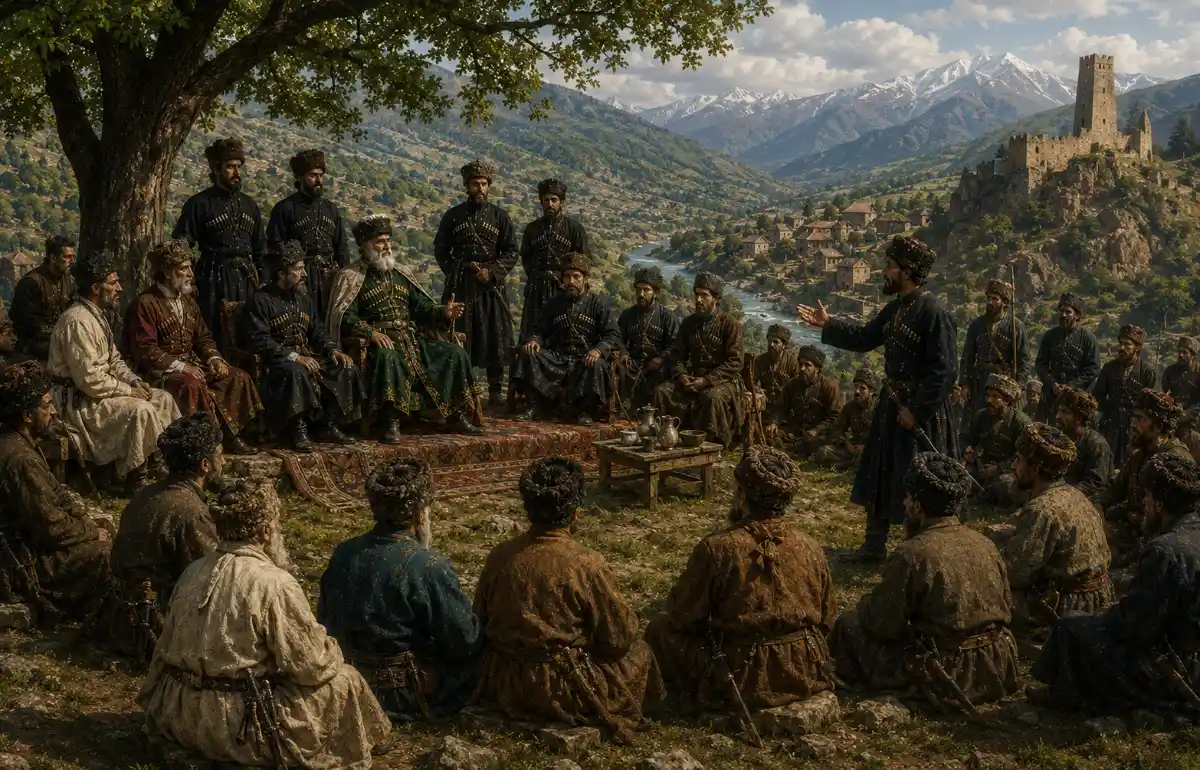
The Temirgoys did not have a king. They did not really have a single ruler in any consistent sense. What they had was a system in which the senior prince acted as a focal point for collective decision-making, advised by a council that drew on all the major lineages of the tribe and, in matters of unusual importance, ratified by an open assembly that any free man could attend.
The council itself was called the Хасэ (khase), and the term applies more broadly across all the Circassian tribes. Among the Temirgoys, the khase met in a defined place near the senior prince's residence, on a flat clearing that was kept clear of buildings for that purpose. Meetings were called when the situation demanded one, sometimes only once or twice a year, sometimes more often during periods of war or crisis. Princes spoke first, then senior nobles, then representatives of the free commoners. Speeches were expected to be measured. Shouting was considered shameful, and a man who lost his temper in council lost standing for years afterward.
The decisions reached in the khase were not always binding in the way a modern legislature's votes are binding. Adyghe political culture rested on consent and on the slow accumulation of consensus, and a decision that lacked broad support tended to fall apart quickly in practice. The senior prince could sometimes force matters by sheer authority, but only in narrow circumstances and at the cost of building up resentments that would eventually surface.
Justice and dispute resolution operated mostly outside the formal council structure. The Adyghe customary law, called Адыгэ Хабзэ (Adyghe Khabze), governed inheritance, marriage, blood feud, theft, and most other questions that would today be settled in courts. Khabze was unwritten, transmitted across generations by elders who served as living archives of precedent. Disputes were brought before respected elders for mediation, and the outcome was usually a negotiated settlement that combined material compensation with restoration of honor. Blood feuds existed and could last generations, but Khabze contained a parallel set of rituals for ending them, including elaborate reconciliation feasts where the offending and offended families ate together.
When the Temirgoys had to deal with outsiders, whether Crimean Tatars, Russians, Ottoman pashas, or other Circassian tribes, the senior prince usually represented the tribe, accompanied by a few senior nobles. Major treaties or alliances had to be ratified by the khase before they were considered binding. This made Temirgoy diplomacy slow and frustrating for the Russian and Ottoman officials who had to deal with them. A messenger sent to negotiate would routinely be told that a decision could not be made without summoning a council, and the council might take weeks to assemble and deliberate.
Religion and the long road to Islam
Temirgoy religious life passed through three broad phases over the course of recorded history, and the boundaries between them are blurry. The earliest layer was a system of pre-monotheistic beliefs centered on a high god called Тхьэ (Tha), a pantheon of subordinate deities associated with thunder, fertility, the hearth, and the hunt, and a set of seasonal rituals tied to the agricultural calendar. Sacred groves, springs, and standing stones marked the landscape, and certain rivers, including the Belaya, were considered to be inhabited by powerful spirits who had to be propitiated before any major undertaking.
Christianity reached the western Caucasus during the Byzantine period, brought by missionaries from the empire's Black Sea provinces. Some Circassian princes adopted Orthodox Christianity, and stone churches were built in several locations between the eighth and twelfth centuries. The ruins of some of these churches survived into the modern era. Among the Temirgoys, Christianity was a minority practice that coexisted with the older religion rather than replacing it. By the sixteenth century, both had been overlaid with elements borrowed from Islam, although Islam itself had not yet become dominant.
The conversion of the Temirgoys to Sunni Islam was a slow process that stretched across the seventeenth, eighteenth, and early nineteenth centuries. Crimean Tatar influence was probably the main initial vector, supplemented later by direct Ottoman missionary activity. The princely class converted earliest, in part because conversion offered diplomatic and trading advantages with the Crimean Khanate and the Porte. Conversion among the nobility followed, and the free commoners came to Islam last and most unevenly. Even at the moment of the Russian conquest in the 1860s, traces of pre-Islamic practice were still visible in Temirgoy life. Certain marriage rituals, certain harvest celebrations, certain protective charms hung over cradles, all carried forward elements that no orthodox Sunni teacher would have recognized as Islamic.
The form of Islam that took root among the Temirgoys was the Hanafi school, the same school that prevailed in the Ottoman world. There was no significant Shia presence and no substantial Sufi tariqat organization in the central Caucasus during the period in question. Religious authority was carried by mullahs trained in Crimea or in Anatolia, and the major life-cycle events, birth, marriage, and death, were marked by Islamic rituals layered onto older Adyghe forms.
The arrival of the Naqshbandi Sufi movement in the eastern Caucasus during the nineteenth century, associated with the long resistance of Imam Shamil in Daghestan and Chechnya, had echoes in the western Caucasus but never developed the same depth. The Temirgoys participated in the broader Caucasian resistance to Russian conquest, but their resistance was driven by tribal politics and by the defense of their land, not by a unified religious ideology of jihad in the sense Shamil's movement understood it.
Language and the Temirgoy literary dialect
The Temirgoys spoke, and still speak where they have preserved the language, the Temirgoy dialect of Adyghe, which is one of the four primary dialects of the West Circassian language. The other three are Bzhedug, Abadzakh, and Shapsug. East Circassian, also called Kabardian, is sometimes treated as a separate language and sometimes as a distant dialect group within the same Circassian whole, depending on the linguist.
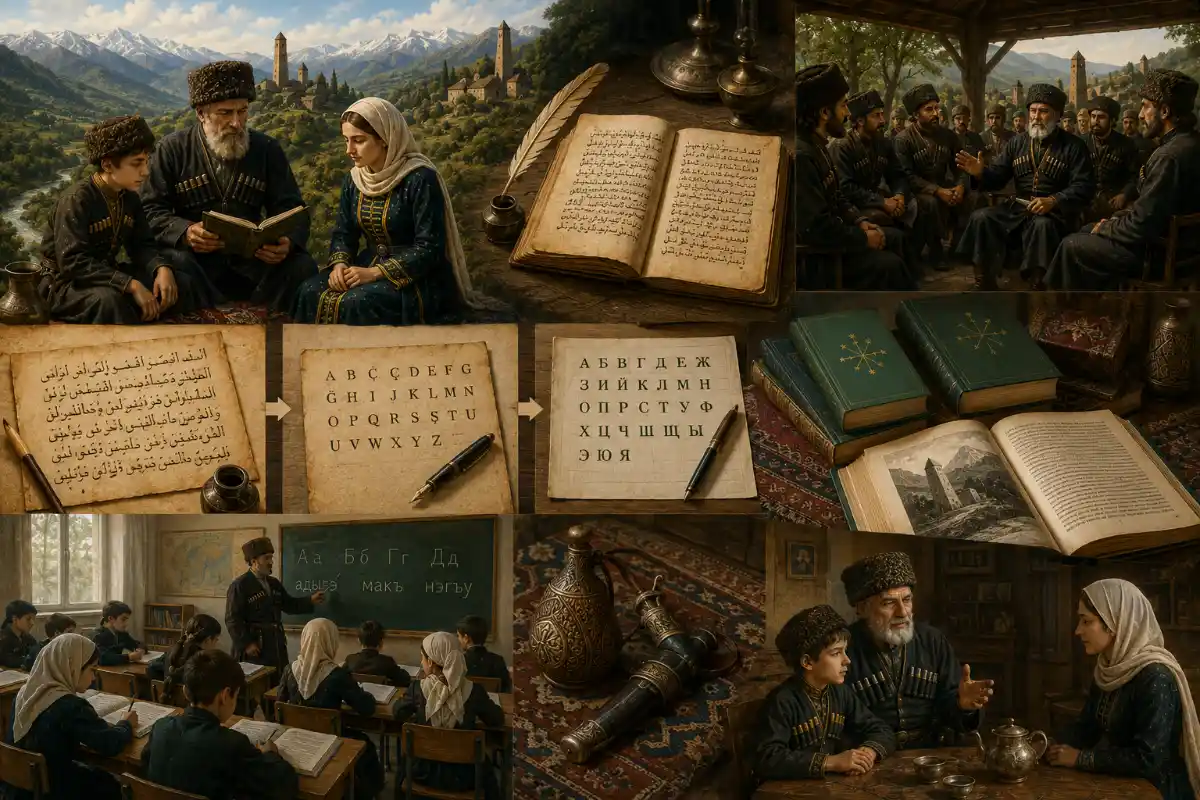
The Temirgoy dialect had several features that set it apart. Its consonant inventory was somewhat reduced compared to Shapsug and Abadzakh, with fewer ejective contrasts. Its vowel system was more transparent than the very compressed system found in some other Adyghe dialects. Its vocabulary preserved a number of older terms that had been lost or replaced in the western coastal dialects. For these reasons, when Soviet linguists in the 1920s set out to design a standard literary form of West Circassian, they chose the Temirgoy dialect as the base.
The choice was political as much as it was linguistic. The Temirgoys had been one of the two largest tribes to remain in the Caucasus after the post-conquest exile, alongside the Bzhedugs, and Temirgoy speech was widely understood across the surviving Adyghe population. The literary standard that emerged from this period is the language now used in Adygea's schools, newspapers, and broadcast media. It is not identical to spoken Temirgoy, but it is closer to Temirgoy than to any other dialect.
The first written form of Adyghe used a modified Arabic script, devised by educated mullahs and used mostly for religious and legal texts. The Soviet language reforms of the 1920s and 1930s replaced this with a Latin alphabet, which was in turn replaced by a Cyrillic alphabet in 1938. The current Cyrillic-based orthography is the one used in all official publications in Adygea. Diaspora communities in Turkey and Jordan have experimented over the years with Latin-based and Arabic-based alphabets, but no diaspora orthography has achieved general adoption.
The Temirgoy dialect today is in a complicated position. Inside Adygea, it is the basis of the literary language and is taught in schools, but daily use is shrinking under the pressure of Russian. In the diaspora, it is preserved at home in many families but is no longer the primary language of any community. Younger speakers in Turkey, Jordan, and Syria typically speak it less fluently than their grandparents, and language loss is a constant worry for cultural activists.
Traditional dress and material culture
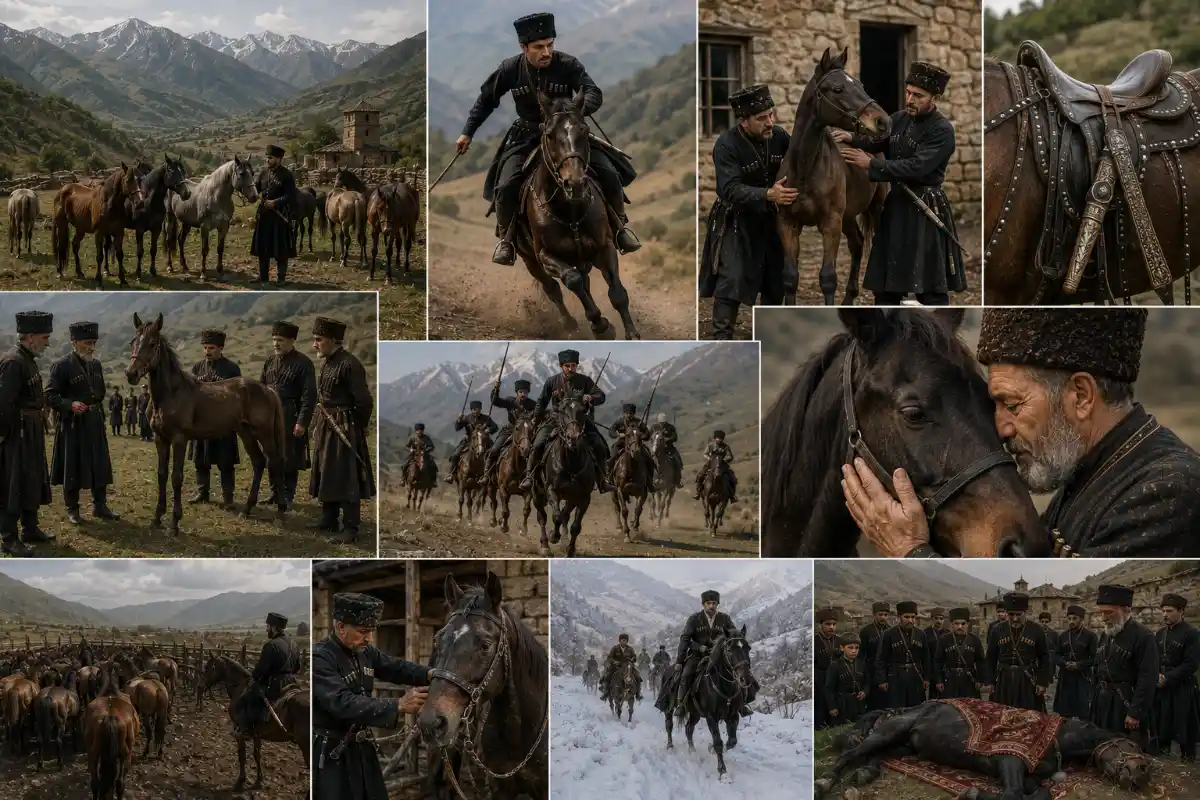
Temirgoy material culture shared most of its features with the broader Circassian world but had its own particular accents. The defining male garment was the cherkesska, the long-skirted coat with a row of cartridge pockets across the chest. The cartridge pockets, called gazyrs, originally held individual pre-measured powder charges for use with muzzle-loading firearms. By the late nineteenth century, when cartridge firearms had largely replaced muzzle-loaders, the pockets had become decorative, and the cherkesska had taken on the meaning of a national costume rather than a practical garment.
Under the cherkesska, men wore a tunic-like shirt called the бэшмэт, and over it, in cold weather, a heavy felt cloak called the бурка. The burka was wide enough to be wrapped around both rider and horse and was the standard sleeping cover during long campaigns or hunts. Felt boots in winter and softer leather boots in summer completed the outfit. Headgear was usually a tall sheepskin papakha for everyday wear, with a smaller felt cap reserved for hot weather.
Weapons were essential to a man's appearance in any public setting. A Temirgoy nobleman would typically carry a kindjal, the long double-edged dagger worn horizontally at the front of the belt, and a shashka, the slightly curved single-edged saber suspended from the belt on his left side. A pistol or two might be tucked into the belt as well, with a longer firearm carried slung across the back when the situation called for it. Decorating these weapons was a major industry, and the silver inlay and niello work produced by Temirgoy and other Circassian craftsmen was prized across the Caucasus and beyond.
Women's dress was more elaborate and more varied. The basic garment was a long dress, called the сай, often made of imported silk and worn over a shorter underdress and trousers. The sai had long sleeves that flowed almost to the floor and were lifted gracefully during dance. Silver belts, embroidered jackets, and tall conical caps with veils completed the formal costume. Embroidery was a central female craft, and the patterns used in Temirgoy embroidery formed a visual language of their own, with motifs that signaled clan affiliation, marital status, and ritual occasion.
Houses, as mentioned earlier, were built of wattle and daub on timber frames. Furniture was sparse. The main living space had a long bench along one wall for seating, a low table that could be brought out for meals, and a hearth with a chain-hung cauldron in the center. Carpets and felt rugs covered the floor and the benches. The walls were sometimes hung with weapons, both as decoration and for ready use. Wealthier households had separate guest houses, called кунацкая in Russian rendering, which were maintained at a higher standard than the family's own quarters.
Music, dance, and oral tradition
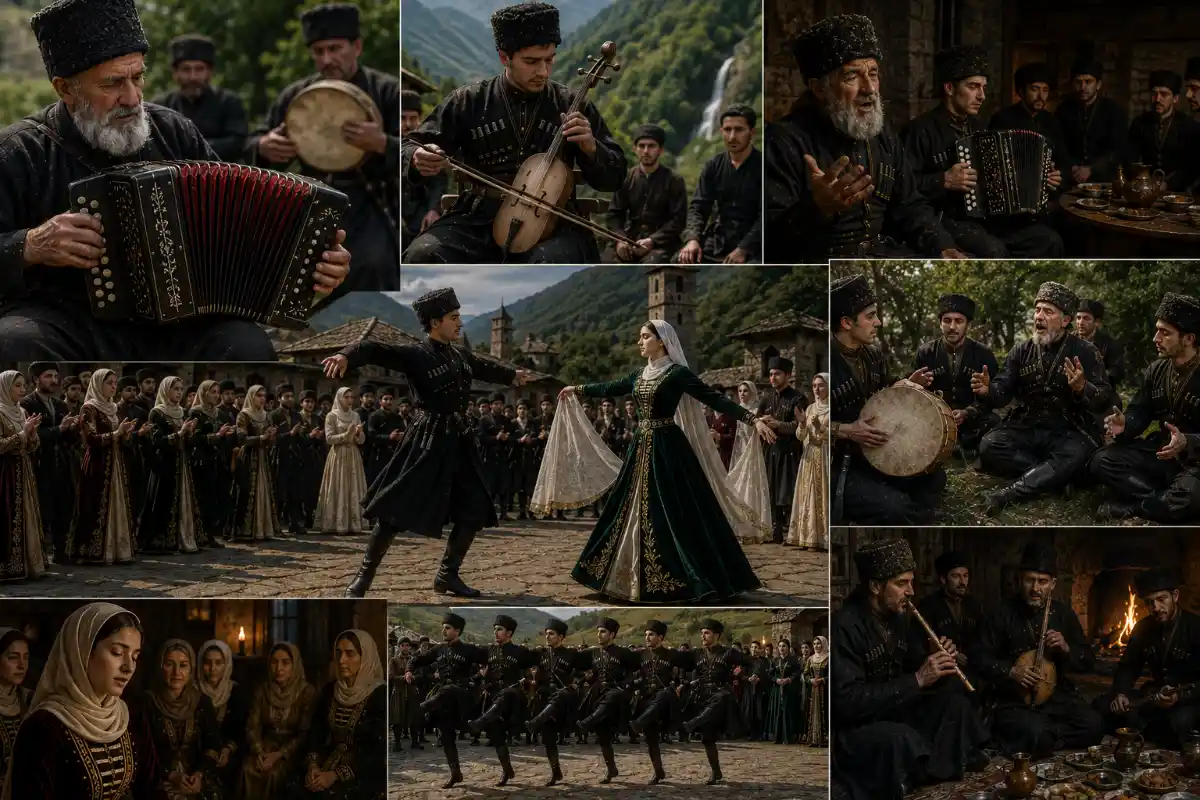
Temirgoy musical culture was rich, varied, and largely oral. The standard instruments were the пщынэ, a small accordion-like instrument that became dominant in the nineteenth century, the шычепщын, a bowed string instrument with a long neck and a small body, and a variety of drums and rattles. Older instruments, including a kind of long-necked lute and a wooden flute, fell out of regular use during the same period and survive today mostly as objects of revival interest.
The pshchyne, the small accordion, took over the role of the main melody instrument in a way that mirrors what happened across much of the Caucasus and the Black Sea region during the second half of the nineteenth century. Russian and Crimean traders brought button accordions into the area, and Adyghe craftsmen adapted the instrument to the local musical scale. By the 1900s, no Temirgoy wedding was complete without a pshchyne player, and the instrument had become so deeply identified with Adyghe music that people forgot it had ever been an import.
Dance was central to Temirgoy social life. The most important dance form was the исламэй, a fast, paired dance in which a man and a woman performed a stylized courtship without ever touching. The man's role was characterized by sharp, precise footwork and proud upright carriage. The woman's role was characterized by smooth, gliding movement, with the long sleeves of her dress used expressively. The dance carried strict rules about decorum and distance, and breaking those rules was taken as a serious affront.
Other dance forms included the уджи, a slower group dance often performed at the close of a wedding or major celebration, and various male solo dances that emphasized weapon handling, including dances performed with drawn shashkas in which the dancer would cut and parry against imaginary opponents in time with the music.
Oral literature was extensive. The Nart sagas, the great cycle of heroic tales shared across all the Caucasian peoples, were told in Temirgoy versions that had their own local heroes and their own particular narrative emphases. Praise songs for fallen warriors, called гыбзэ, were composed in the days following a death and performed at the funeral feast. Wedding songs, lullabies, and humorous songs about village life rounded out the repertoire. A trained тхьэусыхэ, a kind of professional singer-poet, could hold a hall in silence for hours while reciting from memory.
Cuisine
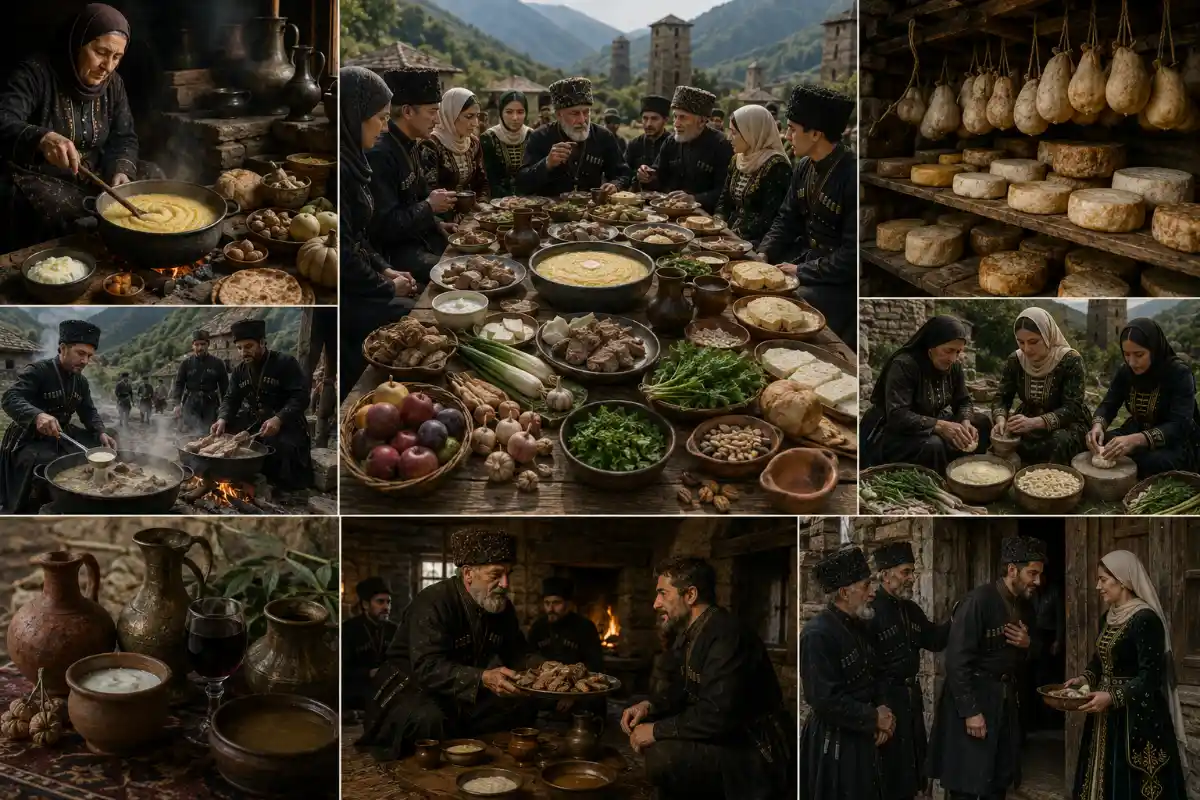
Temirgoy food was straightforward, hearty, and built around the products of mixed farming. The staple grain was millet, prepared either as a thick porridge called пасте or ground into flour for flatbreads. Maize, after its arrival in the seventeenth century, supplemented and partially replaced millet, and a stiff maize porridge similar to Italian polenta became a daily food. Wheat bread was made for festive occasions and for guests.
Meat was eaten less often than the modern reader might expect, given the reputation of Caucasian cuisine. Cattle, sheep, and goats were too valuable on the hoof to slaughter casually. Meat appeared at weddings, at funerals, at the major Islamic holidays, and at the visits of important guests. The standard preparation was boiling, not roasting, and a side of boiled lamb or beef would be served with a sharp garlic-and-sour-cream sauce called бжыныф and with paste, the millet or maize porridge mentioned above.
Dairy was central. Sour milk, soft cheeses, hard smoked cheeses, butter, and clarified butter were all made in quantity, and the smokehouse where hard cheeses were aged was a feature of every prosperous household. Vegetables included onions, leeks, garlic, beans, pumpkins, and a variety of greens both cultivated and gathered. Fruit was abundant in season, with apples, pears, plums, walnuts, and chestnuts featuring prominently.
Drinks varied. Water was the everyday standard. Sour milk diluted with water, called къундэпсо, was drunk in summer. A weak honey mead was made in some households, and in the southern parts of the territory wine was produced and drunk despite the gradual spread of Islamic prohibition. The Adyghe were never particularly enthusiastic about strict observance of the Islamic ban on alcohol, and even after the conversion was complete, wine and a kind of millet beer continued to appear at weddings and feasts in many areas.
Hospitality customs governed how food was served and eaten. A guest, even an unannounced and unrecognized one, was supposed to be fed without question and without being asked his business until after the meal was over. A host who served his guest meager fare lost standing. A guest who ate poorly insulted his host. The choreography of feeding a stranger was as elaborate and as carefully observed as anything else in Adyghe custom.
Military tradition and the way of war
Temirgoy military culture was built around the cavalry. Every adult free man was, in principle, a horseman and a warrior, and the cavalry was the heart of any Temirgoy military force. The horse itself was the central object of the warrior's life, and a man's reputation was tied closely to the quality of his mount, the precision of his horsemanship, and the bravery he showed in mounted combat.
A typical Temirgoy raiding party in the eighteenth and early nineteenth centuries was small, fast, and lightly equipped. Twenty or thirty riders, sometimes fewer, would set out at night, cover long distances at a measured pace, strike a target before dawn, and return home with whatever cattle, horses, or captives they had taken. Major campaigns, called for by the senior prince and ratified by the khase, involved larger forces, sometimes several hundred riders drawn from across the noble households of the tribe. Truly major operations, in which the Temirgoys joined with other Circassian tribes for a coordinated effort, could field a thousand or more horsemen.
The standard tactical approach combined a frontal feint with a flanking maneuver. A small force would engage the enemy directly, drawing his attention, while the larger force swung around to the flank or rear. Adyghe horses were trained to maneuver in tight formations and to respond to subtle weight shifts, allowing complex turns at high speed. The shashka, drawn at the moment of contact, was used to strike on a single rapid pass without slowing. Repeated charges, each lasting only seconds, could break a heavier but slower opponent.
Defensive war was different. When the territory itself was attacked, women and children were moved to fortified hill compounds, and the men gathered in concealment to attack the invading column at choke points along its line of march. Forest and mountain ambushes favored small, mobile parties, and the Temirgoy fighters became expert at this kind of fighting against larger, more conventional Russian forces during the long nineteenth-century war.
A separate strand of the military tradition was the practice of single combat. A man's individual reputation could be made or destroyed in single combat with a rival, and challenges, sometimes formal and sometimes spontaneous, were a recurring feature of life. The kindjal and the shashka, both of which required physical strength and trained reflexes, were the weapons of single combat. The expectation that a man might at any moment be called to defend his honor with his sword shaped almost every aspect of male behavior, from posture to speech.
The Russo-Circassian War
The Russo-Circassian War, which lasted from roughly 1763 to 1864, was the central catastrophe of Circassian history, and the Temirgoys were among the tribes most directly affected by it. The war had no single starting point and no single cause. It grew out of a slow Russian expansion southward across the Kuban steppe, an expansion driven by the Russian state's general project of consolidating its southern frontier and by the more specific desire to control the trade routes between the Black and Caspian Seas.
In the early decades of the conflict, the fighting was sporadic and localized. Russian forts were built on the line of the Kuban river. Cossack settlers were moved into the lands between the Don and the Kuban. Circassian raiders crossed the river to attack the Cossack stanitsas, and Russian and Cossack columns crossed back to burn Circassian villages. The Temirgoys, sitting just south of the river, were drawn into this pattern early. Their cavalry took part in many of the larger Circassian raids, and their villages absorbed several major Russian punitive expeditions.
The character of the war changed in the 1820s and 1830s. The Russian command, under generals including Yermolov and later Vorontsov, shifted from periodic punitive raids to a strategy of permanent military occupation and gradual displacement. New forts were built deeper into Circassian territory. A line of fortifications, called the Caucasus Line, was extended southward and reinforced. The war became continuous, and the casualties on both sides mounted.
The Temirgoys, like other Circassian tribes, were divided about how to respond. Some princely households favored accommodation with Russia, hoping to preserve at least some of their land and authority by accepting Russian sovereignty. Others, including most of the noble class, held out for resistance. The internal arguments over policy were sharp, and they sometimes led to assassinations and family feuds that overlapped with the larger war. Russian agents took advantage of these divisions, offering subsidies and titles to princes willing to come over, and using the converted princes to apply pressure on their kinsmen.
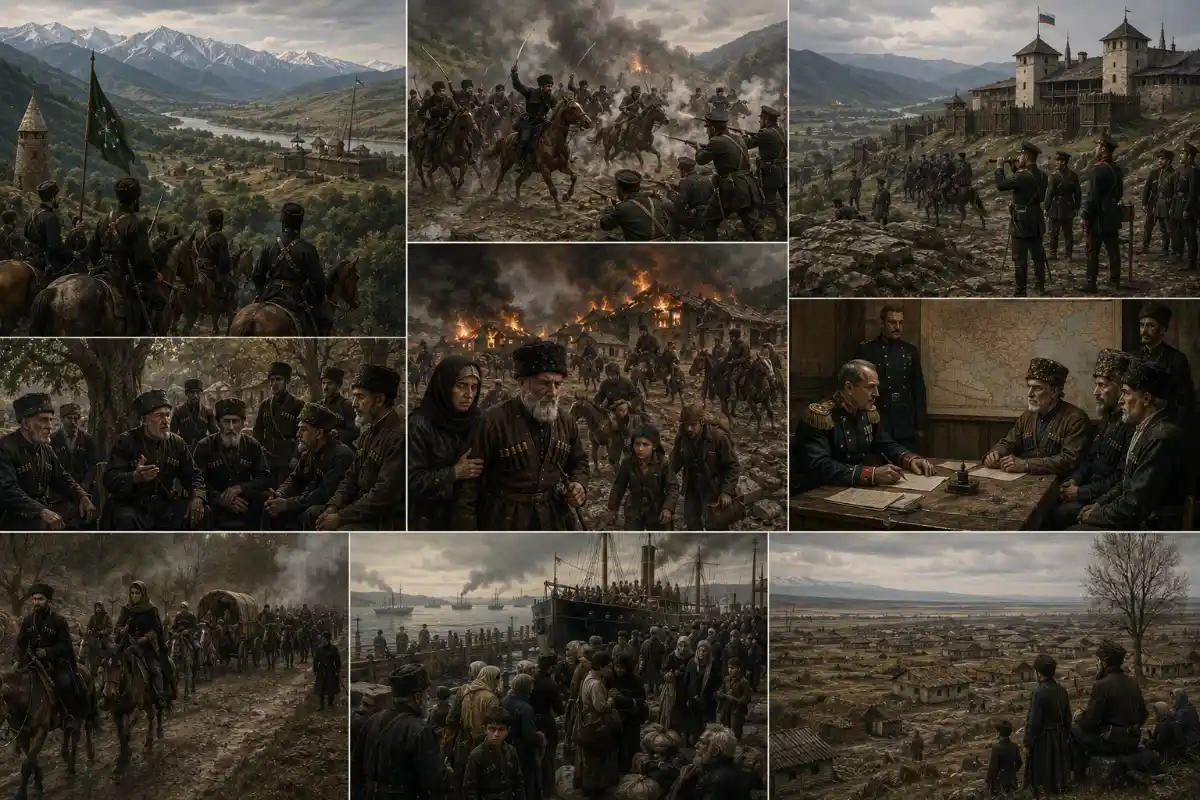
The collapse of the resistance came quickly once it began. By the late 1850s, the Russian army had completed the conquest of Daghestan and Chechnya in the eastern Caucasus, freeing up large forces for redeployment to the western theater. The Crimean War of 1853 to 1856 had briefly given the Circassians hope of British and Ottoman intervention, but the peace settlement after that war made it clear that no Western power would actively support them. The Russian command launched a systematic campaign against the western tribes in the early 1860s, advancing through the river valleys, burning villages, and forcing the inhabitants to choose between submission, deportation to the Kuban plains, or exile.
The final Russian operations against the Temirgoys took place in 1862 and 1863. By the formal end of the war in May 1864, declared by the Russians at a ceremony in Krasnaya Polyana, the Temirgoy population had been reduced by combat, disease, and exile to a small fraction of its prewar size. Most of the survivors had been forced into ships at the Black Sea ports and sent across to Ottoman territory. Those who remained were resettled in compact villages on the Kuban plains, far from their old territory in the foothills.
Exile and the Circassian Muhajirs
The mass deportation of the Circassian population at the end of the war is one of the largest single forced migrations of the nineteenth century, and it is a subject that historians have come to recognize, with increasing willingness, as a deliberate ethnic cleansing rather than a side effect of military operations. Estimates of the total number of Circassians who were forced from their homes vary widely, with most serious scholarship placing the figure between 800,000 and 1.5 million people, of whom perhaps a third died on the journey or in the squalid camps near the embarkation ports.
The Temirgoys were caught up in this exodus along with all the other western Circassian tribes. The major embarkation points were Anapa, Tuapse, Tsemes, and Sukhum. Refugees were herded to the coast on foot, often with no food or shelter for days at a time. At the ports, they waited in vast unsanitary camps for ships, many of which were old and overcrowded. Cholera and typhus spread through the camps, and the death rate was appalling. Ottoman ships, Russian ships, and a few foreign-flagged vessels carried the survivors across the Black Sea to Ottoman ports, primarily Trabzon, Samsun, and Sinop.
Once landed, the muhajirs, as they came to be called using the Arabic term for forced migrants, were resettled by Ottoman authorities according to imperial policy needs. The Ottoman state at the time was anxious to populate frontier zones with Muslim communities loyal to the Porte. The Circassian refugees were directed toward several regions: the Balkans, to reinforce Ottoman positions against Russian and Slavic pressure; Anatolia, to fill in pockets of underpopulated land; and the Levant, to settle the relatively empty zones east of the Jordan river.
Temirgoy communities settled in significant numbers in three Anatolian provinces: Düzce, Sakarya, and Samsun. In Düzce in particular, the Temirgoy population formed several distinct villages and one small town quarter, and the dialect persisted there into the late twentieth century. Other Temirgoy groups settled in Tokat, in Kayseri, in Adapazarı, and in scattered villages across the Marmara region. A second wave of resettlement in the late 1870s, following the Russo-Turkish War of 1877 to 1878, sent some of the Balkan-resettled Circassians, including Temirgoys, southward into the Levant, where they founded villages in what is now Jordan and Syria.
The Jordanian Circassian community is the most cohesive of the surviving diaspora communities. Jordanian Circassians, including descendants of Temirgoy families, have played a prominent role in the country's military and political life since the founding of the Hashemite Kingdom. The Royal Hashemite Court Guard, the elite ceremonial unit that protects the Jordanian royal family, has historically been composed largely of Circassian soldiers, and the Circassian community in Amman remains a recognized minority with its own cultural institutions and a degree of formal recognition in the constitutional structure.
In Syria, Temirgoy and other Circassian families settled in the Golan Heights and around Aleppo and Homs in the 1870s. The Syrian community was significant until the displacement caused by the Six-Day War of 1967, which depopulated the Golan villages, and then by the civil war that began in 2011, which scattered most of the remaining community across Europe, North America, and back to Russia.
Women's lives and the role of the household
Almost every account of Temirgoy life that has come down to us was written by men, about men, for men. The princes, the warriors, the council speakers, and the sword-makers are the figures who appear in the records. The other half of the population, who carried out the daily work of the household, raised the children, managed the dairy and the kitchen garden, and held together the social fabric of the community, are mostly absent from the written sources. What can be reconstructed about Temirgoy women's lives has to be pieced together from oblique references, from ethnographic surveys carried out in the early Soviet period, and from the memories preserved in diaspora communities.
A Temirgoy woman's life was shaped from birth by clan obligations and by a strict code of public behavior. Girls in princely and noble families were raised by their atalyk foster mothers and were taught the skills considered appropriate to their station: embroidery, dress-making, dairy work, the management of a household staff, the recitation of poetry, and the formal etiquette of receiving guests. Girls in commoner families learned essentially the same skills with less ceremony and at a more demanding pace, since their household labor was needed earlier and harder.
Marriage was negotiated between families, with the bride's consent expected but not always central to the discussion. Bridewealth was paid by the groom's family to the bride's family, and the size of the bridewealth was a matter of considerable public attention. Marriages within the Temirgoy nobility frequently involved very large sums, with horses, cattle, weapons, and silver-mounted goods all changing hands. Marriages between commoners involved smaller exchanges but were still substantial relative to family resources. The actual wedding was a multi-day event that drew in the entire extended kinship network and might involve hundreds or thousands of guests.
Once married, a woman moved to her husband's household and entered a new and complicated set of relationships with her mother-in-law, her sisters-in-law, and the senior women of the husband's lineage. The mother-in-law in particular held substantial authority over the daily life of a young bride, and the relationship was the subject of countless songs, jokes, and cautionary tales in Adyghe oral tradition. A bride who could win her mother-in-law's approval was set up for a relatively comfortable life. A bride who could not faced years of friction.
Public behavior was governed by elaborate codes of modesty and reserve. A married woman did not address her husband by his given name in public. She did not eat at the same table as adult male guests. She did not, except in very specific ritual contexts, dance with her own husband or sit beside him in mixed company. These restrictions were not signs of subordination in the simple sense, although they certainly contained elements of it. They were elements of a broader system in which everyone, men included, was expected to maintain a high degree of formal restraint in public, and the slightest deviation from the code was noticed and remembered.
Within the household, women's authority was substantial. The kitchen, the dairy, the storehouse, the loom, and the kitchen garden were her domain. The decisions about how to allocate household resources, how to feed the family through the lean months of winter, how to organize the labor of the daughters, the daughters-in-law, and the household servants, were hers to make. A capable Temirgoy housewife, particularly the matriarch of an extended household with several married sons under one roof, was a figure of real economic and social weight.
Women also played important roles in the maintenance of inter-household relationships. Visits between the women of different households, with their accompanying gift-exchanges and ritual hospitality, knit together the kinship networks that the men's councils and feasts also relied on. The mediation of disputes, particularly disputes that had not yet escalated to a level requiring formal council action, often happened first through the women of the families involved.
The Russo-Circassian War and the deportation broke this system in ways that took generations to recover from, and in many ways the recovery is still incomplete. In the chaos of the exile, families were separated, household compounds were destroyed, and the elaborate networks of obligation and exchange that women had maintained were torn apart. Diaspora communities reconstructed parts of the system in their new homes, but the conditions had changed, and the role of women in those communities evolved differently from the way it would have evolved in the homeland.
Horse breeding and the cult of the mount
If there is one feature of Temirgoy life that gets disproportionate attention in nineteenth-century sources, it is the horse. European travelers, Russian officers, Ottoman ambassadors, and Persian merchants who passed through Temirgoy territory all wrote about the horses they saw. The praise was so consistent across so many different observers that it is difficult to dismiss as cliché.
The Temirgoys bred a particular type of saddle horse adapted to the conditions of the central Caucasus. The horses were medium-sized, hardy, surefooted in mountain terrain, capable of long distances on poor forage, and reliably even-tempered under combat conditions. They were not particularly fast in a sprint and were not bred for the kind of long-legged elegance that European cavalry preferred. What they offered was the practical combination of stamina, intelligence, and durability that the Caucasian way of war required.
Bloodlines were tracked carefully across generations. Each major noble household maintained its own breeding stock, and the choice of which mare to put to which stallion was a matter taken seriously. Foals born to the leading bloodlines were tracked and tested as they grew. A young horse that showed the right qualities was selected for further training and might command extraordinary prices when sold. A young horse that fell short was sent to less demanding work or sold off cheap.
Training began at a young age and was extensive. A horse intended for the saddle of a noble or a prince had to be steady under fire, responsive to subtle weight shifts, capable of executing tight turns at speed, willing to stand quietly during long ambushes, and able to recover quickly from bursts of exertion. The training was carried out by specialist horsemen who lived with the horses for months at a time and who developed close working relationships with the animals.
The Kabardian breed, which is now considered the standard saddle horse of the Caucasus, drew heavily on Temirgoy bloodstock during its formation in the nineteenth and early twentieth centuries. After the deportation, much of the surviving Temirgoy breeding stock was absorbed into the Kabardian breeding program, and the distinct Temirgoy line was effectively merged into the Kabardian one. Modern attempts to identify a separate Temirgoy strain are mostly speculative, although a few breeders in Adygea and in the Turkish diaspora have tried to reconstruct a separate line from the available genetic material.
The relationship between a Temirgoy man and his horse went well beyond the practical. Horses had names, were addressed in conversation, were mourned when they died, and were sometimes buried with honors that approached those given to human relatives. Stories about particularly famous horses circulated in oral tradition. A horse that carried its rider home through a snowstorm or out of an ambush became, in the telling of the story, a character with personality and motives. The cult of the mount was real, and it shaped the way Temirgoys thought about themselves.
Notable families and clans
Naming all the prominent Temirgoy families would be impossible in any single article, but a handful of lineages stand out for the role they played in tribal history.
The Boletoko or Болэтыкъо family was the senior princely line. Members of the Boletoko family acted as the primary representatives of the Temirgoys in dealings with Russia, Crimea, and the Ottoman Empire from the seventeenth century onward. The last Boletoko prince to hold real political authority was killed in the final campaigns of the Russo-Circassian War, and the surviving members of the family were among those exiled to Ottoman territory. Descendants of the line are documented today in Turkey and in Jordan.
The Janchate or Джанчатэ family was a major noble lineage and produced a number of well-known military leaders during the nineteenth century. The Janchate cavalry, raised from the family's own retainers, was considered one of the most disciplined small mounted forces in the western Caucasus during the 1840s and 1850s.
The Khatkh or Хьатх clan was another major noble lineage, with branches that extended across several Adyghe tribes. The Khatkhs were known particularly for their skill in metalwork and in the production of weapons. The decorated kindjals and shashkas signed by Khatkh smiths were prized possessions across the Caucasus and are now collector's items in museums and private collections from Tbilisi to Istanbul.
Other families of note include the Хьанэхъу (Khanakhu), who produced several respected scholars and religious leaders; the Шумахуэ (Shumakhua), known for horse breeding; and the Лэупэкlэ (Leupekle), who provided several of the senior military commanders during the late phase of the resistance. The full genealogical tradition of the Temirgoy nobility is complex, partially preserved in oral memory, and gradually being reconstructed by Adyghe historians and diaspora researchers.
For people interested in their own family history, online tools have begun to make the work of tracing Temirgoy ancestry easier. Family Name Databases and Family Tree Builder projects organized by Circassian cultural associations in Adygea, Turkey, and Jordan now hold tens of thousands of records, and they continue to grow as more diaspora families contribute their oral and written records.
Famous Temirgoys through history
The historical record preserves more names from the Temirgoy past than this article can fully cover, but a handful of figures stand out as worth describing in some detail. The list is not exhaustive, and it skews heavily toward men and toward the nineteenth century, simply because those are the people whom written sources tend to record.
Aytek Boletoko (Айтек Болэтыкъу), active in the late eighteenth and early nineteenth century, was the senior Temirgoy prince during the period when Russian pressure on the central Caucasus was beginning to intensify. He is remembered in oral tradition as a skilled diplomat who managed to keep his tribe out of open war with Russia for nearly two decades while also organizing the internal arrangements needed to fight when the time came. His decisions divided opinion within the tribe even in his own lifetime, and they continue to divide opinion among Adyghe historians today.
Jambolet Boletoko (Джамболэт Болэтыкъу), Aytek's nephew and successor, took the tribe in a more openly resistant direction during the 1820s and 1830s. He coordinated several large joint operations with the Bzhedugs and Abadzakhs against Russian columns moving south from the Kuban line. He was wounded twice in combat and is said to have ridden the last of those engagements with one arm in a sling. His death in 1842, in a clash whose details are still disputed, was mourned across the western Caucasus.
Khadji Berzeg, who was actually a Shapsug rather than a Temirgoy but who held one of the senior commands of the broader Circassian resistance in its final years, worked closely with the Temirgoy noble families during the campaigns of 1862 and 1863. His name appears in Temirgoy oral tradition almost as often as in Shapsug tradition, and his strategic decisions during the collapse of the resistance shaped what happened to the Temirgoy survivors.
Sefer Bey Zan, another non-Temirgoy who nonetheless played a significant role in Temirgoy history, was the chief Circassian envoy to the Ottoman court during the Crimean War and the years afterward. He spent significant time in Temirgoy territory organizing local levies and negotiating with princely households about Ottoman support. His efforts ultimately failed to secure substantive military aid, but his diplomatic memoranda are among the better sources for understanding the internal politics of the western Adyghe tribes in the 1850s.
Among the diaspora figures, several names recur in the historiography. Ahmed Tsey, a Temirgoy émigré who settled in Anatolia after 1864, became one of the first Adyghe-language writers in the late Ottoman period and produced a small body of poetry and political prose that has been republished in Adygea since the 1990s. Yusuf Izzet Pasha, an Ottoman general of Temirgoy ancestry who served in the Balkan and First World Wars, was a prominent figure in Circassian diaspora politics in the early twentieth century. Members of the Boletoko line who reached Jordan in the 1870s were among the founding families of the Circassian community in Amman and produced several officers who served the Hashemite military.
In contemporary times, Temirgoy-descended figures have continued to appear in public life across multiple countries. In Adygea, writers, scholars, and politicians of Temirgoy origin have been prominent in the cultural revival of the post-Soviet decades. In Turkey and Jordan, descendants of Temirgoy families serve in academic, military, and political roles, often without highlighting their tribal background but sometimes carrying it as a quiet point of identity. A full biographical catalogue would run to many pages, and Adyghe cultural associations in Adygea, Istanbul, and Amman continue to compile and update such records.
The Temirgoy tamga
A tamga is a heraldic symbol, a small abstract mark used to identify property, livestock, and family. The Adyghe word for it is дамыгъэ. Every Circassian noble family had one. Every clan had one. Some princely lines had several, used in different contexts.
The Temirgoy tamgas, like Adyghe tamgas more generally, are made up of a small number of basic geometric elements: lines, curves, hooks, crossbars, and circles. The simpler tamgas are essentially abstract, while the more elaborate ones include figurative elements that may suggest weapons, agricultural tools, or ritual objects. A tamga was branded on horses, carved on the gateposts of family compounds, painted on shields and battle banners, and incised on the headstones of family members.
The exact tamgas of the various Temirgoy families have been partially preserved through several channels. Surviving examples are still visible on old gravestones in the cemeteries of Adygea, on family heirlooms, and in the records that some princely and noble families maintained during the Ottoman period and brought with them into exile. Cultural societies in Maikop, Istanbul, and Amman have collected and published catalogues of the surviving tamgas, although the documentation is uneven and many designs have probably been lost.
In the diaspora, the tamga has taken on a new role as a symbol of identity. It appears on jewelry, on tattoos, on the facades of cultural centers, and on the printed materials of family associations. For a community that has spent six generations away from its original land, the small abstract marks that once branded a horse have come to mean something larger: the persistence of the family across distance and across time.
Modern Adygea and the surviving Temirgoy community
The Republic of Adygea is a small federal subject of the Russian Federation, located within Krasnodar Krai. It was established in its current form in 1991, succeeding the Adyghe Autonomous Oblast that had existed within Krasnodar Krai during the Soviet period. The republic's capital is Maikop, and its total population is about 463,000, of whom roughly a quarter identify as ethnically Adyghe.
The Adyghe population of the republic is a mixture of the surviving members of all the western Circassian tribes, including Temirgoys, Bzhedugs, Abadzakhs, Shapsugs, and others. Tribe identity remains real but is now overlaid with a unified Adyghe national identity that has grown stronger since the late Soviet period. People in Adygea today often know which tribal lineage their family belongs to, but they also identify simply as Adyghe in most public contexts.
The Temirgoy community within Adygea is concentrated in the central and eastern districts of the republic, in villages such as Khakurinokhabl, Khodz, and Ulyap. The Temirgoy dialect, in its standardized literary form, is the basis for instruction in Adyghe-language schools and for broadcasts on the republic's Adyghe-language television and radio. Newspaper publications, including the daily Adyghe Mak, are produced in this standard.
Cultural revival has been active since the late 1980s. Folk dance ensembles, choral groups, weaving and embroidery cooperatives, and historical reenactment societies have all emerged or expanded. The Russian and republican governments have supported some of these initiatives, although funding is uneven and dependent on changing political conditions.
A persistent issue in modern Adygea is the question of repatriation. The Russian Federation legally allows the descendants of the Circassian exiles to return and apply for citizenship, but the practical barriers, including bureaucratic difficulty, the cost of relocation, and the limited economic opportunities in the republic, have meant that the actual flow of returnees has been a trickle rather than a wave. Most of those who have returned have come from Syria following the outbreak of the civil war there in 2011, with a smaller stream from Turkey and Jordan over the years.
Cultural legacy and the question of memory
What does it mean for a people to survive a near-total displacement, scatter across half a dozen countries, and try to keep a coherent identity for a hundred and sixty years? The Temirgoy story is one answer, and not necessarily an encouraging one in every respect.
On the one hand, the survival of the Temirgoy dialect as the basis of literary Adyghe, the persistence of family names and tamgas in the diaspora, the continued performance of traditional dances at weddings in Düzce and Amman, the active work of cultural associations in three continents, all point to a real continuity. The Adyghe nation did not vanish in 1864, and the Temirgoys did not vanish either.
On the other hand, language loss is real and accelerating. Most younger Adyghe in the diaspora speak Turkish, Arabic, or English better than they speak Adyghe. The villages of central Anatolia where Temirgoy was the language of daily life within living memory are now functionally Turkish-speaking. Even in Adygea, Russian dominates the public sphere, and the use of Adyghe at home is declining slowly but visibly.
The recovery of historical memory has been one of the most active fronts of Adyghe cultural work over the past three decades. Archives in Russia, Turkey, and elsewhere have been opened to a degree that was not possible during the Soviet period. Family histories, long preserved only orally, are now being written down. The events of the 1860s, which were taboo in Soviet historiography for political reasons, are now openly discussed and commemorated, with May 21 observed each year as a day of mourning for the victims of the deportation.
Younger Adyghe activists have pushed, with varying success, for the official recognition of the events as a genocide, both by the Russian Federation and by international bodies. The political obstacles to this recognition are substantial, and the question is unlikely to be resolved soon. But the work of documenting what happened, naming the lost, and building the institutional infrastructure for cultural survival continues, both inside Adygea and across the diaspora.
For an outside observer, the Temirgoys are interesting partly because their history poses, in unusually sharp form, a question that applies to many smaller peoples in the modern world. What do you owe to a heritage you can choose to remember or forget? What does it mean to be from a place you have never seen and may never visit? How long can a community sustain itself when its members live thousands of kilometers apart, in countries with different languages and different priorities, connected only by family memory and the slow work of cultural institutions?
The Temirgoys have not answered these questions definitively, and probably no one ever can. But the people who carry the name today, in Maikop and Istanbul and Amman and farther afield, continue to live the answer in practice. They marry, they bury, they raise children, they teach the old dances, they argue about how the old language ought to be spelled. They are still here.
Frequently asked questions
Who are the Temirgoys?
The Temirgoys, or Kemguy in their own language, are one of the twelve historical Circassian tribes of the North-West Caucasus. They lived primarily on the plains and foothills between the Laba and Belaya rivers, in what is now the Republic of Adygea in the Russian Federation. They were known for their cavalry, their strict adherence to Adyghe customary law, and their position at the political center of the western Circassian world.
What is the difference between "Temirgoy," "Kemguy," and "Chemguy"?
These are three names for the same people. "Temirgoy" is the older Russian and European form, probably from a Turkic compound meaning "iron clan." "Kemguy" is the Adyghe term used by the people themselves, written Кlэмгуй in modern orthography. "Chemguy" is a French and English transcription attempt at the Adyghe pronunciation. The Turkish-language form "Çemguy" is also widely used in the diaspora.
Where did the Temirgoys live?
The Temirgoy homeland was in the central part of the North-West Caucasus, on the rolling plains and foothills between the Laba (Лабэ) and Belaya (Шъхьэгуащэ) rivers, with the Pshish river forming the western edge of their territory. This area falls within the modern Republic of Adygea.
What language did the Temirgoys speak?
The Temirgoys spoke the Temirgoy dialect of Adyghe (West Circassian), which is one of the four main dialects of that language. The Temirgoy dialect was chosen by Soviet linguists in the 1920s as the basis for the standard literary form of Adyghe, which is still used today in schools, newspapers, and broadcasts in Adygea.
What religion did the Temirgoys follow?
The Temirgoys passed through three broad religious phases: a pre-monotheistic native Adyghe religion centered on the high god Тхьэ (Tha), a period of Byzantine-influenced Christianity that coexisted with the older religion, and finally a conversion to Sunni Islam (Hanafi school) that took place gradually between the seventeenth and early nineteenth centuries. Most Temirgoy descendants today identify as Sunni Muslim.
What happened to the Temirgoys after the Russo-Circassian War?
After the formal end of the war in 1864, the vast majority of Temirgoys were forcibly deported to the Ottoman Empire as part of a larger ethnic cleansing of the Circassian population. The survivors of the journey were resettled across Anatolia, the Balkans, and the Levant. A smaller number remained in compact villages on the Kuban plains under Russian rule, separated from their original highland territory.
Where do the Temirgoys live today?
The largest concentrations of people of Temirgoy descent today live in Turkey (especially in Düzce, Sakarya, and Samsun provinces), Jordan, and the Republic of Adygea in the Russian Federation. Smaller communities exist in Syria, Israel, Germany, the United States, and several other countries. The community in Jordan, while small in absolute numbers, is particularly cohesive and well-organized.
Is "Kemguy" the same as "Adyghe" or "Circassian"?
No. "Adyghe" is the broader name for the people whom outsiders call "Circassian," and the Adyghe nation is made up of twelve historical tribes, of which the Temirgoys (Kemguy) are one. All Temirgoys are Adyghe, but not all Adyghe are Temirgoys. The terms "Circassian" and "Adyghe" are often used interchangeably in English, but in the strictest sense "Circassian" can refer either to the western Adyghe specifically or to the entire Adyghe-Kabardian language family.
What is a tamga, and do the Temirgoys still use them?
A tamga (дамыгъэ) is a small abstract heraldic symbol used by Circassian noble and clan families to mark property, livestock, and gravestones. Every major Temirgoy family had its own tamga. The tradition declined dramatically after the deportation, but it has been revived in recent decades as a symbol of identity, and tamgas now appear on jewelry, tattoos, and the printed materials of cultural associations.
How can I find out if I have Temirgoy ancestry?
The most reliable starting point is family oral tradition: ask older relatives whether they remember their family being identified as Temirgoy, Kemguy, or Çemguy. Adyghe cultural associations in Adygea, Turkey, and Jordan maintain genealogical databases that record family names, village origins, and tribal affiliations. DNA testing alone is not very useful for tribe identification, since all Adyghe groups share closely related genetic profiles.
Are the Temirgoys recognized as an indigenous people?
Within the Russian Federation, the Adyghe people as a whole are recognized as indigenous, and the Republic of Adygea is officially designated as their titular homeland. Tribal subdivisions like the Temirgoys are not separately recognized in Russian law, but they are recognized in cultural and academic contexts. International recognition of Circassians as victims of the nineteenth-century ethnic cleansing varies by country.
What does "Adyghe Xabze" mean?
Adyghe Xabze (Адыгэ Хабзэ), sometimes spelled "Khabze," is the traditional unwritten code of customary law and behavior that governs Adyghe social life. It covers hospitality, family obligation, dispute resolution, the conduct of feasts and councils, marriage and inheritance, and many other areas. It is still respected in many Adyghe communities, both in Adygea and in the diaspora, although it now coexists with the formal legal systems of the countries where Adyghe people live.
Resources and further reading
The literature on the Temirgoys, and on the Circassian people more broadly, is scattered across several languages and traditions. The following pointers may be useful for readers who want to explore the subject more deeply. None of these recommendations should be taken as exhaustive, and serious researchers should consult specialized bibliographies in the relevant languages.
For the general history of Circassia, Walter Richmond's two-volume study, "The Northwest Caucasus: Past, Present, Future" (2008) and "The Circassian Genocide" (2013), is the most accessible recent treatment in English. Paul Henze's earlier work on the Caucasus, although somewhat dated, remains useful for context. Charles King's "The Ghost of Freedom: A History of the Caucasus" (2008) provides a broader regional framing.
For Russian-language sources, the Adyghe Republican Institute of Humanitarian Studies (ARIGI) in Maikop is the central scholarly institution, and its published proceedings and journal articles are the standard reference for academic work on Adyghe history. Soviet-era ethnographies, while colored by the ideological assumptions of their time, contain detailed field data that has not been collected at the same level since. The work of L. I. Lavrov on Adyghe folklore and ethnography is particularly valuable.
In Turkish, the Kafkas Vakfı (Caucasus Foundation) in Istanbul has published a substantial body of work on the diaspora experience, including memoirs, family histories, and academic studies. Cumhur Bal's work on the Anatolian Circassian settlements is widely cited. The journal Nart, published in Turkish, runs regular features on tribal history, language, and culture.
In Arabic, the Jordanian Circassian community has produced a small but growing literature on its own history, much of it focused on the settlement period and the role of Circassians in the founding of the Hashemite state. The Circassian Charity Association in Amman maintains an archive of family records and oral histories.
Primary sources are scattered across several archives. Russian military and diplomatic archives in Moscow and Saint Petersburg contain extensive records of the eighteenth- and nineteenth-century Russian-Circassian engagement, although access has become more difficult since 2022. Ottoman archives in Istanbul hold the documentation of the resettlement period. Smaller collections exist in Tbilisi, Sofia, and various provincial archives across the former Ottoman territories.
For people interested in the Adyghe language itself, the standard introductory textbook is Mukhadin Kumakhov's grammar of Kabardian and West Circassian, available in Russian and partial English translations. Online resources have grown rapidly in the past decade, and several Adyghe-language podcasts, YouTube channels, and language-learning apps are now active. The literary form based on Temirgoy is the most accessible entry point for new learners.
For genealogical research, family-tree databases maintained by Circassian associations in Adygea, Turkey, Jordan, and the international diaspora are the best starting points. Several online projects have begun to digitize Ottoman population registers from the resettlement period, which can be matched with family oral tradition to reconstruct migration histories. The work is slow, but it is the most direct path for descendants who want to trace their specific Temirgoy lineage.
For cultural revival and contemporary issues, the Circassian World website and several diaspora-led organizations maintain news coverage and analysis in English, Russian, Turkish, and Arabic. The annual May 21 commemorations of the deportation are widely covered each year, and the speeches and writings produced around those events offer a window into how the community itself frames its own history and aspirations.
A final note: much of the most important knowledge about the Temirgoys is not in books or archives at all. It lives in the memory of older relatives, in the songs sung at weddings, in the way certain phrases are still pronounced in households that have otherwise switched to Turkish or Arabic or Russian. For descendants of the tribe, the best resource is often the oldest living member of the family, recorded carefully while there is still time.
Conclusion
The Temirgoys are, in one sense, a historical tribe that no longer exists as an independent political entity. Their princes are gone. Their tribal council does not meet. Their independent territory was absorbed into the Russian Empire more than a century and a half ago, and the modern Republic of Adygea, which holds the largest concentration of their descendants, is a constituent part of the Russian Federation rather than a Circassian state.
In another sense, the Temirgoys are very much alive. The literary form of the West Circassian language is theirs. The most prominent dance forms of the Adyghe cultural revival are theirs. The descendants of their princely and noble families are present in the public life of three continents, sometimes prominently, more often quietly. The customs of hospitality, the rules of guest etiquette, the patterns of embroidery on a wedding dress, the phrases of poetry that older relatives still remember, all carry the trace of a tribe that the official histories often treat as a closed chapter.
Whether the Temirgoy identity will continue to find new expressions in the next generation is an open question. The forces working against it, language attrition, intermarriage, geographic dispersion, the relentless pressure of dominant cultures, are real. The forces working for it, family memory, cultural pride, the work of activists and institutions, the simple stubbornness of people who refuse to let go of who their grandparents were, are also real.
For now, the name remains. Темыргой. Кlэмгуй. The iron clan. The people of Kemguy. The story is not finished.