How to Build a Circassian Family Tree: Step-by-Step Guide
Circassian Family Tree — Adyghe Ancestry, Genealogy & Tribal Heritage
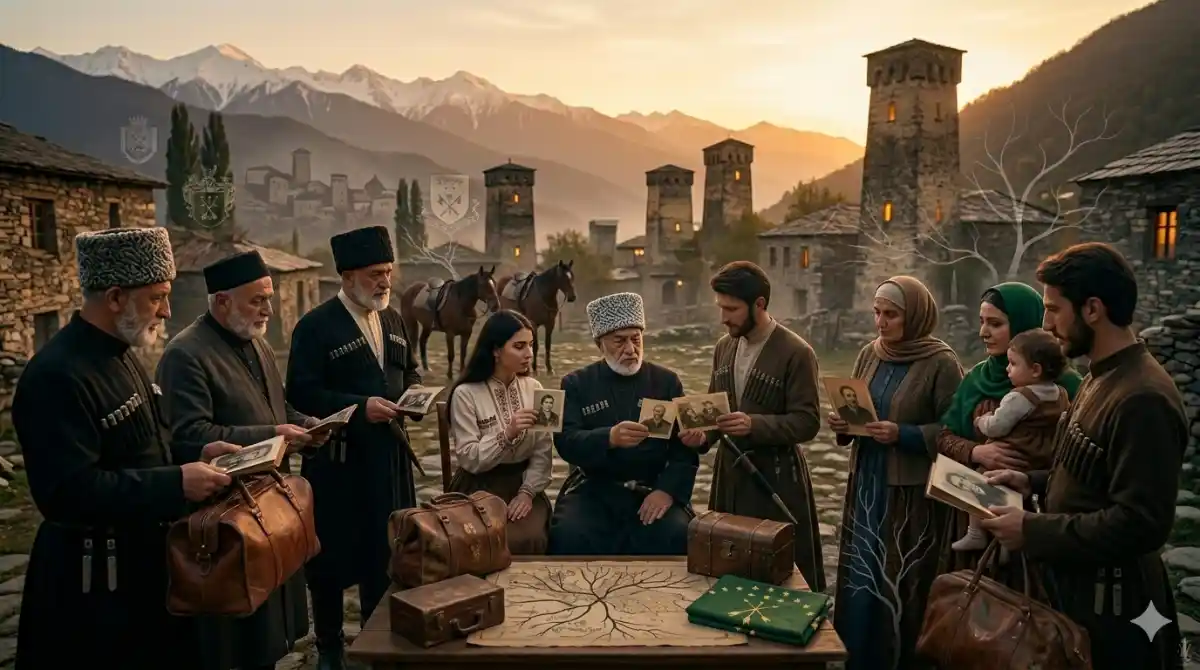
The Circassian family tree is more than a genealogical chart. It is a living record of Adyghe ancestry stretching back centuries across the Caucasus and the global diaspora. Circassian genealogy connects families scattered by the 1864 exile across Turkey, Jordan, Syria, Israel, Russia, Germany, and the United States, preserving the identity of the Circassian tribes for future generations.
Whether you are tracing your roots to the Kabardians, Shapsugs, Bzhedugs, or any of the 12 Adyghe tribes, CircassianWeb provides the tools, data, and community to rebuild your family's story.
Helpful starting points: Circassian Culture and Circassian History.
Quick facts
What it is: A documented record of Adyghe family lineage, tribal identity, migration history, and clan symbols.
Who it's for: Anyone with Circassian or Adyghe roots, in the homeland or anywhere in the diaspora.
Why it matters: The 1864 exile scattered an estimated 1.5 million Circassians. Family trees are how scattered branches find each other again.
Where families settled: Turkey, Jordan, Syria, Israel, Russia, Germany, the United States, and beyond.
Number of tribes: 12 historical Adyghe tribes.
Languages of family records: Adyghe, Russian, Turkish, Arabic, Hebrew, and others.
What this guide covers
What a Circassian family tree is
Why it matters today
The 12 Circassian tribes and where families come from
Circassian surnames and their origins
The tamga system — tribal crests and clan symbols
Migration routes and diaspora communities
Common challenges in Circassian genealogy
How to start building your family tree (step-by-step)
Tools and resources
Frequently asked questions
What is a Circassian Family Tree?
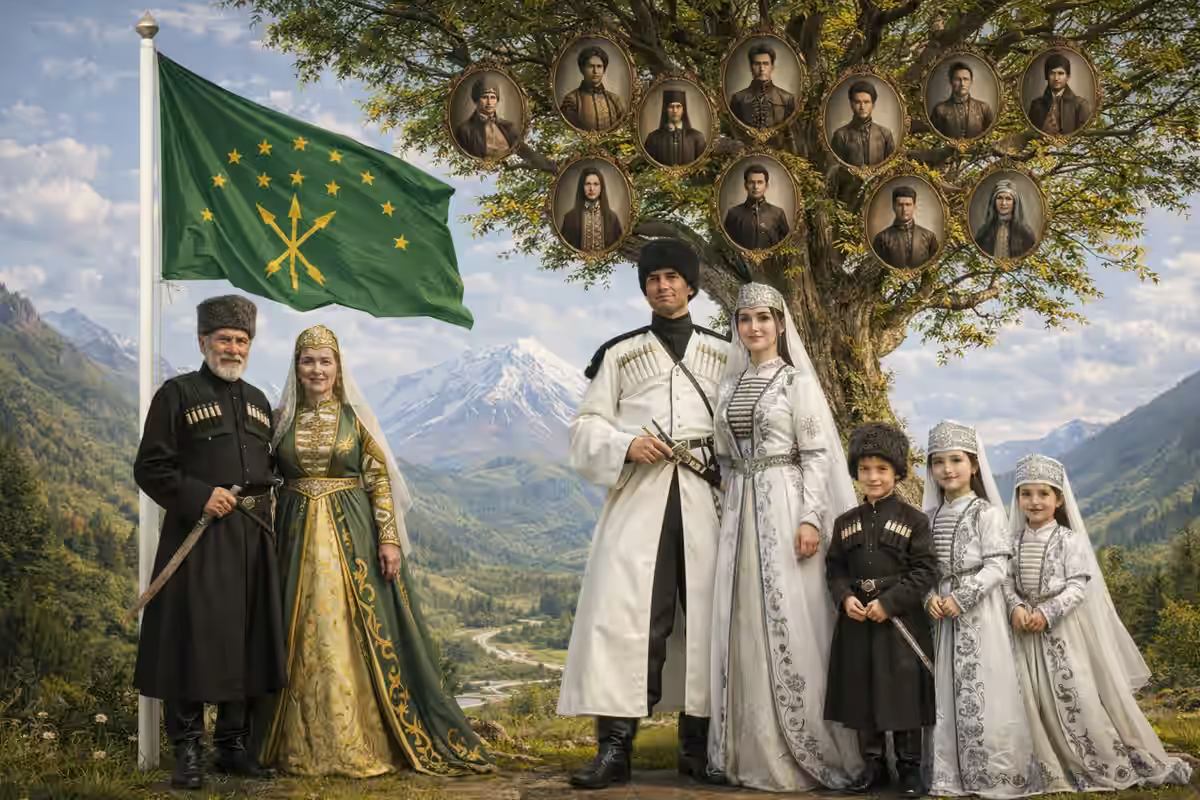
A Circassian family tree documents the lineage, tribal affiliation, and migration history of an Adyghe family. Traditionally, elders preserved this knowledge orally, reciting names, villages, and clan connections going back generations.
What a tree records today
Modern digital tools allow families to build searchable, shareable trees. A complete Circassian tree records:
Names and dates for every known ancestor.
Tribal identity. Which of the 12 Circassian tribes your family belongs to.
Surname origins. Tracked through the Circassian surname database.
Tamga symbols. Linked through the Circassian tamga finder.
Original village in the Caucasus.
Migration route after 1864.
Current location of descendants.
Together, these pieces create a complete picture of Adyghe heritage — not just a list of names, but a map of identity across time and continents.
Oral tradition: how families remembered
For most of Circassian history, family records were not written down. Elders carried the lineage in memory:
A senior elder could recite names going back seven generations or more.
Marriages, atalyk fostering bonds, and migration stories were all transmitted orally.
Songs of praise (гыбзэ) preserved the deeds of fallen ancestors.
Visiting relatives in distant villages refreshed and updated the shared memory.
The 1864 exile broke much of this system. Today, digital tools are helping reconstruct what was lost.
Why family trees matter today
Tracing your Adyghe ancestry is not just a hobby. For the Circassian diaspora, genealogy is a form of cultural survival.
Reconnecting separated branches. Families split by the 1864 exile sometimes find cousins they never knew existed.
Reclaiming lost identity. Many descendants grew up not knowing their original tribe or family name.
Preserving the language. Family memory often carries words, phrases, and songs that no formal record holds.
Supporting repatriation. Some Circassians are returning to Adygea, and a documented lineage helps with the process.
Honoring the dead. Naming and remembering ancestors is a duty in Adyghe Xabze (customary law).
The 12 Circassian Tribes and Family Lineage
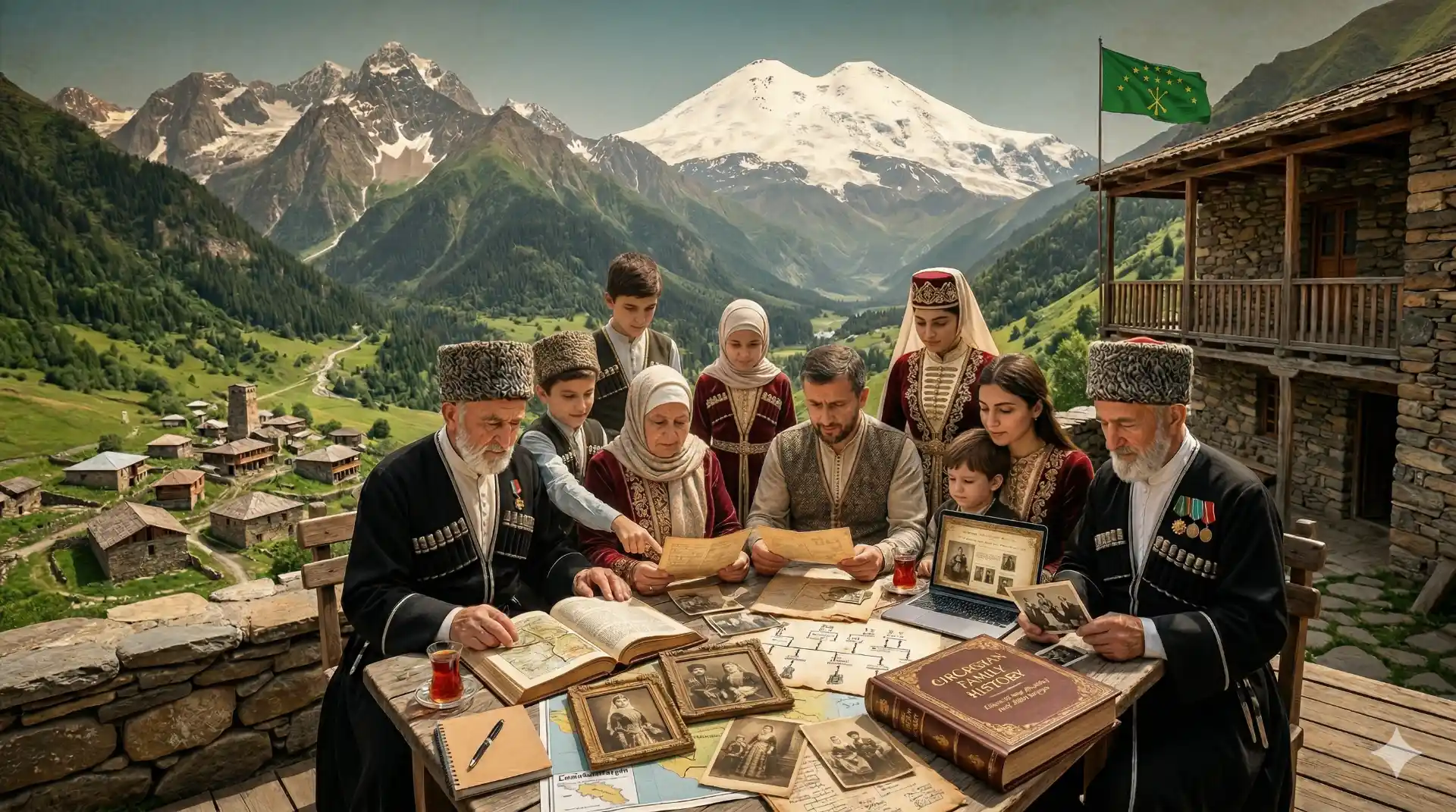
The Circassian nation comprises 12 distinct tribes (Адыгэ лъэпкъ), each with its own territory, dialect, and family names. Understanding which tribe your family belongs to is the foundation of Circassian genealogy.
The main tribes at a glance
Kabardians (Къэбэрдей). The largest tribe, historically dominant in the eastern Caucasus.
Shapsugs (Шапсыгъ). Coastal and mountain clans of the western Caucasus.
Bzhedugs (Бжъэдыгъу). Known for their warrior traditions and distinct dialect.
Abdzakhs (Абдзах). Mountain communities with deep oral traditions.
Temirgoys (Кӏэмгуй). Central Adyghe tribe with extensive diaspora; their dialect is the basis of literary Adyghe.
Besleneys (Беслъэней). Eastern tribe closely related to the Kabardians.
Natukhays (Нэтхъуадж). Western coastal tribe, largely deported in 1864.
Hatuqwai (Хьатыкъуай). Smaller central tribe, absorbed into other groupings after the exile.
Yegerukhay (Еджэрыкъуай). Closely tied to the Temirgoys and Mokhosh.
Mokhosh (Мэхъош). Eastern tribe with strong cavalry traditions.
Zhaney (Жанэ). Old western tribe, largely absorbed after the exile.
Mamkhegh (Мамхыгъ). Small central tribe between the Temirgoys and the foothills.

Geographic overview
Region of the Caucasus Main tribes Eastern (Kabarda) Kabardians, Besleneys Central (Adygea today) Temirgoys, Bzhedugs, Mokhosh, Yegerukhay, Hatuqwai, Mamkhegh Western coast Shapsugs, Natukhays, Zhaney Mountain foothills Abdzakhs
Explore all tribes and their family connections on our family trees browser.
Circassian Surnames and Their Origins
Every Circassian surname carries history. Names like Shogen, Natho, Berzeg, and Tsey connect directly to specific tribes and clans. Understanding your family name is the first step in tracing your Adyghe ancestry.
How Circassian surnames work
Adyghe family names traditionally came from one of several sources:
Patronymic. Named after a founding ancestor (e.g., Boletoko = "descendants of Bolet").
Occupational. Named after a craft or role (e.g., Khatkh = associated with smiths).
Topographical. Named after a place or geographic feature.
Animal or natural symbols. Some names trace to totemic or symbolic associations.
Honorific. Names earned by a famous ancestor through deeds in war or council.
Diaspora surname changes
After the 1864 exile, many families adapted their names to fit their new host countries:
In Turkey: Adyghe endings often became Turkish forms (e.g., addition of -oğlu).
In Jordan and Syria: Names were sometimes Arabized.
In Israel: Hebrew adaptations appeared in the small Galilee communities.
In Russia: Soviet-era documents added -ev, -ov, -in endings.
This makes surname research harder, but not impossible. A name like Berzeg in Anatolia may match Berzegov in Russia and Birzij in Jordan.
Finding your name
CircassianWeb maintains a comprehensive database of Circassian family names. For each name, the database tracks:
Tribal origin
Original Caucasus village (if known)
Geographic distribution today
Historical significance
Variant spellings across the diaspora
The Tamga System — Tribal Crests and Clan Symbols
Every Circassian clan had a tamga (тамгъэ) — a unique heraldic symbol that identified the family. These symbols were:
Branded on livestock to mark ownership
Carved into gravestones
Stamped on documents
Painted on shields and battle banners
Engraved on silverware, weapons, and jewelry
Today, they serve as powerful links to ancestral identity.
What tamgas look like
Tamgas are built from a small set of geometric elements:
Straight lines and crossbars
Curves, hooks, and spirals
Circles and dots
Stylized weapons or tools (in more elaborate designs)
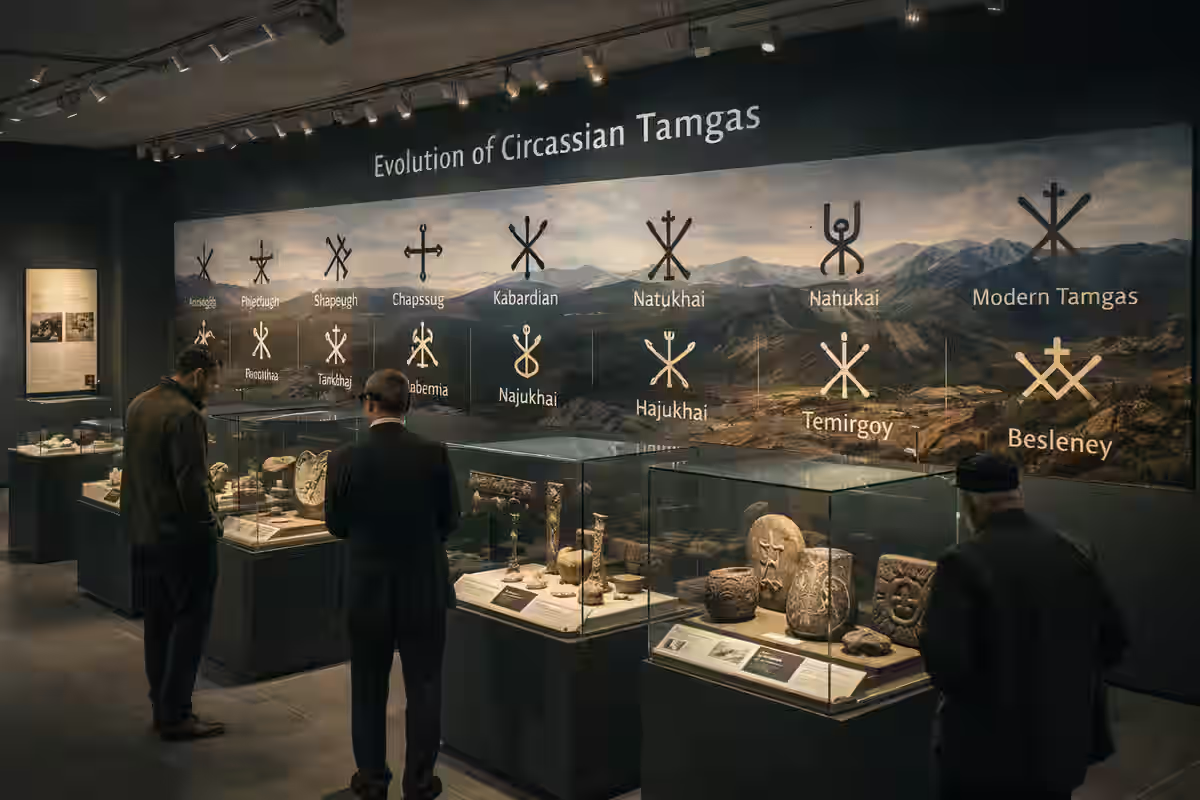
Some clans had a single tamga used across the whole family. Princely lines sometimes had several tamgas for different purposes.
How to find your family tamga
Use the Circassian tamga finder to search for your family's symbol and compare it with related clans. Look for:
Old jewelry passed down through generations
Signet rings or stamps
Carvings on old furniture
Marks on grave headstones in family cemeteries
Drawings preserved in old family papers
The tamga today
In the diaspora, the tamga has been revived as a symbol of identity. You will find Adyghe tamgas:
As tattoos worn by younger generations
On jewelry sold by Circassian craftspeople
On the facades of cultural centers
In the printed materials of family associations
On modern coats of arms revived by genealogy projects
For a community scattered for six generations, the small abstract marks that once branded a horse now carry the weight of lineage memory.
Diaspora challenges in Circassian genealogy
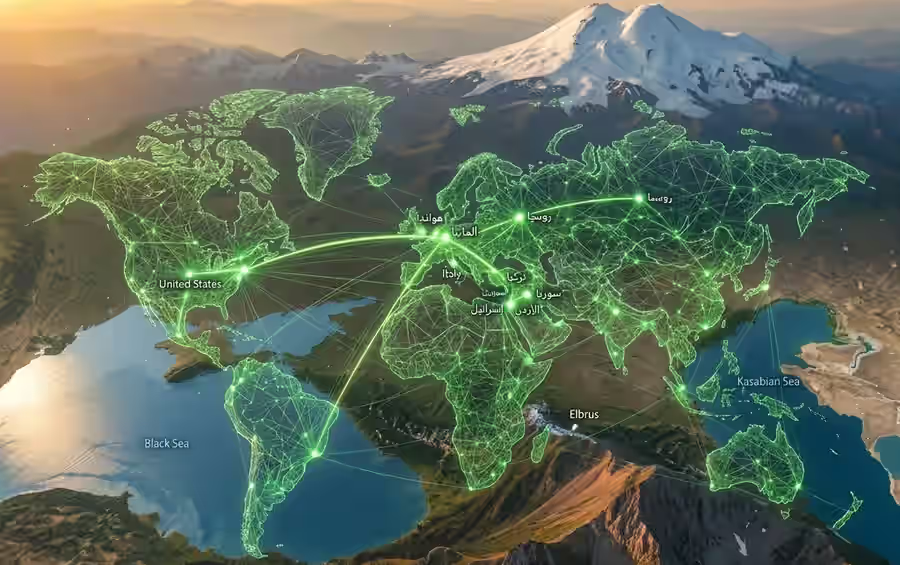
The 1864 exile, often called the Circassian genocide, scattered an estimated 1.5 million Circassians across the Ottoman Empire and beyond. Entire villages were displaced, records were lost, and families were separated, often permanently.
Where the diaspora settled
Country Major Circassian communities Turkey Düzce, Sakarya, Samsun, Tokat, Kayseri, Adapazarı, Istanbul Jordan Amman, Wadi Seer, Naur, Jerash Syria Golan Heights (pre-1967), Aleppo, Homs, Damascus Israel Kfar Kama, Reyhaniye Russia Adygea, Krasnodar Krai, Kabardino-Balkaria, Karachay-Cherkessia Germany Berlin, Hamburg, Munich (mostly post-Syrian-war arrivals) United States New Jersey, California, others
Common genealogical problems
Name changes. Families adapted surnames to Turkish, Arabic, or Hebrew conventions, sometimes more than once.
Lost villages. Original Caucasus villages were renamed or destroyed during the war and resettlement.
Oral tradition gaps. Some branches lost their history entirely after the death of key elders.
Multiple scripts. Records exist in Cyrillic, Arabic, Latin, and Hebrew. A single family may have documents in all four.
Migration layers. Some families moved more than once (Caucasus → Balkans → Anatolia → Levant), with records in three different empires.
Archive access. Russian, Ottoman, and successor-state archives have variable access rules.
Language barrier. Adyghe-language records require a reader fluent in the language and its scripts.
What helps overcome these challenges
Family oral memory recorded carefully while elders are alive
Old photographs, especially with names written on the back
Tamga symbols preserved on jewelry or grave markers
Documentation of the original Caucasus village
Connections with other families from the same village
Centralized digital genealogy databases
Cross-language search tools
How to Start Building Your Circassian Family Tree
Ready to begin? Follow these steps to start tracing your Adyghe roots.
Step 1: Interview your elders
This is the most important step, and it must be done first. Older relatives carry information that no archive holds.
What to ask:
What was the original family surname before any diaspora adaptations?
Which tribe does the family belong to?
What was the original village in the Caucasus?
When did the family leave the Caucasus, and from which port?
Where did they first settle in the new country?
Are there any old photographs, documents, or items with family symbols?
Are there family songs, prayers, or recurring stories?
Practical tips:
Record the conversation. Audio or video. Memory fades, and elders are not always available later.
Take written notes too. As backup and for searchability.
Ask the same questions multiple times over different visits. Details surface gradually.
Sit with more than one elder if possible. Different relatives remember different pieces.
Step 2: Search your surname
Use the surname database to find tribal origins.
What to check:
The original Adyghe form of the name
Tribal affiliation
Geographic distribution in the diaspora
Variant spellings (Turkish, Arabic, Russian, Hebrew)
Other families with the same or similar names
If your surname does not appear in the database immediately, try variant spellings. A name might be recorded under a different transliteration than the one your family uses today.
Step 3: Create your tree
Use CircassianWeb's free tree builder, which supports six languages, to start mapping out your family.
Build outward from yourself:
Yourself, your siblings, and your parents.
Your grandparents (paternal and maternal).
Your great-grandparents (this is where many trees thin out).
Earlier generations as far as oral tradition reaches.
For each ancestor, record:
Full name in original form and in diaspora form
Birth date and place
Marriage date and partner
Death date and place
Tribal affiliation
Original Caucasus village (if known)
Migration history
Step 4: Connect with relatives
The CircassianWeb matching system suggests potential family connections based on:
Shared surnames
Same original village
Common tamga symbols
Overlapping migration routes
When you find a match, reach out carefully:
Introduce yourself and your branch of the family.
Share what you know.
Ask about their lineage and any records they may have.
Compare oral histories. Sometimes two branches preserved different parts of the same story.
Step 5: Add your tamga
If your family has a tamga (heraldic symbol), link it to your tree from the tamga database.
How to identify your tamga:
Photograph any inherited symbols (jewelry, grave markers, old documents).
Compare against the tamga database.
Consult with elders or cultural associations.
If unsure, ask the community.
Step 6: Verify with archives (advanced)
Once you have a working tree, you can deepen it with archival research:
Ottoman population registers (for diaspora families who settled in the Empire)
Russian military and civil records (for those who remained or returned)
Jordanian land grants (for the 1870s wave of muhajir settlers)
Soviet-era census records
Religious records (mosque, church, synagogue, depending on the family)
Some of this work requires specialized researchers fluent in Ottoman Turkish, Russian, or Adyghe.
Step 7: Share your tree
Once you have built something meaningful:
Add it to the CircassianWeb shared database (with permissions you control).
Share with younger family members.
Print copies for older relatives to review.
Donate digital copies to cultural archives.
In Adyghe culture, genealogy is not a private hobby. It is a shared inheritance.
Tools and resources for Adyghe genealogy
Online databases
Circassian surname database — Tribal origins of Adyghe family names.
Circassian tamga finder — Search and compare clan symbols.
Tree builder — Create your family tree in six languages.
Circassian Culture — Background on Adyghe traditions.
Circassian History — Historical context for your family's story.
Cultural associations
In Adygea: The Adyghe Republican Institute of Humanitarian Studies (ARIGI), Maikop.
In Turkey: Kafkas Vakfı (Caucasus Foundation), Istanbul, and regional chapters.
In Jordan: Circassian Charity Association, Amman.
In Israel: Local Circassian cultural centers in Kfar Kama and Reyhaniye.
In the United States: Circassian Benevolent Association, New Jersey.
In Europe: Multiple national associations in Germany, the Netherlands, and elsewhere.
Archives and registers
Russian state archives (Moscow, Saint Petersburg)
Ottoman archives (Istanbul) for resettlement records
Jordanian land records for muhajir-era grants
Soviet-era census data
Provincial Turkish and Levantine archives
Language learning
Learning some Adyghe makes archival work much easier. Resources include:
Mukhadin Kumakhov's grammar of Kabardian and West Circassian
Adyghe-language YouTube channels
Online language apps for Adyghe and Kabardian
University courses at Maikop State University and the Kabardino-Balkarian State University
Books to read
Walter Richmond, The Circassian Genocide (2013)
Walter Richmond, The Northwest Caucasus: Past, Present, Future (2008)
Charles King, The Ghost of Freedom: A History of the Caucasus (2008)
Various publications of ARIGI in Russian and Adyghe
Kafkas Vakfı publications in Turkish
Frequently asked questions
What is a Circassian family tree?
A documented record of an Adyghe family's lineage, tribal affiliation, original Caucasus village, migration history, and any associated symbols such as tamgas.
Who counts as Circassian?
Anyone descended from the Adyghe people of the North-West Caucasus, or from the related Kabardian and Cherkess populations. The term "Circassian" covers all 12 historical Adyghe tribes.
How do I find out which tribe my family belongs to?
Start by asking older relatives. The original family name and the original Caucasus village are the strongest clues. Compare your surname against the surname database, and check whether any inherited symbols match a known tamga.
What if I do not know our original surname?
Many diaspora families changed their names. Work with what you have: country of arrival, port of disembarkation, year of arrival, and any oral stories. Even partial information can lead to matches with other branches.
What is a tamga?
A small abstract heraldic symbol used by Circassian families to mark property and identify lineage. Each clan had its own tamga.
Did all 12 tribes survive the 1864 exile?
Several smaller tribes were effectively absorbed into larger groups after the exile. The Natukhays, Hatuqwai, Zhaney, and others were largely destroyed or merged. The Kabardians, Adyghe (Temirgoy and others), and Shapsugs survived in larger numbers.
How accurate is oral tradition?
Adyghe oral tradition is generally reliable for the past four to six generations, with names, places, and major events well preserved. Beyond that, oral memory tends to compress and stylize earlier history. Combining oral tradition with archival records gives the best results.
Can DNA testing identify my tribe?
DNA tests can confirm broad Caucasian ancestry but cannot reliably distinguish between Adyghe tribes, since they share closely related genetic profiles. DNA is useful for matching to specific other individuals, not for assigning tribal identity.
Are women's lineages included in Circassian family trees?
Yes. Adyghe trees traditionally focused on the male line for naming, but maternal lineages, marriage networks, and atalyk fostering bonds were also tracked carefully. Modern digital trees record both lines fully.
What if my family is partly Circassian and partly something else?
Mixed heritage is increasingly common in the diaspora. Your tree can record both sides. Many descendants of mixed marriages identify with their Circassian roots while honoring other ancestries as well.
How long does it take to build a meaningful family tree?
Initial outline: a few weeks of conversation with elders. Detailed multi-generation tree: months to years, depending on archive access and surviving records. Genealogy is a long-term project, but each conversation adds something.
Is genealogy work expensive?
Not necessarily. Free online tools cover most needs. Costs grow only if you commission professional archive research in Russia, Turkey, or elsewhere.
Can I publish my family tree?
Yes, with privacy in mind. Public family trees help others find their roots. Keep living-relative information private unless they consent.
How do I help other families with my tree?
Add your tree to a shared database with permissions you control. The more trees in the system, the more matches everyone finds.
Cultural legacy: why genealogy is a duty
In Adyghe Xabze, the unwritten code of customary law, remembering your ancestors is a serious obligation. The seven-generation rule, common across Caucasian peoples, says that a person should know the names of their direct ancestors going back seven generations.
For most Circassians today, that rule is hard to keep. The 1864 exile, the Soviet decades, and the gradual loss of language and elders have all worked against family memory. But digital tools, organized cultural associations, and the patient work of individual families are slowly rebuilding what was lost.
When you build your family tree, you are doing more than personal research. You are restoring a piece of a national heritage that almost vanished.
The names are still here. Your job is to find them.
Get started today
Three simple actions to take this week:
Call your oldest living relative. Schedule a conversation. Record what they remember.
Search your surname. Use the surname database.
Start your tree. Use the tree builder to record what you already know.
Once you begin, the rest follows. Family by family, branch by branch, the scattered tree of the Adyghe people is being put back together.