June 13, 1861: When 12 Circassian Tribes United
Circassian Unity Day · June 13
The Day Twelve Tribes Became One Nation
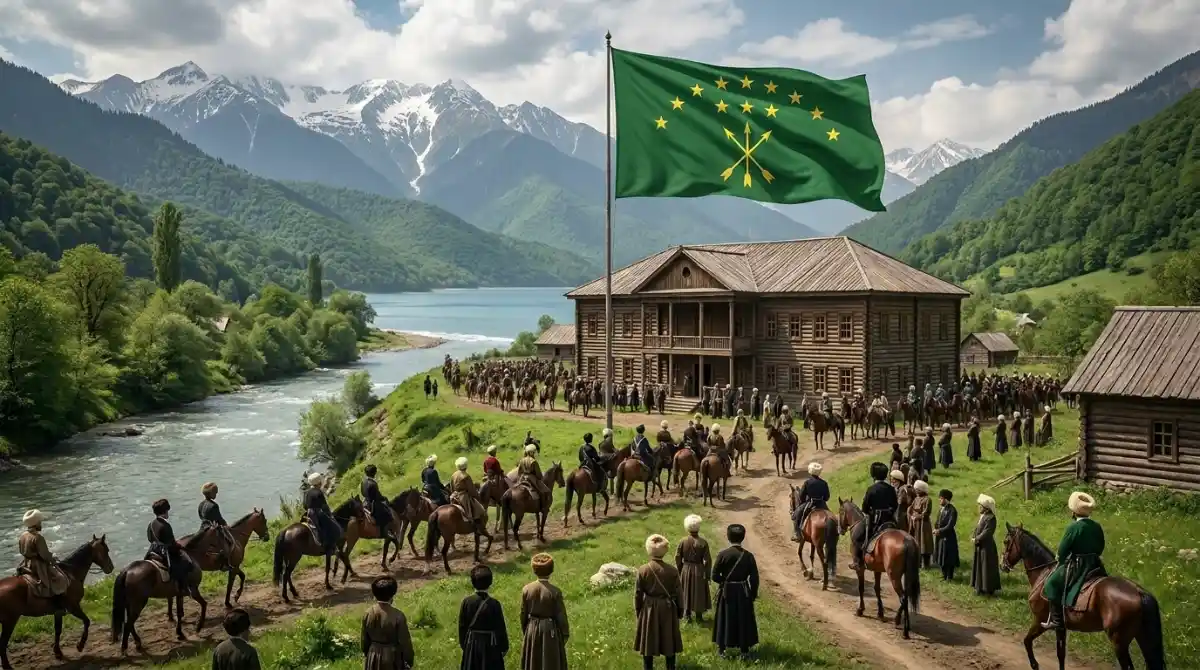
On June 13, 1861, the scattered peoples of Circassia gathered in a wooden hall above Sochi, raised a single green banner, and told the world they were one country. This is the story of the Great Free Assembly, the flag it fought under, and why Circassians still mark the date.
There is a wooden building that no longer exists, in a river valley most people have never heard of, where for three short years a stateless people tried to become a state. It stood near the mouth of the Psakhe, a little north of the town the Circassians called Shache and the Russians would rename Sochi. Inside it, in June 1861, delegates from a dozen tribes sat down together and did something they had never quite managed in their long history: they agreed to be governed as one.
They called the gathering the Great Free Assembly. In Adyghe it was the Xase, the council, raised to the dignity of a parliament. Outsiders writing in Turkish and Arabic called it the Mejlis. Circassians today often call it the Parliament of Independence, and the day it was founded, June 13, is observed across the diaspora as a day of unity. It is the closest thing the Circassian nation has to a founding moment, and it arrived almost too late to matter.
That last part is the hard truth running underneath every commemoration. The assembly was born in the final act of a war that had already lasted, by the Circassians' own reckoning, a hundred years. Within three years the hall would be abandoned, the parliament dispersed into the mountains, and the people it represented driven into the sea or into exile. June 13 is a celebration of unity and a wound at the same time. You cannot honestly tell one half of the story without the other.
This article is the long version. It covers what actually happened in 1861, who the people in that room were, the flag they raised, the letters they wrote to London and Paris and Istanbul, and the catastrophe that followed. It also tries to sort out a confusion that turns up every year online about which Circassian anniversary is which. By the end you should understand not just the date but why it still carries weight for roughly six million people scattered from Amman to Maikop to New Jersey.
Which day are we actually talking about?
If you search for Circassian commemorations you will quickly run into a tangle of dates, and a lot of well-meaning posts mash them together. So it is worth being precise from the start, because precision here is a form of respect for the people who keep these days.
There are three dates that matter most in the Circassian calendar of memory, and they are not the same thing.
DateWhat it marksHow it is observedApril 25Day of the Circassian Flag. The widely shared international flag day, centered on the green banner with twelve stars and three crossed arrows.Flag displays, cultural events, online campaigns, charity drives. A day of pride and identity.May 21Day of Remembrance and Mourning. The anniversary of the final Russian victory at Qbaada in 1864 that ended the war and began the mass expulsion.Marches, black clothing, memorial gatherings in Maikop, Nalchik, Cherkessk, Istanbul, Amman and elsewhere. A day of grief.June 13The founding of the Great Free Assembly in 1861. The day the tribes united into a single declared state under one government and one flag.A day of unity. Marked with the flag, with talks about Circassian history, and increasingly online by the diaspora.
So the flag has its own official day in April, and the parliament has its day in June. The two are tied together by something real, though, and that is why people fold them into each other. The flag was raised over the assembly. When the delegates declared the unity of Circassia, the green banner with its twelve stars became the emblem of that unity, one star for each tribe in the union. To raise the flag and to found the assembly were, in a sense, the same act of imagination: the claim that all these separate communities were one people. Calling June 13 a "day of the flag" is not exactly wrong in spirit, even if April 25 is the date set aside for the banner itself. Think of June 13 as the day the flag stopped being a symbol of hope and briefly became the flag of an actual government.
And why do some sources say June 25?
Here is a smaller wrinkle that confuses readers who go digging. Some reference works give the founding date as June 25, 1861, not June 13. Both are correct, and the gap between them is not a contradiction but a calendar.
Russia in the 19th century still used the old Julian calendar, which by the 1860s ran twelve days behind the Gregorian calendar used in Western Europe. June 13 in the Julian, "Old Style" dating that the Russians and Circassians used at the time corresponds to June 25 in the modern Gregorian count. Circassian tradition keeps the date as it was lived, June 13, which is why that is the day observed. If you see June 25 in a Western source, it is simply the same day translated into the modern calendar. Nothing happened twice.
Who the Circassians were, and what they were defending
To understand why uniting twelve tribes in 1861 was both so necessary and so difficult, you have to know something about how Circassia worked before the war swallowed it.
The Circassians, who call themselves Adyghe, are an indigenous people of the northwest Caucasus. Their homeland ran from the lower Kuban River and the Taman peninsula in the north down the eastern shore of the Black Sea, with the great wall of the Caucasus mountains rising behind the coast. It was good land: forested slopes, river valleys, a mild coastal strip, fertile plains along the Kuban. The Circassians were famous riders and warriors, but they were also farmers, beekeepers, metalworkers and traders, with a code of conduct, the Adyghe Xabze, that governed honor, hospitality, the treatment of guests and the conduct of feuds.
What they did not have was a single ruler. This is the central fact. Circassia was never a kingdom with a crown and a capital. It was a patchwork of tribes, each with its own territory, leadership and customs, loosely bound by language and the Xabze. In the standard count there were twelve major Adyghe tribes, and that number is why the flag carries twelve stars.
The twelve tribes
The usual list of the twelve is the Abdzakh, the Besleney, the Bzhedug, the Hatuqwai, the Kabardians, the Mamkhegh, the Natukhai, the Shapsug, the Temirgoy (also written Chemguy or Kemirgoy), the Ubykh, the Yegerukay and the Zhaney. Closely related neighbors, the Abkhaz and the Abaza, were sometimes counted alongside them and were present in the union of 1861 as well. The Ubykh, who lived on the coast around Sochi and spoke a language all their own, were Circassia's bridge between the Adyghe and the Abkhaz worlds.
These tribes were not socially identical, and that mattered enormously for politics. Circassian writers traditionally divide them into two broad types. Nine of the tribes were what gets translated as "aristocratic" or feudal, meaning they kept a layered society of princes (the pshi), nobles (the work) and various ranks below them, down to bonded peasants. The other three, the Natukhai, the Shapsug and the Abdzakh, were the so-called "democratic" tribes. Somewhere in the late 18th and early 19th centuries these three had pushed back hard against their own nobility and reorganized themselves around popular assemblies, the Xase, where decisions were reached by general agreement rather than by princely command. They tended to live in the high mountains, which is partly why they survived the longest. The flag encodes this division too: nine stars set in an arc for the aristocratic tribes, three stars in a line for the democratic ones.
You can already see the problem the assembly of 1861 was trying to solve. A society of free, proud, fiercely independent communities, some run by princes and some by town meetings, none of them used to taking orders from the others, was being asked to accept a common government, a common treasury and a common army, in the middle of being invaded. The miracle is not that the union failed. The miracle is that it happened at all.
The Xabze and the world the tribes shared
If the tribes had nothing holding them together, the union of 1861 would have been impossible. They did have something, and it was not a king or a church. It was a shared culture, and at its center sat the Adyghe Xabze, the unwritten code of conduct that ran through every Circassian community whether it was ruled by a prince or a popular council.
The Xabze is hard to translate because it is not a single thing. It is law, etiquette, ethics and social custom braided together: how you treat a guest, how you greet an elder, how you conduct a feud and when you end it, how a host is bound to protect a stranger under his roof even at the cost of his own life. Hospitality in particular was close to sacred. A traveler taken in by a Circassian family was owed protection, and a host who failed that duty was disgraced. These were not quaint manners. In a society without a state, the Xabze was the state, the thing that made cooperation and trust possible across clans that might otherwise be at each other's throats.
The tribes also shared a language, or rather a family of closely related Circassian languages, with the western Adyghe dialects on one side and Kabardian, the eastern dialect, on the other, and the singular Ubykh tongue off on its own. They shared a body of ancient myth, the Nart sagas, the epic tales of a race of heroes that the Circassians hold in common with their Caucasus neighbors. And they shared a tangled religious history. Circassians had been pagans, then for centuries nominally Orthodox Christians under Byzantine and Georgian influence, with old Circassian deities surviving underneath the new faith. From roughly the 18th century onward Islam spread among them, carried partly by the Ottomans and the Crimean Tatars and pushed hard during the war years as a banner of resistance. By 1861 most Circassians were Sunni Muslims, which is part of what the green of the flag points to, though the older layers never entirely vanished from the culture.
All of this is what the assembly was building on. The delegates who met above Sochi did not invent a Circassian nation out of nothing. They took a people who already shared a language, a code and a story, and tried to give them, for the first time, a government to match.
The hundred years' war
Circassians date their war with Russia from 1763, the year the Russian Empire began building fortifications on Circassian land and asserting authority over it. The fighting did not end until 1864. That is the war that the Great Free Assembly was created to win, or at least to survive, and a hundred and one years is a long time to be at war.
Russia's interest in the region was strategic and, by the 19th century, increasingly absolute. The northwest Caucasus sat between the expanding empire and the Black Sea coast, between Russia and the Ottoman world to the south. As long as the Circassian coast was independent, the Black Sea was not a Russian lake, and the southern frontier was not secure. Successive tsars came to see the Circassians not as subjects to be governed but as an obstacle to be removed. By the reign of Alexander II that logic hardened into an explicit policy of clearing the land of its people.
For most of the war the Circassians fought the way their society was built to fight: locally, tribe by tribe, valley by valley, with bursts of brilliant resistance and no central command to hold it all together. They were extraordinarily effective at this. Russian generals spent decades and tens of thousands of lives grinding through terrain where every ridge could hide an ambush. But fighting that way had a fatal weakness against an empire. The empire could lose a battle, regroup and come back next season with fresh regiments. A tribe that lost a battle lost a generation of its men and could not replace them.
The Circassians knew this. The whole drive toward unification, which runs through the half-century before 1861, was an attempt to fix it, to build something that could coordinate the defense of the entire country instead of leaving each tribe to bleed alone. The Great Free Assembly was the last and most complete version of that attempt.
What the fighting actually looked like
It helps to picture the war itself, because the assembly was a response to its specific shape. This was not a war of front lines and pitched battles. It was a long, grinding campaign of forts, raids and clearances along a coast and through a tangle of forested mountains.
Russia's main instrument on the Black Sea side was a chain of coastal fortifications, the Black Sea coastal line, garrisons strung along the shore meant to cut the Circassians off from the sea and from the Ottoman trade and arms that came across it. The Circassians fought back by besieging and sometimes overrunning these forts; the sieges of places like Lazarevsky, Velyaminovsky and Mikhailovsky in the late 1830s and early 1840s were part of this. Holding the coast mattered to both sides for the same reason: the sea was the Circassians' only link to the outside world, the route by which gunpowder, salt and the occasional sympathetic foreigner arrived. Cut the coast, and the resistance slowly suffocated.
In the interior the Circassians had the advantage, and they used it well for decades. The mountain tribes, especially the Abdzakh and Shapsug in their high valleys, were nearly impossible to subdue by direct assault. Russian columns that pushed into the forests were ambushed, harried and bled. The Circassian fighter, mounted, lightly armed, intimately familiar with the ground, was more than a match for a regular soldier in that terrain. The Caucasus cavalry tradition was so admired that the Circassian style of dress, the long coat with cartridge loops across the chest, was eventually adopted by the Cossacks who fought them and became iconic across the whole region.
What broke this was not better Russian soldiers. It was a change of method. Under generals like Yevdokimov, and with the backing of the war ministry in St. Petersburg, Russia shifted from trying to defeat the Circassians to trying to remove them. The forests were cut down to deny cover. Villages were burned and their populations driven off the land for good. Crops and stores were destroyed to make the country unlivable through the winter. This was a strategy aimed at the people, not just the fighters, and against it the old tribal tactics, brilliant as they were, had no answer. You cannot ambush a policy of starvation. The assembly of 1861 was an attempt to meet a national emergency with a national institution, at the exact moment the emergency had become a campaign of extermination.
The long road to unity
The assembly of 1861 did not appear out of nowhere. It was the culmination of decades of trying, and the earlier attempts are worth knowing because the people and ideas behind them carried straight into the parliament at Sochi.
The diplomats and the British connection
From the 1830s onward, a handful of Circassian leaders understood that survival meant two things: unity at home and recognition abroad. The most important of these was Seferbiy Zaneqo, a Shapsug prince born in Anapa around 1798, who spent much of his life as a kind of self-appointed ambassador for Circassia in the Ottoman capital and in correspondence with Britain. Zaneqo grasped that an isolated mountain confederation had no future unless a great power treated it as a country, and he spent years trying to make that happen.
Britain, for its part, had its own reasons to take an interest. This was the era of the Great Game, the long contest between the British and Russian empires across Asia, and a number of British figures saw an independent Circassia as a useful check on Russian expansion toward the Ottoman Empire and, beyond it, toward British India. The most famous of these was David Urquhart, a Scottish diplomat attached to the British embassy in Constantinople, who became a passionate, almost obsessive, advocate for the Circassian cause. Urquhart promoted Circassia in the British press, helped publicize its struggle, and is often credited in Western accounts with designing the Circassian flag in the mid-1830s.
The flag's origins are genuinely contested, and it is worth being careful here rather than repeating the simplest version. Western literature has long named Urquhart as the designer. Circassian and Caucasus historians push back. The historian Samir Khotqo, for one, has argued that the flag's symbols are older and indigenous, drawn from heraldic traditions the Circassian princely houses already used, and that the design was assembled and promoted above all through the mission of Seferbiy Zaneqo. There is also the inconvenient detail that the British traveler Edmund Spencer described a Circassian banner in his account of the region around 1830, before Urquhart had even arrived. Urquhart may have given the flag publicity and a polished final form. He almost certainly did not invent it from nothing. The honest summary is that the flag grew out of Circassian symbols, was crystallized in the 1830s during the push for unity, and reached the world partly through British hands.
The Vixen and the war of recognition
One episode from this period shows how close the question of Circassian independence came to igniting a wider war. In 1836 a British merchant ship, the Vixen, sailed to the Circassian coast carrying salt and, by some accounts, more than salt. The Russians seized it, claiming Circassia was Russian territory and the coast was under blockade. The Circassians and their British supporters insisted Circassia was an independent country and the seizure was an act of piracy against a neutral vessel. For a few tense months the affair threatened to drag Britain and Russia into open conflict. It blew over, Britain did not go to war, and the lesson the Circassians should have drawn, and perhaps did, was that sympathy in London was not the same as soldiers on the coast.
Muhammad Amin and the assemblies before the assembly
Inside Circassia, the work of building unity went on through religion and through councils. In the 1840s and 1850s a Naqshbandi figure named Muhammad Amin, sent from the camp of the great Dagestani resistance leader Imam Shamil, worked among the western Circassians to organize them under a more centralized, Islamic administration, with courts and a structure that cut across tribal lines. He had real success among the Abdzakh in particular. He also had rivals, including Zaneqo, and the western Circassian leadership was never fully united behind any one man.
There were also repeated councils. At a congress at Abin in 1857, the gathered Circassians reportedly resolved to keep fighting the Russians and die rather than surrender and die, a grim calculation that tells you exactly how they understood their choices by then. Foreign volunteers turned up to help: in 1857 a band of Polish fighters under Teofil Lapinski arrived to fight alongside the Circassians, Poles having their own bitter quarrel with the Russian Empire. None of it was enough to change the arithmetic. But it built the habits and the relationships that made 1861 possible.
By 1860 the situation on the coast was desperate. The Crimean War had ended in 1856 with the Peace of Paris, which demilitarized the Black Sea but, crucially, did not grant Circassia the independence its leaders had hoped for. With the western powers at peace with Russia and no longer interested in stirring trouble on the Caucasus coast, Russia was free to turn its full attention to finishing the conquest. The Russian general Nikolay Yevdokimov began a methodical campaign of clearing the mountains, pushing the population off the land. The coastal tribes, the Ubykh, the Shapsug and the Natukhai, were running out of room and out of time.
June 1861: the founding
So we come to the building above the Psakhe. In the spring of 1861 the coastal Circassians built themselves a capital, or at least a seat of government: a large hall, by the descriptions a substantial log house, in a river valley near Shache, the place that is now Sochi. The Adyghe name for the site was Shache or Mutıxwa; in the geography of modern Sochi it sat in the area around Mamayka, on the Psakhe. It was not a city. It was a parliament house in the woods, within sound of the sea and within reach of the Russian advance.
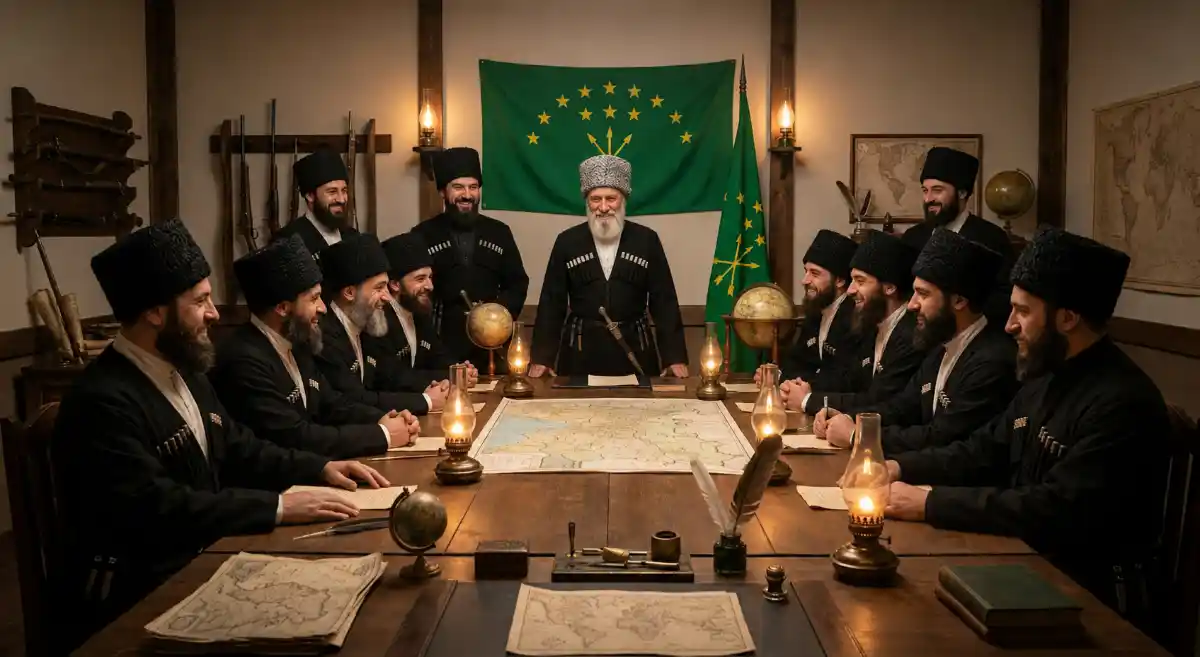
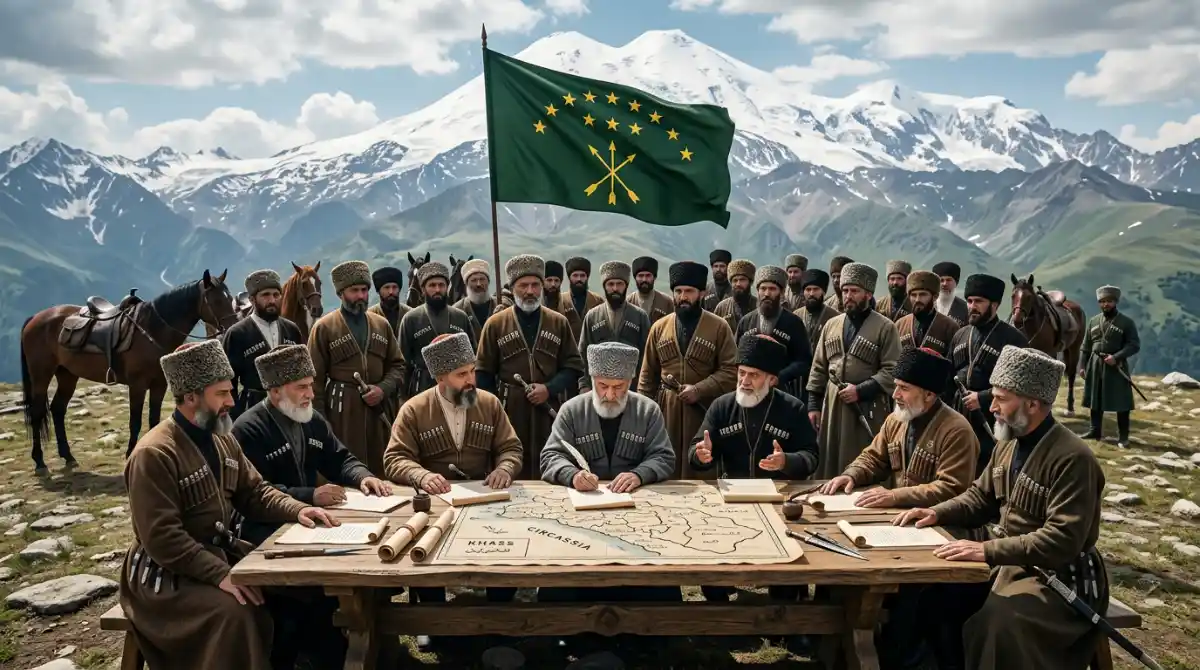
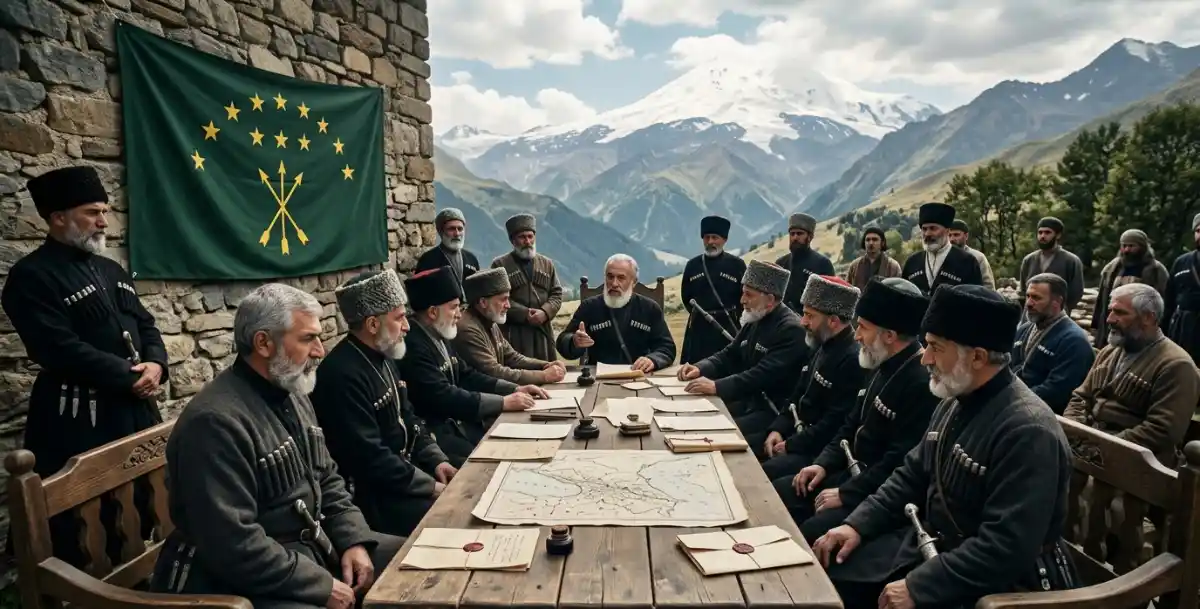
The records place the founding of the assembly there on June 13, 1861 in the dating of the time. Leaders, elders, nobles and commanders came from across the surviving Circassian lands. The three coastal tribes most directly threatened, the Ubykh, the Shapsug and the Natukhai, were the core founders. But representatives also came from the Hatuqwai, the Abdzakh, the Bzhedug, the Temirgoy and the Kabardians, and the Abkhaz and Abaza were represented too. Men of every social rank, princes and free commoners alike, sat in the same hall. That detail mattered to the people who recorded it. For a society obsessed with rank and lineage, putting aside those distinctions to sit as equals in a common council was itself a statement.
Hajji Gerandiqo Berzeg
They elected a leader: Hajji Gerandiqo Berzeg, an Ubykh prince of the powerful Berzeg house, and they made him head of both the parliament and the nation. He was by then an old man, around sixty, and he had spent essentially his entire adult life at war with Russia. He came from a line of resistance leaders; his predecessor as Ubykh prince and as a leader of the wider confederation was Ismail Berzeg, who had carried the Circassian cause to the British and to the Polish exiles in the 1830s and 1840s. Gerandiqo had led Circassian forces in the field during the Crimean War years, when they pushed to retake forts and territory from the Russians.
The accounts of him are striking. He had made the pilgrimage to Mecca, which is why his name carries the title Hajji. He reportedly lost two sons in the fighting and, in one telling, met a surviving son across a battlefield. People called him the Ubykh Shamil, after the legendary imam who held out for so long in the eastern Caucasus. He would outlive the war, dying in exile in the Ottoman Empire around 1881, an old soldier of a country that no longer existed on any map. If June 13 has a human face, it is his.
The people in the story
The assembly was not one man's project, and the years around it are crowded with figures worth knowing. A few of them carry most of the weight.
Ismail Berzeg, Gerandiqo's predecessor in the Ubykh leadership, had spent the 1830s and 1840s doing the diplomatic groundwork: writing to the British, corresponding with the Polish exile government of Adam Czartoryski, insisting to anyone who would listen that the Circassians were a free people fighting for their independence. He died in Mecca in 1846. The line of leadership that produced the assembly ran straight through his house.
Seferbiy Zaneqo, the Shapsug prince and tireless ambassador, did not live to see the parliament he had spent his life working toward; he died on the eve of it, around the start of 1860. But his son Karabatir Zaneqo carried the family's role into the assembly itself and sat among its members. The flag most closely associated with Circassia is tied to the father's mission, the parliament to the son's generation.
Muhammad Amin, the Naqshbandi organizer sent from Imam Shamil's movement, represented the religious and centralizing current in western Circassia. He built courts and administrative structures across tribal lines in the 1840s and 1850s, with real success among the Abdzakh. By the time of the assembly his moment had largely passed, and he eventually came to terms with the Russians, but the habit of supra-tribal organization he encouraged fed into what came after.
On the foreign side stood David Urquhart, the Scottish diplomat and propagandist who made Circassia a cause in Britain and is linked, rightly or not, to the flag; and Teofil Lapinski, the Polish officer who brought a band of volunteers to fight alongside the Circassians in 1857, one of several outsiders who saw in the Circassian war a front in their own struggle against the Russian Empire.
And on the other side of the table were the men who decided Circassia's fate. Tsar Alexander II, the reformer who freed Russia's serfs in 1861, approved the policy that emptied the Caucasus of its people in the same years. His minister of war from 1861, Count Dmitri Milyutin, was the architect of the expulsion strategy, who reasoned coldly that removing the Circassians would open the land for settlers and clear the frontier of a hostile population. General Nikolay Yevdokimov was the man who carried it out on the ground, valley by valley. It is worth naming them, because the destruction of Circassia was not a natural disaster. It was a decision, made by people, who had names.
What the assembly actually decided
The Great Free Assembly was not a debating society. It set out to function as a real government, and the program it adopted, which some historians describe as a constitution, was ambitious to the point of being unrealistic given the circumstances. The core decisions, as they come down to us, ran roughly as follows.
Circassia was declared an independent state, and the assembly declared itself the common government of all Circassians regardless of tribe. Unity was to be binding; the assembly claimed the authority to enforce it, by force if necessary, against tribes or communities that broke ranks. The initial parliament had fifteen members. The country was organized into administrative districts, with the structure built around the union of tribes that the twelve stars represented, and each district was to have appointed administrators responsible for civil affairs, justice and security, acting in the name of the assembly. These administrators would collect taxes on the parliament's behalf and were to raise a national army on a fixed quota: every hundred households would supply and support five cavalrymen. The taxes raised were to be spent for the good of the country and the cause of independence. Some accounts describe the federation as organized into three federal districts grouped around the coastal tribes, the Ubykh, the Shapsug and the Natukhai, with the broader union of tribes folded into the state.
Read that list again and notice what it is: a tax system, a standing army with conscription quotas, a civil administration, courts, and an enforcement mechanism. This was an attempt to build, in a matter of months and under enemy pressure, the machinery that established states take generations to grow. The historian who wrote the most influential modern study of this period, Walter Richmond, and others have noted how late and how illusory it all was. A Soviet-era Abkhaz historian, Georgy Dzidzaria, described the constitution as the high point of the mountaineers' political thinking and, in the same breath, as a project that could not overcome the deep tribal divisions or the sheer disparity of force. Both things are true. It was the best political idea the Circassians ever produced, and it could not save them.
The flag over the assembly
This is where June 13 and the green banner meet, and where the flag stops being a design and becomes the symbol of a state.
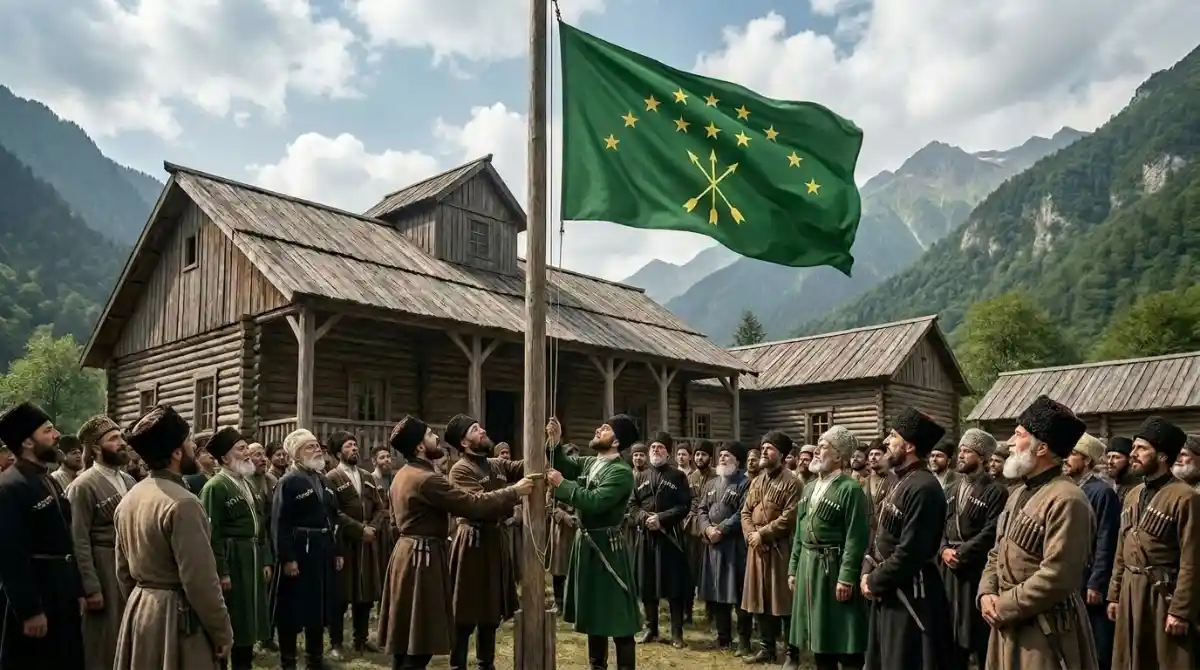
The flag is a green field. Across it are twelve gold stars, nine arranged in an arc like a bow and three set horizontally, and over the center lie three crossed arrows, also in gold. Every element carries meaning, and the meanings are layered because the flag itself was assembled from older symbols.
The green is usually read two ways at once, and Circassians tend to embrace both. It is the green of the Caucasus, of forests and mountains and the land itself, and it is the green associated with Islam, the faith most Circassians had adopted by the 18th and 19th centuries. The gold is read as a sign of a hoped-for future of peace and plenty, of harvests and grain.
The twelve stars are the twelve tribes, one each, all equal, none ranked above another. That equality was the point. Seferbiy Zaneqo, in the account of how he conceived the design, is said to have explained that each star stood for a tribe and that all were represented without prejudice, none favored over the rest. When you remember how stratified Circassian society was, this is a quietly radical idea. The arrangement of nine stars in the arc and three on the line preserves the old distinction between the aristocratic and democratic tribes, but it folds both into a single banner. The flag does not pretend the differences away. It insists they belong to one nation.
The three crossed arrows are the part people most often get wrong. They are not a symbol of war for its own sake. In the Circassian reading, drawn from the Xabze, the arrows mean something closer to a conditional: peace if you come as a friend, war if you come as an enemy. Crossed arrows signified unity and a readiness to defend, not aggression. One traditional gloss holds that three arrows carried in a quiver marked a man going to the hunt, while a larger number signaled a hostile intent, so three arrows are deliberately the peaceful number, the sign of a people who will fight only if attacked. For a nation that spent a century being invaded, that is not a slogan. It is a fairly exact description of how they understood their own war.
How the flag reached the field
There is a much-loved story about the banner that is worth telling carefully, because it sits at the boundary between documented history and national memory, and both deserve honesty.
In the telling that comes down through Circassian tradition, the unity flag was prepared abroad, in the Ottoman world, and sewn by the hands of a Circassian woman of high station, sometimes described as a princess of the Ottoman court, before being sent home to Circassia. Edmund Spencer, the British traveler, left an account of the banner being unfurled before a great Circassian gathering, the long-awaited national flag arriving from Istanbul, and the crowd erupting, thousands of swords raised, a single roar of joy. Whether Spencer's scene belongs to the 1830s or is read back onto later assemblies, the emotional core of it is what survived: the moment a divided people saw a single flag of their own and recognized themselves in it.
By 1861, that flag was the flag of the Great Free Assembly. The banner of hope had become the banner of a government. This is why, even though April 25 is the formal day of the flag, June 13 cannot be told without it. The assembly and the flag are the same claim made in two forms, one written into a constitution and one stitched into cloth: that the twelve tribes were one country.
The flag that outlived the state
The state died in 1864. The flag did not. It went into exile in the memory of the diaspora and stayed alive for more than a century with no country to fly over, carried in households from Anatolia to Amman as a symbol of a homeland most of those families would never see.
Then, as the Soviet Union fell apart, the flag came home. In 1992 the newly formed Republic of Adygea, one of the Russian republics where Circassians are a titular people, adopted the historic green banner with its twelve gold stars and three crossed arrows as its official state flag. For the first time since the assembly, the flag flew over a government building on Circassian land. It is not an independent Circassia, far from it, but it meant that a symbol invented to unite the tribes against an empire now flies, officially, inside the state that conquered them. Circassians across the world treat it as the flag of the whole nation, not just of one republic, which is exactly how its 19th-century creators intended it.
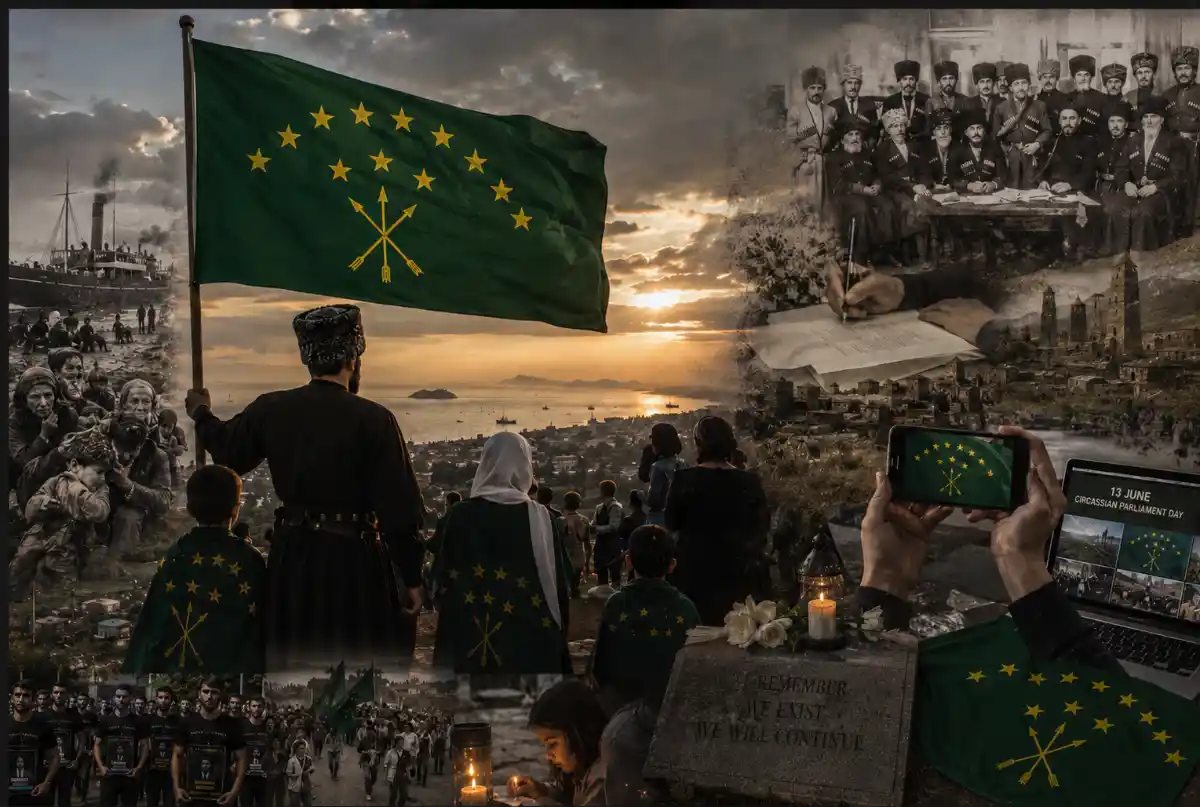
The design has been standardized over the years, with the green field and the gold stars and arrows fixed to particular shades, but the meaning has not changed since Zaneqo's day. Twelve stars, twelve tribes, equal and undivided. Three arrows for a people who fight only when attacked. Green for the land and the faith. When you see a Circassian wave that flag at a wedding in New Jersey or a memorial march in Nalchik, you are looking at the only piece of the Great Free Assembly that survived intact.
The letters to Europe
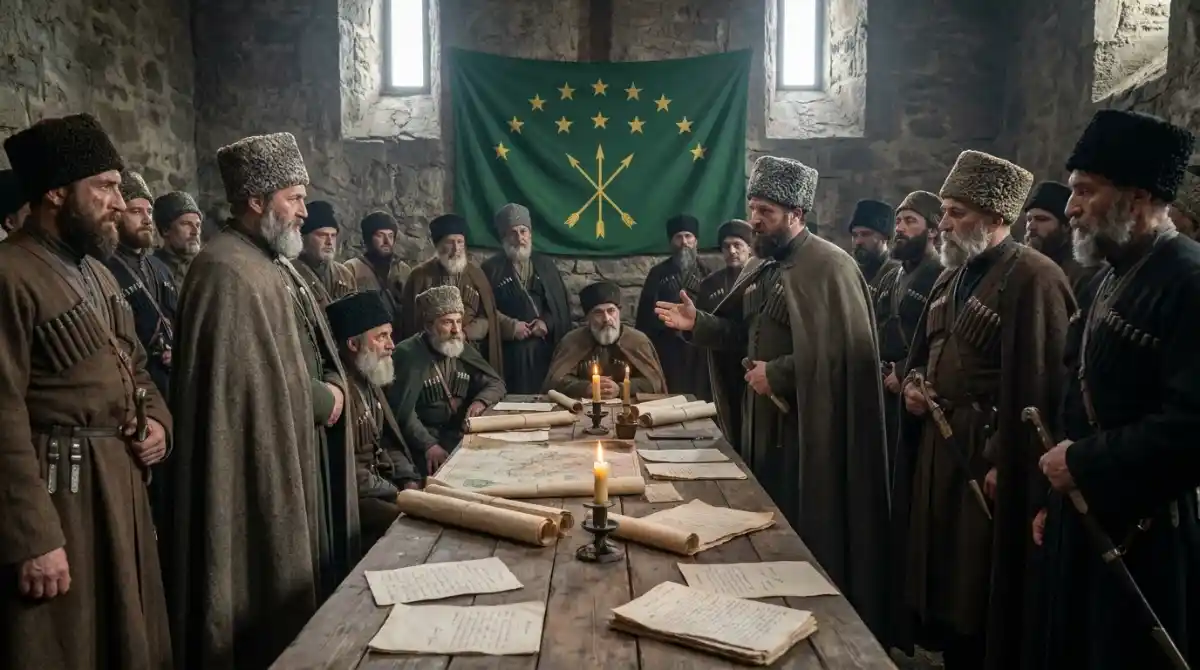
The assembly's first instinct, once it had declared itself, was to make the world acknowledge it. The leaders understood with painful clarity that a declaration was just paper unless a great power was willing to back it. So they did what a real government would do. They drafted a declaration of independence, and they sent embassies abroad.
Delegations went to three capitals: Constantinople, the seat of the Ottoman sultan; London, the great rival of Russia; and Paris. Their message was direct. Circassia is an independent nation. Russia is destroying us. We are about to be driven from our land. Recognize us, and help us arm and defend ourselves. The cost of these missions was borne by the people themselves; by one account the households between Tuapse and Adler, the very heart of the coastal lands, were required to contribute funds to pay for the journey to Europe. Around the same period the Ubykh elders, including a Berzeg, sent appeals through the British consul at Sukhumi asking the British government to take note that Russian armies were crushing their independence and that Yevdokimov's forces were closing in.
For a moment it even looked as though the wider world had noticed. The New York Times of September 4, 1861 carried word that the Circassians had proclaimed a republic. A people most American readers had never heard of had its independence announced in the paper of record of a country across an ocean, in the same season that the United States was tearing itself apart in its own civil war.
And then nothing came. No recognition, no arms, no intervention. The reasons were cold and structural. The Crimean War was over; Europe was at peace with Russia and had no appetite to reopen the wound over a coast that mattered little to anyone but the people who lived there. Britain's enthusiasm for Circassia had always been a tool of the Great Game, useful when it could pressure Russia and quietly shelved when it could not. The Ottomans were weak, in no condition to fight Russia for the Caucasus, and would within a few years become the reluctant destination for the Circassian refugees rather than their protector. The embassies came home with sympathy and excuses. The assembly was on its own.
The Circassians had built, on paper, everything a state needs except the one thing that makes a declaration real: a great power somewhere willing to defend it.
The Tsar's ultimatum
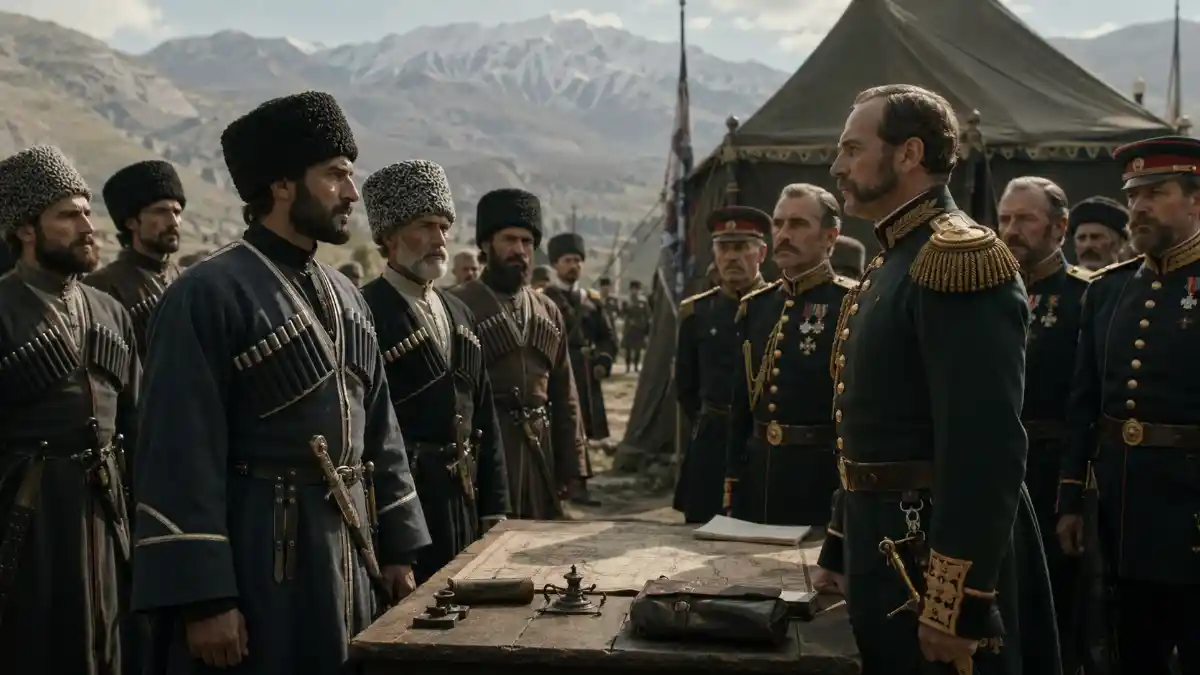
In September 1861, Alexander II, the same tsar remembered in Russia as the Liberator for freeing the serfs that same year, came south to the Caucasus to deal with the Circassian question in person. A delegation of Circassian leaders went to meet him. Gerandiqo Berzeg came on behalf of the coastal Adyghe.
The Circassians came prepared to negotiate. By several accounts they were even willing to accept Russian citizenship, to become subjects of the empire, if they could keep their land and their homes. They wanted peace on terms that let them go on existing where they had always lived.
The answer they received closed every door. After conferring with his generals, who had by then committed fully to the policy of expulsion, the tsar's terms were not a compromise but a sentence. Circassia would be annexed unconditionally. The Circassians would not be allowed to remain on their coastal and mountain lands. They could resettle on the plains north of the Kuban under Russian control, or they could leave for the Ottoman Empire, but the homeland itself was to be emptied. The clear implication, which Russian commanders did not trouble to hide, was that those who refused both options could be killed. The delegation was given roughly a month to decide.
The negotiation failed on both sides at once. Alexander would not bend, and the Circassians, gathered in their assembly, could not bring themselves to accept exile from the only land they had ever known. There was also, as Dzidzaria and others noted, no real unity even now on how to respond; some leaders were ready to make concessions, others were not. But the assembly's final answer, when it came, was refusal. They would not surrender their country. They would not march into the sea on command.
The collapse
What followed over the next two and a half years is the part that turns a story of unity into a story of catastrophe.
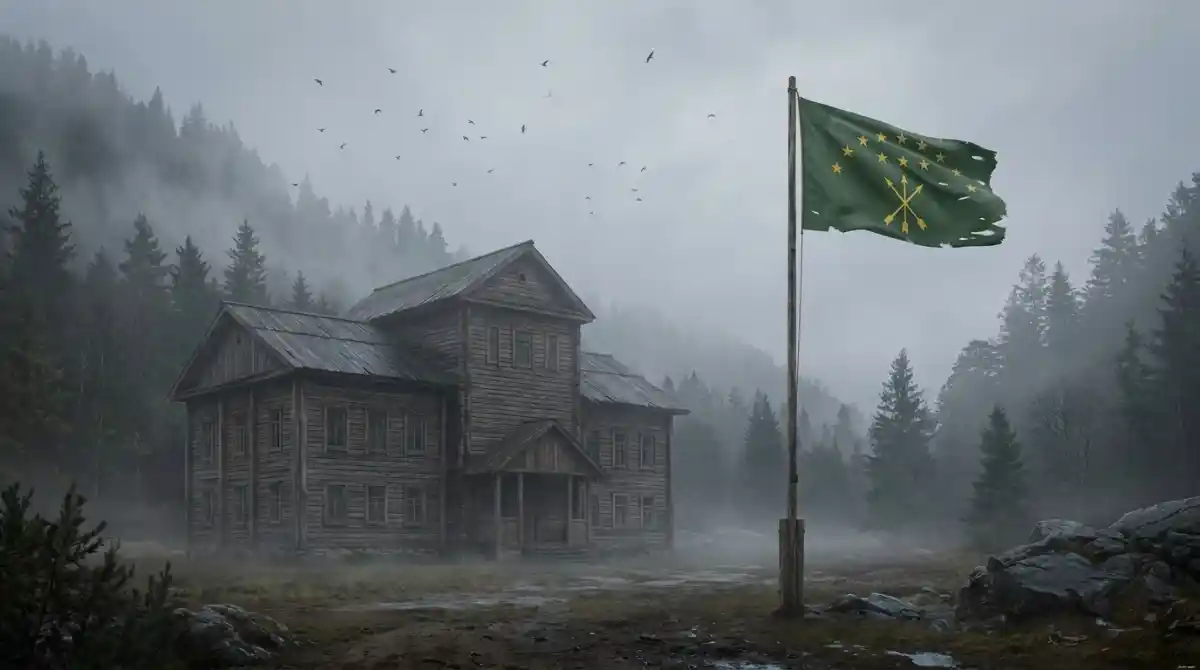
The Russian advance did not pause for the assembly's diplomacy. In 1862 Sochi fell. The parliament house above the Psakhe had to be abandoned. Many of the leaders who had founded the assembly were killed or scattered. The government did not formally dissolve, though. It retreated, as the resistance always had, into the mountains.
The parliament reconvened in a place the Circassians called Mutıxwa, now the village of Plastunki, and continued to function in some form from 1862 into 1864, a government in flight holding meetings in the high country while its territory shrank around it. Yevdokimov's methodical campaign ground on through the valleys, clearing village after village, pushing the surviving population toward the coast and toward the passes. By 1864 the resistance and what was left of the assembly had been forced back into the upper reaches of the mountains, to a high meadow the Circassians called Qbaada, the place the Russians would rename Krasnaya Polyana. A century and a half later it would host events of the 2014 Winter Olympics, a fact that Circassians have never been allowed to forget.
At Qbaada the assembly held its last meeting and took its last decision. The choice was the same one the congress at Abin had faced in 1857, only now there was no margin left. Surrender and exile, or fight. They chose to fight. On May 21, 1864, the last organized Circassian forces were defeated at Qbaada. A Russian victory parade was held on the field to mark the official end of the war. After a hundred and one years, the Russo-Circassian War was over, and so, effectively, was Circassia.
May 21 is the day Circassians now mourn. June 13 is the day they founded the thing that May 21 destroyed. The two dates are only weeks apart in the calendar and three years apart in history, and you cannot really hold one in your mind without the other.
Exile
The defeat at Qbaada was not the end of the suffering. It was the beginning of the worst of it.
The Russian policy was not occupation. It was removal. The surviving population of the northwest Caucasus, several hundred thousand people at least, was driven from the homeland, most of it toward the Black Sea coast and onto ships bound for the Ottoman Empire. The ports of the Circassian coast, Sochi among them, became embarkation points for a forced exodus that killed staggering numbers of people. Families were marched to the shore and packed onto overcrowded boats. Many drowned when those boats went down. Many more died of hunger, cold and disease while waiting on the beaches or after they landed in an Ottoman Empire entirely unprepared to receive them. The beaches of Sochi, as one account puts it, became a vast unmarked grave.
The scale is contested, as it always is with events the perpetrating state refuses to fully document, but the range of serious estimates is grim no matter where you land in it. By the most widely cited figures, the indigenous population of the northwest Caucasus was reduced by something on the order of ninety to ninety-five percent. Estimates of the dead, from the killing and the deportations together, run from several hundred thousand into the range of one to one and a half million. Less than a tenth of the Circassian people remained in the homeland. Most historians who study it, and the parliaments of several countries, now call it genocide.
The people who survived became the Circassian diaspora, and it is enormous. The largest community by far is in Turkey, where estimates run into the millions and where the great majority of all Circassians now live. There are large communities in Jordan, where Circassians have long held a respected place and where the language has been notably well preserved; in Syria, where the community was caught up in the recent war and some have returned to the Caucasus; and in Israel, where a few thousand Circassians live mainly in the villages of Kfar Kama and Reyhaniye. Smaller communities exist in Germany, the United States, Saudi Arabia, Egypt, Iraq, Iran, the Balkans and beyond. In the homeland itself, perhaps several hundred thousand Circassians live in the Russian republics of Adygea, Kabardino-Balkaria and Karachay-Cherkessia, plus the Black Sea Shapsug of Krasnodar Krai, divided by administrative borders that Soviet policy drew between people who are, in the end, one nation.
The exiles were called muhajirs, an Arabic and Ottoman word for those who migrate for their faith, and the name stuck. The Ottoman state, overwhelmed and underprepared, scattered them where it needed loyal populations: along contested frontiers in the Balkans, in the Arab provinces of the Levant, on the edges of the Anatolian plateau. Many Circassians were settled deliberately as a buffer people, soldiers and frontiersmen for an empire that was not theirs. It is why there are Circassian villages in Jordan and the Golan, why Amman itself was effectively refounded by Circassian settlers in the 1870s, and why Circassian cavalry served in Ottoman and later regional armies for generations. The community's survival in the diaspora is real and in places remarkable, but it was built on the wreckage of a deportation, and the older generation never let the younger forget the difference between a home and a place you were sent.
The Ubykh, the very tribe that led the assembly in 1861, paid the steepest price of all. Driven out almost entirely, they assimilated into the larger Turkish and Circassian populations of the Ottoman lands. Their language, which had no written form and was unlike any other, slowly died with them. The last fluent speaker of Ubykh, a man named Tevfik Esenç, died in Turkey in 1992. A whole tongue, spoken by the people who built the parliament house above Sochi, is simply gone.
The capital that became a resort
There is a particular cruelty in what became of the places where this history happened, and Circassians feel it sharply.
Shache, the coastal site the assembly chose as its seat, is now Sochi, Russia's premier summer resort, a subtropical strip of palm-lined promenades and beach hotels where millions of Russians take their holidays. The beaches that holidaymakers lie on are, in the most literal sense, the ground over which Circassians were herded toward the ships in 1864, the shore where families waited and died before they could be carried away. By one account those beaches are a single great cemetery. Most of the people sunbathing there have no idea, and were never taught.
Qbaada, the high meadow where the war ended on May 21, 1864, became Krasnaya Polyana, a mountain resort above Sochi. In February 2014 it hosted the alpine and sliding events of the Winter Olympics. The Games fell on the 150th anniversary of the destruction of Sochi and the expulsion of its people, and Circassians around the world tried to make the world notice the coincidence. They mostly failed. The opening ceremony staged an elaborate pageant of a thousand years of Russian history and said nothing about the indigenous people of the very coast the cauldron was lit on. The slogan that circulated in the diaspora that year, that the world was being invited to ski on mass graves, was bitter, and it was not inaccurate.
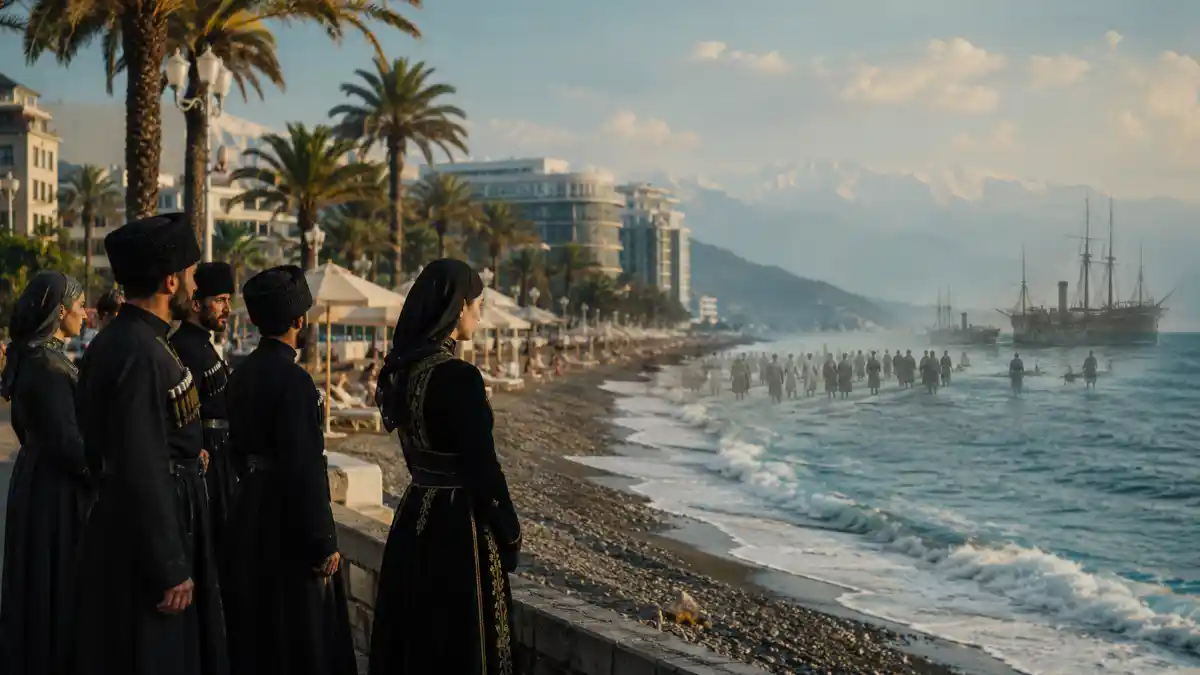
This is part of why the dates matter so much. The physical landscape of Circassian memory has been paved over, renamed and repurposed, much of it turned into a place of leisure. The land does not remember on its own anymore, because the people who would have remembered were removed from it. So the memory has to be carried in the calendar instead, in April and May and June, by a diaspora that holds the dates precisely because the places were taken away.
What June 13 means now
Set against all of that, you might ask why anyone would celebrate June 13 at all. It commemorates a government that lasted three years and lost. Why mark the founding of a state that was destroyed almost as soon as it was declared?
The answer you hear from Circassians is that June 13 is not really about the institution. It is about the idea, and the idea did not die at Qbaada. For one moment in their history, the Circassians stopped being a collection of tribes and chose to be a nation. They wrote it down. They raised a flag for it. They sent ambassadors in its name. They told an empire that they were a people with the right to exist on their own land. Everything that has happened since, the exile, the assimilation, the slow erosion of language and the borders drawn to keep them apart, has been an argument against that idea. June 13 is the day the idea was first made real, and remembering it is a way of keeping the argument going.
For a diaspora, this matters in a specific way. A scattered people is always at risk of dissolving into the countries that took them in, of becoming Turks or Jordanians or Americans who happen to have a Circassian grandmother. The dates on the calendar are anchors against that drift. April 25 anchors the symbol. May 21 anchors the grief. June 13 anchors the political fact that there was, once, a Circassia, declared and governed and flagged, and that its people never agreed to disappear.
The observance today is mostly cultural and increasingly digital. Circassians post the flag, share the history, hold gatherings and lectures. In a pattern that became obvious during the pandemic, when in-person events were impossible, the diaspora moved the commemoration online without missing a beat, photographs of the flag, threads about the assembly, fundraising for Circassian refugees, particularly those who fled the war in Syria and returned to the homeland. The internet has done for the modern Circassians something like what the assembly tried to do in 1861: it lets a scattered people act as one, across borders, around a shared set of symbols and dates.
Holding on to the language and the story
The harder, slower work behind the commemorations is keeping the culture itself alive, and that fight is real. The Adyghe language is classified as vulnerable, and in the diaspora it erodes with each generation that grows up speaking Turkish or Arabic or Hebrew or English at school and Circassian only with grandparents. Jordan and Israel have done comparatively well at holding on to it; in Jordan a notable share of the community still speaks Adyghe, and the village of Kfar Kama in Galilee runs Circassian-language schooling. Elsewhere the decline is steeper. The death of Ubykh in 1992 is the warning every Circassian organization keeps in mind: a language can end inside a single human lifetime.
Against that, the community has built dance ensembles, language courses, cultural associations, family-history and genealogy projects, and a steadily growing body of online archives, recordings and heritage sites that let people in the diaspora trace their tribe, their village and their line back toward the homeland their ancestors were driven from. None of this restores what was lost in 1864. But it does something the muhajir generation could only dream of: it lets a Circassian born in Amman or Istanbul or New Jersey find the thread back to a specific place and people, and decide for themselves to hold it. June 13 sits at the center of that effort, the day that says there was a nation here, and it had a government and a flag and a name, and we are still its people.
The unfinished business
It would be dishonest to end on a purely warm note, because the things the assembly fought for are still unresolved, and Circassians know it.
Recognition of the genocide remains partial. Several regional bodies in the Caucasus acknowledged it in the 1990s, and the country of Georgia formally recognized the Circassian genocide in 2011. Russia has not, and treats the subject as politically dangerous, which is one reason the 2014 Sochi Olympics, staged on the very ground where the war ended and the exile began, were so painful for Circassians to watch. The opening ceremony's grand pageant of Russian history did not mention the people who had lived and died on that coast.
The other long-running aim, the reunification of the divided Circassian lands and the right of return for the diaspora, remains a hope rather than a policy. Circassian activists continue to press for the consolidation of the territorial divisions Stalin imposed, for easier citizenship and return for the diaspora, and for the preservation of the Adyghe language, which is under real pressure both in the homeland and abroad. None of this is settled. In some ways the agenda of June 13, a single recognized Circassian nation with control over its own affairs, is still the agenda.
Questions people ask about June 13 and Circassia
A few questions come up again and again when people first meet this history, and they are worth answering plainly.
Was Circassia ever really an independent country? In practice, yes, for most of its history Circassia governed itself, owed allegiance to no foreign ruler, and was treated by outside observers as a distinct nation. What it lacked was the modern apparatus of statehood: a single government, recognized borders, a seat at the table of empires. The assembly of 1861 was the attempt to supply exactly that. The reason Circassia rarely appears on old maps as a country is not that it did not exist but that the empire that conquered it wrote the maps. The New York Times could call it a republic in 1861. Russia called it a rebellion.
If there were also Ubykh, Abkhaz and Abaza in the union, why only twelve stars? The twelve stars stand for the twelve major Adyghe tribes in the traditional count. The Ubykh are usually included among the twelve, and the Abkhaz and Abaza, while closely related and present in the resistance, are a distinct branch of the Northwest Caucasian family. The number twelve is the canonical figure that became fixed in the flag, even though the real coalition was a little broader and a little messier than a tidy dozen. National symbols simplify; that is part of how they work.
What is the difference between Adyghe, Cherkess, Kabardian and Circassian? Mostly they are different names for one people. "Circassian" is the English umbrella term. "Adyghe" is what Circassians call themselves. The Soviet and Russian administrations split the people into separate official nationalities tied to separate territories: Adygeans in Adygea, Kabardians in Kabardino-Balkaria, Cherkess in Karachay-Cherkessia, Shapsug in Krasnodar Krai. Many Circassians regard those labels as an artificial division of a single nation, which is one reason the unity celebrated on June 13 still feels politically charged.
Why didn't Britain or the Ottomans help? Britain's interest in Circassia was always strategic, a lever against Russia in the Great Game, and once the Crimean War ended and Europe wanted peace with Russia, that lever was no longer worth pulling. Sympathy in the press never translated into ships or guns. The Ottomans were too weak to fight Russia for the Caucasus and ended up absorbing the refugees instead of defending the homeland. The Circassians learned the oldest lesson in international politics: powerful friends help you when it serves them and not a moment longer.
Is it accurate to call what happened a genocide? Most historians who study it use the word, and they do so on the evidence: an explicit policy of removing a population from its land, carried out with mass killing and forced deportation that destroyed the great majority of a people. Georgia recognized the Circassian genocide in 2011, and several Caucasus bodies did so in the 1990s. Russia rejects the term. The dispute is political, but the underlying facts, the scale of the death and the deliberate emptying of the land, are not seriously in question among scholars.
A wooden hall, a green flag, and an idea that would not die
I keep coming back to the building above the Psakhe. It was made of logs. It stood for a handful of years. There is nothing left of it now but the river and the name of a Sochi neighborhood. And yet for those few years it held the boldest thing the Circassians ever attempted: the decision to be one people under one government, made by men who had spent their whole lives being many.
They knew the odds. Berzeg was sixty years old and had buried sons in that war. The leaders who sent embassies to London and Paris understood, better than anyone, that paper does not stop an army. They did it anyway, because the alternative was to be erased without ever having declared that they existed. June 13 is the record of that refusal.
For the six million or so Circassians alive today, in Turkey and Jordan and Israel and Germany and the United States and the three small republics in the Caucasus, the date is a thread back to the moment their ancestors named themselves a nation. The state did not survive. The flag did. The idea did. Every year on June 13, and on April 25 with the flag, and on May 21 with the dead, a people that was supposed to vanish answers the empire that tried to erase it by doing the simplest and most stubborn thing in the world. They remember, and they say the name out loud.
The three dates, in one line
April 25 is for the flag. May 21 is for the dead. June 13 is for the day twelve tribes became one nation. Keep them distinct, and you keep the whole story straight.
A short chronology
The events around June 13 stretch across more than a century. Here is the spine of the story, in order.
YearWhat happened1763The Circassians date the start of the war with Russia from this year, as the empire begins asserting authority over their land.1830sCircassian leaders, with figures like Seferbiy Zaneqo and British support from David Urquhart, push for unity and recognition. The flag of twelve stars takes shape. Edmund Spencer describes a Circassian banner around 1830.1836The Vixen affair: Russia seizes a British ship off the Circassian coast, briefly raising the prospect of an Anglo-Russian war over Circassia's status.1856The Crimean War ends with the Peace of Paris, which demilitarizes the Black Sea but does not grant Circassia independence, freeing Russia to finish the conquest.1860Gerandiqo Berzeg becomes leader of the Circassian Confederation. The coastal tribes begin organizing a unified assembly.June 13, 1861The Great Free Assembly is founded at Shache (Sochi). Circassia is declared a unified independent state under one government and one flag. Berzeg is elected head of parliament and nation.Sept. 1861Alexander II meets a Circassian delegation in the Caucasus and demands unconditional surrender and departure from the homeland. The assembly refuses. The New York Times reports that the Circassians have proclaimed a republic.1862Sochi falls. The parliament house is abandoned and the assembly relocates to Mutıxwa (Plastunki) in the mountains.May 21, 1864The last Circassian forces are defeated at Qbaada (Krasnaya Polyana). The war ends, and the mass expulsion begins. Observed today as the Day of Remembrance.1864 onwardSeveral hundred thousand Circassians are deported across the Black Sea; estimates of the dead from killing and deportation run from hundreds of thousands to over a million. The diaspora forms.1992The Republic of Adygea adopts the historic Circassian flag as its state flag. The last speaker of Ubykh dies in Turkey the same year.2011Georgia formally recognizes the Circassian genocide.2014The Winter Olympics are held at Sochi and Krasnaya Polyana, on the 150th anniversary of the expulsion.
Sources and further reading
Sufian Zhemukhov and Robert Orttung, "Sochi and the Circassian Issue," Institute of Modern Russia (2014).
"Krasnaya Polyana: Breaking the 150 Years of Silence," The Jamestown Foundation, citing Georgy Dzidzaria, Muhajirs and the Problems of Abkhaz History of the 19th Century, on the Mejlis and its missions to Constantinople, London and Paris.
Walter Richmond, The Circassian Genocide, Rutgers University Press (2013), including the chapter "A Pawn in the Great Game" on the flag and the politics of the period.
Charles King, The Ghost of Freedom: A History of the Caucasus, Oxford University Press (2008).
"150 Years Ago, Sochi Was the Site of a Horrific Ethnic Cleansing," Smithsonian Magazine (2014), on Alexander II, Count Milyutin and the expulsion policy.
Edmund Spencer, Travels in Circassia, Krim-Tartary, &c. (1838), the earliest Western description of the Circassian banner.
Naima Neflyasheva, interview with Dr. Samir Khotqo (ARIGI), "The creation of the Circassian flag is connected to the pan-Circassian mission of Sefer-bey Zaneqo," AbkhazWorld, on the indigenous and heraldic origins of the flag.
"Parliament of Independence (Circassia)" and "Circassian flag," Wikipedia, for the structure of the assembly, the membership and the standard reading of the flag's symbols.
Biographies of Hajji Gerandiqo Berzeg, Ismail Berzeg and Seferbiy Zaneqo, leaders of the Circassian Confederation.
The New York Times, September 4, 1861, reporting that the Circassians had proclaimed a republic.
PONARS Eurasia and Eurasianet, on the May 21 Day of Remembrance and the recognition of the genocide, including Georgia's 2011 recognition.
The Circassian Diaspora and Circassian Genocide research projects, for population estimates before and after 1864 and the present distribution of the diaspora.
Note on dates: the founding of the Great Free Assembly is given as June 13, 1861 in the Old Style (Julian) calendar used at the time, which corresponds to June 25 in the modern Gregorian calendar. Circassian tradition observes June 13. Casualty and population figures for the 1864 expulsion vary between sources and are presented here as a range.
Published by CircassianWeb · circassianweb.com · A heritage resource for the global Circassian (Adyghe) community.